The Cats clamor for kibble in the early morning light at Leafhopper Farm! These prowling feline fantastics have kept the mice out of the grain room, the voles out of the garden, and have a handled on our rat population under the hen house. They occasionally stalk the humming bird feeder, but no fast fliers have been hit yet. Birds are wiser around the farm, taking to the shrubs and hedgerows with gusto when any cat’s around. My cat alarm identification has gone up, and I look forward to testing it in the woods soon.
What am I talking about? Bird language! Birds make special calls for different events, and the pitch of the calls changes, depending on what the bird want to communicate. The sounds relate very much to what they are trying to convey, like a “shh-shh” “shushing” noise directed towards a threat, like people walking near-bye, or a cat stalking a nest. Shrill noises are alarms, a sort of shouting through the woods to let everyone else know there is danger, usually a predator moving through a bird’s territory.
The chickens have bird language, just like their wilder cousins. When an aerial threat flies over, the hens make a low “tulck” cluck, deep in the throat and subtle, but all the birds will look up and watch the sky for danger, passing on the low “tulck” warning through the flock. When I am “raiding” the nests for eggs, a laying hen might give what I call a “dinosaur” call. It’s a very reptilian, shrill roaring, like the raptors in Jurassic Park (I think they used digitally manipulated chicken noises). That muted roar is definitely telling me not to come near the nest. On this fine morning, the hens are clucking merrily as they glean some Scratch and Peck breakfast among our swales.
Living in a saturated environment can sometimes overwhelm the senses. Observing frost heaves coming out of dead twigs in a sea of woody detritus; patchwork sewn together with time and careful intimacy, laced in ice on a cold morning, blue light cast’s the ground aglow.
The kids are having their first week out all together as the sun shines down. We’re really lucking out with the nice Spring weather! The goats are doing quite well, with both momma does keeping on the weight and producing great milk. I’ll be enjoying some of Brownie’s next week, as by then, the kids will be eating more solid food and can afford to let me have a few mason jars here and there. With all these kids, our herd has doubled in size. It’s going to take some smart adjusting to navigate this growing family. That’s the fun of developing a healthy goat herd here at Leafhopper Farm!
Leafhopper Farm is emerging as a productive restoration farm in the face of many challenges in our modern agricultural economy, but none so fierce as climate change. In the summers of 2015, 2016, and 2017 we had record droughts. In the winters of 2016 and 2017, we broke record rain levels. These two statistics seem counter intuitive, but they are the facts, and it’s been a game changer in the agricultural community, no matter the size, product, or production. In the hill country, where Leafhopper Farm is located, the summer droughts have put a tax on local wells, making it impossible to irrigate large production gardens.
These limitations have been solved in the development of certain water systems, including swales, rain catchment, and hugaculture/mulching techniques, but it will be this year in 2018, that the full water systems of Leafhopper Farm come together to support larger food forest aspirations. With the instillation of a 20,000 gallon pillow tank, we can utilize enough roof catchment to flood irrigate our swale systems!
swales being dug in 2015
The tank will also provide security against summer fire threats, which are becoming a very real hazard to us here on the west side of The Cascades. This large rain catchment system was designed in our original plan, and is at last, being fully implemented.
Many of you who do not live in western Washington, but do know of Seattle’s legendary rain, might be confused with how our temperate rain forest is experiencing drought, especially with all the record breaking rain during our 9 month wet season. Right? Well, the rain is coming down in heavy bursts, over a few hours, like flash flooding in the south. We all know that when a lot of rain falls at once, little of it has time to soak into the ground. Instead, it’s washing into our rivers and streams, then to The Seattle Sound and into the ocean. Our forests are not getting the deep, slow drip continuous rain of misty damp we’re used to getting in winter.
The Central Cascades, Stevens Pass in March, 2018
Another detriment playing out in our climate change is snow pack levels. In 2015, there was very little snow in the mountains by spring melt time. Rivers dropped to record low levels, and salmon runs were non-existent that fall. It was a scary summer, full of fire and scorching temperatures, which killed many cool weather crops, traditionally planted in the temperate Pacific Northwest. The past two summers, I’ve grown tomatoes without a greenhouse. That’s incredible for western Washington! The down side, is that many of my native species are beginning to succeed. Western Hemlocks are the most obvious. The drought conditions have stressed these water loving trees and many are starting to die. On my land, 20% of them are past recovery and will be taken down to prevent fire threat.
The farm is bracing for a continual trend of hotter summers, heavy rain winters. The lack of snow pack in our mountains right now tells me we’re in for more hot, dry weather this coming summer in 2018. On the farm, we’re planting drought resistant trees, like oak and pine. Our creek buffer will support the wet loving trees like Hemlock and Red Cedar. Our USDA grant to restore and replant is moving right along in it’s process. We’ve taken soil samples, checked to make sure no culturally sensitive areas could be present on the property, and planned out a list of species, hedge designs, and specific locations of wet spots where riparian species can thrive. The feds are strict, but that’s great for this work, and the farm’s future stewarding Weiss Creek.
Weiss Creek in March, 2018 (with flowering oso berry)
Our S2 rated (Salmon Bearing, Secondary Source->tributary of a major salmon spawning river) is fed by springs. It’s continued to flow through all the droughts, and that’s comforting, though I wonder how much more water would be coming through if we were getting the water in slow seep doses to replenish our aquifers. Now, with the onset of heavy rains, the creek often changes levels, with mass runoff events. I wonder if there is enough water flowing by fall, to encourage salmon up the smaller tributaries, where they usually spawn in their home creeks.
My love of the mountains, specifically skiing, gives me a chance to track snow and what’s happening during the crucial winter snow pack build up, which will directly impact production in the coming seasons. The melt rate is also very important to know. Last winter, there were “adequate” snow levels, but a few 90dagree days in April melted the snow quite rapidly, causing flooding, and the loss of our snow early in the season. This quick melt contributed to a bad fire season later in the summer. On the mountain right now, there is currently what’s considered normal snow pack. But that’s not taking into consideration the final tally of snow this season, or what the Spring temperatures will do to melt off the water too quickly. On another note, the link above is maps put together by USDA and National Resources Conservation Service. The map has a sub-text warning that funding will prevent them making a map next year, leaving many of us farmers wondering how we will be able to predict and prepare for climate change in the future.
It’s important in agriculture, to build in multiple fail-safe production methods to prevent total crop loss. To mono-crop, means you’re in the fast lane to famine. Investing in diversity helps support healthy land and resilient crops, most of which are perennial in nature. Fruit and nut trees are a long term investment, but the pay off comes for generations. It does take proper care and good planning to cultivate any long term success in life. Leafhopper Farm will be ready for whatever nature offers. The farm will continue to mass plant trees, shrubs, and medicinal plants which work together to form a tight knit community of plant allies, which will in turn, support us in our stewardship of place.
Our head doe dropped her kids last weekend and we’re now celebrating three kids at Leafhopper Farm! These two newest additions to the herd are settling in now after an initial some what violent entrance into this world. When I heard the cries coming from the barn, I knew what was happening. Coming into the birthing stall, I found two wet kids shivering in the hay and nearby, a broken water bucket that had been cracked down the side in two places. It looked like Brownie has stepped backwards into the bucket in the throws of labor. Neither kid was wet with water, and the after birth was laying neatly in a pile on the floor. Thankfully, no one was drowned.
The two kids were up and kicking almost immediately, it’s an impressive thing to see newborn animals right up and active within minutes of their birth. These two were hoping around and looking for Mom’s milk. Meantime, our other doe, who had kidded last week, was calling in confusion as her own baby wandered around his new friends trying to meet them. Brownie did not care, already acquainted with Gwern. The new kids were male and female, another set of twins! Well, as Branwen began to sniff the two new kids, she suddenly lifted her ears (a sign of aggression) and began snorting (another sign of aggression). Then she charged the little male goat and pummeled him with her horns. This behavior took me off guard. Brownie was so calm with Branwen’s kid, I had not expected the same courtesy to be withdrawn once Brownie’s kids arrived.
Initially, I thought the attack was simply a miscommunication, in which one male kid was mixed up with the other, and both Mom’s were confused. I tried moving each Mom with her babes to opposite sides of the stall, to prevent mixing in the moment of bonding for Brownie. But Branwen was determined, and, crossing the stall, she grabbed Brownie’s male kid by the shoulder and threw him across the stall. Blood came out of the little kid’s nose and that was enough to tell me this was not going to work. Branwen and Gwern were moving to another stall. After the separation, everyone settled down. This kidding issue is not common, and never happened before at Leafhopper Farm.
Error
This video doesn’t exist
My theory now, is that Branwen picked up on the fact that another buck was now in the herd. I was not able to find anything about this online, but what I did see was aggression towards only the male babies. The little girl goat was left alone. There must be something in the smell. It all came down to sniffing, then butting. What I know now is that my does must be separated at kidding time. Luckily, the barn can turn into 3 stalls, and everyone has settled in happily. The kids are alright!
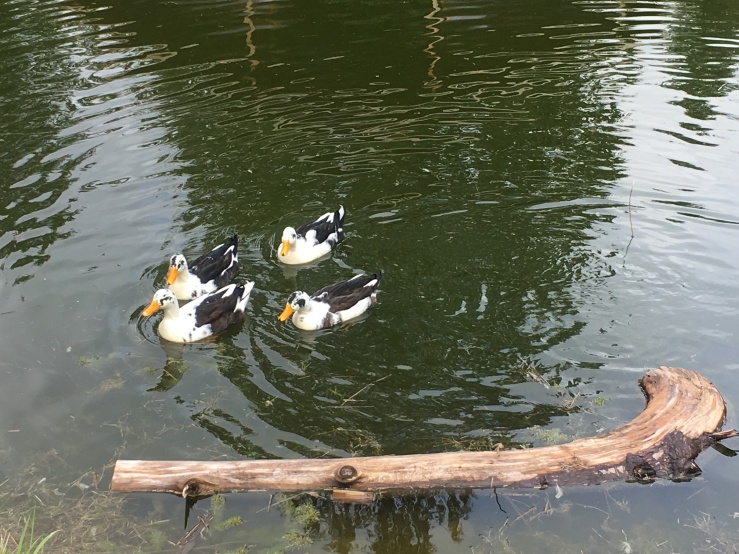
So, I was just informed by Alexia of Hawthorn Farm, that my duck are not Magpies, but in fact, Anconas! I then went to task on finding out what separated Magpies from Anconas and found a lot of murky water. It turns out, not much tracking has been done on Magpie genes, but for the expert Ancona breeders, Magpies are just genetic variations of Anconas related ONLY to color. This makes me feel a lot better about calling my birds Magpies, but they are Anconas, and since I’m not clear on the actual genetics of my birds, I’ll stick with the label given by the person who selected and bred mine.
Error
This video doesn’t exist
The ducks are enjoying their pond life and also helping to seal the pond. Yes, it’s working! We’re retaining more water this year, and I’ll thank the ducks for their work. Another gift of observation Alexia offered for me was the probable gender of my Anatidae friends. Turns out, you can sex adult ducks by their quack! Since all my ducks are making the same call, there is a solo gender on the water. The low quack these birds are rhythmically calling is a typical male noise. Females in comparison, sound like this. More call comparisons and more great duck/bird info can be found here. If you have not yet used All About Birds.com (Cornell Ornithology Lab), you’ve got to check out this top bird info site.
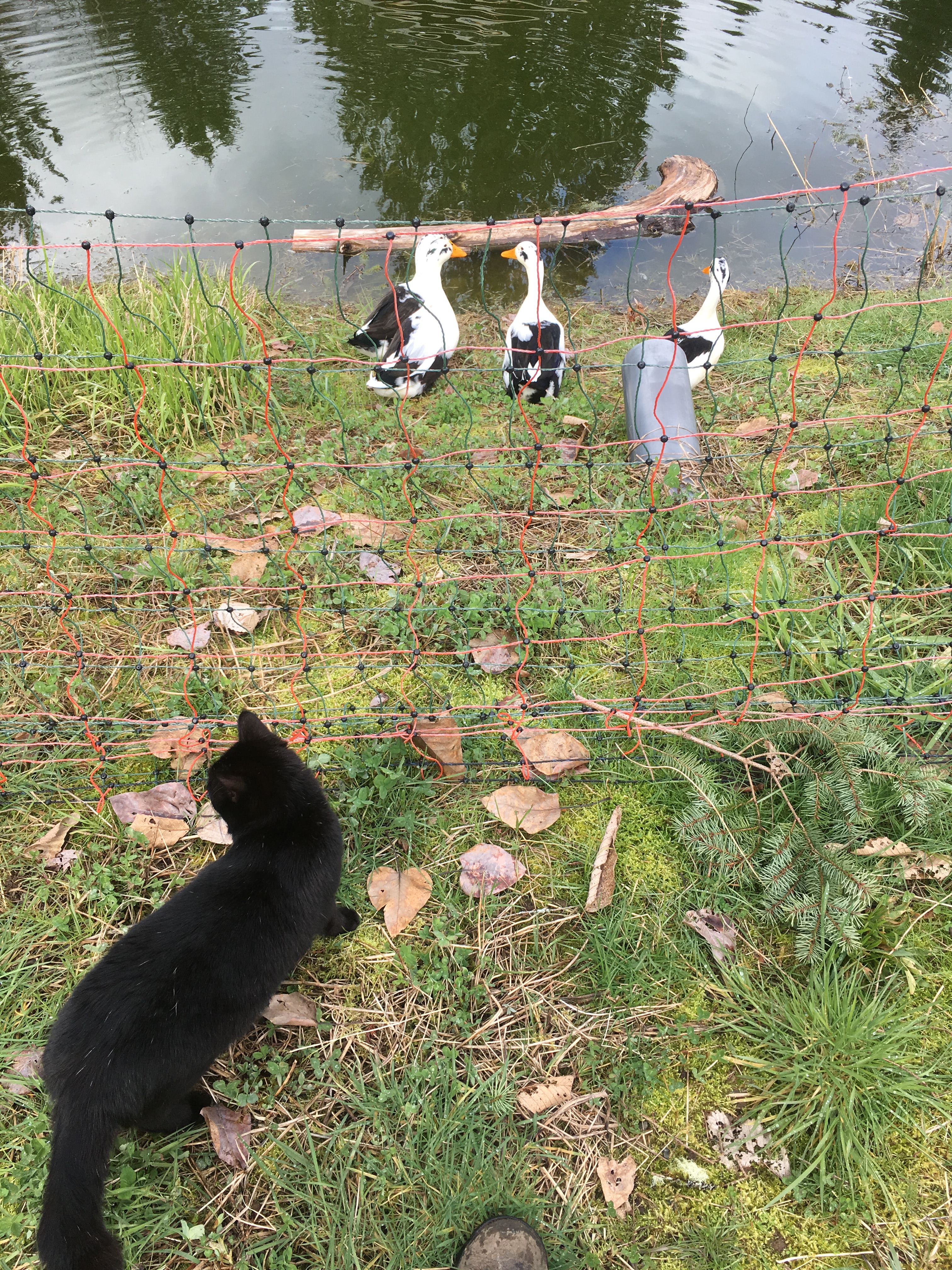
Lucia looks down at “the boys” as they return to the water after a quick check to see if the feeding person was actually bringing food. I was not, so they promptly returned to the pond for a good swim. More ducks will be coming in late April. The new clutch will be pastured, leaving the pond for our resident hooded mergansers Lophodytes cucullatus, who are back in town again and not shy about showing up.
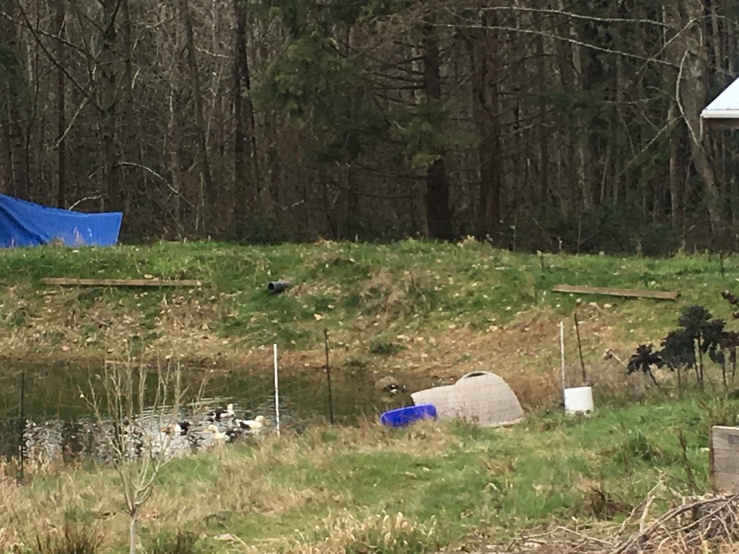
merganser on right, just above blue bin
We’re building a nest box for this wild friend and hoping to court him to Leafhopper Farm with a sweetheart to make more of this North American unique species. The picture above is also a strong reminder of the risk of mixing wild with domestic ducks; a health risk not tolerated by the poultry industry. In Washington State, you are advised to keep domestic fowl away from wild. In future, Leafhopper Farm will not be raising any domestic ducks in our habitat pond. Though it would look nice, the farm built the pond for great blue heron and their fellow wild feathered friends. It will be good to enhance this habitat by sealing the pond and planting shrubs for cover and nesting.
The sun came out for a day and so did our goat herd for the first time since the new birth of our first kid in 2018. Branwen was reluctant to move too far from the barn, but Gwern was excited to enjoy his first pasture adventure. He’s a soft as a peach and just as sweet!
Error
This video doesn’t exist
Bran is maturing nicely into a well mannered weather (castrated) goat. Here you can see him playing with our Nigerian Dwarf ADGA (American Dairy Goat Association) registered buck Brockstaro “Brock”. Bran will also be the herd protector, with a large set of sharp horns and the size to deter many would be predators. However, he is not a fail proof defense against predation, but a good initial deterrent.
Brownie is still holding on to her kids and not ready to give them up yet. She’s so big now, I hope it’s only twins! It’s great to see the herd together and acclimating so well. You have to be sensitive in reintroducing the does with their kids. Often times, the young males will be over excited and want to play too rough with the newborns. In watching the video above, you get an idea of adult goats at play. The picture below beautifully shows the herd at peace in the sun, enjoying supple spring grasses on a lazy afternoon.
During the night Branwen dropped her first kid! This little buckling has been christened “Gwern”, the son of Branwen in Irish legend. If you remember, Branwen and Bran were born on St. Patrick’s Day, so the twins were named after twins in the Irish pantheon. Gwern also means “Alder” in Welsh. Though the story is tragic, like most legends of the time, we hope to see Gwern shining in his golden light as a strong new member of the herd at Leafhopper Farm. He’s already stolen our hearts and showed that even in cold weather, goats are so hardy and strong from the moment they’re born. Branwen also deserves major shout outs. She dropped her kid like clockwork, and had no complications. Both mother and kid are thriving, and Gwern is already trying to eat alfalfa with his mother and grandmother.
Brownie is about to pop, though with her, it could be another week before she’s ready to kid. I gave up on the calendar date, which passed two weeks ago. This was the first year I tracked the gestation of my goats, and obviously, I was off on when Brownie was actually bred. In watching her udder expand, I would say she’s due by next week at the latest, and though I will not bet on that, I will be prepared for the second kidding.
Our herd should have three new kids by Spring, and that will be the most goats we’ve had in our small herd. We’re now breeding a ADGA registered Nigerian Dwarf buck “Brockstaro” to our ABGA registered Boer does. The genetics should give us a great dual purpose breed. Though Leafhopper Farm does not wish to become a dairy, we will enjoy more fresh goat milk from our does. After the kids beguine eating solid food, we’ll take a mason jar or two from full udders from time to time, without starving the babes.
If Brownie does drop triplets, a lot of hard work will go into bottle raising one of the three. Goats only have two teats to feed kids, and the third kid will be left out of the feeding and starve if not raised by people with a bottle, or, if you are lucky, a doe with only one kid adopts the other one. Since Branwen is only in her first freshening (breeding), she will not be able to support two kids in a healthy way. Therefor, we’re stuck bottle feeding if triplets are born. Having more kids than you can feed seems counter productive to survival, and I would agree, but remember we’re working with highly domesticated genetics, in which people see numbers as the end game. We’re always wanting more, so we engineer it in our animals for ultimate production on an industrial scale. Biology can only be pushed so far, and goats only have two working udders, not 3, or 4. Trust me when I say if that was possible, the milking industry would have done it a long time ago.
We’ll keep breeding goats for the long term work of browsing back blackberry at Leafhopper Farm. The genetic diversity of our herd will continue as we breed down size and focus on good milk production too. We’ll continue to hold our numbers under 8 animals at any given time, to protect the overall health of the goats, and the land they live on.
Winter is offering a final reminder of her cold nature as we head into the final weeks before Spring. The past few days, we’ve remained locked in below freezing temperatures. Water buckets were solid before the end of the day and needed constant attention. That’s ok, because both Brownie and Branwen are still holding their kids in; good thing, because today it was snowing and bitter out again. The temperatures are trying to warm up, but we’re continuing to expect snow for a few more days.
On the bright side, the precipitation is greatly needed on the landscape, and up in the mountains, we’ll have great skiing and snow pack! Keeping track of the moisture banking up at elevation tells me what kind of a summer we’re in for. Slow melting water will have time to soak into the ground, hard rain erodes away quickly, and does not soak in to replenish the aquifers, which feed my well. Cold weather also hampers the insect populations, that in turn saves many of our crops from pestilence, but might also be hurting beneficial insects like bees and lady bugs, along with ally predator insects like lacewings and wasps.
In the gardens, our cloche and cold frames vigilantly guard the overwintered greens like radishes and spinach. Other cold hardy edibles, including kale, will continue year-round production. It’s taken little effort this year for salad through the seasons. Other seeds sewn a few weeks ago during the warm period will have a shock if starting the germination process. Until the ground warms up, those seeds are sleeping just below the frost line. Mulch will help to keep them safe till the end of April.
More young native plants are moving into the kitchen garden this year. There will be vegetable production happening there too; including garlic, which was planted in a few months ago. This bed might just evolve into a nursery for young perennials. I will certainly want to propagate many established verities on the land already. The tree nursery is getting full, and my front garden does host more than enough space for my personal food production needs. When the raised beds are completed, they will host additional food growing space as the farm continues to expand to meet the needs of our community.
With the weather outside a little frightful, we’re taking time to plan for the warm up planting rush. I’ve enjoyed pouring through the permaculture and woodland living materials in the home library and online. I’ve been meeting face to face with principal networks who will be directing certain projects on the land later this summer, including some forestry which will require experience with a chainsaw I do not have. (aka massive trees being harvested to prevent damage to outbuildings, along with the thinning of overcrowded groves on the farm. More to come on that front in July!
Right now there are lots of baby animals incubating away into March. By then, we’ll be ready for the day and night tending of chicks and kids. Hopefully the weather will allow for more red alder thinning and some log inoculation to boost our crop of edible mushrooms. The stream buffer fence build has slowed, though I hope to have that project completed by the end of March for sure. As soon as the ground thaws, we’ll be back to post setting and fence erecting.
Leafhopper Farm does not use a tractor, but sometimes, machines make light work. This truck brought several loads of biomass (brush and tree limbs) to the farm, staging them for a summer project in which we will place this organic material in our forest stands to cover eroded forest floor and encourage the renewal of topsoil and biodiversity.
It is always amazing to me that people need to get rid of biomass, and regularly send it to the dump or some other kind of land fill. It is also amazing to me that people chip large matter into smaller matter using a large amount of fuel and time to do something nature is quite good at on her own terms. But we like instant gratification, and the power over the natural world. Heck, I dug water features and plant all kinds of non-native species around the farm without hesitation. Humans love to manage nature.
This large mulch will fill in where the forests have fallen behind due to overgrazing. Without top soil, under-story vegetation cannot get a good foot hold. We’ll manipulate the environment by placing a concentration of biomass in the woods to act as a platform for mycelium. As the biomass breaks down, we’ll plant in under-story shrubs like mock orange and twin berry. We’ll introduce different strains of mycelium to encourage the mushroom decomposes of wood. In time, this brush will become black gold.
Moving all this material takes time, and machines, and people who operate those machines efficiently. We’re staging materials with one truck, hauling from location to drop point at the edge of my land where my neighbor is cool with me storing organic materials. Later this summer, we’ll have other trucks come to pick up the brush, moving it down to the forest on my land when the ground is solid for machines. We’ll also a few of the stands, milling the wood and piling branches on contour along the slope. Then we’ll bring in this stages biomass to fill in under the remaining trees in each stand.
The truck helps us gather measurable vegetation for a very large scale mulching extravaganza. I cannot imagine how many wheelbarrow loads and pickup truck runs it would take me to move something like this. Understanding scale is very important as you plan projects. Sometimes you’ll have trouble fully grasping what kind of scale you’re working with until a project begins in earnest.
I’ve been calculating how much clay it would take to seal our pond, and discovered it would take over 200 tons of material. That’s a lot of truck loads, not to mention the machines it would take to properly spread and pack down the clay around the pond. We’re going to try more spot sealing this summer, with only a few truckloads of clay and minimal machine work. I’m sensitive to when and where large machines come into the landscape, and thankful they are available to help shift our limitations, allowing fast setting of habitat for future restoration here at Leafhopper Farm.
The cats are alert and playful at Leafhopper Farm. They’ve been cleaning up our vermin issues and establishing a strong territory to prevent future infestations. These furry friends are such a pleasure, bringing a whimsical style to the farm and socializing like butterflies with the entire community. Though they are cute, these cats are predator extraordinaire, and our resident bird populations are learning that the gardens and ground are not always safe to hang out in. Even the rabbits are learning to stay back, as Muir caught his first bunny a few weeks ago. Lucia specializes in voles.
The birds are not often caught now, as they have learned that the cats are here to stay. Lucia did catch an alligator lizard earlier this month during the warm spell, but I took it away and let her know that was not an appropriate snack. I do the same with birds, though they have not had many (only 3 that I’ve found the feathers of). As things warm up, their prey list will expand, but I hope that through diligent training, the cats will get the message on what to hunt and what to leave alone. It is possible to train a cat.




 EEC Forest Stewardship