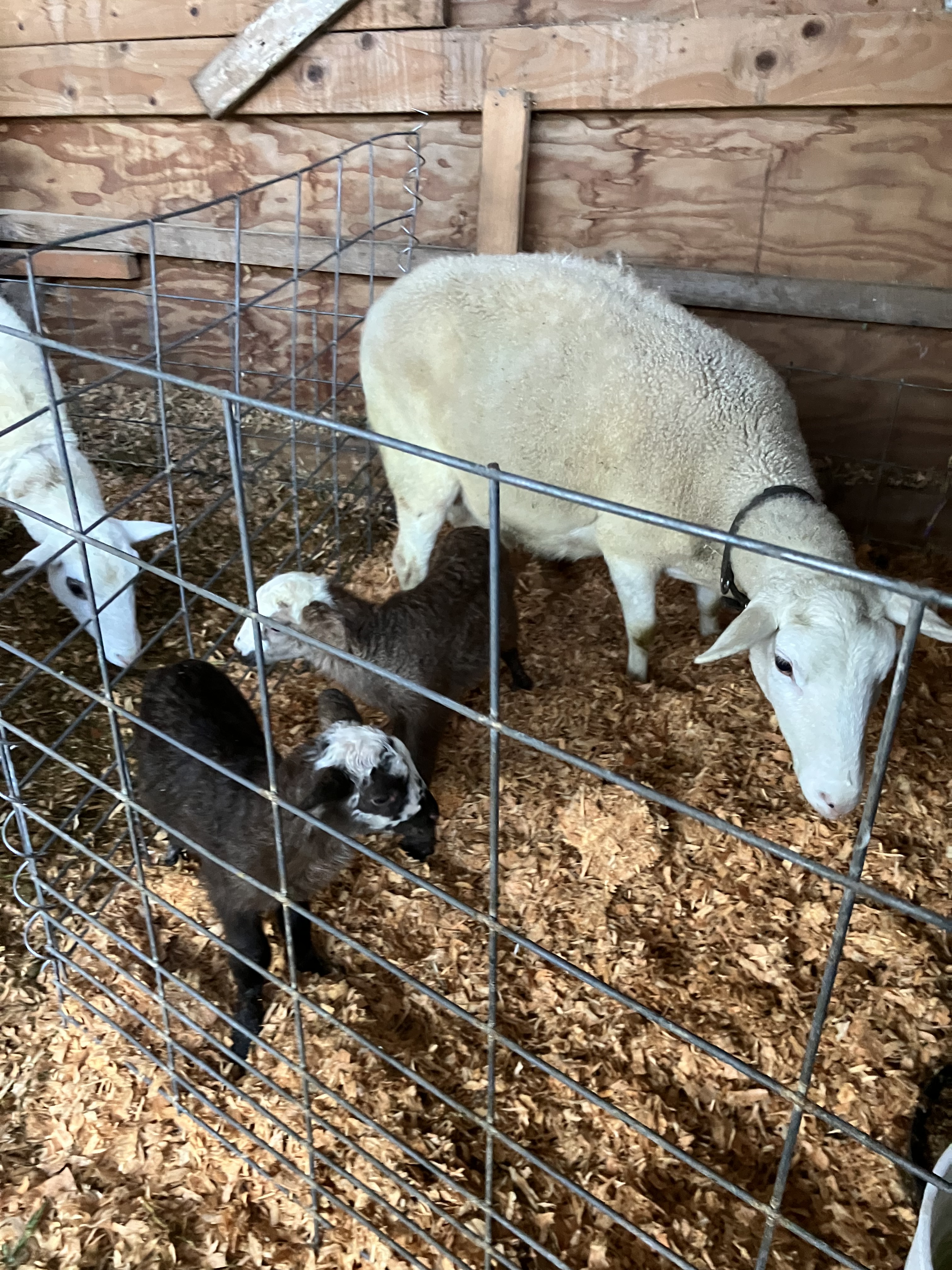
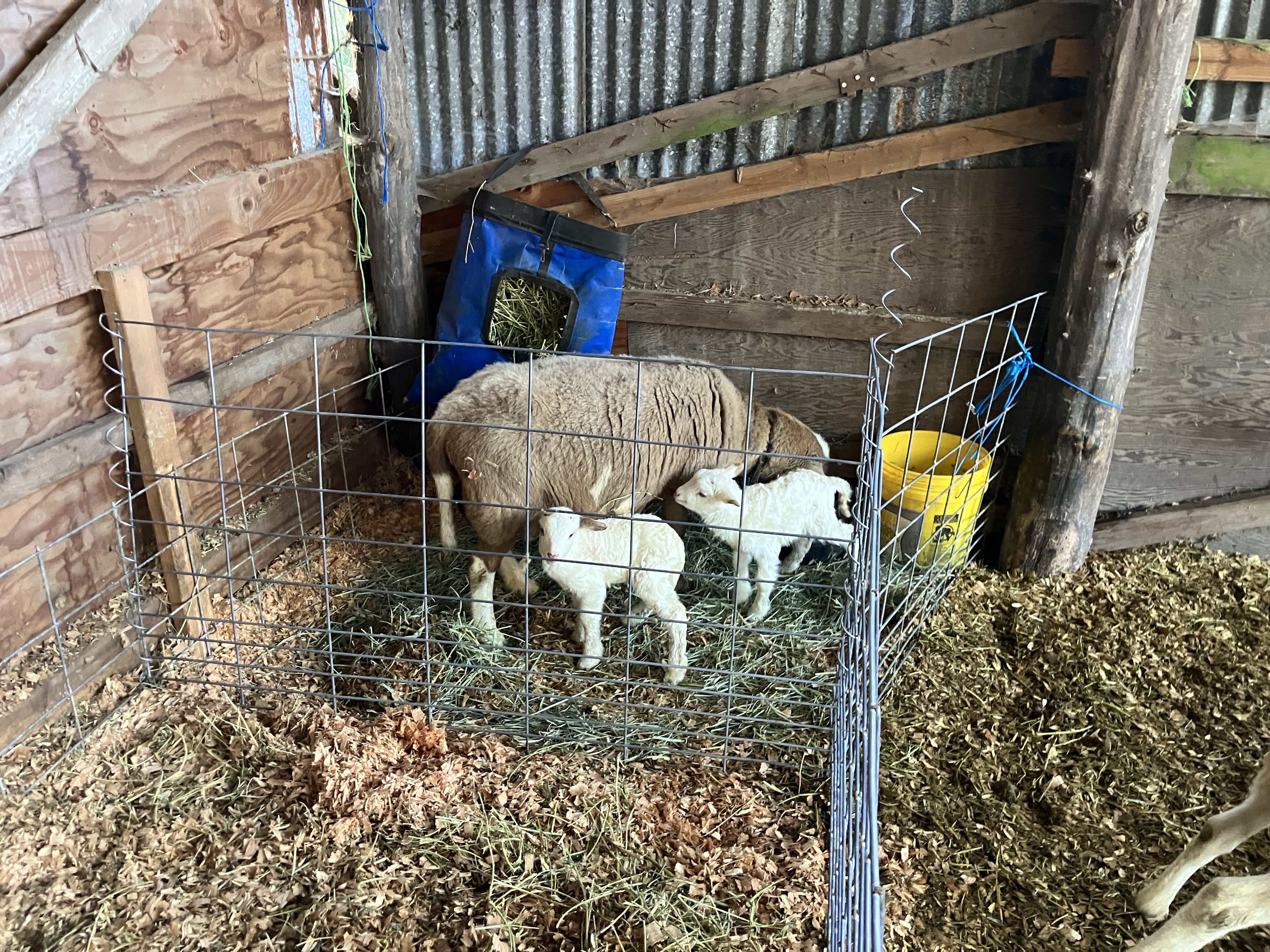
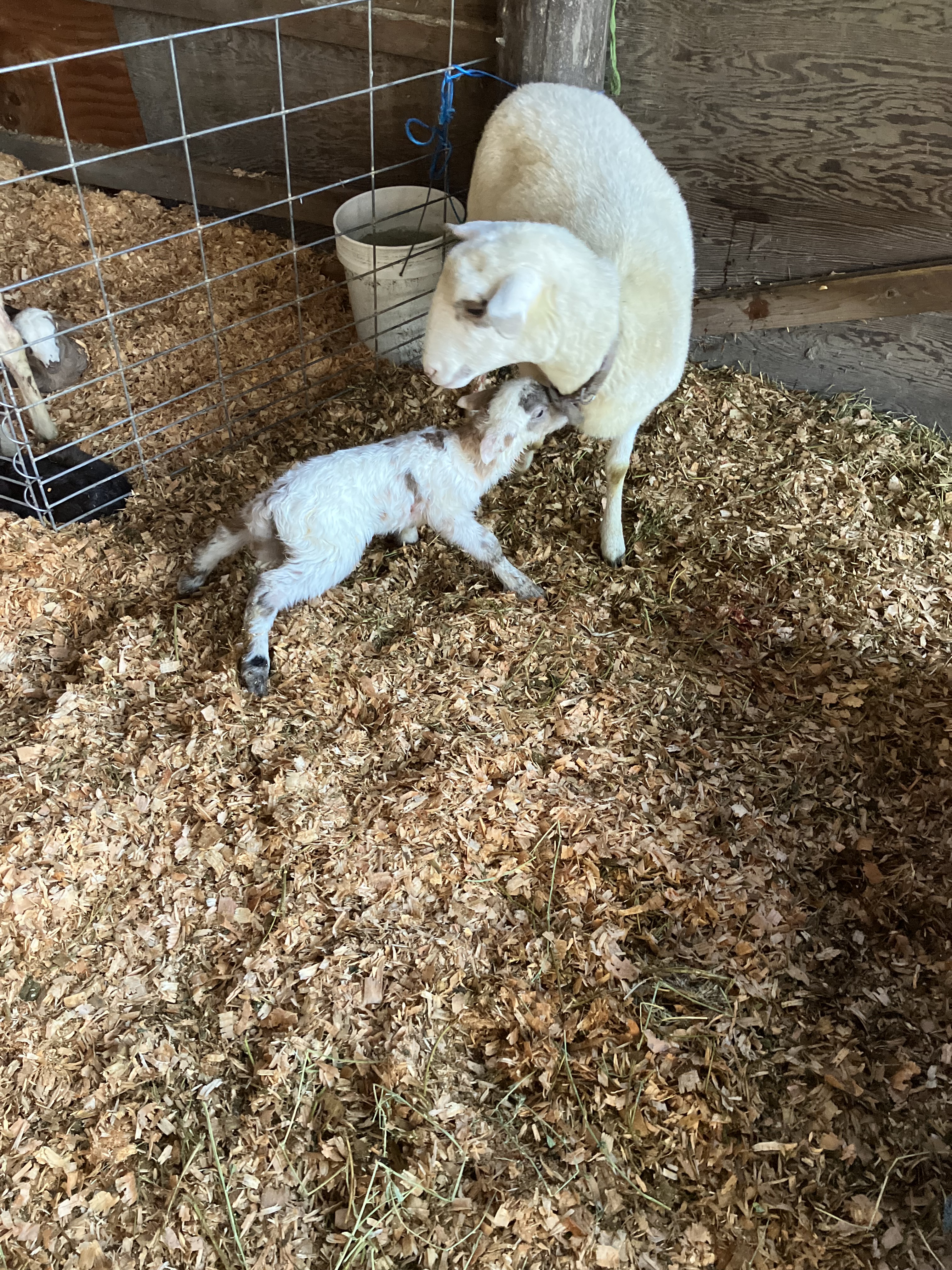
The babes are landing here at Leafhopper Farm! Our ewes timed their hormonal activation with the cold spell, which is not unusual. Weather snaps trigger labor, so I was down night and day with fresh towels checking for wet lambs on the ground. Mamma was ahead of me every time. Katahdin sheep are very good mothers, meaning they stay right with their lambs when they drop, and clean them thoroughly, as well as making sure they suckle and stay close. Not all sheep breeds have kept these instincts, especially in larger industrial flocks where every lamb is delivered and checked by people who tag, mark, and manage thousands of animals. I really can’t imagine doing this, and would never want to. Sheep can be great mothers, and go through labor just fine on their own, in fact, when a ewe went into clear labor while I was finishing the setup for a new lamb and mamma, I left for about an hour, then came back to check in on things and the lamb was safely delivered, cleaned, and nursing just fine. I do put ewes and their new babes into separate little temp stalls while they bond. In less than 72 hrs, the new family unite is brought back into the main herd to keep the connections with their flock.
There are many labor signs to look for in a ewe, but goop is the sure signal she’s’ about to drop her lambs. We’ve had two sets of twins and one single so far, with many more ewes still growing bellies. It’s always a trick for me to guess one or two, but this year, the twins were more obvious, and I’m glad we’re back to having more twins again in 2026. Last year, there were no twins at all, and I learned that I might have introduced the rams when the ewes were a lower summer weight, and therefor, the ovulation cycles were less productive, giving us all singles. It was a lesson in timing, like so much of working with nature- cycles of boom and bust we humans rarely experience any more, much less pay attention too. This year, I made sure the ewes were at the peak of spring grazing fitness, fat and happy, before introducing the rams. The timing has paid off, and I’ll keep a closer watch on the condition of my ewes, letting that dictate ram introduction, rather than when I’d prefer to time my lambing season.
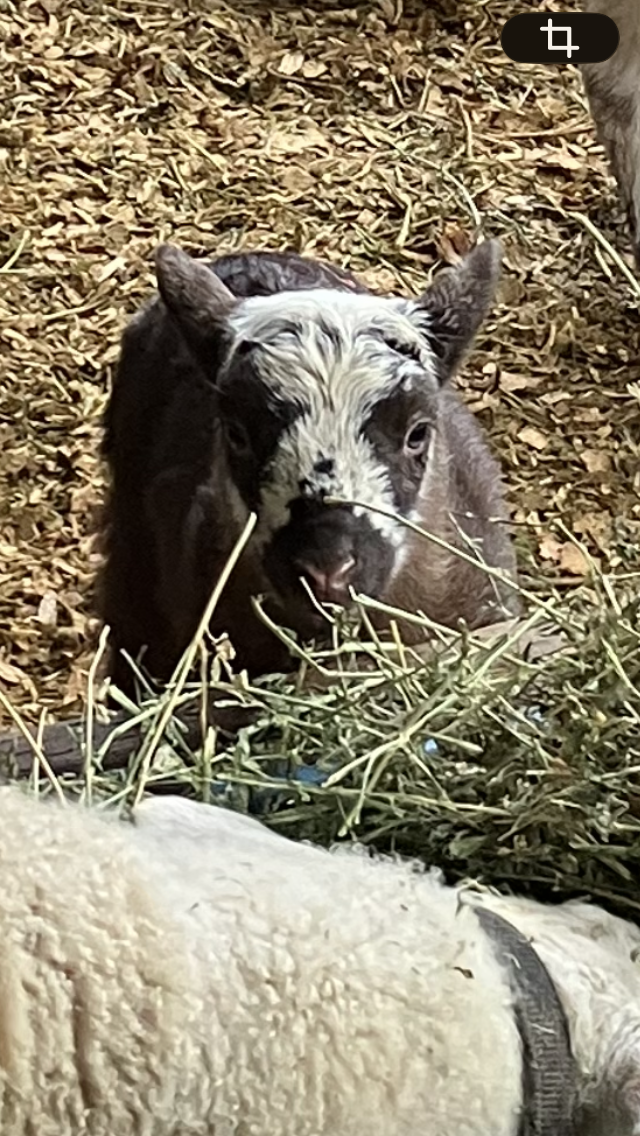
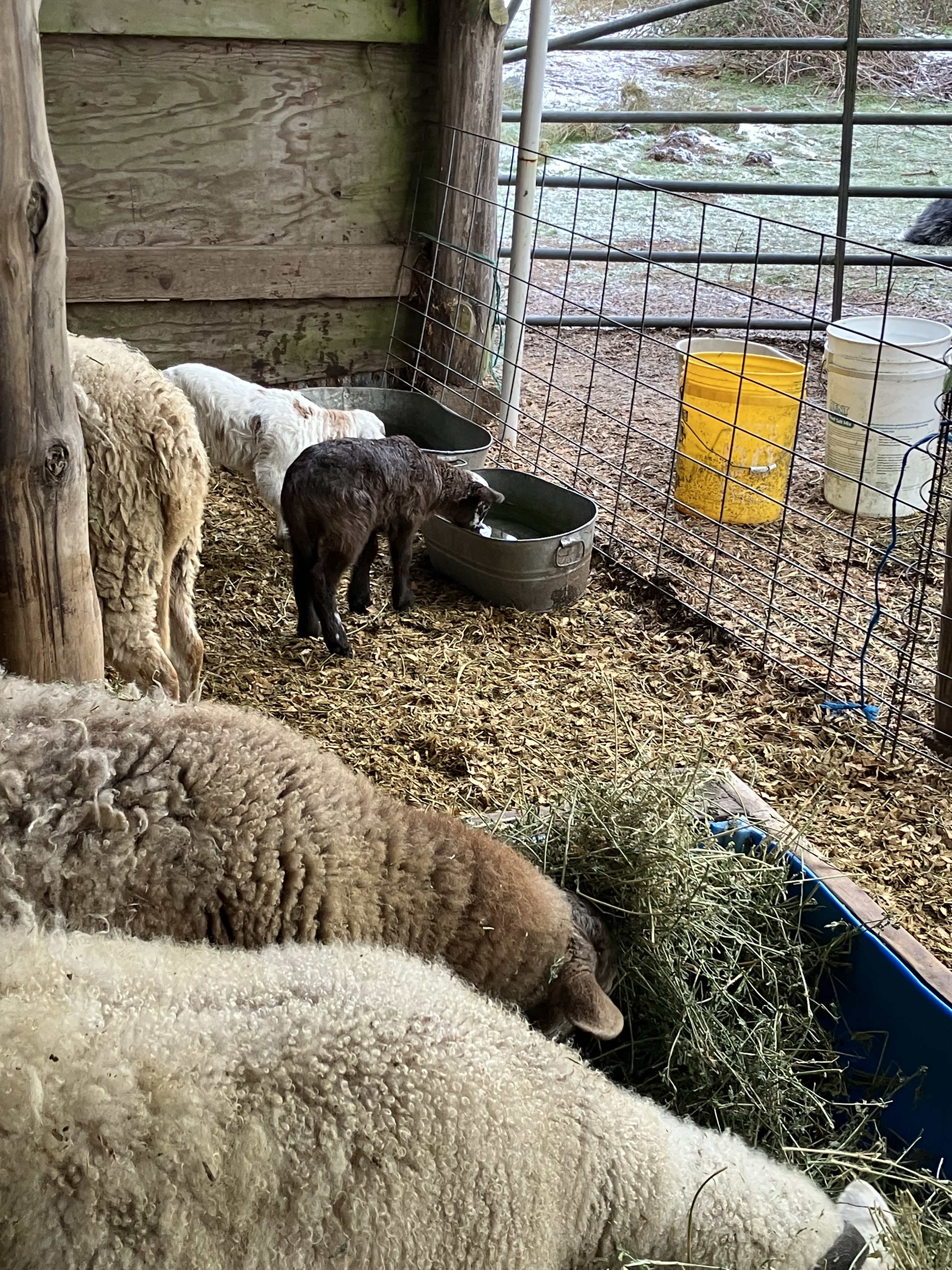
Our newest twins came on the 25th of January, 2026. They are a pair of very healthy boys, out of the bellwether of our flock, Lickety-split. Ruckus has brown tipped ears, and his brother, Rubik’s Cube, had the black spot on his shoulder. “R” names for 2026, and I’m coming up with lots of fun ways to name a lamb. The other twins are Rolo (candy) and Ruby, fraternal, and the single is Riot Girl. Rolo has what I like to call the primitive sheep markings- a white “X” on his face. It’s a sure sign he’s reverting back towards his wild ancestor genetics, which is not bad, so long as he remains poled (no horns) and a hair sheep, meaning less to no wool in his coat so he can shed it well each Spring. Katahdins sheep shed their wool, so no shearing necessary. This Spring, I will be collecting some of the hair that’s shed for a friend’s needle felting craft. Hair can be felted, and still used for material. Though wool is much more suited to cloth making, the art of felting offers a lot of crafty ways to use the fiber.
Riot Girl was a huge single lamb, the second single from Opal, who has some important flock genetics, but might get culled soon because she’s only dropping singles. I did keep her ewe lamb from last year, Quartz, who is carrying a lamb as a first year- a good sign. Riot is looking like a great prospect for breeding, but only time will tell. Sometimes it takes a few years to iron out the genetic possibilities, but it’s a lot of good learning, and fun guessing what might appear along the way. The flock is looking so good this year, they have kept their weight on well, which speaks to the calm barn setting and good alfalfa quality we’re now banking on for good breeding results. With a second ram in the planning again, I’ll have a lot of options on how to split up the genetics in this next round. I’ve actually tried to have a second home bred ram a couple of times in the past, but in one case, the older ram got beat up by the ram lambs and died from internal injuries, and the aggressive ram lambs I was planing to overwinter went to slaughter because of temperament issues. This year, 2026, Okie will continue his duties as head ram, while Quinn, a ram lamb from 2025, will be getting his first introduction to a few ewes for breeding in a separate herd this year. It might end up being too much separation and extra work, but I’d like to get at least tow distant lines going for long term genetic health in the flock. It’s never an easy goal with such a small herd. Too few differences to really keep the DNA fresh.
The lambs grow up so fast, I sometimes forget that within a few days, they are eating hay and drinking water on top of the rich milk diet. This little lamb time god quick, so I find myself spending a little more time in the barn watching the babes romp and run amongst their feeding flock family. Even in the 20F temperatures in recent weeks, the lambs are born and thrive. They are so well coordinated for this lifestyle, and can survive a lot of challenges at birth with the help of their capable mothers. I’m really lucky to have found such a great breed of sheep to work with. Katahdins are calm, patient, gentle, and great mothers. In the eight years that I’ve worked with this flock, I’ve come to love the breed, and hope to convince others, especially sheep beginners, that this is the breed for you. They also taste amazing, mild and flavorful, without the grease of a wool sheep, or the mutton taste with age. My 7 year old ewes taste as good as the lambs. This meat breed was developed for the human pallet, not cloth guilds. If you are looking for a great meat breed that makes it’s weight without grain, choose Katahdin all the way!
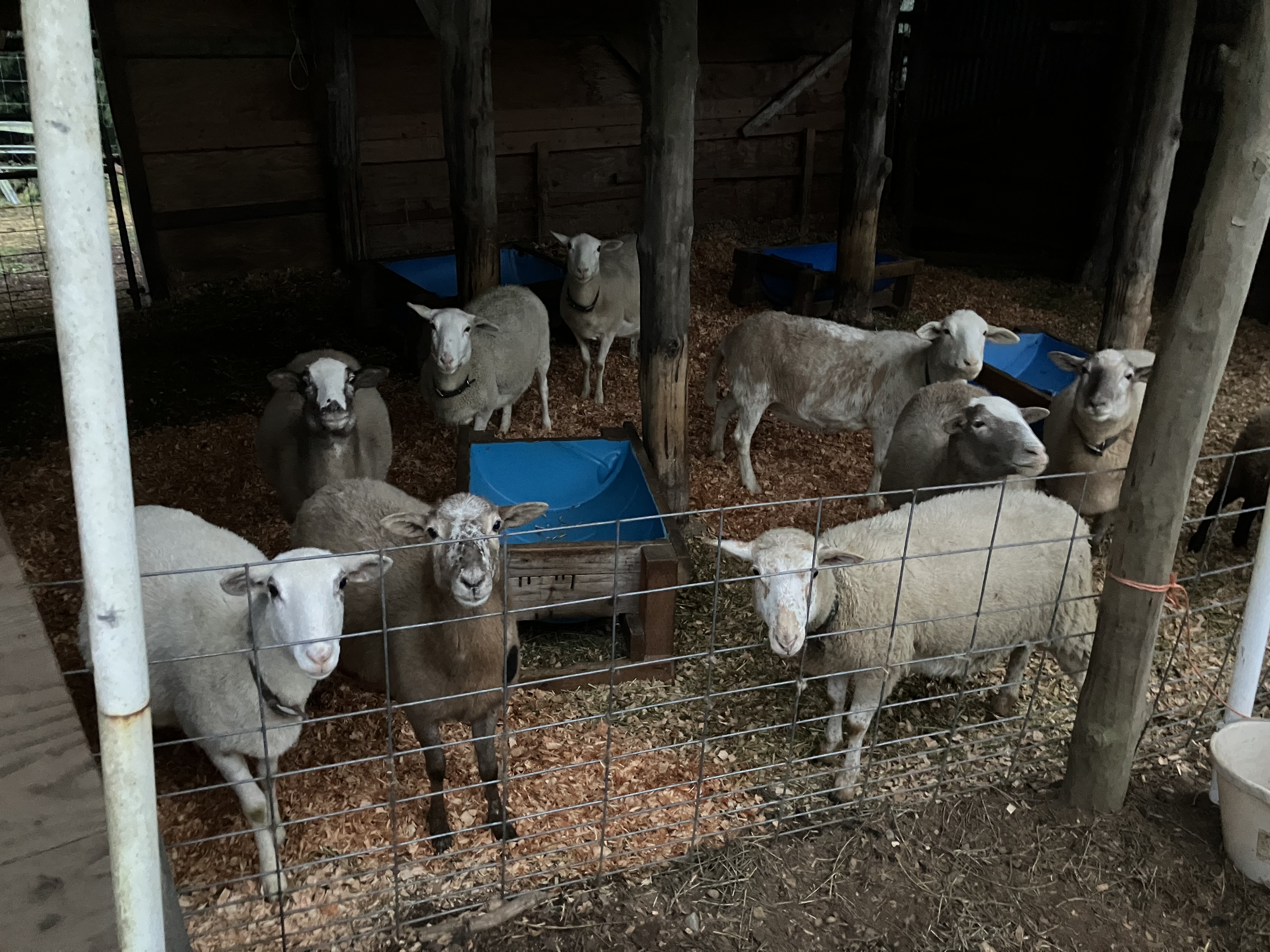
The gals are at it again in another winter lambing, which will start in the next few weeks. Now that I’ve said that, it will be another month. Ha! The ram went in late July 2025, and that means any time after Solstice was open to lambs dropping. Here we are a month later, and a few of my early ewes are showing up almost there. It’s a bit of a guessing game, but that’s half the fun with a small flock. Industrial flocks are synced to get them in the same cycle, which shortens the lambing season into one stretch of just a few weeks. In large flocks, scanning is also common practice. Professional outfits will come with all the necessary equipment and expertise in reading the ultrasound to ensure good prediction of production from each ewe. What a mouth full! It’s also a burdensome cost for a small farm like mine, so. I don’t participate. Katahdin sheep are also great mothers, birthing independently, and usually taking to their lambs with enthusiasm.
Not all sheep are like this, and that’s down to commercial breeding. Responsible operations would ideally breed for traits like good mothering, but often fleece, carcass size, and a certain look are more important to get the best price for each animal. Value is relative- remember that when you think about buying anything. We’re entering a world now with dynamic pricing, and that’s having a profound effect on where I’m willing to do business. This concept is not new, but it’s being implemented now on many items that used to be price stable, with good reason, especially when it comes to shelf stable food. Not much of what Leafhopper Farm produces is shelf stable, hence, most of our fruit and meat is sold at the time of harvest. That’s also the easiest way to sell food. If you dehydrate, preserve, or do anything with your products that involves a kitchen, you’re in need of a USDA inspected facility.
If I wanted to sell my lamb by the cut, I’d have to have a USDA certified kitchen and slaughtering setup, or have a mobile slaughter truck come, then take the carcasses to a butcher. The latter is a possibility, especially if I have clients who are less hands on, but luckily, at Leafhopper Farm, the learning through hands on experience remains a priority. We’re a demonstration farm, showing people how they can better connect to their food, the living earth, and each other. Clients buy a live animal, take possession of it, then I help them learn slaughtering, hanging, and butchering. They leave with the whole carcass wrapped and cut by them. It’s a great way to learn, and I have clients that now come and buy their animal and do the whole process themselves. That keeps things as local and fresh as possible. My sheep are born, raised, and die here, without any unknown handling, processing, or transportation- all of which is quite stressful for the animals.
At Leafhopper Farm, we’re striving for quality of life for all the animals that live here, from better habitat for wildlife, good clean food and water, safety from predators, and the natural cycles animals prefer to live within. The sheep graze during the growing season, and remain on pasture during the warmer dry months. All the lambs are pasture raised, naturally weening from their mothers as they grow up. The flock is small and intimate, living together as one unit, without separation, except the rams during lambing. An uppity ram might hit one of the ewes and cause her to miscarry, so the males stay in a separate pen, which seems to be a relief to the ewes during pregnancy.
I’m excited to plan my new young ram lamb for breeding in 2026. Quinn is the son of Lickity-Split, my favorite ewe. He’s still young, but perfectly capable of covering some ewes of his own. Our resident ram, Okie, will remain our main breeding fella for the foreseeable future, but mixing things up a little bit is a fin way to see what might drop in the genetic pool. Since the flock is so small, I don’t do a lot of long term breeding planning, because there’s not enough genetic stock to make huge developmental changes within the herd. Splitting the breeding for a few years will still diversify the genes enough to focus on some I really like, while allowing others new ones to emerge. It’s an experiment, and may come to little overall change, but I like trying different ideas, and this is one I’ve made time and space for this year. The rams are happy to be together right now, and they will be separated at breeding time. I’m not sure yet what that will look like, but stay tuned for more on flock development at EEC Forest Stewardship.
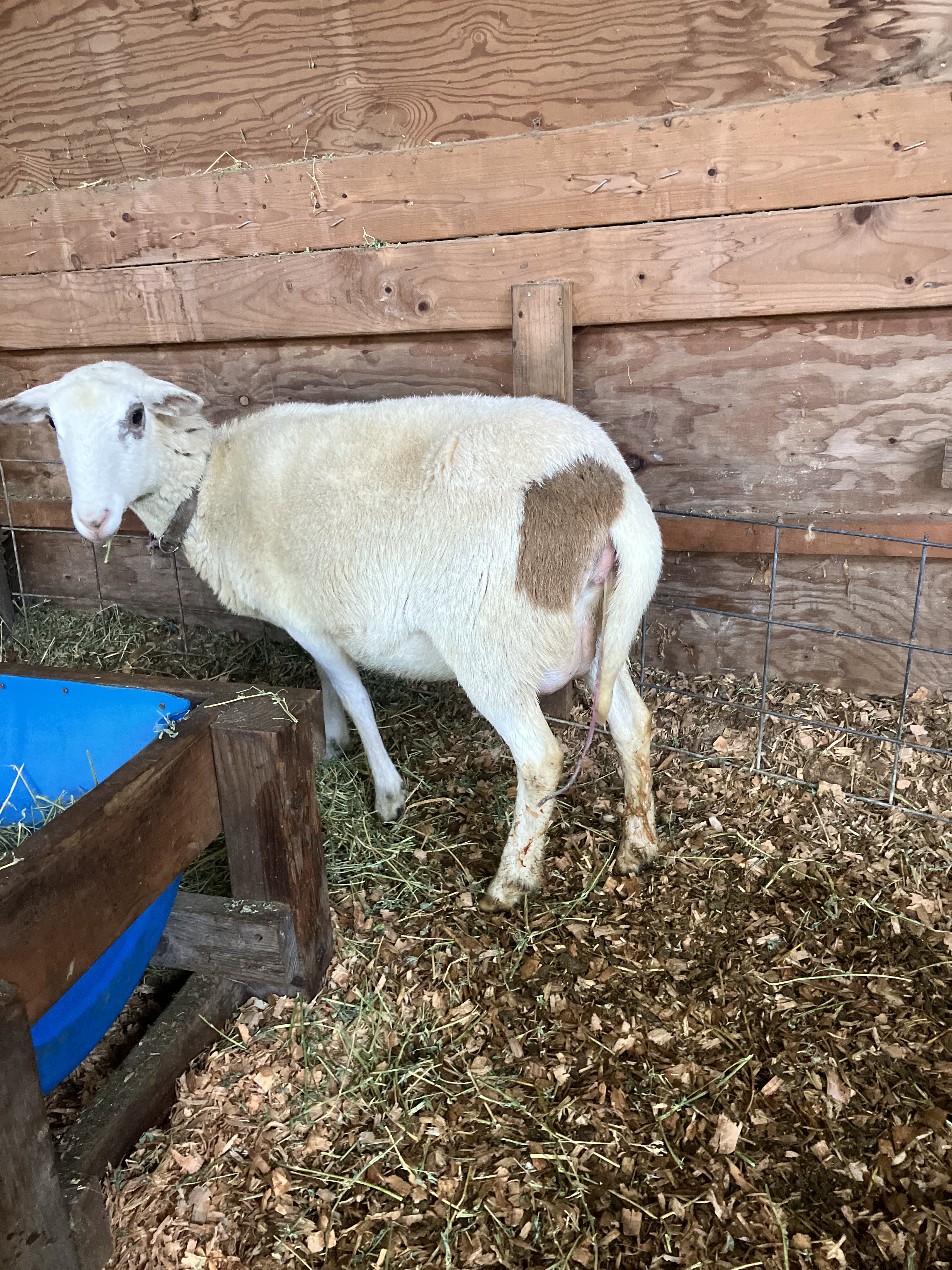
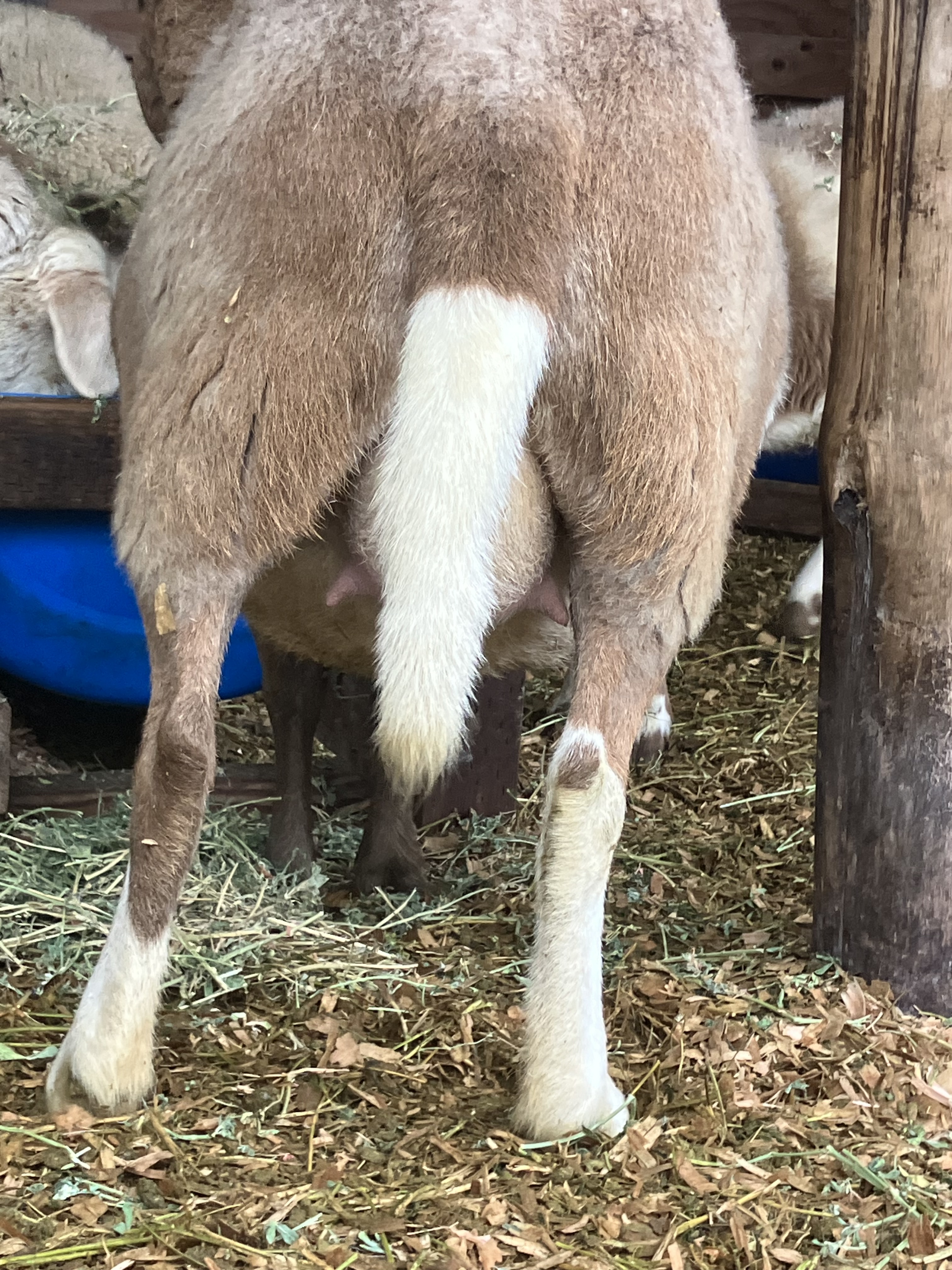
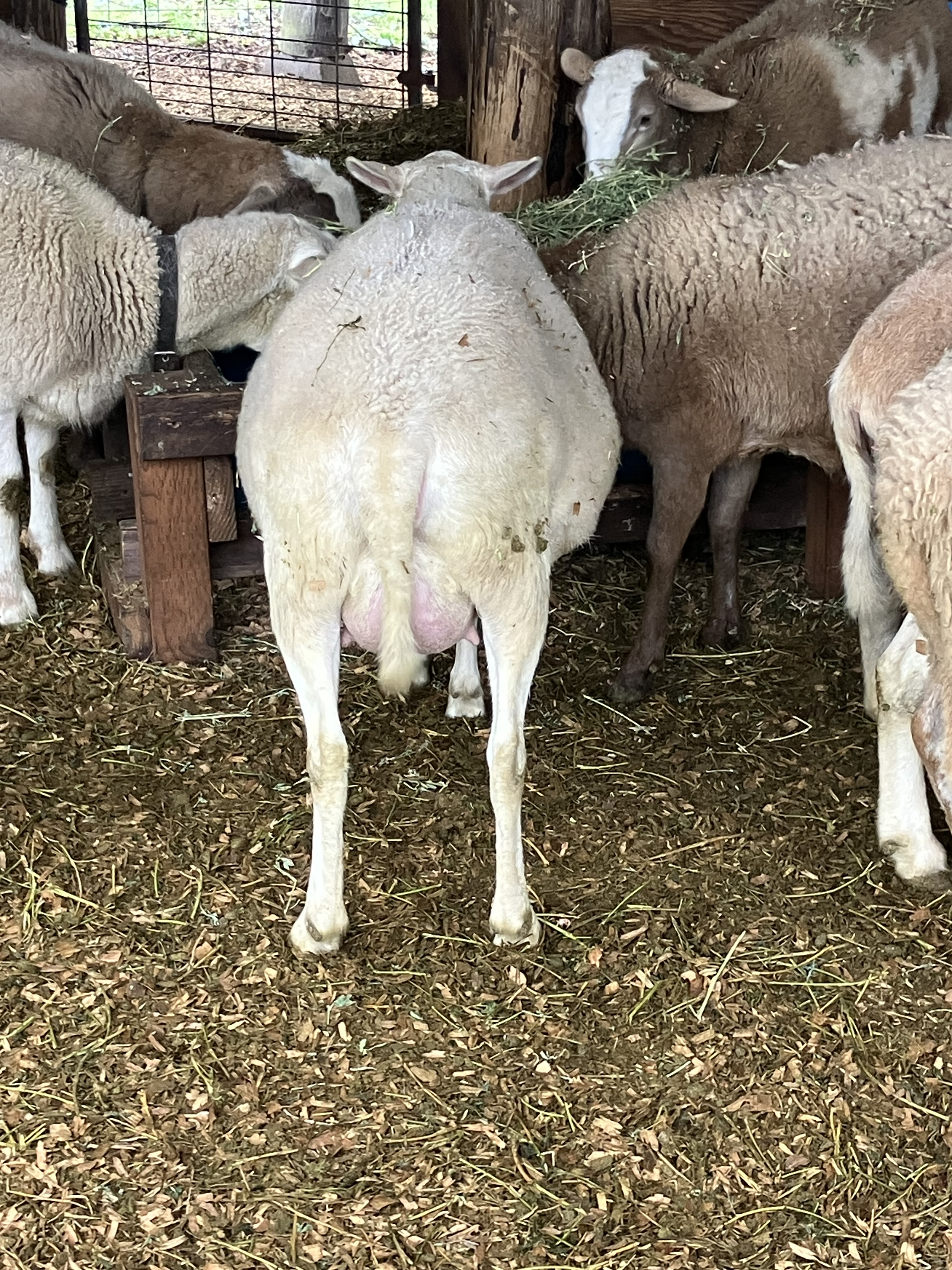
Right now, the lambs are gestating into their final weeks, though some of the ewes, especially the first years, might be months out from their drop date. It’s called dropping because the lamb drops out of the ewe when it’s born. Based on some bag swelling, I’m guessing these two ewes are due in the next week or two. Again, it’s not a perfect science without exact covering dates, but rough guessing does pan out when the teats look like this on a ewe.
The white ewe is Nelly, my go get em’, first out of the gate (usually) lamber. She’s half St. Croix, from a ram who was bred in a more commercial flock, where he had certain high production genetics, like size. Nelly is larger, and usually drops twins like clockwork. She also eats a bit more to maintain her large frame, which is not ideal when you’re working with pasture most of the year. Katahdin sheep are bred to put on good meat weight on pasture alone, which is great for keeping alfalfa costs down during the winter, when I have to hay the sheep to protect the pasture and let it rest during the wet season. The barn offers shelter and protection during lambing, and helps me keep the babes where I can see them. You’ll often see new lambs separated from their moms in open pasture settings. The oversight demanded to make sure the ewes and their offspring are safe goes beyond what’s needed in this setting. I have a small flock, in a decent barn, with maximum visual capability. If the LGDs bark in the night, I can come down to the barn and shine a light on all my animals at once, checking to make sure everyone is safe and accounted for. I could not imagine having to head into an open pasture to try to find lambing ewes in the dark- they often hold up in dense vegetation when lambing in the open, or hid their lambs while in recovery.
This year will be a good year for lambing at EEC, I can feel it, so, in this final countdown, I am so grateful for the sheep, their hard work to grow lambs each year, and the healthy good meat we’re providing at Leafhopper Farm. The land and the animals thrive, reflecting the healthy and happy life these animals live in their time under my care. I am so thankful for all the lessons they offer me, the time we spend together, and the trust they lend when I’m there to help. These sheep are my life, the legacy of this farm, and the real stewards of this place. So much abundance to come.
The profound action of an old growth forest cannot be easily measured. What we continue to slowly reveal, is that all our landscapes have profound function in our very survival. As humans, our curse is hubris. We think we know how to run the world, how to best manage wilderness, as though it needs our management. EEC Forest Stewardship is stewarding, but that’s cleanup after previous land owners cut the forest, put too many animals on the landscape, and degredated what had been crucial old growth temperate rainforest. There’s little of it left where the farm runs today, and not mush elsewhere, outside a few token National Parks. It’s difficult to know old growth is still being cut around the world, and that it will take thousands of years for any of those forests to come back. We humans don’t comprehend that kind of timeline, because it far exceeds our own lifetime. Another fault of our species is the lack of ability to see time outside ourselves. By this I mean, ecology has been evolving as a massive system for millions of years. The wilderness we see today, what’s left of it, has been evolving through complex cycles of climate change, global catastrophes, and many mass extinctions, which deeply impact how and what thrives on the land today. People really have no clue, but we’re great at tearing things up to get to what we value, no matter the cost.
I’m going to try to take a minute to help us look a little deeper into the ecology of old growth forests, and why they are crucial to human survival. There are reasons to stop cutting old growth which stretch far beyond any single bird species or carbon sink, it’s about how water gets to the land, how it’s filtered and cleaned for us to drink, how the air is filtered too, and soil building for generations to come. We like to count board feet of timber harvests, where easy profit is made, but if I came to my city council tomorrow, and told them we needed to pull up the drinking water pipes in town so I could get to some coal seams under the streets, that’s when people say “no” to extraction. When we see a direct affect to our lives, we ask for change. People, we have to see it now, before the only safe water to drink comes from a corporation that makes you pay too much for too little.
Forests make our climate, and without massive, old growth stands, these functions of our rains will continue to diminish. I’m not the best at explaining all this, but these two videos help, and I think taking some time to watch will help us all better understand why even younger forests need protecting, and why EEC Forest Stewardship strives to educate others about restoration farming and why planting native forest is crucial to our survival as a species. Please take a moment to take in these great pieces of information and reflect on how you can better support the protection of our native forests. Right now, our government is acting to cut unprecedented acres of our federal forests, they want to cut acreage about the size of California throughout the US. How can you help? Contact your local representatives, state, and federal too. Tell them our forests are not for sale, and why forests are important to you as a tax payer in The United States.
On another important note- all the land we live on today in The U.S. is stolen from tribal people who were deeply harmed by our government through military oppression, racial prejudice, and colonial dominion, and that’s just a jumping off point. Our continued abuse of tribal people, the lands, which are still held sacred by the tribes, which also still exist today to bare witness to Americas 250 years of direct abuse, and the hundreds of years of colonial oppression before that. I acknowledge that when I talk about federal and state forests, along with National Parks, I am participating in the dialogue of stolen land now “owned” by this country.
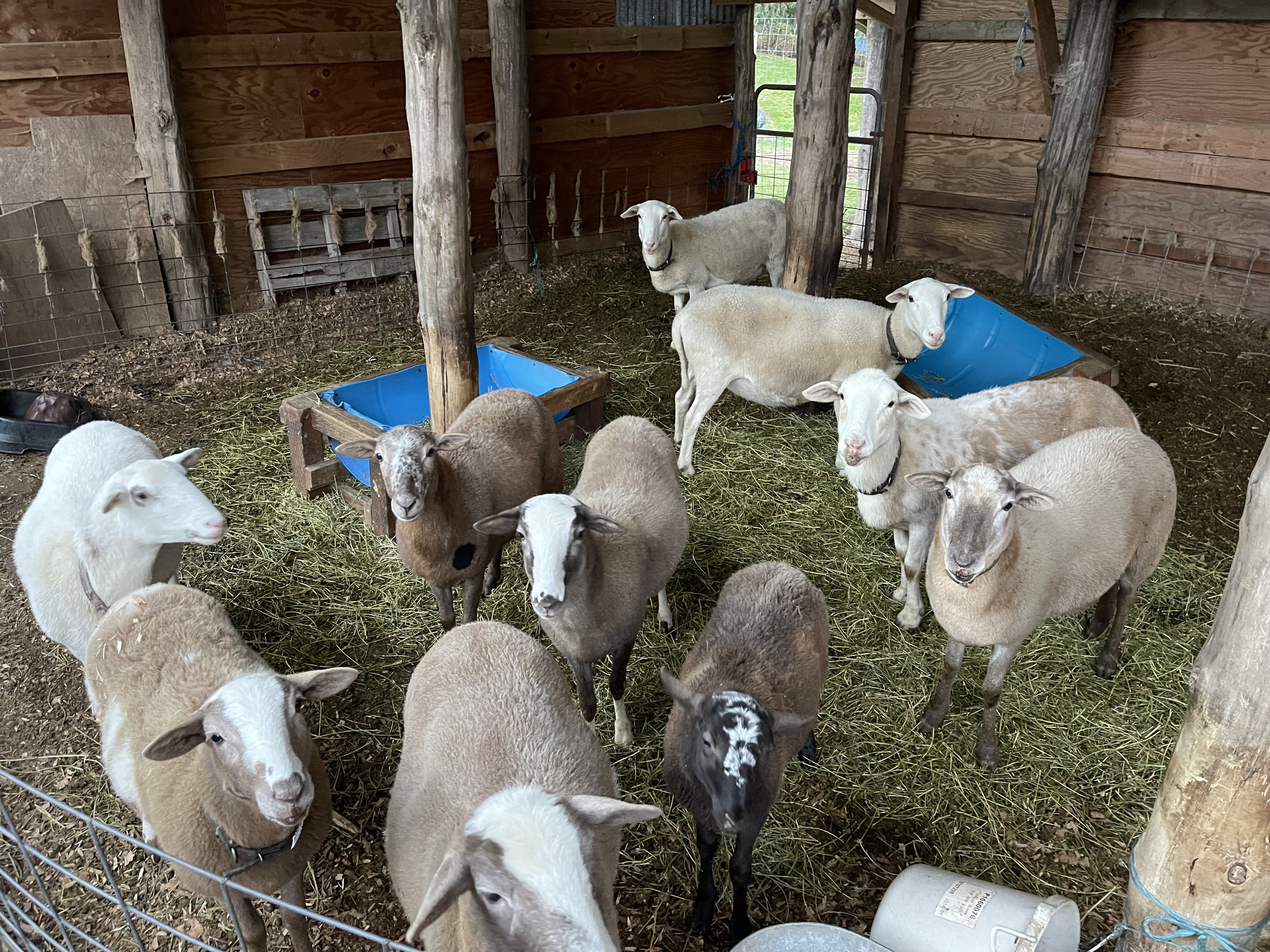
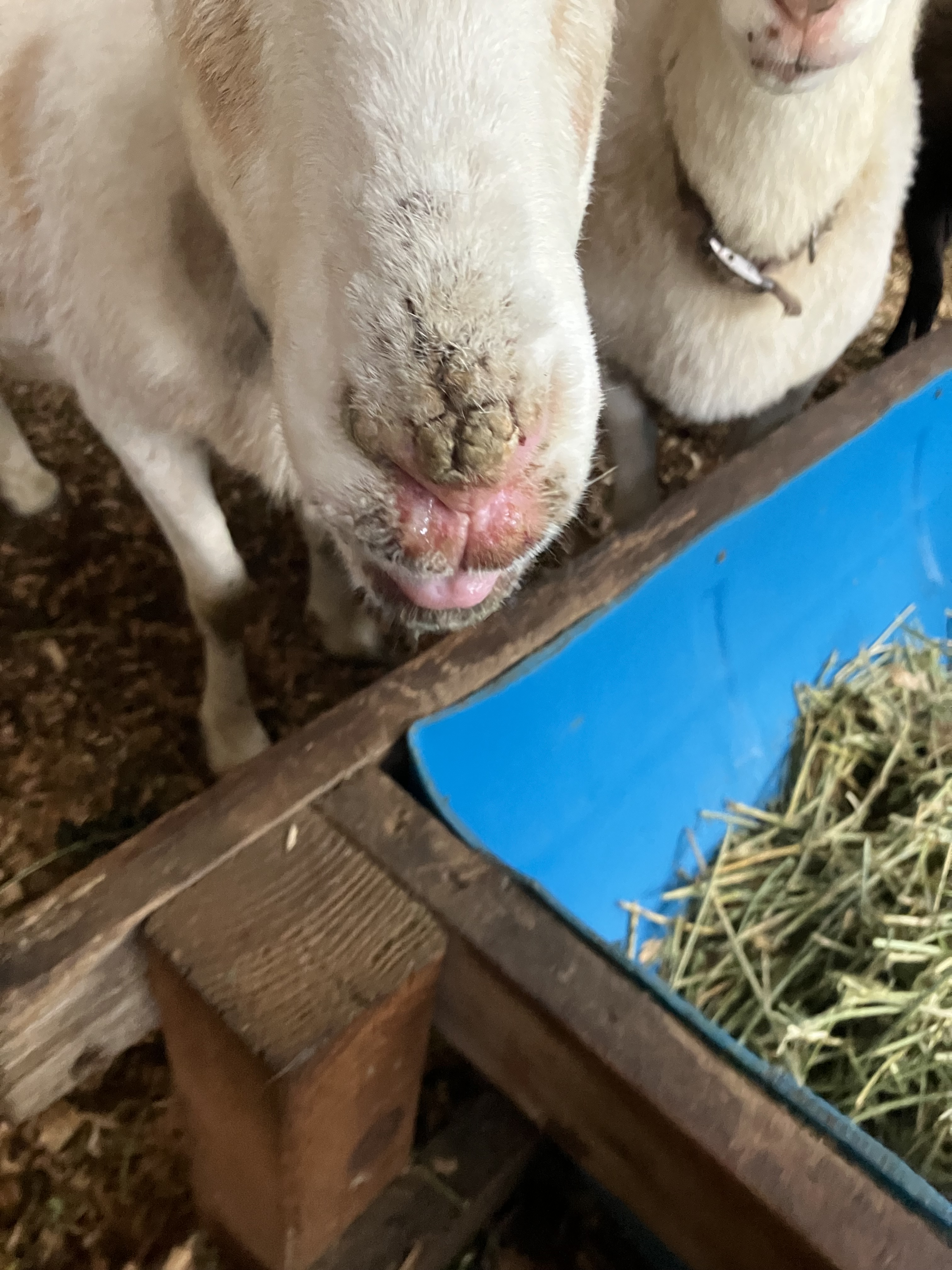
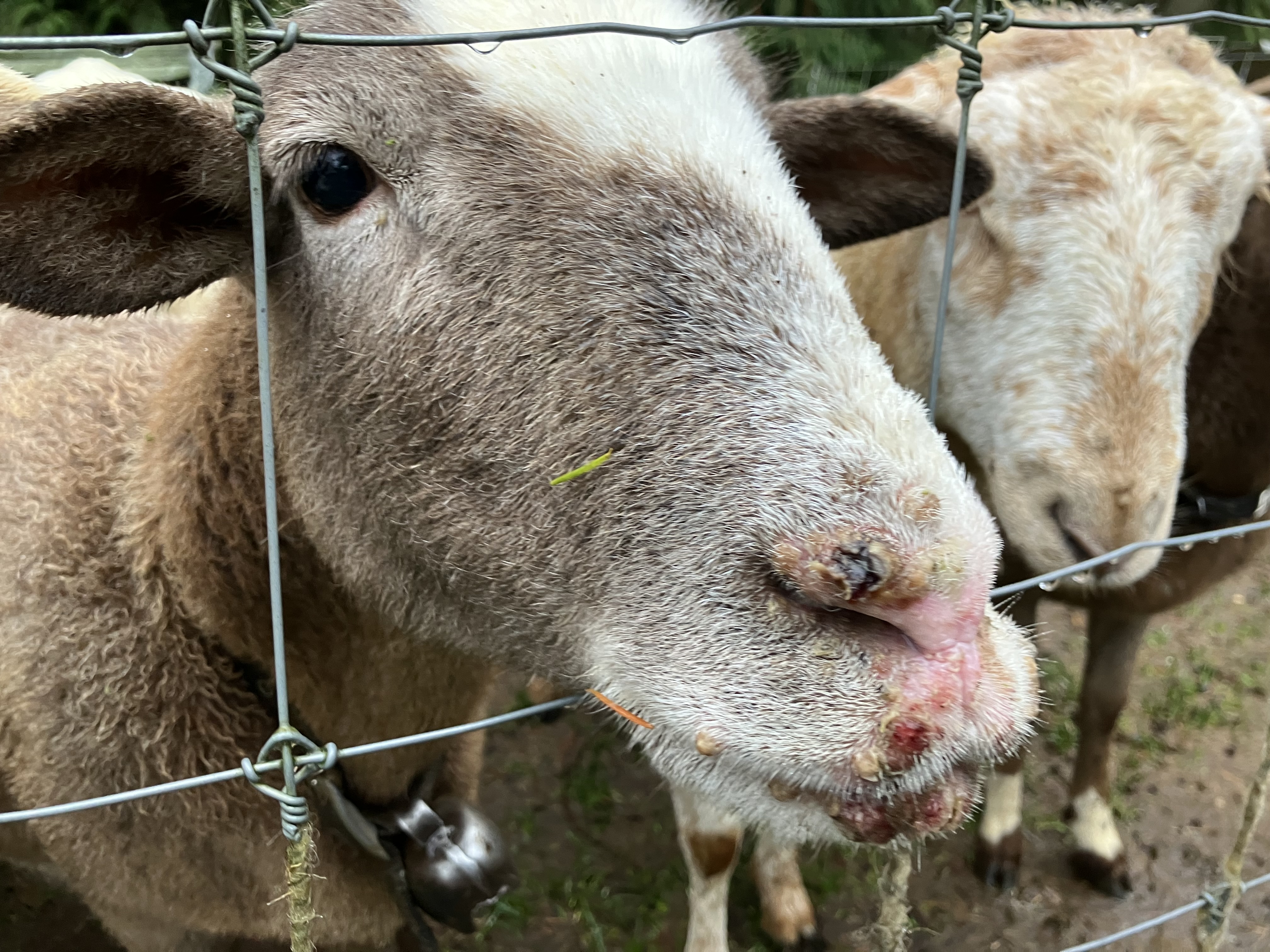
Did you know that sheep can get chickenpox? Well, it’s not quite the same virus, but similar, and contagious to humans. No, I did not get it, I used gloves and a lot of bleach to clean and keep things sterile through the infection. When I first got home from a recent trip, I went to check the flock and found them all with sores on their mouths and flipped out. After a long talk with my sheep mentor, I got on the internet and scared myself a bit more. How did the pox get into my farm? I don’t have other animals coming and going, and not a lot of visitors from other farm yards. Well, I’ll get to how I think it came into the farm, but first, a little more about this zoonotic disease.
Parapoxvirus affect vertebrates, and can jump from animals to people, so you have to handle it with caution. ORF stands for contagious ecthyma, also known as contagious pustular dermatitis, or sore mouth. It’s endemic in farmyards around the world, and commonly infects herds that have not yet been exposed. Luckily, it’s not fatal, unless you have young lambs, which were not dropping when this infection occurred in late Fall. I’d also finished my culling, so thankfully, none of my economic plans were interrupted. Typical infection causes one or two sores on the mouth, but my gals were eating alfalfa together out of the feeders, which, when the ewes dig down through the twiggy material to get to the leaves, prick their faces with micro-scratches, which then get secondary infection from the ORF. It made the noses of some of my gals look hideous for about a week.
As soon as I knew what I was dealing with, I got everyone out of the barn and away from the feeders. Then I fed everyone on fresh ground each day for the next two weeks until the infection resolved. I had a very well established local vet practice out to see things and make sure OLF was the virus I was dealing with. The vets complimented the overall health of my herd, and said there was not much they could do, the virus naturally resolves its self within a week. Once infected, the sheep have a natural immunity after that. The doctor assured me there was nothing I had done wrong to get the infection, that it could have come in on my shoes after a trip to the feed store, or on any surface touched by someone with the virus on feed sacks, mineral blocks, etc. I asked if it could come in on farm yard pumpkins and they said that was possible. I’d purchased a bulk load of post Halloween pumpkins from our local grocery store as treats for the animals, and shortly after those were fed to the sheep, they got OLF.
That’s the only think I could think of to fully explain the infection and timing. The virus spreads fast once infection occurs, and I had not been to the feed store within the week before I left. The vets were least suspicious of the pumpkins, and said it was not likely they were the culprit, so I did a little experiment. My rams were in a separate pen and not infected. They had not received any pumpkin. So, I had one left, and cut it up for them. Two days later… OLF. The rams had it, from the pumpkin- but that’s still only a hypothesis, so I can’t be 100% sure, but it was present in the rams right after exposure to the pumpkin. Here’s why this is a serious concern. If pox virus is on pumpkins that people take home and handle to carve, people will get OLF. I wonder how often this happens, and parents don’t connect the dots, thinking their kid is just having a reaction to something mundane, not a farmyard virus. This is scary folks, think about it.
How did the pumpkins get the virus? Well, we use animal manure to fertilize a lot of agricultural fields. Usually, the manure is kept in a liquid form and sprayed onto fields before planting. Other times livestock is moved through the fields to glean and graze, dropping their manure as they move around, and then that’s tilled in before the next planting. Either way, manure carrying the virus came in contact with the pumpkins, and was carried to my farm. I’ll not be feeding pumpkins to my livestock again. It’s haunting me now, because I wonder if it could be in hay too, or the alfalfa from the fields, or the grain. Anything growing in the soil where the virus is can have it, hence, it’s endemic in farmyards. I don’t know how more people don’t end up with it, but also wonder if it’s even being diagnosed. The pustules clear up in a week, and if you aren’t working on a farm with livestock, you might have a hard time connecting your infection with OLF.
This is not an article to send everyone with a blister to their doctors asking about OLF. It is an exercise in awareness- awareness that viruses are rampant, they are in our food industry, and without good oversight, inspections, and USDA engagement, the public won’t know what’s going on. Guess what? Our current administration has fired a lot of the USDA inspectors and oversight in our food web, so we’re in the dark about a lot that’s going on back on the farms. My vets confirmed this, and they are seeing a heck of a lot out there, especially on dairy farms, so folks, wake up. Wash anything you buy that was grown in a field. Be very cautious about sharing scraps of veggies with your animals. Dogs and cats can get this too- any vertebrate. Perhaps why we don’t see it more in people is due to its self vaccinating state as a virus that once you’ve had, you don’t get again. Wish COVID was like that.
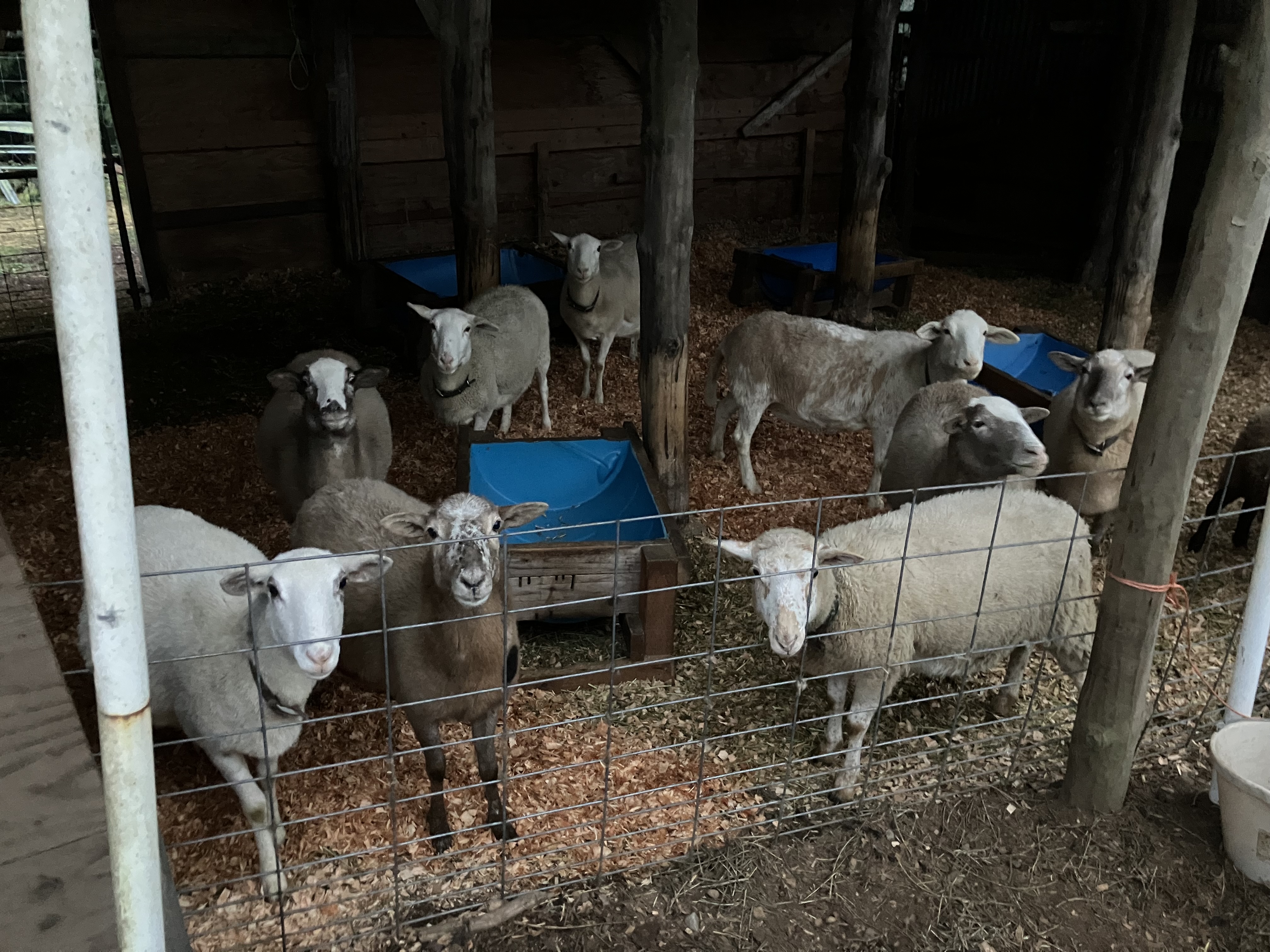
It was so scary to see my ewes sick like this- a first time for me in ten years of sheep raising at Leafhopper Farm. The sour mouth made it uncomfortable to eat, but the ladies kept at it, especially once the alfalfa was in the field, on fresh ground each day. Normally, feeding on the bare earth is not good, but for an infected flock, moving them around the pasture to eat off clean dirt is much better than putting their heads in feed bins where the prickles of the stems cut their sensitive faces. When they are not breaking out with pustules, the feed bins are fine to eat out of. After the infection cleared up, the gals were back in the barn with fresh bedding and clean feed bins. They were quarantined for two weeks, with no additional culling or processing, because an infected carcass can still spread the virus, so don’t slaughter during an outbreak. I am so glad I’d already done my culling earlier in the fall, so this outbreak did not directly affect my profit line. I could see this being a major issue in larger operations where there is not as much oversight. Again, USDA is limping along with no real inspectors left to see that livestock is clean and safe. This should be keeping us all up at night.
I can’t say that a lack of USDA inspection caused my outbreak, but the vets confirmed infections of all kinds are up in the livestock world, and to be extra cautious with exposure. Luckily, Leafhopper Farm has a closed flock, meaning we don’t bring in new animals each year. Our breeding ram was sources in 2021 from a registered flock in the next county, so I can trace him back to his breeder and her flock. Since he’s been here for going on 4 years, I consider him well established and not exposed to any outside breeding. No other sheep or goats come to the land for any reason. This is one way to help keep a flock healthy and safe from exposure, but unless you’re cleaning your boots every time before you go to the barn, you could be bringing in something. I’ve now taken to having one pair of muck boots for the barn only, and do not wear any other shoes down there, but sometimes, when I’m walking by in other shoes, I still forget and walk in to add extra water, etc. So my biosecurity is a work in progress.
I’m still haunted by this virus, though it’s common and endemic, I’ll now have it in the soil here forever, though the vets assured me it was already here in the environment, as most viruses are, and that potential stress might have brought out the infection in my flock. I can’t think of any major stress these sheep could have been through in recent months, I still blame the pumpkins. Now, in January, it was like a dream. The ewes and rams cleared up, and there is no sign of the virus left in the flock, but it’s still around, so I’m washing hands, cleaning things with bleach, and keeping a sharp eye out as lambs get ready to drop. The young are the most susceptible, but there is not an active breakout in the herd now, so lambing season should go smoothly. I could vaccinate the lambs against OLF, but the vets explained that the adults now have immunity, so the lambs should be ok. My herd is not large enough to need vaccination, and getting OLF gives that immunity for the foreseeable future, so I’ll hope that with good clean bedding and healthy ewes, the lambs will stay healthy too.
It can sometimes be very embarrassing for livestock operations to have a breakout of disease, but also not uncommon. I was horrified that I had somehow neglected my animals or shown some kind of bad practice. The vets assured me I had done nothing wrong, and that this happens to most sheep herds. Has it happened to yours? My sheep mentor told me about her breakouts, which happen every 7-10 years. That’s how long it takes for immunity to drop enough for another round of infection to take hold. With this in mind, I’ll be less surprised if I get another breakout in a few years. It will be in the barn and around the landscape forever. That’s a sobering thought, because it also means a child playing in the field where the sheep graze could still become infected. That goes for children playing in any field where manure has gone, even composted manure, because viruses stay on surfaces a long time. It cannot be spread from human to human- thank goodness! To find out more, read the CDC description here.
It was not easy writing this post, I wanted to be honest about what happened, but not panic my clients, as no meat sold this year was in any way affected by this outbreak. I’ll have a full report on lambing soon, and hope to have a safe and healthy herd moving forward. Future outbreaks can occur, and I will know what I’m dealing with in future, but what a learning experience. I’m thankful for the vets that came and assured me the animals were ok and that I did nothing wrong. I’m grateful to the ewes, who took the whole thing in stride and managed to not get me sick during the outbreak. Thanks to my mentor for keeping me calm, friends who were supportive, and family for listening to my heartbreak. I’m so glad things are back to normal here now, and that all the animals are healthy and back to thriving on the landscape. Stay tuned for a lambing update soon. No one had dropped yet, but we’re in the final weeks of gestation, which is always an exciting time.
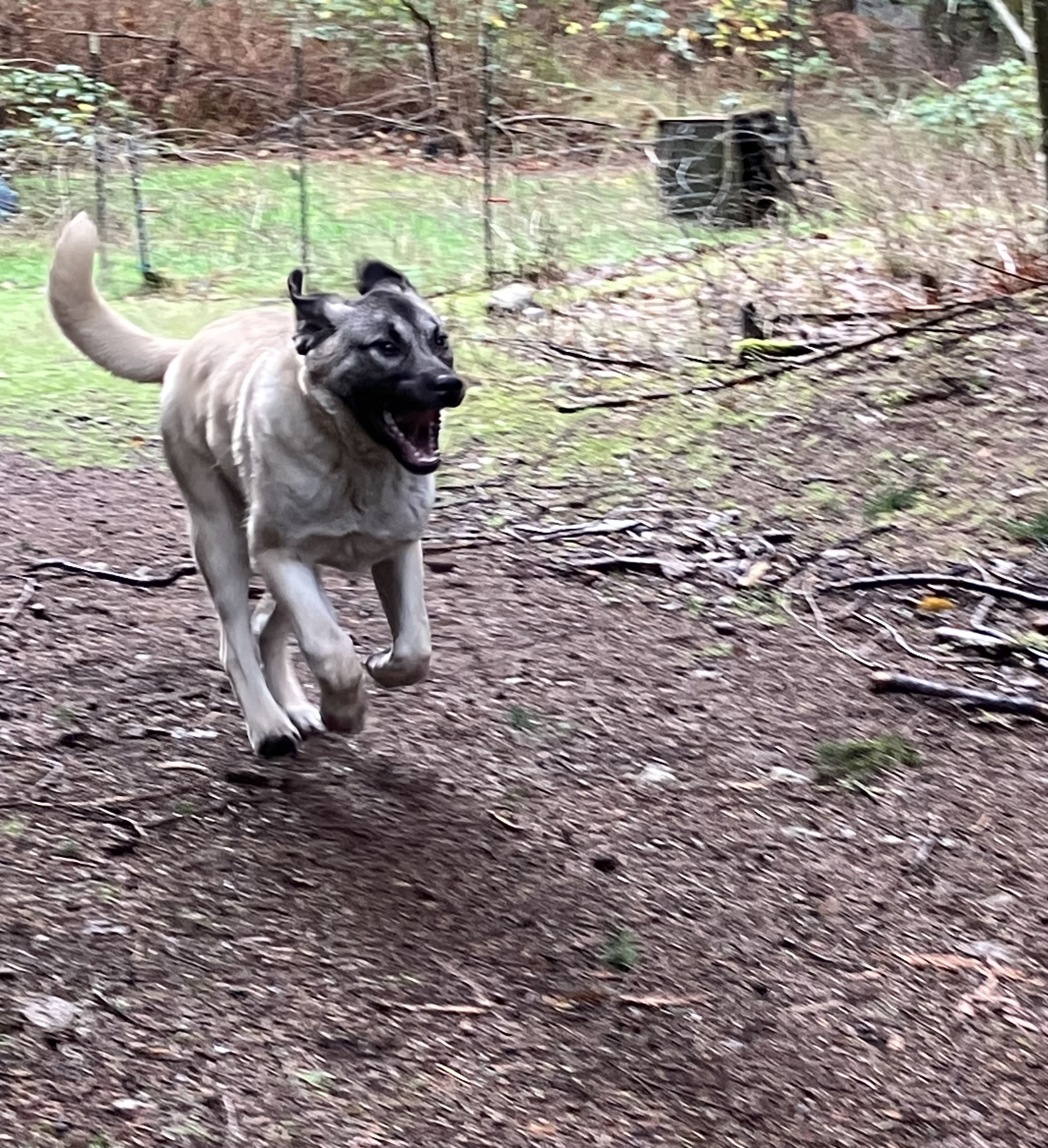
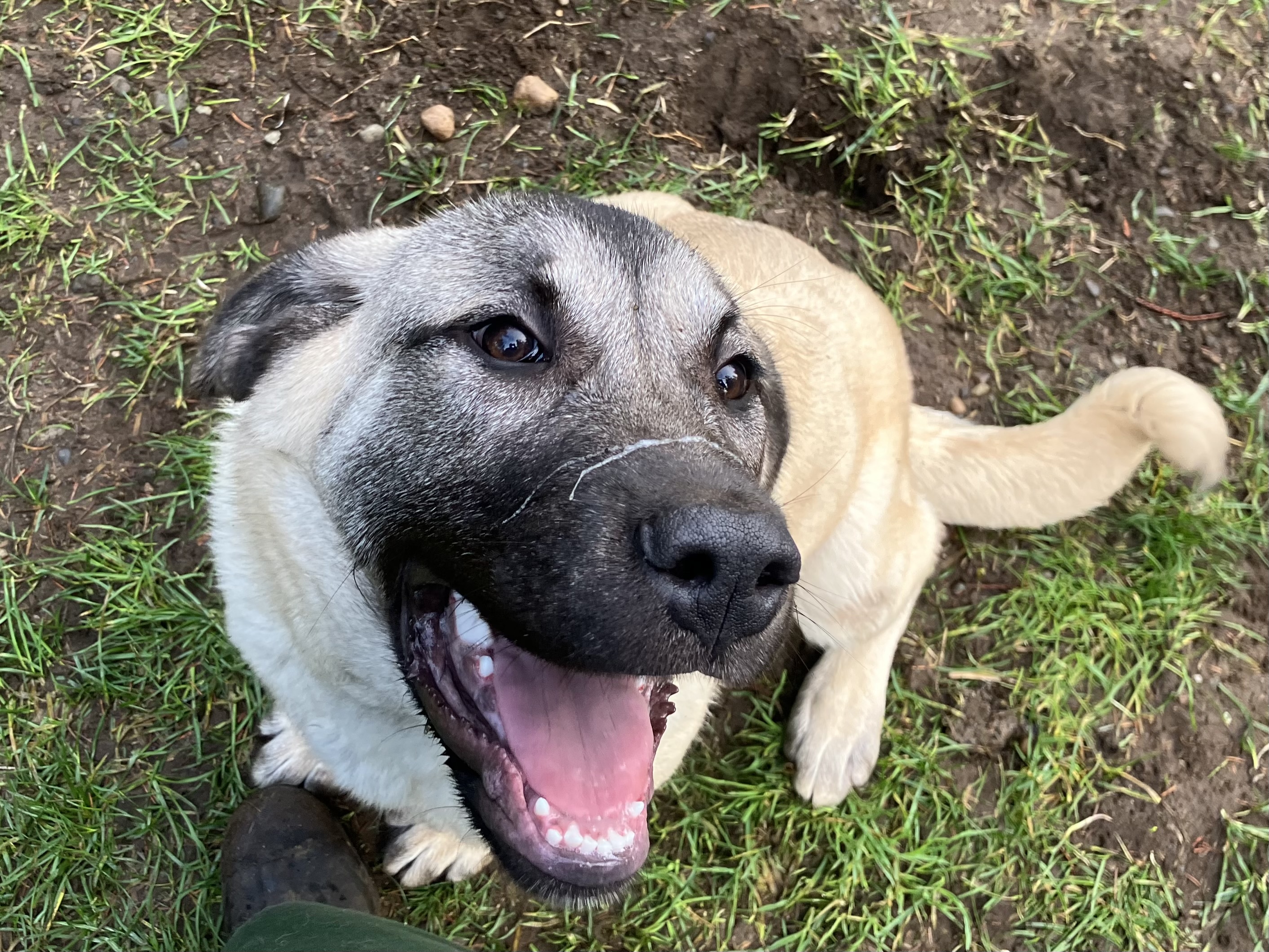
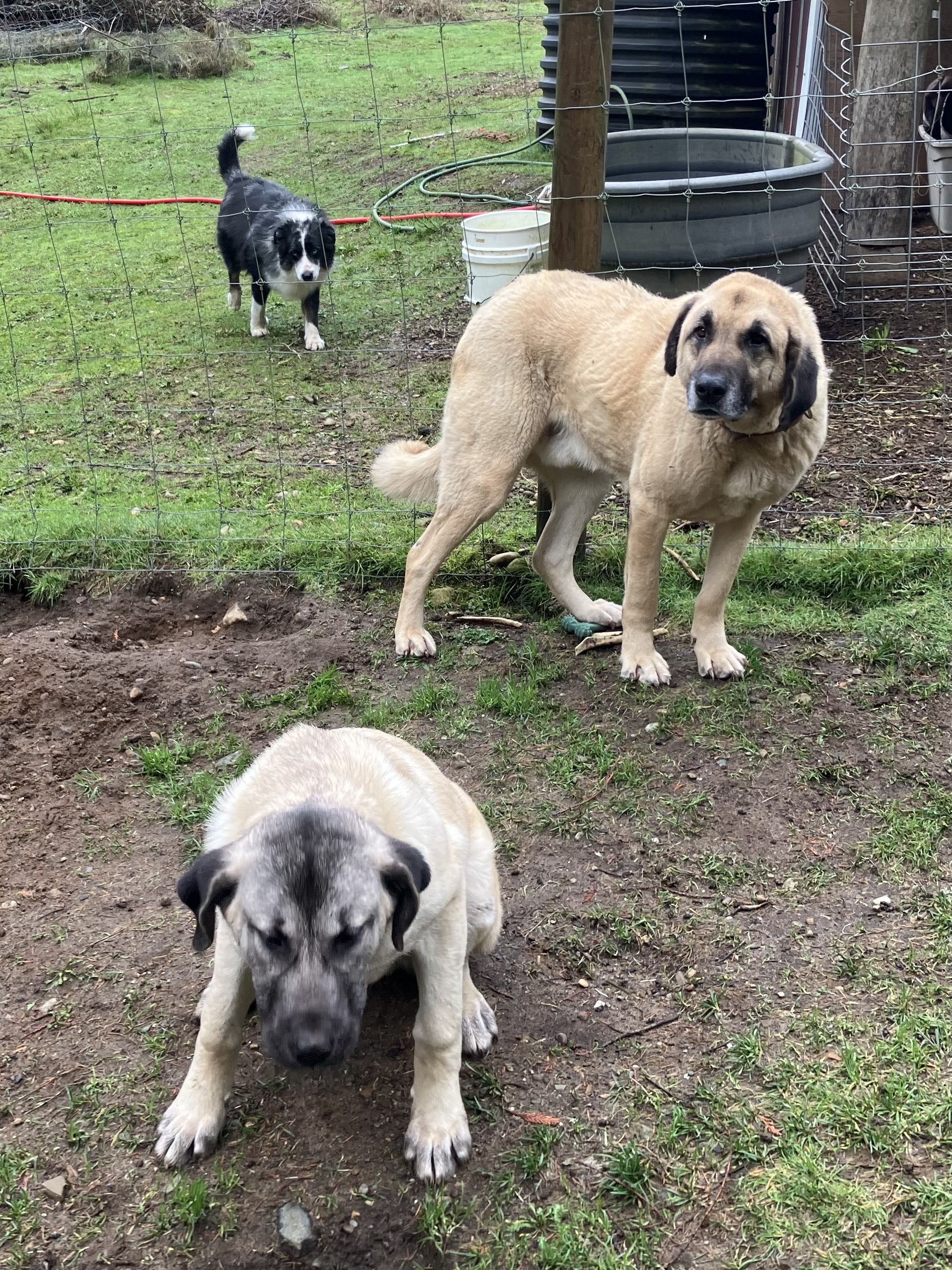
EEC Forest Stewardship has gone to the dogs this month. With winter fully set in her darkest days, the night predators are more active in seeking out a meal in the lean times. With the advent of a full moon, the nights become as active as daytime for many species, and the Livestock Guardian Dogs are on patrol day and night to deter incidents between wildlife and domestic stock. Our newest LGD on the farm is Koban, now in his fifth month on the job, he’s learning his big dog bark now, and running night rounds on his own. In the last hours of December, there was a particularly active evening and the onset of a wolf moon. I was awakened at 2am by my herding dog Val, who sleeps on the covered porch, barking at something on the move through the property. When I hear certain barks from my dogs, I know the situation is serious. Quickly rising from my bed, I put on my robe and grabbed the flood light for good vision outside. First I let Val loose to show me where the threat was. She tore off into the west orchard and at first, I thought I heard a deer pronking away. Then I heard the fleeing animal stop, and Val holding her ground with more intense barking. A deer would not stop and turn like that while being chased. I was going to head down the hill to join Val with the light, hoping to catch a glimpse of what was happening, but suddenly, both Kangal LGDs caught wind of the situation and all hell broke loose. Kangals bay when they see danger, and though I was still in the dark, the dogs knew there was an immediate threat on the landscape, and they were raising cane about it.
I called Val back to me and listened till the baying died down. The Kangals had run off the threat and Val calmly went back to her kennel. I returned to the house and crawled back into bed, knowing it would take a while to get back to sleep after all the excitement, but the peace would not last long. As I was just drifting off, I heard another barking in the yard, this time, it was not Val, but Koban. He was barking from just below the house, meaning he was out of the upper pasture enclosure for the first time. I jumped out of bed. Went out to find my Kangal puppy confused and upset in the driveway. How had he gotten out? It was now 3:30am, and I calmly put the agitated puppy back in his pen, and let Gill loose to run him on patrol along the fence, while I searched for a way out. There was one looser part of the fence I tied down, but I think Koban night have been motivated to jump the gate, if he saw the predator approaching. Still, he had remained on the property, and not run off chasing something, a real miracle for the night that I stopped to give thanks for.
Kangals like territory, and will expand their boundaries as far as they are allowed, so high fencing and good recall training are priceless. With the Kangals back on track in their enclosure, I returned to the house in hopes of getting some sleep, but the disturbances continued, so I used my final defense tactic, I loaded the 20ga and set off two compelling rounds from my boom stick, which silenced the night and let me get some sleep. This is a great way to deter predators, make loud noise, especially gunfire. Now, I’m not aiming at living things, I shoot into a safe berm in a ditch next to the house. The noise is enough to drive off threats, wildlife tends to avoid gunfire, and healthy predators flee. There were no more disturbances that night, but when I walked around the next morning to check for evidence, a deer jaw had been dug up from the compost and drug to the fence. I covered the compost with a fresh layer of ash, and made sure it was well covered with additional leaf litter and manure.
Scent will bring in a predator, so keep pens clean and kitchen scraps well buried. The ash is an additional deterrent that keeps wildlife and my herding dog out of the compost. I had just recently slaughtered a ewe, so the smell of blood was in the air, even with good cleaning and rinsing of my tools. I had put the guts far down by the creek, but a clever coyote might have come up to check for additional opportunity after a fresh kill. The old deer jaw had come up, and that was more than enough reward to risk slipping in. I’ve got a new gap under the fence to fill. It’s always important to check your fence lines, especially if an animal gets out. I’ll be spending a bit more time checking mine now that I have an excited pup who does not need to become an escape artist. I’ve learned that if animals learn to escape, that’s what they will do. Keeping boundaries well fences, and animals well fed are two of the best remedies to escaping.
I’m not mad at Koban for getting out, he was doing his job, but I am now more aware of his enclosure, and keeping him engaged in more sportive ways of protection. Let’s hope his adventures remain contained to his pasture duties. There has not been another escape since the last day of December, and I am thankful for all the support the dogs bring to the farm, and their loving companionship. LGDs prevent livestock losses, and most importantly, prevent fatal encounters with me. I’ve never shot a predator on this land, and would only do so if I found it actively attacking my animals. I hope to keep wildlife safe through deterrence strategies, and dogs are one of the best. Gratitude to my Kangals, Valentine the Aussie cross, and the energy to preform my own responsibilities to the farm, even in the middle of the night.
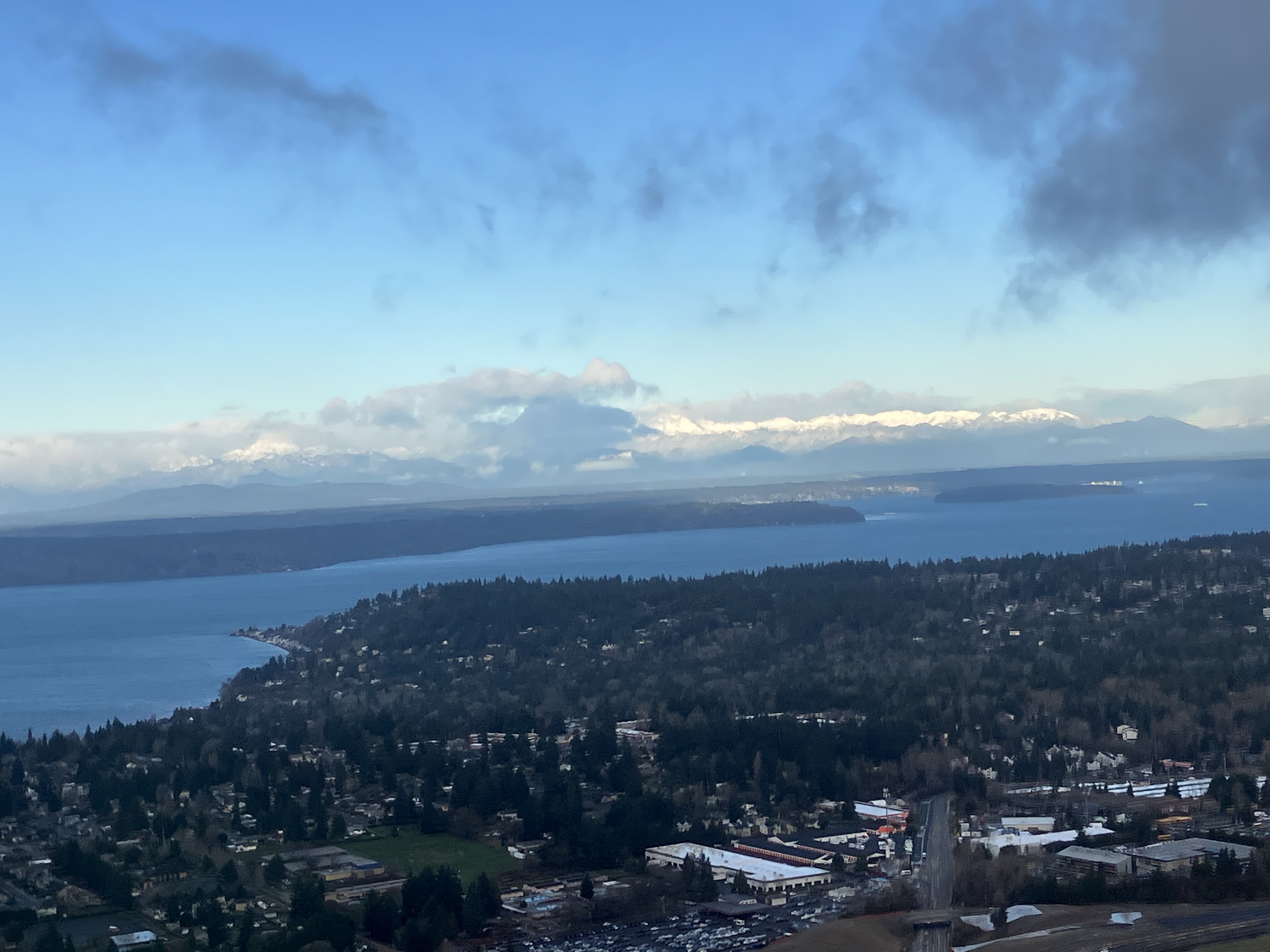
Yes, a surprise two day trip to visit family and I’m back in the air again- biggest carbon footprint I can make. I try to make the most out of these moments, so I grabbed a window seat and looked down. I knew it was going to be wild scenes in Puget Sound, freshwater outflow from flooding rivers carried sediment deltas far out into the ocean waters. The tides push back, but it’s fascinating to see just how much soil is going into the ocean from 50 miles inland or more. There’s also human and animal sewage, vegetation, dead animals, trash, polluted runoff from roads, and much more. I’m sure the coloration of these plums says something about their makeup, either way, it’s dumping into harbors and clogging waterways. Nature continues her rebellion against our abuse, and it’s easy to see the bigger picture form a few thousand feet up.
There’s a fresh snow on The Olympic Mountains, and also on The Cascades, near where I live. This snow pack is crucial to survive the summer drought, but the snow is late, and even the ski industry is getting hit this year as mountains remain closed into December. Hopefully this first snow stays, and gets added to often throughout the next few months of Winter. When we don’t get enough snow, the river valleys shrivel to nothing, and it does not really matter how much flooding happens now, all that water flushes away into the salty sound, and ocean beyond. In some places, like EEC Forest Stewardship, we retain the water, slowing it with earthwork swales, then sinking it into the soil, letting the plants drink deeply, storing the water. If we designed all the ground like this, we could keep water on the land where it falls, banking it into the ground to help maintain a strong water-table below.
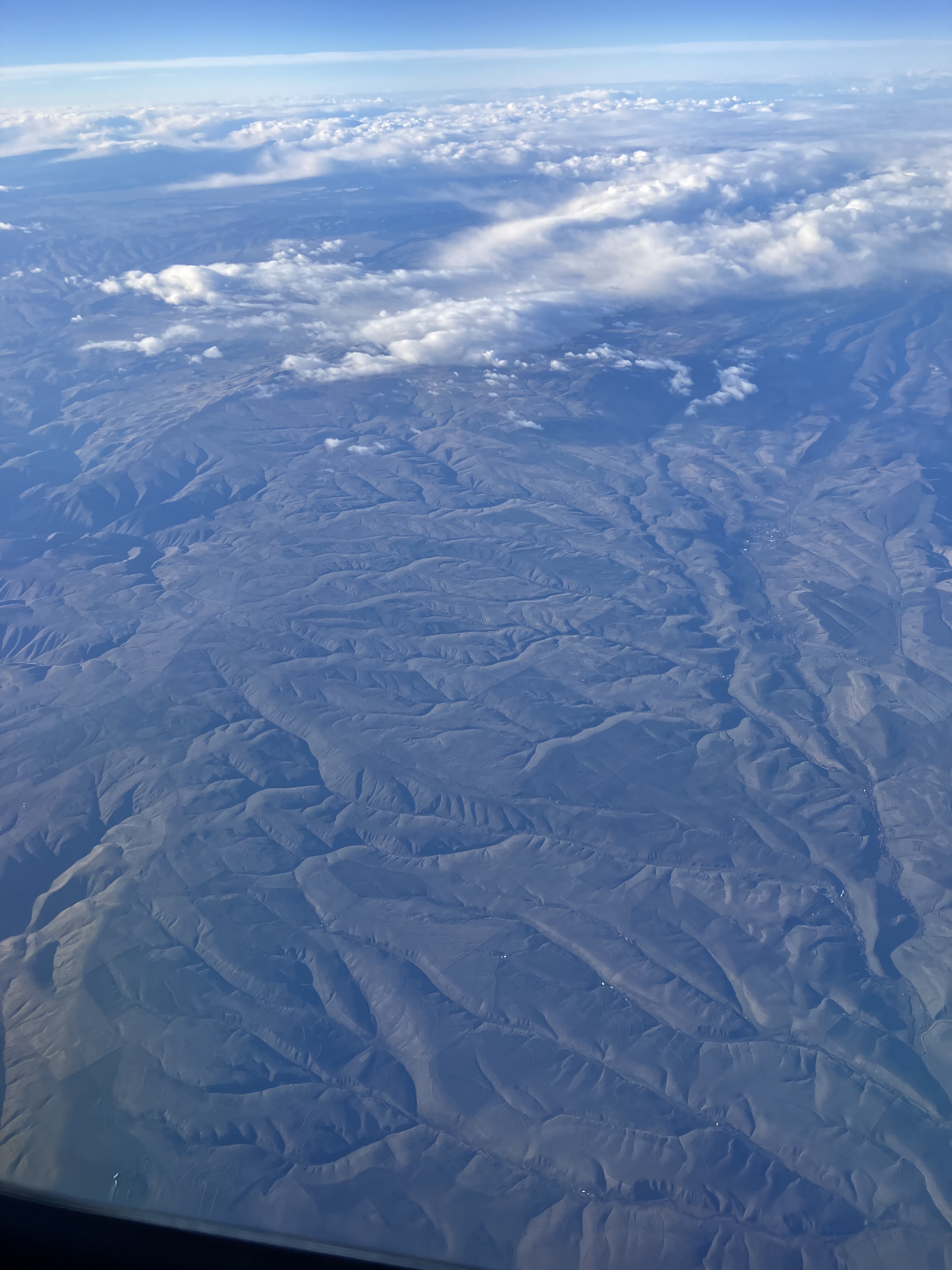
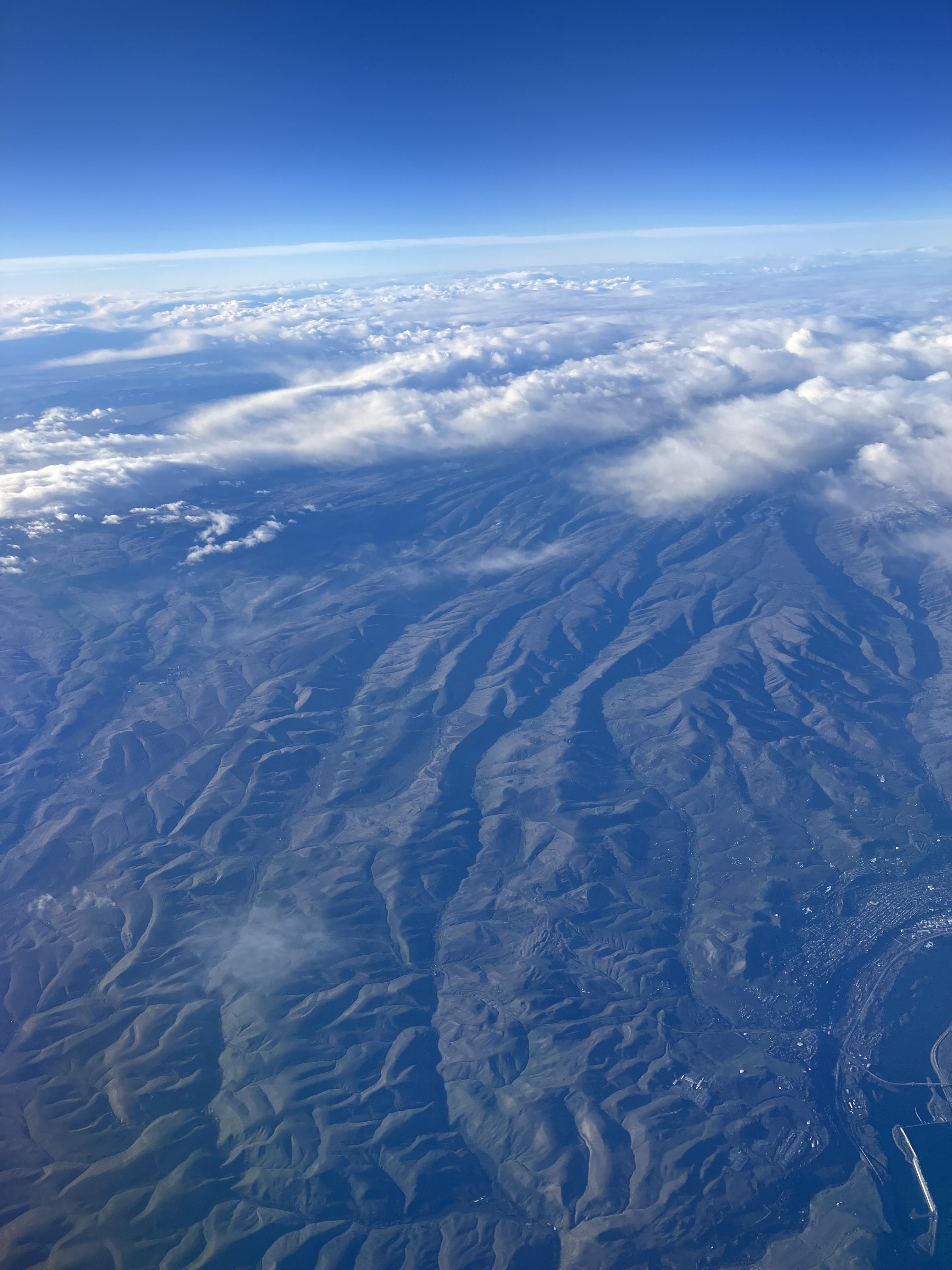
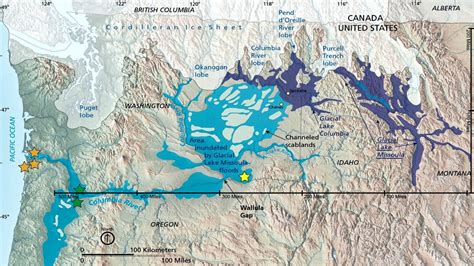
Water has been a huge influence on sculpting this landscape as glaciers ground the geology into pebbles and ice age floods scoured the land. Drumlins are easy to spot from a plane, and I took full advantage of flying over them with enough visibility to snap a photo or two. Since I was headed to The Southwest, we flew down into the Oregon end of Glacial Lake Missoula Flooding. Looking closely, I can pick out the river bottom ripple effect of the massive waters cutting across the landscape. These dynamic changes are nearly impossible to fully comprehend, as we’ve never seen water of such volume in recorded history. The First Nations of the area do have oral histories that tracked glacial retreats and migration up and down the coast and inland valleys in their canoes and on foot further east in the high desert, thousands of years before Spanish conquistadors brought horses.
In early December, 2025, atmospheric rivers flooded The Cascade Mountains for weeks, and the lowland valleys below. This flooding was no where near what the melting ice sheets delivered in a single major flooding event, but Western Washington got a glimpse at how water takes over a place, filling space and blanketing vast areas with sudden change. Thankfully, EEC was not in any flood danger, but witnessing some of the chaos from the air as I flew south, gave a lasting impression.
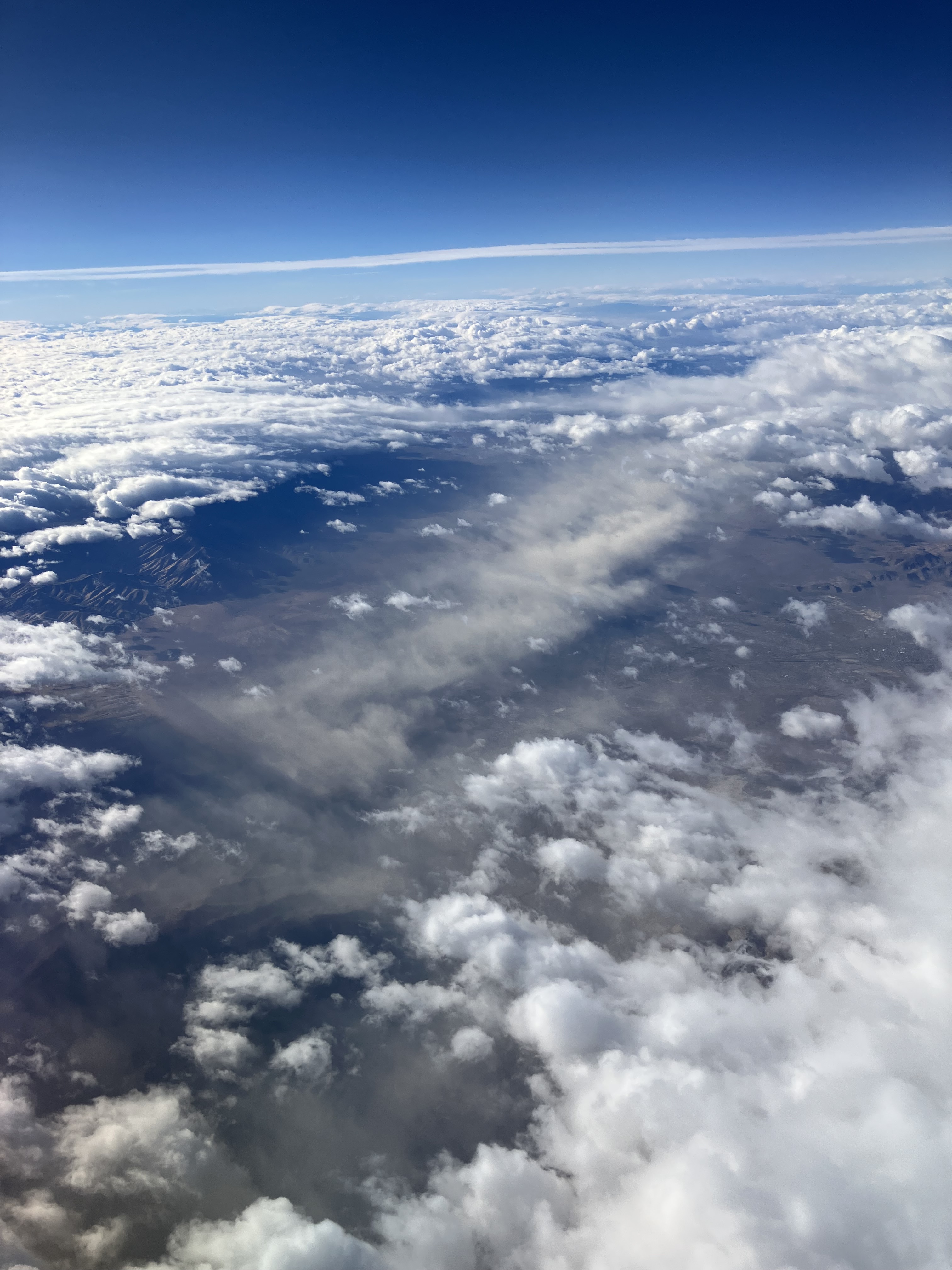
As my flight continued, passing over Western America from 40,000 feet above, I was able to witness other climate fueled changes going on across the landscape. Over Utah, The nearly dried up Great Salt Lake is caught in a polluted disaster as winds whip up the dry lake bed where countless toxic sediments await a chance to fly. When this happens, air quality plummets, and being without filtration masks or an h-vac environment will cost local residence their health and well-being. I knew my flight path would take us very near Salt Lake City, Utah. As we crossed over this vivid landscape, I began to see the dust clouds rising between the vapor clouds at low altitude. At first I thought they were wildfires, but no flames appeared below. The wind was carrying up the dust and spreading the heavy metals and corrosive chemicals left in the lake bottom after two centuries of industrial abuse and environmental neglect.
Perhaps we think, in our short lifetimes, that these catastrophic environmental collapses will not bother us directly. It’s already costing us, from insurances of all kinds, to the environmental pollution that causes so much of the health problems we face at younger and younger ages- effects not easily measured by science, due to the expansive variables involved. Half the population in The USA suffers from poor air quality. You may be living in what you think is a pristine environment, but the legacy of industrial greed and corporate extraction haunt not only the air we breath, but also the water we drink, and the food we eat- all of which remains exposed to our own polluting habits. Flying on an airplane is not helping, as I said earlier, it’s one of the worst impact I can make as an individual at this time on Earth. Where have we gone so far off the rails? In one word- population.
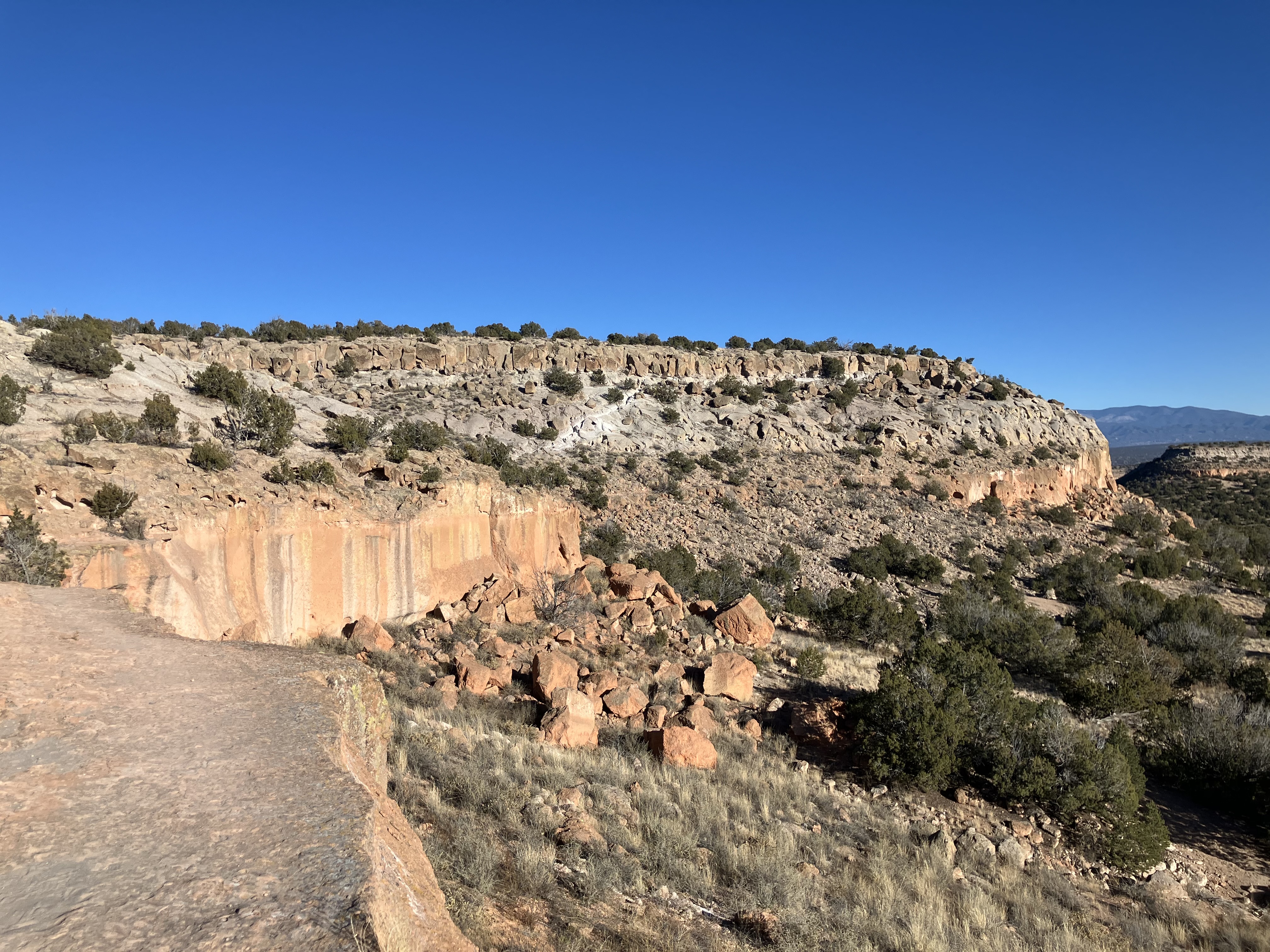
Let’s take a trip back in time, to a place in The Southwest of America where prehistoric humans thrived in a different climate, one that today may present as high desert, but was once a lush savanna with thriving populations of grazing animals and clean environmental quality. Tsankawi is a magical place I’ve written about before. As a avid outdoor enthusiast, I am draw to places where early peoples lived and thrived when the environment was conducive to such habitation. The site is an entire small mesa complex that would have had a flowing stream on the south side with canyon walls to drive herds towards easy to hunt bottle necks along the waterway. 360 views from the top of the pueblo secure the area from all direction against raiding and ambush. The stone age people who first established residency in the cliff caves would have thrived in a time of more rain, better vegetation growth, and many more animals to hunt. They would have been dabbling in early agriculture, as well as hunting and gathering throughout the region.
Life would have been mush more challenging over ten-thousand years ago, but it would have also been short and sweet. I can only imagine that during a lifetime in this stone age village, a person would have deep connection to place, the plants and animals that sustained them, and strong connection and belonging in the community to survive. How can we rekindle this connection in our own lives today? Can you cultivate anything in soil where you are? What is the source of your drinking water? Where does your food come from? Do you have a larder for emergency? What kind of birds sing near your home through the different seasons? These are only a few questions out of many we can all be asking ourselves to reconnect with the natural world, and better see our relationship to it. We may thin more about a grocery list than setting a trap for a rabbit or foraging for wild grains, but the sources of our food still come from land worked by other people to keep us fed, and those crops can and will be directly impacted by our actions day to day.
The people who established the cliff dwellings at Tsankawi eventually abandoned the area by the 16th century, about the time there was a sever drought across most of The Southwest. The exact reason for human depopulation throughout the region is still unclear, but unrest was the outcome, through many of the surrounding First Nations today claim the stone age people of Tsankawi as ancestors. The high desert now well established in New Mexico does not lend its self to massive populations, but in prehistoric times there were many more natural limitations to massive growth, from infrastructure to the variable climate and unstable early agricultural. Too many people in an area depleted wildlife through hunting and trapping, until a lack of food would force displacement. When resources became scarcer, raiding would increase, making permanent settlement vulnerable to attack. The larger a settlement, the larger the demand on the natural world, which, when left unchecked, depletes everything until famine and starvation take hold. Ecological collapse often plays a role in toppling civilization, and without food sovereignty, all populations are susceptible to this looming threat.
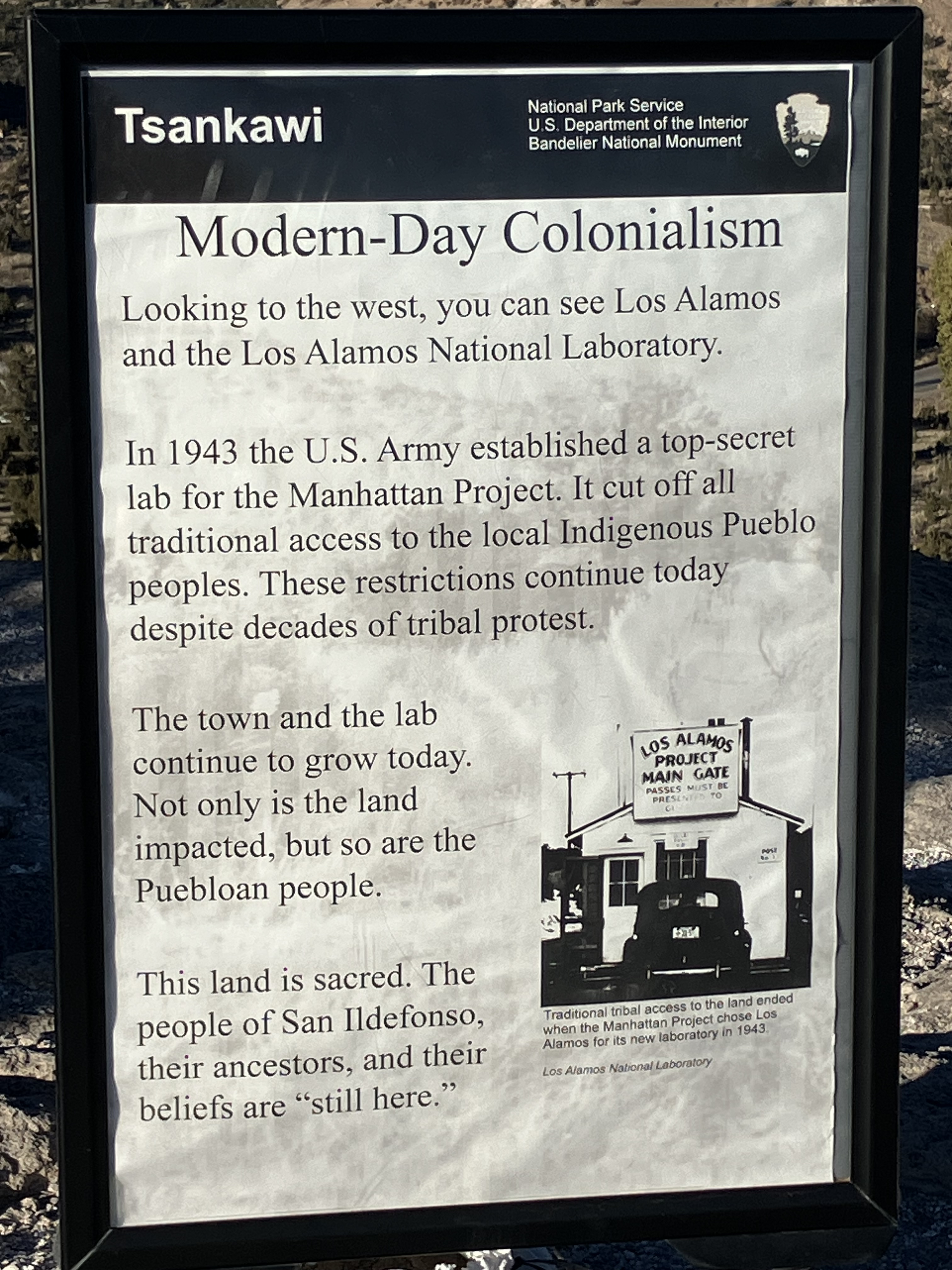
The United States has an unbelievable arsenal with weapons of mass destruction for all. Just a few miles from this site, the birth place of atomic weapons continues its quest to stay ahead in the arms race. The current indigenous nations of the area remain on reservations (pueblos), through they continue to quest for their access to sacred sites and the resources needed to remain connected to the land through hunting and gathering, as well as agriculture. They also have strong spiritual ties to this place, where ritual and traditions are still practiced. I am so grateful to know these people are still present and active in the area, and continue to voice their concerns about colonial treatment of the earth and the impact of military occupation today. Reflecting on our personal lineages and how we directly or indirectly benefit from the removal of indigenous people from their traditional homelands over the past few centuries. My ancestors came from Europe on boats through Savannah Georgia and moved west from the 1700s through the 1900s, ending up in Oklahoma, where many First Nations were sent as eastern states filled up with European immigrants after initial colonization of The East Coast.
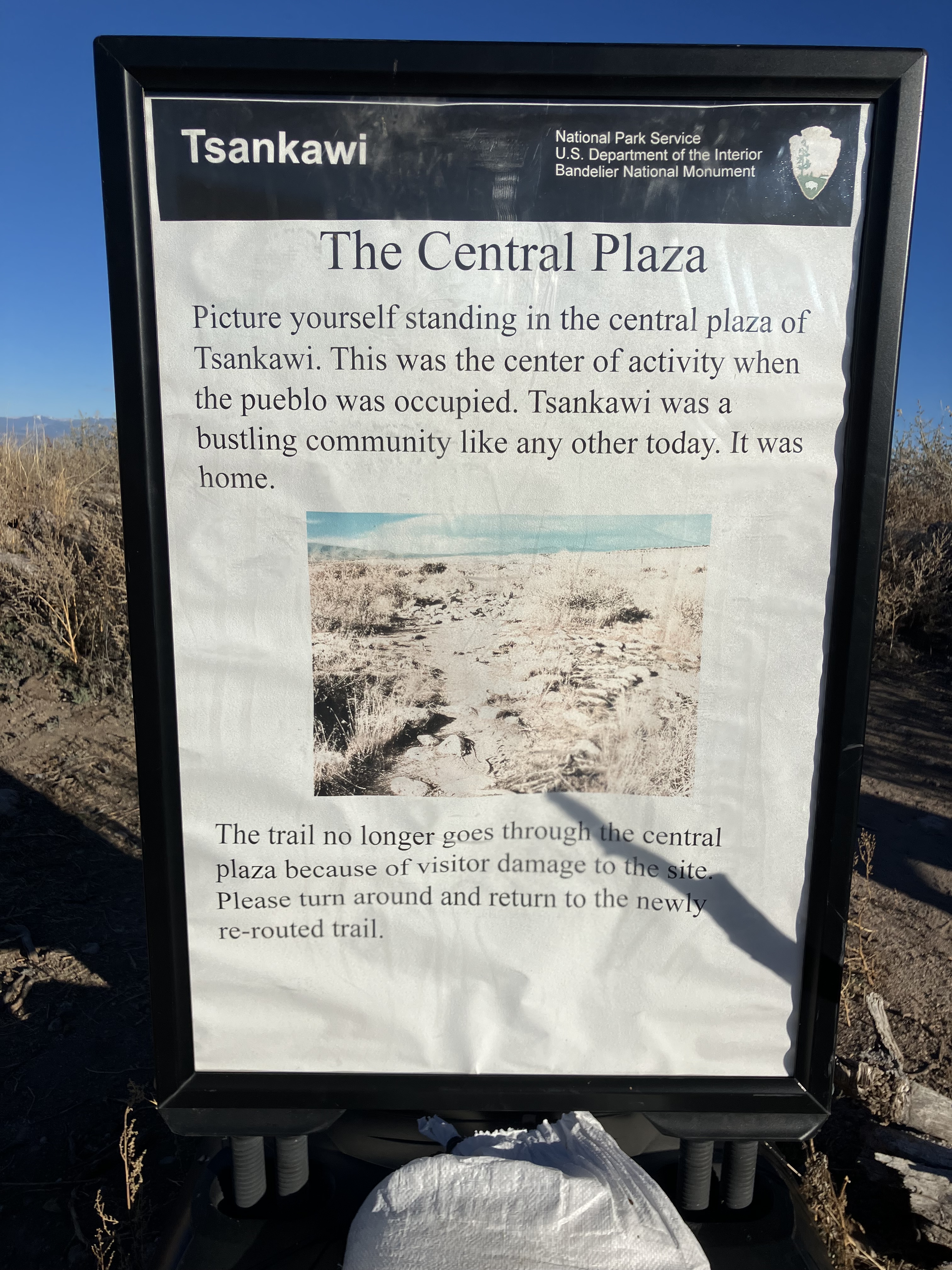
Right now I am sitting on stolen Snoqualmie Tribal lands that were carved up by timber barons in the late 1800s, along with railroad tycoons looking to cut a way through the big trees to ports along The West Coast. Legacies do matter, and our ability to name our ties to them, to see how we live in the wake of them today can be a powerful and ongoing lesson. It’s a chance to reflect, take in, and respond. My response is to stand in these sacred places to learn from the statements being erected by the original people, who are still here and willing to speak to us, to ask us to listen. They are slowly putting up their own boundaries, offering insight, and reminding visitors that the land is still part of their heritage. When I summited the cliff and stepped to the edge of what was a later pueblo structure, there was a new sign up with a clear message to go no further. Though in past visits, there were walking paths into the central plaza, now a clear direction to keep out reminded me that people are not always respectful guests.
I’ll remind us that National Parks, like Bandolier, were never discussed with the local indigenous people that once lived there. Whole villages were often removed from the wild places we call park today. Though parks do preserve important wilderness, the people that lived in deep connection with those places, were part of the wildness in them, have been taken away to offer an illusion of pristine wilderness we like to think of as untouched. Some states are working to change this assumption by teaming up with local tribes to change public understanding of parks and why they disenfranchise many indigenous people who once inhabited what are now National Parks. Tsankawi remains part of The National Park system, and visitors pay a fee to be there, but local Pueblo People also come to practice traditional ways in the area, and remain connected to their ancestral place. Where are your ancestral places?
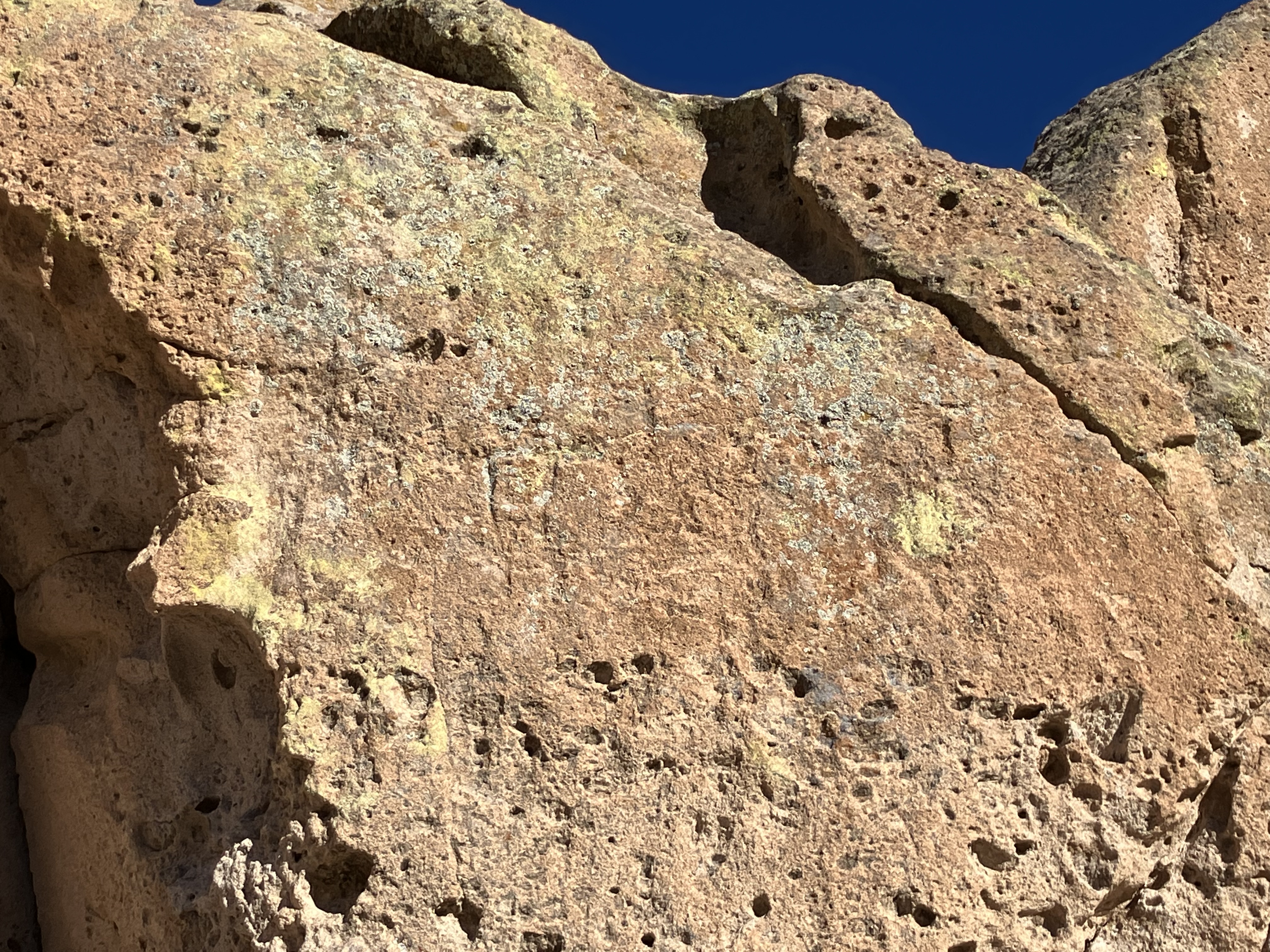
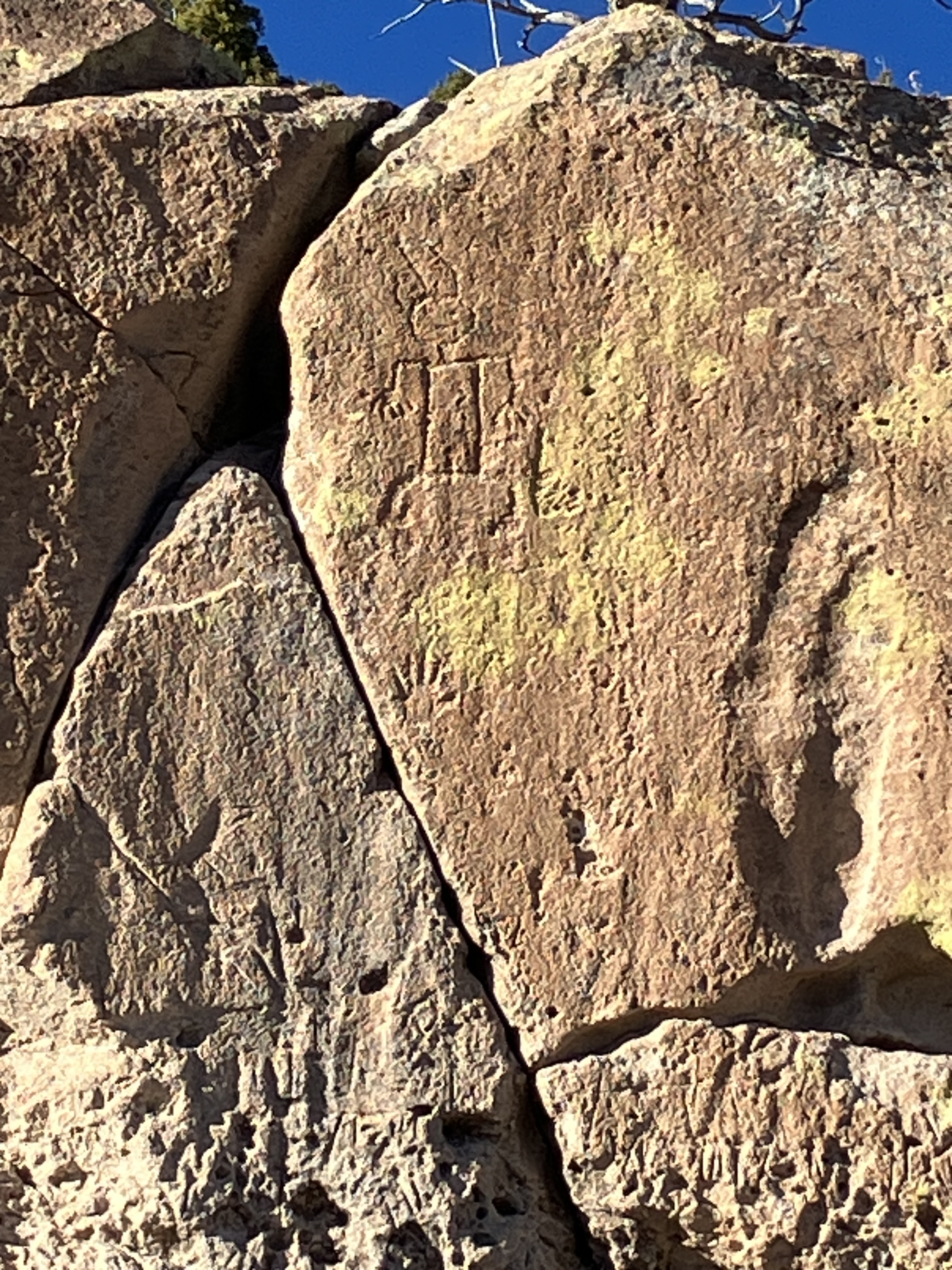
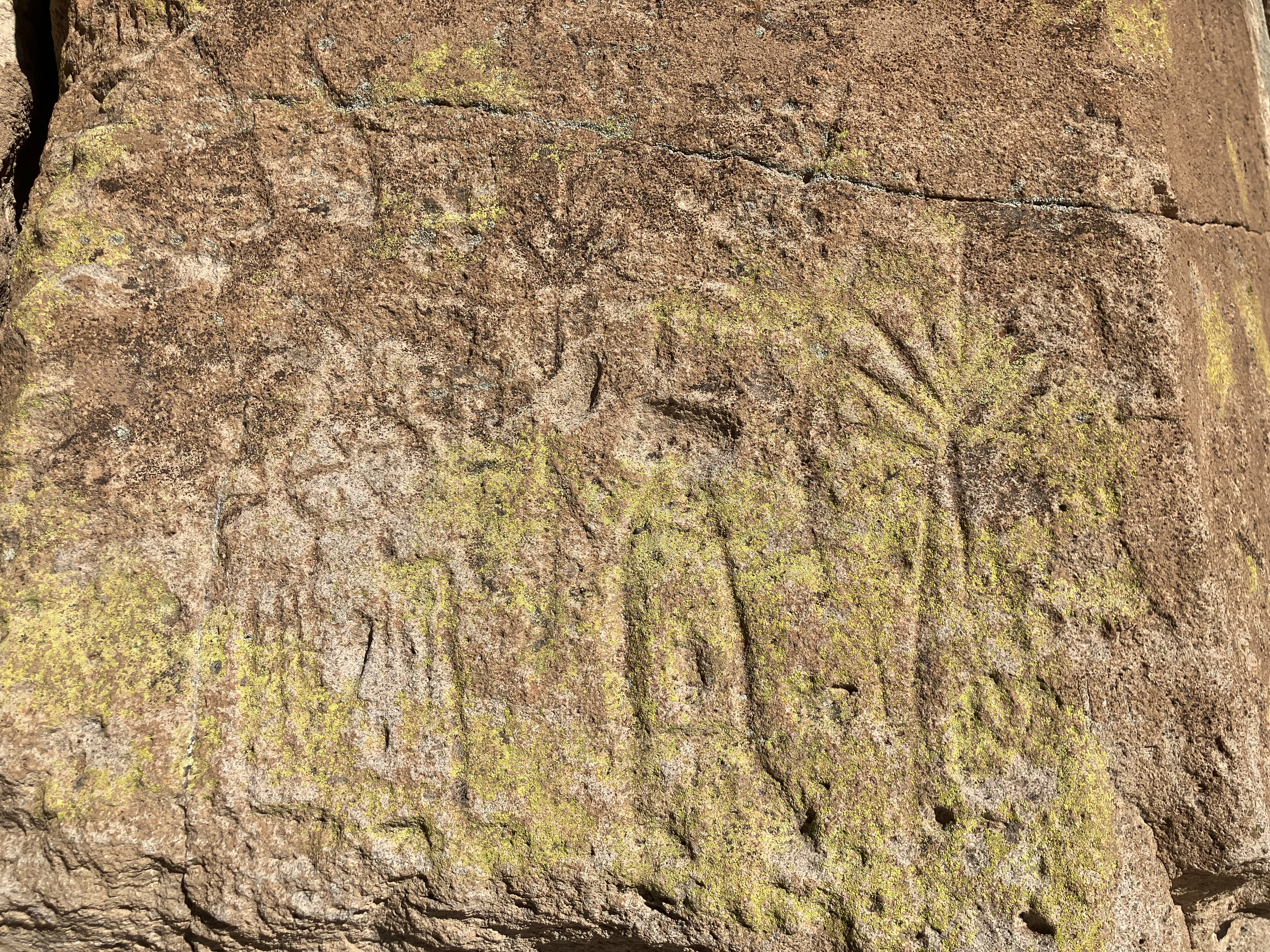
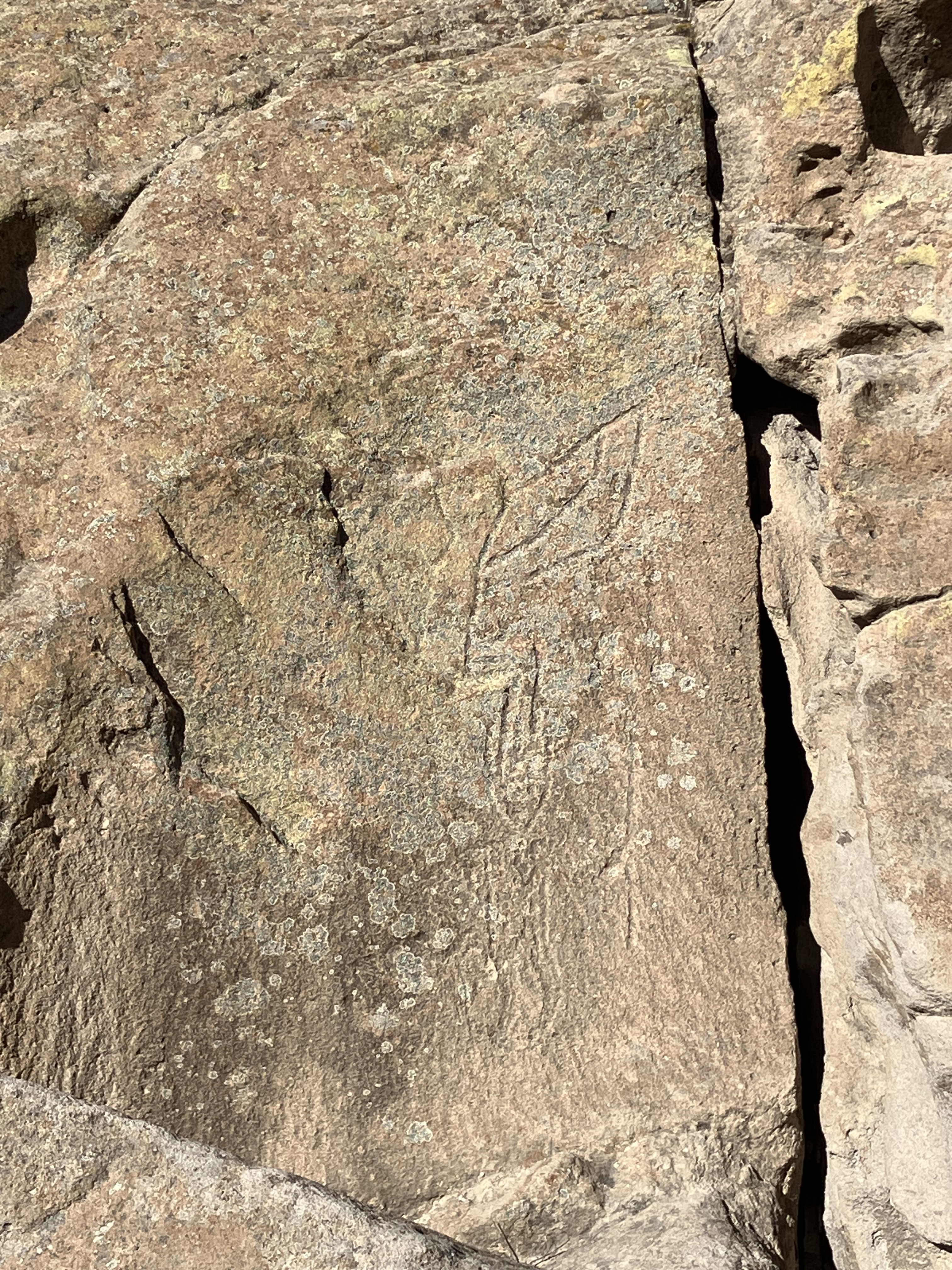
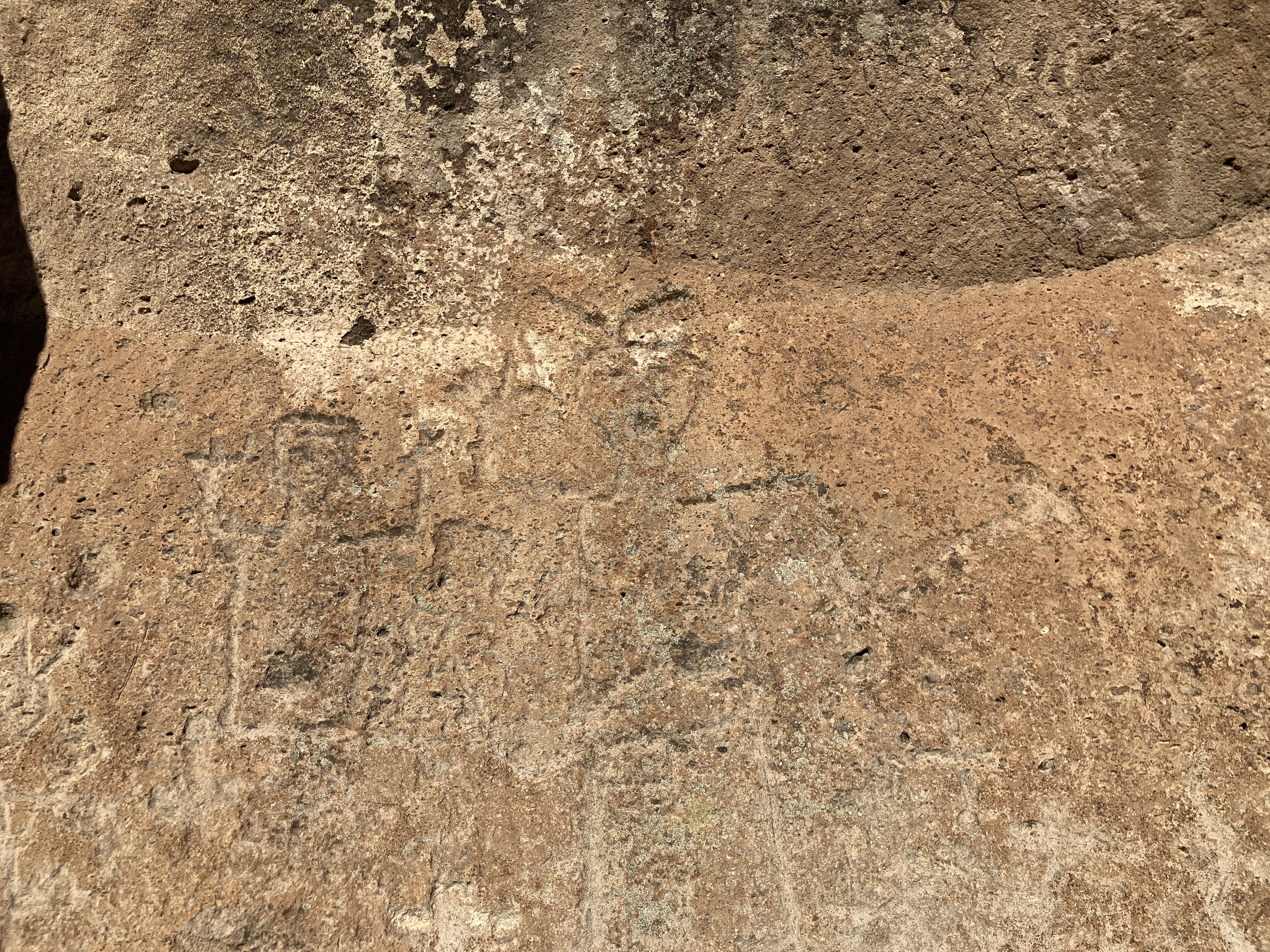
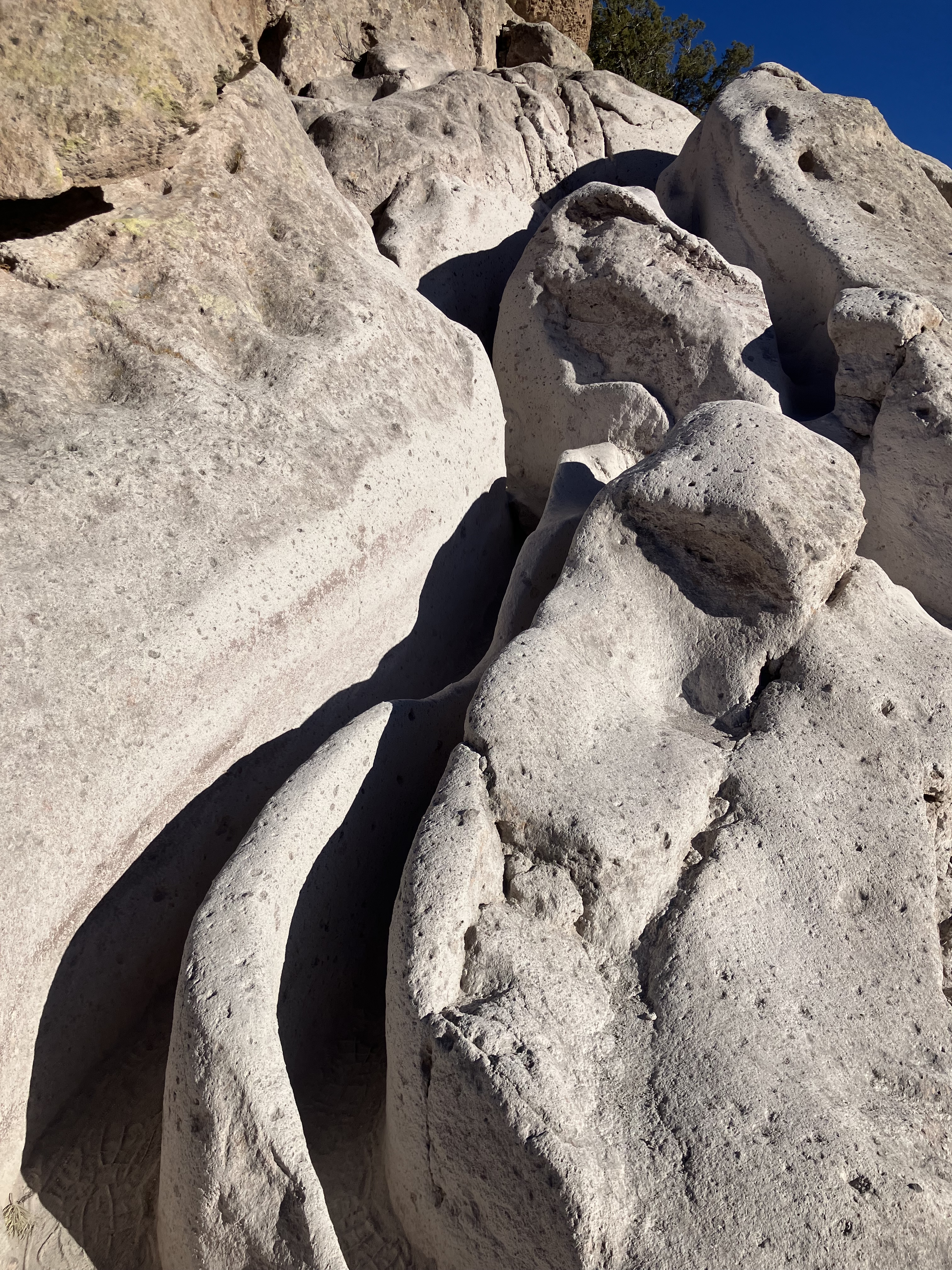
The petroglyphs are yet another reminder that ancient people lived here and were deeply connected and reliant on place for shelter, food, water, family, and community. We can all relate to these needs in our lives today, but most of us will never carve sacred symbols into the wall where we live in reverence to the space that holds us. When did you last make some lasting rock art to communicate? When did any of us last sleep in a cave? I took the opportunity to sit in one at the site, looking out across the landscape while imagining what it would be like to tend a fire there, cook some venison, and talk with friends and neighbors late into the night, sharing stories of long journeys successful hunts, and celestial navigation. When was the last time you slept under a blanket of stars? This place truly inspires me, and helps craft some personal dreams to reconnect, share, and spend more time outside with others. Though I came to the monument alone, I met others on the trail who stopped to talk and reflect on the experience in this magical place. We stood in awe, appreciating the beauty and human presence literally carved out of petrified pumice. Below is a footpath up the cliff side that has been worn down over centuries of use. There are many paths like this along the way in this loop trail, and the feeling of following those footsteps drops me right into prehistoric life thousands of years ago.
I’d flown a few thousand miles to be here, and celebrated another incredible trip to one of my favorite prehistoric sites on earth. The opportunity to be in a high desert terrain full of early human settlement and a legacy of connection to the sacred rejuvenated my own vision to place connection back in Washington. I chose to live where I am because of the abundance- water, temperate rainforest, ocean, mountains, rivers, lakes, and high desert on the other side of The Cascades if I want to dry out and find the sun again. What privilege! We can all be grateful to access- public parks, public lands, public education. Let’s try to spend more time in public, being present with place and those who share it with us.
As the flood waters receded, I returned to The Puget Sound and found it raining again. I love water, and am thankful for all its gifts, even when it seems like we’ve had too much of it. The sacred floods are a part of this land’s great history, along with massive ice sheets, monumental great floods we can’t comprehend, and a lot more to come. From strata volcanoes to some of the most active fault lines on earth, Western Washington is a heck of a place to call home, and I’m grateful for it every day, and the opportunity to share these adventures with you dear reader- thank you for your time and interest.
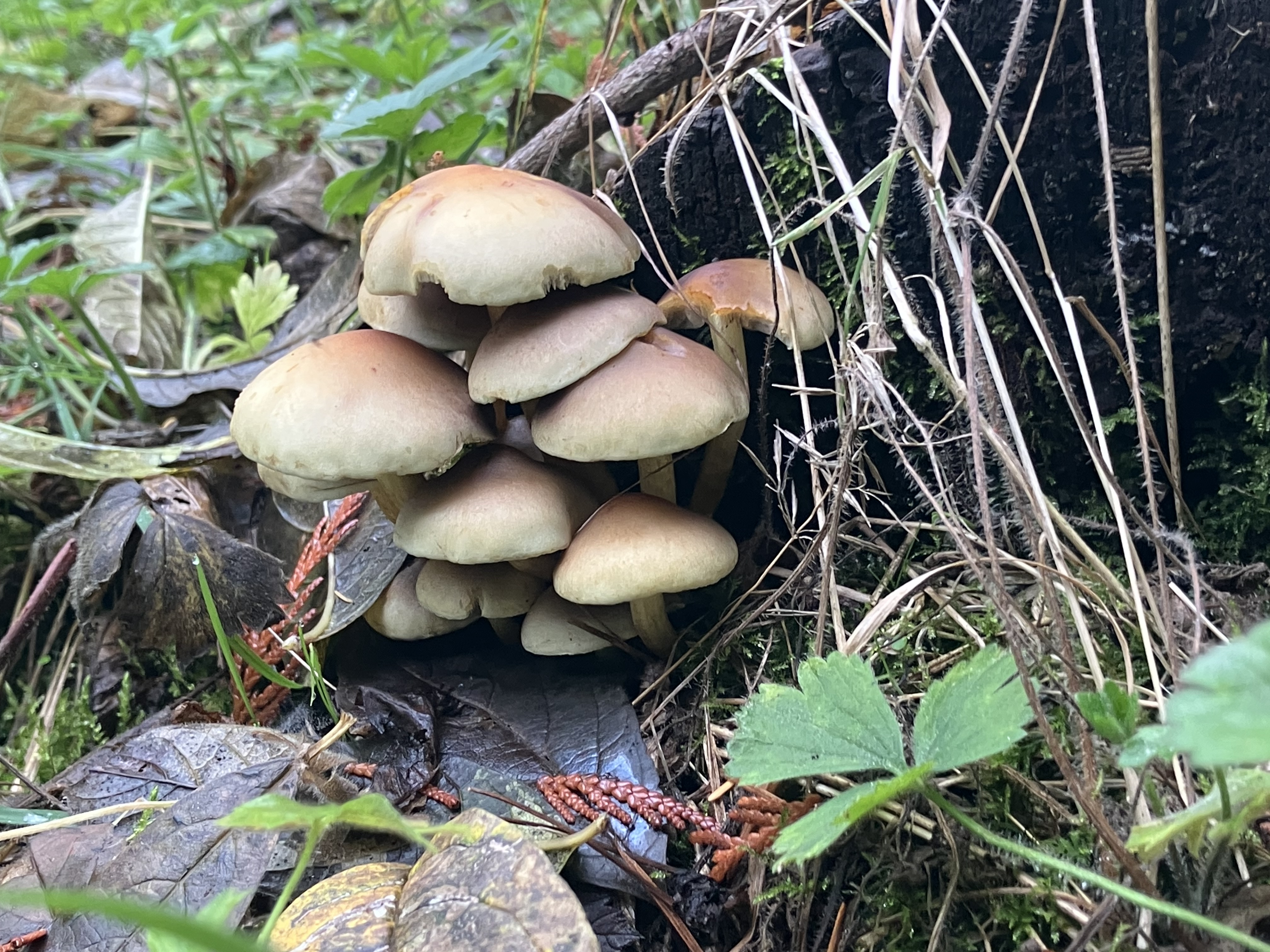
The fungi are blooming at EEC Forest Stewardship as the rains settle in and temperatures drop. These sulfur tufts or Hypholoma are common on stumps and logs in temperate climates. This particular fruiting is happening on a log that was inoculated with shiitake spores many years ago. I noted that several of these old inoculated logs were covered in Hypholoma this Fall, 2025.
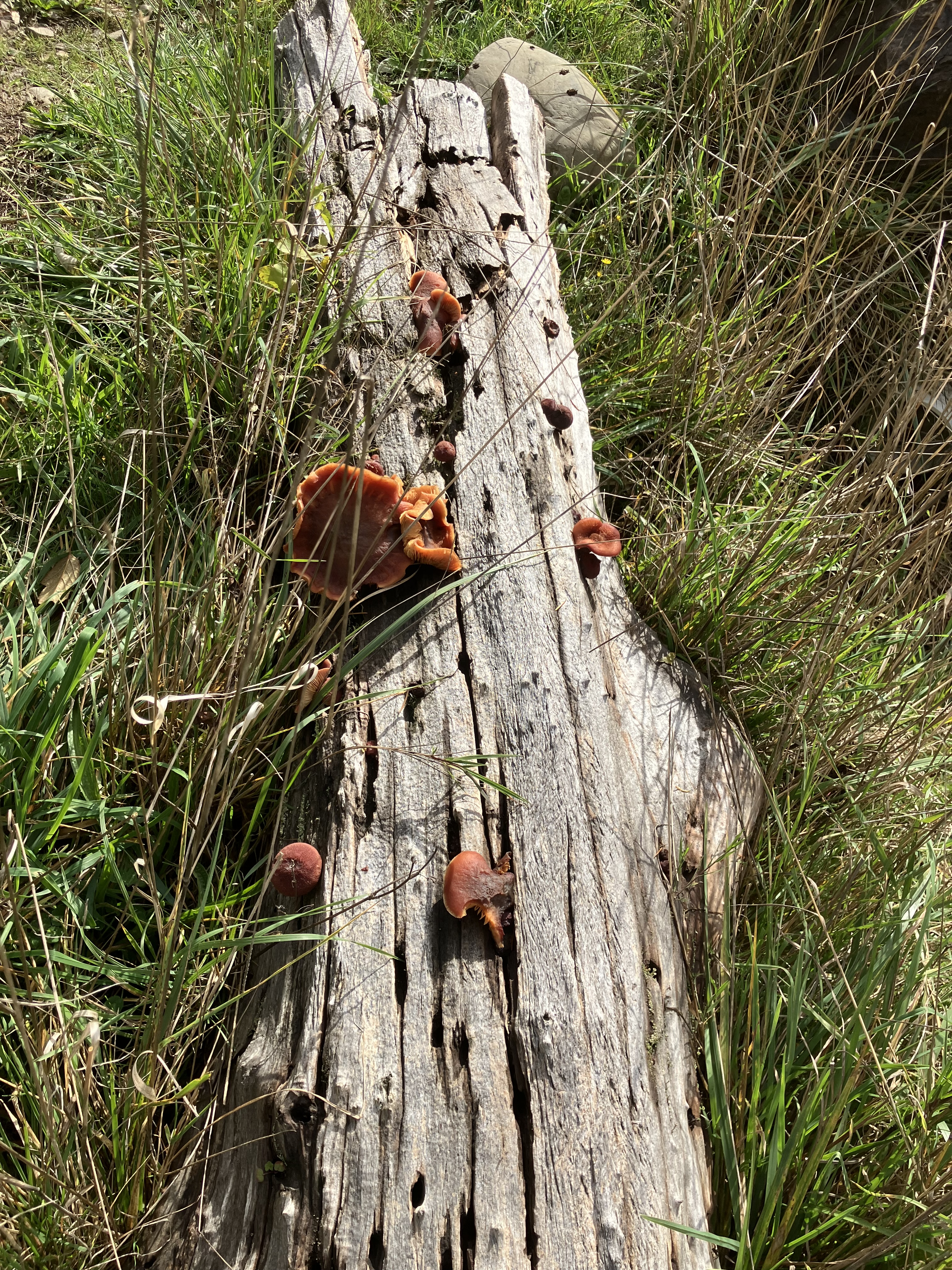
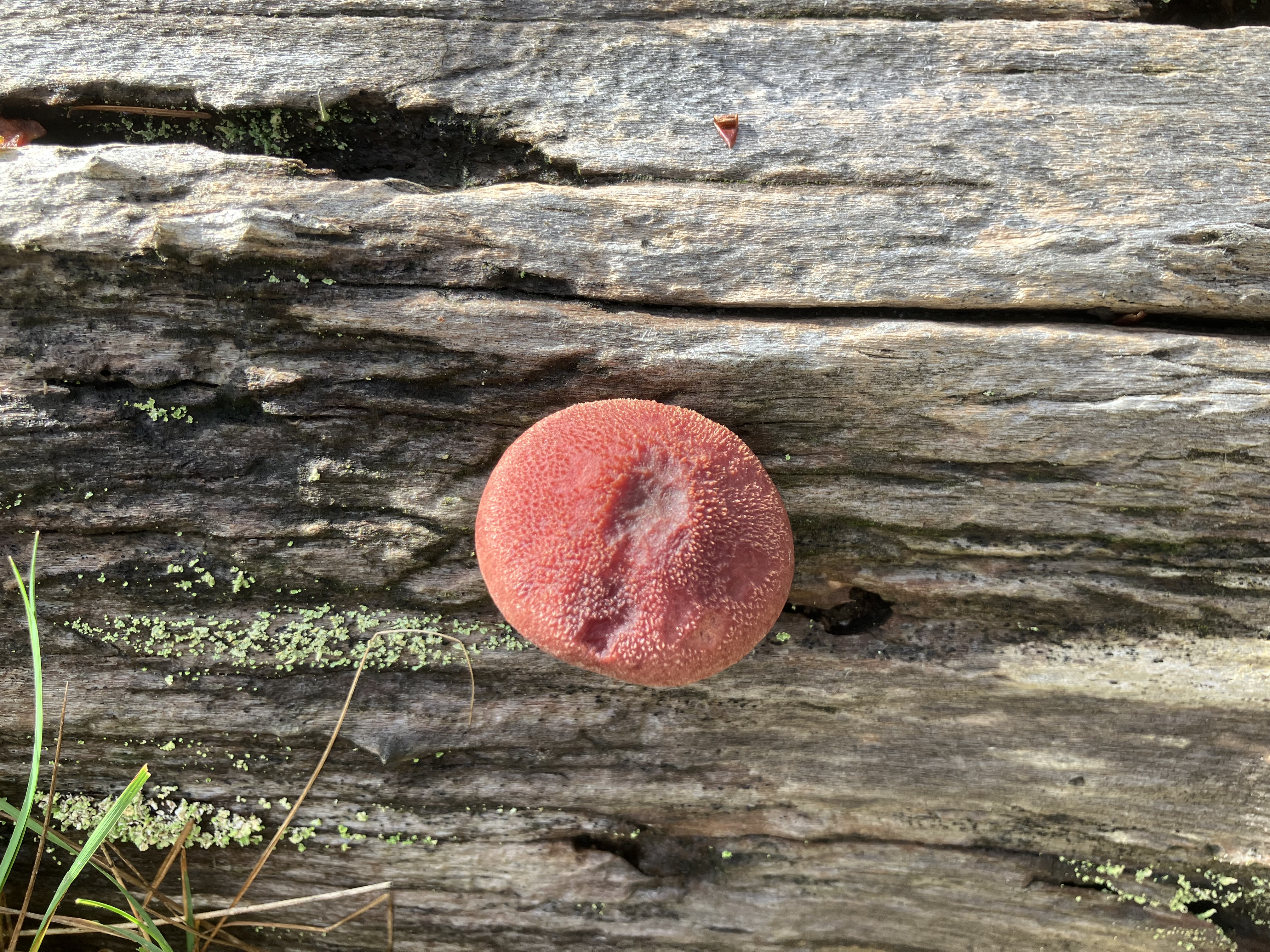
Gymnopilus or Pholiota?
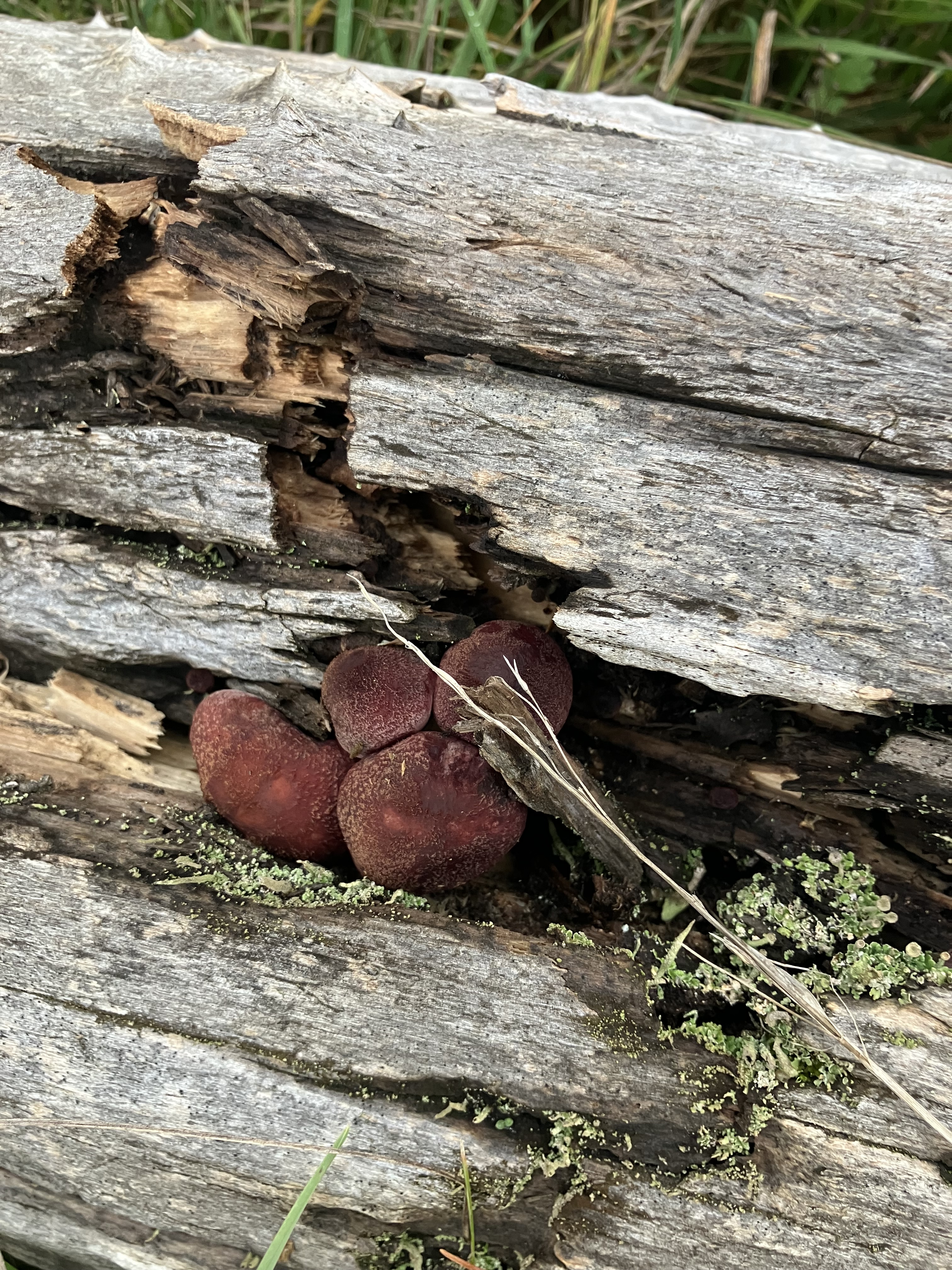
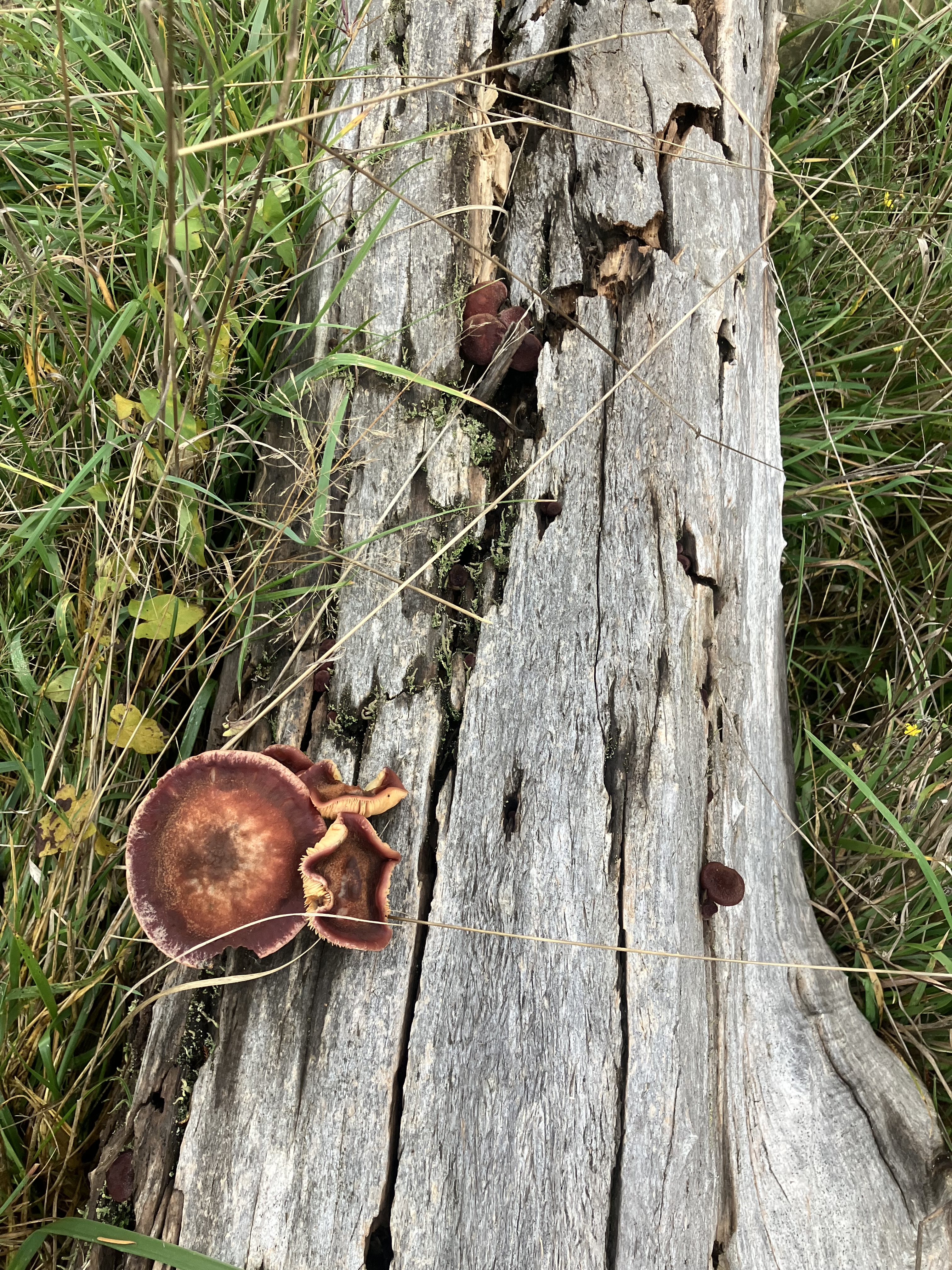
Sometimes the coolest looking shrooms pop up out of the logs around here and I really have a lot of learning to do. Mushrooming is a hobby for me, so I try to keep the quest fun by allowing my self to acknowledge that sometimes, I just don’t know what kind of mushroom I’m meeting. The bristly looking red mushroom above was giving me a little trouble. At first I thought it was a Jack-o-lantern, but then it had that texture on the cap, so I dug a little deeper into species and found several other leads. By now, I figured the only way to really know was spore prints and a microscope, so I took a step back and continue my wonder. I used to do a lot more spore analysis, but have put the hobby part of this adventure front and center, thus allowing some limitations in this field of knowing. Mushroom knowledge is changing every day as we do more DNA gene sequencing and spend more time in the field getting specimens to study- and that’s the job of mycologists. Yay science!
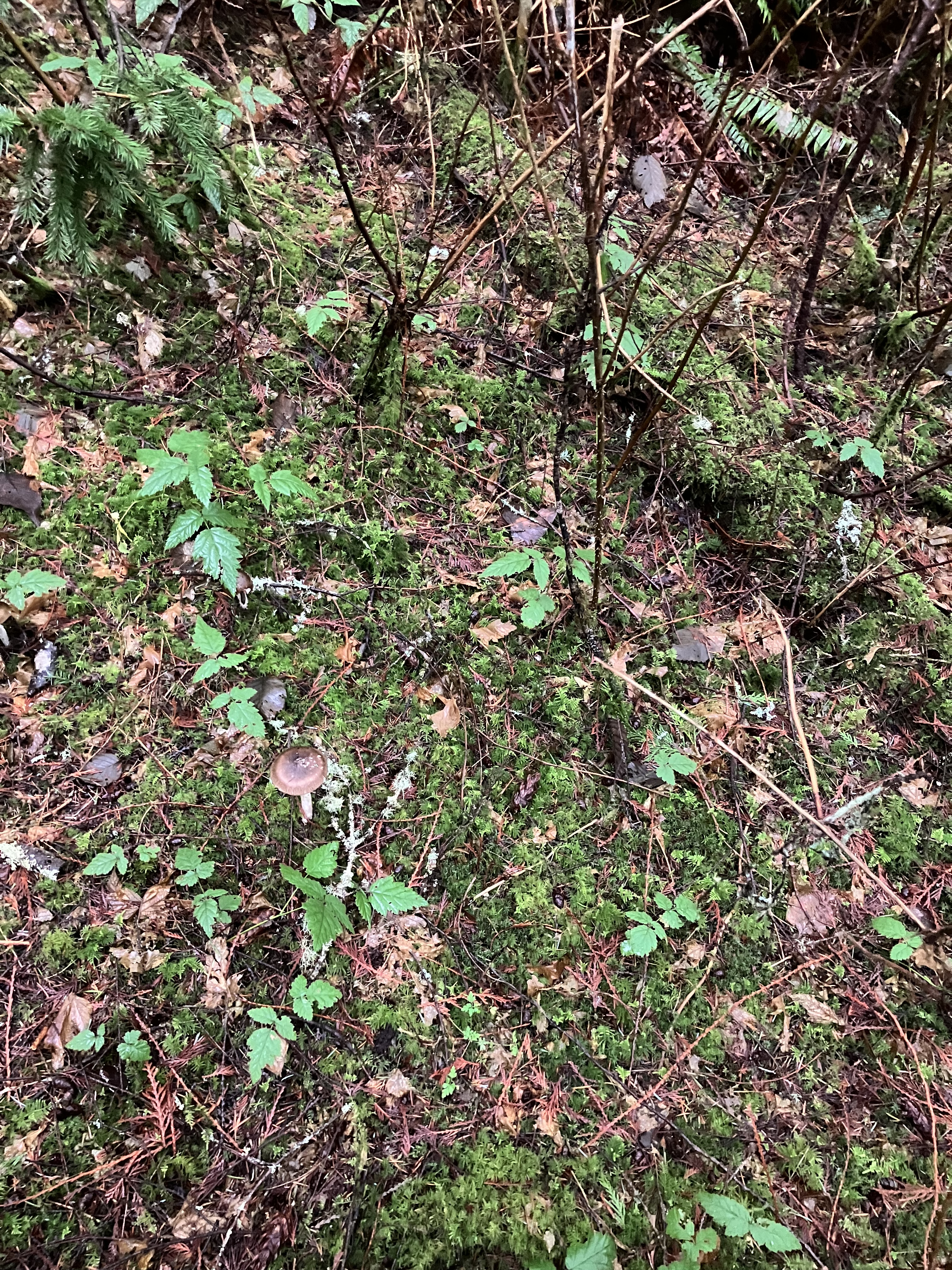
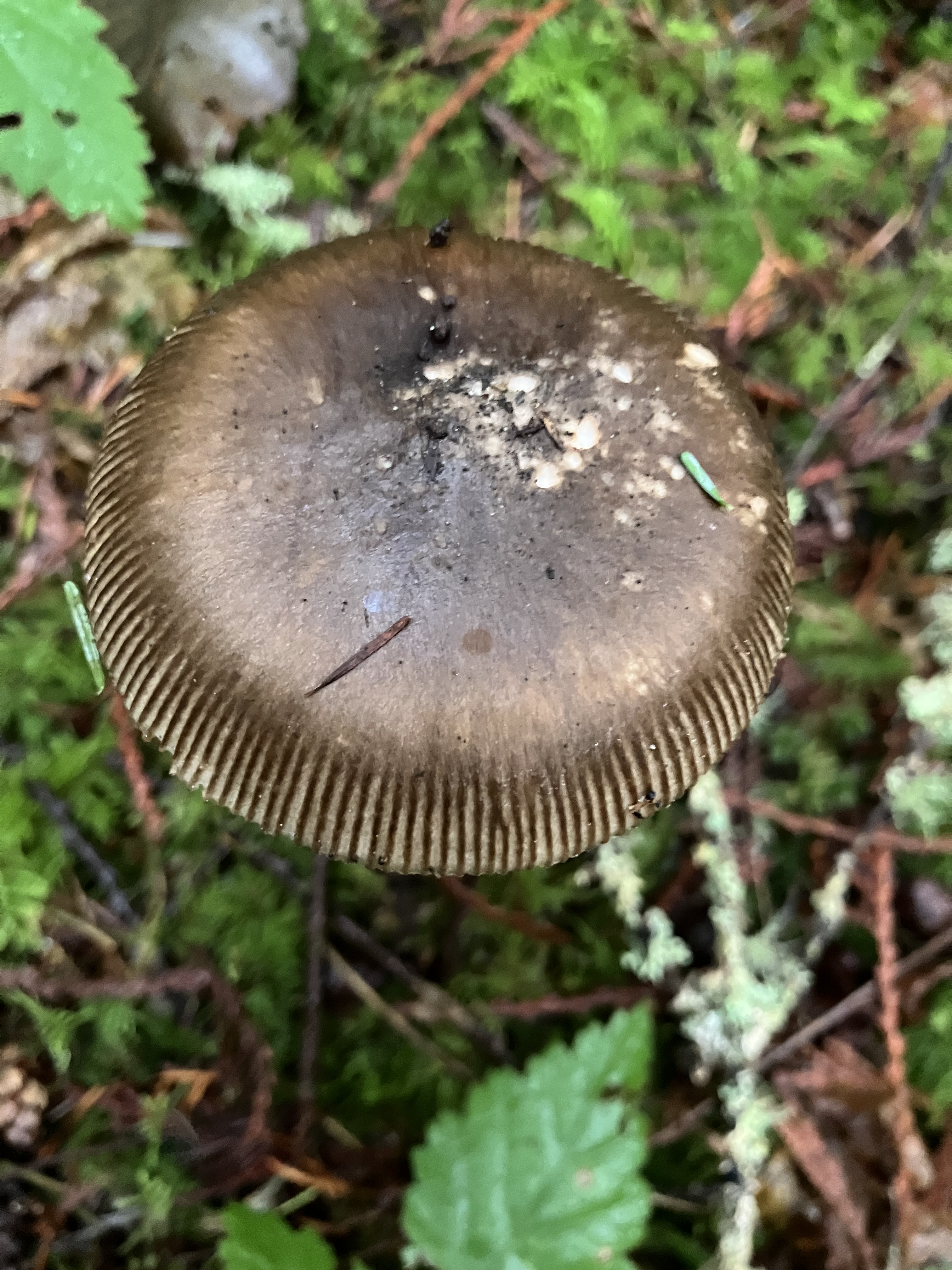
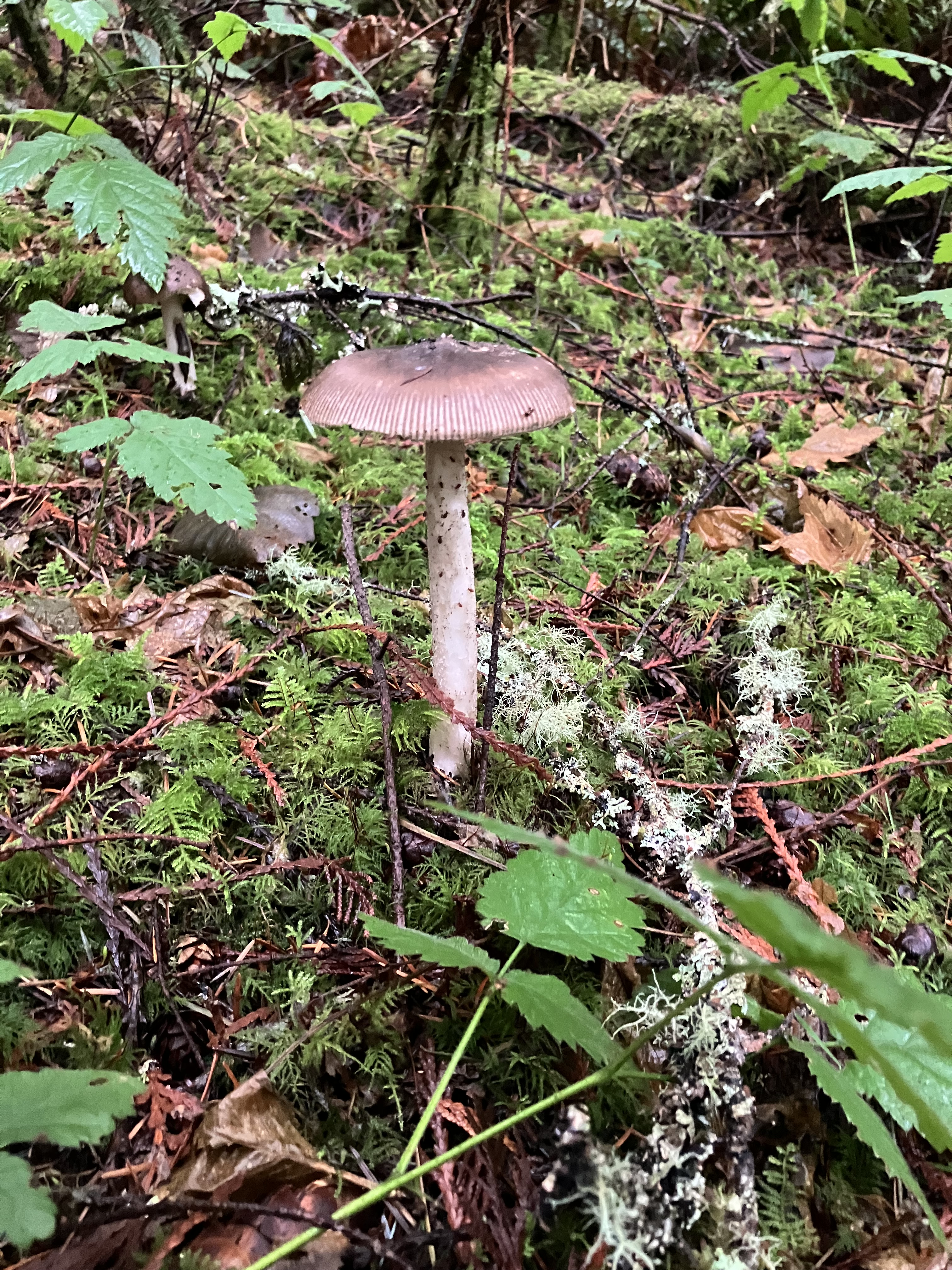
When I’m walking around in the landscape at EEC Forest Stewardship, I do try to capture images of fruiting mushrooms for a land journal of species I keep for personal record, but getting the exact ID on each bloom I encounter is not the object of my observations, just seeing them their and recording presence can be enough. This brown mushroom could be easily missed in the first photo far left, but it’s size caught my eye, and the unique ring of texture around the cap.
The stipe was too tall and thin for a russula, and that ribbed pattern around the cap was fascinating. Also- the color of this mushroom seemed to change with the light- as you can see, the shot from more directly above shows a more yellow/brown cap, where the shot from the side, far right, is almost mahogany. Still, as I looked on at the stipe (stem) of the mushroom, I kept getting Agaricus vibes. Later at home, as I began crafting this blog and sitting down with my computer, I began my typical online search using PNW Pictorial Key for Mushrooms. It’s worth sitting down with this guide when you have a chance. I’ve found most of the species I’m looking for when I really take the time. It took me scrolling through each gilled mushroom family until I got to Amanitaceae. This is a large branch of the mushroom community, which includes A. Vaginatae, known for having “grisettes”, that patterning on the edge of the cap. That name also refers to a cheap gray wool fabric, in 17th century France, that was worn by working class women. I then went on a journey through the life of a Grisette, and thank the mushroom world for this history lesson. Check out Madam du Barry to find out more.
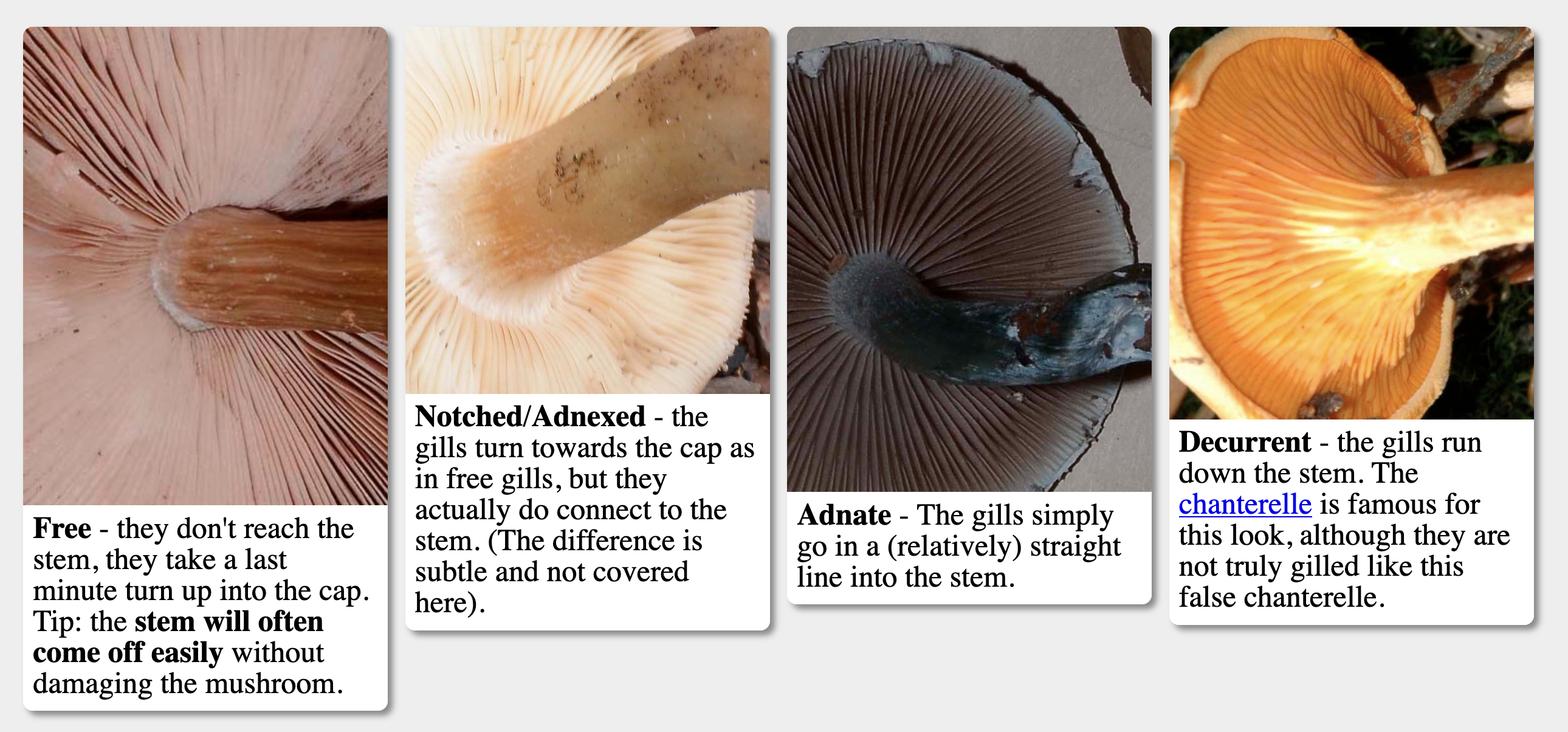
So, mushrooms of EEC Forest Stewardship- I love tangents! I’ll also not soon forget grisette, or this pattern on a mushroom. This could be an edible type of fungus, but because it can also resemble toxic varieties, I leave it alone. Remember- a brave mushroomer is a dead one This is an old adage I deeply appreciate, and repeat often. This healthy fear of what could also be is important when deciding to harvest and eat a mushroom, and I would advise against it, unless you are with a mycologist who can confirm with absolute certainty. Know that the kind of certainty you might want could involve a microscope and some sharp eyes, not easy testing in the field. Pictures are your best bet for ID, but even I often fail to get all the angles needed to confirm physical traits- in this case, no picture of the underside of the cap for gill confirmation. The details of physical characteristics in the attachment of gill to stem matters.
This is another direct reference from the PNW Pictorial Key. Please picture all sides of a mushroom for better identification, and even through I don’t do many spore prints now, I recommend trying it a few times to get a little dirt time in knowing how. Note the last mushroom example above- the false chantrelle. As noted, the true chantrelle is not gilled. Veined mushrooms are easy to spot once you know the difference, until you find toothed fungus, jellies, slime molds, puffballs, and a list of diverse shaped, consistencies, and colors that boggles the mind. They grow in almost any conditions, but are most prolific in woodlands, where carbon dense branches and logs need help decomposing back into the soil to promote rich growth and abundance in vegetation, cultivating rich habitat for all life. Mycology is the system of redistribution of resources through a network of root like structures binding soil and plant in a superhighway of nutrient corridors for consumption and production we humans have a hard time fully understanding, but could appreciate if we sat with our living surroundings more. Wake up!
The
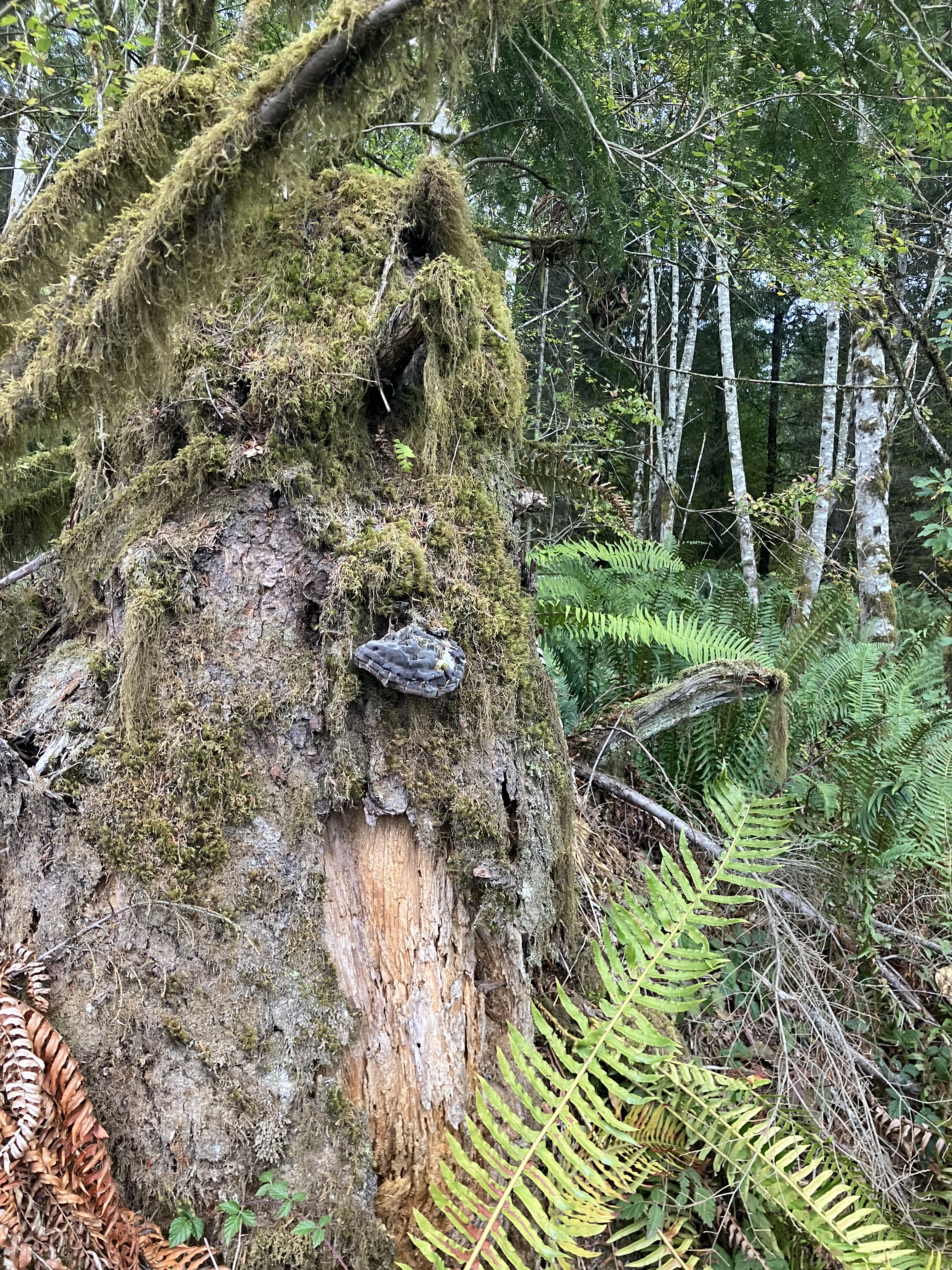
Polypores are crucial wood decomposers in an ever growing temperate rainforest. Most of the elder trees have been cut, especially in the landscape that includes EEC. The Weyerhaeuser Company, a European Colonial Legacy of extraction industry, built, literally, on the timber feet of old growth canopy that had not been present in Europe since Roman Occupation. A legacy of ecological genocide continues today throughout The Americas, but mushrooms never stop trying, following their own original instructions to help transform through decomposition. On an old growth stump, lasting reminder of the tremendous forest that once stood, this Sitka Spruce elder hosts a bracket fungus of some kind. It could be a red belted conk. Age is making the ID of this fungus among us difficult, but it’s a legacy of decomposition vital to forest health. In an old growth temperate rainforest, their are countless kinds of mushrooms, which reflects the complexity of mature forests. We humans cannot recreate these systems with all our fancy tech and scientific studies- through we are starting to get an inkling of all the layers involved.
For monoculture tree plantations, fungal invasion is a constant battle. Some mushrooms do kill trees, but usually only when a tree is already compromised in some way. When I read about laminated root rot taking out whole forest groves, I wonder why there is surprise at this when all the trees have the same genetic makeup. That same GMO technology can also develop resistant strains, but with monoculture, there is always a lack of genetic diversity for future health in a forest. As long as we continue to choose profit and industrial production, we’re hurting our ecological survival as a species. Don’t be fooled by green wash, your product placement ads often have promises of planting trees (in a plantation where they will be cut), or “sustainably harvested” (after the rainforest was cut and cleared to plant the palm oil trees). In short, if it’s mass produced, it’s hurting out environment; from food to clothing, furniture, and electronics, everything made today for our addictive consumer culture huts us by destroying the very environment we rely on to survive as a species. Please don’t buy in!
Mycology can help us see the rebound in the environment, and tell us what’s out of balance too. Mushrooms are actively trying to decompose all kinds of matter in the environment, from toxic fuel spills to harmful pathogens, mycology is on the job 24/7 to keep the soil healthy, as well as send vital nutrients across the environment to aid plants in need. These often overlooked, and certainly underappreciated fungal friends are important players in the health of global ecology, so next time you see a mushroom, say hello, and take some time to get to know the fungus among us doing it’s job to clean up and enhance habitat for all.
EEC Forest Stewardship restores land damaged by colonial farming legacy, clearing the land for production. This practice has a dramatic cost that is still overlooked as we continue to clear and develop for profit across the earth. Leafhopper Farm uses livestock to reintroduce animal numbers that would have been thriving on this landscape before European hunting and trapping for market consumption, along with apocalyptic habitat removal eradicated most flora and fauna in less than one hundred years. As a white, European colonial descendant- aka, my ancestors came to this continent from Europe starting in the 1700s through to the 1800s through indentured servitude, tenant farming, sharecropping, railroads, and military service. All these opportunists were spurred by land grabs from Natives, tycoon greed, dehumanization of First Nation Peoples, over-consumption of finite resources, religious despotism, and hubris of the worst kind.
Our Nation is still living off the stepping stones of our ancestral legacy built on the backs of others- mostly folks brought in as slaves, servants, and laborers. Numbers of poor grow, while wealth consolidates into the hands of a few. What does this have to do with food? I know, I like to go down the “hard to sit with” presence we find ourselves living in, but it’s crucial to understanding how we can make affective change in our own lives to shift away from the present trends and habits that have brought so much destruction to the very environment we can’t live without. The sheep, chickens, and geese play important roles filling in some of the missing pieces on the landscape to restore the fertility to the land. Without returning our landscapes to what they once were- or at least moving back in that direction, we’ll be more deeply impacted by exponential change happening in our environment, due to careless handling by those who came before.
The best thing we can do is consume less. At EEC, the livestock eats mostly off the land where they roam daily. In winter, the sheep go into the barn for lambing and to let the wet soils remain intact. Hooves on muddy slopes cause erosion. If the old growth rainforest was still present, along with the apex predators like wolves, elk herds would be pushed around the foothills, moving them up into the foothills, and back down across the floodplains, as they do in Yellowstone today. There are natural balances we humans care little about in our day to day lives. We embraced the artificial, because of modern convenience, but it’s not making us better beings on this planet. We don’t need religious guilt to keep us regulated on some moral high ground, we need mother nature to give us a slap in the face so we wake up. She’s doing that, with weather, which will fundamentally shift, along with our ocean currents, icecaps melting, sea-level rise, and all the extreme meteorology that comes with it.
Yes, you’ve heard all this before, I’m sure, but have you shifted any of your own habits to affirm this truth? Any less online purchasing? Any less screen time? What about consuming food in season? Would that help? Yes– a lot. At EEC, the seasons dictate what we have in stock, what we’re preserving for later, and when our bodies need these different nutrients throughout the year. There are also economic reasons eating seasonally is best. We just fall out of these good habits because of all the convenient bad ones. They are bad- bad for our health, bad for our environment, and ultimately, contributing to our collective destruction. Since we’re all so overwhelmed by life now, it seems not to matter. We’re all just trying to get by. No, we’re conditioned, and it’s not going to stop unless we put down our screens and get outside.
If you’re looking for a little inspiration, especially with The Holidays of Winter well in play, take an historical journey with Ruth Goodman into Tudor culinary arts. Not all our ancestors ate was pottage- but a lot of it was- especially the majority of the population, which was poor. Perhaps a little time thinking about simple food and why it’s still a winner today for health and ease of making. Especially in Winter, when, here at the farm, I’m pulling stock out of the freezer, or from a glass jar where the flavor and nutrition have been sealed away for several months. We’re far from the caliber of peak freshness, but still fed by delight of taste. Roasts and stew grace the table, along with bottled fruit wine, pies, and jams offer sweetness through the cold, wet, dark months. I’m picking some green lettuce and borage from the garden, but when the next heavy frost comes, root veggies become a staple. This year, I’ll be harvesting some sunchokes for the table.
For the feasting days, I’m plucking four geese for the larder. If our wild waterfowl were not devastated by bird flu and habitat loss, I’d be able to hunt them too, but better to raise my own birds now, and a few older hens and young roosters are going to the freezer soon. It’s past the main slaughter season, but I’ve still got a few animals to pluck for a bountiful fresh harvest through the winter. Our Western Washington mild winters afford a little more flexibility in harvest- from animals to vegetables. I even harvested chantrelles in early December, and hope to grab a few more in this week of warm deluge we’re expecting. Our plentiful waters also carry a bounty of aquatic life that’s harvestable year round. From shellfish and seaweeds on the coast, to trout and perch inland, the fresh eating continues. Restoring our salmon stream at EEC is a key give back to habitat, with our wildlife corridor, native replanting of forest and understory, and water quality protection with agricultural setbacks well beyond minimum requirements in an active CREP program to help restore priceless salmon habitat.
The vision is tightly woven together, with more pattern and material to come. Adding more layers makes for a stronger basket, and our environment needs as much as it can get. Is there a way to consolidate your own habits to better accommodate the natural world in some way? “Reduce, reuse, recycle” was something I grew up hearing, and my Mom knows “mend and make due” form her Mother. My Grandmother grew up during The Dust Bowl in Oklahoma, and experienced rationing during World War Two. These mindsets are missing today, and most of us don’t choose to remember past struggles. Our history shapes who we are and what we do now. I’ve watched modern industrial agriculture with chemical companies after WWII poison the land, water, and people of this country, and the world, and I want that to stop. My idealism led to cultivating food without chemicals, though a small amount by comparison to what’s needed to support consumer addiction today. I still go to the store on a monthly basis, and I buy out of season sometimes, but I’ve found that by learning what it in season, I am less likely to look for what’s out. If you could stop buy tomatoes in winter, that would be a huge first step. Here’s a site with some helpful swap suggestions.
Endemic food plants in our region is another key way to get the best food and support native plants in making a comeback. At EEC, we’re planting cultivated adaptable fruit tree varieties that can make way for native species over time. Our back field grove of chestnuts will shelter the future oak and evergreen forest plantings that will allow us to step back, returning the habitat to native forest in time. I’ll be spending the rest of my life learning about the native plants of this region, how to grow them, what amazing gifts they offer in food, medicine, and materials as I adapt my life to what’s growing around me. For those of you living in more developed cities and apartments, you can make your home a habitat for houseplants of all kinds- including tropical exotics. Use your environment to your advantage. Here’s another great- though extreme inspiration for sustainable urban living. If you have time to watch a streaming service, you can take a few minutes to explore fresh ideas to change old consumer habits that do more harm than good.
As we head towards the end of another year, take some time to reflect on what you’re buying power means to the world around you. Since we’re living in a cash economy, what can you do to save more by reducing your purchasing, reusing what you have, and perhaps, recognizing something you’ve been buying out of habit, rather than need. I’ve recently caught myself reaching for packaged hard-wear instead of the loose stuff in the bins at the hardware store. By taking just a few extra seconds to pluck each individual eye hook, instead of buying all that extra packaging, helps me reduce plastic in the world. It also encourages the store to keep stocking loose items instead of embracing more packaging. I’m also going to the store- and hitting many stops in one go when I shop. It ends up being far less driving than the delivery trucks that are now coming through the neighborhoods several times a day to get those packages to your door same day. Online ordering is not good for our planet.
Back at the farm, we invested in a large solar bank for energy consumption, and continue to let nature take her course in our production of food. We share our bounty with friends and neighbors, and sell enough to pay for any extra inputs- like alfalfa and scratch and peck for the hens. The future of this landscape is looking lush and abundant, with systems to save water, sunshine, and fertility for the future generations of all life on earth. How can you make a difference today? What buy power can you flex to help support restoration in your life and your local community? Small steps count, like sharing a ride, planning less trips out in your car, or canceling some of your online orders. Reach for local, learn what’s growing nearby, take a walk in your local park, and look up at the sky. Slow change is OK, mother nature takes millions of years in adaptation to hone her own systems, we only have this finite life to make ours, but it’s still an impact that will be felt for centuries to come.
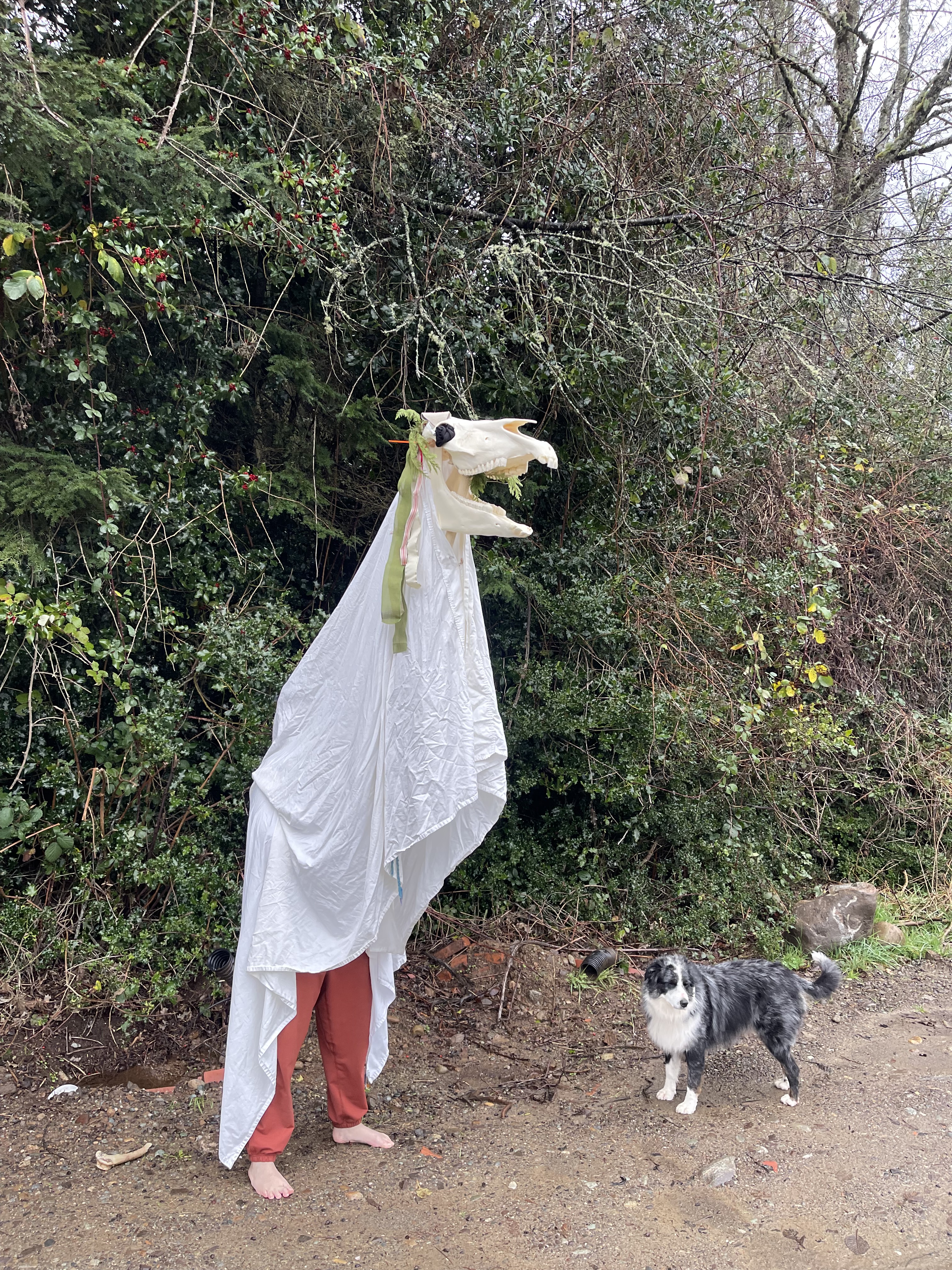
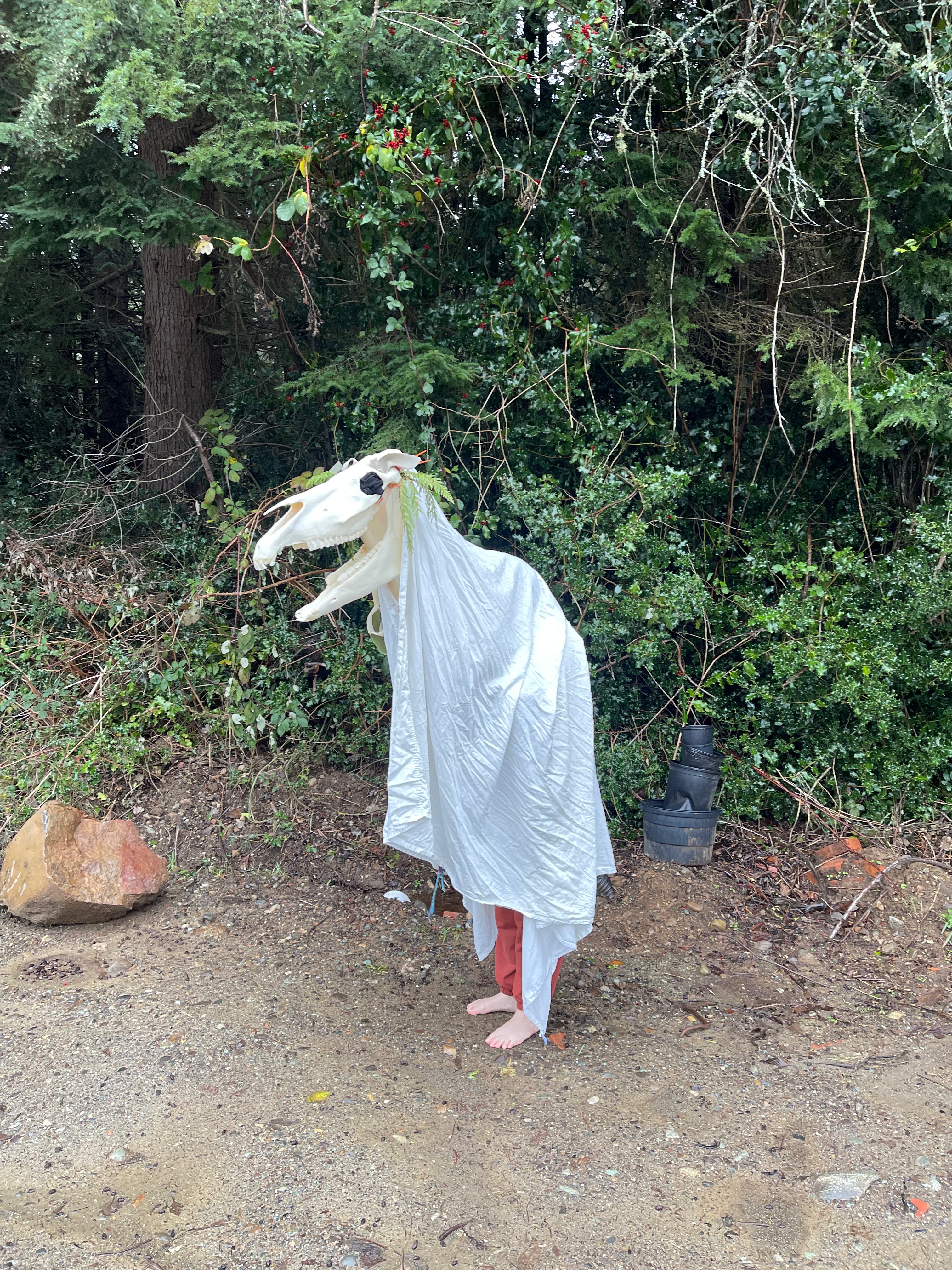
Mari Lwyd came for a visit to celebrate the shortest day of the year! This Welsh tradition is picking up in popularity among the more “old time religion” folks like me- pagan drawn. The darkest time of year calls for festivities and light, singing, and a cup of good cheer. Blackberry wine bottled and corked for friends and family in Fall, comes out of storage and into glasses for all. Songs of holly and ivy, pushing back darkness with candle light, and joyful voices raised together in celebration of the returning light ring through the air. There is also a feeling of stillness in the forest, dripping rain taps out a rhythm of dormancy, yet buds begin to swell on branches all around. Hints of Spring stir through rippling currents as puddles drain down the hillside and into a melodious creek.
Weiss Creek in mid-December, 2025
The gray mare of winter stalks along from house to house, imagery that invokes starvation, while also heralding in tides of joy and wassailing through neighborhoods and village taverns. The Mari Lwyd comes with a troop of melodies and versus, poetry of playful wit and sharp rebuke if no spirit of generosity shines. Winter signals a shift from the labors of harvest and preservation, to the lean times of quiet reflection and hope for survival, and the sun’s warm return. I find this seasonal shift to be a good space for gratitude, community connection, and inside revelry. Board games are played, puzzles are solved, and a few days of feasting help tide us through dark cold months ahead. If only we could fully hibernate, shutting down our senses and sleeping through to next Spring. Still, in Western Washington, the blossoms will return by February, and soon, mid march will offer us respite and regrowth as waking fertility returns.
I took a walk around the land barefoot, feeling the wet, cold ground under me, connecting to the winter feel of it, for our temperate plain. The picture below captures so much of what I am grateful for here at EEC Forest Stewardship- from the animals of Leafhopper Farm, to the forest growing up around us, with more trees to plant and better restoration to come. Ewes in the bard feast on alfalfa, and grow little lambs that will start dropping in the next few weeks. Valley runs towards me with a tennis ball, eager to fetch again across the wide open pasture scapes that allow a full throttle sprint and plenty of visual ground to chase a ball down. Shelters remain dry and warm, grasses continue to grow, and a break in the rain lets me take time to wonder at this living, thriving place I call home. There are still areas to clean up, improve, and replant. These future projects are what add great spice to the daily routines of feeding and watering, chopping and hauling, farm labor that is, for me, worthy living. Much thanks to all that goes into this gift, on one person’s experience tending place and regenerating temperate rainforest here in The Pacific Northwest.
Thank you to all who take time to read these reflections, spending time with me at EEC, and to those who hold a thread in my life- near and far. Thank you for letting me be a part of your lives, sharing stories, laughs, cries, but most importantly, genuine connection. Love to my family- you are beautiful people that mean the world to me, and I’m glad to be in it with you. Joy, wonder, learning, and a cup of good cheer to all in this time of solstice magic and the celebration of returning light. Merry merry and Happy New Year!
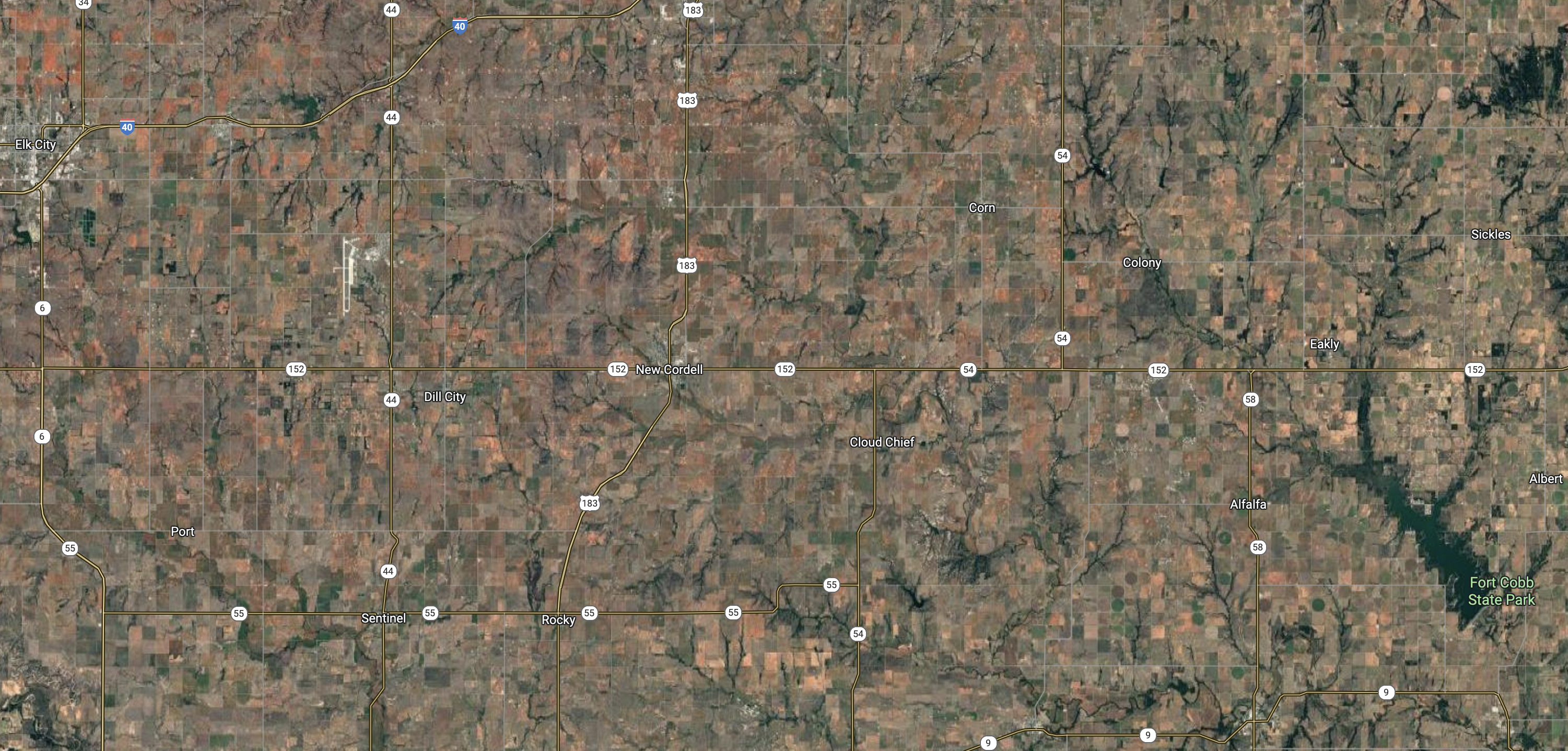
Satellite mapping is incredible. It’s been a great way for me to visually grasp landscapes, ecosystems, and terrains on a level only recently possible to modern humans. I’ve always looked out the window on flights- when lucky enough to get the seating, and have a strong familiarity with central plains farmland, as pictured above. The 160 acre squares are common in Oklahoma, and many other states where land allotments were granted in the late 1800s–early 1900s. Why 160 acres? The National Park System can answer that-
Homestead claims were made based on the rectangular survey system, which is still used in the United States today. This system surveys and organizes land based on the 640-acre section, also known as one square mile. The 160 acre homestead comprised one quarter-section of a square mile. When Congress passed the Homestead Act in 1862, the technology of the day was still primitive enough that 160 acres was thought to be the maximum amount of land a family could realistically farm. As time went by and more settlers came searching for land to claim, homesteaders had to go further west to find plots still available. This forced them to go to areas where the climate made farming much more difficult and 160 acres was not enough for a viable homestead. As a result, Congress passed several additional homestead laws allowing claimants in certain parts of the country to acquire more than 160 acres.
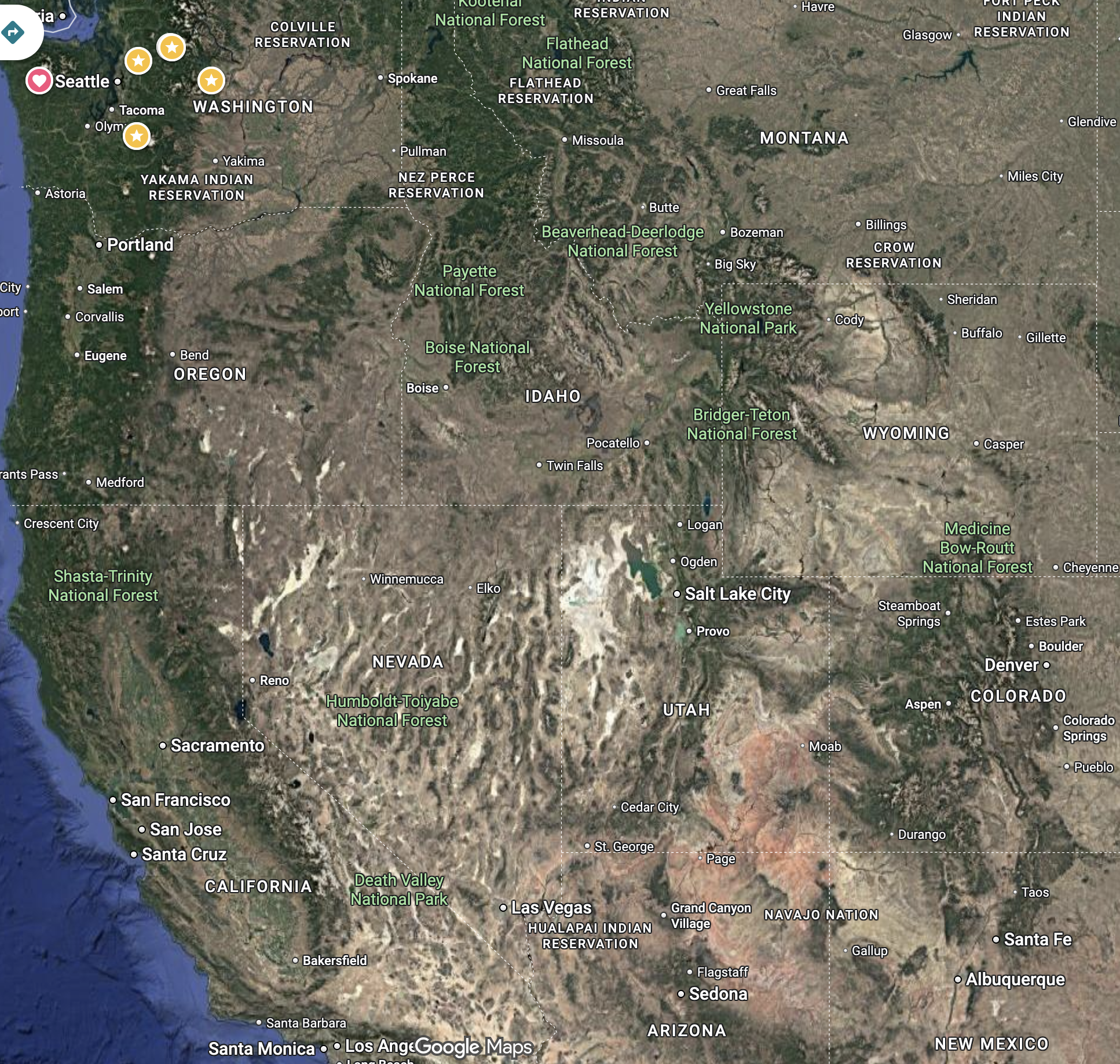
Even the property of EEC Forest Stewardship is marked out on the title and legal description based on the surveyed quadrant. All land in The United States is labeled this way, so we’re already grided out, even in The National Parks. I think there is a pristine fantasy in our minds about the wilds of America, most of which are pictured in The West of the country. Yes, the west is wilder than the east in The USA, but that’s more topographic than anything else. Just look at west vs. east from satellite:
It may still be hard for you to see this, but there is an extremely different terrain and ecology on each side of our continent. Yes, our county spans a continent, which is not normal for most countries, we have a heck of a land mass we’re working with, which felt to settlers like an endless plane after they came over the Appalachian Mountains by the millions post Revolutionary War. England had not allowed it’s colonies to expand further west, understanding that Tribal People owned what was on the other side, but then General Washington promised troops 100 acres of Indian land as payment for service in the war- let’s not forget all the land already claimed by colonial powers was taken in the first place, so why not expand and have the rest? Manifest destiny right? Wrong! Manifest Pest is more like it. Oklahoma was homesteaded after it served as reservation lots for tribal people pushed out of the east and starved into submission. Tribes had been pushed out so many times by then, America thought nothing of taking what was left and squaring it out for settlement, because there was so much space, why not?
Even back in New England, the land was carved time and time again to suit development. In New York State, where once Patroons ruled 16 mile stretches of river, yeoman farmers plowed up 60, 80, and 100 acre parcels for family farming. These more elongated grids are still visible from above.
Then in that post revolution era, the 160 acre homestead lot took shape, and in The Ohio River Valley, a wave of colonial gridlock appeared- nearly overnight.
Down in Southeaster America, the pine lands were a little more hilly and wet, but carving apart the landscape is still clearly evident, our scabs netted across the earth, cutting apart the natural environment to fuel expansion and abuse of our finite resources that has proven madness.
During The Dust Bowl, more waves of humanity fled their own undoing in my home state, to the sugar bowl in California, Oregon and Washington. The Sunshine State is grided out in a very familiar pattern, and we’re back to bottom land agricultural dominance. This time woven in with fracking industry, which also dots the landscape of oil rich portions of our nation.
Those undeveloped flanks of The Central Valley are craggy desert hillsides, not suitable for grazing or planting. But these grids somewhat pale in comparison to the checkerboard system embraced by northern California, Oregon, and Washington States.
By then, the railroads were connecting the coasts with transportation to ship all the wonderful, endless natural resources out of the inland and into the pockets of investors, a few already wealthy white men, who took this whole continent, including Canada and Mexico- not to mention Central and South America, into complete exploitation for personal greed. That’s so vast, I know you’re still trying to figure out this pattern, but it’s as plain at a cleared checkered board- consumption.
Washington likes to call it’s self The Evergreen State, but the pimples are showing through. We blight our forests with continual cutting, monoculture replanting, and the application of both “treated” biosolids (human shit), and chemicals like herbicides and pesticides to keep the trees growing up while the native flora and fauna are killed off in mass genocide. When a Native Person once pointed out to me that their people have been surviving apocalypses since White Men first came to these shores, the message starts to ring true.
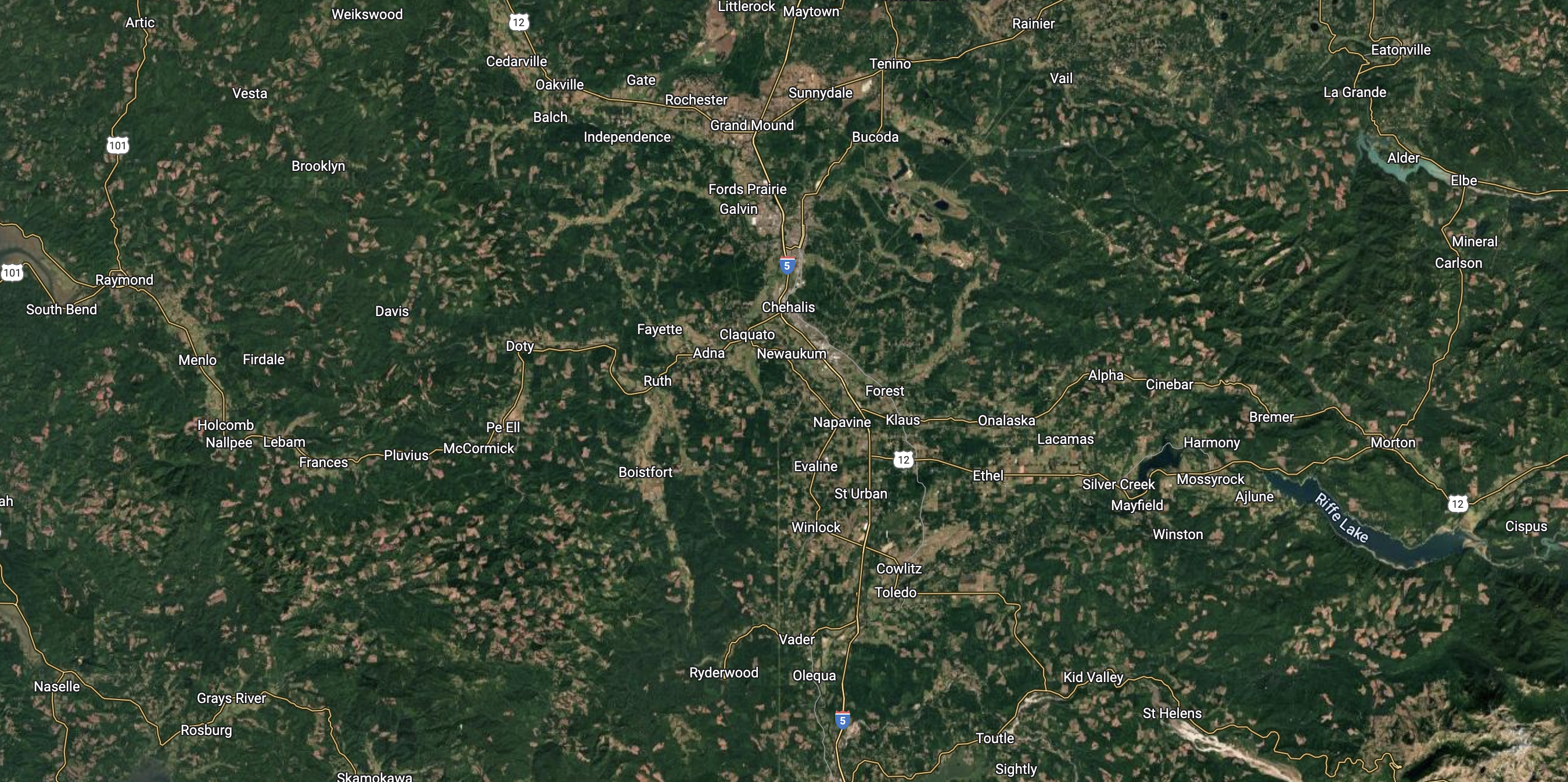
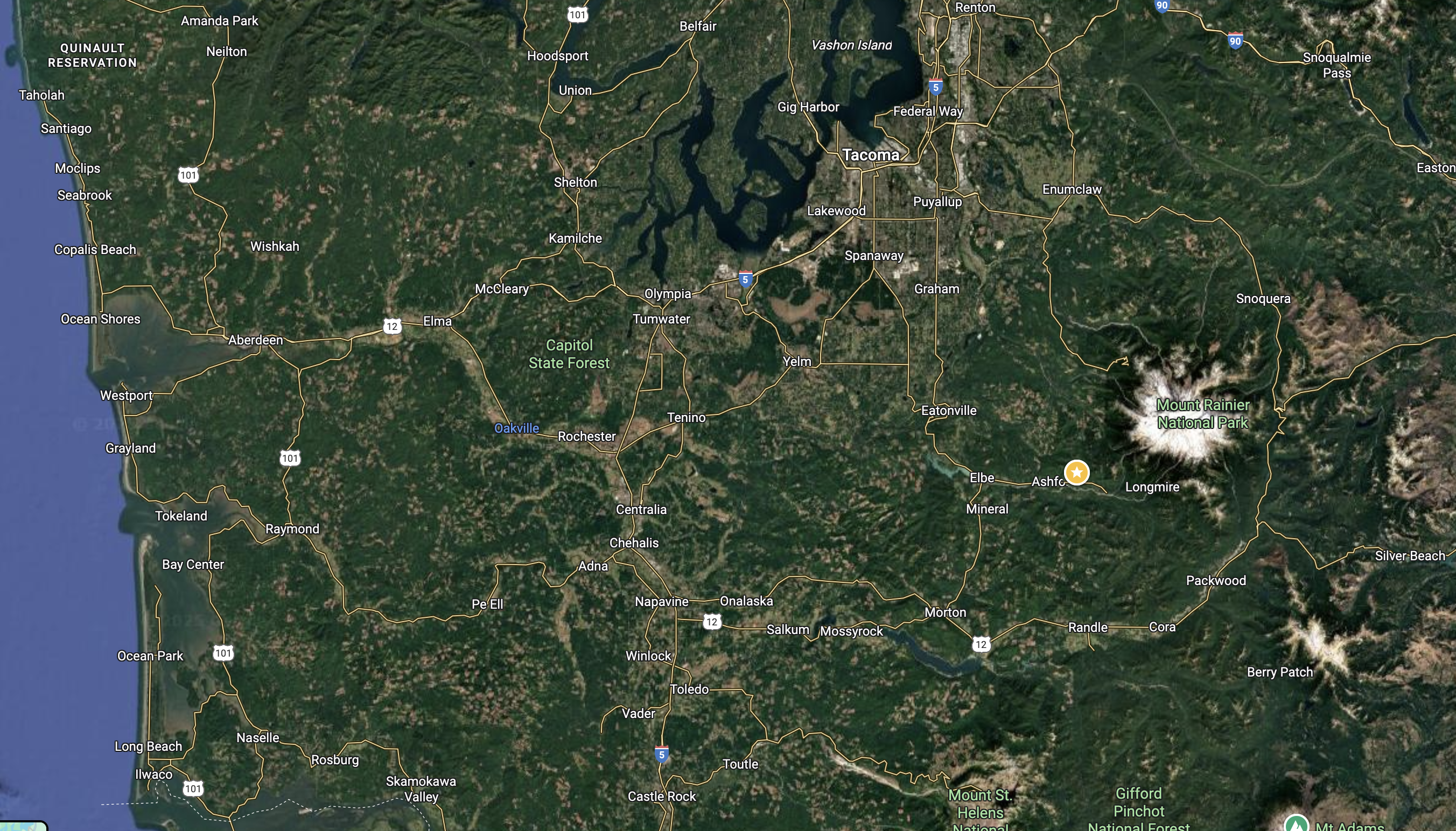
I’m still trying to help us see the vastness of colonial and colonial legacy settlement in America. Below is a satellite photo of south-central Washington State. It’s an area comparable to Massachusetts, Connecticut, and Rhode Island combined. You can still easily see all the clear cutting pockmarks across the landscape, and don’t think the green areas are pristine woodlands- they are monoculture plantations with no wilderness left for most of the mega fauna that once roamed in the millions throughout this landscape. White settlers came and cut it, burned it, lay track, bulldozed, fenced, and mined the skin of this earth in a similar way men abuse woman to this day. I’m calling it out, that’s for sure. Drill baby drill? Grab em’ by the Pussy? Anyone?
This legacy of consumption, conspicuous consumption, is written across our landscape, and EEC Forest Stewardship folds right in. The dairy farms of The Snoqualmie Valley, the logging camps, railroad, removal of First Nation People- it’s all here in much the same way it is on The East Coast, and that visual scar of gridded insanity lives on in the shape of all our square homes, square rooms, square screens, and square boxes we eagerly await at our doors. Just in time for the holidays!
P.S.
The day after completing this writing, NPR had a story about actual gridlock and how traffic is at a record high, leading to more commuting hours in our lives. I’ve experienced this personally living in King County, even at the furthest reaches of its boarders. Duvall is a bedroom community for workers in and around Seattle, including Bellevue and Redmond, the cities built by Microsoft. The tech industry put Seattle on the map, along with timber and mining. We’re about 45 min from the city by car with no traffic, but because of the congestion that continues to build, it can be a commute of 2-3 hours. Yes, there is an effort to expand more public transit, like light rail and ride share vehicles, the fact that there are too many of us continues it’s shockingly absent stint in our collective consciousness. When do we say “enough!”? When do we draw our own boundaries around consumerism? When do we stop? Then I ask, “What can I produce?”. Rather than always assuming another generation is the most important thing for each of us to produce, we’re getting the memo that many of us just should not breed, and instead, grow ourselves in other gifts to help the generations to come- and not just humans. What if the old adage, “for my family, for the future generations, and for those to come” actually embraced all the future life on earth, not just one species? Perhaps gauging to that measurement would help with solving most of our current social, economic, and psychological challenges today.





 EEC Forest Stewardship