Winter Mushrooms

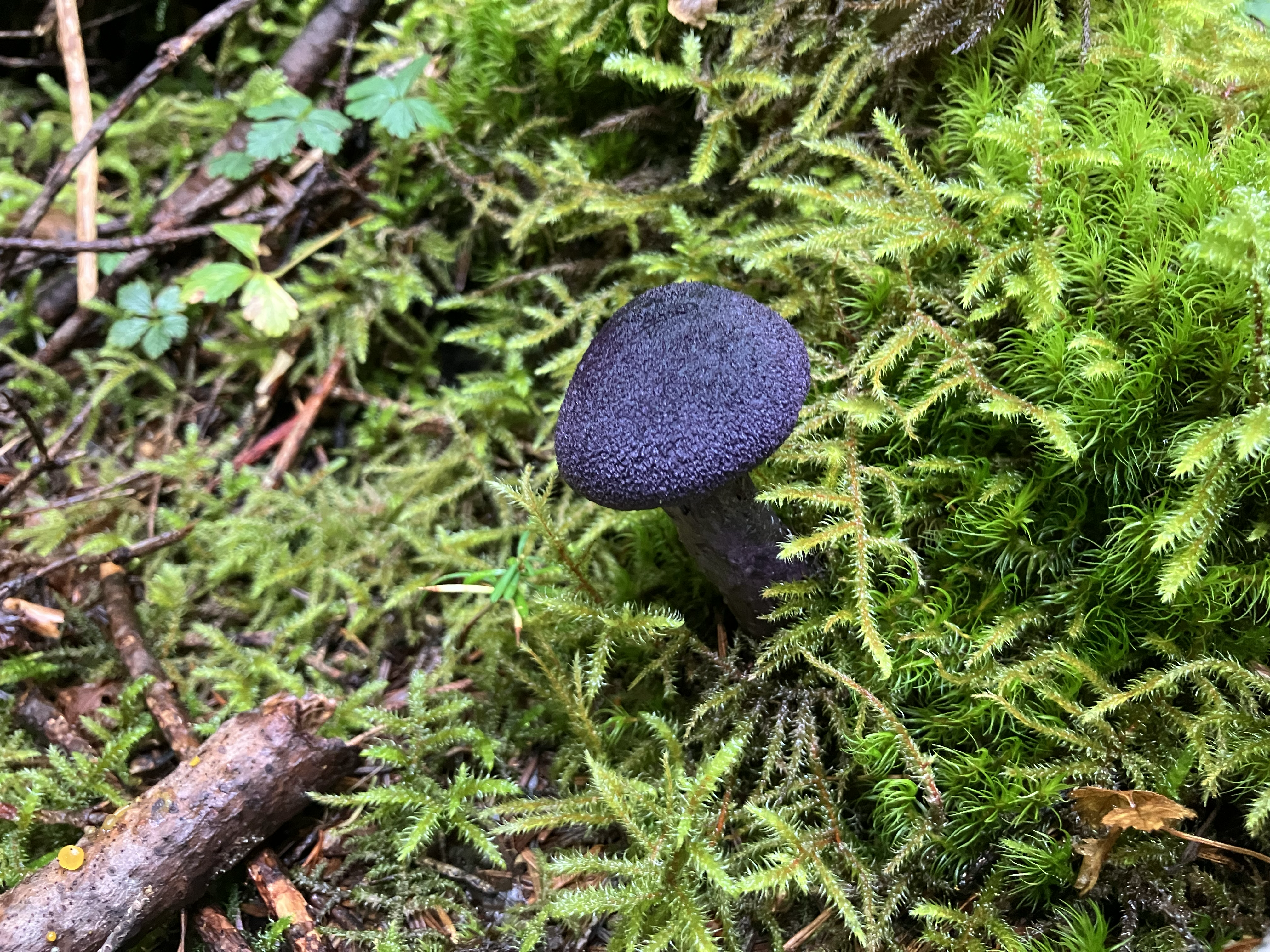
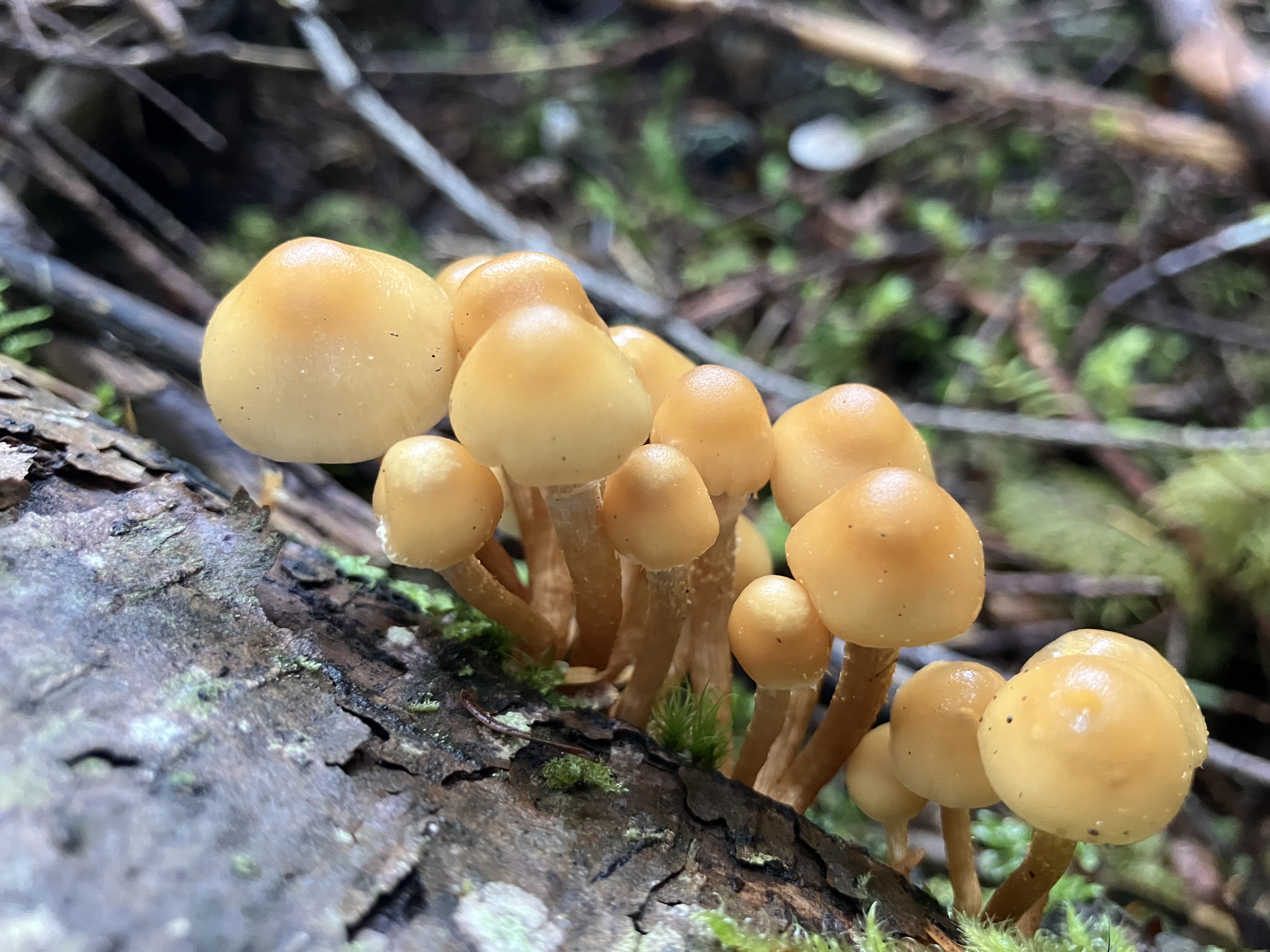
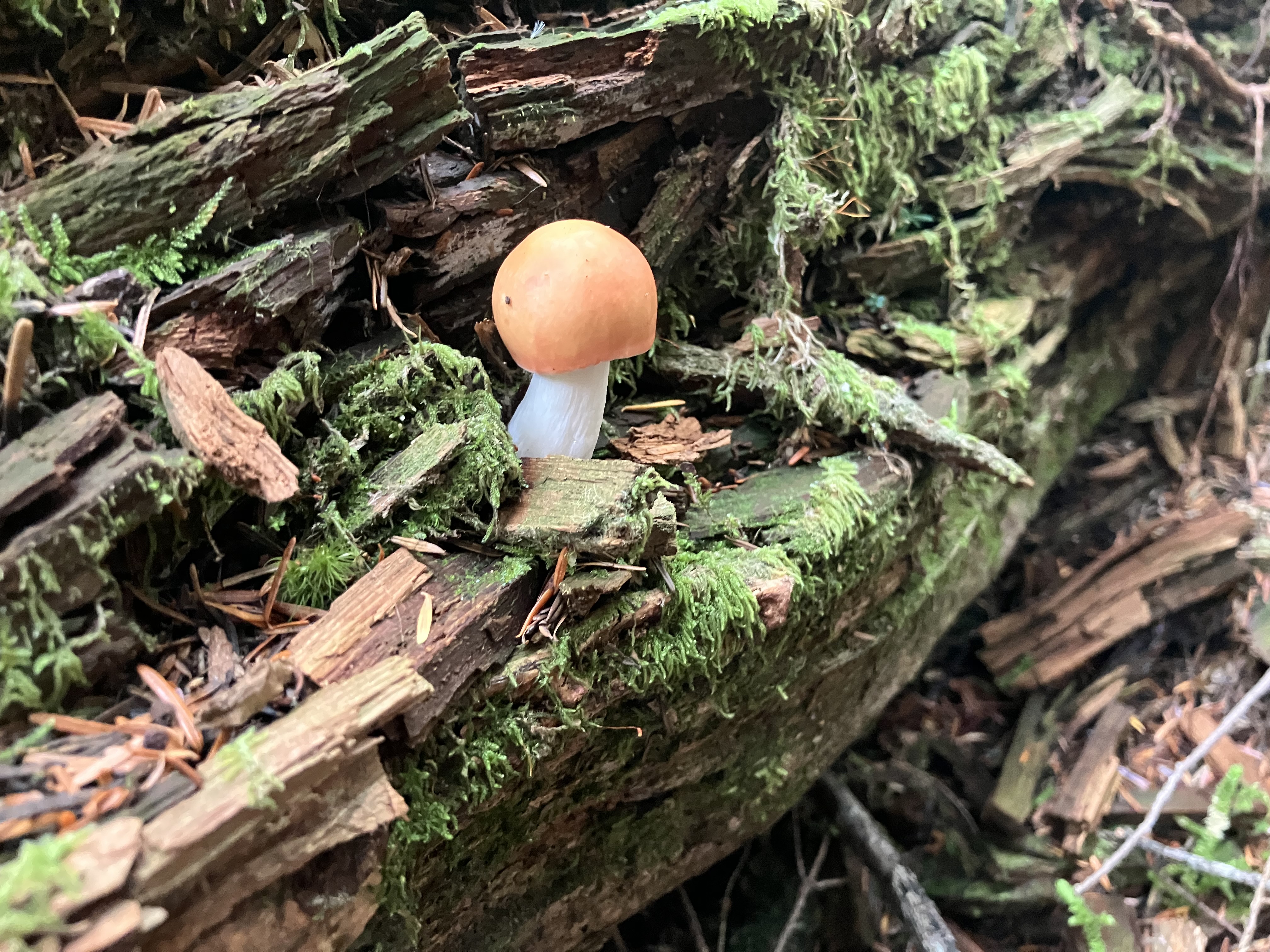
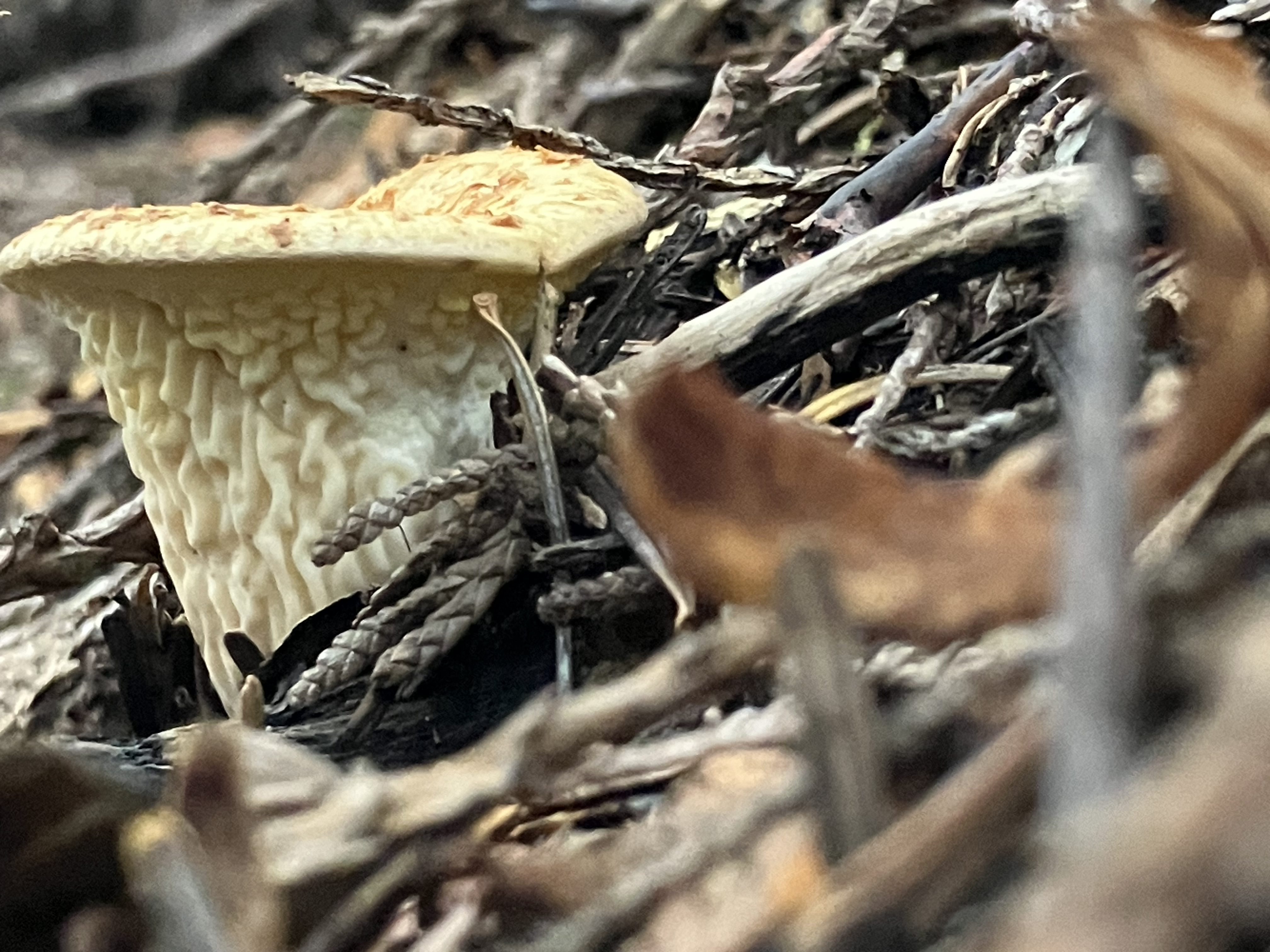
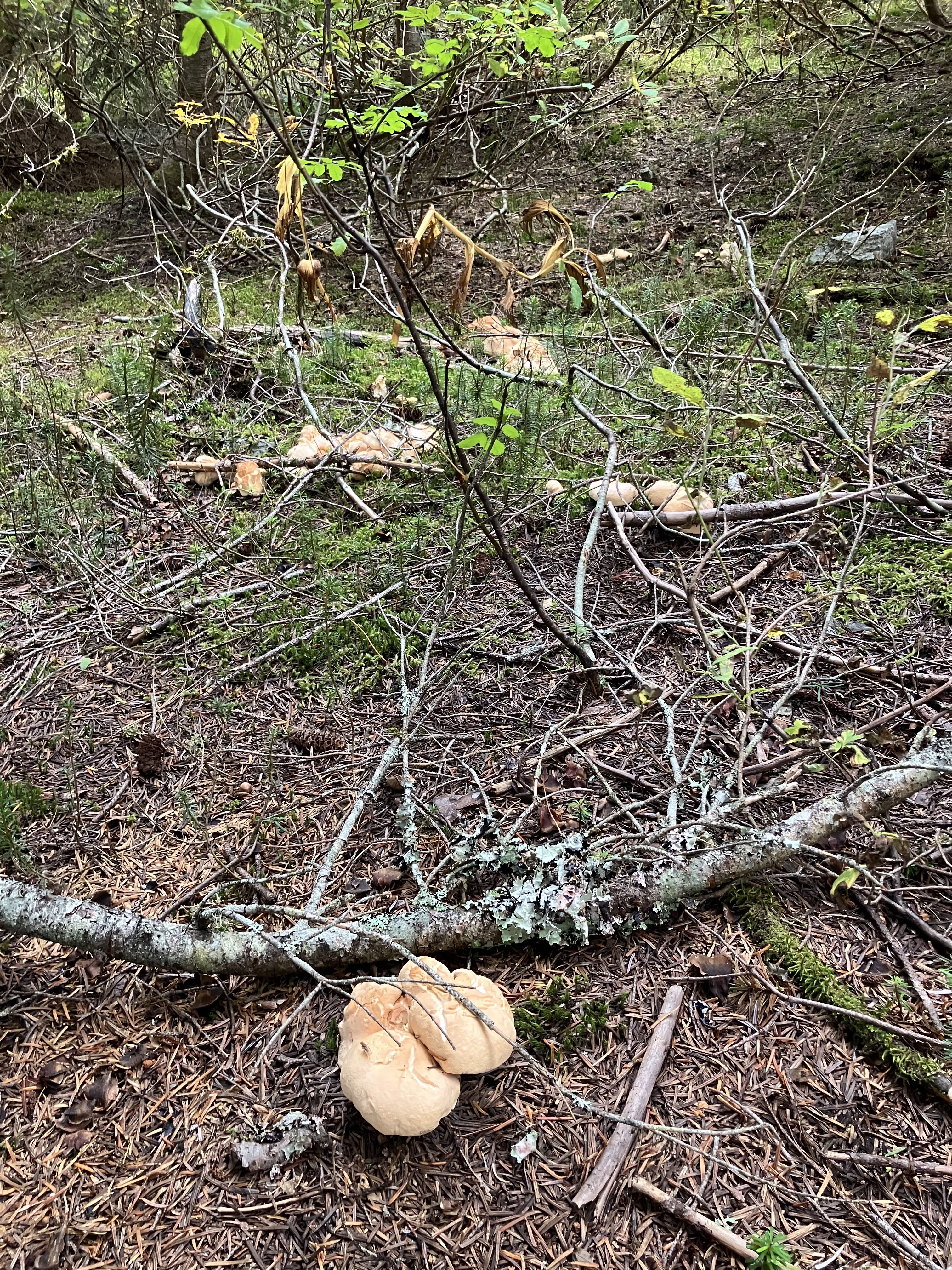
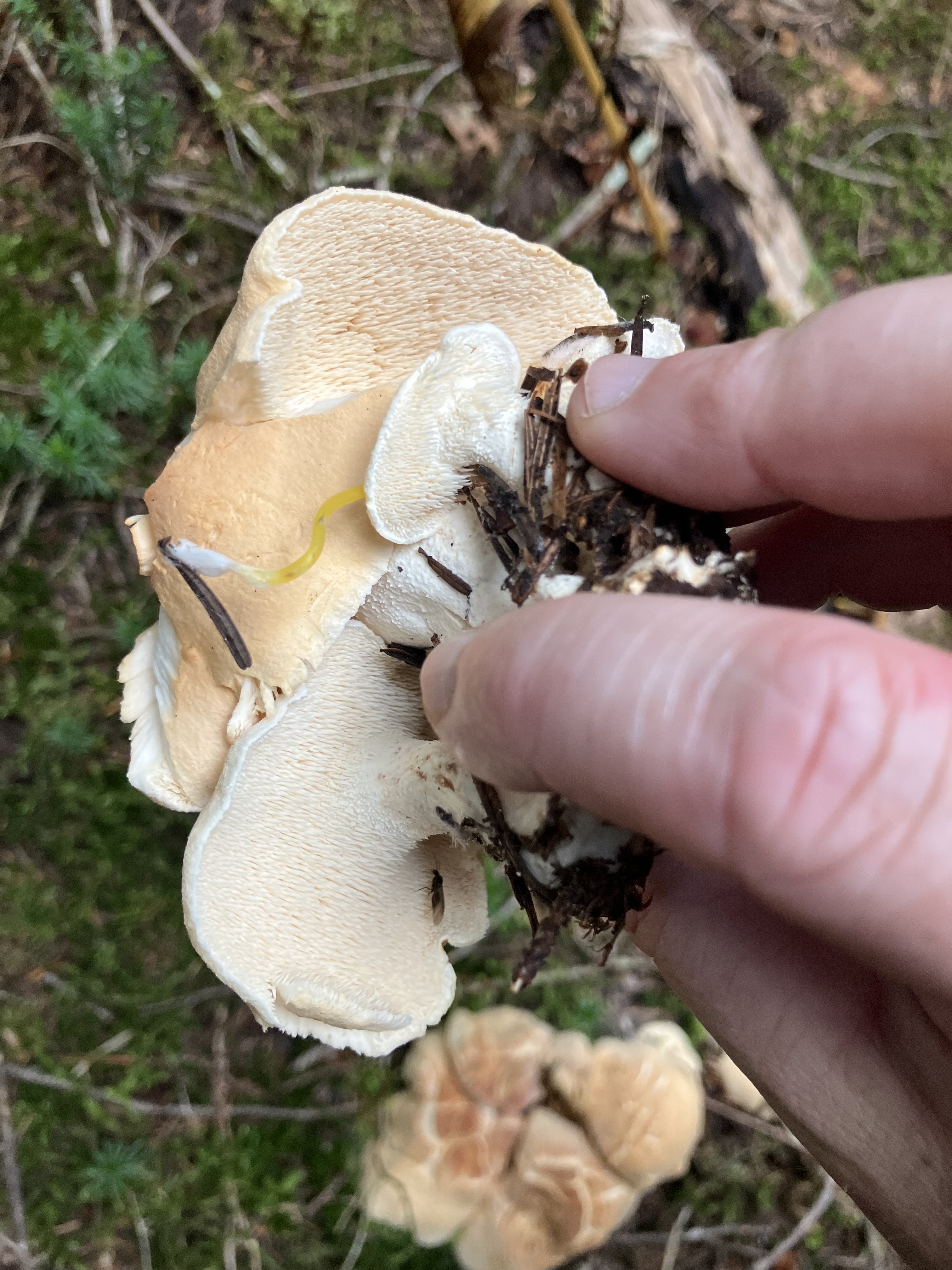
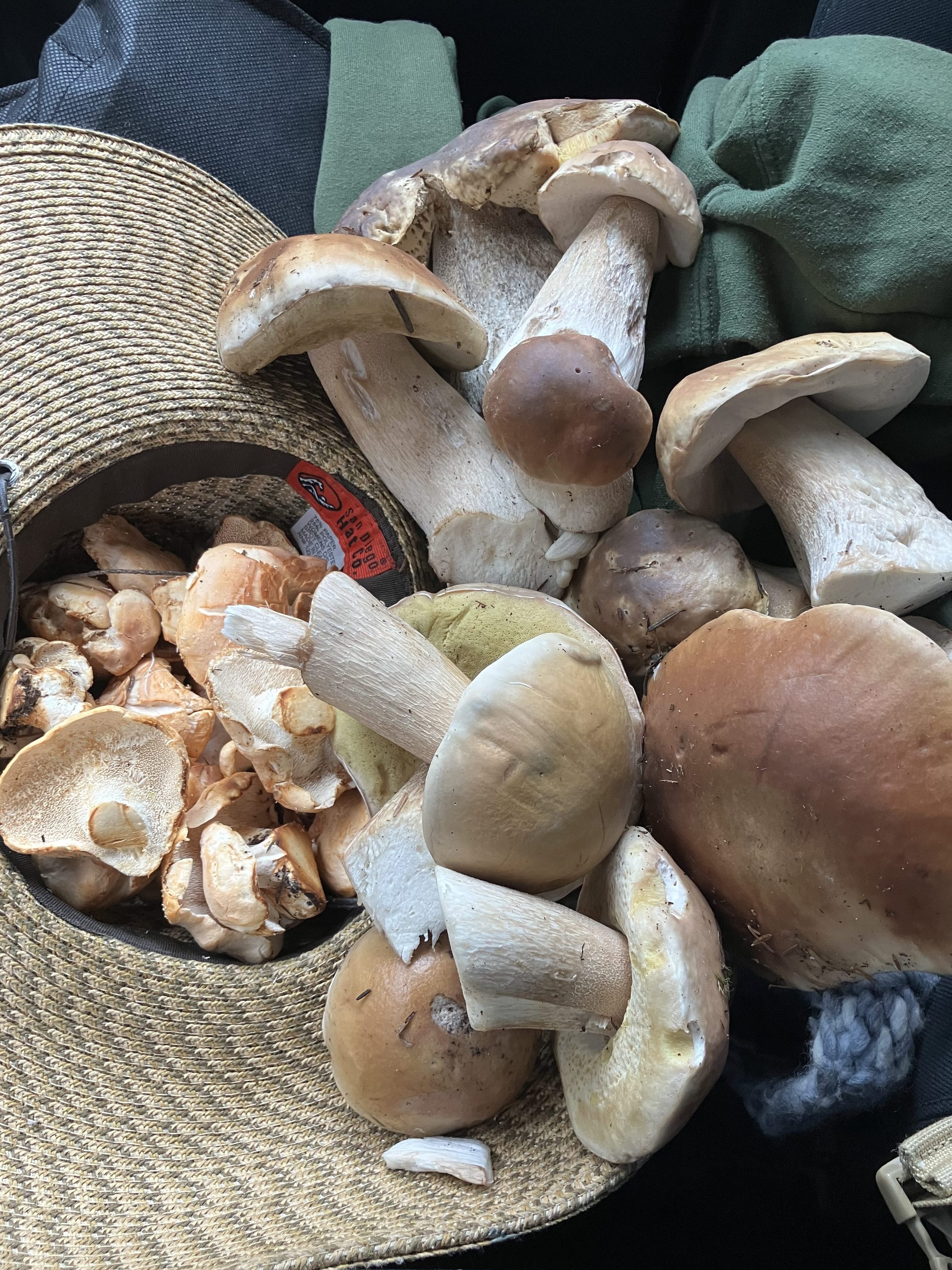
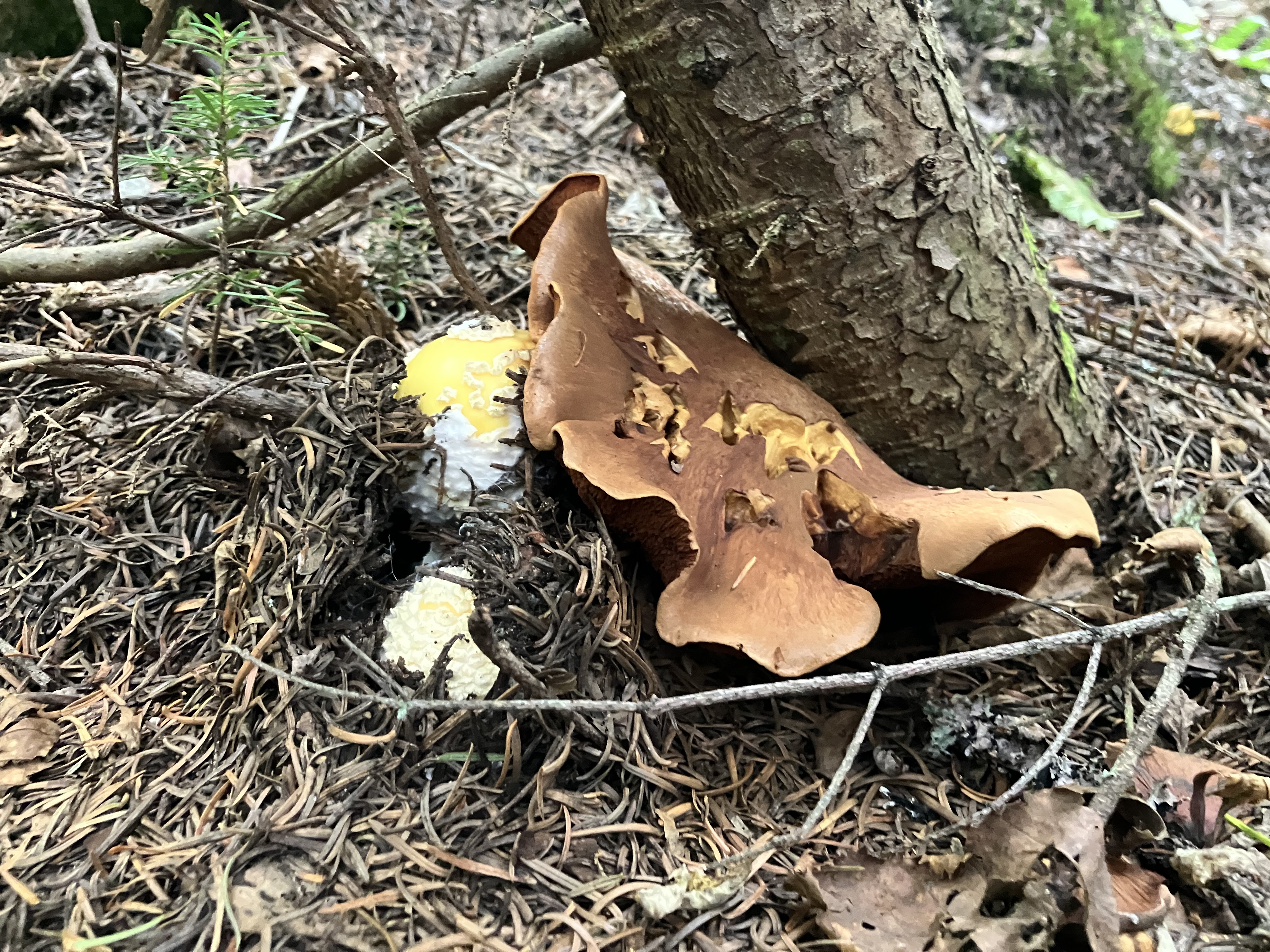
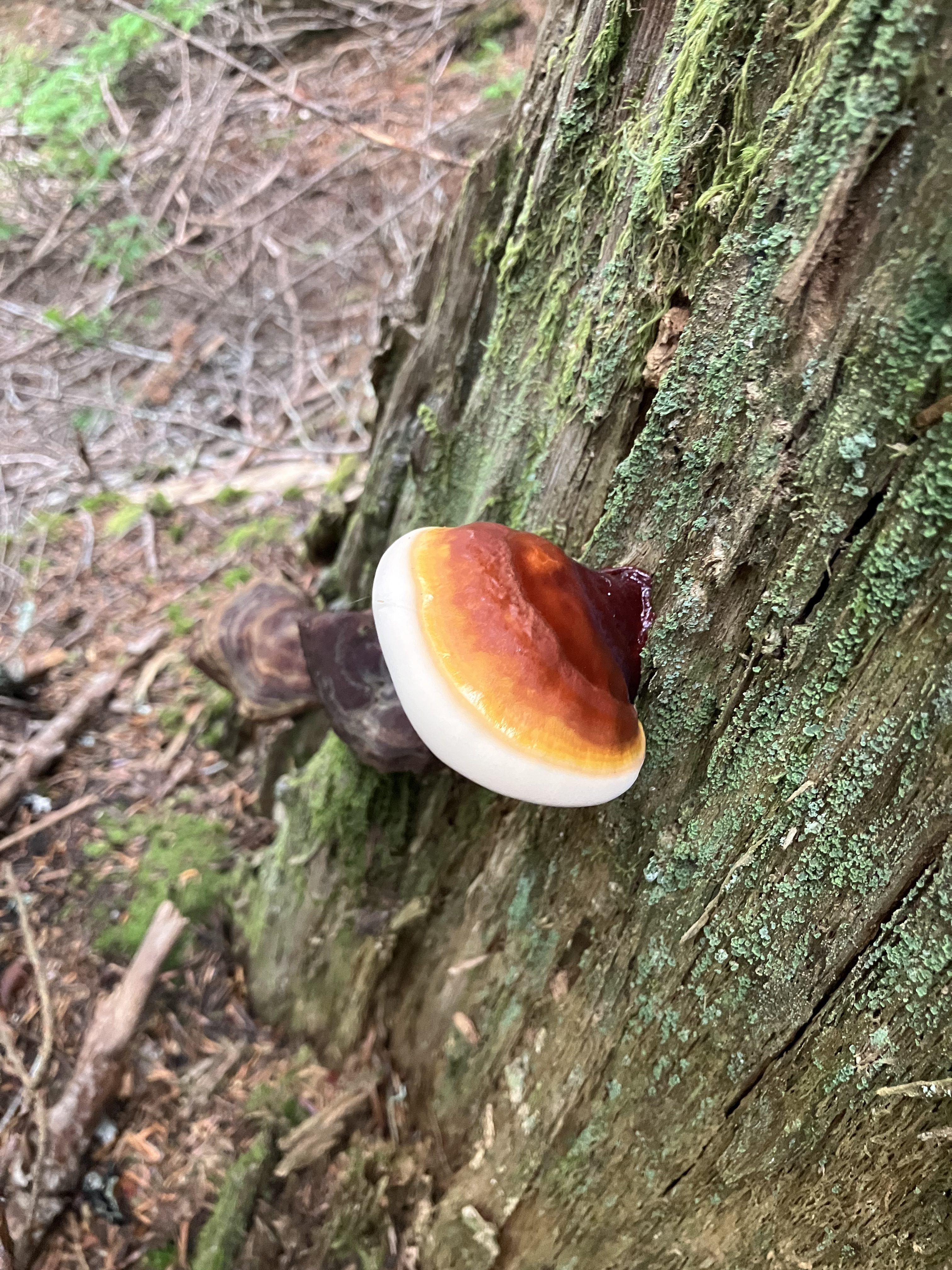
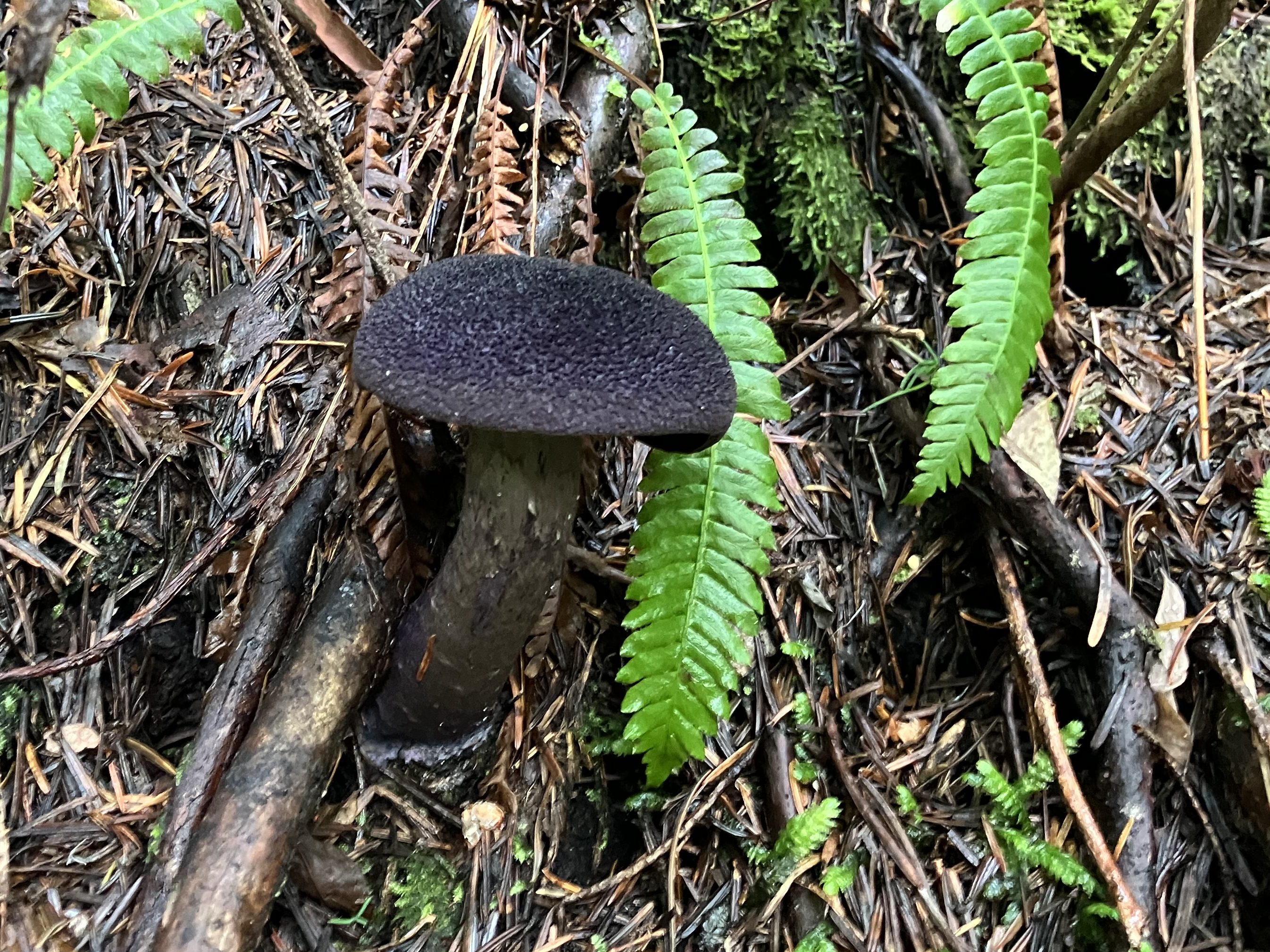
There are always mycological mysteries in the woods to look for here in The Pacific Northwest. These turkey tail variants were a bright spot in the leaf litter and fallen branches from recent wind storms in the fall of 2025. Now, the last day of January 2026 reveals more breakdown happening in these fungal forests. Debris is the key to a healthy temperate rainforest. Needles, leaves, logs, stumps, and twigs were once part of something living that banked nutrients and sun energy into living material, which in time, follows through its lifecycle and returns to dead matter on the ground from whence it came. Thus, the nutrients and sun energy is returned to the soil and redistributed back into the forest for current and future vegetative growth. That’s how massive forests continue to mature and survive. The mushrooms are playing two key roles in this cycle by breaking down the dead matter, and carrying it around through their mycelia, underground, to surrounding parts of the forest that need the nourishment.

Ecosystems are collective, complex parts of a working whole. If any one part is removed, the system can collaborate to fill the gaps, but if too many parts are removed, the system must evolve into something else, usually, an ecosystem less productive and more vulnerable to climate change. For example, where there are intact rainforests from peak to shore along The West Coast, there is less erosion from flooding because established root systems buried in 10-12 or more feet of topsoil with layers of material on the ground to protect the soil, which still acts as a sponge to soak up rain and hold it. This is how our old growth forests all over the world defend against fire, drought, flooding, and even freezing, as a large body of biomass is harder to drop the temperature of. Man I could have written that better, but there’s a nice long link line to click on for scientific elegance.

Our fungal friends remain an indicator species of soil health, though sometimes, a mushroom is unwelcome because of our preconceived notions on what’s healthy or attractive in our surroundings. To be sure, mold in food or mildew in our bathroom are not healthy fungal neighbors, in the soil outside, mushrooms are crucial, and though they may not always be the mushrooms you want to see, they are playing a role in ecological virility that should compel us to take note and embrace these breakdown cycles. When they are present in a still living tree, that’s a signal that the trees health is poor, and it’s better to recycle it back into the soil for a healthier tree or two to start. But landscaping does not like rotting wood on the ground- unless chipped and spread, which is putting a mulch layer down, but not at the slow rate needed to maximize the return of nutrients.

Humans get hung up in maximizing time, because we’re taught to dwell on death and how short our lives are. What if we turned that on it’s head a bit, and thought of a bigger picture we’re folded into? I think that’s where this current drive of religion comes from, we want to belong and share a story- we do, as living animals on this earth. Our individual part to play is so varied, like our personalities and abilities as people. Imagine if we were given the time and space to find our gifts within community, realizing our place, and being fully supported by those around us, because our gifts enhance their gifts through collective work and exchange. Nature is demonstrating this every day, and we the people chose to move further away from our natural rhythms with this earth, shutting out the very world we cannot live without, that irony still keeps me up at night sometimes.
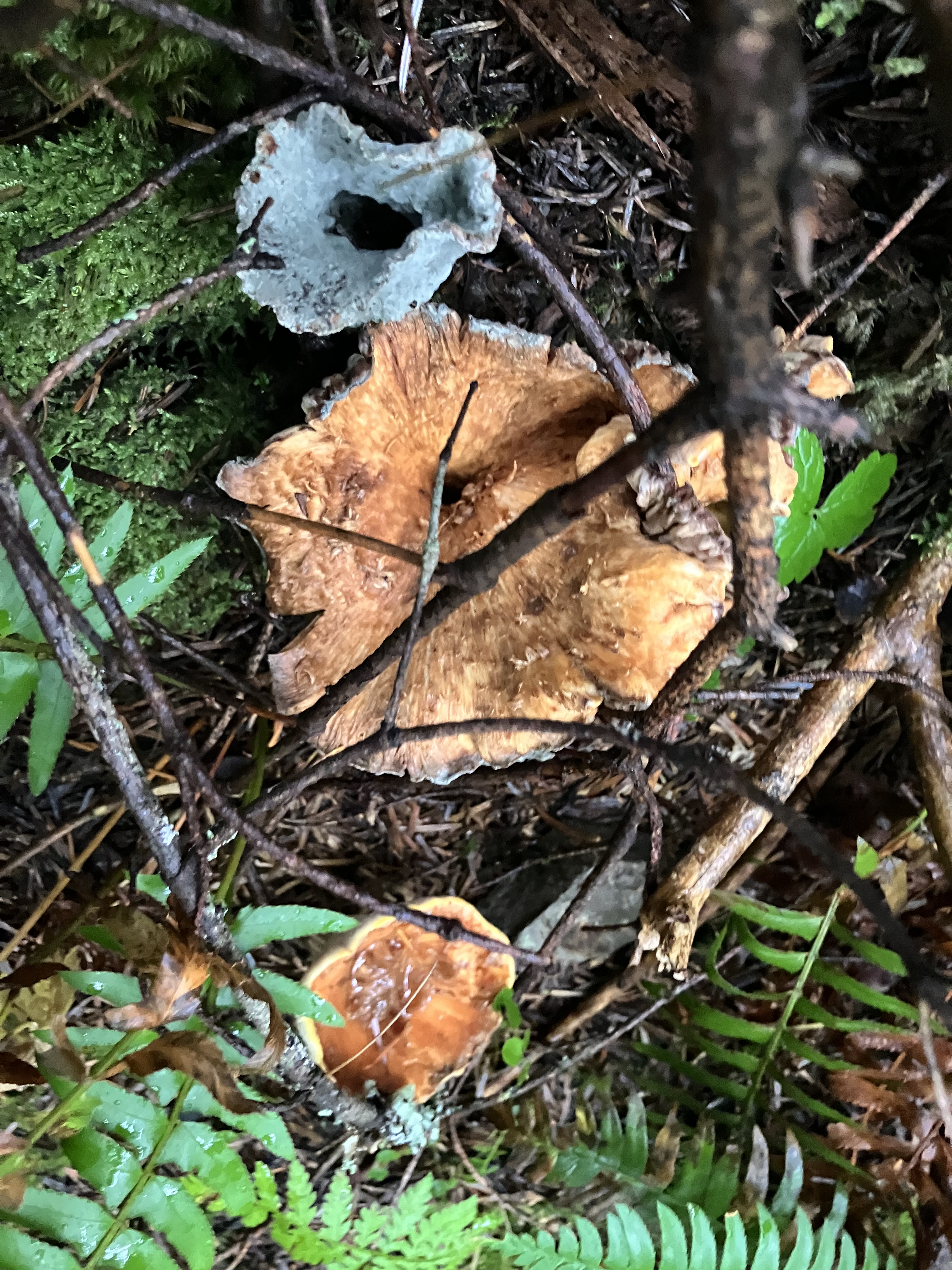
In the Winter months, when the light is short and there is a little more personal time to reflect and turn inward, I try to look at nature more closely, seeking her guidance and gleaning inspiration for the coming Spring. Something that always pops up in my path, no matter where I’m walking, are mushrooms.

What a show- and it’s free to the inquiring eye, but also in my ears through bird song and crackling leaves underfoot, the bubbling brook along the path, and snapping twigs as I brush against the Salmon-berry stocks. The scent of decomposing wood, mossy wet rocks, and wet earth fills the air. This living system folds into my deepest memories, ancestral trails winding back into far distant memory. My whole body comes alive with it, moving through the forest and reliving foundational steps taken by all my relations. How can this experience not be healing? Why stay away from it? So many do, and some, not by their own choice, but by the make of our world today, much of our habitat is artificial light and stone, the makings of a prison for the mind and body. We can redesign, but not all of us will live in futuristic clear plastic jungle domes or rooftop garden paradise. Think of how suburban topiary and turf lawns might feel. Hey, even a house plant need light and water, make sure you get those two too.

We like to simplify things, so we don’t have to think too hard about basics, in most cases, but nature is another world from that one, it cannot be put into a pot, dressed with an LED, and given sugar and spice lattes to survive. Somehow, we’ve come to believe we can live like that, and the cracks of this facade are showing. In fact, the wall is coming down around us right now, and we’re worried about what time our next package will arrive. Time out people, circle up for a little nature insight. Go outside. Can you see the sky? Sunlight gives us much needed nutrients for our survival. Can you take a deep breath? Fresh air keeps out lungs healthy and strong. Can you touch living soil? I’m not talking about a sandbox or mulch playground- I mean dirt that’s continuous to the mantle of our planet’s core, with vegetation growing in it- that’s living soil. If any one of these basics does not exist in your world, you are bound to have some serious health problems. I’ve not even gone into the fourth key element of sutvival, safe drinking water, because we’re all challenged in that realm- microplastics and forever chemicals are global, so even in the rainforests of far off jungles (those really don’t exist anymore), our better living through chemistry has gifted us generational cancer rates that are exponential like Amazon Prime profits, and we keep streaming away, never imagining the streams nearby run full of unseen pollution that is in the bodies of babies when they are born.

But hey, mushrooms could help us with most of these pesky forever chemicals and microplastics, because there are species of mushrooms that eat toxins, neutralizing them in some cases, or at least binding them in a far less radical form. Our fungal friends cannot get us outside and reconnected on their own, unless, like me, you are excited to go see them outside. Luckily, there are literally millions and billions of other organizes outside to learn about and love, or get grossed out by, or feel a joy from. That’s the beauty of nature, it’s full of never ending lessons, good lessons, for us all. It’s also the first place I found myself, really connected with who I am and what brings me joy. Being outside is our best teacher, and great for the health of our bodies, including eyes that spend way too much time on screens today. Vision is children atrophies sooner when they are not outside, the dense layers of nature actually strengthen our eyes by forcing us to look at several depths all the time.

When humans began to see nature as something to exploit, rather than live with and be nourished by through a deep interconnected relationship, we began to evolve away from connection and caring. It’s been generations of removal, extraction, and abuse of the land that holds us. Even though much of the landscape we live in today pales to its former wildness, the mushrooms remain present and working hard decomposing and redistributing resources throughout the complex ecology of this earth. Our fungal friends do not give up, just shift in adaptation to the world as it continued to change. This is a good mindset for us all to take in. Perhaps it’s time for a change? I’m not sure exactly what that looks like, but the best change I’ve seen, happens outside.
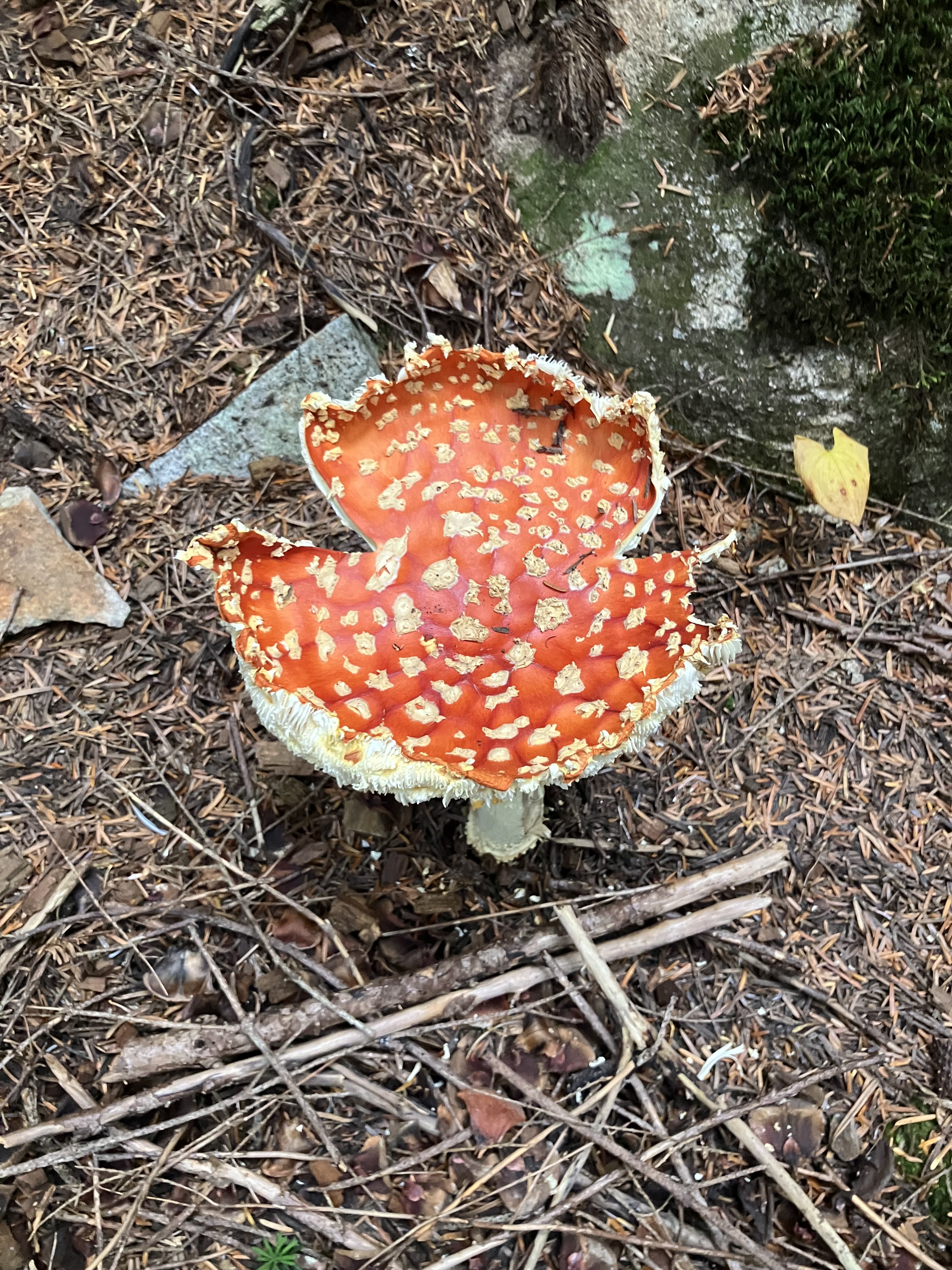
It’s why I chose to live in a place where I could be outside year round and the living world around me remains bountiful and alive, with ocean shores, alpine peaks, rainforests, and step-desert all in one state. I’m walking in a state park just south of Seattle. It’s a densely developed surrounding area, but there was space made for trees and creeks too. Though the land was clearcut a century ago, younger trees are starting to girth out, showing potential for old growth some day. A volcano could change everything tomorrow, nature can still be a truly destructive force, but she’s equally durable, rebounding in her ever abundant way. We would do well to learn from her, and spend less time trying to get in her way. Our demand for convenience, this sycophant to cooperate power through economic dominion, clouds our judgment today. I’m not sure what can free us from this tyrannical bond, but Frodo really should get that ring to Mt. Doom, if you know what I mean.

Cat Amongst The Chickens

The opposite is true in this situation, one of the young Cemani roosters had been roughed up by our enthusiastic Kangals, survived, and found temporary reprieve as he recovered, in the house, with the kittens. We’d had a bought of below freezing temperatures, and the bruised chicken had not been able to get enough grain, causing a drop in weight, and a need for some R&R. A temporary bin home was set up, with water, unlimited grain, and fresh dry bedding, near the woods stove. For the kittens, it was a chance to learn bird manners, leaving the rooster to perch and inspect his feline housemates. After a few days of close contact, all the animals were at peace together in the living room. I was even able to put out a towel for the bird so he could stretch and move about a bit as he grew stronger. It’s the first time I’ve hosted a maturing bird in the house like this- weather compelled the indoor housing, and right in the middle of things helped me keep a good eye on his improvement, and offer the fast growing young felines some stimulation and restraint training, which they took to quite well.

Training animals when they are young is crucial to getting manners and safe handling throughout the animal’s lives with people. I’ve talked about the importance of domesticity in domestic. All animals on the farm are well domesticated, and have a few social ques built in with their upbringing. The rams would be my only exception, they are intact males for breeding, though they are handleable enough- with great care, to be moved by hand when necessary. The chickens are not prone to being picked up, but if I lift them off their roost at night, or need to pick one up to help them, like in this example, the animal should acclimate to the process without struggle (when done properly). That last part is key. If I don’t get the right grip and balance in the hold, the animal might feel unbalanced or vulnerable to the contact and struggle, which means flailing of wings, claws, teeth, hooves, and in short, peril to the handler- that’s me. I sometimes wear gloves, and often have long sleeves and pants on. Birds like to be supported under the keel- and if you don’t know what that is, don’t pick up a bird. Sheep need head directing, so I place a hand under the chin of the animal to point it in the right direction while the other hand is on the rump, pushing the animal forward. The kittens are still being lifted by the scruff of the neck, then cradled against the chest. Your skill in handling will reflect in the temperament of your animal.

Animals will reflect our intentions back at us. The chicken in the house would become vocal if I walked by or stood up. The bird was tracking my movement and action and would move away if I came to close when he was out on his towel. By the end of his stay inside, I knew he was ready to return to the coop when he began straying off around the house, pecking around. I knew if he was that mobile, he felt good enough to return to his flock. The kittens are still inside learning house rules like, “not on the table” and “out of the kitchen”, to name a few. I have a taxidermy goose in the living room, complete with fake sedges and dirt ground at it’s webbed feet. This would be a playground for kittens, but a few days of “off” and “leave it” have led the cats to ignore it all together. Now, I would not trust them with it long term without my oversight, but in future, they will leave it alone, knowing it’s not their territory to be in. I claim things- it’s great practice in boundaries. The couch is mine, kitchen, table surfaces, shoes, books, even bowels with human food in them left on the ground. The training continues, but for the most part, these kittens are picking up on the communications fast.

Not everything works out well in basic training. Kittens are energetic, and knocked over a heavy object the other day in their romping around. Said object fell onto light, breakable objects, and chaos ensued. Gladly, both kittens were ok, but the vulnerable glass objects were shattered. You win some, you loose some. I did not get angry at the cats- I did hurry to put them away so they would not get into the glass shards, but it was not their fault for roaming and playing. As an animal handler, that’s your hardest job to remember- it’s not the animal’s fault. These creatures are in the moment, and we have a hard time joining them there. Both parties can be frustrated. That’s another tell to the handler that the animal needs a break- and the person, also an animal, too. I like to use the term handler, because people only have so much control. Take that lesson and hold it close. We’re hands on with animals- and at one time physical domination was thought by most, to be the only way to keep domestication. Times have changed, and the world of animal communication is at hand.

My kittens may not reason out the complex dialogue of language I’m offering, but they do get one animal telling another to back off- leave a place, or simply leave something alone. Koban, my young Kangal LGD is learning this lesson well. He’ll be 130lbs when full grown, and I already strain a bit to move him off with one hand, if I need to. “Off” is a crucial word he has to respond to. When I walk into his pasture with food, he could leap up and knock me down, but he does not, instead, he sits, because he was taught at a very early age that, when he’s excited, he should sit. And folks, he does. There will be future challenges around this, so I have to earn his respect by remaining consistent and fair. Animal handlers have to give a fair ask to get a positive response. Koban know he will get to eat, but he must first sit and wait- all my dogs do this. I also have to give him a clear release command to eat. He’ll wait patiently, but I can’t ask him to do that all day, that would not be fair. I can keep him engaged with training while he is eating, pick up the bowl of kibble for a moment, then put it back down, pet him all over, including his feet and belly while he’s standing. Soon, I’ll clip his nails, brush him, and even pick up his back end while he eats. Not all the time, and now through his entire meal, but I will disrupt him with handling and closeness around food, because that keeps him docile and easy going while he eats.

Koban will even come get pets while he’s eating, showing that his relationship to his food is non-aggressive, he’s not worried, which would become fear, which becomes a bite when someone gets too close. Instead, he’s chill, attentive, and confidant- without being overt. Does he still occupationally jump up in excitement when I come in with his food? Yes, but he’s learning, and when undesirable behavior happens, it’s a perfect training moment to remind him of what’s wanted. “Down” followed by “good down” when he does it- remember to reflect back a positive response to positive behavior- and be specific. “Good dog” is amorphous- connecting “down” with “good down” reinforces the behavior asked for.

What happens when the desired behavior does not manifest? It’s not the animal’s problem- it’s you. Maybe you were unclear, certainly the animal needs more training, try backtracking to a behavior they do offer and step off it into the next behavior, try again, or perhaps, and this is often true with my Kangal, give the animal more time to complete the desired behavior after you ask for it. It’s never a good idea to repeat a command- they heard it the first time, repeating it confuses them. Well, she’s making that sound again and gesturing, I thought it meant one thing, but she keep saying it so it must not really mean anything. Pro tip- drop “no” from your animal handling vocabulary. It’s not a desired behavior, it’s overused, and becomes the first numb word in any animal’s own vocabulary. “Sit”, sit”, “sit”, “sit”- becomes the voice of adults in The Peanuts Cartoons. With my Aussie cattle dog, I will physically move her into a sit if she “ignores” me, and then say, “good sit” to reinforce the desired behavior.

Not all animals are created equally- there are many limitations depending on species you’re working with. Val is a high functioning breed- she could know thousands of words, most I didn’t actively teach her. She is very independent, so commands are sometimes more like suggestions, but she does know when she’s not offering the desired behavior- and how. Still, I’m responsible, I chose to get a high functioning, independent breed that’s known for being strong willed, but also very devoted to those who earn it. There are days when I can tell she’s not having me lead the day, but she does come around most of the time, especially because she’s food motivated. The chicken in my living room right now, remains at the other end of that functioning scale. It can’t understand the limitations of a towel, not pooping when it needs to, or that my house plants are not a viable salad bar. So it’s not left in the living room unattended. Proper boundaries for animals and people makes for a much happier domestic life.
Soon the chicken will go back outside to rejoin the flock, and the cats will continue their house training, while Val looks on from the covered porch, awaiting her next meal. Down at the barn, the ewes allow me to attend them in lambing- what trust! Koban is taking a lesson from Gill in how to meet and greet the new members of the flock- animals can and do “train” other animals. I am so thankful for Gill’s ability to assist in showing Koban what his role is on the farm. When it’s time for patrol, Gill takes the lead, but he’s letting Koban bark more, as the pup find his adult dog voice. Maybe Gill is having a little laugh listening to his young pack mate’s mewling whine evolve into a guttural howl, before rounding out in one or two deep throated barks. Koban takes it all in stride, but he is soon due for a teenage breakdown, where he’ll be growing so fast, his brain will literally shut off many of his learning functions, just to keep up with the body as it matures. Again, I have to be aware of this and not come down on him too hard when he rebels. Find the good behavior where you can. It’s a never ending learning journey, and one I’m deeply grateful to have experience with. Gratitude to all the animals I work with, learn form, and try to teach, or at least, sway towards domestic behavior when I can.

Washington Outdoor Women on Twin Falls Trail

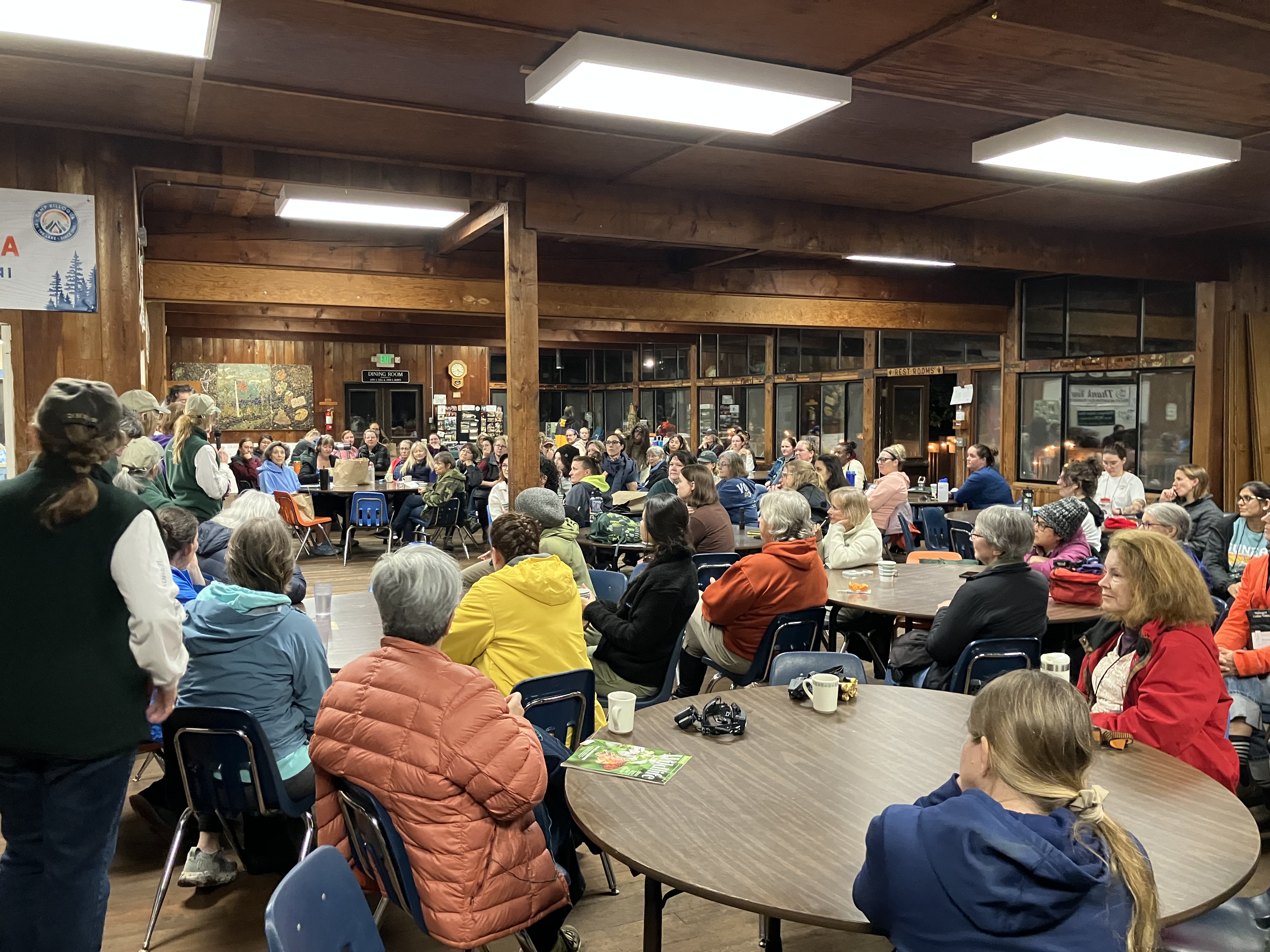
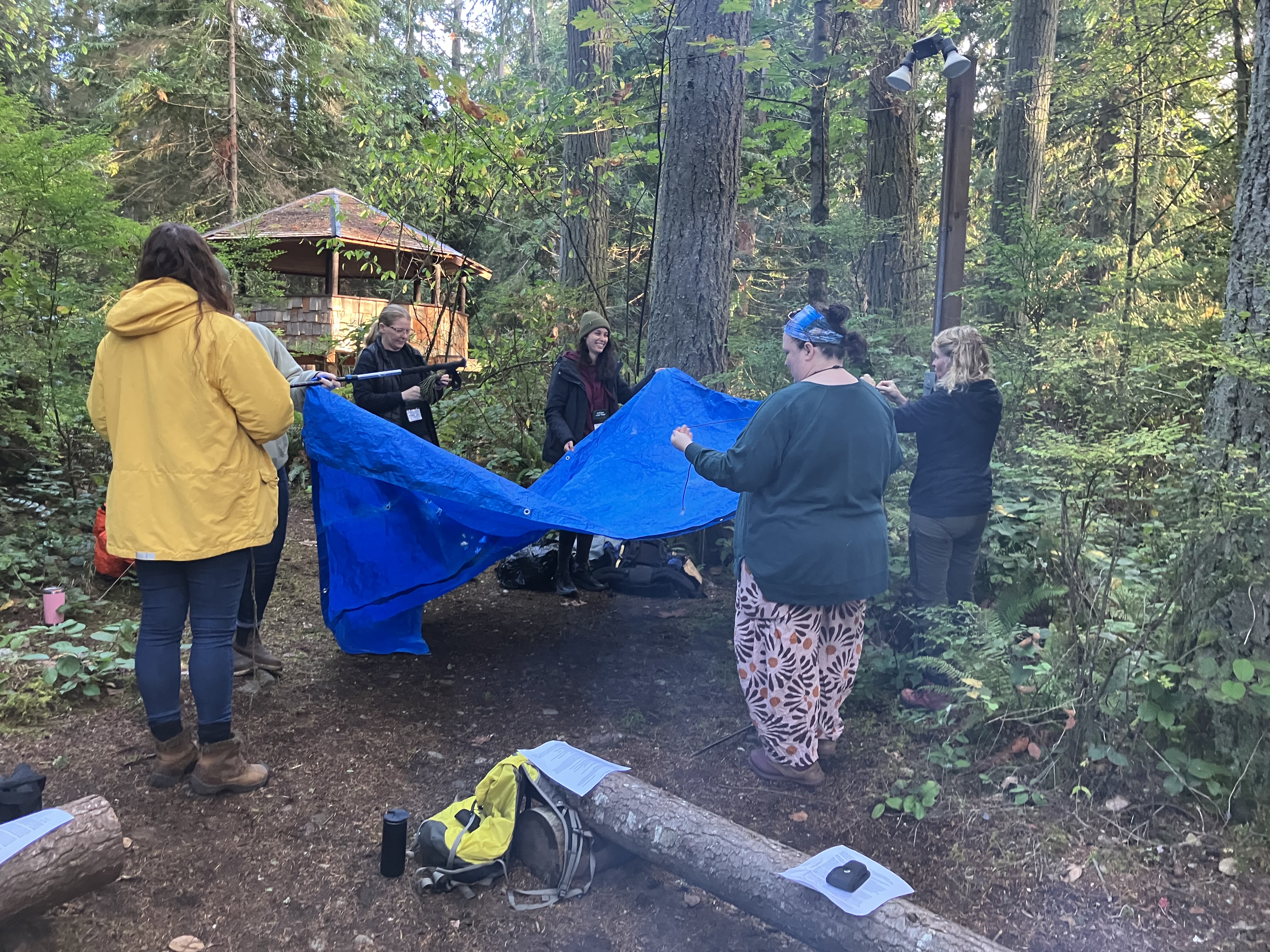
It was a wonderful day of community learning and adventure in our local Ollalie State Park. Ollalie is a Chinook word for salmon berry, a favorite local native plant fruit. The Twin Falls Trailhead takes us on a 2.4 mile round trip excursion to see some excellent water features on The South Fork of The Snoqualmie River. Yes, the lands are ancestral to Lushootseed Speaking people of the area, and we acknowledged this important legacy before starting our hike. The recent historic flooding in our area was evident along the trail and in the river, where huge logs stood atop glacial erratic boulders, hanging nearly ten feet in the air. It was an impressive reminder of what water can do to a landscape. The same powerful flow of this water is harnessed for hydroelectric by Puget Sound Power and Light, but you will not see any of the industrial facilities in the park, they are hidden high above the cascading falls, with turbines hidden down a drilled tunnel through the mountain to avoid disturbing the natural views.

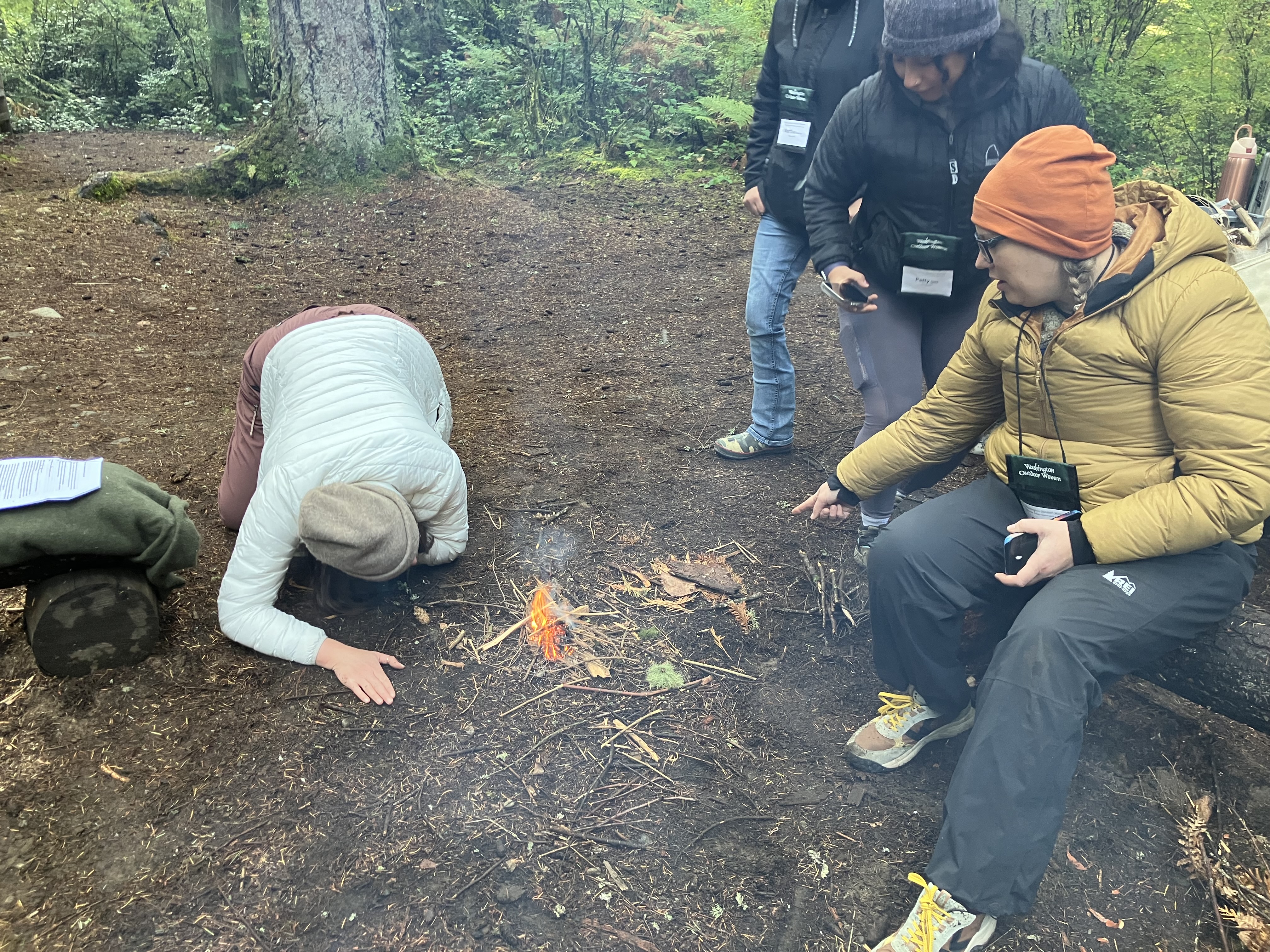
Our group was energizes, and listened with great attention as I shared knowledge about medicinal and edible plants along the way, forest ecology basics and what to look for in the environment, and practical survival skills introduction, including shelter construction, water purification, and how to build a fire safely in a forest. It was a class for all ages of adult women, and we kept up a great spirit of camaraderie throughout the hike. There were some challenging obstacles, including slick black ice on part of the trail, that brought some of us to our knees as we ascended. Patience, cooperation, and good communication got us up and through that skating rink, and our group was able to make it to the middle falls before the trail closed for flood repair. Spirits were high as we turned to make our decent, with plenty of learning in our heads.

The highlight for me was sharing my knowledge, and reflecting with others. It was a full four hours of download, sharing plant information, answering questions about survival skills, and collectively pondering on how to help restore our temperate rainforests. We noted the recreational impact of the trail, how people engaged with nature in public parks, and what we could do to continue our learning in nature together. Some of the questions these amazing folks offered were great food for thought, part of why, at least for me, group learning is crucial to community connection and shared understanding. From the start of the day, I made it clear that we would be learning together, sharing our insight, and forming new understanding of ourselves and the environment around us. The group was wonderful, I could not have asked for a more engaged and authentic crew of people to be out in the woods with.

Winter Celebration

Mari Lwyd was spotted wandering Duvall in mid January, 2026. The Welsh tradition of “The Grey Mare” is part of winter wassail, mummering, and general winter festivity. There was general curiosity and good will at the sight of a skeletal horse head entering the pubs and taverns. All were welcoming, and we drank cider at every stop- pouring a little into planters or soil where we could in thanks for the bounty of spring. Winter traditions usually hearken back to warmer times, reminding us that we will survive another cold dark season, only to return to the light with new growth and abundance when the growing season starts once more. Wassailing is a specific tradition to bless the apple trees for a good crop in the coming year, so that more cider can be made to give many cups of good cheer. The beverage has a strong history here in America, being one of the only safe liquids to drink in early colonial times. Every homestead had an apple orchard, and you can still find legacies of these fruit stands across the US. Johnny Appleseed was an early planter of this important food crop, though his seeds were wild, and often grew into non-edible varieties, which were still good for pressing into cider.

Because apples were so imperative to survival in our early agricultural history, paying homage to the trees became an important ritual to ensure a good crop each year. In Duvall, we visited our local Grange, where some apple trees grow in the back garden. There we poured our libations, spoke poetry of gratitude and best wishes, and asked the trees to return next Spring with abundant blossoms and good fruit for the press. Another ritual would be placing bread on the branches- gifting the tree important sustenance from the fruits of our labors- growing, cutting, winnowing, grinding, and baking bread was a very labor intensive practice in early times, so to gift the value of that work to the apple trees was another way of sharing bounty to ask for more. People knew that good harvest were not always a guarantee, but apples were one of the most stable fruits cultivated, and could bear up to many weather events that might crush or flood grain crops in the field.
For our festivities in the local pub crawl, this first year was a sort of test, to find out the challenges of walking around with a heavy horse head, as well as the reception from our community. I’ll say, even with an important sports-ball game on in some of the establishments, Mari Lwyd was welcome. Some taverns even offered free drinks- but the gray mare is not a beggar, so good tips to the staff came none the less, with deep appreciation for the ritual of community and spirits. It was a pleasure to see all the smiles and questioning glances as the stick horse appeared at the bar. People were open to learning, and asked great questions about what was going on. Our wassail crew was small in this first year, but the general good cheer never waned from place to place.
So much gratitude to all who participated, with special thanks to Peg, who took these videos, edited them, and shared the fun from our night on the town. It was a big edge for me, being out with the skull and trying on a new tradition for our little village. I hope in future, with a little more planning, to have musicians, more singing, and greater numbers of participants. It was not advertised publicly, but next year, the plan will involve flyers, a talk with week before at our local library about the custom, and a bit more prepalnning with the establishments who wish to fold in their own celebrations. Why Mari Lwyd? Because Whales announced they were gifting the tradition to the world, with no worry of cultural appropriation, because the tradition is so old, and winter celebration is so important to our moral in the darkest time of the year.

I’ve been involved in mummering before, and love the idea of a winter celebration to get us out of our houses and into the village together. Singing and dancing through life would be our ideal, and in times where screens and passive watching have become the norm, stretching out of our normal comforts to connect together is more important than ever. I would ask each of us to seek out these opportunities where they exist, and if there’s nothing local to get involved in, create your own local traditions to celebrate. How can you contribute to community connection? What are some important songs for you culturally? Where do you go to seek out others in times of need?

Though it’s not mentioned in the known histories of Mari Lwyd, I thought of another important reason the grey mare might have been wandering through the neighborhood in times of old, going from house to house to ask for a cup of good cheer and something to eat. The mummers would know who could afford to give of their bounty, and who would need help. Houses that were struggling would not be able to share cider and bread or dry meats. Perhaps the poorer members of the community would be in the wassail group to receive the abundance from homes that could afford to be generous. These exchanges were crucial to village survival. The ancient songs speak to these rituals of shifting wealth from those that have to those in need. Generosity of spirit and material wealth has always been a part of community connection and thriving. That spirit lives on today in volunteering, philanthropy, and open hearts and minds that continue to keep camaraderie and togetherness a central part of village life. May we all take time to sit with the grey mare, asking ourselves how we can contribute to our village custom and tradition for the people.

Lambing Starts

The babes are landing here at Leafhopper Farm! Our ewes timed their hormonal activation with the cold spell, which is not unusual. Weather snaps trigger labor, so I was down night and day with fresh towels checking for wet lambs on the ground. Mamma was ahead of me every time. Katahdin sheep are very good mothers, meaning they stay right with their lambs when they drop, and clean them thoroughly, as well as making sure they suckle and stay close. Not all sheep breeds have kept these instincts, especially in larger industrial flocks where every lamb is delivered and checked by people who tag, mark, and manage thousands of animals. I really can’t imagine doing this, and would never want to. Sheep can be great mothers, and go through labor just fine on their own, in fact, when a ewe went into clear labor while I was finishing the setup for a new lamb and mamma, I left for about an hour, then came back to check in on things and the lamb was safely delivered, cleaned, and nursing just fine. I do put ewes and their new babes into separate little temp stalls while they bond. In less than 72 hrs, the new family unite is brought back into the main herd to keep the connections with their flock.

There are many labor signs to look for in a ewe, but goop is the sure signal she’s’ about to drop her lambs. We’ve had two sets of twins and one single so far, with many more ewes still growing bellies. It’s always a trick for me to guess one or two, but this year, the twins were more obvious, and I’m glad we’re back to having more twins again in 2026. Last year, there were no twins at all, and I learned that I might have introduced the rams when the ewes were a lower summer weight, and therefor, the ovulation cycles were less productive, giving us all singles. It was a lesson in timing, like so much of working with nature- cycles of boom and bust we humans rarely experience any more, much less pay attention too. This year, I made sure the ewes were at the peak of spring grazing fitness, fat and happy, before introducing the rams. The timing has paid off, and I’ll keep a closer watch on the condition of my ewes, letting that dictate ram introduction, rather than when I’d prefer to time my lambing season.

Our newest twins came on the 25th of January, 2026. They are a pair of very healthy boys, out of the bellwether of our flock, Lickety-split. Ruckus has brown tipped ears, and his brother, Rubik’s Cube, had the black spot on his shoulder. “R” names for 2026, and I’m coming up with lots of fun ways to name a lamb. The other twins are Rolo (candy) and Ruby, fraternal, and the single is Riot Girl. Rolo has what I like to call the primitive sheep markings- a white “X” on his face. It’s a sure sign he’s reverting back towards his wild ancestor genetics, which is not bad, so long as he remains poled (no horns) and a hair sheep, meaning less to no wool in his coat so he can shed it well each Spring. Katahdins sheep shed their wool, so no shearing necessary. This Spring, I will be collecting some of the hair that’s shed for a friend’s needle felting craft. Hair can be felted, and still used for material. Though wool is much more suited to cloth making, the art of felting offers a lot of crafty ways to use the fiber.

Riot Girl was a huge single lamb, the second single from Opal, who has some important flock genetics, but might get culled soon because she’s only dropping singles. I did keep her ewe lamb from last year, Quartz, who is carrying a lamb as a first year- a good sign. Riot is looking like a great prospect for breeding, but only time will tell. Sometimes it takes a few years to iron out the genetic possibilities, but it’s a lot of good learning, and fun guessing what might appear along the way. The flock is looking so good this year, they have kept their weight on well, which speaks to the calm barn setting and good alfalfa quality we’re now banking on for good breeding results. With a second ram in the planning again, I’ll have a lot of options on how to split up the genetics in this next round. I’ve actually tried to have a second home bred ram a couple of times in the past, but in one case, the older ram got beat up by the ram lambs and died from internal injuries, and the aggressive ram lambs I was planing to overwinter went to slaughter because of temperament issues. This year, 2026, Okie will continue his duties as head ram, while Quinn, a ram lamb from 2025, will be getting his first introduction to a few ewes for breeding in a separate herd this year. It might end up being too much separation and extra work, but I’d like to get at least tow distant lines going for long term genetic health in the flock. It’s never an easy goal with such a small herd. Too few differences to really keep the DNA fresh.

The lambs grow up so fast, I sometimes forget that within a few days, they are eating hay and drinking water on top of the rich milk diet. This little lamb time god quick, so I find myself spending a little more time in the barn watching the babes romp and run amongst their feeding flock family. Even in the 20F temperatures in recent weeks, the lambs are born and thrive. They are so well coordinated for this lifestyle, and can survive a lot of challenges at birth with the help of their capable mothers. I’m really lucky to have found such a great breed of sheep to work with. Katahdins are calm, patient, gentle, and great mothers. In the eight years that I’ve worked with this flock, I’ve come to love the breed, and hope to convince others, especially sheep beginners, that this is the breed for you. They also taste amazing, mild and flavorful, without the grease of a wool sheep, or the mutton taste with age. My 7 year old ewes taste as good as the lambs. This meat breed was developed for the human pallet, not cloth guilds. If you are looking for a great meat breed that makes it’s weight without grain, choose Katahdin all the way!

Lambing Countdown

The gals are at it again in another winter lambing, which will start in the next few weeks. Now that I’ve said that, it will be another month. Ha! The ram went in late July 2025, and that means any time after Solstice was open to lambs dropping. Here we are a month later, and a few of my early ewes are showing up almost there. It’s a bit of a guessing game, but that’s half the fun with a small flock. Industrial flocks are synced to get them in the same cycle, which shortens the lambing season into one stretch of just a few weeks. In large flocks, scanning is also common practice. Professional outfits will come with all the necessary equipment and expertise in reading the ultrasound to ensure good prediction of production from each ewe. What a mouth full! It’s also a burdensome cost for a small farm like mine, so. I don’t participate. Katahdin sheep are also great mothers, birthing independently, and usually taking to their lambs with enthusiasm.

Not all sheep are like this, and that’s down to commercial breeding. Responsible operations would ideally breed for traits like good mothering, but often fleece, carcass size, and a certain look are more important to get the best price for each animal. Value is relative- remember that when you think about buying anything. We’re entering a world now with dynamic pricing, and that’s having a profound effect on where I’m willing to do business. This concept is not new, but it’s being implemented now on many items that used to be price stable, with good reason, especially when it comes to shelf stable food. Not much of what Leafhopper Farm produces is shelf stable, hence, most of our fruit and meat is sold at the time of harvest. That’s also the easiest way to sell food. If you dehydrate, preserve, or do anything with your products that involves a kitchen, you’re in need of a USDA inspected facility.

If I wanted to sell my lamb by the cut, I’d have to have a USDA certified kitchen and slaughtering setup, or have a mobile slaughter truck come, then take the carcasses to a butcher. The latter is a possibility, especially if I have clients who are less hands on, but luckily, at Leafhopper Farm, the learning through hands on experience remains a priority. We’re a demonstration farm, showing people how they can better connect to their food, the living earth, and each other. Clients buy a live animal, take possession of it, then I help them learn slaughtering, hanging, and butchering. They leave with the whole carcass wrapped and cut by them. It’s a great way to learn, and I have clients that now come and buy their animal and do the whole process themselves. That keeps things as local and fresh as possible. My sheep are born, raised, and die here, without any unknown handling, processing, or transportation- all of which is quite stressful for the animals.

At Leafhopper Farm, we’re striving for quality of life for all the animals that live here, from better habitat for wildlife, good clean food and water, safety from predators, and the natural cycles animals prefer to live within. The sheep graze during the growing season, and remain on pasture during the warmer dry months. All the lambs are pasture raised, naturally weening from their mothers as they grow up. The flock is small and intimate, living together as one unit, without separation, except the rams during lambing. An uppity ram might hit one of the ewes and cause her to miscarry, so the males stay in a separate pen, which seems to be a relief to the ewes during pregnancy.

I’m excited to plan my new young ram lamb for breeding in 2026. Quinn is the son of Lickity-Split, my favorite ewe. He’s still young, but perfectly capable of covering some ewes of his own. Our resident ram, Okie, will remain our main breeding fella for the foreseeable future, but mixing things up a little bit is a fin way to see what might drop in the genetic pool. Since the flock is so small, I don’t do a lot of long term breeding planning, because there’s not enough genetic stock to make huge developmental changes within the herd. Splitting the breeding for a few years will still diversify the genes enough to focus on some I really like, while allowing others new ones to emerge. It’s an experiment, and may come to little overall change, but I like trying different ideas, and this is one I’ve made time and space for this year. The rams are happy to be together right now, and they will be separated at breeding time. I’m not sure yet what that will look like, but stay tuned for more on flock development at EEC Forest Stewardship.

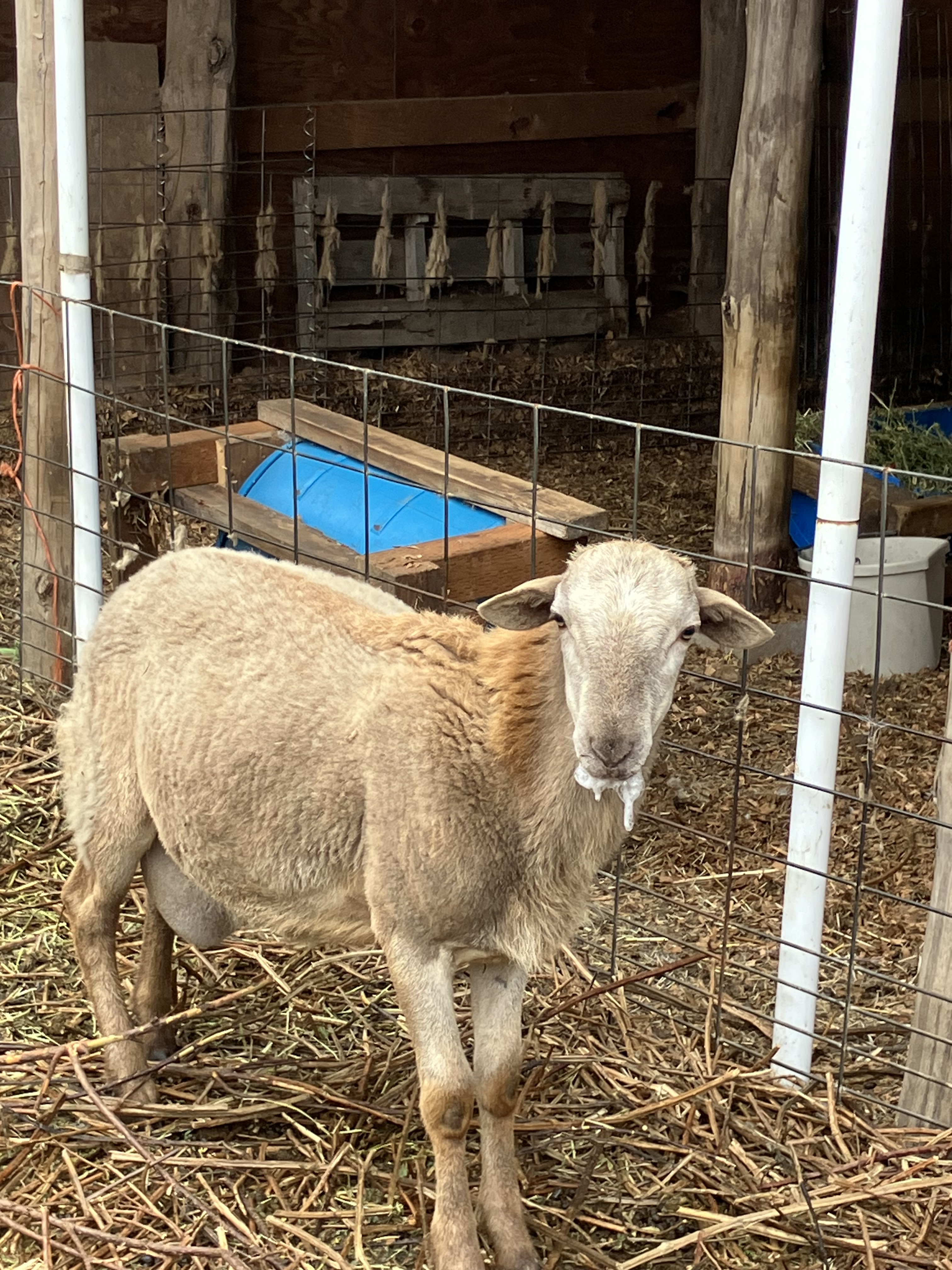
Right now, the lambs are gestating into their final weeks, though some of the ewes, especially the first years, might be months out from their drop date. It’s called dropping because the lamb drops out of the ewe when it’s born. Based on some bag swelling, I’m guessing these two ewes are due in the next week or two. Again, it’s not a perfect science without exact covering dates, but rough guessing does pan out when the teats look like this on a ewe.

The white ewe is Nelly, my go get em’, first out of the gate (usually) lamber. She’s half St. Croix, from a ram who was bred in a more commercial flock, where he had certain high production genetics, like size. Nelly is larger, and usually drops twins like clockwork. She also eats a bit more to maintain her large frame, which is not ideal when you’re working with pasture most of the year. Katahdin sheep are bred to put on good meat weight on pasture alone, which is great for keeping alfalfa costs down during the winter, when I have to hay the sheep to protect the pasture and let it rest during the wet season. The barn offers shelter and protection during lambing, and helps me keep the babes where I can see them. You’ll often see new lambs separated from their moms in open pasture settings. The oversight demanded to make sure the ewes and their offspring are safe goes beyond what’s needed in this setting. I have a small flock, in a decent barn, with maximum visual capability. If the LGDs bark in the night, I can come down to the barn and shine a light on all my animals at once, checking to make sure everyone is safe and accounted for. I could not imagine having to head into an open pasture to try to find lambing ewes in the dark- they often hold up in dense vegetation when lambing in the open, or hid their lambs while in recovery.

This year will be a good year for lambing at EEC, I can feel it, so, in this final countdown, I am so grateful for the sheep, their hard work to grow lambs each year, and the healthy good meat we’re providing at Leafhopper Farm. The land and the animals thrive, reflecting the healthy and happy life these animals live in their time under my care. I am so thankful for all the lessons they offer me, the time we spend together, and the trust they lend when I’m there to help. These sheep are my life, the legacy of this farm, and the real stewards of this place. So much abundance to come.

Forest Function

The profound action of an old growth forest cannot be easily measured. What we continue to slowly reveal, is that all our landscapes have profound function in our very survival. As humans, our curse is hubris. We think we know how to run the world, how to best manage wilderness, as though it needs our management. EEC Forest Stewardship is stewarding, but that’s cleanup after previous land owners cut the forest, put too many animals on the landscape, and degredated what had been crucial old growth temperate rainforest. There’s little of it left where the farm runs today, and not mush elsewhere, outside a few token National Parks. It’s difficult to know old growth is still being cut around the world, and that it will take thousands of years for any of those forests to come back. We humans don’t comprehend that kind of timeline, because it far exceeds our own lifetime. Another fault of our species is the lack of ability to see time outside ourselves. By this I mean, ecology has been evolving as a massive system for millions of years. The wilderness we see today, what’s left of it, has been evolving through complex cycles of climate change, global catastrophes, and many mass extinctions, which deeply impact how and what thrives on the land today. People really have no clue, but we’re great at tearing things up to get to what we value, no matter the cost.

I’m going to try to take a minute to help us look a little deeper into the ecology of old growth forests, and why they are crucial to human survival. There are reasons to stop cutting old growth which stretch far beyond any single bird species or carbon sink, it’s about how water gets to the land, how it’s filtered and cleaned for us to drink, how the air is filtered too, and soil building for generations to come. We like to count board feet of timber harvests, where easy profit is made, but if I came to my city council tomorrow, and told them we needed to pull up the drinking water pipes in town so I could get to some coal seams under the streets, that’s when people say “no” to extraction. When we see a direct affect to our lives, we ask for change. People, we have to see it now, before the only safe water to drink comes from a corporation that makes you pay too much for too little.

Forests make our climate, and without massive, old growth stands, these functions of our rains will continue to diminish. I’m not the best at explaining all this, but these two videos help, and I think taking some time to watch will help us all better understand why even younger forests need protecting, and why EEC Forest Stewardship strives to educate others about restoration farming and why planting native forest is crucial to our survival as a species. Please take a moment to take in these great pieces of information and reflect on how you can better support the protection of our native forests. Right now, our government is acting to cut unprecedented acres of our federal forests, they want to cut acreage about the size of California throughout the US. How can you help? Contact your local representatives, state, and federal too. Tell them our forests are not for sale, and why forests are important to you as a tax payer in The United States.

On another important note- all the land we live on today in The U.S. is stolen from tribal people who were deeply harmed by our government through military oppression, racial prejudice, and colonial dominion, and that’s just a jumping off point. Our continued abuse of tribal people, the lands, which are still held sacred by the tribes, which also still exist today to bare witness to Americas 250 years of direct abuse, and the hundreds of years of colonial oppression before that. I acknowledge that when I talk about federal and state forests, along with National Parks, I am participating in the dialogue of stolen land now “owned” by this country.

ORF Comes To Leafhopper

Did you know that sheep can get chickenpox? Well, it’s not quite the same virus, but similar, and contagious to humans. No, I did not get it, I used gloves and a lot of bleach to clean and keep things sterile through the infection. When I first got home from a recent trip, I went to check the flock and found them all with sores on their mouths and flipped out. After a long talk with my sheep mentor, I got on the internet and scared myself a bit more. How did the pox get into my farm? I don’t have other animals coming and going, and not a lot of visitors from other farm yards. Well, I’ll get to how I think it came into the farm, but first, a little more about this zoonotic disease.

Parapoxvirus affect vertebrates, and can jump from animals to people, so you have to handle it with caution. ORF stands for contagious ecthyma, also known as contagious pustular dermatitis, or sore mouth. It’s endemic in farmyards around the world, and commonly infects herds that have not yet been exposed. Luckily, it’s not fatal, unless you have young lambs, which were not dropping when this infection occurred in late Fall. I’d also finished my culling, so thankfully, none of my economic plans were interrupted. Typical infection causes one or two sores on the mouth, but my gals were eating alfalfa together out of the feeders, which, when the ewes dig down through the twiggy material to get to the leaves, prick their faces with micro-scratches, which then get secondary infection from the ORF. It made the noses of some of my gals look hideous for about a week.

As soon as I knew what I was dealing with, I got everyone out of the barn and away from the feeders. Then I fed everyone on fresh ground each day for the next two weeks until the infection resolved. I had a very well established local vet practice out to see things and make sure OLF was the virus I was dealing with. The vets complimented the overall health of my herd, and said there was not much they could do, the virus naturally resolves its self within a week. Once infected, the sheep have a natural immunity after that. The doctor assured me there was nothing I had done wrong to get the infection, that it could have come in on my shoes after a trip to the feed store, or on any surface touched by someone with the virus on feed sacks, mineral blocks, etc. I asked if it could come in on farm yard pumpkins and they said that was possible. I’d purchased a bulk load of post Halloween pumpkins from our local grocery store as treats for the animals, and shortly after those were fed to the sheep, they got OLF.

That’s the only think I could think of to fully explain the infection and timing. The virus spreads fast once infection occurs, and I had not been to the feed store within the week before I left. The vets were least suspicious of the pumpkins, and said it was not likely they were the culprit, so I did a little experiment. My rams were in a separate pen and not infected. They had not received any pumpkin. So, I had one left, and cut it up for them. Two days later… OLF. The rams had it, from the pumpkin- but that’s still only a hypothesis, so I can’t be 100% sure, but it was present in the rams right after exposure to the pumpkin. Here’s why this is a serious concern. If pox virus is on pumpkins that people take home and handle to carve, people will get OLF. I wonder how often this happens, and parents don’t connect the dots, thinking their kid is just having a reaction to something mundane, not a farmyard virus. This is scary folks, think about it.

How did the pumpkins get the virus? Well, we use animal manure to fertilize a lot of agricultural fields. Usually, the manure is kept in a liquid form and sprayed onto fields before planting. Other times livestock is moved through the fields to glean and graze, dropping their manure as they move around, and then that’s tilled in before the next planting. Either way, manure carrying the virus came in contact with the pumpkins, and was carried to my farm. I’ll not be feeding pumpkins to my livestock again. It’s haunting me now, because I wonder if it could be in hay too, or the alfalfa from the fields, or the grain. Anything growing in the soil where the virus is can have it, hence, it’s endemic in farmyards. I don’t know how more people don’t end up with it, but also wonder if it’s even being diagnosed. The pustules clear up in a week, and if you aren’t working on a farm with livestock, you might have a hard time connecting your infection with OLF.

This is not an article to send everyone with a blister to their doctors asking about OLF. It is an exercise in awareness- awareness that viruses are rampant, they are in our food industry, and without good oversight, inspections, and USDA engagement, the public won’t know what’s going on. Guess what? Our current administration has fired a lot of the USDA inspectors and oversight in our food web, so we’re in the dark about a lot that’s going on back on the farms. My vets confirmed this, and they are seeing a heck of a lot out there, especially on dairy farms, so folks, wake up. Wash anything you buy that was grown in a field. Be very cautious about sharing scraps of veggies with your animals. Dogs and cats can get this too- any vertebrate. Perhaps why we don’t see it more in people is due to its self vaccinating state as a virus that once you’ve had, you don’t get again. Wish COVID was like that.

It was so scary to see my ewes sick like this- a first time for me in ten years of sheep raising at Leafhopper Farm. The sour mouth made it uncomfortable to eat, but the ladies kept at it, especially once the alfalfa was in the field, on fresh ground each day. Normally, feeding on the bare earth is not good, but for an infected flock, moving them around the pasture to eat off clean dirt is much better than putting their heads in feed bins where the prickles of the stems cut their sensitive faces. When they are not breaking out with pustules, the feed bins are fine to eat out of. After the infection cleared up, the gals were back in the barn with fresh bedding and clean feed bins. They were quarantined for two weeks, with no additional culling or processing, because an infected carcass can still spread the virus, so don’t slaughter during an outbreak. I am so glad I’d already done my culling earlier in the fall, so this outbreak did not directly affect my profit line. I could see this being a major issue in larger operations where there is not as much oversight. Again, USDA is limping along with no real inspectors left to see that livestock is clean and safe. This should be keeping us all up at night.

I can’t say that a lack of USDA inspection caused my outbreak, but the vets confirmed infections of all kinds are up in the livestock world, and to be extra cautious with exposure. Luckily, Leafhopper Farm has a closed flock, meaning we don’t bring in new animals each year. Our breeding ram was sources in 2021 from a registered flock in the next county, so I can trace him back to his breeder and her flock. Since he’s been here for going on 4 years, I consider him well established and not exposed to any outside breeding. No other sheep or goats come to the land for any reason. This is one way to help keep a flock healthy and safe from exposure, but unless you’re cleaning your boots every time before you go to the barn, you could be bringing in something. I’ve now taken to having one pair of muck boots for the barn only, and do not wear any other shoes down there, but sometimes, when I’m walking by in other shoes, I still forget and walk in to add extra water, etc. So my biosecurity is a work in progress.

I’m still haunted by this virus, though it’s common and endemic, I’ll now have it in the soil here forever, though the vets assured me it was already here in the environment, as most viruses are, and that potential stress might have brought out the infection in my flock. I can’t think of any major stress these sheep could have been through in recent months, I still blame the pumpkins. Now, in January, it was like a dream. The ewes and rams cleared up, and there is no sign of the virus left in the flock, but it’s still around, so I’m washing hands, cleaning things with bleach, and keeping a sharp eye out as lambs get ready to drop. The young are the most susceptible, but there is not an active breakout in the herd now, so lambing season should go smoothly. I could vaccinate the lambs against OLF, but the vets explained that the adults now have immunity, so the lambs should be ok. My herd is not large enough to need vaccination, and getting OLF gives that immunity for the foreseeable future, so I’ll hope that with good clean bedding and healthy ewes, the lambs will stay healthy too.

It can sometimes be very embarrassing for livestock operations to have a breakout of disease, but also not uncommon. I was horrified that I had somehow neglected my animals or shown some kind of bad practice. The vets assured me I had done nothing wrong, and that this happens to most sheep herds. Has it happened to yours? My sheep mentor told me about her breakouts, which happen every 7-10 years. That’s how long it takes for immunity to drop enough for another round of infection to take hold. With this in mind, I’ll be less surprised if I get another breakout in a few years. It will be in the barn and around the landscape forever. That’s a sobering thought, because it also means a child playing in the field where the sheep graze could still become infected. That goes for children playing in any field where manure has gone, even composted manure, because viruses stay on surfaces a long time. It cannot be spread from human to human- thank goodness! To find out more, read the CDC description here.

It was not easy writing this post, I wanted to be honest about what happened, but not panic my clients, as no meat sold this year was in any way affected by this outbreak. I’ll have a full report on lambing soon, and hope to have a safe and healthy herd moving forward. Future outbreaks can occur, and I will know what I’m dealing with in future, but what a learning experience. I’m thankful for the vets that came and assured me the animals were ok and that I did nothing wrong. I’m grateful to the ewes, who took the whole thing in stride and managed to not get me sick during the outbreak. Thanks to my mentor for keeping me calm, friends who were supportive, and family for listening to my heartbreak. I’m so glad things are back to normal here now, and that all the animals are healthy and back to thriving on the landscape. Stay tuned for a lambing update soon. No one had dropped yet, but we’re in the final weeks of gestation, which is always an exciting time.

On Patrol

EEC Forest Stewardship has gone to the dogs this month. With winter fully set in her darkest days, the night predators are more active in seeking out a meal in the lean times. With the advent of a full moon, the nights become as active as daytime for many species, and the Livestock Guardian Dogs are on patrol day and night to deter incidents between wildlife and domestic stock. Our newest LGD on the farm is Koban, now in his fifth month on the job, he’s learning his big dog bark now, and running night rounds on his own. In the last hours of December, there was a particularly active evening and the onset of a wolf moon. I was awakened at 2am by my herding dog Val, who sleeps on the covered porch, barking at something on the move through the property. When I hear certain barks from my dogs, I know the situation is serious. Quickly rising from my bed, I put on my robe and grabbed the flood light for good vision outside. First I let Val loose to show me where the threat was. She tore off into the west orchard and at first, I thought I heard a deer pronking away. Then I heard the fleeing animal stop, and Val holding her ground with more intense barking. A deer would not stop and turn like that while being chased. I was going to head down the hill to join Val with the light, hoping to catch a glimpse of what was happening, but suddenly, both Kangal LGDs caught wind of the situation and all hell broke loose. Kangals bay when they see danger, and though I was still in the dark, the dogs knew there was an immediate threat on the landscape, and they were raising cane about it.

I called Val back to me and listened till the baying died down. The Kangals had run off the threat and Val calmly went back to her kennel. I returned to the house and crawled back into bed, knowing it would take a while to get back to sleep after all the excitement, but the peace would not last long. As I was just drifting off, I heard another barking in the yard, this time, it was not Val, but Koban. He was barking from just below the house, meaning he was out of the upper pasture enclosure for the first time. I jumped out of bed. Went out to find my Kangal puppy confused and upset in the driveway. How had he gotten out? It was now 3:30am, and I calmly put the agitated puppy back in his pen, and let Gill loose to run him on patrol along the fence, while I searched for a way out. There was one looser part of the fence I tied down, but I think Koban night have been motivated to jump the gate, if he saw the predator approaching. Still, he had remained on the property, and not run off chasing something, a real miracle for the night that I stopped to give thanks for.

Kangals like territory, and will expand their boundaries as far as they are allowed, so high fencing and good recall training are priceless. With the Kangals back on track in their enclosure, I returned to the house in hopes of getting some sleep, but the disturbances continued, so I used my final defense tactic, I loaded the 20ga and set off two compelling rounds from my boom stick, which silenced the night and let me get some sleep. This is a great way to deter predators, make loud noise, especially gunfire. Now, I’m not aiming at living things, I shoot into a safe berm in a ditch next to the house. The noise is enough to drive off threats, wildlife tends to avoid gunfire, and healthy predators flee. There were no more disturbances that night, but when I walked around the next morning to check for evidence, a deer jaw had been dug up from the compost and drug to the fence. I covered the compost with a fresh layer of ash, and made sure it was well covered with additional leaf litter and manure.

Scent will bring in a predator, so keep pens clean and kitchen scraps well buried. The ash is an additional deterrent that keeps wildlife and my herding dog out of the compost. I had just recently slaughtered a ewe, so the smell of blood was in the air, even with good cleaning and rinsing of my tools. I had put the guts far down by the creek, but a clever coyote might have come up to check for additional opportunity after a fresh kill. The old deer jaw had come up, and that was more than enough reward to risk slipping in. I’ve got a new gap under the fence to fill. It’s always important to check your fence lines, especially if an animal gets out. I’ll be spending a bit more time checking mine now that I have an excited pup who does not need to become an escape artist. I’ve learned that if animals learn to escape, that’s what they will do. Keeping boundaries well fences, and animals well fed are two of the best remedies to escaping.

I’m not mad at Koban for getting out, he was doing his job, but I am now more aware of his enclosure, and keeping him engaged in more sportive ways of protection. Let’s hope his adventures remain contained to his pasture duties. There has not been another escape since the last day of December, and I am thankful for all the support the dogs bring to the farm, and their loving companionship. LGDs prevent livestock losses, and most importantly, prevent fatal encounters with me. I’ve never shot a predator on this land, and would only do so if I found it actively attacking my animals. I hope to keep wildlife safe through deterrence strategies, and dogs are one of the best. Gratitude to my Kangals, Valentine the Aussie cross, and the energy to preform my own responsibilities to the farm, even in the middle of the night.

Flying Away From Flooding

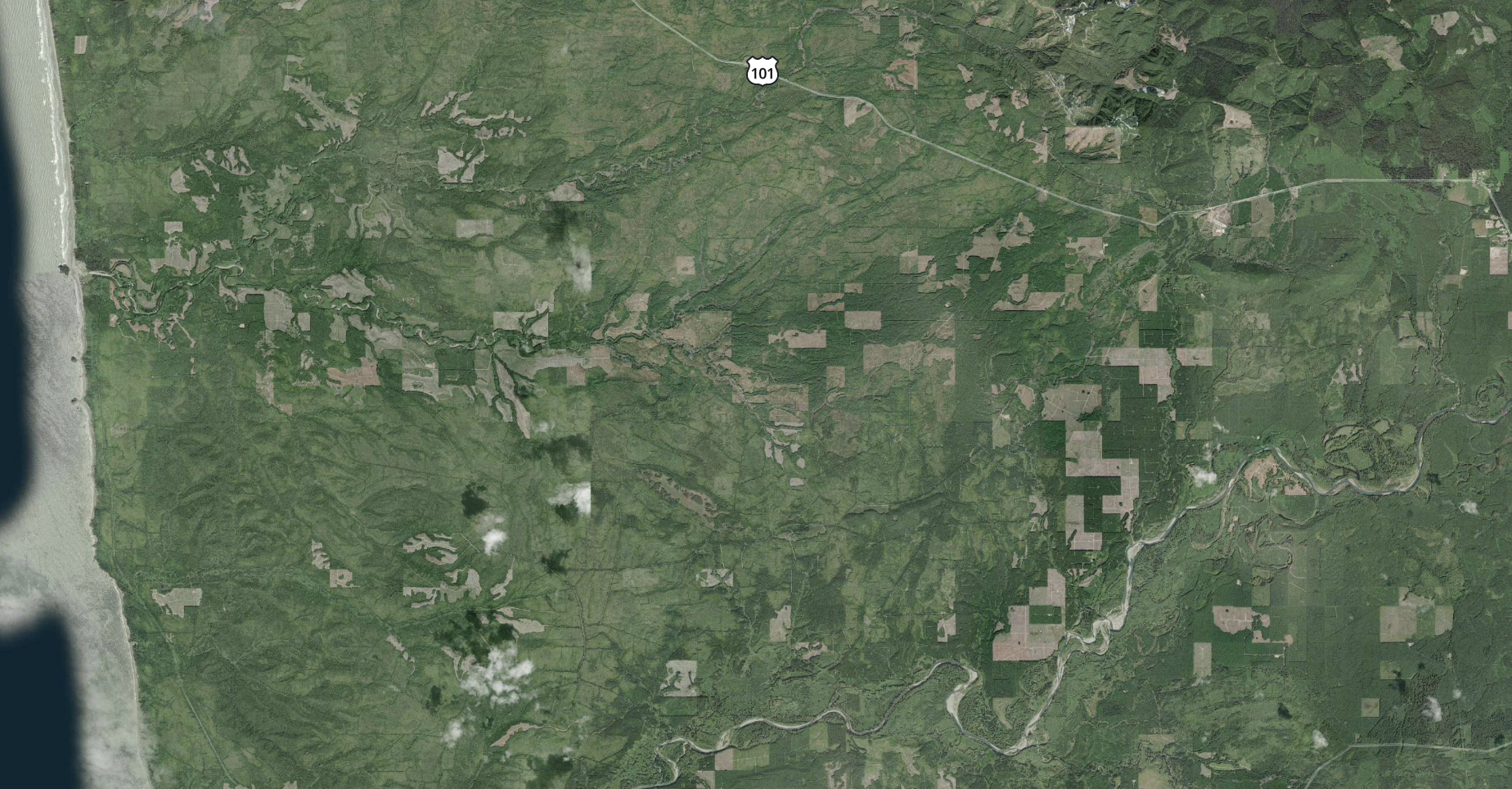
Yes, a surprise two day trip to visit family and I’m back in the air again- biggest carbon footprint I can make. I try to make the most out of these moments, so I grabbed a window seat and looked down. I knew it was going to be wild scenes in Puget Sound, freshwater outflow from flooding rivers carried sediment deltas far out into the ocean waters. The tides push back, but it’s fascinating to see just how much soil is going into the ocean from 50 miles inland or more. There’s also human and animal sewage, vegetation, dead animals, trash, polluted runoff from roads, and much more. I’m sure the coloration of these plums says something about their makeup, either way, it’s dumping into harbors and clogging waterways. Nature continues her rebellion against our abuse, and it’s easy to see the bigger picture form a few thousand feet up.

There’s a fresh snow on The Olympic Mountains, and also on The Cascades, near where I live. This snow pack is crucial to survive the summer drought, but the snow is late, and even the ski industry is getting hit this year as mountains remain closed into December. Hopefully this first snow stays, and gets added to often throughout the next few months of Winter. When we don’t get enough snow, the river valleys shrivel to nothing, and it does not really matter how much flooding happens now, all that water flushes away into the salty sound, and ocean beyond. In some places, like EEC Forest Stewardship, we retain the water, slowing it with earthwork swales, then sinking it into the soil, letting the plants drink deeply, storing the water. If we designed all the ground like this, we could keep water on the land where it falls, banking it into the ground to help maintain a strong water-table below.

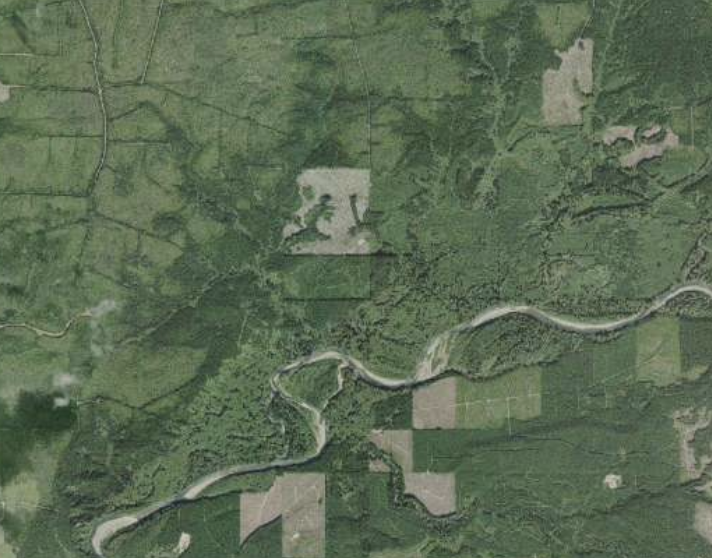
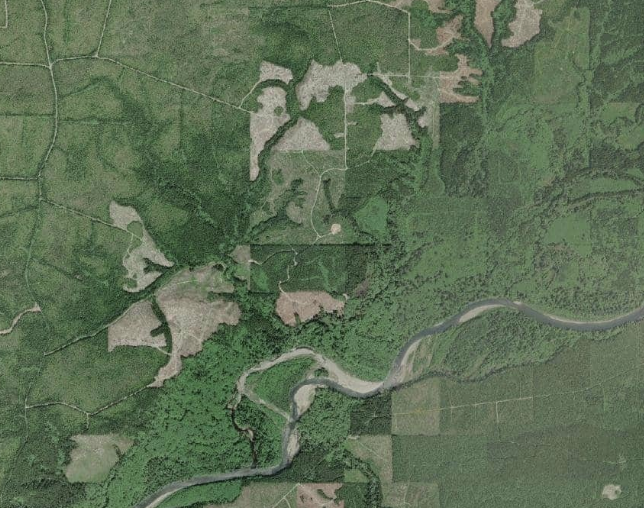
Water has been a huge influence on sculpting this landscape as glaciers ground the geology into pebbles and ice age floods scoured the land. Drumlins are easy to spot from a plane, and I took full advantage of flying over them with enough visibility to snap a photo or two. Since I was headed to The Southwest, we flew down into the Oregon end of Glacial Lake Missoula Flooding. Looking closely, I can pick out the river bottom ripple effect of the massive waters cutting across the landscape. These dynamic changes are nearly impossible to fully comprehend, as we’ve never seen water of such volume in recorded history. The First Nations of the area do have oral histories that tracked glacial retreats and migration up and down the coast and inland valleys in their canoes and on foot further east in the high desert, thousands of years before Spanish conquistadors brought horses.

In early December, 2025, atmospheric rivers flooded The Cascade Mountains for weeks, and the lowland valleys below. This flooding was no where near what the melting ice sheets delivered in a single major flooding event, but Western Washington got a glimpse at how water takes over a place, filling space and blanketing vast areas with sudden change. Thankfully, EEC was not in any flood danger, but witnessing some of the chaos from the air as I flew south, gave a lasting impression.

As my flight continued, passing over Western America from 40,000 feet above, I was able to witness other climate fueled changes going on across the landscape. Over Utah, The nearly dried up Great Salt Lake is caught in a polluted disaster as winds whip up the dry lake bed where countless toxic sediments await a chance to fly. When this happens, air quality plummets, and being without filtration masks or an h-vac environment will cost local residence their health and well-being. I knew my flight path would take us very near Salt Lake City, Utah. As we crossed over this vivid landscape, I began to see the dust clouds rising between the vapor clouds at low altitude. At first I thought they were wildfires, but no flames appeared below. The wind was carrying up the dust and spreading the heavy metals and corrosive chemicals left in the lake bottom after two centuries of industrial abuse and environmental neglect.

Perhaps we think, in our short lifetimes, that these catastrophic environmental collapses will not bother us directly. It’s already costing us, from insurances of all kinds, to the environmental pollution that causes so much of the health problems we face at younger and younger ages- effects not easily measured by science, due to the expansive variables involved. Half the population in The USA suffers from poor air quality. You may be living in what you think is a pristine environment, but the legacy of industrial greed and corporate extraction haunt not only the air we breath, but also the water we drink, and the food we eat- all of which remains exposed to our own polluting habits. Flying on an airplane is not helping, as I said earlier, it’s one of the worst impact I can make as an individual at this time on Earth. Where have we gone so far off the rails? In one word- population.

Let’s take a trip back in time, to a place in The Southwest of America where prehistoric humans thrived in a different climate, one that today may present as high desert, but was once a lush savanna with thriving populations of grazing animals and clean environmental quality. Tsankawi is a magical place I’ve written about before. As a avid outdoor enthusiast, I am draw to places where early peoples lived and thrived when the environment was conducive to such habitation. The site is an entire small mesa complex that would have had a flowing stream on the south side with canyon walls to drive herds towards easy to hunt bottle necks along the waterway. 360 views from the top of the pueblo secure the area from all direction against raiding and ambush. The stone age people who first established residency in the cliff caves would have thrived in a time of more rain, better vegetation growth, and many more animals to hunt. They would have been dabbling in early agriculture, as well as hunting and gathering throughout the region.

Life would have been mush more challenging over ten-thousand years ago, but it would have also been short and sweet. I can only imagine that during a lifetime in this stone age village, a person would have deep connection to place, the plants and animals that sustained them, and strong connection and belonging in the community to survive. How can we rekindle this connection in our own lives today? Can you cultivate anything in soil where you are? What is the source of your drinking water? Where does your food come from? Do you have a larder for emergency? What kind of birds sing near your home through the different seasons? These are only a few questions out of many we can all be asking ourselves to reconnect with the natural world, and better see our relationship to it. We may thin more about a grocery list than setting a trap for a rabbit or foraging for wild grains, but the sources of our food still come from land worked by other people to keep us fed, and those crops can and will be directly impacted by our actions day to day.

The people who established the cliff dwellings at Tsankawi eventually abandoned the area by the 16th century, about the time there was a sever drought across most of The Southwest. The exact reason for human depopulation throughout the region is still unclear, but unrest was the outcome, through many of the surrounding First Nations today claim the stone age people of Tsankawi as ancestors. The high desert now well established in New Mexico does not lend its self to massive populations, but in prehistoric times there were many more natural limitations to massive growth, from infrastructure to the variable climate and unstable early agricultural. Too many people in an area depleted wildlife through hunting and trapping, until a lack of food would force displacement. When resources became scarcer, raiding would increase, making permanent settlement vulnerable to attack. The larger a settlement, the larger the demand on the natural world, which, when left unchecked, depletes everything until famine and starvation take hold. Ecological collapse often plays a role in toppling civilization, and without food sovereignty, all populations are susceptible to this looming threat.

The United States has an unbelievable arsenal with weapons of mass destruction for all. Just a few miles from this site, the birth place of atomic weapons continues its quest to stay ahead in the arms race. The current indigenous nations of the area remain on reservations (pueblos), through they continue to quest for their access to sacred sites and the resources needed to remain connected to the land through hunting and gathering, as well as agriculture. They also have strong spiritual ties to this place, where ritual and traditions are still practiced. I am so grateful to know these people are still present and active in the area, and continue to voice their concerns about colonial treatment of the earth and the impact of military occupation today. Reflecting on our personal lineages and how we directly or indirectly benefit from the removal of indigenous people from their traditional homelands over the past few centuries. My ancestors came from Europe on boats through Savannah Georgia and moved west from the 1700s through the 1900s, ending up in Oklahoma, where many First Nations were sent as eastern states filled up with European immigrants after initial colonization of The East Coast.

Right now I am sitting on stolen Snoqualmie Tribal lands that were carved up by timber barons in the late 1800s, along with railroad tycoons looking to cut a way through the big trees to ports along The West Coast. Legacies do matter, and our ability to name our ties to them, to see how we live in the wake of them today can be a powerful and ongoing lesson. It’s a chance to reflect, take in, and respond. My response is to stand in these sacred places to learn from the statements being erected by the original people, who are still here and willing to speak to us, to ask us to listen. They are slowly putting up their own boundaries, offering insight, and reminding visitors that the land is still part of their heritage. When I summited the cliff and stepped to the edge of what was a later pueblo structure, there was a new sign up with a clear message to go no further. Though in past visits, there were walking paths into the central plaza, now a clear direction to keep out reminded me that people are not always respectful guests.

I’ll remind us that National Parks, like Bandolier, were never discussed with the local indigenous people that once lived there. Whole villages were often removed from the wild places we call park today. Though parks do preserve important wilderness, the people that lived in deep connection with those places, were part of the wildness in them, have been taken away to offer an illusion of pristine wilderness we like to think of as untouched. Some states are working to change this assumption by teaming up with local tribes to change public understanding of parks and why they disenfranchise many indigenous people who once inhabited what are now National Parks. Tsankawi remains part of The National Park system, and visitors pay a fee to be there, but local Pueblo People also come to practice traditional ways in the area, and remain connected to their ancestral place. Where are your ancestral places?

The petroglyphs are yet another reminder that ancient people lived here and were deeply connected and reliant on place for shelter, food, water, family, and community. We can all relate to these needs in our lives today, but most of us will never carve sacred symbols into the wall where we live in reverence to the space that holds us. When did you last make some lasting rock art to communicate? When did any of us last sleep in a cave? I took the opportunity to sit in one at the site, looking out across the landscape while imagining what it would be like to tend a fire there, cook some venison, and talk with friends and neighbors late into the night, sharing stories of long journeys successful hunts, and celestial navigation. When was the last time you slept under a blanket of stars? This place truly inspires me, and helps craft some personal dreams to reconnect, share, and spend more time outside with others. Though I came to the monument alone, I met others on the trail who stopped to talk and reflect on the experience in this magical place. We stood in awe, appreciating the beauty and human presence literally carved out of petrified pumice. Below is a footpath up the cliff side that has been worn down over centuries of use. There are many paths like this along the way in this loop trail, and the feeling of following those footsteps drops me right into prehistoric life thousands of years ago.

I’d flown a few thousand miles to be here, and celebrated another incredible trip to one of my favorite prehistoric sites on earth. The opportunity to be in a high desert terrain full of early human settlement and a legacy of connection to the sacred rejuvenated my own vision to place connection back in Washington. I chose to live where I am because of the abundance- water, temperate rainforest, ocean, mountains, rivers, lakes, and high desert on the other side of The Cascades if I want to dry out and find the sun again. What privilege! We can all be grateful to access- public parks, public lands, public education. Let’s try to spend more time in public, being present with place and those who share it with us.

As the flood waters receded, I returned to The Puget Sound and found it raining again. I love water, and am thankful for all its gifts, even when it seems like we’ve had too much of it. The sacred floods are a part of this land’s great history, along with massive ice sheets, monumental great floods we can’t comprehend, and a lot more to come. From strata volcanoes to some of the most active fault lines on earth, Western Washington is a heck of a place to call home, and I’m grateful for it every day, and the opportunity to share these adventures with you dear reader- thank you for your time and interest.