Boulder Retainer Wall

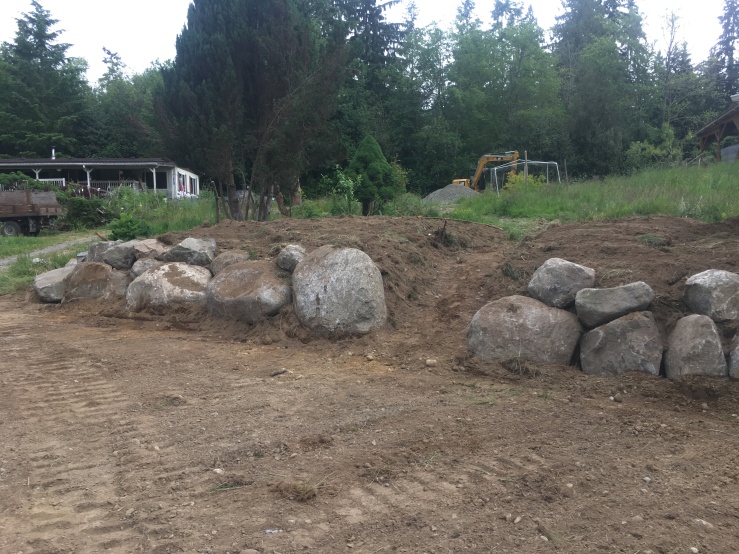
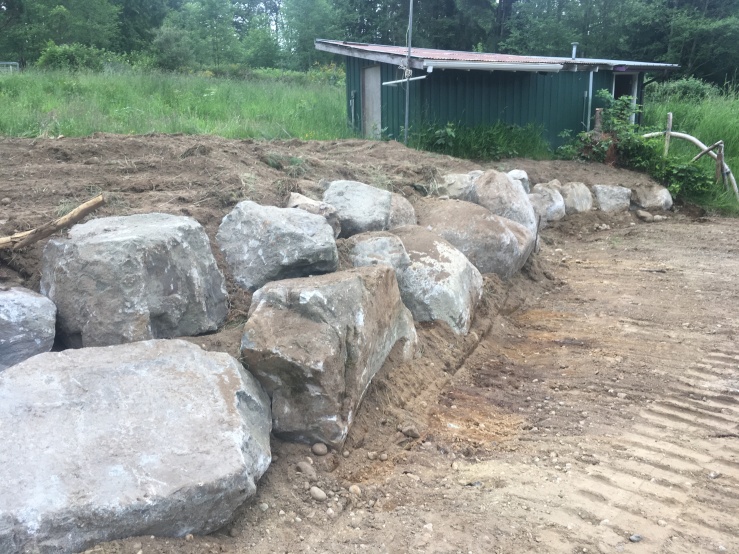
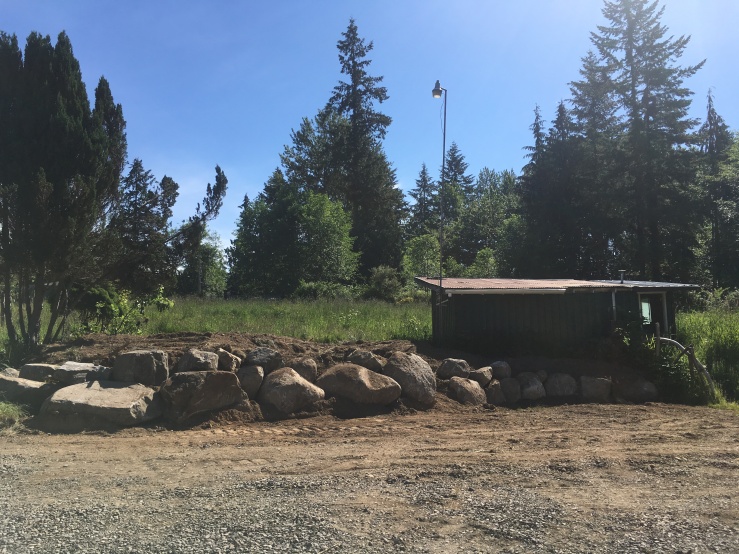
As the original designer of Leafhopper Farm, Steve, used to say; “It’s all about entropy.” This is true, especially when you’re living on a hillside. The area below has been slipping south, and I’ve had plans to build a retaining wall for a while. Now the rock is in, and hugaculture beds set for more garden growth. This area will be planted with natives and cultivated as an amazing sun trap. The rockery also offers unique habitat options for our local wildlife, and I hope a lot of snakes call it home in future.

IMG_8321.JPG

We’re also trying to remain aware of human use in space, part of the permaculture inspiration at Leafhopper Farm. A footpath established from the parking area to the main living spaces compelled access, so a ramp was put in to allow for human foot traffic, and the use of a wheelbarrow. This freshly establish bed space will receive a cover crop and some good watering in the coming weeks. Bare earth is not good, and in these hotter months ahead, establishing ground cover will be harder, but not impossible with some good irrigation.


IMG_8323.JPG

This new rock wall is also addressing drainage, as much of the water falling during heavy rain further up this slope sheets off down the hill and into the driveway. Now the retaining wall catches that runoff into beds, and many new plants put in will suck up that moisture with enthusiasm. There will still be overflow drainage planning, and in future, perhaps a rain garden instillation will go in. Though we are getting less and less rain, when it does come down, it pours, impeding the slow soak in which this environment is better suited to.

IMG_8329.JPG

This parking space is also now well defined for future use. Creating clear transition zones in more often used areas of a landscape helps direct smooth flow and clear design. Anyone approaching this wall will naturally move to the ramp to go past the barrier. The landscape is held in deep planting beds behind large rockery stacked boulders. The form is pleasing and well shaped in a curving flow along a south facing slope. The solar heat bank within these igneous giants will keep the beds warmer, and reptiles happy too. Our snake and lizard populations are allies in the control of insects and gastropods.

With the use of natural material from our area, we have sculpted a topographic anchor, improving the landscape and addressing one of our greatest challenges on a hillside, erosion. The project took an afternoon to complete using a bucket loader, a delivery of stone from another excavation site near by which wanted them removed, and biomass from the farm to build up our new planting beds. Having a practiced operator for the machine was also priceless, doing a project like this yourself would take several days of boulder maneuvering in unskilled hands. Another great shout out to Mark for knowing his machinated helpers so well.

Cascade Scouting

IMG_8311

The spring melt is well underway in the Cascade Mountains near Leafhopper Farm. My partner Bernard and I went out to scout some beautiful places and found some great waterfalls and perhaps, a fossil or two. In our enthusiasm to get into the alpine elevations, we assumed the warm weather had taken care of the last snows along mountain roads leading up to the peaks. Well, not yet!

After forwarding a few very hair raising spots where avalanches had come down earlier in the winter, we decided not to forward on into the ice and snow, for fear of getting stuck or slipping off the ledges. Though we were unable to summit, we found a few great water features in their peak spring flow along the gullies in our beloved mountains.

IMG_8312

It was impressive to see many fresh fallen logs and other woody debris at the base of some falls. The winter activity in these mountains can be rather dramatic, from ice snapping trunks, to high wind blow over. Remanence of this forceful weather lay across the road and in ditches along our drive. Rock slides were also evident, and we even spend some time clearing small boulders from our path.

The spring buds had not yet bloomed at higher elevations, and the trip backwards in time was a little confusing. At the start of our drive up, red alders were fully leafed out, and salmon berries were rip for eating. At a few thousand feet up, trees were just starting to leaf out, and some salmon berry had not even gotten that far yet. In some areas, more south facing, fire weed was popping up, but on the north face of the slopes, only a few ferns had leafed out at all.

IMG_8313

At one waterfall, we stopped to have a closer look at the rock formations, seeing a sprinkling of granite and some more familiar metamorphic fluvial deposits, which are known to have good fossils within. We looked hard, and even thought we’d identified some shapes, but no official confirmations were made. I took the picture below to show a form which looks a lot like a palm frond, something common in our finds further north in The Cascades.

IMG_8314

It is always so special to visit our nearby peaks, enjoying some good mountain time, while exploring the endless back roads and forest service trails all over Washington. We were able to see so much, make notes on future foraging sites, mark spots to go back to for more exploring, and enjoy the general splendor that is The Central Cascade Range.

Megaladon Magic

IMG_8297.JPG

An amazing machine showed up early in the morning to help work on large scale at Leafhopper Farm. There’s been some tree work done, and a lot of debris needs to shift around the farm to new homes where we’re setting up hugaculture beds. What about top soil to cover the branches you ask? Well, the other major porjects for this week’s machine work involve leveling space for our 20,000 gallon cistern and a future greenhouse/biomass storage shed.

IMG_8300.JPG

All the sod and top soil from the building site was trucked around in a matter of minuets. It was fabulous! For someone who usually does everything with a wheelbarrow, the expediency of a few good machines and a day’s work has done more than I would have been able to manage over a month of continuous labor. This “megaladon” work, an affectionate name I give to all the earthworks machines that come onto the farm, has been planned out over a few years, making the week long rental of the machine count for every task. We’re moving lots of material, and grading, and setting a large rock retaining wall down by the well house. I could never have achieved this along with just a shovel and my truck for hauling.

IMG_8303.JPG

A machine’s “footprint” on the land is quite large, and a lot of recovery time will happen after the work is finished. But the work will happen fast, and get large scale projects completed in a timely manner, leaving more time for me to plant, tend, and manage the farm as a whole. None of the biomass is leaving the property, all trees fell will be milled and returned in a lumber package for future building.


The large pile of dirt pictured above is all top soil and sod leveled off the building site. Our magical operator, Mark, who also runs Allied Tree Care, has put a lot of time and planning in as well. I am so grateful for his experience and support in this series of large scale projects, because I would be at a loss on how to drive the machine, much less drop 2-3 ft. diameter trees. Mark has supported Leafhopper Farm in all it’s earthworks projects, as well as water feature design, swales, drainage, road work, and so much more. It really is special to have a friend with the knowledge and network to acquire all the equipment and material we need, without any hassle.

IMG_8301.JPG

We had rock and sand delivered to make a “bed” for the water tank (pillow) to rest on. The dumpster hauling truck made it easy to fill one bin, while he went to pick up more materials in another. Then he would dump one and haul the other to a new part of the land where the topsoil would be placed. It was a great way to stage and move material without interrupting the flow of machine work.

By the end of the day we had our topsoil staged, tree branches moved, new hugaculture beds established, one tree removed, power lines located by the electrical company (always call before you dig!), and even a habitat snag placed where the old spruce hybrid Christmas tree once stood.

IMG_8306.JPG

Day two of the large scale project time was delayed by rain, something you don’t want to move heavy material around in if you can help it. We’re hoping things will dry up this afternoon so we can renew our work in shaping more landscape. We’ll get a delivery of rock today and have a retaining wall set with the help of the megaladon. The final big push will be next weekend, when we drop a grove of bark stripped cedars next to the barn sheds and chicken coop. That biomass will take a few more days to stage and set for erosion control in some of our healthier forest groves. More to come at Leafhopper Farm.

New Perspective

08CC298C99B66E5AB2AA02C6CB60D975.JPG

We went up a few hundred feet to see how things were getting on at Leafhopper Farm. A good friend brought over her drone for some fun flying, and it was wonderful (though loud). The evolution of landscape in the last six years shows across these acres, and there’s so much rich terrain, it’s hard to pick a place to even start. Above, using the central turn around drive like the center of a clock, we’ll start in the top right corner at one o/clock where the pond is. Currently, the water is a third of the size designed when we dug. It’s still an impressive feature, and will seal in time, making a fabulous habitat for wildlife and people alike.

Moving down to about three o’clock is the double cabin and sunken garden space where a raised bed stands. There is room for more raised beds as production demand increases, and irrigation from rain catchment off the roof into a 5oo gallon cistern. Note that just to the south of the cabin, at four o’clock, we topped a western red cedar to protect our structures, and bring more light to the gardens to the north of the tree. Just to the left of the tree in photo, is the green house, which is hosting mostly tomatoes right now. Our starts are out in the kitchen and front gardens now. Due south at six o’clock is the driveway, but just to the left of that is another cut tree. A hybrid Christmas tree planted by the previous owners was a cause for concern to structures, and again, we cut to also let in more light to the upper gardens, which has made a HUGE difference in production this year.

Between seven and eight o’clock are the swales, ready for planting this fall and winter, after our 20,000 gallon tank is installed to flood irrigate. Our well house stands at nine o’clock, and by eleven, we’re looking at a cedar grove slated to come down later this week. Below is a close up of that grove and the buildings, including the shop and tiny house structure at noon in the photo above. This grove was stripped of much of its bark by livestock overwintered without enough fodder. Horses are notorious for this behavior, and it’s killed a lot of trees here in The Pacific Northwest. The grove just to the north of the barn structures will also be thinned, giving us a load of wood to mill locally and build with.

E2A1B8CC660F8FB80E14684DA33CA6C3.JPG

The current barn and coop structures are in desperate need of rebuilding, and some good lumber will aid greatly in making repairs, as well as putting in a new biomass/greenhouse structure for rain catchment to fill our new bladder tank. This will be the only planned “logging” of Leafhopper Farm during my stewardship of the land, and hopefully the last. However, we’ll have King Conservation District out this week to talk about the farm’s forestry plan, and hope it’s all conservation and restoration planting from here on out. On another note, we’ve already planted replacement trees equivalent to this grove on other parts of the property, and will continue to reforest in our stream buffer area, and other groves on the land that could use some diversifying.

In navigating the drone to look at different aspects of the landscape, I could not help but notice how green and lush the property looks, and yes, it’s Spring, but the land still looks diverse and thriving, without bare spots or dead zones due to over grazing or chemical abuse. There are tended garden spaces, human and animal trails, earthworks, and so much vegetation, I love it! The shot below of the main house and garage show how much gardening is going on in zone 1.

8E113234090F1E823163A3CEF197C9F2.JPG

A lot of the kitchen garden space has turned into native plant nursery, which will continue to lead our gardening plans as we shift more into perennials and under-story stock. Hedge plants also thrive here, and once established, can be cultivated as “mother plants” to new offshoots. We can take cuttings and root stalk from the natives to perpetuate more of each species on the landscape. I’ve already been experimenting with some of our cultivars, most recently lavender, which I pulled from all the herb gardens, as they were becoming too big for small rock gardens. I did leave rooted branches behind as I dug up each main shrub, and those branches are now filling out as new shrubs themselves. In replanting, I doubled my lavender population.

In the photo above, you can see there are three main gardens, the kitchen, front, and raised beds. All planting locations have hose access from a spigot, and in future, a more elaborate drip irrigation will be implemented. Right now, we’re still using primitive sprinkler heads and a single hose. It’s a passive system, but I move the sprinkler around and get the focused weeding done in the process. We have more in the gardens this year than ever, with a third planting happening in the next few weeks, to fill in the last open spots for food crops this summer.

A lot of the drone footage was video, and too large to upload onto this platform. We’re hoping to upload them on our Youtube channel this week with more commentary.


Goat Grazing

IMG_8244.JPG

The goats play an important role in maintaining the landscape at Leafhopper Farm. By grazing and browsing, these ungulates replace the wild species no longer roaming this area. Cervus canadensis are native, and some roam the valley not far from here, but they are not migrating through in vast herds as they once did, and the undergrowth has changed drastically in response.

The introduction of Rubus armeniacus by Luther Burbank, a famous plant breeder, and infamous eugenicist, to temperate climates across America from seed catalogues, left our region with an invasive legacy. Without intensive management, this plant will take over any open space. That’s where the goats come in, and they are very efficient at consuming the quick growing shrub.

I’ve spent a lot of time talking about how goats help maintain the farm grounds, and they can also be good lawnmowers in the fields. This helps keep grass seed down, and turn fodder into meat and more goats. In the picture above, Branwen stands at the edge of her finished grazing area. It’s easy to compare eaten swath to untouched pasture; what a difference!

IMG_8265.JPG

Above you see a recent cleared space the goats moved through. This area was infested with thick blackberry, which is still rooted in the ground, but not getting much sun anymore. That’s how the goats win out in the end, by taking the photosynthesis away from the bramble, curbing its expansive growth. Below you see another pictures of bramble takeover. It’s a patch of blackberry which will be mowed down to the nubs of rooted plant, then left to bake in the hot summer sun.

IMG_8267.JPG

The goats are keeping the grounds manageable, but they are not the long term plan for the landscape. Eventually, we’ll establish enough under-story and new trees to shade out the bramble, because in an intact forest, the ground cover of blackberry cannot establish, because not enough light penetrates through the layers of evergreen branches to the forest floor. If it does, I can easily clip the few that try to reestablish. Eventually, we’ll phase out goats at Leafhopper Farm, in favor of cultivating continued rich diversity of plants, without invasive bramble taking over.

Finally, a picture of the same space above, after goats graze it down for a full day. They really are amazing transformers!

IMG_8272.JPG


Flock Refresh

IMG_8241

The new chicks hatched in March are now integrated with the adult flock. Though noticeably smaller, these hens and young cockerels are fully fledged chickens now. To introduce them to their now home, and let the older gals get to know them, I keep all the chickens in for a day together, with plenty of grain and fresh greens as a distraction. The young hens are brought in during the night while they are roosting, then they wake up in the coop with the other hens and begin socializing. It’s important that new hens in a flock come in a group of three or more, so they can bad together in the face of an established flock. This avoids bullying and pecking, but some will go on as “pecking order” is established.

IMG_8259.JPG

Our Ayam Cemani rooster, “Black Jack”, is minding the hens well. He’s a handsome guy, and I’m excited to see how his genetics play out in next year’s clutch. I will not be buying extra chicks this year, instead focusing on the Cemani genes. They seem to pair well with the Delaware hens, and the Barred Rock genetics come out strong too. I’m not so happy about the Rhode Island Red genes with Ayam Cemani, the offspring have rather bladed heads and smaller frame. The Delaware genetics enlarge the Cemani frame, making them better layers. If I do introduce another breed, it would be Orpington, as those hens will be large, and pass it on into the Ayam Cemani.

IMG_8255.JPG

Next year, we’ll see how the Maran genetics play out, and the Barnavelder. It will also be interesting to see how Black Jack’s genes look, compared to his brother Big Comb’s. Big Comb was obviously a mixed Cemani with Barred Rock, and those genetics were showing up strongly in the chicks. There is one Barred Rock cross in our flock, but Big Comb had a lot of red in his comb, which is not present in a pure blood Cemani. We’ll see what Black Jack “throws”. This batch of chicks was another successful incubation, with a lot of nice black hens in the final flock count. In a few more years of breeding, Leafhopper Farm will begin to sell Ayam Cemani stock for collectors interested in working with this Javanese native.


Garden Delight

The second round of planting is in and growing strong at Leafhopper Farm. The gardens are “thicker” this year with a sprinkling of native plants which have been slowly establishing in the garden. Young plants need a few years of nursery care before being planted out on the landscape. Many of these plants are shrubs and trees, so the gardens are not their final home. With a cover crop in, weeding has been very easy, and a lot of lovely green mulch abounds.

Potatoes planted last summer are showing up with gusto this year, and we’re bound to have a good crop. The greens will not get a lot of mounding, because they were unplanned, and I’m going to start thinning them out, to make space for other crops, but there were certainly some left overwinter in the soil and they are not back in action, for better or worse. Most information on this issue is vague, and using the same seed potato stock each year is not recommended, so next fall, I’ll be sure to hunt out all the tubers.

Onions are also thriving this year, though most are small native verities, like nodding onion (Allium cernuum), we’re still using them in substitute for store onions with great success. Chives (Allium schoenoprasum), are useful too, and easy to transplant, bringing more flowers around the garden for pollination. Brassica oleracea has flowered out in all her verities. I’ve certainly gotten a very good head start in the garden this year, and hope for a lot of good eating this growing season. 

Many more seeds have yet to be planted through the next few months, and I will try to get a cold weather garden in by September this year. This last weekend, many of the greenhouse herbs were transplanted, and I took a risk in putting out baby pepper plants, who are still very vulnerable to slug predation. A few extra starts are still in the green house, to be planted out in a week or two. The timing of planting this year seems more in sync, with some plants bolted for seed, while enough young plants to harvest tender leaves from are coming into maturity at the same time. Now if I can keep the plantings in rotation enough to keep those young plants from bolting too soon in the hot temperatures of mounting summer sun.

Weeds are down, but still present, and rather than fight with them or worry, I just keep planting in new things to help shade them out. Weeding is also a given, and the study of what weeds come in and when they seed is ongoing. My cover crop did preempt the weeds in some parts of the garden, but enough weed seed is still coming though to illicit more mulch and better seed prevention through early removal of unwanted species. I’m itching to get a new scythe stone in the mail, as I lost my old one on a day of cutting and have no other rounded stone to use on the curved blade. The grasses are going wild with our recent rains; warming temperatures only add to the abundant growth.

This wonderful kickoff to the growing season has put Leafhopper Farm’s gardens in full bloom, and we look forward to cultivating more verities of tasty edible morsels, along with some good pollination color. The diversity and scale of gardens continued to grow, and with it, more advanced systems of watering, weeding, and planting to support this labor of love.

Kittens Continue – for now

IMG_8218.JPG

These little grey puff balls are slowly mutating into cat like formations at Leafhopper Farm. Lucia moved them under the woodpile to cooler locations after we had an 87 degree day. The new “den” is dark and cool, colder then I would like, but heaven to a momma cat with two kittens. We’ll be taking the whole pride in for vet check next Friday, and Muir will be castrated while Lucia gets her final blood work before her own surgery to spay in a few weeks.

The two kittens will be additional barn cats, and that’s the cat legacy of the farm. After a year of observation and continued debate over cats as part of our systems, they have done a good job with keeping mice out of the buildings, but rats continue to survive on the property, especially at the chicken coop. We’ll be building a new coop soon, which might help address the issue, but the cats have not kept up with rats, and I had to bait for them again as a result of a minor spring infestation. The cats have caught and killed rats, but I’ve only seen them with younger ones. The number of adult rats on site speaks for it’s self. We’ll double our cat numbers to 4, and skim down on feeding to stimulate appetite.

Muir had a young rabbit this morning, and I have not seen many bird feathers about. Robins even have nests in most of the usual places. Ground nesting birds are absent from the zone 1 areas of the farm, but there are many hedgerows being planted to supplement cover and create more habitat. The cats will be here for now, but no plans of continuing this species at Leafhopper Farm is slated for the future.

Farming is Suicide

NPR ran a story this week about how farmers now have the highest occupational suicide rate in The United States. Note that educators are lowest in this risk pool, so it’s not about salary. This is about the soil, the earth, and an impossible task to squeeze blood from a stone. Any large scale commercial farmer, we’re talking mostly people growing industrial crops like soy, corn, and grains, are waking up to the loss of any financial safety net from the government. First I have to ask why these large scale places need such a safety net that without it, their farms fail, and second, why supposed food crops are tied up in political shenanigans.

The first question takes us deep into the history of farming in America. From The Dust Bowl on, government stepped in to give financial buffers to farms when bad weather or international trade prices caused a major upset to profit margins. We’re still talking about mega farms, places where a mono-crop policy of planting the most lucrative plants like fuel crops, and animal feed crops for factory farms, overtook a farmer’s focus on feeding people. These industrial farmers are still fed the myth that farming feeds America, but that is a threadbare story. Most soy, wheat, and corn goes overseas, into ethanol, or down a pig/cow/chicken’s throat in a feed lot where the animals are fed more than just grains.

Perhaps it is the realization that most farmers really aren’t feeding people any more, which has an effect on their moral fiber. Maybe the idea of poisoning the land with chemicals to get a better crop, while seeing the devastation it causes, then feeling their hands are tied, pushes farmers on large grow operations to despair. Most large farms in the Midwest are controlled by corporations, not the families running the farms. Those bright red barns and smiling faces of young families we see all over the consumer market are total facade. Politically, it’s a staple in conservative rhetoric, and the conservative minds of Midwestern towns eat it up, like they eat up Tyson meat products and push into WalMart with open arms, not realizing those are the companies preying on their small town industries and putting them all out of work.

I feel this personally, as an Oklahoma native, watching my father’s small home town disintegrate before my eyes as the peanut and cotton industries abandon the state for international markets, ushering oil and gas to drill and frack, polluting water and soil even more. What I see planted near town now is fuel crops for ethanol, and that plays into the commercial energy market just fine. But there are no more family farms, and the only real cattle ranch left is the Braum’s corporation; an ice-cream chain that is known for using growth hormones in their animals to produce more milk. Those cows are not happily wandering a grassy plain, but cooped up in a milk parlor while what’s left of their range is carved into drill decks for more fracking operations.

Another article I read recently about farmer’s suicide links the current crisis to a commercial fallout in the 1980s. In a nut shell, the farming economy bottomed out, and loans were called in. Millions of acres of land were lost to corporate mega-conglomerates who seized on privatizing farming and creating the huge mega-farms we know today across the Midwest. The control of farming was finalized with the patenting of life, and any farmer not participating in the Monsanto seed programs ended up in court battles over GMO seed contaminating their crops. For those who are still unaware of these practices, read this. Monsanto, and other large industrial agricultural companies now run farming practices and prices all over the world. This is part of a much larger consolidation of all consumer goods into the hands of a few large businesses which now run the world economy, and not for the greater good of the people, but for the profit of investors.

Food is not a stock, it’s a staple for survival, and that’s why most of us who go into growing food feel passionate about what we do. Some farmers keep to the organic method, and have a successful time of growing smaller, better quality crops that people will eat. But the capitalist market wants its share of profit, and food is a requirement to live, so it’s an easy market to corner and control with the right execution. Farmers are the one’s being executed, through manipulation of the market, and a false floor of economic support promised by government, then pulled out from under them like a cheap rug.

When farmers are forced to sell their land, they loose the ability to control their lives, and put food on the table, even for themselves. If you know a farmer, you know someone who lives a very thin profit margin, but it’s not just happening in farming these days. With such success in the agricultural market, corporate America is turning to every field, not just those of wheat and soy, but those of education, construction, medicine, you name it, a corporate Leviathan with “investors” is lurking in wait for the next big cash cow to slaughter. Sadly, we the people are on the chopping block, along with our health, sanity, and freedom.

Agricultural Awareness

At Leafhopper Farm, a small stream, Weiss Creek, dissects the landscape down the southern slope of the property. This modest water feature continues down into Sonqualmie River, which feeds into The Snohomish, and on into Puget Sound, then north through The Wanda Fuca Straight to The Pacific Ocean. Water permeates all things on this earth, and we are made up of a staggering 60% H2O. If the water in our streams, rivers, and oceans are polluted, how’s the body doing? Chemicals are permeable in water, and come into all bodies of water, including the plants and animals we eat. You may have a water filter on your well, or even your kitchen faucet, but do you have one on your meals too? This is a core foundation at Leafhopper Farm, and the fundamental practice of holistic agriculture. You are what you eat and drink, and folks, the diet of planet earth is increasingly toxic. Forget climate change as “the boy who cried wolf”, we’ve already got a serial killer in our midst and its name is consumerism.

Where it hits home the most to me is still the water, because that’s a tester for the world’s blood, not just the H2O, but also Hemobloben. Our runoff water from farming is clogging the waterways, turning thriving aquatic landscapes into “dead zones”-actual places with no life, because common soil fertilizers has saturated our water tables. There is no debate about this, and summer algae blooms are the inconvenient tip of the iceberg. And to shatter, then sink a titanic myth perpetuating this abusive agricultural practice of industrial fertilizer mega-farming genocide; we’re not feeding the world from America’s breadbasket, we’re feeding a commercial industry of livestock and transport, a Leviathan of truly hideous decent for our consumer needs.

From fast food to your uber lyft, the engines that run America are fueling monopoly on all our dreams as a nation, now acting on frustration. We’re griping about Mellennials, who are now 30 by the way, as a generation of teenagers we’re calling the right to life march, that’s a wake-up call. But back to agriculture; this farm, a place where no industrial chemical fertilizers are used, the soil is generating some wonderful productivity, endless abundance, and more to come. It’s small, not commercial, but focused on food and health as a baseline of action.

The research on unsustainable agricultural practices is mounting, though current administration response continues to lag, and we’re running out of time. This TED talk with scientist Nancy Rabalais, explains how phosphates and nitrogen run off are killing our water systems, and she goes on to clarify what our industrial agriculture is up to, besides continuing to toot their horns about feeding the world, which they don’t.

Farmers are held hostage by the companies that control them. Ask potato farmers in Idaho who really makes the call on what kind of spuds to plant. Ask chicken farmers in Missouri who own their chickens, it’s not the farmer. Add suicide statistics to the list and you’ll quickly see why farms are disappearing across our country, but the pollution only grows. Please, if you can, find a local farmer and ask how you can support them. Look into conservation efforts along rivers and streams in your area. Do your own part to buy less toxic food, materials, and think about how to lighten your footprint on this earth.

At Leafhopper Farm, we have volunteered a larger stream buffer, and put it into a long term lease with USDA to protect salmon habitat and our water. We do not use sprays that are not totally biodegradable, like whey or vinegar. Neem oil has also come into our list of approved garden and orchard “chemical” support. All of these are totally organic and safe in small doses. That’s another secret, staying small. I may not be feeding a nation, but I am giving the nation clean air, water, and soil; investments with a sure return for a future of health and happiness. May we all continue to have this shared vision, and work to better the environment which supports all life, including ours.