Welcome Ram King

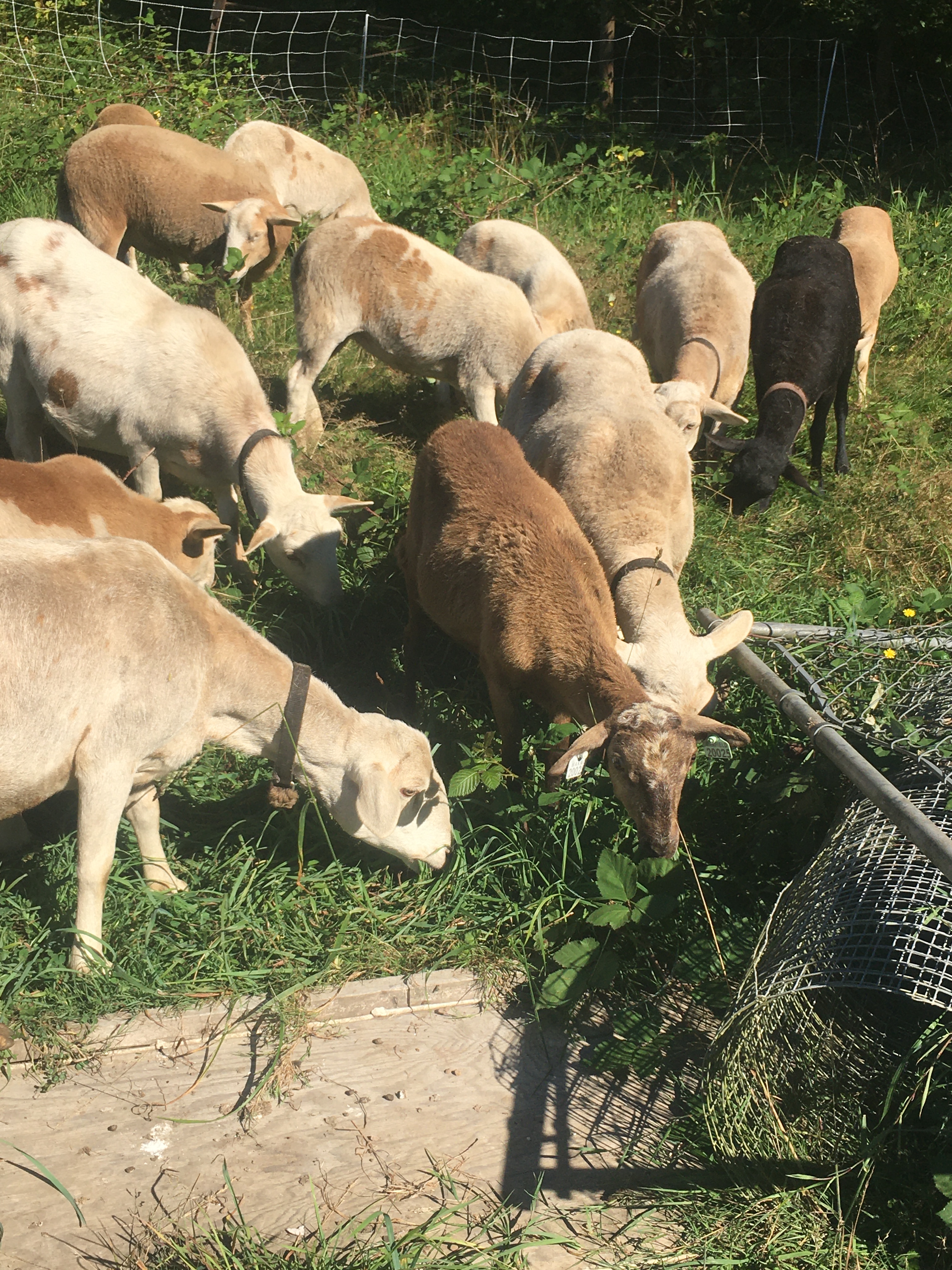
King, our new St. Croix ram at EEC

We’ve got a new face in the flock here at EEC Forest Stewardship. “King” is a 2018 born St. Croix ram from Yelm WA. What?!- not a Katahdin? Well, the Katahdin breed came out of St. Croix genetics, so reintroducing them to our flock through this ram for a few years is a fresh boost of genetics to reaffirm certain standards we’re going for. King is still a hair breed sheep- meaning he sheds each Spring. He’s also naturally poled, like the ladies- we avoid horns for safety. Though I did embrace it with my goats, I’ve begun to shy away from such risks as I am usually handling my animals alone, and don’t want another potential hazard if I can help it. I’m not a fan of disbudding or docking– which seems counter productive to good old domestic selection. Luckily for me- the Katahdin and St. Corix are both naturally poled (no horns) and have tails which do not need docking. They are also naturally resistant to parasites and hoof rot. These are all great characteristics of a domestic livestock breed.

King is showing great promise in another stellar feature of La Corix sheep- he’s got a chill attitude. Just watch how he handles hanging out with our Kangal (Anatolian Shepherd) Gill for the first time. Many sheep would panic and seeing such a large carnivore at their heels, but King takes it in stride, though he’s never been with an LGD before in his life. It’s amazing how quickly their instincts arrived at a mutual agreement to live and let live- at least for now. It is not recommended to introduce rams to young pups- in fact, it’s recommended that Anatolians not begin working with livestock directly until they are two years of age. If a pup gets introduced too early, he’s libel to rough house with the sheep, and potentially get killed by a ram who will not tolerate harassment of his harem. Timing is crucial with any introduction, and livestock are no exception. I’ve learned over the years to take new relationship building on the farm very seriously, especially inter-species socializing.

When King arrived Saturday afternoon, I started by putting a thick collar on him for safe handling, and then tested a tether right outside the house where I could keep an eye on him. Gill was alert barking from the barn down below, seeing a new animal on the land and showing good concern for the new animal. King has never been tethered before, but stood patiently, enjoying his fresh grass pasture and paying no mind to the barking. He was hesitant with my approaches, but I brought some treats and did not pressure him into an encounter, I let him come to me, sniff, lick, then allowed him to back away and return to grazing. Every time I engage with the ram, I remain facing him, use his name, remain respectful of his body language (when he backs away, I keep my distance to respect his space). Gill offered the same respect, and when he did start to come too close, King stamped his foot and lowered his head, sending Gill away. It was amazing to watch these two species pick up on each other immediately.

The introduction to Gill came on day three. Day two, King was invited into the barn, to his own small enclosure, to meet the ewes and Gill behind a safe fence. He was calm and curious, bright eyed and brilliant. The ladies sniffed and cooed over this new stud, and he was eager to meet and greet through the fence. Gill was relaxed and happy to be in his den, and got a good smell of King when he came in to know it was just another sheep in the herd. After a successful two nights of pen acclimation, we put King out with Gill on his tether with supervision. The ewes were let out on the other side of the fence, and you can hear the bell ringing nearby in the video above. Gill checked the area and hung out with King for a bit, then went about his business making the rounds of his territory while King enjoyed some Douglas Fir branch tips. St. Croix are browsers, like Katahdin. Yet another quality we’re selecting for here at EEC. Blackberry is not grass, so we need animals that like shrubs as well as grass. Most wool sheep are strictly grazers, so they would not take out blackberry on this farm- and we’d have to shear each spring.

These are still early days of introduction, but I have confidence in the characteristics of these breeds and what they are selected for- ease of handling, multi-purpose, and resiliency. King will most likely become more protective of the ewes when he is in rut, which is just the nature of breeding. When working with any ram, you have to remain vigilant. Rams got their name for the physical action of ramming others. It is a grave mistake to turn your back on a ram, even a gentle one, as they could intellectually charge for any number of reasons. By remaining face to face with the animal you are telling it that you are aware of his presence, and respectful of his “majesty”. In return, the ram will form trust with you, and be more at ease. I’m sure King will teach me many more lessons. He’s been a pleasure to work with so far, and I look forward to getting to know his personality and behavior with the ewes later this summer. For now, as a precaution, he’s being kept separate from the ewes who are still heavily pregnant and would not welcome a love sick ram on their backs. Stay tuned for lambing updates, and ram work ahead.

“Fun”gal Food

Towards the end of winter, the larder is emptying out, and many of the more adventuresome food stuffs are eagerly awaiting my culinary experimentation. Organ meats can be fun, but I think my favorite challenge this year has been a fungal friend. Laetiporus sulphureus is a wood eating mushroom, and in The Pacific Northwest, it prefers evergreen trees. The taste of spruce was certainly present in this mushroom, even through it’s texture was more like chicken. I wrote a blog last fall about processing and storing the “chicken”- cook the mushroom before freezing if you can’t eat it all in the moment. Often, you come upon many pounds of this species when it is fruiting.

This flush filled up two grocery bags

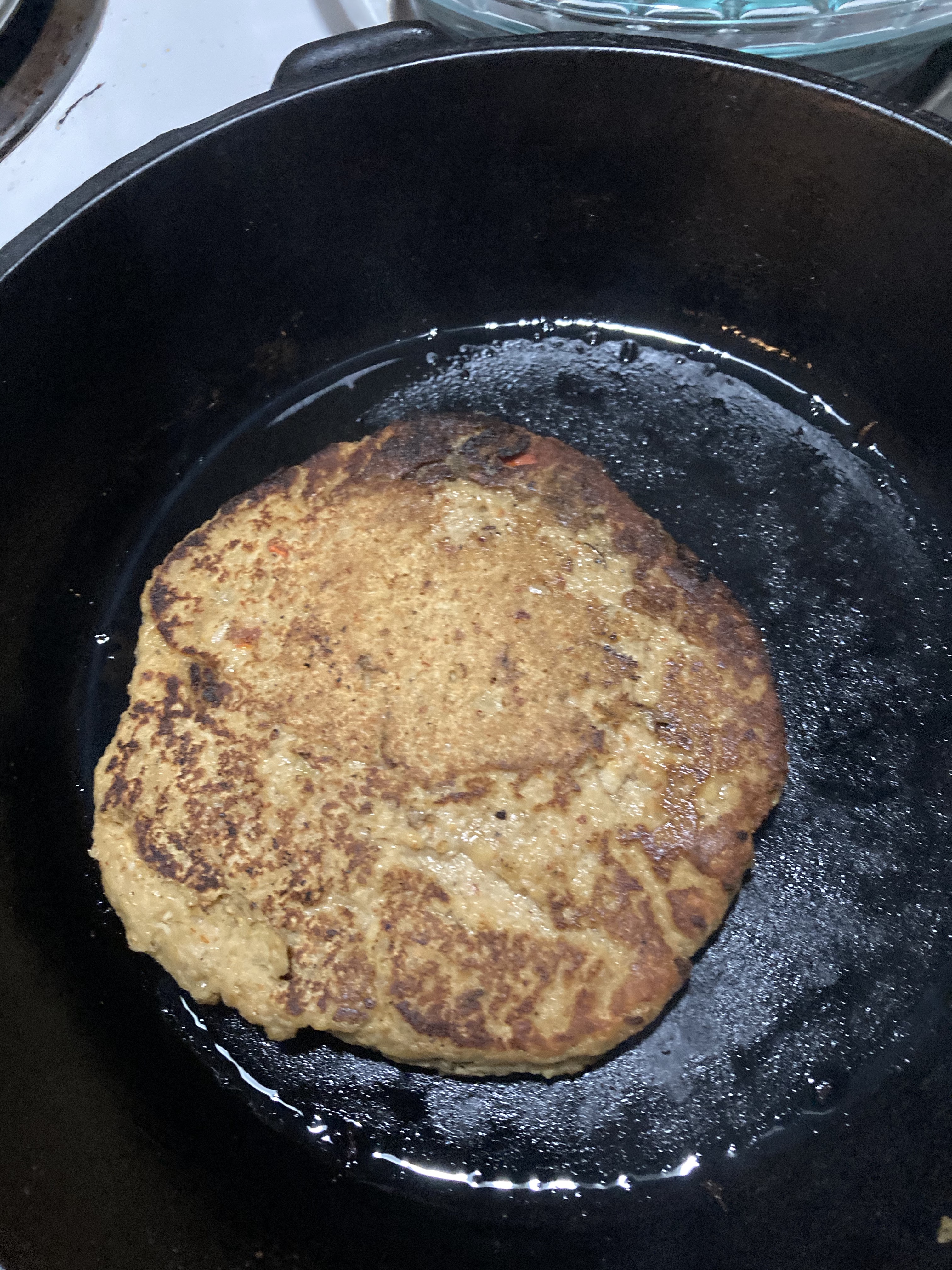
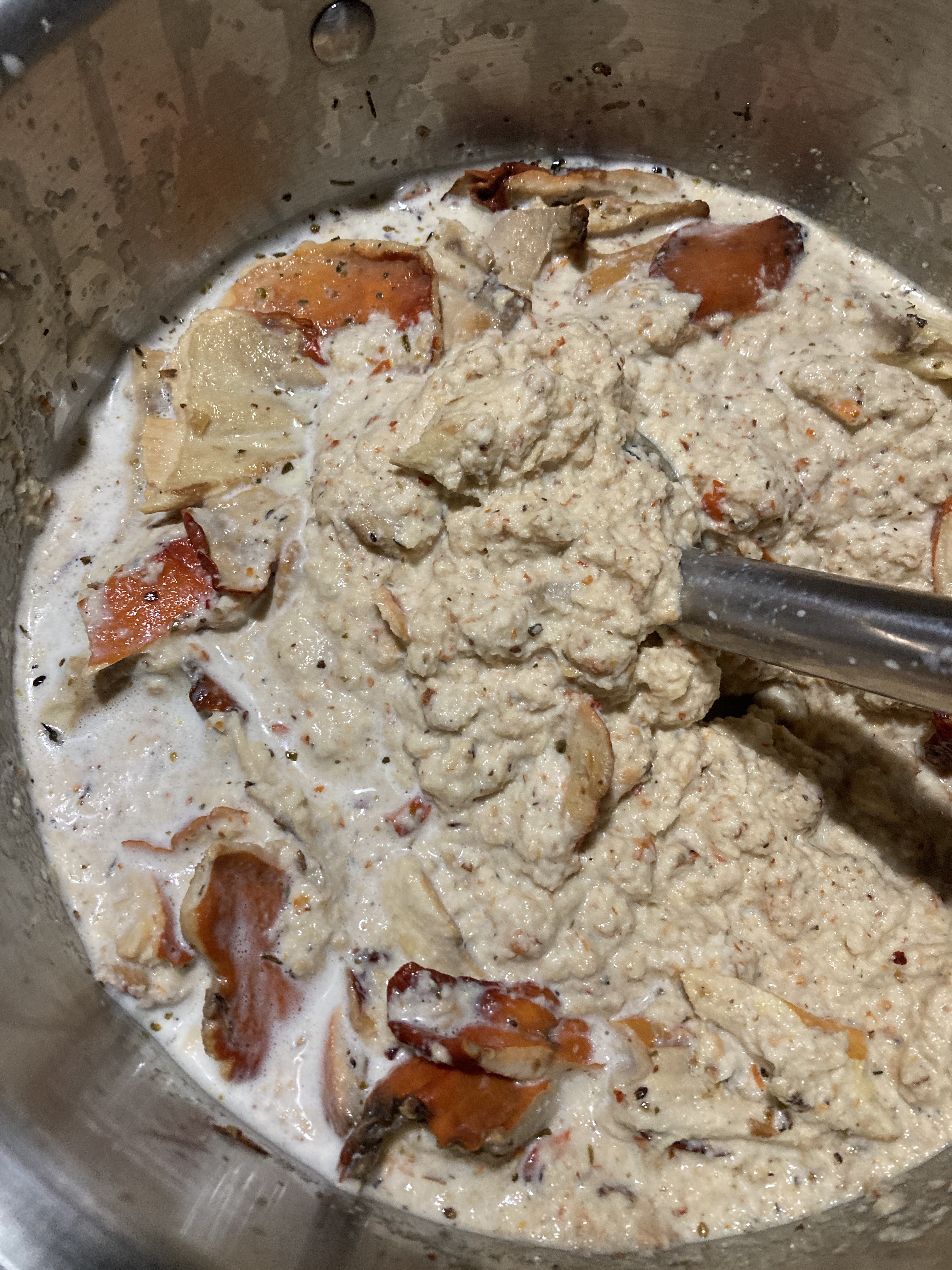
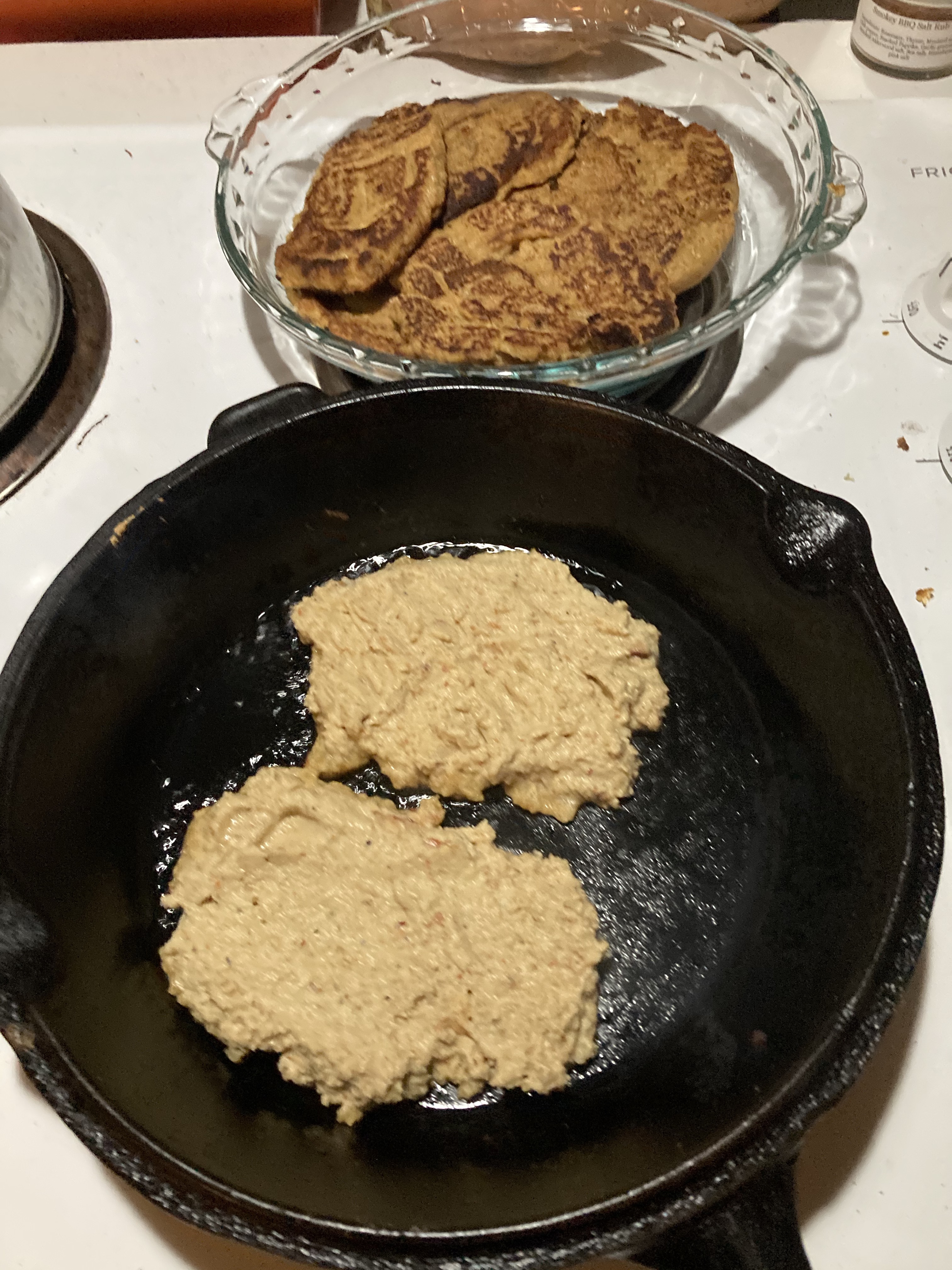
Reaching into the freezer, I pulled out a gallon bag of the sauteed CotW to thaw out for a tasty winter meal. I had planned to pulverize the mushroom into a soup, and began cooking the fungus down in a large pot. Then I took my hand mixer and began transforming the fruit into mush. The “meat” mashed right up, but rendered into a mousse like consistency. I added a bit of milk, hoping to “soup up” the sauce. Instead- I began to have the feeling I was stirring a batter. The pancake inspiration came, so I added a few eggs. The seasoning already on the mushrooms was garlic and herb, so I pictured savory latkes. Because these fungal fruits had fed off an evergreen log, they had that slightly bitter taste of pine tree, so I knew I had to put a little more salt and oil in to cut that taste. Onion was also a great addition, though I used flakes to save time. I will caramelize some first before adding next time.

The cast-iron pan was hot, and I used some fantastic bacon grease to round out my savory pancake flavor. By now, I had enough mix to make a flock of cakes, so I planned to refreeze some for later. The consistency and flavor of my new food was fantastic! What a great way to offer up mushrooms. My partner loved them with our dinner, and the next day I shared leftovers with another friend who also gave high praise. A few weeks later I took out another batch of Chicken of the Woods and repeated the recipe- this time I left out the milk completely, and added less oil. The cakes were even more light and fluffy, and still held their meaty flavor. I still left out the caramelized onions, so I know batch number three will be the best so far. There’s still another gallon bag in the freezer for continued experimentation. I love the amazing diversity of mushrooms, how they are a food group, and what wonderful fungus flavors I have yet to discover.

The recipes out there are endless- here’s one from a guy I’m a big fan of in the fungal family. Paul Stamets is the Pacific Northwest mushroom expert, and I appreciate the way he approaches mushroom learning. Note his advice about potential gastric intestine discomfort, which can come from under-cooking your mushrooms. There’s a lot to learn about identifying, harvesting, and cooking up mushrooms. In this blog, I try to stick to the safe species that are found locally in my area, but please, if you are new to mushrooming, please take a class and make sure you forage with someone who knows mushrooms well in your area. What I am sharing relates to Chicken of the Woods from Western Washington. There are eastern verities which look very similar, but might have very different properties. Mushrooming is a great adventure, please remain safe and do not explore the pallet of fungus without expert guidance, many species can make you very sick, and some might even kill you. Here at EEC Forest Stewardship, we love sharing our mushroom experiences and introduce our readers to new species, but this blog is not a mushroom teaching tool so much as an inspiration. Please be excited about mushrooms, learning about them, foraging, and, with the right mentoring- eating some of the most delicious, well kept secrets of the woods.

Record Snow

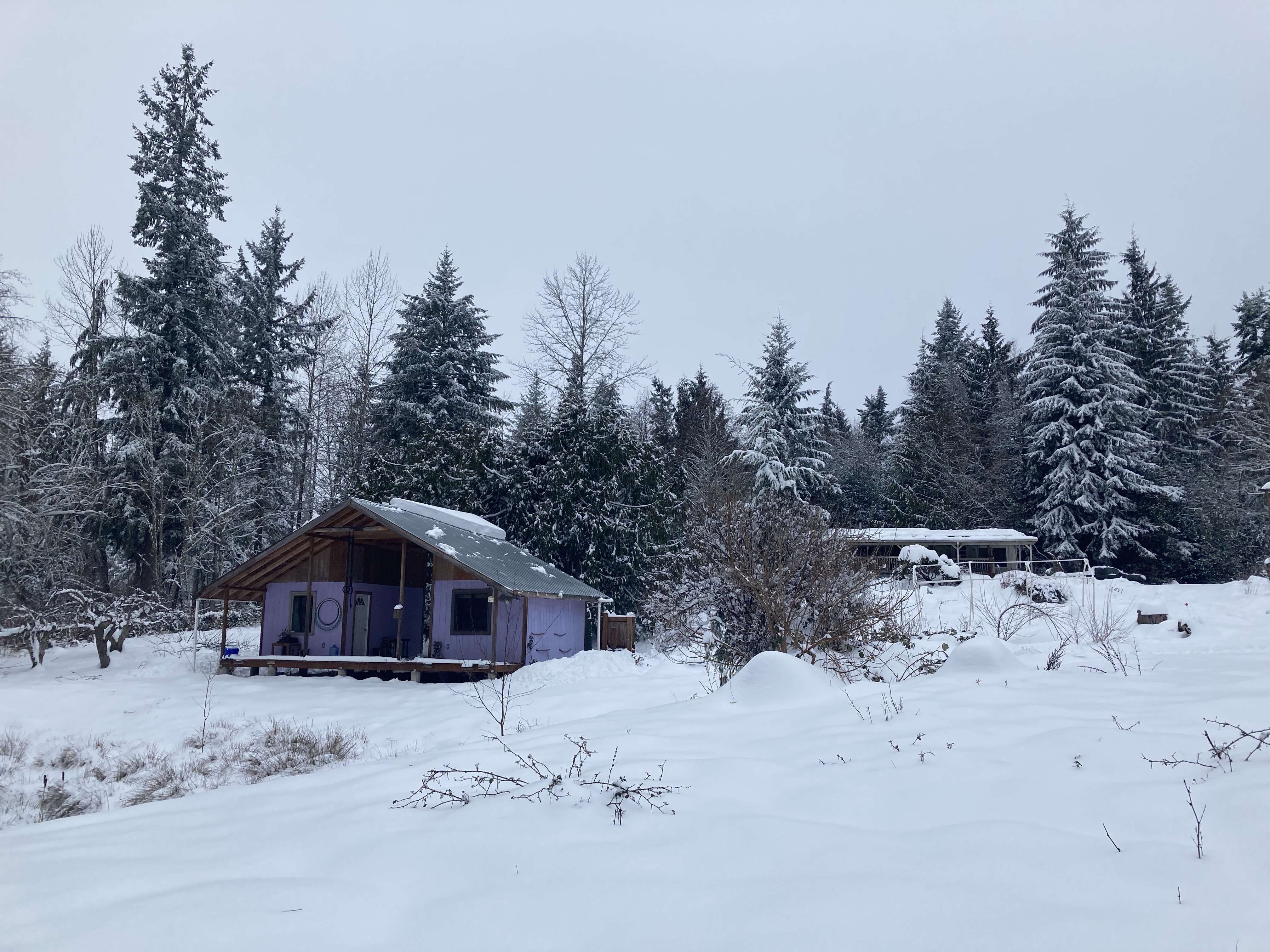
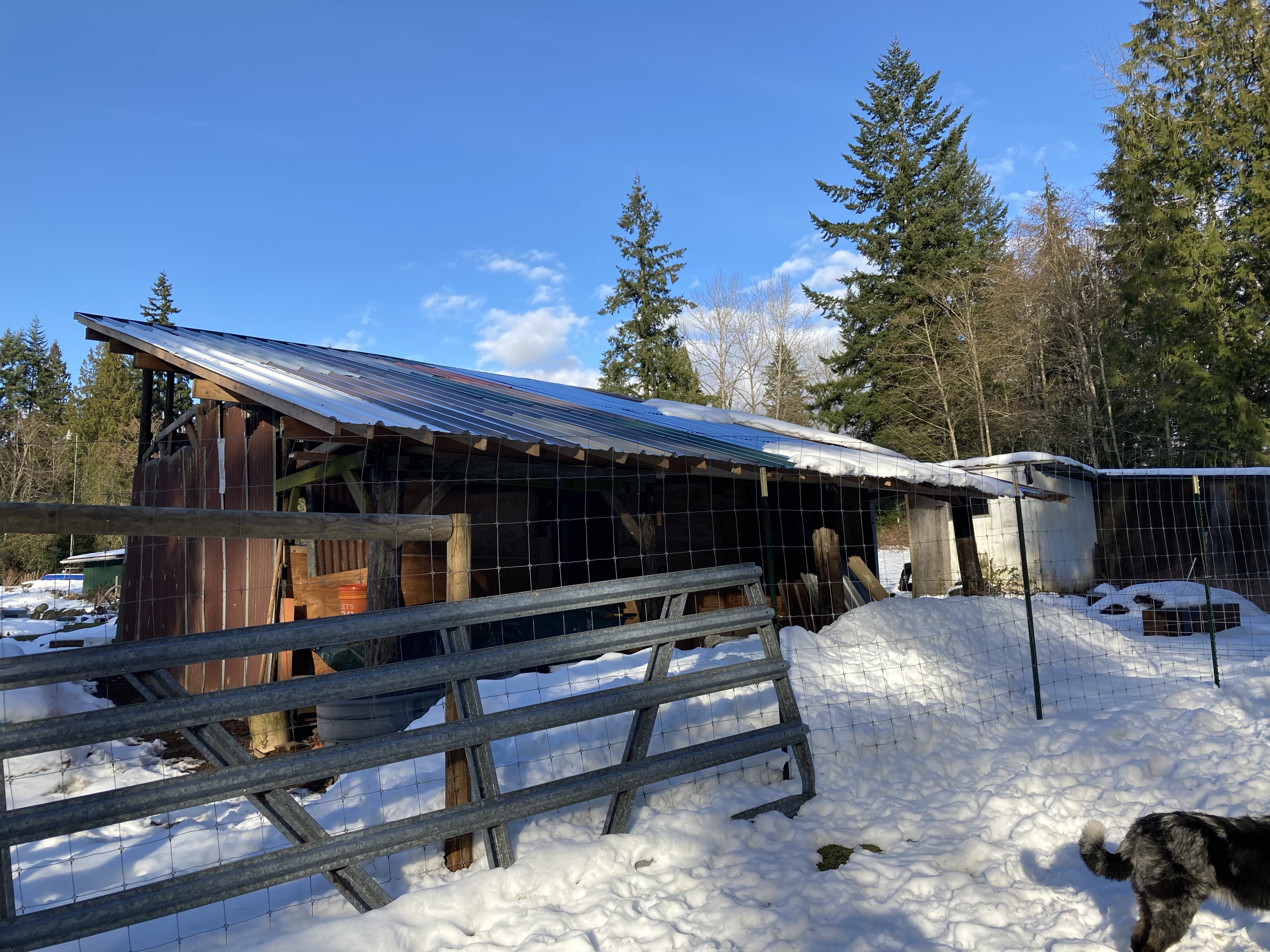
The weather has been wild and wintry this weekend. We had over 12″ of snow in a two day period, which required some roof shoveling and a lot of snow day enjoyment. We even had time to build a snow man or two. The sheep stayed tucked away in the barn with plenty of hay and water. Breaking ice out of water buckets was a constant task too- for the temperatures dropped into the 20s. But the snow was beautiful- soft, light powder- something we rarely see in these parts. Though this snow is “rare”, it will continue to grow in frequency for us, as the climate continues to shift. We’ve planned accordingly, building all new structures on the land with metal pitched roofs to shed the snow readily, so we won’t have to shovel them. The success of this design is evident in the picture below. While the double cabin roof is self-clearing, the house roof further up the hill, with little to no slant asphalt shingles, was hand shoveled by my devoted partner before we got another 3″.

This is the future of winter weather in The Cascadian Foothills. There’s an old homestead (over 100 years) near me, with the original farmhouse. It’s age is evident in the small, multi-pained windows, and very slanted roof pitch. Though historic in settlement, recent renovations of the dwelling added french doors off the mudroom, giving the early American settler image a tragic garage addition feel. One could transcend the nature of the refurbishment and recognize the complete destruction of forest and wetland thanks to colonialism. But I digress. The highly sloped roof is a reminder that about a century ago, it was much cooler in The Pacific Northwest. Heavy snow was a given in the winter time, and the build of this homestead reflects the winters that are starting to return.

The snow is a wonderful gift to our region, despite causing disruption of normal routine. It’s insulating coverage of young bulbs helps to encourage their survival and successful flowering later this Spring. Slow melt means slow, deep watering for the landscape, something our increasingly hard rains abate. In future, we’ll be grateful for more snow as a protector against Summer drought. We’ll also get more rain, but in a sheeting off the land sort of deluge- causing more erosion and less replenishment of our aquifers. These more extrema environmental changes are happening all around the world, so stay tuned! In another 50 years, Cascadia could be heading back into another Ice Age. However, the pendulum keeps swinging us into much hotter, more extended summers, so I don’t see the cool arctic air winning in the end.

Within the next few decades, there will be a continued threat of both horrific earthquakes, volcanic eruption, and fire. Drought already stalks our water table, along with more wells being drilled for private home development, and the clear-cutting of forest, which removes the protection of topsoil on our hillsides. This fertility loss is happening across the nation and around the world. Snow gives us an opportunity to slow some of that erosion and get an aquifer recharge. Shade from forest can also prolong snow on the ground. The pile formed behind our barn did not finish melting away for over three weeks. Part of that miraculous length of ice cold was supported by shade being thrown from a southern grove of Western Red Cedars. Life’s web of intricacies goes far beyond any human developed system of land management- that word, management- is part of the issue. We want to control, rather than cooperate with nature- steward what’s already in place, rather than augmenting it to perpetuate world consumption at an unsustainable rate. This shortsightedness has led to breakdown across the natural world, and humans are deeply reliant on these systems to survive.

Our best response to these changing times it to restore as much natural habitat as we can, stewarding place with the understanding that our lifetime is only one of many to come, and to have those future generations, we have to have a thriving environment for all to live. It’s such a simple concept, yet the balance has already tipped so far, we have a great shift in the opposite direction to look forward to- and severe weather is a herald of difficult times. While we experienced a few hours without power, other parts of our country experiencing this same cold front were left in dire straights for weeks. Many people, Americans, froze to death in their homes. Power grids failed, potable water was compromised, and many towns and cities found themselves stranded in what some called a living hell- especially when they received that month’s power bill. The weather extremes will continue to directly effect economy, as well as ecology.

After the snow subsided, we received thick coatings of ice across the landscape. This sudden refreeze can greatly affect budding shrubs and trees, not buried under the great snow insulation. The pear tree above is completely encased in ice, and this image will become a common occurrence, into Spring. With that, our increasing hail storms, bringing pea sized ice pellets to the ground- often covering the land in a strange white blanket of frozen grit. These weather events will also stray into Spring flower season, harming our ultimate fruit production and orchard health, no to mention the wild species that flower early in the season. Our native Anise humming bird, which overwinters in Western Washington thanks to human feeding over the decades, relies heavily on this species flowering in early Spring, along with Big Leaf Maple, which offers bees their first crop of honey. Hail will bruise and batter the flowers, knocking off petals and crushing delicate stamens. If the storm comes in Summer, your fruit will be bruised and perish sooner on the tree. EEC Forest Stewardship is planting a lot of fruit and nut trees on the land. The weather may put these cultivar species out of service, or at least render them less productive. Though are ultimate plan is to reforest the property in native growth, fruit and nut trees are still mixed in for human enjoyment and survival- should the grocery store shelves go empty during a cataclysmic disruption.

Being mindful of our location in foothills, with The Pacific Ocean not far, the arctic just a Canadian Provence away, and climate change continuing to rev up, EEC will keep evolving to pair well with the seasonal swings. Ice and Snow, drought and fire, wind and hail, all these elemental shifts give our environment crucial signals of adaptation. As a whole, our species is incredibly adaptable to environmental change, as so, people will survive the big shifts. But as nations and cities, we will have to redesign entire infrastructure, and at least here in America, we are refusing to see the writing on the wall. Even with the extinction of fossil fuel, our demand for a stable grid with 24 hour electrical consumption at extreme levels will topple- in a day, week, or even months, but more like brown-outs rolling into black-outs, seasonally, like Texas in the winter of 2021. Grids will come back online, only to be lost again in another extreme weather event yet to come. Through this slow destabilization, humanity will be forced to reckon with its limitations, and plan within the finite resources of Earth.

On a small acreage here in Western Washington, we are privileged to heat our home with wood, hold deed to property with a spring fed creek and recovering forest, with livestock, adequate shelter, and enough food production to give minimal support in chaotic times. Every small piece of the survival puzzle you can be aware of helps. Even recognizing the weak points in your basic survival needs can prepare you for when they fail- if you already have time and resources to devote in this thinking and planning- many more people do not- as they are already just barely getting by. We played in the snow, enjoyed the work, and knew it was a short lived weather event. Gratitude to this land for keeping us warm, fed, watered, and stewarding. Appriciation to weather for continuing change in our day to day lives and offering subtle, and not so subtle hints about our evolutionary process and adaptation.

Garden Wake Up

It’s time to flip soil in the gardens to get ready for spring planting. I’ve already set up a cold frame and planted arugula, cabbage, beets, chard, and a few wild flowers. Spinach is up, and our kale, chard, and borage overwintered nicely. I’ve found some delightful potatoes, and the rhubarb is already unfurling small leaves. All the seasonal bulbs are poking up out of slightly warmed soil, but we won’t see them flowering for another couple of months. Though we’re in the middle of winter on the calendar, here in the temperate rain-forest, warmer Pacific fronts dominate the region, preventing long hard frosts from setting in. Snow is in the forecast, but a cold frame in early February is usually enough protection for cool weather crops. We’ll also be getting the greenhouse back online- as I’ve been missing the abundance of a well tended vegetable patch.

After several years of experimenting with the zone one gardens, I’m making some major changes. The classic consequence of having so much space around the buildings to plant brings too much tending time. Weeding is out of control- especially when morning glory established its self. However, the rich composted soil these larger spaces have cultivated are perfect for some larger shrub species, and some root stalk roses I planted a few years ago are now establishing bush like structure, and I’ve stool and layered them, shaping the future hedge, which will protect the gardens from chickens. After tearing out all the old chicken fencing- which had been slow buried over time as more compost entered the garden, the chickens came right in to help glean and clean the soil. It made a mess of walkways and the driveway, but denuded the soil of harmful bugs. I would not encourage the chickens to be in the food gardens during the growing season because of fecal contamination issues.

With all the fertility mounting in our garden, a lot had spilled out, onto the driveway, which surrounds the house and cultivation space. I took a 4 pronged pitch fork and slipped it right under the sod, pulling up the layer of turf, then flipping it up into the hedge layered roses to form a planting bank. I then shoveled up the underlying soil, piling it on top of the sod and roses, revealing the driveway and cutting a satisfying edge around the gardens. I’m planning to establish thimble berry in the bank pictured above. Further back along the edge, you can see the roses and continued bank of turned turf. I will be covering the turf mounds with an organic, slow decomposition, weed cover sheet, which will prevent the grass from re-establishing. The plan is to plant squash into it later this summer.

Mulching is a big payoff in our cultivated spaces around zone 1. Cardboard is the best material for this practice, especially if you are establishing trees and shrubs- as the plantings will establish within a few years, shading out the weeds. Some species, such as lavender, cannot fight off the turf encroachment, and must be mulched every few years, along with diligent hand weeding during the growing season. Hopefully, once the twin berry and crabapple establish, these lavenders will be large enough to hold thier own. This area pictured below is also a compost location (black box with yellow lid), and we’re slowly building up this mound to create another hedge. Banking the fertility- literally, gives all these perennial species a head start on developing healthy root systems in a collective effort. Companion planting is a great way to bring diversity into your gardens, invite the complex system of plant neighborhoods to thrive, and reduces the need for human management.

Vegetable gardens demand a lot of sunlight and watering. Then you’re contending with a lot of weeds. It’s a big part of my personal struggle with gardening on a large scale- there’s no over-story. Without shade, all the bramble species and grasses fight to get a foothold, as this environment is usually temperate rain-forest canopy, which does not allow the weeds and other invasive to take root. With an intact forest, you’re not going to cultivate carrots and squash, so a cleared patch is maintained, and a never ending fight with nature persists. Sure, we could put everything into raised container beds, requiring more water and tending in other ways. The bottom line is- gardening will always require a lot of work and inputs to remain productive. It’s a luxury, and not the main mission of EEC, but veggies are nice, and self sufficiency, even partial sufficiency, feels compelling. We’re also eager to demonstrate alternative cultivation practices. Since gardening is a gateway to land stewardship- EEC will keep hosting gardens, as well as forest restoration.

Building good topsoil takes thousands of years in a non-human altered environment. Watching the fertility building in these gardens over the years gives me hope that the land can heal and regenerate faster with holistic help. Our original human instructions are to tend the landscape- assisting in regeneration and expansion of health in the ecosystem, which in turn, feeds and nurtures us. How did humankind drift so far away from this mantle of responsibility for the environment? That’s a story for another day. For now, we’ll keep tending the soil, forest, water, and life here at EEC Forest Stewardship. Look for more garden updates in Spring, as we’ll be checking in on the cold frame plantings and getting more seed in the ground.

Land Restoration in Action

Here at EEC Forest Stewardship we spend a lot of time and energy restoring the landscape. This action takes many forms, but the most recognizable and immediate solution is replanting. In our forest, there are a lot of neglected edges, which have been the focus of restoration projects. Our stream buffer along Weiss Creek is one example (pictured above), replanted with native varieties in 2020. In a temperate rain forest environment, covering soil surface with layers of vegetation is imperative to prevent topsoil erosion and landscape degradation through nutrient loss. Often people thing putting a lawn down is enough, but in a place with heavy rains and sloping hills, grass doesn’t cut it. “Lawnscape” also invites invasives like blackberry to come in, which is actually another way nature is trying to heal the soil surface, but blackberry makes it harder for other over-story species to take root.

Blackberry grows into head height surface cover, protecting the soil and preventing erosion. Old cane dies back each year, providing a great soil amendment to enrich the topsoil with carbon through the organic breakdown of plant material. When I cut back blackberry, I find a dark fluffy debris pile under the plant- ideal for planting into with native growth- provided I keep the blackberry at bay until the new trees and shrubs establish. Once the canopy returns, blackberry retreats due to the lack of sunlight. Many of the pasture spaces at EEC were overridden by bramble when we arrived, and we used goats for several years to cull back the canes. Now that the blackberry is manageable, we’re planting the landscape quickly, encouraging that new over-story to take shape.

Some of our plantings still live along side blackberry, but eventually, the trees will overtake the forest floor and provide a new habitat of more stable vegetation, also inviting diversity in new species to regenerate the land. Our introduction of Garry Oak (pictured above) will provide drought tolerance to the forest, something to start planning for as the climate shifts. While our water dependent hemlocks continue to die back as summers get hotter, the oaks will thrive in the more extreme temperatures, and provide acorns for wildlife and people. We’ve also mixed in big leaf maple and hazel to provide great leaf mulch to amend the oak’s tannin, and a better diversity of deciduous trees for the forest. Eventually, evergreens will be planted in, after the other established native growth overshadows the sun loving oaks.

This succession planning allows us to evolve our restoration methods with the regenerating forest on a more natural timeline. EEC Forest is currently farming focused, with a need for pastures, fruit and nut trees, and sunny places for people to enjoy. In another 60 years, the older trees will tower over this modest acreage, blocking out the light that many of these cultivar species rely on to survive. By then, there will be enough fertility on the ground to provide good foundation for more evergreen plantings, which will be introduced after the oaks and maples get in a good run. However, if climate continued to fluctuate, the evergreens may struggle to remain drought resistant and die off like the hemlocks. Then we’ll be very glad we implemented a wave of oak and other nut trees which can handle the dryer conditions.

Our back 40 already had a small grove of hybridized chestnut varieties established and thriving. They are pictured above, with our other major fertility contributor to the land- sheep. Because of all the topsoil erosion which followed two major logging operations over the past 100 years, the current soil cannot provide enough stability, or fertility to a developing evergreen forest. Teenage Douglas Fir trees take up HUGE amounts of nutrients from the soil. In it’s current state, our land could not support the trees through this development into old growth forest. To speed up the restoration of soil fertility, we’ve implemented animal systems to mimic the original elk and deer populations which would have been contributing manure and under-story vegetation management. Here’s the scoop on sheep poop.

The nut trees are an in between species, a luxury food for our farming production, and great deciduous trees, which will put a lot of great leafy debris into the soil with the sheep poop to offer complete nutrients into the growth cycle for future biomass. To be clear, all these systems are based on a well managed holistic plan that involves moving the animals around in concentrated grazing cycles in line with pasture recovery and improvement. The sheep are not allowed to graze as they please all across the land. They are stationed in moving pastures for short periods of time so that the landscape can rest and regenerate before another round of grazing comes through.

Our other major player in regeneration through animal systems is the birds. Chickens and sheep go hand in hand. Sheep graze the grass and poop nutrition across the landscape. Chickens follow behind gleaning pest insects out of the manure and also put down more fertility with their own fecal contribution. There is also a collection of poop out of the coop, which is folded into gardens and into reforestation planting to give trees and shrubs a concentrated boost in fertility from the moment the roots take hold. Our hens cannot get to the back field, but the sheep are not in the back field for extended periods of time, allowing longer recovery and proper manure breakdown before more grazing commences. If you don’t rest your fields between grazing, your land will not have a chance to recover this is why so many fields end up destroyed by overgrazing. A detailed calendar for grazing in western Washington can be found here.

If we had to remove all our animals tomorrow, the recovery of the land would continue, though at a slower rate. What you choose to plant on the land will have a lasting effect on restoration and recovery in your bio-region. If we simply put in nothing but evergreen trees at EEC, the lack of diversity would cause stagnation in forest growth. By layering the plantings with under-story, as well as over-story vegetation, we are regenerating the intact nature of our temperate rain-forest by providing all the species specific contributions in complex ecosystems. But if you are not wanting to return your landscape to a climaxed old growth forest, there are still ways to enhance and regenerate the land, especially along your edges.

At EEC Forest Stewardship, there are some areas of our landscape which will continue to provide open space for an orchard and gardening, near the living space, where people spend most of their time. Along the edges of these areas, blackberry pushes to take advantage of open sun spots, and rather than fighting the bramble in an endless battle, we decided to put up a wall. We started with a physical boundary built from pallets, which also keeps out the deer who want to eat our crops. We then established a hedgerow of native species. After five years of slow going, we are finally seeing the results of our hedge beginning to take shape. In the winter of 2021, we will lay this hedge over for the first time, constructing a living wall which will continue to thicken and diversify along our edges. Edge space is a transition zone, usually teaming with more life and diversity of vegetation because of its in between state.

This edge on our eastern property boundary, gets great morning and early afternoon sun, plunging into shade by late afternoon, thus staying cooler during the hot summer, and allowing more sensitive plants like ferns to have a chance at reestablishing. We’ve put a mix of under-story plants like elderberry and day lily along with trees like river birch and red alder in- though these trees will be pleachered to discourage vertical growth. If the trees grow up, they block out the sun for many of the edge species, which utilize both sun and shade to thrive. Maintaining this balance, while regenerating a diversity of plant growth, enriches the landscape and maintains the boundary while producing a verity of fruits and flowers for people and wildlife.

Biomass is the main key to regenerating a landscape. Topsoil takes a long time to form on its own. By layering woody debris and livestock bedding with nitrogen rich dung (mostly made up of pulverized and digested plant matter), we invigorate the degraded soil quality with organic inputs. There are many ways to do this, but the absolute key in any composting mix is carbon. If you take fresh “hot” manure, and dump it in concentration (aka- years of muck from your horse barn/chicken coop) right onto the living soil, you’ll kill the biology with too much nitrogen. This is common practice in industrial farming, though they use chemical fertilizers, which then run off into wild water sources, polluting drinking water across the world.

Woody debris, such as tree clippings, aged wood chips, and fallen branches create great carbon sources for compost. At EEC, we commonly pile large branches, then cover them with livestock bedding- a mix of straw (more carbon) and manure (hot nitrogen), and cap that with cardboard (more carbon). The wood pulp of the boxes keeps water off the hot nitrogen, which will have time to slowly compost in with the branches in rich breakdown of nutrients for the soil over time. In the picture above, we are piling biomass for more than just compost- the red cedar is free standing in an active living space, and food production zone. Before our stewardship began here, the area was lawn. The cedar’s roots were exposed at the surface around the base of the tree where active foot paths, and a lack of any forest debris could collect. In time, the roots would be damaged, causing failure and inevitable dye back of the tree’s root system. We’re rolling out a protective carpet for this cedar, while tending the foot paths, and allowing a cushion of topsoil to return.

Whatever steps you can take to help regenerate the landscape around you is good. If you don’t have a forest, but want to learn more about how to regenerate the living world where you are, start by learning about your bio region and what kind of plants and animals tend that space already. If you’re in a cement jungle, and/or don’t have a lot of time for stewarding land, tend a house plant, and learn about keeping a “micro-biome” alive. Having close contact with soil and plants, as well as animals, invites us to better connect with our own living environment. We notice more about living systems, health, and general quality of life. When we ignore life, it tends to disapear- and that’s what’s happening to our planet’s living systems, right now. Please look to landscapes that are left, and try to support them with your time and energy. Restoration is possible, but it takes active participation for all people who share this rare and precious place.

Suds in Weiss Creek

For years now, we’ve been working hard here at EEC Forest Stewardship to restore a buffer of dense, native forest around our salmonid stream. It’s the largest investment in restoration on the land so far, including many days of hard work fencing to keep livestock out. Even with six foot woven wire field fence, we can’t keep every threat at bay. Last week, I noticed soap suds in the water. Earlier that day I had also seen a neighbor washing her car in her front driveway, near the headwaters of our creek. There were too many suds in the water to have come from just the car washing, and after a chat with county water experts, we decided to take a sample to find out what’s in the water.

My concern was the volume of soap running in the stream. I’ve seen suds once in a while during major runoff periods, but nothing like this on a normal flow day. The most likely culprit- inappropriate tie in of laundry facilities too close to the stream. It’s one of the most common hazards to wild water in our county. So much bad runoff like this occurs, that the county will not make an official report until summer, during the driest period of the year, when there is little runoff to track from the creek back to the source. My local water ecologist said it was not enough runoff to address with legal action, but what about a formal site visit to fix the runoff? Nope, not without serious concern. It was hard to hear this, knowing more laundry would be draining into Weiss Creek.

Mindful design can prevent this pollution, but people often overlook ecological sensitivity when developing. Here in Western Washington, water is abundant, on the surface, and reflects the health of our ecosystem in plain, often painful sight. In Puget Sound, where this creek water will eventually end its journey to the sea, orcas are going extinct, wild salmon populations have crashed, and shellfish regularly test positive for methamphetamines because of the high concentration of sewage overflow into wild waters. Last month, we had major flooding in our county, and millions of tons of sewage poured into Lake Washington and Puget Sound. Local beaches were closed, and shellfish harvesting put on hold, actually, it was already on hold because of toxic algae blooms that have started happening in winter as well as summer due to warming ocean currents in The Pacific. People, it’s getting bad, and our pollution has been expanding, along with population.

What can we do? Be aware- of the limits our ecosystem can endure. Think about where your water is going after it disappears down the drain, or down the street. One huge action you can take right now? Stop buying toxic soaps and cleaners. I get sick walking down a cleaning isle in the supermarket- the smell of highly concentrated chemical compounds is noxious. Why these chemical agents are still legal is beyond me. Since we live on a septic system here at EEC, all products must be biodegradable. We do have a couple of grey water catchment systems- with limited use, and discharge stations into properly engineered catchment basins with sand and gravel filtration. They are also set back far away from any major water sources, from our well to the creek.

There is soap in our wild water at EEC right now, because someone is operating laundry facilities right next to the creek, with no awareness of ground saturation. The runoff is minimal right now, but over time, will lead to alterations in the creek’s chemistry, affecting our endangered fresh water muscles, salmon, trout, and any other living cells which rely on clean water to survive. This single laundry source will not kill off everything, but it’s the first of many to be found along this water’s path to the ocean. By the time this water reaches Puget Sound, its got a long list of possible pollutants which can be found here. Needless too say, our small part in keeping toxins out of wild water makes a difference. Hopefully, this sudsy mess clears up, but until the laundry being run upstream moves away from the creek, these bubble troubles will continue to persist.

Winter Update

A modest grove of Ponderosa Pines stand at attention on the west fence line of “the back 40” after a few inches of snow on Winter Solstice. My hair is also now at shoulder length again- growing for Wigs for Kids this year. Made a resolution to be gentler with myself- and show empathy to my faults with grace. Though my hair grows fast, the trees are slow, and with good reason- putting on what could be thousands of rings in one lifetime, while I will hope for 100. The trees behind me also mark a fence line, which I am now clearing in preparation to install a new field fence- to keep in sheep and dogs, while deterring coyote. Only two large pasture areas will be fenced, leaving the open wildlife corridor along Weiss Creek as a highway for wildlife. In another 60 years, the whole place will become forest in perpetuity.

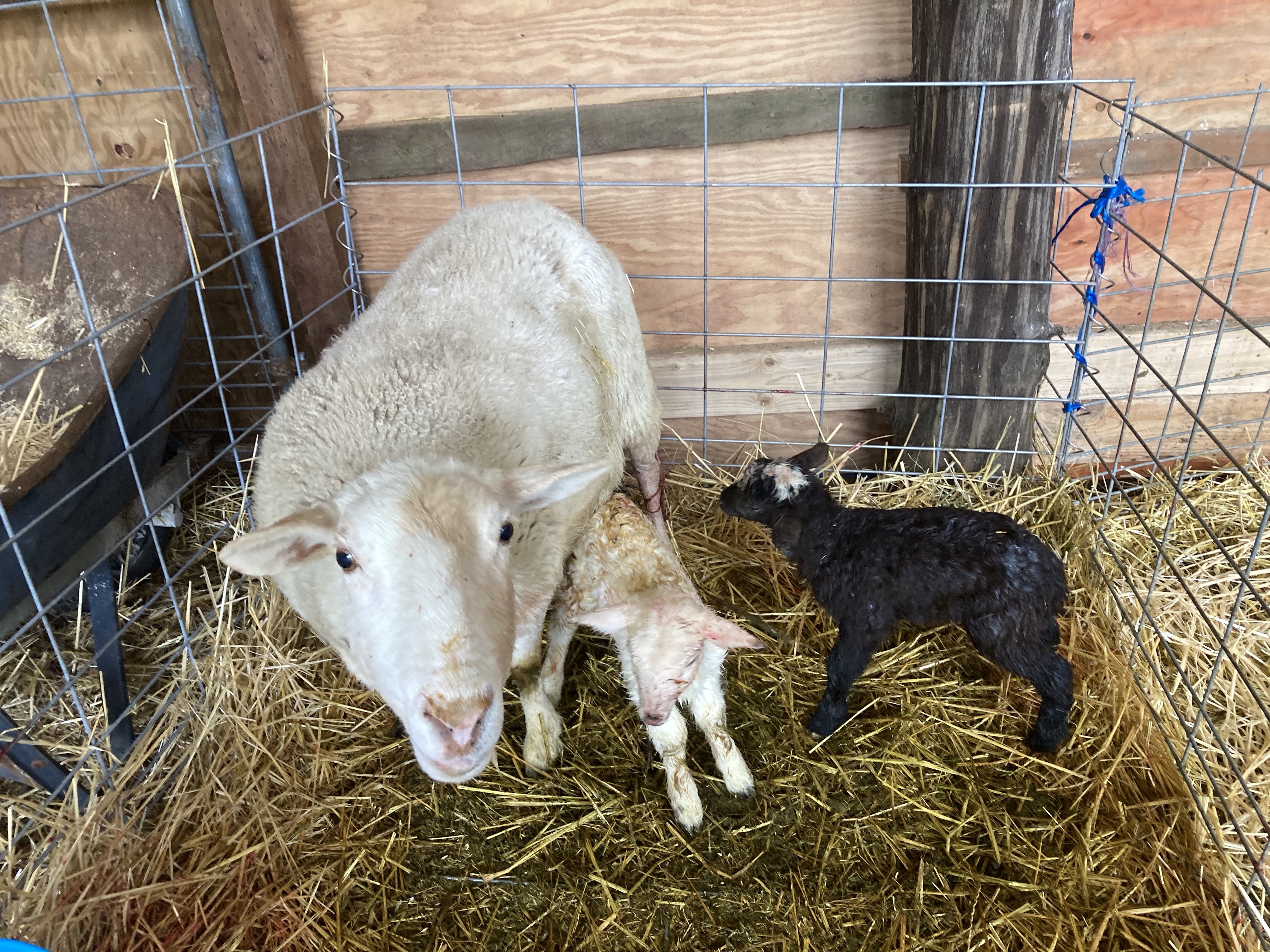
In the mean time- make way for new lambs and more forest replanting. Our herd of Katahdin Ewes are about to burst with new life- which will double our herd and requite a lot of smart resource management. This should be the largest flock you’ll ever see at EEC. After this year, we’ll be culling and selling to get our herd down to about 8 breeding ewes and one ram. That’s the dream team of working sheep here on the land- and our barn will be a palace for the resident flock. Right now we are at 14, with at least 8 lambs on the way- 16 if everyone has twins, but I doubt that. Still, we’ll have too many animals, and we only came to this as a plan to create our own herd from good breeding stock- most of which consisted of old ewes who will pass on some well established genetic material for our fresh, young herd. The older ewes have also had time to pass on wisdom to their daughters, thus ensuring good instinct and herd habits.

The slightly deconstructed sweat lodge frame you see in the picture above was erected just before COVID by a First Nation person who had to pause on his spiritual quest, as he was assigned to a COVID ward at his hospital as soon as the virus took hold- Washington State had the first domestic cases in The US. This amazing front line healthcare worker has not been able to get back here for work on his sweat lodge, but did celebrate a union of partnership with his beloved at the end of 2020. More good news in these darker times. The lodge will eventually become active, but for now, nature happily comes back into her own.

There has been a lot of new growth here at EEC Forest Stewardship- including the continued restoration of our stream buffer. Young native plants like snow berry, Douglas Fir, and even Saskatoon berry are continuing to hold fast in the replanting near our salmon bearing stream. This restoration is some of this first large scale replanting on the property, and it’s a motivational for how quickly overgrazed pasture invaded by blackberry can quietly turn back into a native forest with thriving under-story. Though just like the Ponderosa Pines, growth is slow, the long term regeneration of this landscape is easy to see, and celebrate.

Our new Livestock Guardian Dog, Gill, has been a wonderful addition to the stewardship program. He continues to show great social ability and good manners at EEC. With a lot of good structure, routine, and patience, I’m learning how the Kangal (Anatolian) Shepherd works and plays. Gill has become good friends with Valentine, and the two can play for hours while I’m working in the field nearby. Though Gill came to us with a history of dog aggression, especially with toys and food, we have slowly been working on these behavioral challenges, and found that most of them melt away once Gill began to trust Valley as a balanced animal. She has never shown any possessive behavior, and happily drops a stick or bone if Gill wants it- he in turn grows tired of grabbing things the other dog could care less about, and goes back to his watch on the sheep. With his natural instincts fed, Gill shown no interest in what might be called delinquent behavior. It’ a win win for us and the dog.

In other animal news, baby chicks are growing up fast, showing lots of great instinct as fair feathered friend of fertility- pooping out organic yummy for our compost, and scratching away at the ground as soil aerators and bug pest predators. Yay chicken systems! We’ll plan to cull older hens in February, to make room for our new young pullets. A local outdoor educator has asked to buy a few hens from the cull for a survival class. It’s always great to support outdoor education, and lessons in animal processing is a specialty at EEC. In the mean time, cold winter weather has kept the chicks inside until more favorable temperatures arrive. In a few months, these young birds will also have enough plumage, and body mass to go outside. They will remain in their “round pen” setup next to the house for a few more months, gleaning bugs and weeds around the edges of our buildings so we don’t have to mow. I’ll also make use of them in the garden, turning the soil, in prep for the planting season.

Speaking of gardening- I spent the Fall trying to rebuild edges- specifically along the driveway where greens began reaching into the road, pushing cars and trucks into the water redirect ditch on the other side. I pulled back the rock wall and began uprooting the invasion onto the road. The garden became a nursery for young native plants a few years ago, and this fall, many were uprooted from the garden and replanted into the greater landscape around us. The kitchen garden remains the most active cultivation garden near the house, but the front garden is the largest, and right now, full of grass. I have to admit, I’m not a great gardener- not in the veggie sense- and this winter, I am committed to working on re-establishing productivity in the gardens with the redesign of a greenhouse, and some major planning for seasonal replanting in the gardens. But that plan will have to wait a bit longer, as a more crucial infrastructure project is looming.

With the introduction of a Livestock Guardian Dog- Gill, the Anatolian Shepherd, we’re doing the responsible thing by establishing two large fenced fields to allow him free roaming space, while protecting our sheep from coyotes and roaming dogs by erecting 2,000 feet of six foot high field fence. This new boundary will establish the edged of the property (good fenced make good neighbors), while inviting our large dog to patrol freely, especially at night, when most predators are on the prowl. It’s taken a while to finally plan out fence lines, as these boundaries will be permanent (through my lifetime) and create hindrances to wildlife. We established the wildlife corridor first, so the migration paths of the animals could find the clear rout through. Once the new fencing goes up, wildlife will be funneled down to the creek, where they can pass through safely.

Though it is often encouraged to get fencing up quickly, at the start of a land stewardship project, I would say it is even more important to first know where the animals are moving, their trails and established territories within the landscape. Permaculture observations talk about human flow and traffic patterns, which dictate paths and gates. Animal paths are also important, though often overlooked when establishing hard edges on a property. This is one of the greatest challenges in dividing up a landscape into property lines. Hard boundaries often ignore natural features, animal migration routs, and even critical ecological niches where rare species are often found. Think of “The Wall” on our southern most boarder here in The US. There are massive lawsuits in action to stop the destruction of indigenous sacred sights, protect critical animal migration routs, and allow natural flow of a meandering habits of a huge river system.

In planning the long term management of EEC Forest Stewardship land- we cemented the long term reforestation plan with King County in our Public Benefit Rating System application, finalized in October of 2020. This contract will bind the land in a long term plan to slowly convert from agriculture to native forest over the next few decades. In setting resolution to be gentle with myself this year, I also put into action the slow plan of restoration, now on the books in our local county offices. In short- 20 years of sheep, then transition to another 20 years of replanting. The livestock will be fully phased out when I get into my 60s. As by then, the fertility of the land should be reasonably capable of supporting a forest, and my body will not be able to keep up with stock any more. In 40 years, the established forest will have grown tall enough to shade out most of our pastures, and without livestock, the land will need to be replanted to prevent blackberry from taking over again.

Our “zone 1” landscape will remain open, with orchard, out buildings, and residential habitat. In this area human activity will continue indefinitely, as long as it needs to. Right now, that looks like my home, but in 40 years, that could be an educational building or museum dedicated to holistic land stewardship. These are visions right now, and do not have to come to full fruition any time soon, slow growth, like the trees, making it easier to formulate the best design in time. Recognizing that anything could happen to disrupt, change, or eliminate this strategy, and that’s where continued adaptability comes into play. This is how nature survives, and EEC will too- maybe not as a forest as I see it, but as a landscape none the less. It is through strong intention, observation, and planning in both physical replanting and restoration, and legal definition which can help to formulate a strong future for forest on this property. May these actions help, not hinder, the natural world.

The struggles of 2020 were unprecedented in this world, and I fear the challenges will only continue. When we put our focus on the earth as a whole, transcending out personal fears and accepting our ignorance, we are open and ready to relate. Through relation with the world around us, we can better serve community needs, adapt to changing climate, and prepare for long term survival. Not just human survival, but ecological survival. As humanity confronts it’s ultimate vulnerability, perhaps we can restructure our consumer culture, to a more productive, collective mindset of restoration and rehabilitation for ourselves, and the environment. Gratitude for all the rich experience, opportunity, and privilege of land stewardship. Happy New Year!

Carrying Capacity

In the hunter education curriculum of Washington State, we teach a section on carrying capacity. It is the concept that all ecological habitats have a maximum support limit for wildlife. This maximum is built off of finite resources- mainly food, shelter, and water available to animals for their survival. This habitat limitation is used to determine hunting limits in a given area- called a game management unit (GMU). Wildlife biologists hired by the state, study these carrying capacities and health of different species. When a wildfire comes through and destroys habitat, the hunting limits are raised in that GMU for the season to avoid what is called “winter kill”- usually the collapse of a species because of sudden loss of habitat, resulting in a mass die off during the harsher winter months. Starvation is the root cause of these animal’s decline.

Any ecological system has a carrying capacity, and all living things within that system thrive or decline with the health of that environment. Another important detail we teach in Washington State hunter education is human encroachment on wildlife, specifically habitat destruction for development, which is acknowledged as the number one cause of the loss of habitat for wildlife. What we do not connect is the human ability to “transcend” carrying capacity, living beyond the means of their environment, through industrialization. Humans have no carrying capacity- they expand exponentially- for the most part- though virus outbreaks and natural disasters can hinder populations for a period of time. Still, human population continued to grow without any need to accommodate their environment. We do not see a reason to hinder our expansion, as humanity generally believes it is divine right or manifest destiny, which allows their ultimate conquest of the natural world.

It is this egoism and complete lack of connection to nature’s limitation, which will be our ultimate downfall as a species. There is a mass extinction in progress, brought on by human overpopulation and consumption, a nightmare in the making. Because of the disconnect from nature and the biological indicators which dictate life on earth, people have become threatened by the collapse of nature, and are scrambling to point the finger at anything but themselves. Case in point- predator species.

In a recent hunting report, I found myself wondering why the editors of this publication chose to feature historical photos celebrating the mass slaughter of cougars in the west. I was taken aback by this ending page of the report, as it seemed very insidious. Never had I seen such blatant hatred of wildlife portrayed in our field report. I wrote to the editor of this publication and voiced my concerns. He responded by saying because of mismanagement of predators in Idaho (his home) the populations of wolves and cougars had exploded, and elk and big horned sheep populations were crashing because of over predation. He warned me that soon, Washington State woulds be feeling similar effects, as we too have stopped allowing dog hunts of predators and left wolves protected from hunting all together.

He went on to say his family and beloved pets were under constant threat of cougar and wolf attacks from the wilderness beyond his backyard. As I read his response, I could not help but wonder how he didn’t see the irony in his choice to move into the wilderness, and then feel threatened by the wildlife there, blaming the animals for his situation. Without sounding too confrontational, I asked him about human encroachment on animal habitat and the likelihood of our destruction of habitat as part of the reason elk and sheep populations might be in peril. I reminded him that ecosystems were limited to their carrying capacities and that animal populations cannot grow beyond those limitations. He said he could not say- and that I should contact my local wildlife biologists to get more information.

I did- and here’s a current project biologists for Washington State Department of Fish and Wildlife are working on related to human caused habitat loss. These studies affirm my theory that people are having a much higher impact on wildlife than any wolf or cougar. I would also suggest that cattle and sheep being herded onto public land where what’s left of habitat protection for wildlife exists, puts elk and big horned sheep at risk to domestic animal diseases. Idaho’s own wildlife biologists working for state fish and game agencies also point to domestic sheep and goats being the cause of declining big horn population. Wolves and cougars are not the issue folks- we are.

Man- yes- men in particular, have been driven by fear of what they cannot control since the dawn of humans. This rather reptilian reaction to “other” was a once important part of discerning a threat- but remains cultivated as a way to project fear as hatred towards anything- specifically predator species, and people who don’t look or think like “us”. The willingness for people to turn into ignorant mobs and hunt down what they cannot understand seems to be an outdated model- one that would only feed destruction, which ultimately consumes all- our consumer culture today.

The insidiousness of these “hunted” cougar pictures goes far deeper than habitat destruction and human encroachment on the wilds. What my subconscious was reacting to in these pictures was a haunting familiarity to other photos I have seen in history books- ones in which it is not feared predator animals hanging, but people. Man’s desire to hate what he fears runs deep. I dare to speculate that the hatred towards wolves and cougar, are in the exact same vein of ignorance as white men’s fear of other races. This fear of the other has haunted humanity long enough, and our own carry capacity for the abuse of human rights has worn thin. My hope is that soon, this ignorant fear will collapse, not unlike the elk and sheep populations in Idaho, forcing us to take a hard, long look in the mirror.

Public Benefit Rating System (PBRS)

1st proposal PBRS

EEC Forest Stewardship is taking a broad step in 2020, we’ve applied for our county’s Current Use Program. What is current use, you may ask? Well, it’s a process by which you give up development rights in a specific area of your privately owned land, and contractually promise to regenerate forest and/or maintain agricultural spaces for current and future food production. This fits beautifully in our mission here at EEC, and we’ve spent about five years working out our plan and trying to get other neighbors to sign on with us. We finally got our new neighbor to the east interested, and she’s agreed to co-apply together. This gave me the motivation to finish my plan, write hers, and pay the high fee to apply (almost $800 for both parcels).

It’s not cheap, but if you do get in, you’ll save more than that on land taxes each year, which will be a huge help in keeping our land affordable and accessible. Though the tax reduction is a good reason to join, we’re actually doing this more for the conservation and long term restoration plans already in place at EEC Forest Stewardship. Our Forest Stewardship plan is part of the PBRS system, so that work gets folded right into our application. The woman assessing out application has encouraged me to choose agriculture as a main focus, as food forests are not all native plantings, as cannot be labeled as forest restoration (at this time). It meant separating our plans and reworking a lot of the details, but our county support has done the grunt work (thank you Megan). Here’s the plan now-

Final Proposal PBRS

The biggest change in the plan is separation of the two parcels, but my neighbor is still on board with the plan to enter open space, and that’s the most important designation. Her application will also be agricultural, but I won’t be libel for any missed application on her property, and she will be independently graded from mine. It does still allow us to plan together, and I hope to support a forestry stewardship plan that does include both properties in scope. My neighbor’s placement at the headwaters of Weiss Creek, our salmanoid stream, means the spring fed habitat is protected at both ends. The other end, which empties into The Snoqualmie River, is replanted in native habitat and also in open space.

Since EEC Forest Stewardship already has a forestry plan, and acts upon it, we’ll continue implementation along side the PBRS Agricultural listing- which means keeping fields open, or in our case- the production of a nut grove and orchard. It will also allow us enough grazing space for sheep and chickens. At the end of my lifetime, the whole property will go into conservation easement with a nature learning center focusing on restoration agriculture. By that time, the native forest will have overtaken the pastures, and hopefully, the agricultural plantings are established for another two or three generations. After that, the whole property will be replanted as native forest (or more likely, naturally folded back in).

Visions of future forest for EEC

It’s important, as a land steward, to think ahead several generations. When folks acquire property (acknowledgement here of First Nation stewardship and stolen land- land which was not acquired until colonial ownership imposed its self on native people), privileged land owners act on immediate wants, rather than thinking through the long term care and succession of place. Usually it’s about building a home, shelter, which we equate to security and assets. Since that’s our current system of governance, that’s the game played. Sadly, it does not guarantee good stewardship of place.

Development goes hand in hand with population- homes won’t sell if there aren’t people to fill them. Strip malls only go in where people will shop. We are all contributing to this problem as a species, and until we act as one (globalization), our consumer impact on the natural world will continue to degrade quality of life for all living things. Small steps help, and putting land you are lucky enough to steward, into long term conservation, can have a huge impact. Targeting agriculturally impacted land allows for restorative practice, hand in hand with economic production, through agricultural sales to fund restoration.

Again, small steps- and at EEC Forest Stewardship, we not only produce agricultural commodities, but also embrace Washington State’s ecological improvement vision. Our county offers many incentives to improve habitat. From salmon stream to landslide prone slopes, EEC is replanting native forest for long term stability in the environment. PBRS, CREP, Forest Stewardship, and federal agencies like USDA work closely with land owners to meet professional goals with ecological recovery. It does mean signing contracts, and agreeing to “devalue” your property by giving up development rights. Without being able to look beyond our own lifetimes, it becomes clear that working towards restoring land is ultimately the greatest legacy to leave for future generations.

Holiday Chicks

Hatching chicks in December? Isn’t it too early? Well, if you are expecting eggs by summer time, hatching out in winter is a good idea. If you do wait till spring, it will be another year before you see good egg laying. The “Easter” chicks will mature normally, but come into peak laying in winter, when, due to long dark hours, production slows. A winter rest also allows her to conserve energy against the cold. Another logical design nature gave these animals is the common sense not to attempt hatching out chicks into the cold. Commercial production birds- even the “friendly” free range, are kept under artificial lights to maintain production. I’ve never known the artificial disruption of the circadian rhythm to be a good thing. Even Certified Humane embraces artificial lighting systems.

Ok- but I’m using a ton of artificial to hatch out these chicks in winter at EEC. Yes, because I too run a domestic artificial system. However, I find the winter hatch out to be far less of a stress on the birds- because of the human intervention with consistent warmth, food, and fresh water. As the human in need of eggs, choosing to raise birds for food, my method of stewardship can play with nature’s balance to enhance my production- while allowing the flock to experience normal ovulation cycles, along with other important cycles, which give these animals a better quality of life. Hens left on a normal light cycle tend to live and produce longer than hens living under continuous laying conditions.

What about the lack of mother hen in the chick’s lives? Well, the cool thing about birds (and many other species of avian and reptilians), is the incredible built in instincts which these animals possess from birth. Just imagine hatching from an egg at the start of life. Taking a moment to understand the physics which come into play in this initial action, birds are kick ass little rebels with compelling cause. They do need social flock time- so hatching a clutch is important. The birds will work together to find food, scratching in the bedding for dropped grain. They also protect each other by giving alarm to warn each other of potential danger. Because I incubate and hatch in the house, the chicks develop in a safe space, where my voice, vibrations, and the general goings on in the home are present.

I do not imprint the chicks on me, instead, allowing them to bond with each other as birds, and usually keeping this connection together when they move into the adult coop. When you introduce young birds to a mature flock, there is safety in numbers. Already in this young brood, “older” (day or two at most) birds are taking younger ones under their wing, another level of developmental security in the clutch that forms naturally. Another point in the bird’s favor is their breeding- they are all at least half Ayam Cemani- which is far closer in makeup to it’s original jungle foul cousins. It’s driven to forage beyond the coop feeder, and prefers insects to grain. Most chicks will go for bugs, but adult layer breeds are often more inclined to the metal hopper. Below is a scene of fresh bug feeding- no one goes for the grain when fresh “meat” crawls by.

The chicks will stay indoors for another week- then quickly outgrow this initial bin and graduate into a sturdy hardware mesh enclosure in the garage with a dehumidifier that keeps the room well above freezing. It’s still chilly, but the chicks will keep their brooder heat source until fully feathered and large enough to produce enough heat mass. As the weeks progress, these little chicks will become awkward teenagers and graduate to outside. Our weather remains temperate enough for the birds, with good rain and wind shelter, to survive outside. They are then hardened up for a few more weeks, before fledgling out and moving into the adult bird coop. I’ve been working on this rhythm with the chickens for several years now, and the “holiday cycle” chicks tend to be the most acclimated, and efficient animals in the flock.

Spring and summer hatched chicks are ok, but end up being less accustomed to people because they don’t get time in the house- the weather is fine outside to brood and hatch them in the unheated garage. They also start laying in the late fall, and go into early shut down, which can give another boost to longevity, but makes the grain input too costly. This is the curse of capitalism, and not being able to fully close the circle of inputs on the farm. That’s why we are moving towards forest restoration, using livestock for a period of time earlier in the restoration to improve fertility bank for long term old growth forest. Chickens are a primo species to fold in fertility on the land with low input costs. You could just do birds and get enough regeneration in the soil, but since we’re managing in a high growth area, we also fold in sheep to keep up with the grasses and blackberry.

Chickens will outlast sheep in our stewardship restoration project. The work of these birds is tremendous, and getting eggs on top of all the free physical labor- a natural stewardship to the soil- is worth the grain input. Eventually, we could pair the flock down to just a handful to keep the garden edges free of pests, and mowing the lawn around the house. Might even go to geese then- we’ll see. But these ever present peepers are a pleasure to work with and learn from. We’ll enjoy our holiday hatchers of 2020, and look forward to more in 2021.