We’re all about passive systems here at EEC Forest Stewardship. Earthworks projects on the farm revolve around water catchment, redirect, and slow/sink intentions. Out of such work and planning, water, which we sometimes get a lot of here in Western Washington, has a good place to go for long term investment in drought resistance.
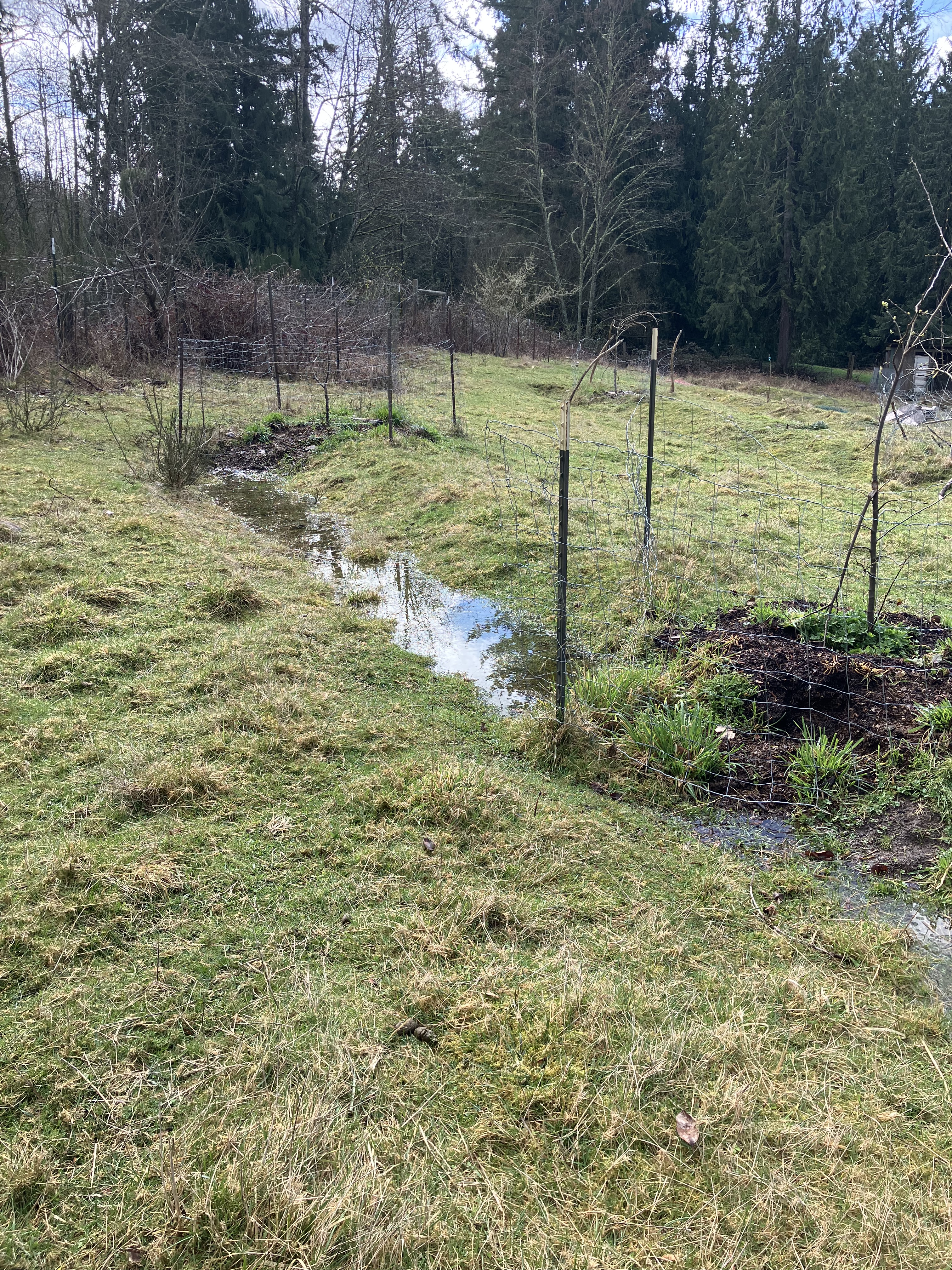
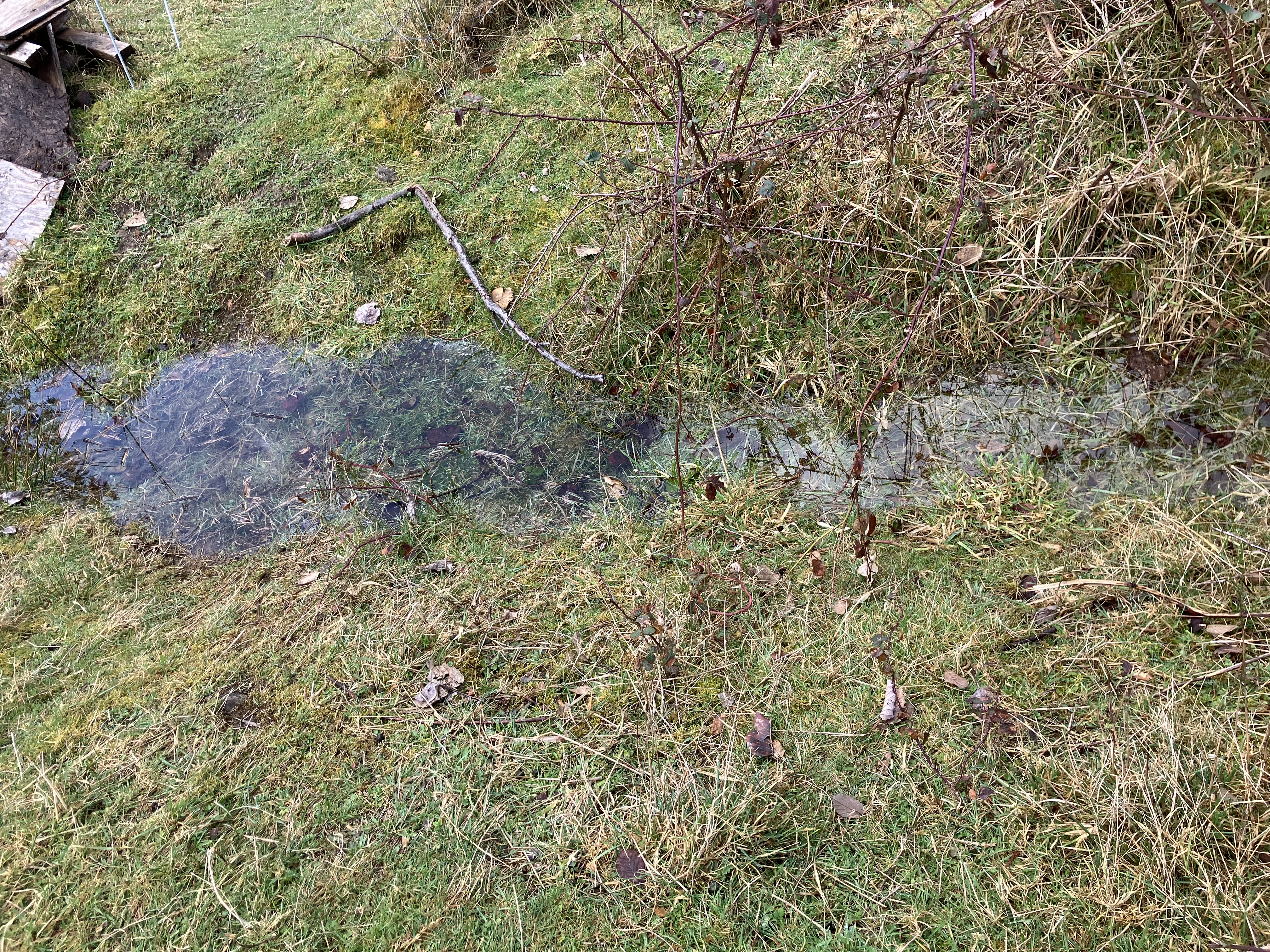
Our swales are one of the most simple ways to slow, sink, and store water. Above you see a swale at work with recent rains. The water can sit and slowly sink into the ground, moving down hill towards the young fruit trees establishing on the mound down hill. Other than initial earthworks, done in a few days after a year of planning, this system is self sustaining and crucial to keeping the forest alive as it slowly returns. This water will also make it’s way down into the aquifer, which feeds the well on this ridge. With all the housing developments down the hill from this farm, much of the water that used to sink in on this ridge in the once complex old growth temperate rainforests, which are now completely gone, now spills down and away along road ditches to the ocean beyond, lowering out potable water table until wells run dry. The housing developments below are unconcerned, because they rely on city water- like so many today. The corporate nation dreams of the day it can fully privatize water, which, though a fundamental human necessity to survive, would make a great commodity on the markets- already does in bottled water. Our utilities are becoming more and more expensive, with less and less investment in the infrastructure and care needed to sustain the expanding construction to keep up with housing shortages. So, it’s good to keep a well and work to keep the water where it falls- or nearby enough to support the living vegetation also crucial for our survival as a species.
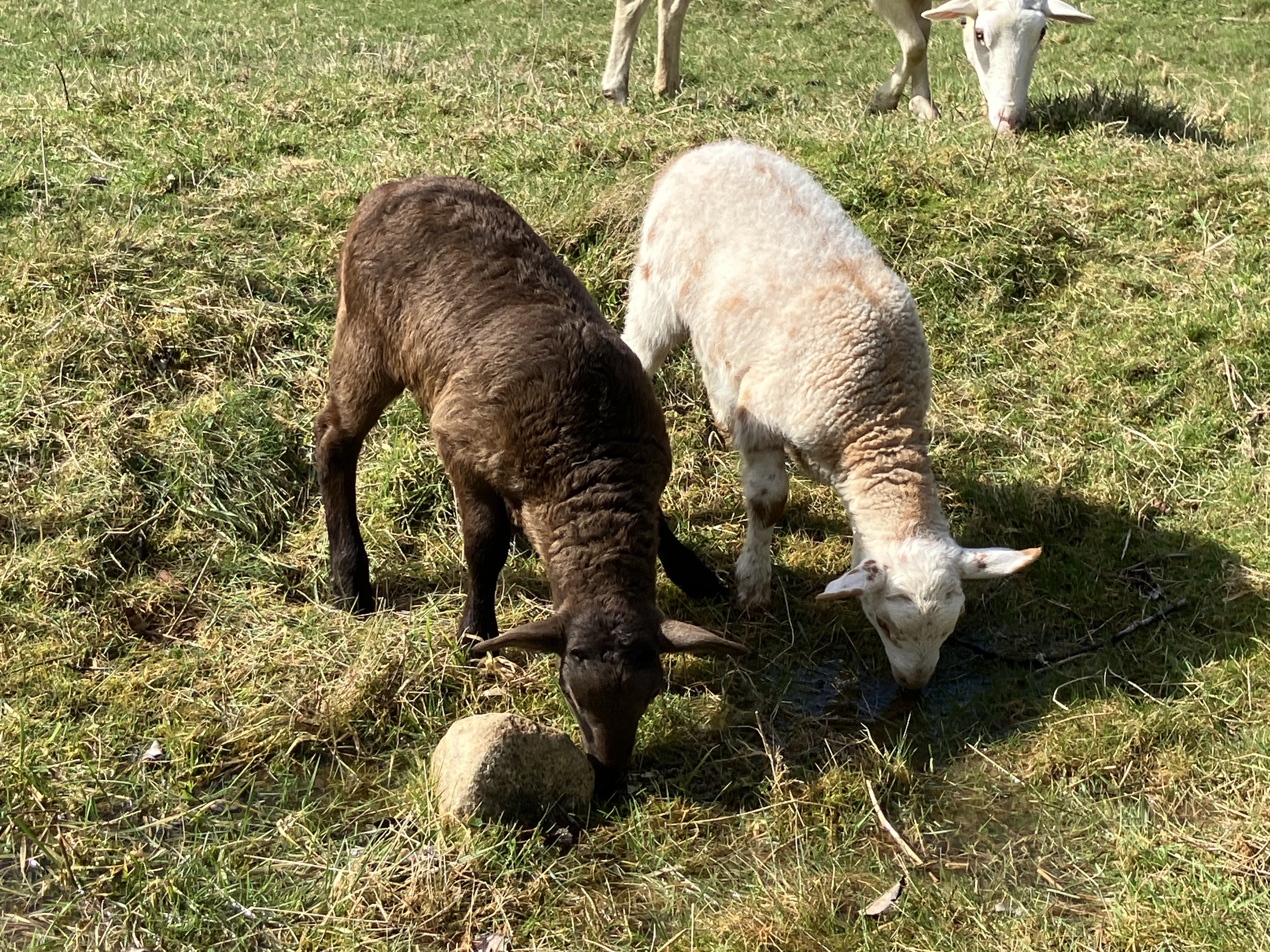
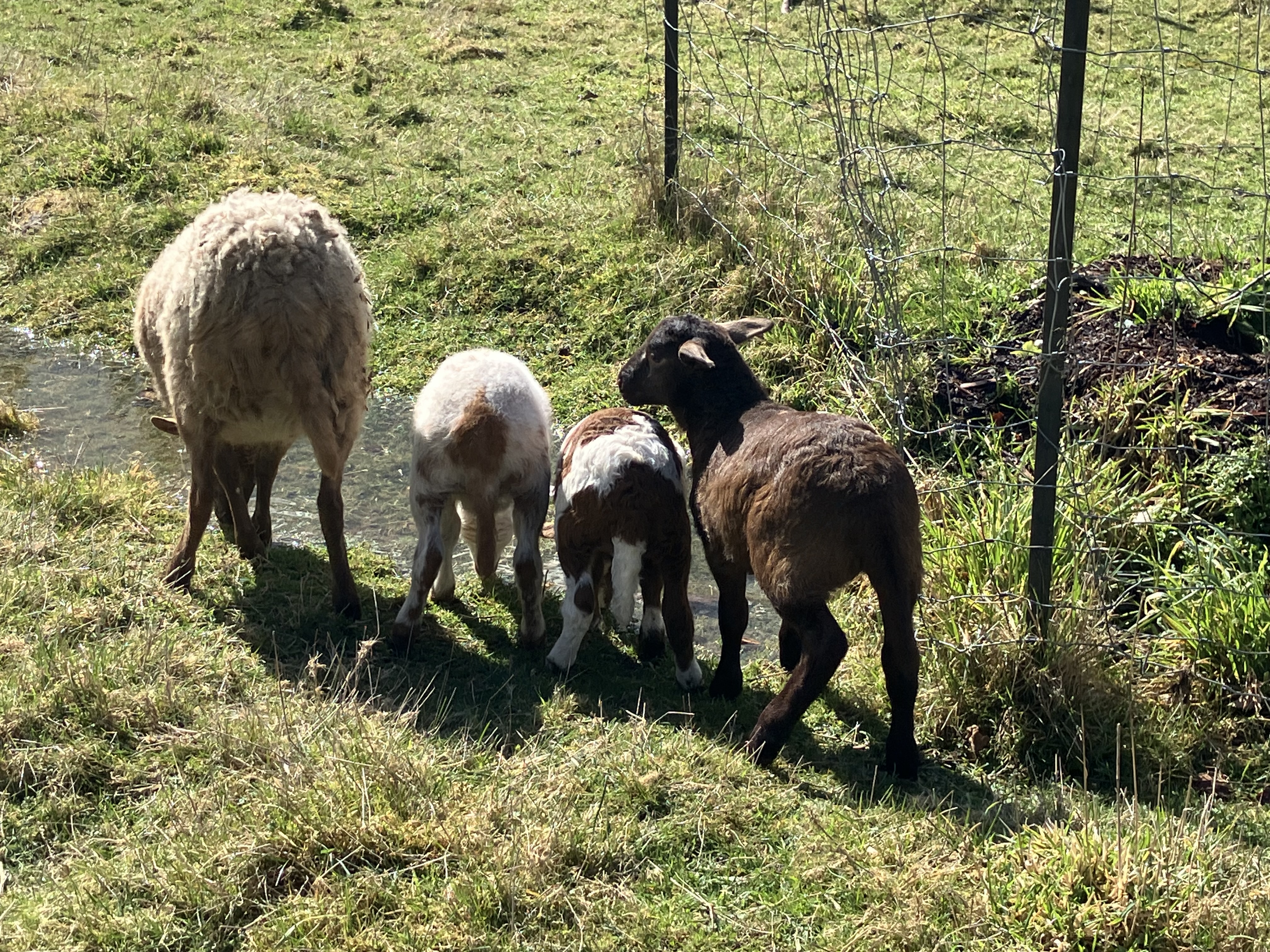
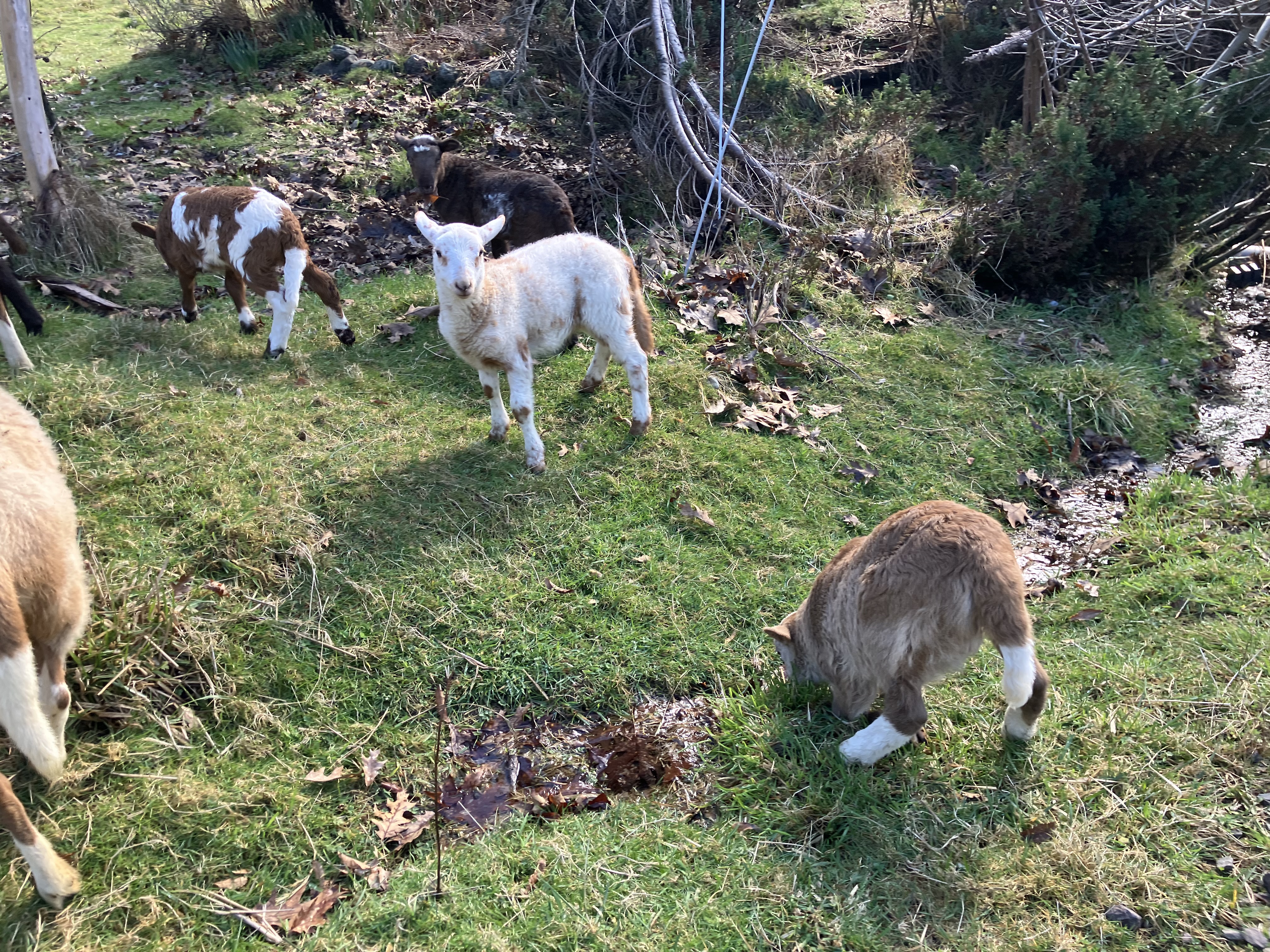
When there are major rain events, like the nearly 1/2 inch that fell the night before these pictures were taken, the water sometimes sits on the surface “day-lighting” for a day or two. Our sheep and chickens, as well as the geese, enjoy the fresh water to drink and play in. Some of the water is directed into catchments. There are a number of pipes under driveways and gardens which lead to our central water feature- the pond. With years of observation come smart design with nature. After reading the water running across the land for many seasons, it becomes easy to make a smart water plan for catchment. I’ve even added more design over time, after the initial implementation of earthworks. Having a machine do so much of the digging at the start is helpful, but takes some planning and investment. The rewards are endless, because once you’ve set the design in place, the rest of the work is passive and free.
One of the most recent redirects implemented at EEC goes from a rain garden wetland habitat, down a driveway, around the back of the pole barn, and into the pond. For almost a decade I watched a stream of water heading down the driveway and on down past the barns, along an access road to the back pasture. It was starting to cut into the road as it picked up speed down hill. By redirecting the flow at the top of the hill, the erosion was not only stopped, but more water then went to the pond during major rain events. We’re now catching even more surface water to slow and sink for the aquifer, and forest below. The pond is not sealed, so water can slowly seep into the ground. The pond does remain year round, and there are fish living in this modest waterscape. The system has yet to fill the pond high enough to actually top the outflow, but having two input pipes should bring us closer to that goal. Stay tuned for our next major flooding event.
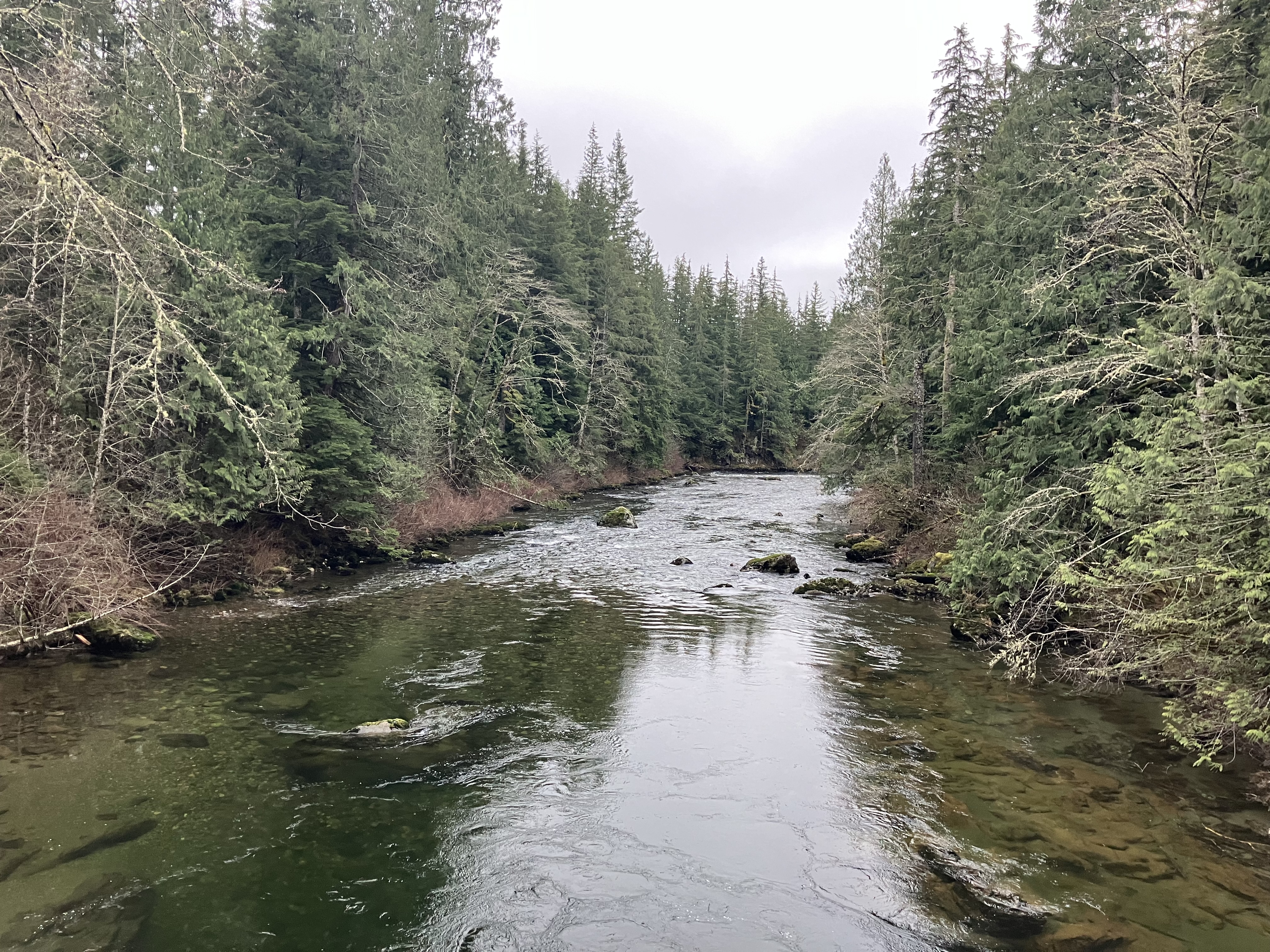
Pacific coastal rainforest is lush and full of activity, even in January. It’s also been a mild winter by the start of 2025. Snoqualmie, the river moon valley, ropes through ancient glacial lake bottom in echos of evergreen forest, now twigs and matchsticks more often than old growth. Still, a wide, deep river sister follows a signature ice groove along a managed forest with minimal setbacks bordering erratic boulders and cement rebar bridges, which I drive on this vantage, overlooking salmon dreams, whispering needles, scaled harmony. Poetic bliss, if the fish were here, historic numbers are a song on the wind. Oral history told by important kin to the fish nation, and I wish them well in their defending. Water, life giver, purity and quantity, though still deeply rooted in a cycle, became a hostile combatant to man made disruptions. Snoquamie Falls is the natural dam of this fork of flowing water that floods human endeavor and becomes a monster. It’s only our own projections, along with construction of our own egocentric ambitions to monetize the natural cycles of crucial complexity we prefer to destroy. A destructive lineage tracing back to those mammoths people are talking about resurrecting. But I love to digress- or transition?
There is this place, where water brings abrupt frocking, these transition zones are all part of wonder in nature, scaling upward, a few thousand feet from mere home ground 4-600′. An alpine lake reflect that hint of robin’s egg blue, and bird song echoing the winter quiet into melodic texture of branching twig cracking under the tire turning my box of metal ride up a final steep climb and into that white track of temperature trigger of physical form. Ice at the root of such garb, on a molecular level. Not like the lake, which rippled invitingly, etching the elevation in charcoal, navy oceans of deep stone trappings. There’s actually a quarry, right at the final turn around the climb and gaining a last look at the tranquil, the truck, pup, and I raddled along the very stone taken from the abrupt change, yet another transition, quick, and then gone around the switch back, and the next bend into daylight’s shining embrace.
Roads stretch flat, a pure white water, yet also still and sharp, like my mother’s linen, the folds of time, layers of second and third dusting, There is not enough to ski, slick, in full sun, soft to the step, but shallow; scraping of an oil based product I’m also heavily wrapped in as a final shell of protection from cold habitat, crisp in step and hiking upward in a steady climb across clearcut, with recent replanting- our “plant a tree” farewell songs of loss for commercial gain, and home grown, local; part of the effort to fold in recycling and our waste systems… but I digress, I guess, again, as one wheel in the universe of life- I can’t start musing on what is without what for. Therefor, Boldly choosing to move forward and literally climb into the first peaks, it was a delight to park, let the dog out for some good snow time, and let my body fall into rhythms of ancient tellings, smells you only get outside- even if they are tainted with traffic exhaust and the smell of oil cooking, sloppy grease traps, or the sour sick whiff of freshly spread manure from industrial agriculture, not to mention build up of us, the settlers. Less than aware ancestors cut old growth hillsides over one-hundred years ago, then another generation got the second growth with the understanding of a last good harvest. In my lifetime, by third growth, commercial development of the valley below into the cities at mouths, deltas, or filled in wetland from here to the sea, inland waterway often clogged with meth shellfish, motor traffic, diesel, hydraulic oil, ballast putridity, and the last orcas evolving to tolerate the conditions we the people have rendered uninhabitable, all the transitions are still part of the the same living network of collective survival, technology cannot bring us closer to said resources without destroying them, and our very beating hearts.
Every important piece of ecological functioning uninhibited, deepens purity of the sources; from the water sheds, to an even more crucial system of long term filtration. The ground is not being poked here for intentional deep well disposal of industrial shit. Our needed comforts, like my synthetic sports wear, still produce these unwanted waste chemicals, and even the wash water from my laundry, and in many homes, the petroleum based detergents, will end up in our water. The heavy metals in all our systems, even personal digestive tracks of the many billions carry these toxins, gaining them at first conception, through genetic marks they leave on us, our biorhythms, leading to cancer, or signaling our lives as having gone too far into comfort as a magical remedy to the realities of life? How am I coping? Maybe I light up a joint, take a drive into the mountains to move and observe, reflect and grow into place with purpose, driving into the edges of wilderness, pushing out a few deer, squirrels, snow shoe hare, and countless other beings already fully immersed in themselves and their place where wildness is required for long term survival. I did leave the truck a couple of miles back, hopefully it remains dependable as a ride home.
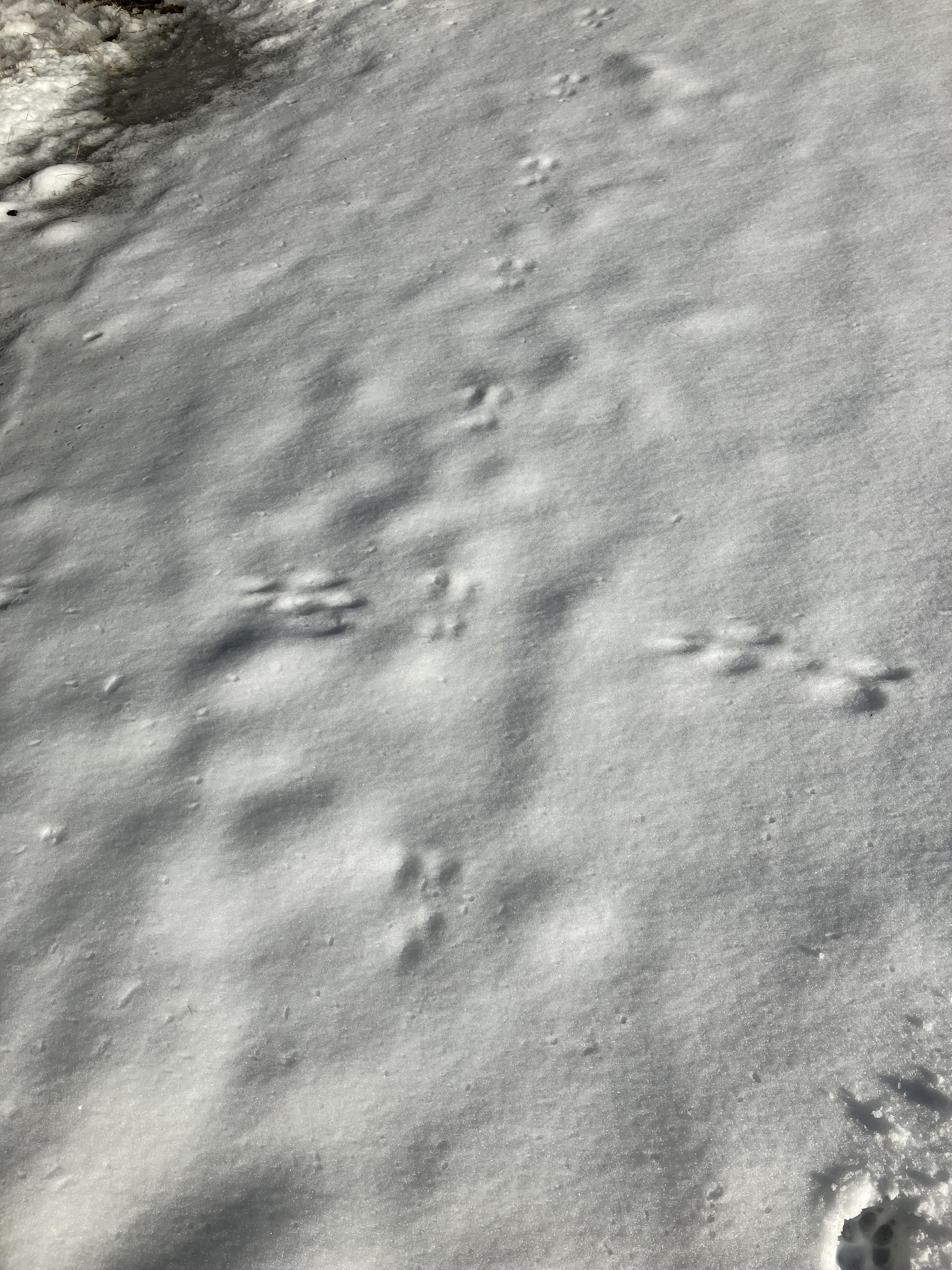
The survival rate varies form species to species, but our race, the human populous at large, would not last long out here alone, but together, with enough others, you can transition beyond mere castles in the sky longing, and into community building. Building is what got us here, or so I’m told by the western centric narrative of “U-S-A” chanting idiocracy we just voted in a second time. What a transition that will be. Look! The rabbit’s made the sign of the cross- nature is protected! I recall Magic The Gathering, in which, I’d cast the card Circle of Protection White, and the next four years would be shut out, returning me to reality after the tornado, house dropped on the witch’s sister, and a yellow brick road we’re all still following towards The Emerald City. Pay no attention to the man behind that curtain and keep clicking the red slippers repeating, “There’s no place like home.” This was not what I was thinking as I climbed at the time, but something triggers in the back of my mind at the thought that these lands that I walk are stolen, by our own negligence and people. We’ve taken the bait, hook, line. and sinker. Now, past the tipping point, while walking in fast melting snow, the waters that would have to keep our wells wet and the animals, all of us, alive through hotter and hotter summers. This is something I now think of with each drive up. But look at that view, and the bought access and freedom to some here, so American.
The clear cut gives us this lovely view looking back down the draw I’ve been ascending, a reasonable road hike to about 1200′ of elevation gain at a modest slope and a couple of stream crossings- over bridges. This is the private commercial timber products operation, which literally built (and still does) the civilization enveloped in a beautiful transition of cloud, water in a most haunting, yet crucial part of temperate rainforest ecology. Beyond the inversion, jetting peaks of The Olympics rise into a well named National Park of excellent wilderness, and beyond, the Pacific coast. Layers of so much nature you might be lured into the false sense of abundance in natural resources and the basics for survival, but it’s not enough to sustain this population, and that’s another thought tucked away in the brain, which sets off alarm bells, but the temperate rainforest is where I want to be for the best chance at survival if the comforts were lost through unpredictable happenings of this earth.
I reflect on L.A. right now, and what mental health workers are calling immediate steps in transition, encouraging victims of fire to plan in small graspable moves, get food, water, shelter, the usual survival drill. I do not mean to say this tragedy is simple or usual, though it is man made. Development greed and continued denial of human overstep wherever and whenever we want. As I watched and listened to the governor of Cali proudly say he would wipe ecological restrictions out of rebuilding requirements, I could see the lineup of future fire destruction in these overpopulated places and grieve. When temperate forests dry out in prolonged drought, fires will happen for us too. Rain is good, waters must run deep to keep us safe from fire’s consumption. Before I share with you the magical tail of temperate, I’ll anchor my wander in the picture of this aspect, under the veil, and you can see the developed world at work.
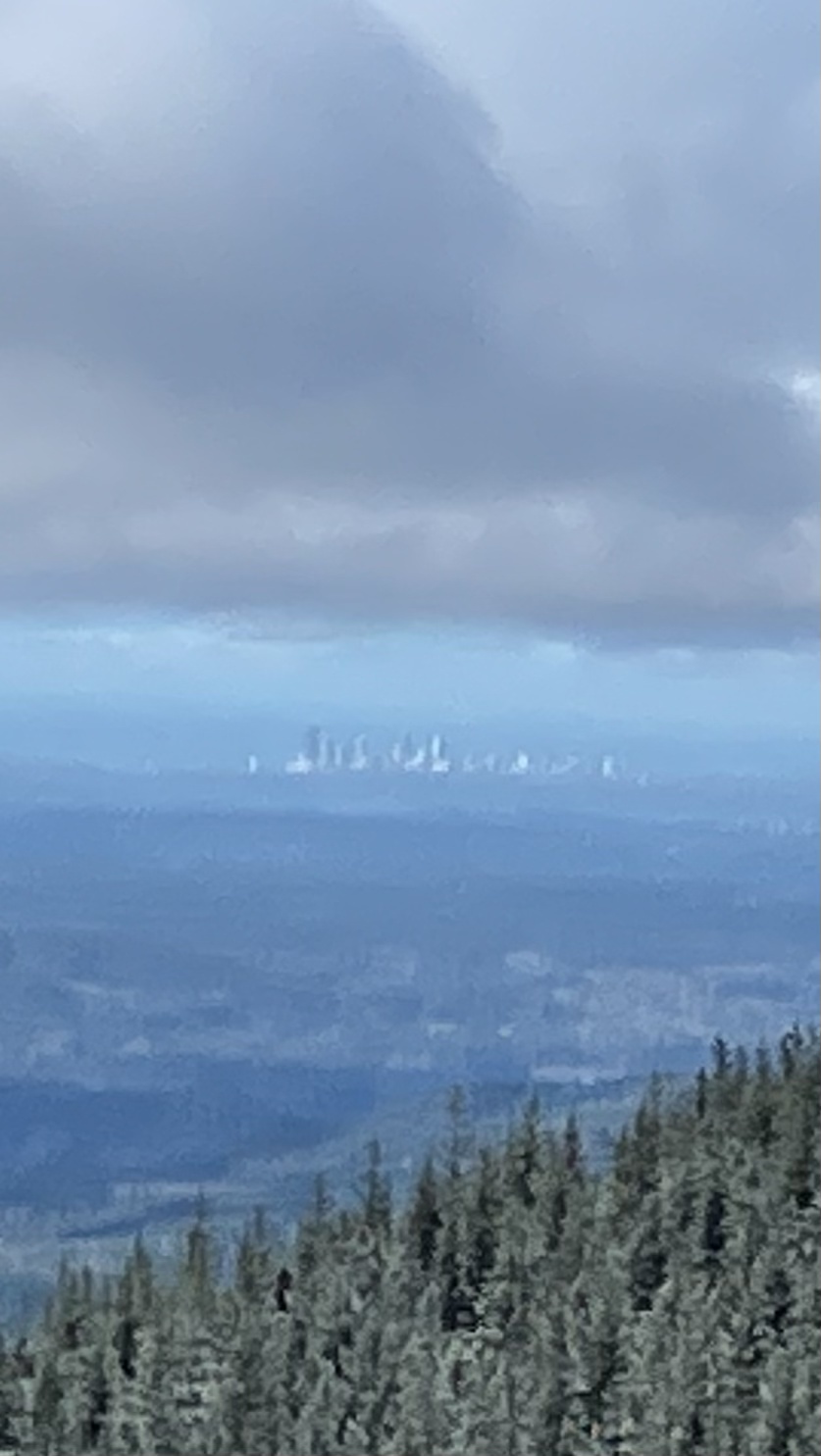
It is a city in the clouds, and a micro-macro in computer technology, the birth of such spells and casting now ruling our consumer, social, and soon to be political personalities far off, as though in a distant land. It’s like that here, what a privilege, in a private acreage, admiring the spectacle, and being one at the same time. Wait, what? Let me draw your attention to the patchwork quilt in the rolling hills and valley below. That’s where the farm is, and where I sleep. There are still some standing groves of second and third growth, maybe some that might be left for a few generations before falling into manipulative speculation or castration of wildness for all. I’ve cut trees, asked and paid others to do so on the landscape I sometimes curate with my own ideas of stewardship transition, of wandering as a right, possession of pace and space, wherever my feet are planted.
Brave little wetland setbacks that have been granted, in more recent tending of this land, a common thread in developing, to build, taking is the order of business. Order, tight squares in neat harvesting, these hills could be rice fields, no, we have not cut our jungle usefulness as a resource that can be swiped, bundled, and chopped into board feet. Left face of this rise out of the Snoqualmie Valley and Rattle Snake Ridge beyond, where there are timber investments from LMNO alfa-beta medatronic meta-gaming. Metagaming mother nature, for those of you more hip techno-files out there AIing the you know what out of finite, as I type, or hike, loosing steam, but looking back at the time and space passing, appreciating where and what I can be doing to transition. How about casting a spell?
Spellbinding, movement, frozen, liquid, bubbling chatter under thin ice. Here, the freeze is only skin deep. Snow is blanketing the open space, but where the stands of uncut forest remain, there is open ground, and a wall of sun catch for the south facing hillsides. Still, erosion pulls at the road cuts, scabs put down to give people, like me, easier access to the first peaks left behind ice flows a mile deep in memories compressed into stones, layers of boulders and pebbles give way to allochthon signatures, vaulted granite base with volcanic wedded basalt linger. Not quite spires, but no less towering in formation, the scent of alpine spruce has overtaken cedar and fir domain with the stiff bristled hardy stands at the edge of the commercial boundaries, beyond, more transitions of mountain scree, frozen alpine waters that, in high summer, offer beauty of turquoise depth. Seasonal transitions aside, on this day, a return to my evergreen chariot and drive through grey daylight, home in time to check stock and bundle self into hearth before the frost comes down in it’s own quiet spell into night. The pale rose hinting at setting, pearl globe bouncing off the edges of uplift, calling the evening chorus of those birds who will wait out the night in thick needle beds, perched under down and comfort in the light breeze that sings her balanced little heart to sleep before dark sets a web of mist from mountain clefts to farm’s edge.
Grounded environment, yet change apparent, ever encroaching on the peace of mind, yet the beauty is still there, she painted her subtle hints in breath and sky, along the cold parts of skin where no cover let the light in, along tailored edges, where this transfer of power, from self to source, ashes that will one day plant another tree in the forest of our enchanted societal normalities, whose plot am I gleaning from in the classic sunset image, tire tracks and all. Clear cuts offer space for a mind melded to technology, even without bitcoin. Smart phone, computer whore, and a gasoline consumer wearing her own death suit in water proof apparel. Transition out of these wet cloths.
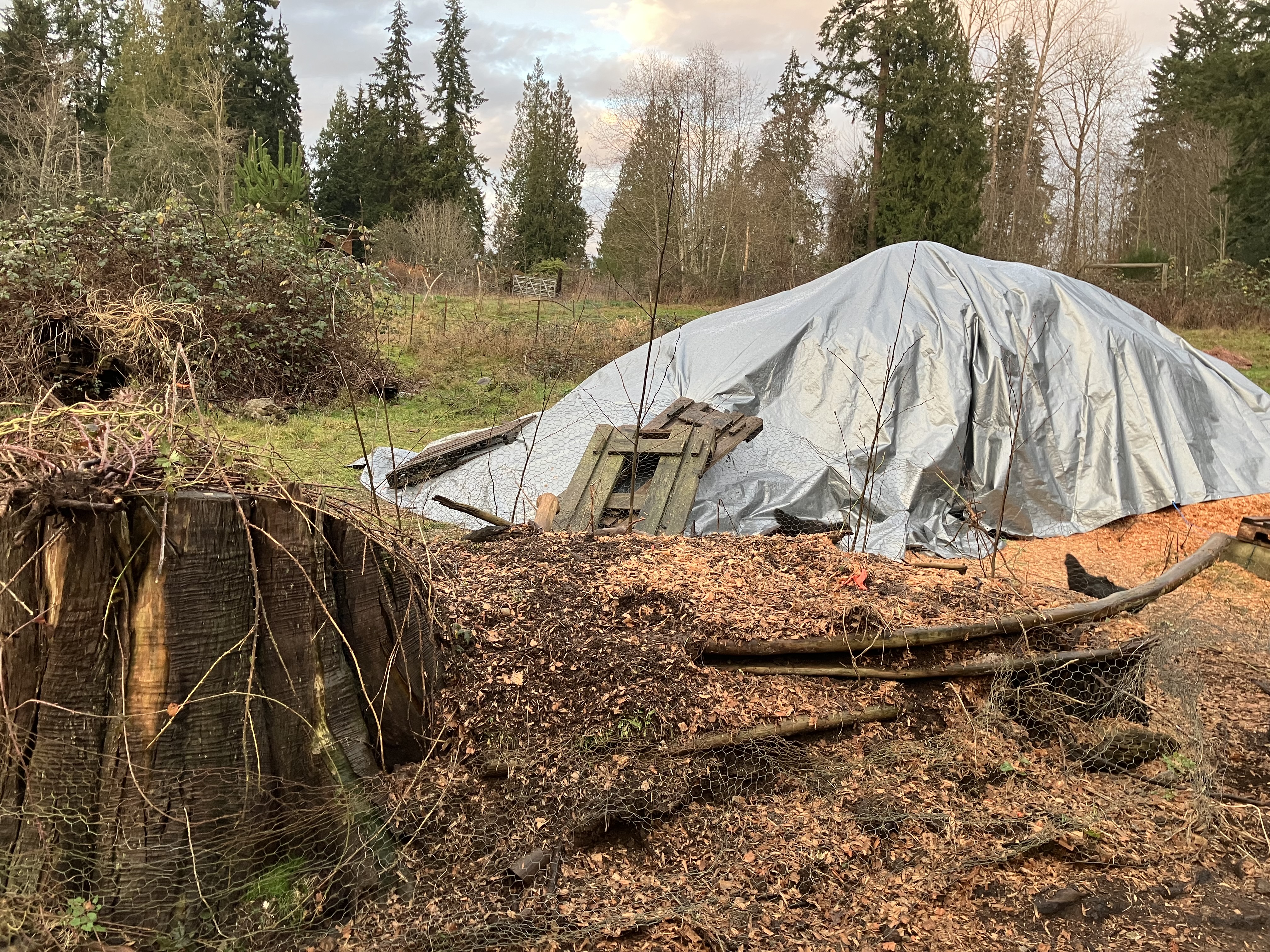
It was a late fall day and I had a bucket of native plants that needed a new home. A few days earlier I’d been on my driveway pulling up all the young alder trees to re-home them away from main thruways. Now I had a combination of canopy and understory plants that were ready to put back in the soil in there forever home. I’d been eyeing one of my worm cities as a possible location. It had some good legacy stumps and banked fertility in some piled compost of sheep barn bedding which had been cooking down for over a year and was ready to host new plantings. I was going to shovel the whole thing into the bed of my truck to transport across the property to another raised bed that needed some topsoil. Then I thought about how much work that would be, and decided to bring the plants there and make a nice tree island.
A tree island is my name for a small cluster of trees holding a little island forest habitat, surrounded by open pasture. One might call it a grove, but I like the idea of an island of raised habitat on the landscape. To prep the “bed” I turned the surrounding soil up onto the old pile until there was a substantial mound. Then I planted the shorter understory plants on the south side, mulching them with some shavings. It’s important to keep track of young plantings if you can. I use bright orange flagging tape to show where things are. I also snuck a couple of oaks in for long term growth. On the north side of the mound I transplanted the red alders from the road. They are already over head height in stature, and will easily keep above the smaller plantings as everything sets. It certainly transformed a muddy stack into a beautiful bed of young native plantings that are sure to add layers of vegetation, diversity in ecology, and change in terrain for the eye, to name a few benefits of establishing a tree island.
This is also a berm, well drained in flood months, yet mulched to keep summer sun off the soil. More layers of animal bedding that is nitrogen cold, will be spread in lower outer rings to be turned into more compost as soil builds. alders will be thinned and even pleachered to allow sunlight north of the mound where other swales and more established tree islands are set and growing for a decade. The south facing hillside gently slopes on the north end of the property, so I’ve planned sun isles through the future standards that will litter the upper pasture and main living area of the land. Oaks will eventually be harvested for wood heat, some acorn production similar to native hazel, and savanna silvopasture with deciduous nut and fruit trees dominating the canopy.
This tree island will host 20-30 years of alder and oak growth, while hosting long term hedge and shrub species for pollination and further starvation food wildlife habitat. Our chickens will use the young stands as shelter and as summer clutch rearing habitat until chickens are phased out of restoration plans for EEC Forest. Though chickens are a jungle fowl, avian flu and other bird carried pathogens in our area might cause the necessary culling of flocks if infected. Leafhopper will comply with any state mandates, but if our animals are slaughtered, we will not plan future production livestock and phase towards total rewilding sooner in the 60 year lifetime plan of my direct work with this landscape, in hopes of cleaner air, soil, and water for future generations of all living things.
These tree islands will thrive and grow with or without human tending, in a succession stand of oak savanna, the most successful forest in this soil, with the glacial till drainage, and sloping topography. Layers of slide alder, hazel, and in seasonally flooded areas of the land, willow to root long term understory deciduous drought resistant hundred year canopy return. There are enough maturing trees already on sight to produce native coniferous species as long as current climate allows. That’s where I try not to scry the future few hundred years with too much confidence. Soil building takes thousands of years, in which time, for this rather active geologic web of tectonic sudden upheaval and strata volcanic presence invites. Paring that with exponential climate instability with the not so subtle storms of wind and water, drought and fire to uncharted ferocity akin to fears of AI.
The weather is happening in real time, and when it’s privatized by that shadow cabal known as prosperity to the few at the cost of the many, we’d all earn some ancestral wisdom in looking up at the sky, watching the light, clouds, wind, and colors of seasonal shifts and nature’s language of entropy, which is usually experienced by us as slow and uneventful- most of the time. Hopefully the trees survive into some forest cover, and nuts offer food source that even humans can eat. This tree is fire friendly, drought tolerant, and could fend off blackberry with chemical warfare. They are spaced well from the long term establishment of understory shrubs planted in the island ecology. Mock orange and service berry are drought tolerant, also friends of fire, and offer food, materials, and medicine. Together, these plant companions will establish a long term cooperative adaptation, and provide layers of abundance and regeneration for the landscape through all of nature’s change.
My hunting mentor invited me to be his support on a black powder late deer season hunt. This window of four days allows one final chance at a deer before the season is over. It’s short and sweet, so you have to use all the waning daylight you can to be in the field. I took my shotgun to watch for grouse, but my main mission was to learn from my mentor. Time in the field with this accomplished sportsman is worth it, and a rare gift of his time with me. We were in The Snoqualmie Tree Farm for the whole hunt. Though we did not find any deer or grouse, many good things happened, including a lot of learning for me. Thanks to the people who take time to teach and offer opportunity for others to learn.
The weather played a big part in making our hunt difficult. This may surprise some, because the sky was clear and the sun was out- but blacktail deer sleep away bright days, and become more nocturnal. They get too hot in the sun with those warm winter coats coming on. Rain and clouds are what bring these deer out, so we saw very little activity, in fact, none. No deer showed it’s self the entire four days we were out, and we were covering lots of ground. My mentor thought it might also be the uptick in chemicals being used on the tree farm grounds. They spray herbicides in the young plantings, and spread treated sewage everywhere. The deer are repelled by these unnatural applications in their landscape. We could not find any brows or tracks in these chemically altered spaces. My mentor ever said he might stop coming here to hunt because of the disruption.
The views of our surrounding mountain ranges was quite magnificent. I’d not seen a good panorama of The Olympics for a while. In one of our spots, we were high enough to see just above the teenage plantings to our west. I spent some time scrambling along a recently logged off ridge line to get a picture. While picking my way through slash and slope, I picked up on a fresh set of deer tracks that went in the direction my mentor had gone. He would pick a place to hunt and I would stay on the opposite side of the road from where he went in. That way, he would know what direction I was in, and I stayed out of his hunting ground. Black powder guns don’t have a long range, but having a plan on where everyone is to keep out of each other’s line of fire is an important part of safe hunting. If my mentor wanted to change position, he would first meet me back at the truck at our planned check in time, and then make a new plan so we were always on the same page in the field.
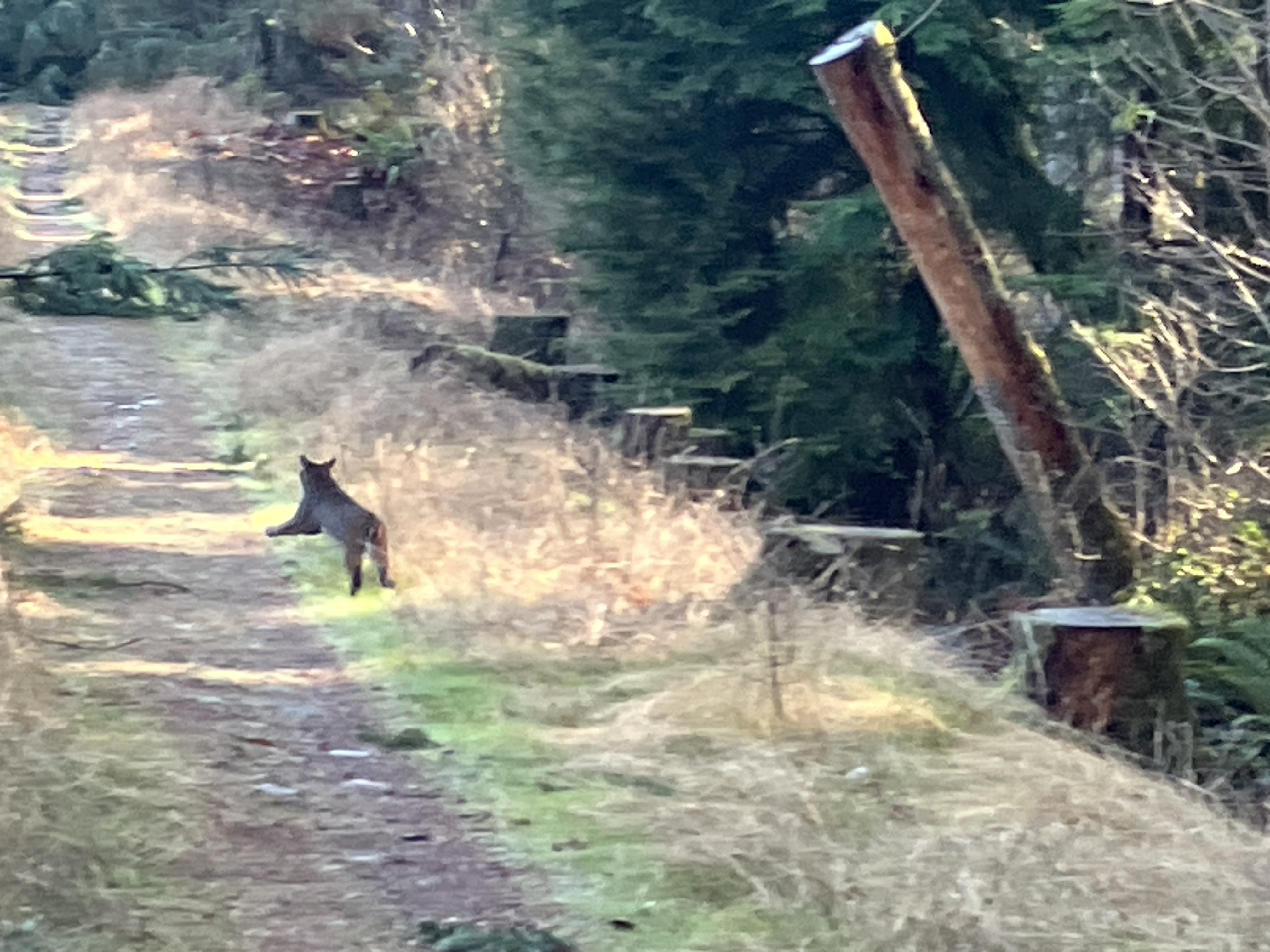
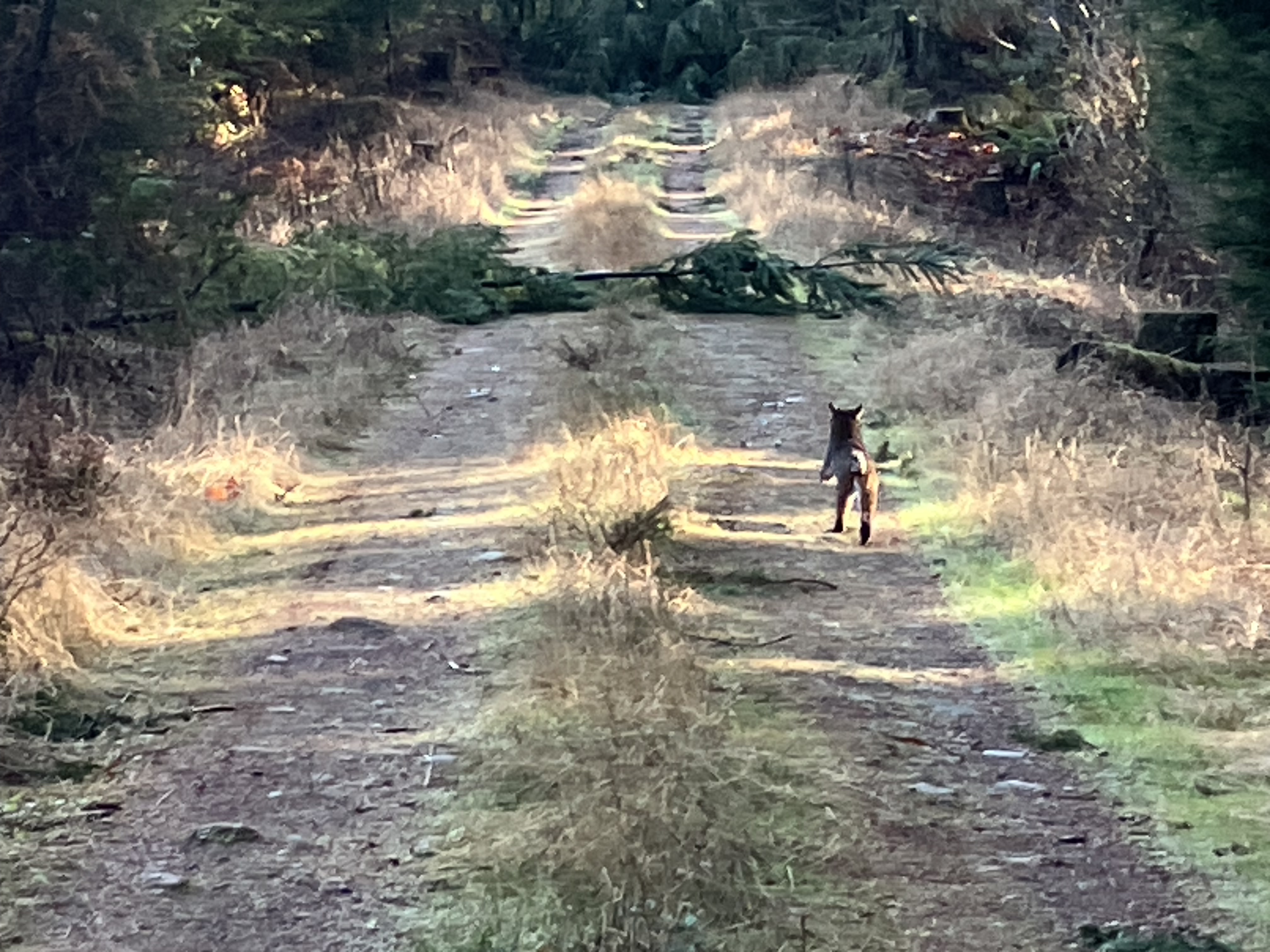
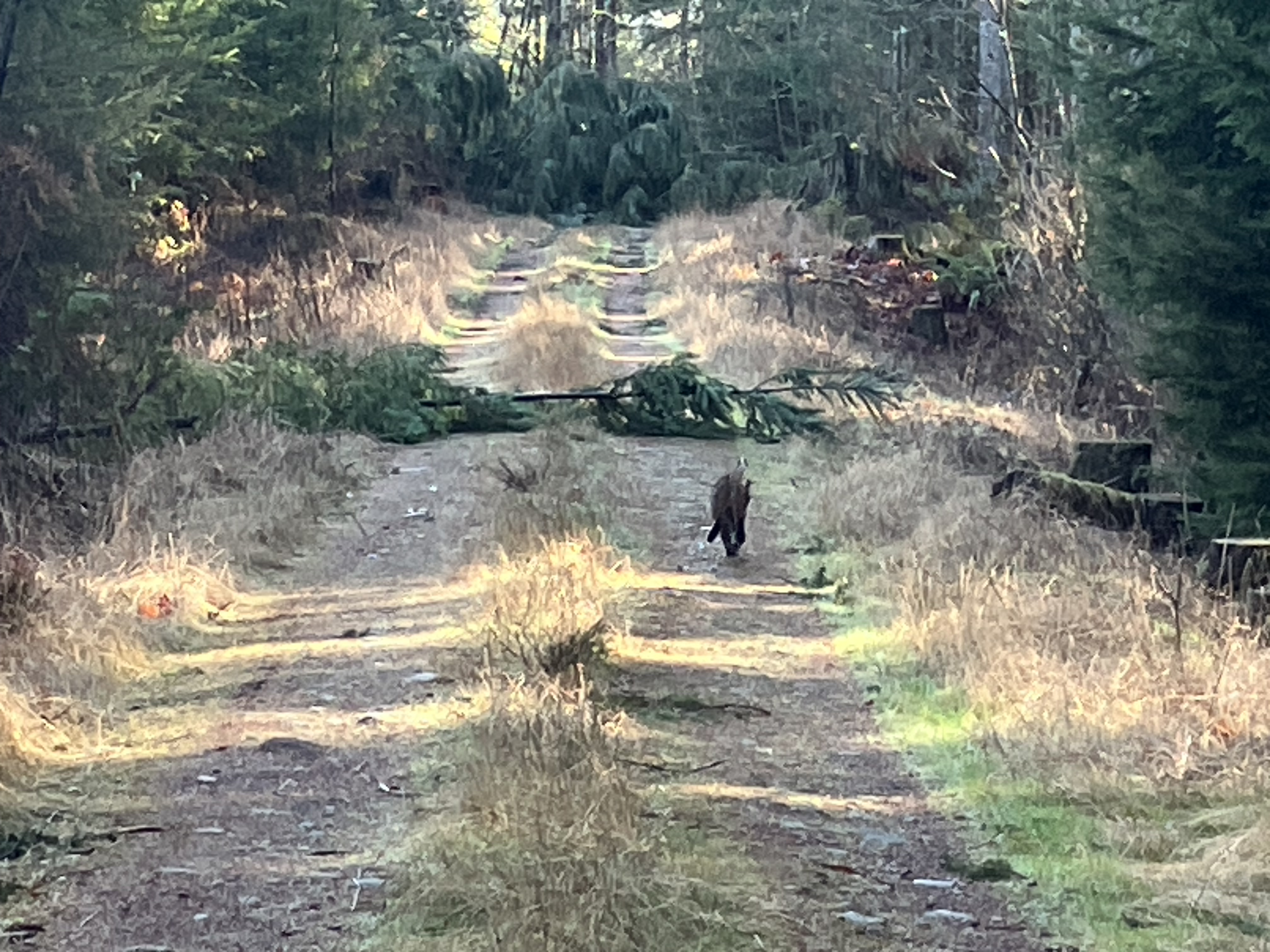
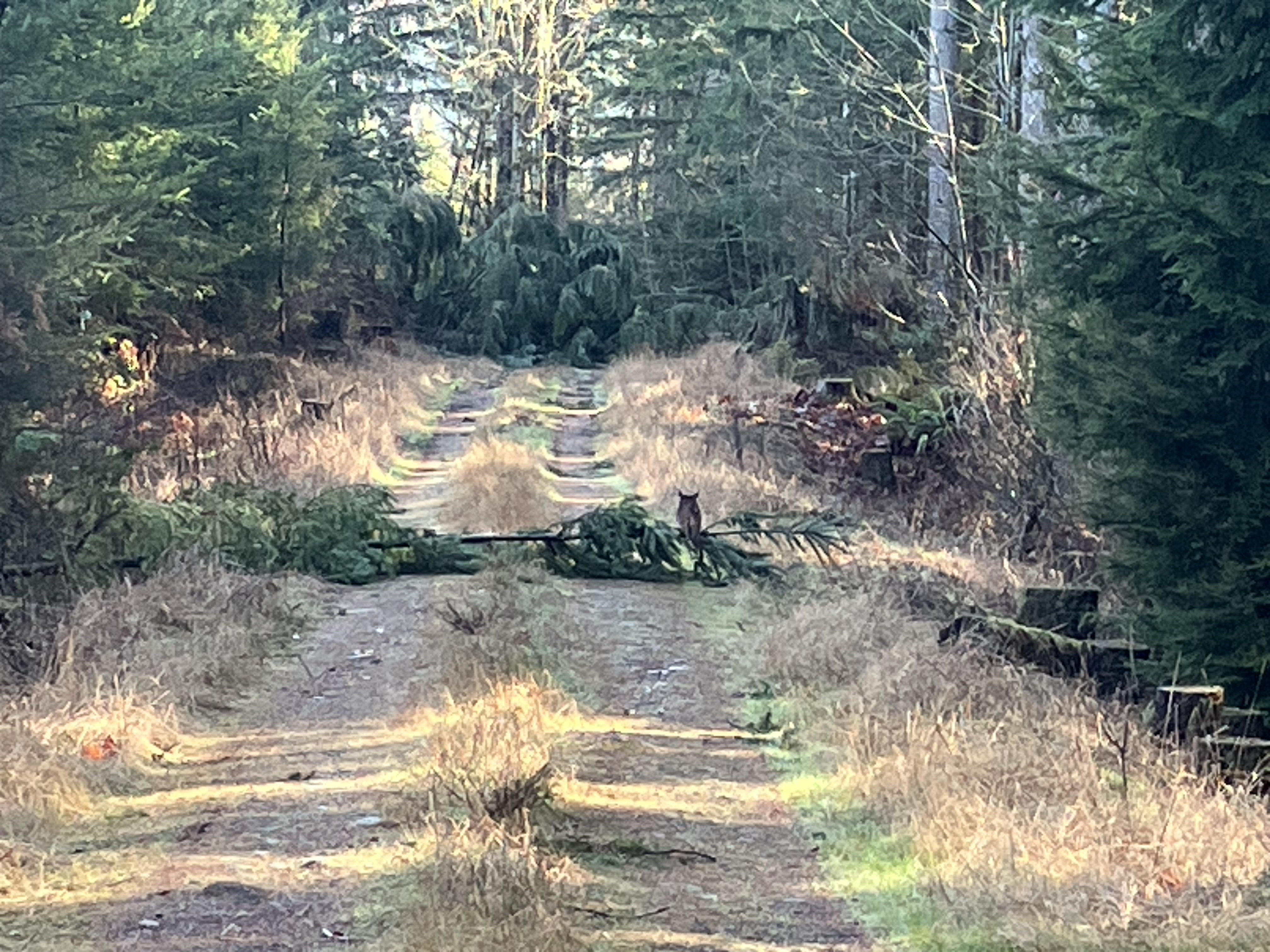
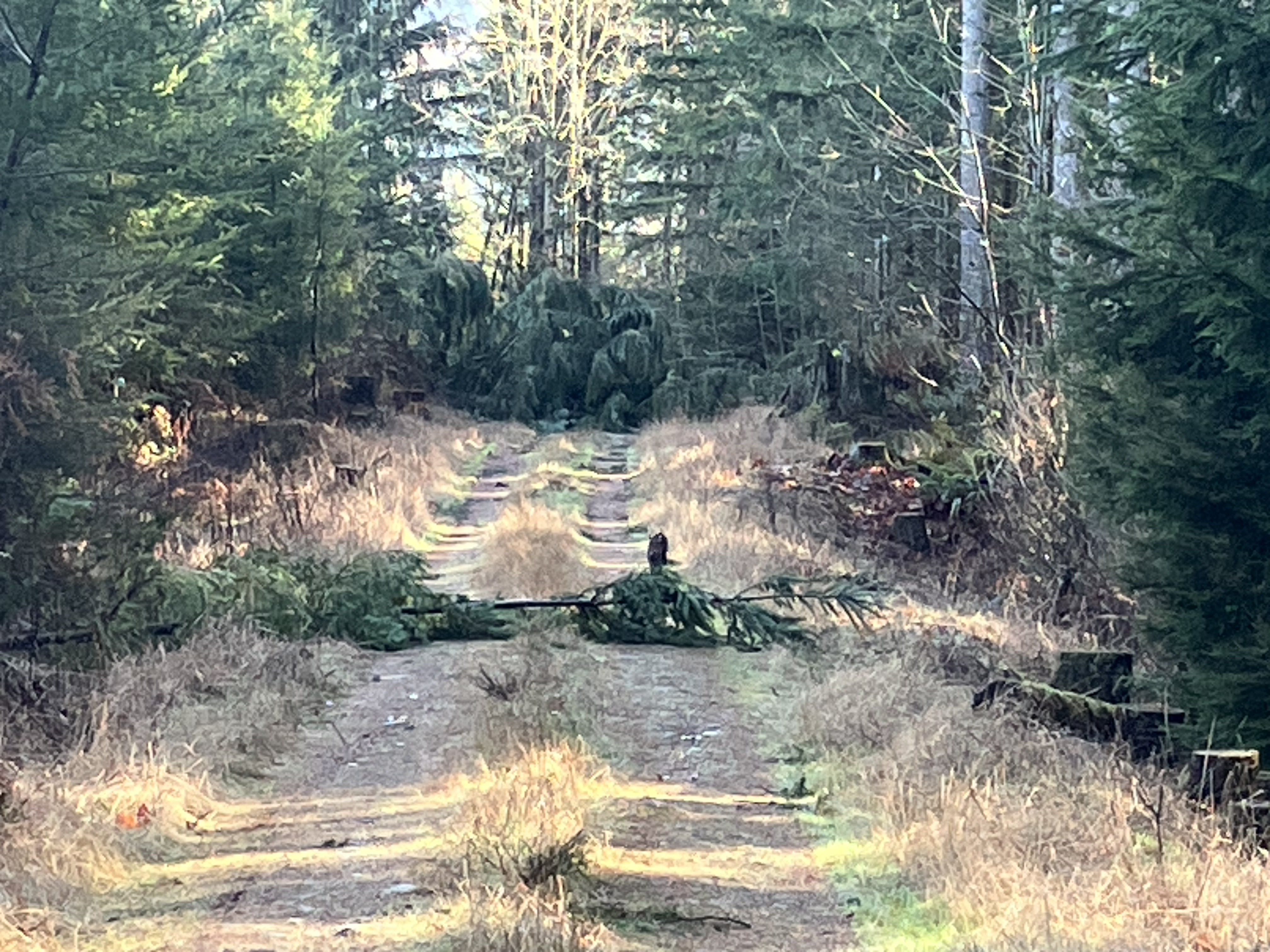
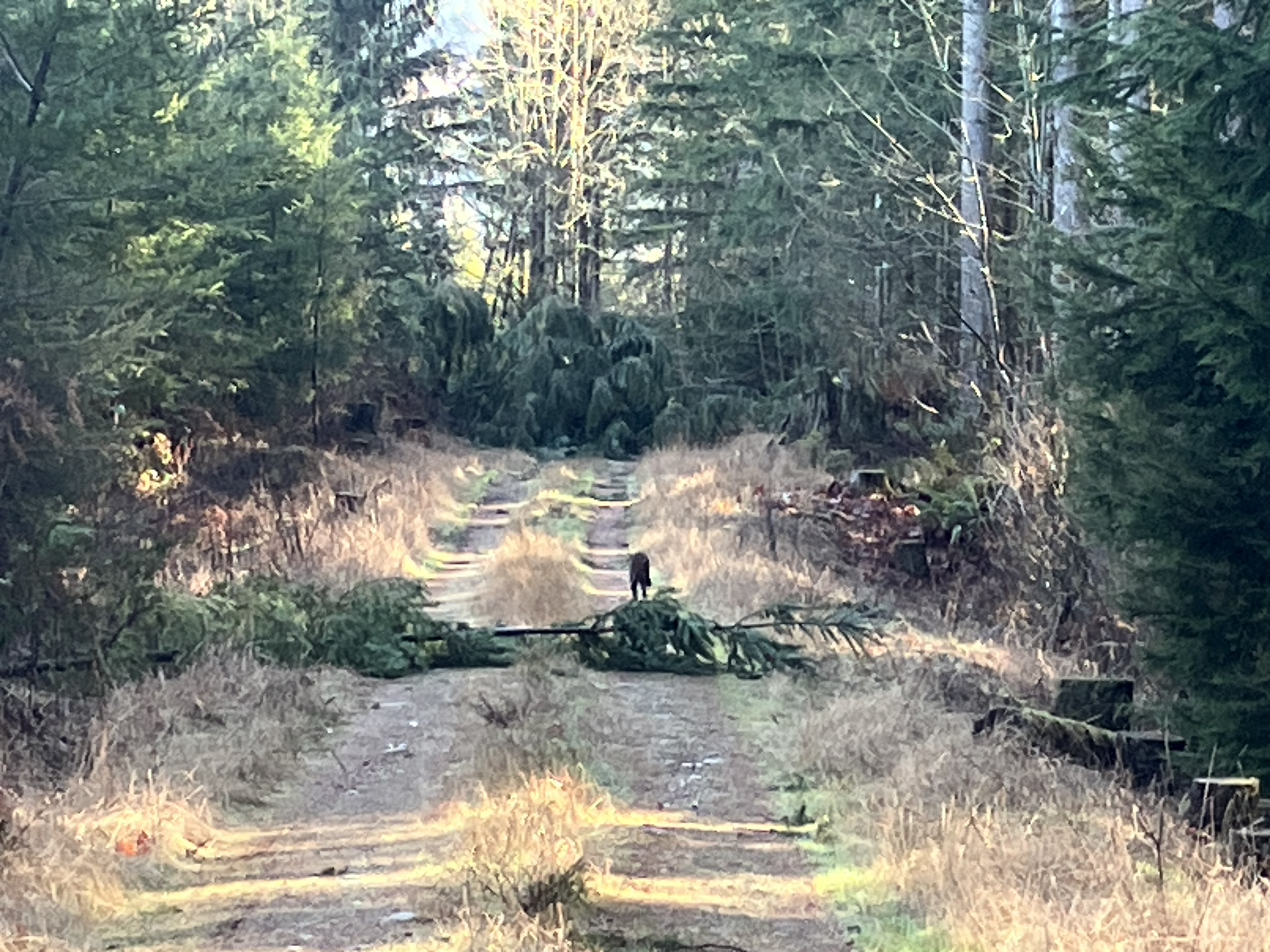
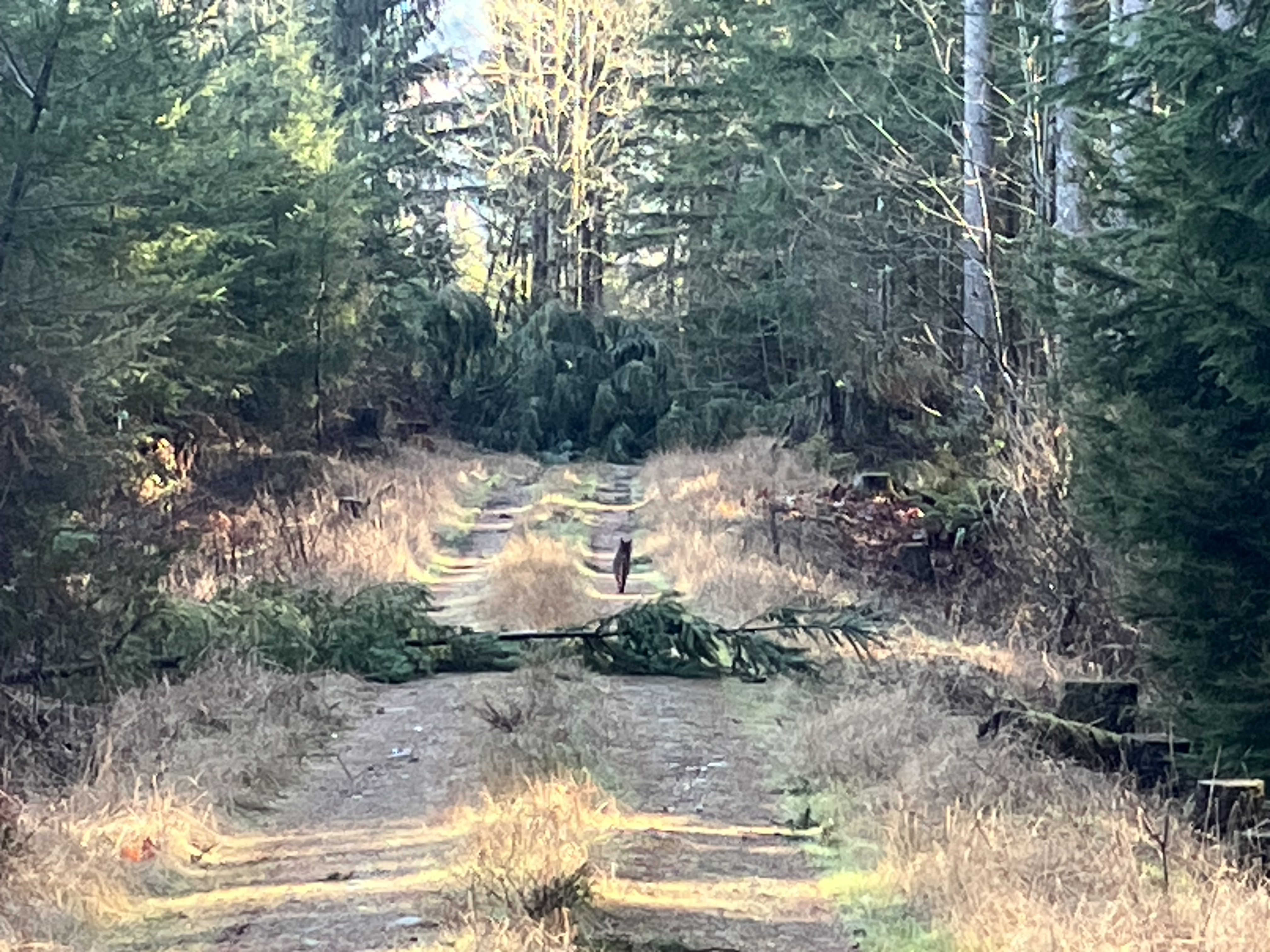
My hunt for grouse was fruitless. There was not a bird in sight where we were. Was there any wildlife at all? Yes! We had an amazing encounter with a young bobcat. While checking out a quarry for deer- “a quarry?” you ask, yes, a quarry, where deer will sometimes look for mineral deposits in the exposed layers of earth; Wes saw movement just before I picked up on it- I was driving. We stopped the truck and watched a bobcat slink across the road and into the woods. That’s usually how you see a bobcat, briefly crossing the road. But this cat did not go too far. Moments later, as we got out to look around, the cat popped back out on the road and gave us another show. We began to observe the animal together, noting its dark morph and unusual behavior. My mentor guessed it was a young animal that had not learned to fear people yet. The encounter was magical.
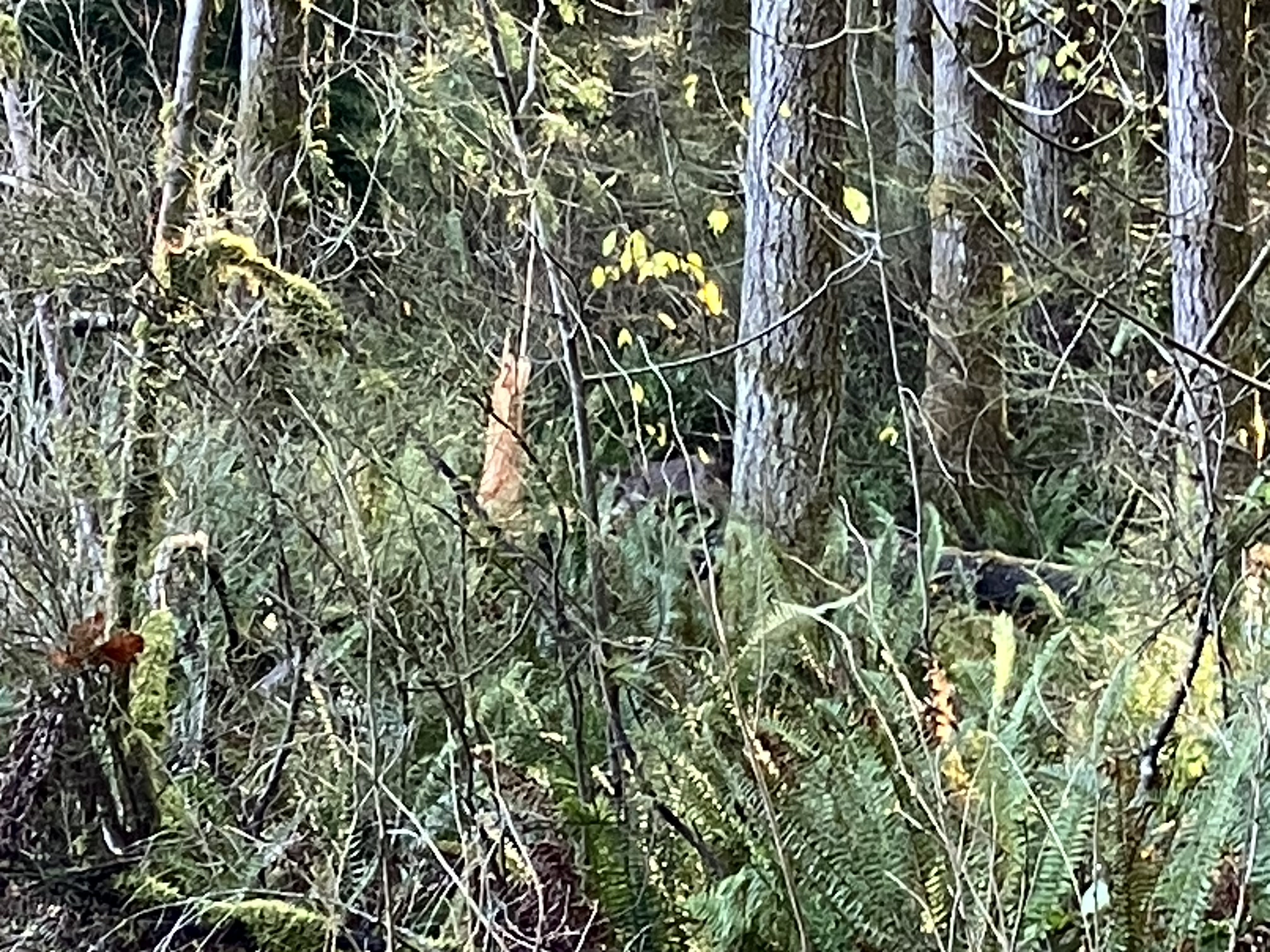
Bobcats have amazing camouflage. Can you see it in the picture above? It’s crossing a log right to left, about center in this photo. I only knew it was there because I’d watched it moving for a while. My mentor and I were happy to stand and observe the animal for as long as it chose to be around us. You might be wondering why we didn’t hunt it. Well, we didn’t want to. Bobcats are not good eating, and the pelt market is not something I wish to participate in. We had our small game license, and could have harvested this cat, but that was not our intention. We were appreciating the opportunity to observe and learn form a shy, mysterious animal. The cat seemed to pick up on our intentions, and came out a few more times to show off it’s unusual dark morph and how athletic it was. I got a great series of photos as it ran away down the road.
It was a gift to watch the bobcat for so long. Sometimes it’s good to pause in a hunt to let nature show you a few things. I was glad my mentor wanted to take the time with me to watch. That was a special moment for both of us, and we cherished it. Time in the woods can slow way down. Each day there was a series of adventures. There had been a recent wind storm that knocked down a lot of trees. Many roads were impassible, which shrunk our hunting options, but there was still much ground to cover, so we did some driving, a lot of scouting (looking for recent tracks or brows) and my mentor took a few walks into recent clear-cuts in hopes of getting a deer up. They usually lay down to rest during sunny days, so you have to go into the open places and try to spook one up from it’s lay. My mentor is in his 70s, and though he is still in good shape relative to his age, he went slow, and had to take breaks between each wander. The relaxed nature of this rhythm helped me relax and enjoy the days too. I was often on a road keeping a safe distance while watching for a grouse. Not even a wing beat was heard.
I did find mushrooms, chantrelles were on the menu each night when we got home in the dark. This year, mushrooms have been off the hook in these woods. I would carefully hunt the ground, keeping a sharp lookout for any golden treasures, and I usually found them, quietly waiting on the edge of a tree line, or half buried under the needled of a fir tree. It was wonderful foraging, and rewarding to find some almost everywhere we went.
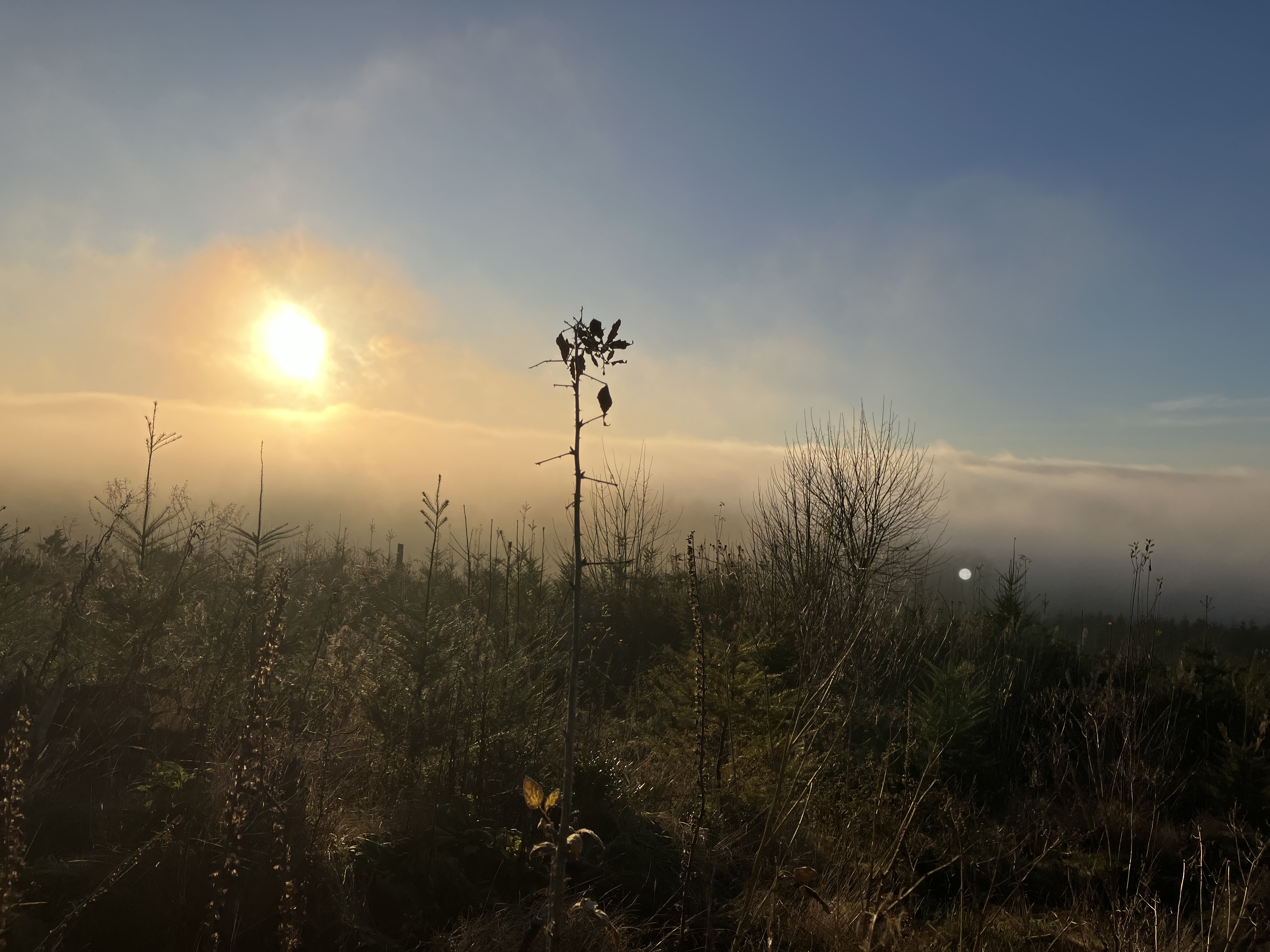
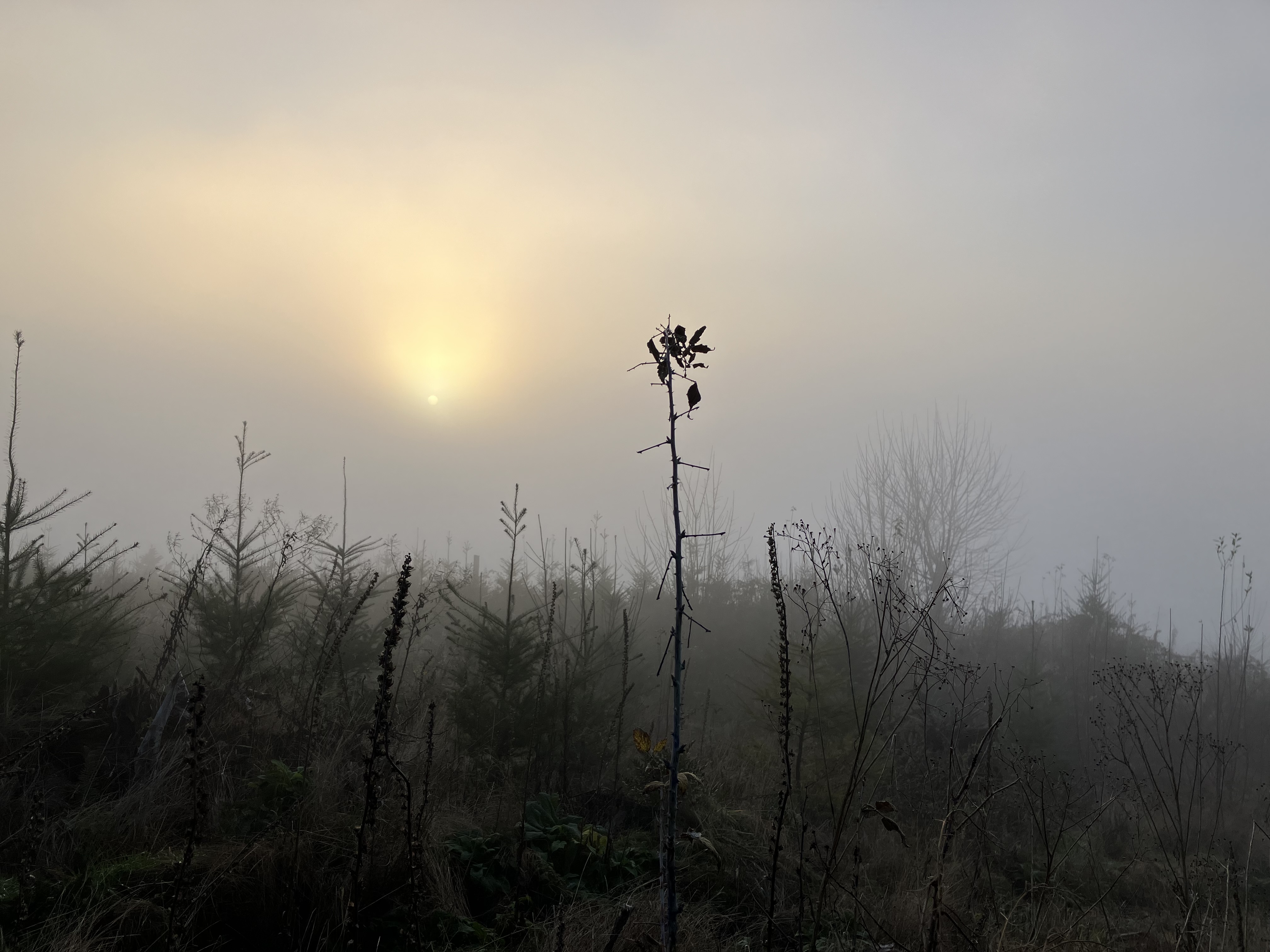
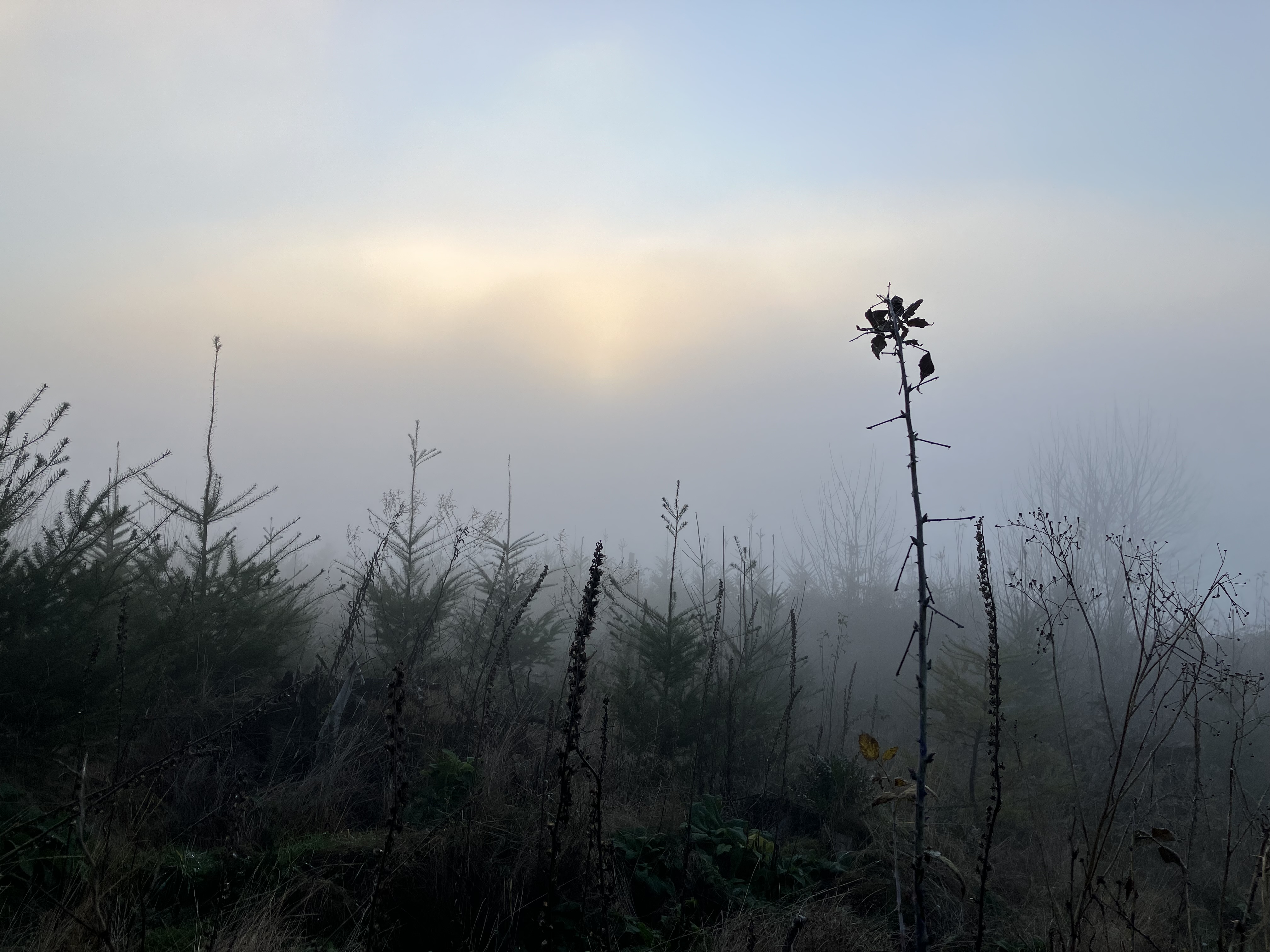
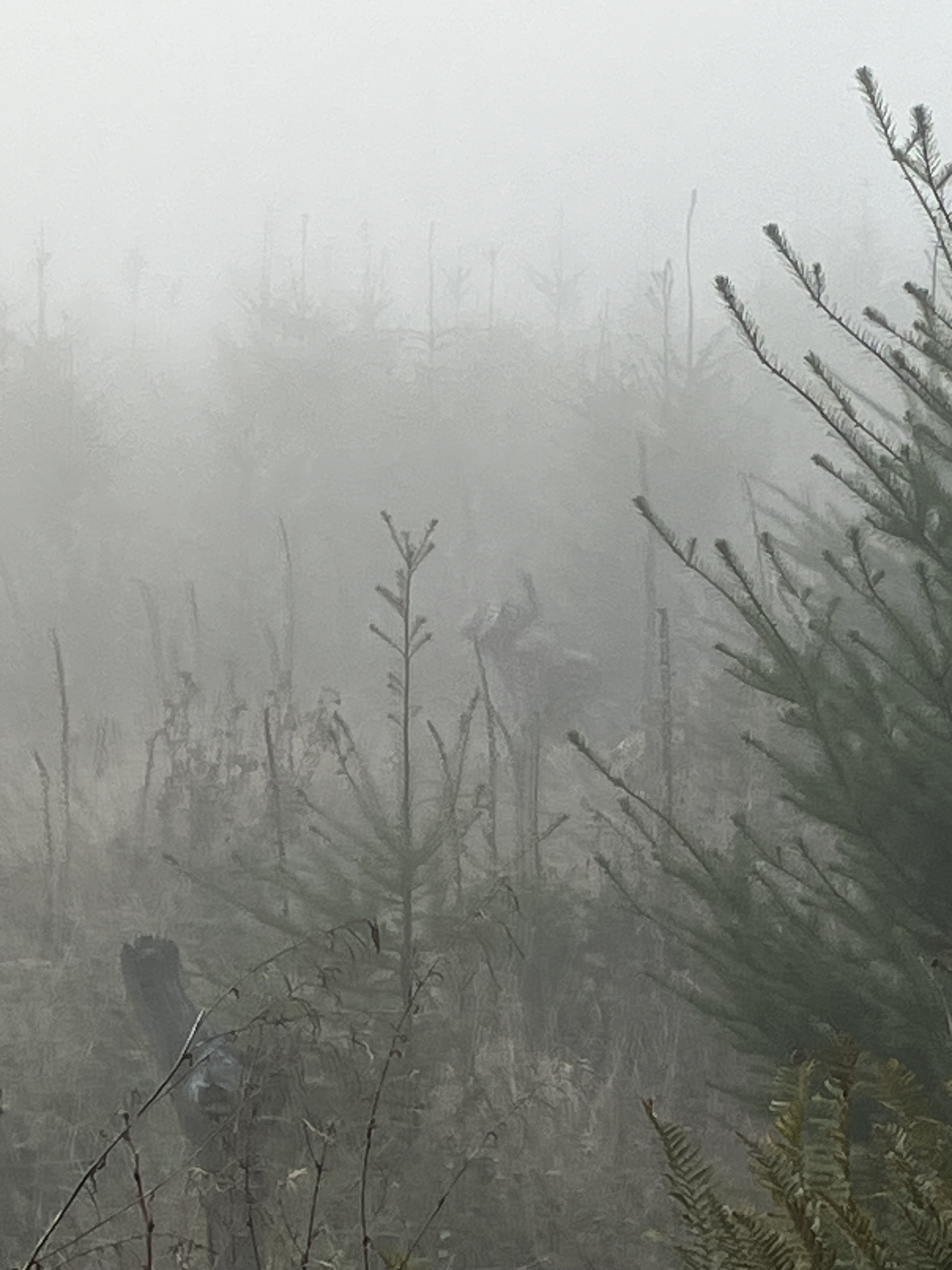
The golden light towards the end of each day was also beautiful to watch. Though on our last evening out, the weather was changing, and a thick mist rose up from the valley below to blanket us as the light faded. My mentor was a little frustrated, because it closed our last day of hunting a little earlier than we had hoped. Once the light is gone, even if the hunting hour is not over yet, you can’t shoot what you can’t sight in. Though the mist was welcome earlier in the evening, as a motivator to move the deer around, it soon became our shut out. I sat and documented the change in light as the fog set in.
Things got dark and still faster than we realized. As I waited, I thought about how quickly the conditions change in the higher elevations where we were. Even with the influx of moisture, the deer remained illusive and we ended out last evening without harvesting any animals, but I still got a handful of mushrooms.
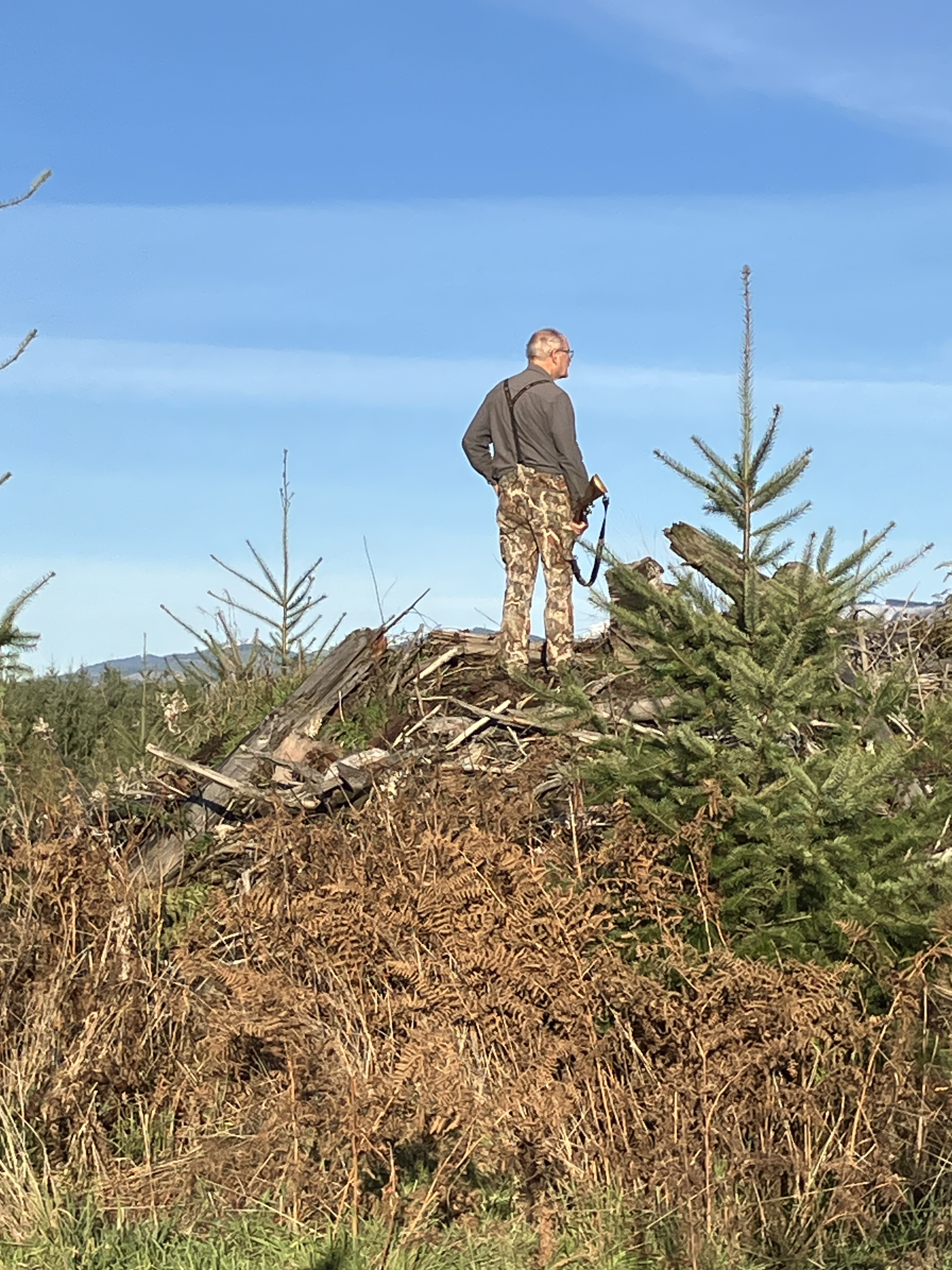
When my mentor came out of the hunt to rejoin me at the truck, I was amazed at how well he blended into the landscape with the added shroud of mist. I took a few photos to show how hard it is to see someone in this kind of situation, burning the images into my memory. Late season black powder does not require hunter orange. You can see why knowing exactly where your hunting buddy is prevents confusion or worse, a fatal shot at someone. Never point a gun at something you can’t see clearly. There was a moment when my mentor’s movement first caught my eye, that I thought he was a deer in the low light and poor visibility. I continued to sit still with my gun across my lap, sorting the visuals that told my brain one thing, while my wisdom said remain still and just watch.
Hunting has taught me a lot about what our eyes perceive, versus what is really before us. For the rest of my life, I know I’ll have moments like this, thinking I see one thing, when it’s really something else quite different. Learning not to react with sudden impulse in these situations is a key safety skill. What a lesson that day. Again, so much gratitude to my mentor for inviting me on the experiential learning adventures. Of course, I’m also there as additional brute strength in case there was a deer harvested. Having a buddy to help get it out is always good. Though we did not receive a deer in this hunt, I got some priceless in the field dirt time with a man I have a deep love and respect for. I hope to pass these experiences on in my own mentoring, and look forward to more time with others in the hunt. So much gratitude for all the opportunities to learn and be with good teachers, who are also continuing to learn.
In February, 2024 our elder Big Leaf Maple began a final bow to the ground. The upper branches of this giant wove into other surrounding trees as it fell, slowing its final decent, for now. Hoping the root ball was still connected, I have chosen to leave the tree as is to allow spring bloom, summer leaf out, and fall drop before trimming some of the branches blocking the access. No part of the bridge was harmed, though a beefy branch did fall onto the bridge and needed to be removed. Much of teh debris that came down fell on the banks of the stream, building a natural mesh of organic matter to help hold the steep wall of clay and gravel. So much of the original stream bed of our creek was eroded away after two rounds of clear cutting, and without more restoration down stream, flooding and erosion will continue to damage the landscape.
Allowing trees to fall and stay where they land builds fast forest floor and water retention, encouraging resiliency in the face of drought. Along with all the wonderful restoration rolls a fallen tree offers, our maple also gifted us with edible flowers. As the cascading blossoms unfold, we took and afternoon to harvest a bag or two for the table at home. Since the branches of this tree are now in reach, we had an easy time picking this spring feast from our grove.
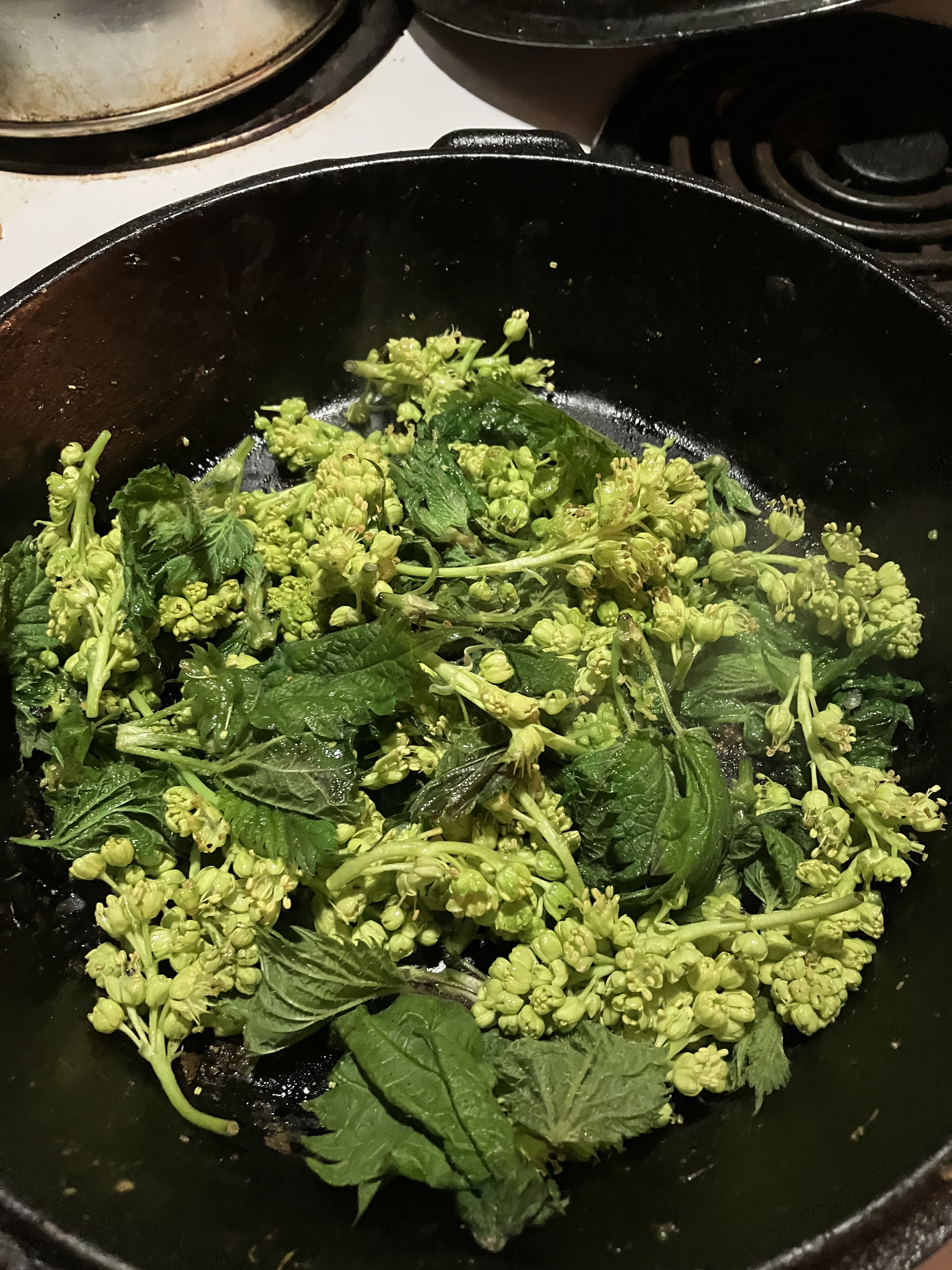
For my first taste of maple blossoms, I added some nettle, butter, and salt, then mixed into a greater fried rice dish with egg and pecans. Just a sprinkle of summer sausage and the full range of flavors came through in this delicious dinner. To eat from our trees, fed such nutrition from the land, this is the dream. Finding feast where they land enables a deeper connection to our ever changing woodland, reminding us that even falling trees are full of treasure to enjoy.