Current Tracking

So, this site is a personal business and lifestyle for a single, queer, feminist, educated, childless cat lady with dogs; raising geese, sheep, and chickens too. It’s a world where people cannot afford eggs any more, and I have buckets from a flock that’s taken 10 years to develop, and could be exterminated at any time should bird flu infect any one bird. Farming is high risk. It’s why so many were consolidated into the industrial food system that feeds the box store buying majority. It’s convenience, to be sure, I still go to the grocery store, and I have 10 acres and an able body, capable mind, and willing community to connect with for financial, social, and emotional support- as well as family. My personal village of loved ones in enough to hold up this amazing experiment in slow food, personal obligation, social networking, and lessons in life, liberty, and the cost of a dream. Most of these blog posts are about the farm and forest relationship, food production, and the day to day realities of restoration forest farming in King County, Snoqualmie First Nation Homelands, here in The Pacific Northwest temperate rainforest ecosystem. What a journey, surreal at times.

After COVID, the social dynamic of this country changed. I went from hosting group classes, to person to person learning with most of my clients. This Spring, 2025, I officially took time off from volunteer teaching hunter education for Washington Department of Fish and Wildlife to focus on mentoring women and girls in outdoor pursuits- from hunting to hiking, back country exploration and basic survival training. I will be leading a course in basic survival this Fall, 2025 for Washington Outdoor Women. I’m excited to follow through on this partnership, which had just begun before the pandemic, and as the world shut down, that organization took a hiatus till this year, and I am glad the opportunity is back online and expanding. Contributing my skills to forward the education of women and their empowerment in the great outdoors remains a steadfast dedication in this life.

Farming economy in King County remains a bit of a challenge. The animals pay for themselves, there’s no question about that, but the continued communication on the human side of investment remains, well, questionable. There seems to be a wealth gap in community expectation- surprise? No. But the reasons fluctuate, like tidal living should, and I’ve always struggled with value vs. true cost of doing this work ethically, while asking for the true price of market fluctuation. For example- I’ve asked for $8/dz eggs on organic layer feed and full pasture access in 2025. That’s a $1 raise in price since 2013, and remains the price through all the crazy inflation of today- because the true cost of these eggs has remained the same, people are just experiencing price gouging from a subsidized industry due to scarcity of layer hens. Right now, bird flu is the culprit, tomorrow, it will be grain costs to feed the animals, then, with funding for research and oversight stripped, our agricultural inspections and protections are out the window and all bets of food safety with them. I sleep at night knowing my food production is part of a living system I myself choose to rely on and be intricately connected to. People want everything cheap- especially food. How we’ve gotten away with thinking food really should not cost anything reflects on the disconnect between Americans and their basic needs.

I have the privilege to live the homestead dream, and have always moved towards this life goal, at first manifesting in my childhood, with a love of nature and outside connection, developing into animal husbandry, and a love all creatures great and small. High school brought summer internships at The Central Park Conservancy where I learned about major city park management and how people have great impact on environment. College found me connecting with Main Organic Farmers and Gardeners Association while I worked on a major in Sociology. I made contact with a board member from MOFGA , and he hired me for paid summer employment as a dairy hand. That was my first lesson in hard farming realities, with paychecks bouncing from month to month and seeing the farmer I worked for overwhelmed by how fast agriculture was changing. He was a shepherd- like Farmer Hoggett from Babe, able to hand shear a full fleece and more. The sheep market had stalled out, so he became a dairyman, and hated it. Lee Straw showed me the future of farming in one summer, and I walked away shaken.

The summer after that, I worked as an intern for an openly gay woman Massachusetts State House Representative and learned a lot about local politics, state legislation, and why I would never make it as a lobbyist. I’d come into that job the summer DOMA (The Defensive Marriage Act) was struck down, and gay marriage was legalized in MA. I was dating a woman at the time, and suddenly felt that my relationship was more valid- how many have questioned the validity of their relationships with another based on gender constructs? What does this have to do with current events at EEC Forest Stewardship? Well, the queer woman running the place is getting agitated by a slow, steady, familiar walk back of civil rights. I’ll step into my woman’s shoes and point out I have less rights as a woman today than my Grandmother. WTF? My gender and sexuality are under attack- gosh, if I was trans, non-white, or unable to pass as straight, a migrant, refugee… how would I stay sane?

The following college summer, I worked as a wrangler for YMCA of The Rockies. I’ve always loved horses, and took a summer job working with them full time in a pictures part of The American West. Colorado treated me well, though working at a summer camp where most of the staff had been campers as kids cultivated a hard social culture to break into, I managed to navigate with a few other “outsiders” and was voted “most likely to run a tattoo shop” by my fellow staff. I was also the wrangler- out of an all women’s crew, who was know as the bronc rider. A week before the kids show up to camp for the summer, we wranglers are arriving to vet a herd of trail horses for the children to ride safely. These poor animals are rented from a large stock yard called Sombrero Ranches. Hundreds of horses are kept on large feed lots in the greater Denver area and then shipped to summer rentals, like YMCA of The Rockies, each season. Well, summer is the start of work for these overwintered animals, and they were fresh under saddle, to put it lightly. I earned my rides; about 20 out of 130 horses in our initial delivery out of a semi truck. We sent 4 back, three would buck under saddle, and one was too old and rickety to risk putting an unbalanced first time rider on.

I shared this story recently, attempting to demonstrate some of my horsemanship qualifications. I rarely mention them in these writings, because I’ve stepped away from horses in my choice of home environment here in Western Washington. Mules or a couple of bog ponies might one day be in my future- and sooner the better, as my body will age out of riding in an equine’s lifetime. That’s sobering limitations for me at 43. So what about horsemanship qualifiers? How do you answer the question, “What’s your riding experience?” I could sum it up as- started bareback before I could walk, under saddle by 5, maybe sooner, Mom would know. I took lessons from 6-11, then a move to Dallas TX suburbs; single parent income would not support riding lessons or a pet horse. Annual visits to Oklahoma offered occasional backyard riding with friends who still had horses. Ranch work for a few years gave me more riding skills and herd management training. In 2011 I went to Mongolia and road on a migration with over 2,000 animals, 16 people, two yurts, and three dogs- one of which had only 3 legs- it was incredible, but what does that have to do with current events here at EEC?

In September, I hope to be back in the saddle for an ACT ride with Daniel Curry. I will have a lot more to share about this bucket list dream to horse pack into back country for a good cause. Though EEC Forest Stewardship is not in current wolf territory, ancestral legacies of wolf, elk, and more remains an intention in the restoration of this landscape. After working with WDFW as a volunteer, I wanted to get more perspective on relationships with wildlife and people. I’m not going to get into all the drama of wolves here in the west. My goal in connecting with Daniel is to gain some perspective, get some time in the saddle, and support a local wildlife conservation effort that one man is struggling to establish with the ranchers in his community. I see similar struggles right here in my own neighborhood that EEC restoration efforts are hoping to address for generations to come. As wolves, a keystone species that once thrived across North America, loose protected status under The Endangered Species Act, I thought it might be good to check in with an in the field boots- or hooves on the ground biologist who is devoting his life to reconciling people with these animals for the sake of all our survival. So riding and stuff.

Over the past few months, as more and more “Oh Sh*t!” moments grip The American Psyche, I’ve found a few glimmers of humor in the great ocean of bile being served up as news in our zeitgeist. Laughter is an important remedy during hard times. As the madness of life continues- I’m grappling with the laughable alongside tears of frustration and outright horror. A lot of my personal rage has manifested in gender dynamics for a long time- thank you feminist upbringing. Here are two snapshots in which women calmly attempt to express rationally while men fight on the street or coup a country in the background. We’re all trying to stay focused while too many man children roll about in the sand box kicking grit into all our teeth. WTF humanity? Have we truly lost our way as a species thanks to idiocracy? I’m going to get back to 4 minute dance fitness breaks and advocating for global unity. How are you taking yourself a little less seriously for the sake of personal sanity? Sit back and binge a couple of good snap shots in time. Truly, “humanity rises and falls as one.” *CRASH*

Welcome “Quercus”, Our New Ewe Lamb of 2025

There’s a late arrival to the flock this Spring. On May 30, our first year ewe Pandora surprised me earlier this month by bagging up. It was three weeks past my official Ram exposure to the ewes, but I also realize I put him back in with them on pasture later, after I thought the gals had finished cycling. Well, I really don’t read the signs well when a ewe drops into heat. Apparently Pandora was late to the party, but still ready to dance. That’s ok, I really should just leave the ram in till late winter- but I don’t like feeding him alfalfa, or letting him bully the gals off their food so he gets his own digs in the winter, but I let them all go on pasture together because there is enough food and space for them all. When the ewes are heavily pregnant, the ram is removed until after all the lambs are born and stable. Oakie is a good ram in the flock most of the time, I don’t see him bully lambs unless it’s over food- until the rut. By then, all the lambs should be sold or slaughtered, so he does not have to fight with other rams for the ewes. But that might change this year, as I am looking at overwintering one of my ram lambs, who is turning out very well.

Quercus is a ewe lamb in my favorite line- her grandmother is Lickety-Split, who was the first lamb born at Leafhopper Farm, out of Ingrid, who was the lead ewe and my favorite friendly sheep. Not all sheep are friendly with people, many prefer distance and an occasional polite hand sniff when they do get close. I don’t mind if a sheep is shy, as long as I can handle them when I need to. If a sheep is prone to panic when I come into the barn, I tend to cull them because it’s not helpful to keeping a calm herd and handleable (domestic) animals. Quercus’ Mom, Pandora, is a little shy, but not panicky. She let’s me offer a hand sniff, and will stand when I catch her collar and look her over. It’s important to look over your animals often to make sure they don’t have any hidden injuries or other ailments that take some visual checking. When I came into the pen to check Pandora’s new lamb, she stood by, sniffed my hand, and stood while I looked at her new born to make sure everything was ok. That’s a sure sign of calmness in a ewe that I appreciate, and her little lamb shows the same temperament. This is a big reason I love this line in the flock. Lickety-Split comes right to me for head scratches- even in the field, and the rest of the herd usually follows her over for social time. Some might call her a Judas Sheep, but she’s my Bellweather. She even wears a bell. Her granddaughter might be a future lead ewe herself one day.

For now, Quercus enjoys her new life in the flock and gets a wander around the pasture, close to momma and grandmomma in the field. She’ll have a lot of catching up to do before running around with the rest of the lambs from this year. They are all growing very fast because they are all singles and getting exclusive rights to mom’s milk. It’s a first here at EEC, to have all singles, but that’s ok, everyone is healthy and happy, and we have a great sized flock. May the herd continue to show good development as this grand experiment in Katahdin Sheep continues.

Woods Weekend

My hunting mentor invited me to be his support on a black powder late deer season hunt. This window of four days allows one final chance at a deer before the season is over. It’s short and sweet, so you have to use all the waning daylight you can to be in the field. I took my shotgun to watch for grouse, but my main mission was to learn from my mentor. Time in the field with this accomplished sportsman is worth it, and a rare gift of his time with me. We were in The Snoqualmie Tree Farm for the whole hunt. Though we did not find any deer or grouse, many good things happened, including a lot of learning for me. Thanks to the people who take time to teach and offer opportunity for others to learn.

The weather played a big part in making our hunt difficult. This may surprise some, because the sky was clear and the sun was out- but blacktail deer sleep away bright days, and become more nocturnal. They get too hot in the sun with those warm winter coats coming on. Rain and clouds are what bring these deer out, so we saw very little activity, in fact, none. No deer showed it’s self the entire four days we were out, and we were covering lots of ground. My mentor thought it might also be the uptick in chemicals being used on the tree farm grounds. They spray herbicides in the young plantings, and spread treated sewage everywhere. The deer are repelled by these unnatural applications in their landscape. We could not find any brows or tracks in these chemically altered spaces. My mentor ever said he might stop coming here to hunt because of the disruption.

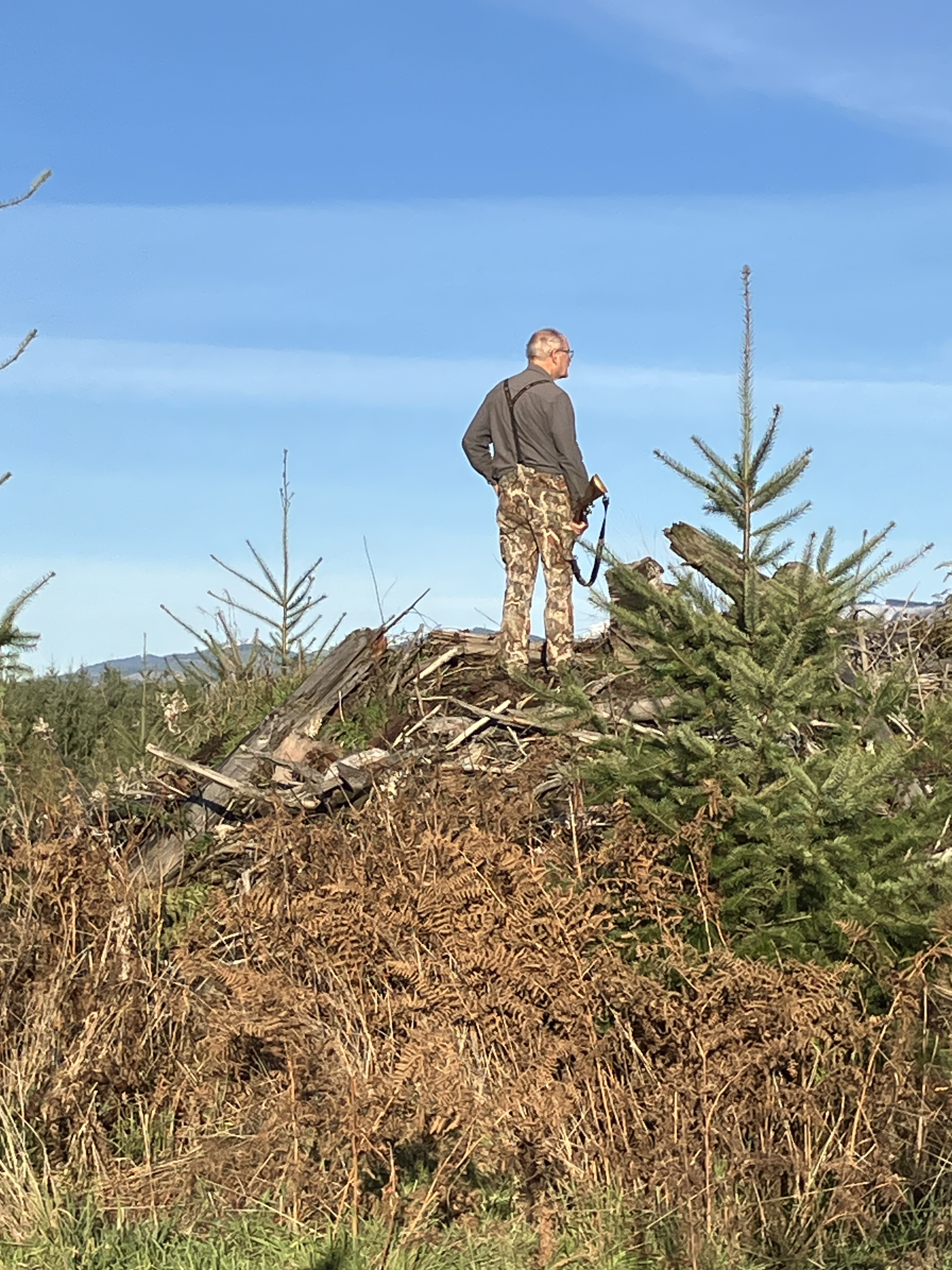
The views of our surrounding mountain ranges was quite magnificent. I’d not seen a good panorama of The Olympics for a while. In one of our spots, we were high enough to see just above the teenage plantings to our west. I spent some time scrambling along a recently logged off ridge line to get a picture. While picking my way through slash and slope, I picked up on a fresh set of deer tracks that went in the direction my mentor had gone. He would pick a place to hunt and I would stay on the opposite side of the road from where he went in. That way, he would know what direction I was in, and I stayed out of his hunting ground. Black powder guns don’t have a long range, but having a plan on where everyone is to keep out of each other’s line of fire is an important part of safe hunting. If my mentor wanted to change position, he would first meet me back at the truck at our planned check in time, and then make a new plan so we were always on the same page in the field.

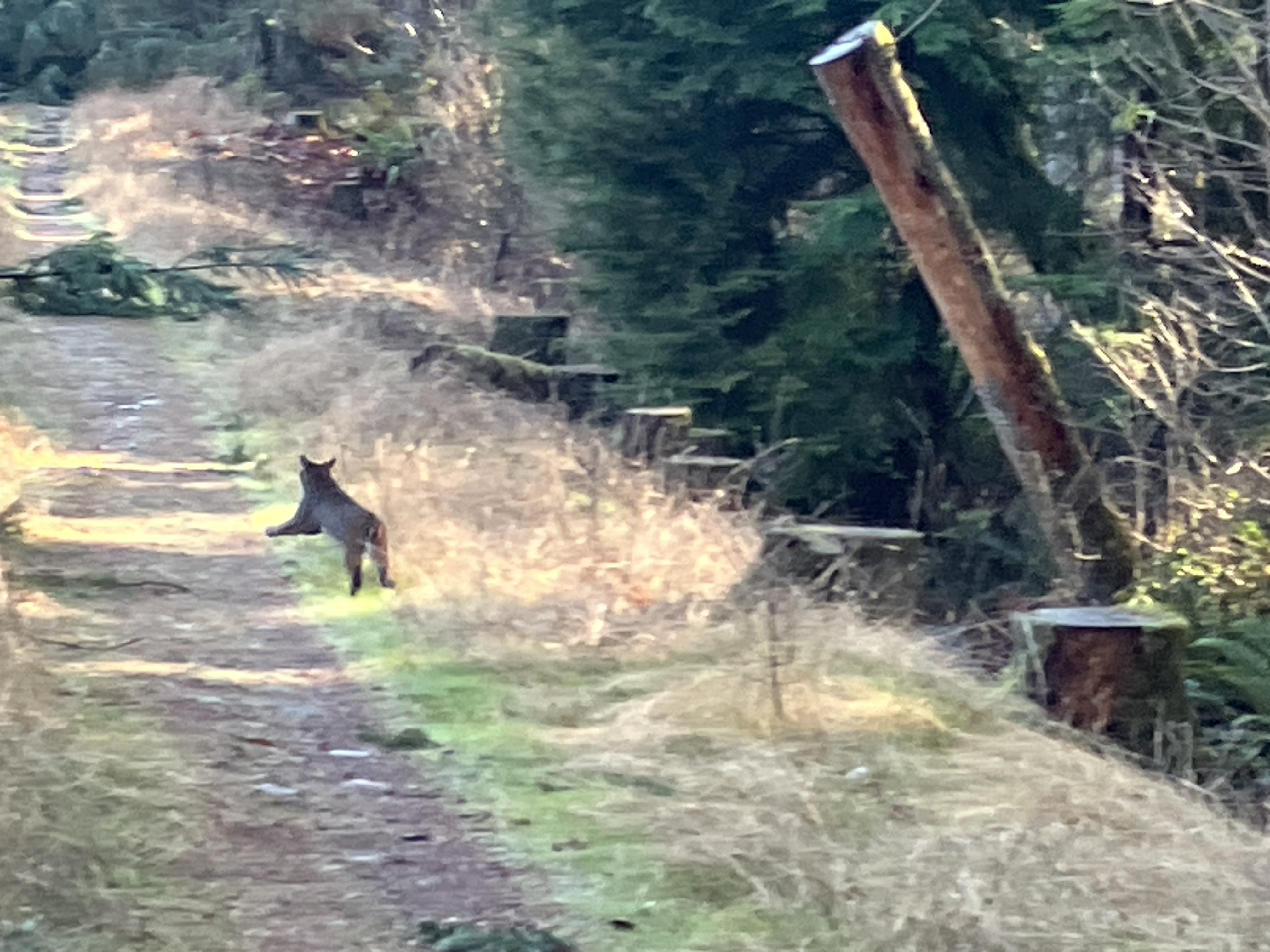
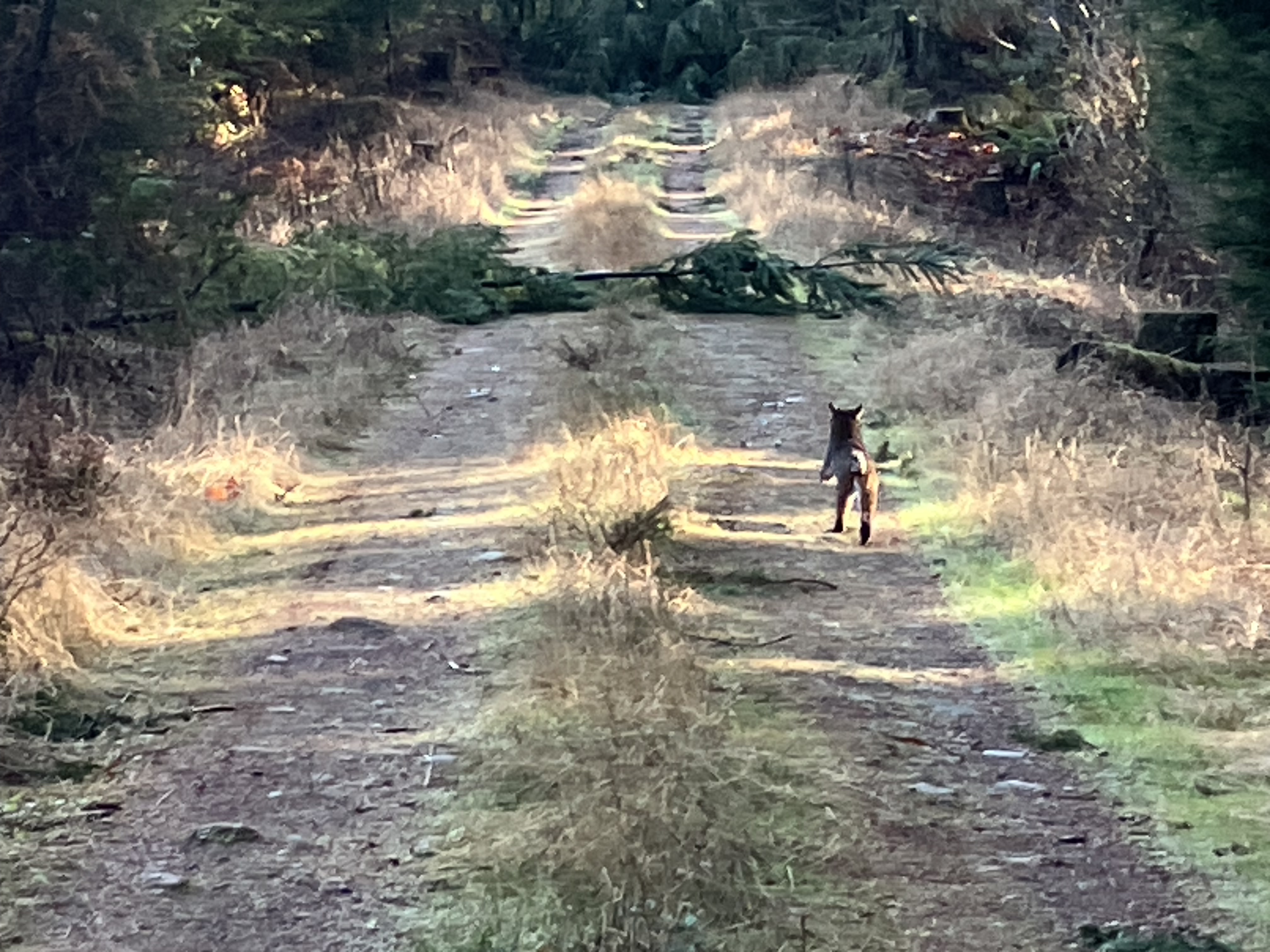
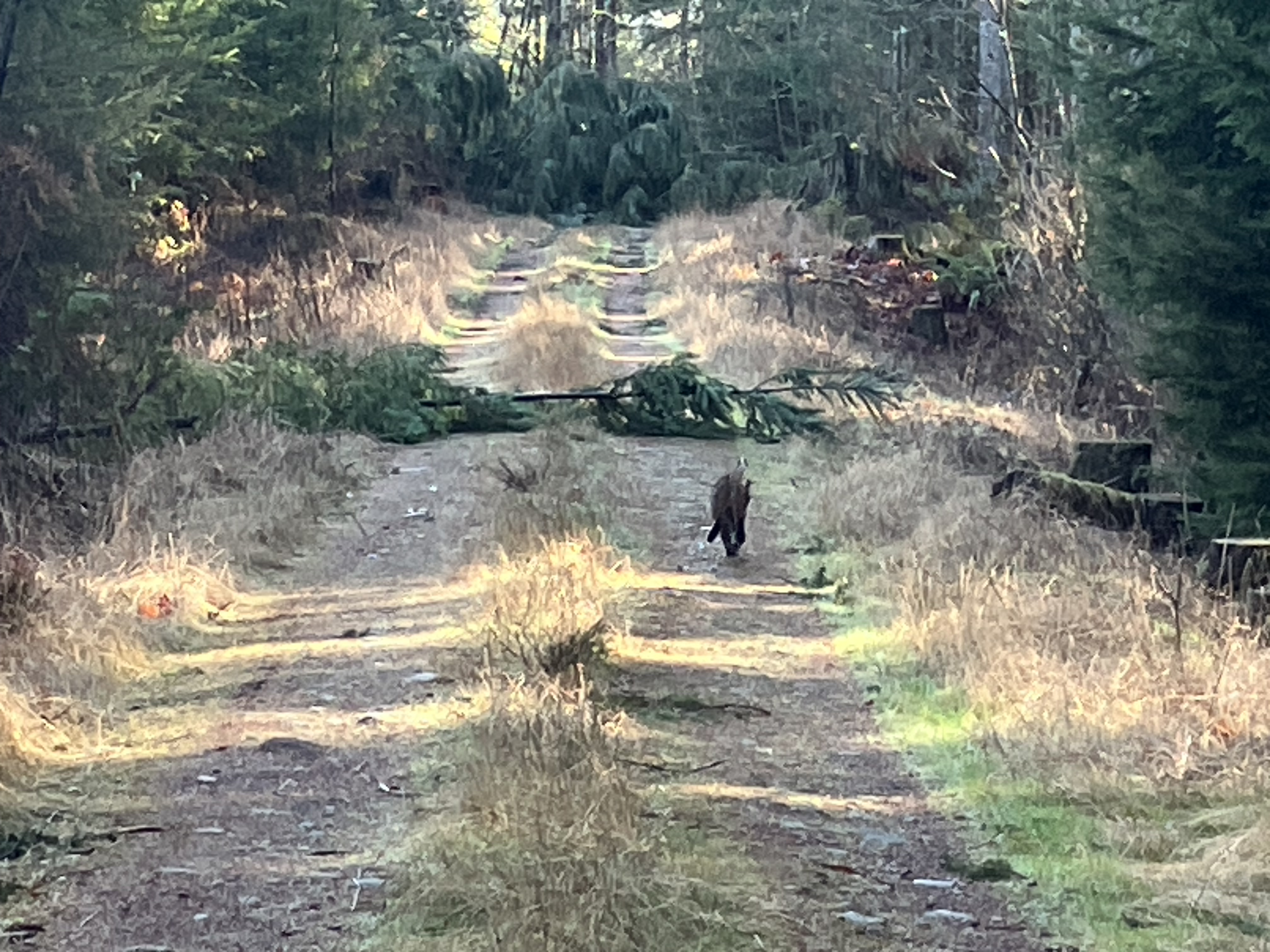
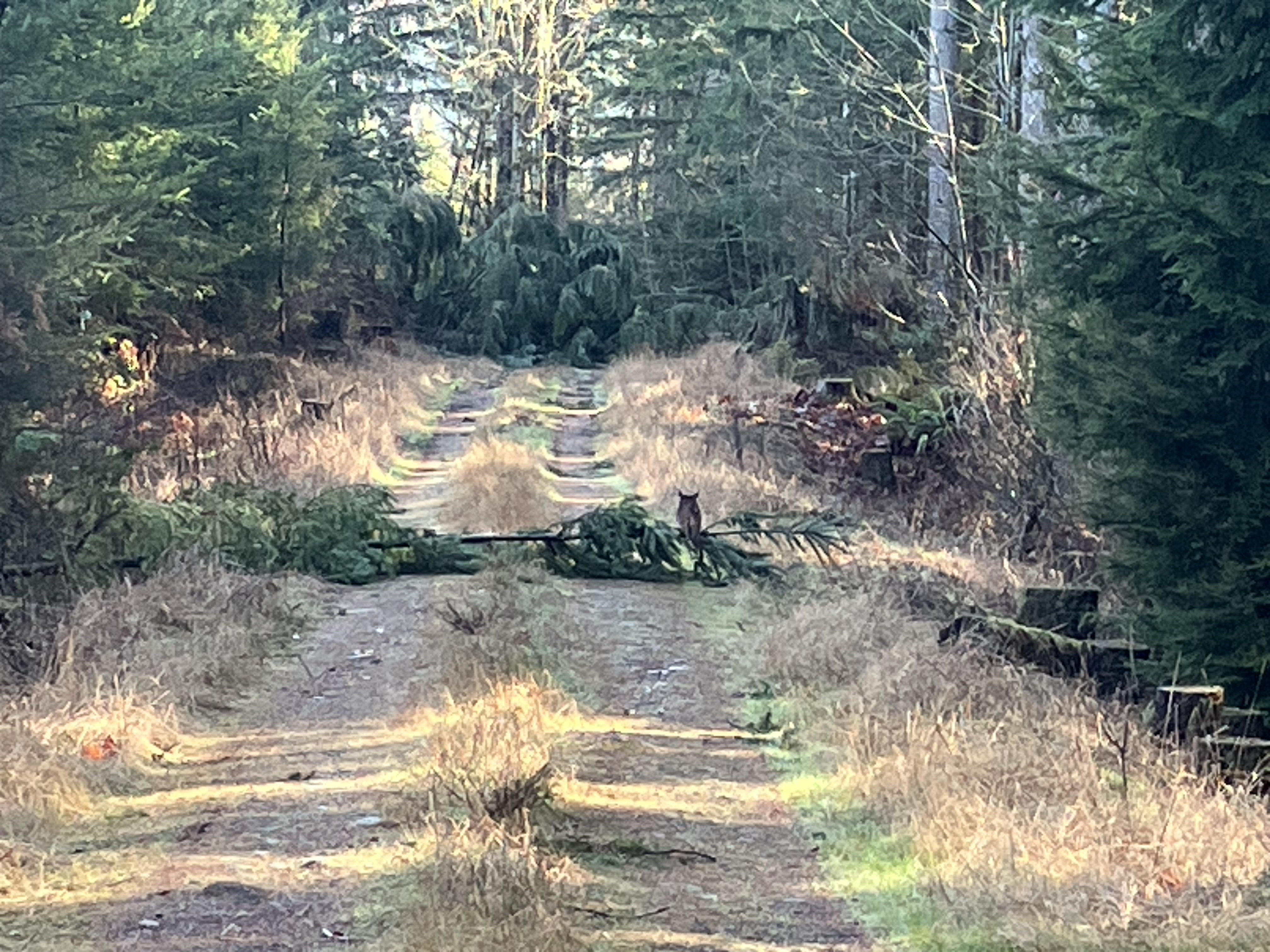
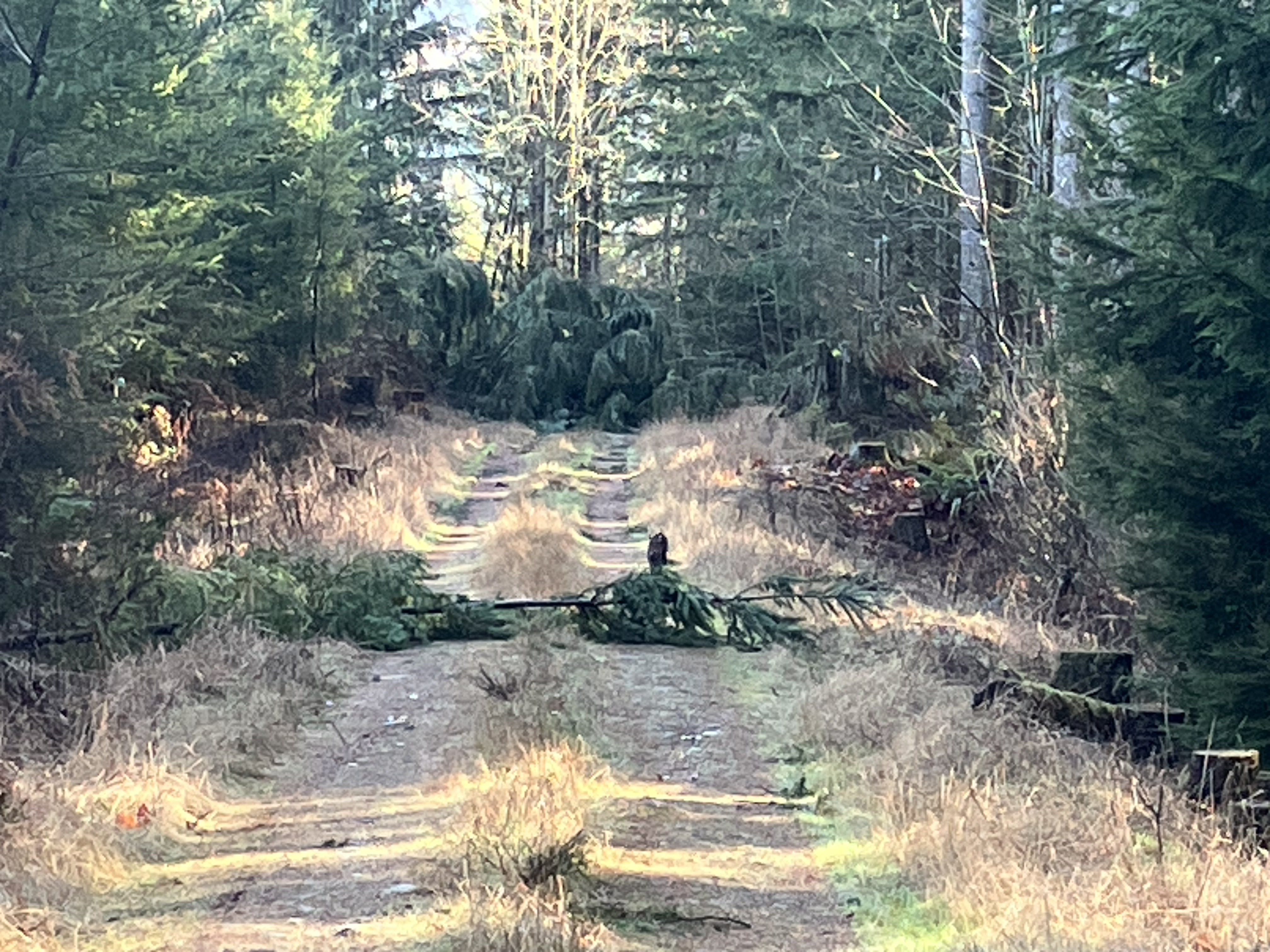
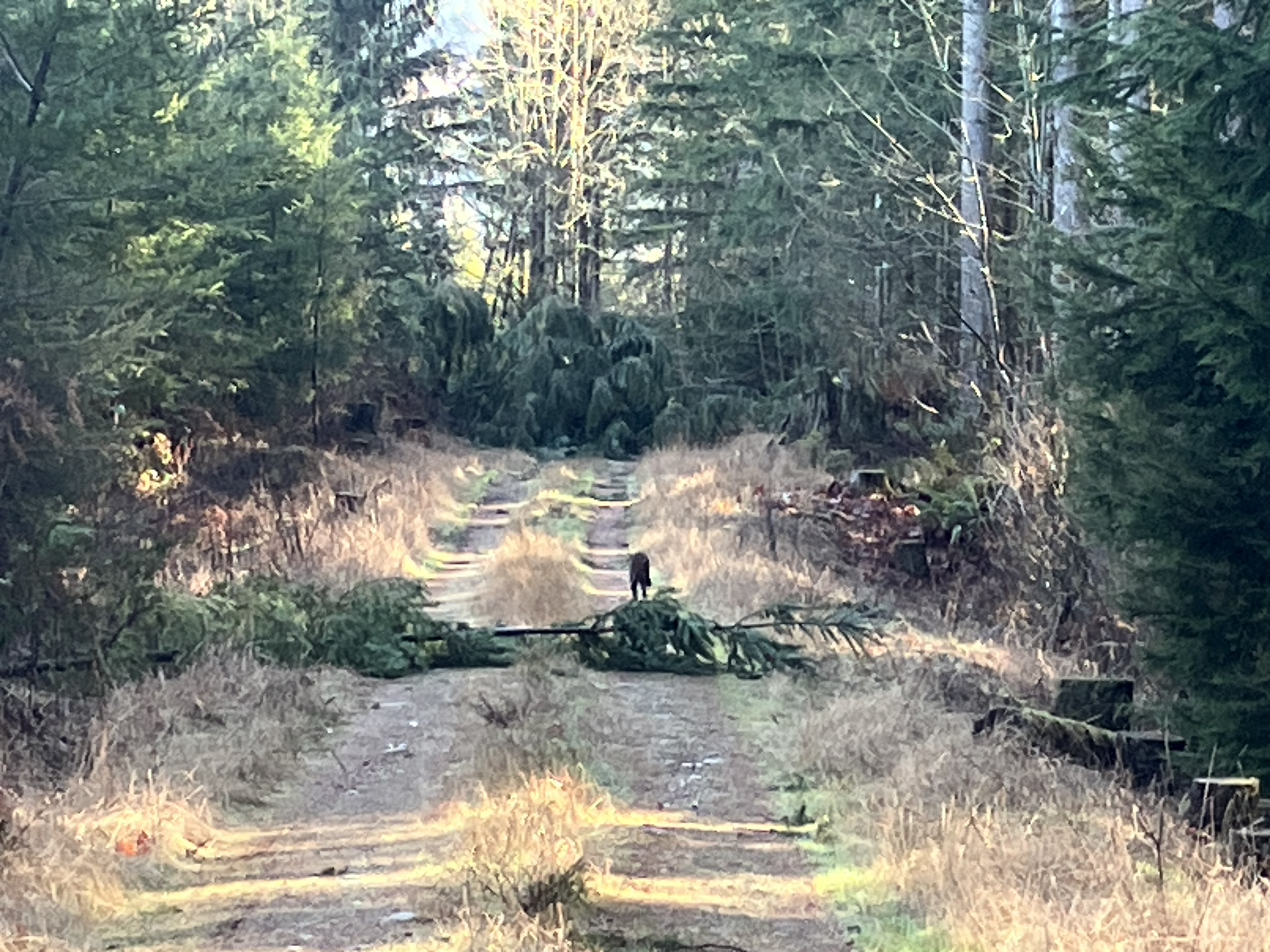
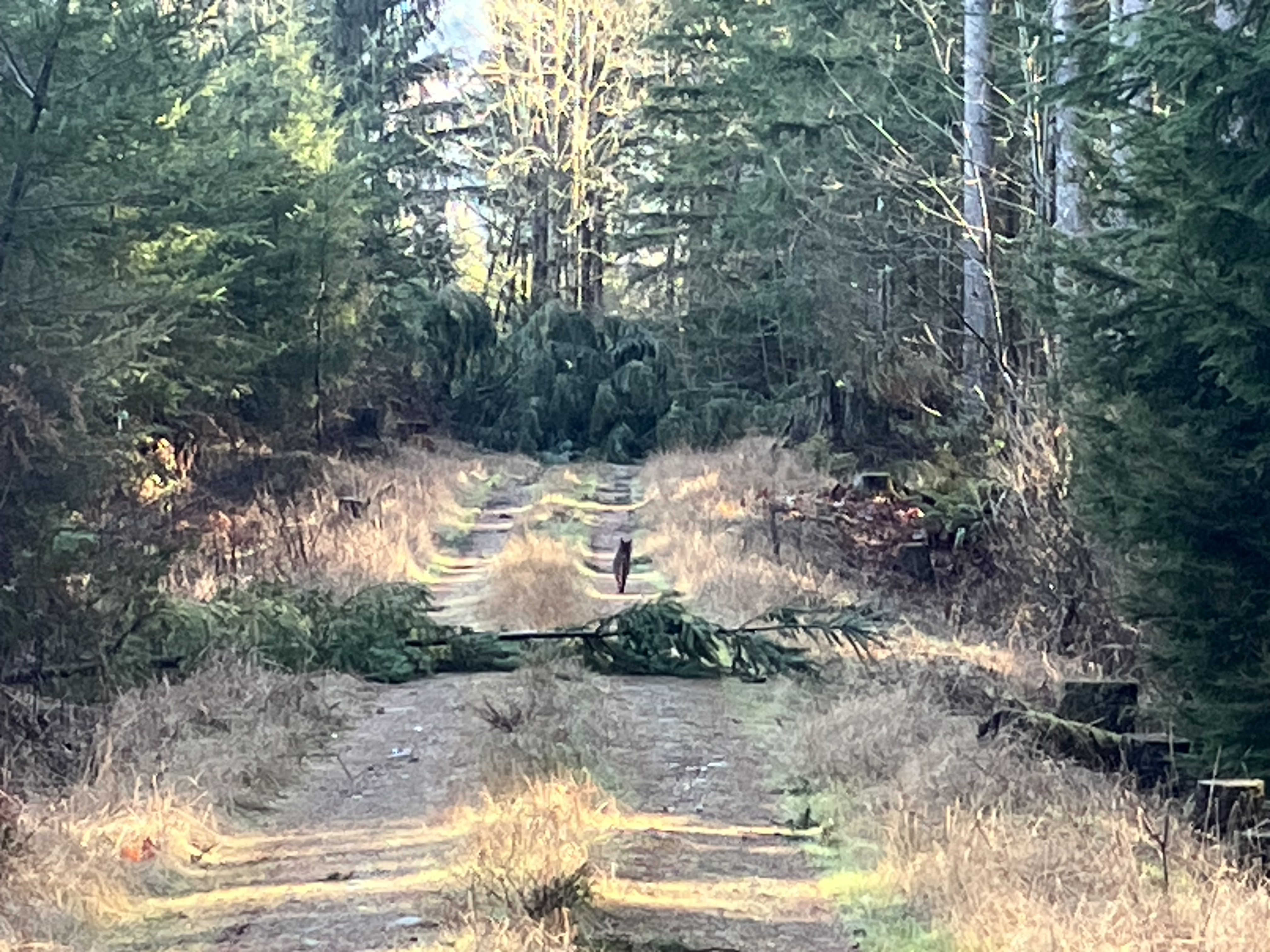
My hunt for grouse was fruitless. There was not a bird in sight where we were. Was there any wildlife at all? Yes! We had an amazing encounter with a young bobcat. While checking out a quarry for deer- “a quarry?” you ask, yes, a quarry, where deer will sometimes look for mineral deposits in the exposed layers of earth; Wes saw movement just before I picked up on it- I was driving. We stopped the truck and watched a bobcat slink across the road and into the woods. That’s usually how you see a bobcat, briefly crossing the road. But this cat did not go too far. Moments later, as we got out to look around, the cat popped back out on the road and gave us another show. We began to observe the animal together, noting its dark morph and unusual behavior. My mentor guessed it was a young animal that had not learned to fear people yet. The encounter was magical.

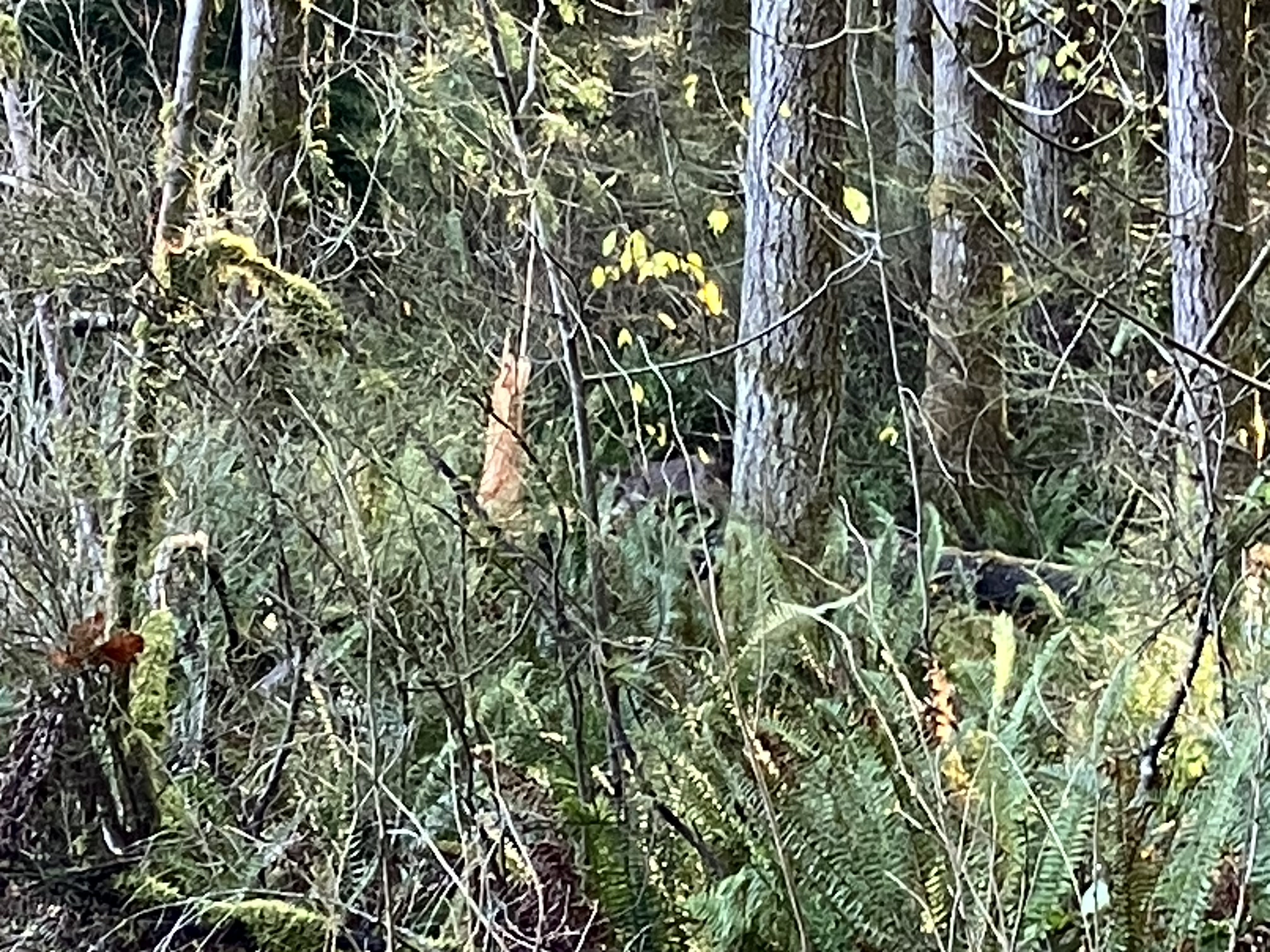
Bobcats have amazing camouflage. Can you see it in the picture above? It’s crossing a log right to left, about center in this photo. I only knew it was there because I’d watched it moving for a while. My mentor and I were happy to stand and observe the animal for as long as it chose to be around us. You might be wondering why we didn’t hunt it. Well, we didn’t want to. Bobcats are not good eating, and the pelt market is not something I wish to participate in. We had our small game license, and could have harvested this cat, but that was not our intention. We were appreciating the opportunity to observe and learn form a shy, mysterious animal. The cat seemed to pick up on our intentions, and came out a few more times to show off it’s unusual dark morph and how athletic it was. I got a great series of photos as it ran away down the road.

It was a gift to watch the bobcat for so long. Sometimes it’s good to pause in a hunt to let nature show you a few things. I was glad my mentor wanted to take the time with me to watch. That was a special moment for both of us, and we cherished it. Time in the woods can slow way down. Each day there was a series of adventures. There had been a recent wind storm that knocked down a lot of trees. Many roads were impassible, which shrunk our hunting options, but there was still much ground to cover, so we did some driving, a lot of scouting (looking for recent tracks or brows) and my mentor took a few walks into recent clear-cuts in hopes of getting a deer up. They usually lay down to rest during sunny days, so you have to go into the open places and try to spook one up from it’s lay. My mentor is in his 70s, and though he is still in good shape relative to his age, he went slow, and had to take breaks between each wander. The relaxed nature of this rhythm helped me relax and enjoy the days too. I was often on a road keeping a safe distance while watching for a grouse. Not even a wing beat was heard.

I did find mushrooms, chantrelles were on the menu each night when we got home in the dark. This year, mushrooms have been off the hook in these woods. I would carefully hunt the ground, keeping a sharp lookout for any golden treasures, and I usually found them, quietly waiting on the edge of a tree line, or half buried under the needled of a fir tree. It was wonderful foraging, and rewarding to find some almost everywhere we went.

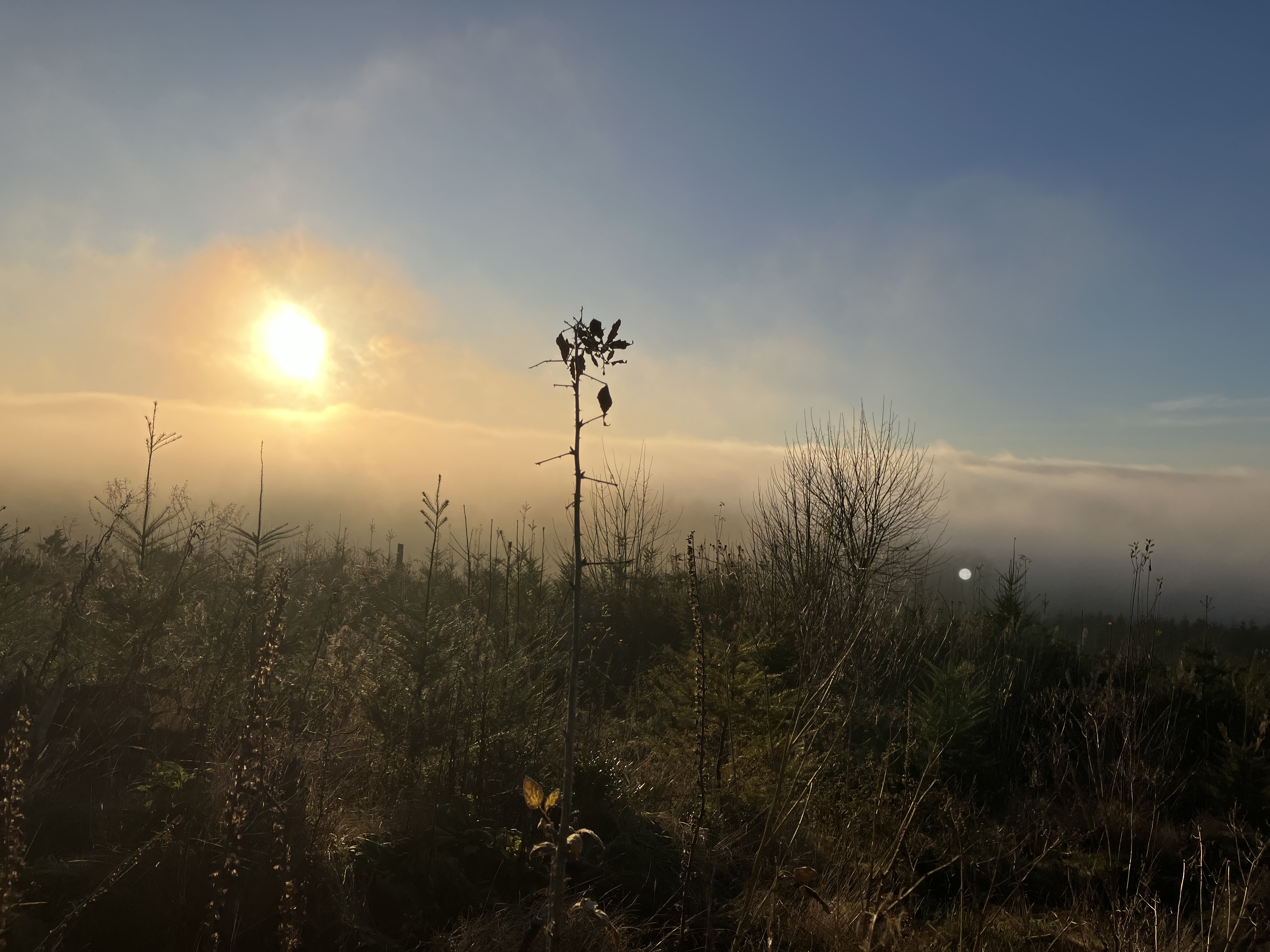
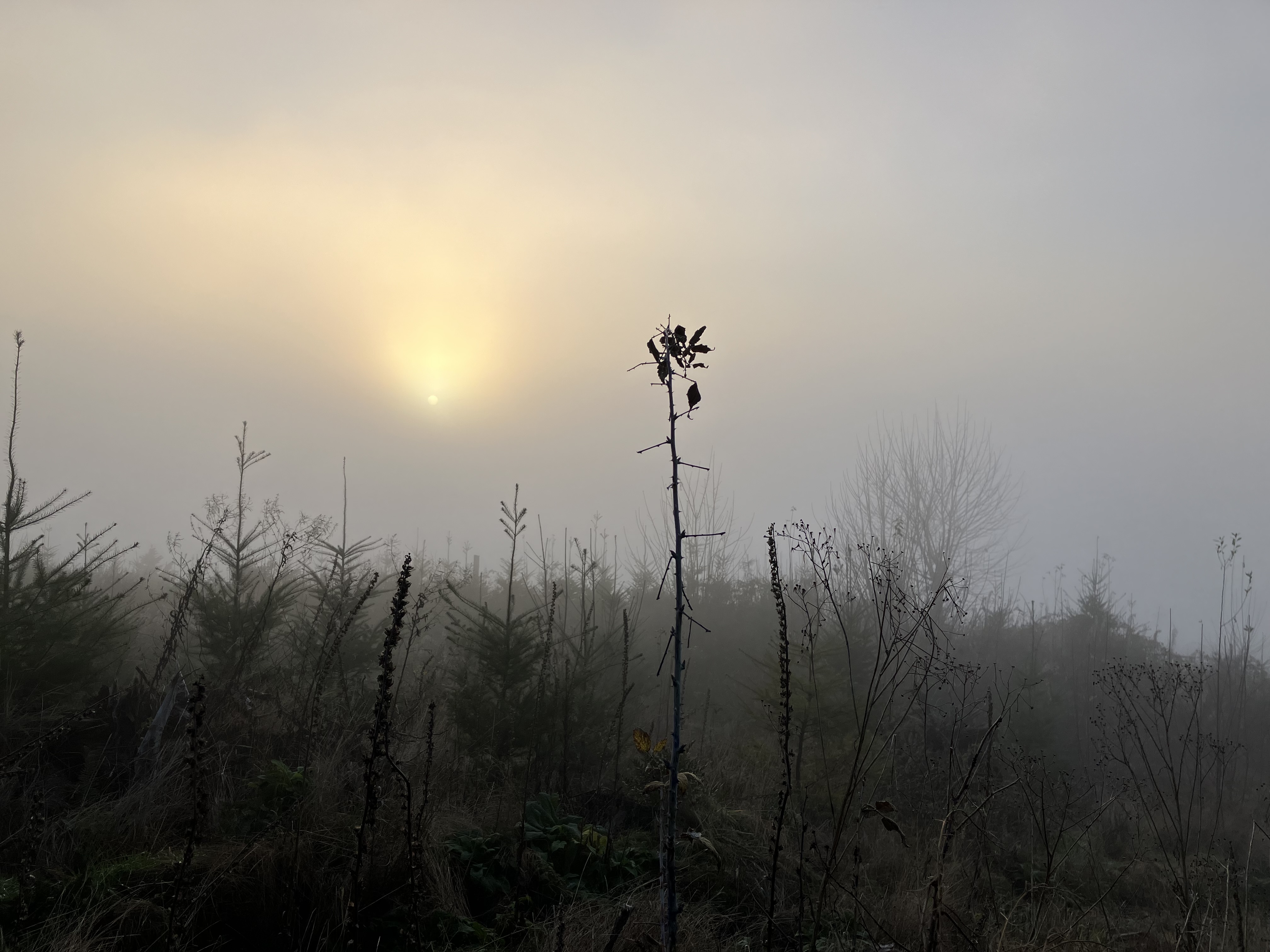
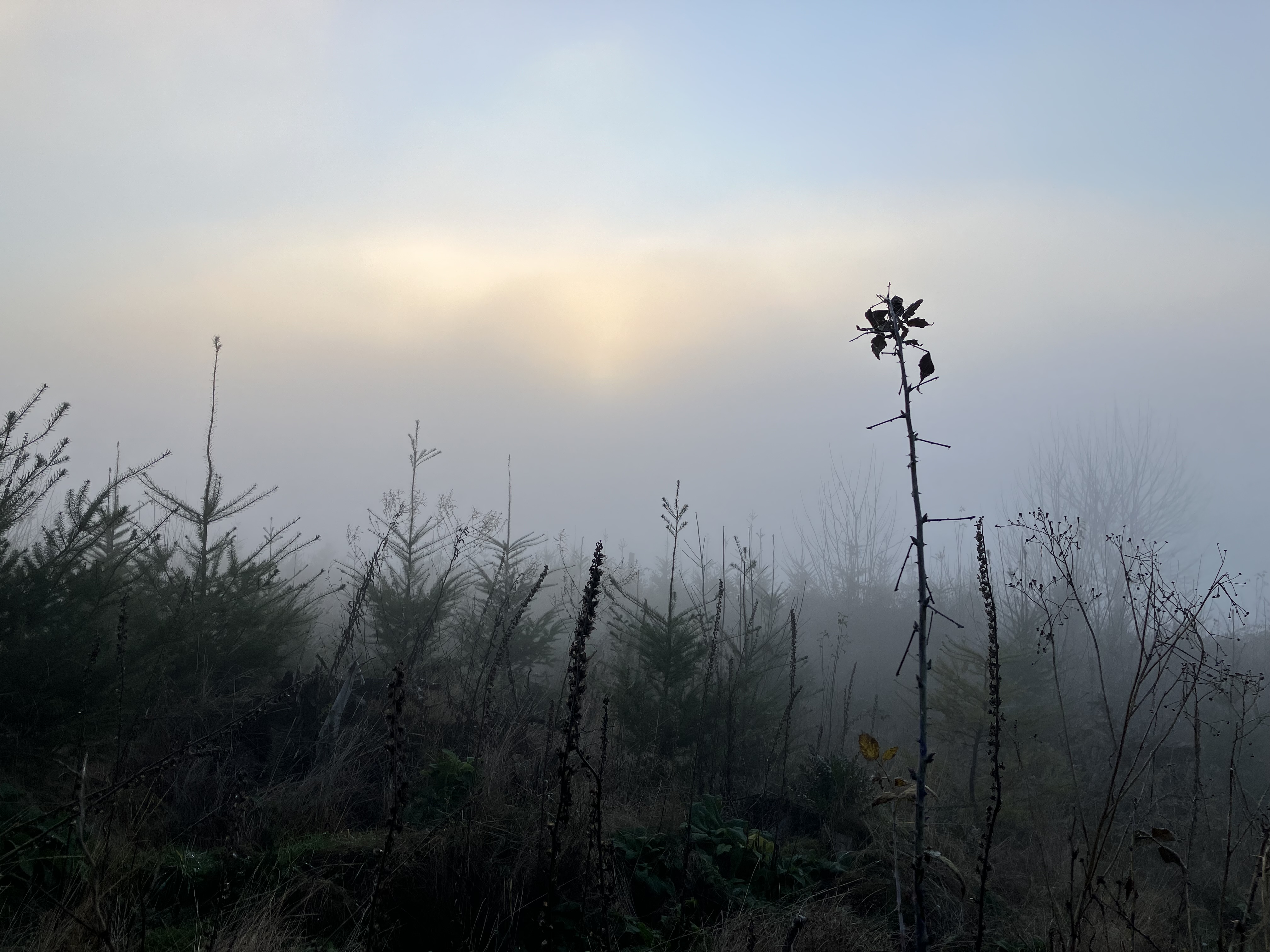
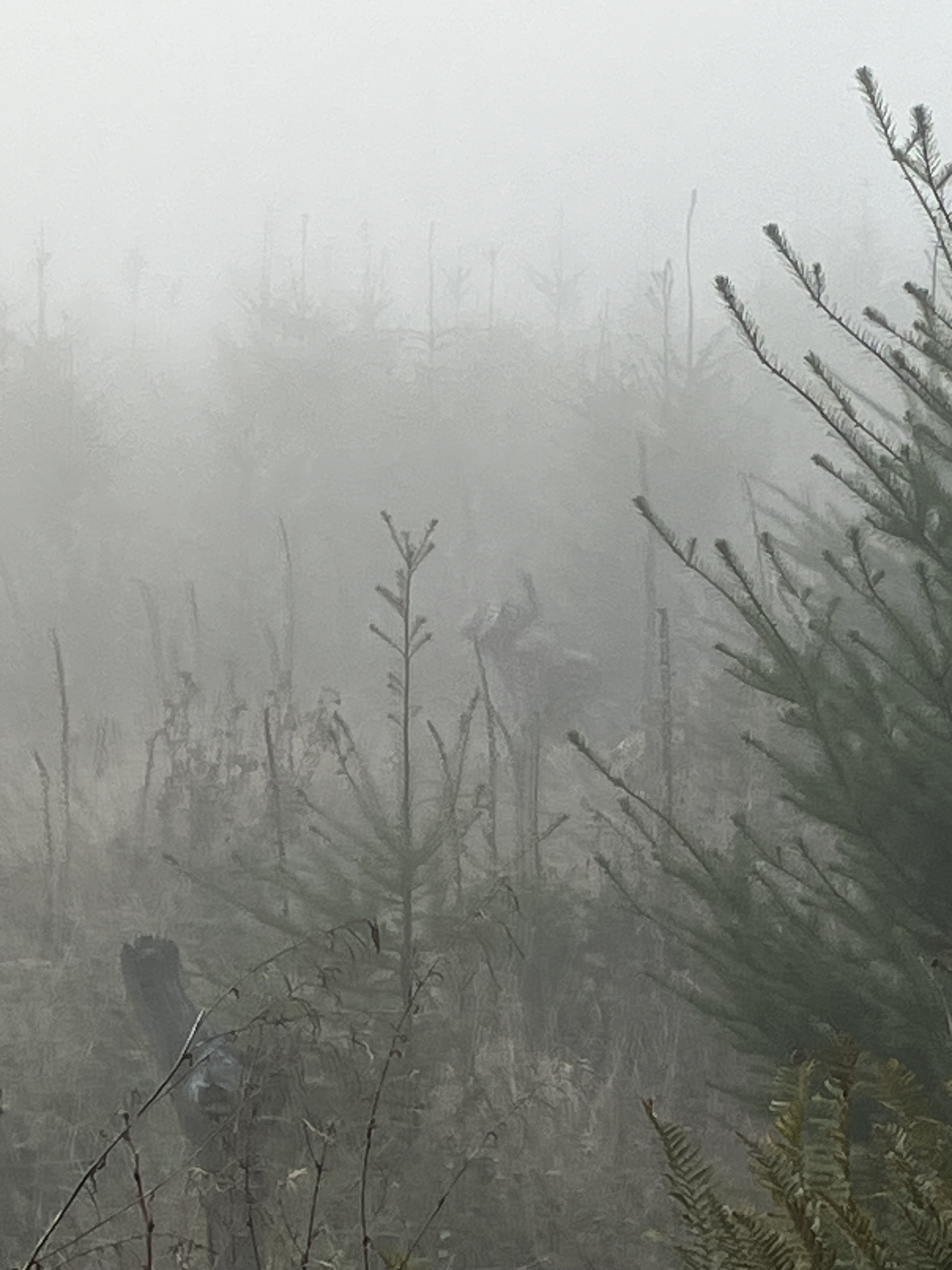
The golden light towards the end of each day was also beautiful to watch. Though on our last evening out, the weather was changing, and a thick mist rose up from the valley below to blanket us as the light faded. My mentor was a little frustrated, because it closed our last day of hunting a little earlier than we had hoped. Once the light is gone, even if the hunting hour is not over yet, you can’t shoot what you can’t sight in. Though the mist was welcome earlier in the evening, as a motivator to move the deer around, it soon became our shut out. I sat and documented the change in light as the fog set in.

Things got dark and still faster than we realized. As I waited, I thought about how quickly the conditions change in the higher elevations where we were. Even with the influx of moisture, the deer remained illusive and we ended out last evening without harvesting any animals, but I still got a handful of mushrooms.

When my mentor came out of the hunt to rejoin me at the truck, I was amazed at how well he blended into the landscape with the added shroud of mist. I took a few photos to show how hard it is to see someone in this kind of situation, burning the images into my memory. Late season black powder does not require hunter orange. You can see why knowing exactly where your hunting buddy is prevents confusion or worse, a fatal shot at someone. Never point a gun at something you can’t see clearly. There was a moment when my mentor’s movement first caught my eye, that I thought he was a deer in the low light and poor visibility. I continued to sit still with my gun across my lap, sorting the visuals that told my brain one thing, while my wisdom said remain still and just watch.

Hunting has taught me a lot about what our eyes perceive, versus what is really before us. For the rest of my life, I know I’ll have moments like this, thinking I see one thing, when it’s really something else quite different. Learning not to react with sudden impulse in these situations is a key safety skill. What a lesson that day. Again, so much gratitude to my mentor for inviting me on the experiential learning adventures. Of course, I’m also there as additional brute strength in case there was a deer harvested. Having a buddy to help get it out is always good. Though we did not receive a deer in this hunt, I got some priceless in the field dirt time with a man I have a deep love and respect for. I hope to pass these experiences on in my own mentoring, and look forward to more time with others in the hunt. So much gratitude for all the opportunities to learn and be with good teachers, who are also continuing to learn.