New England Mushrooms

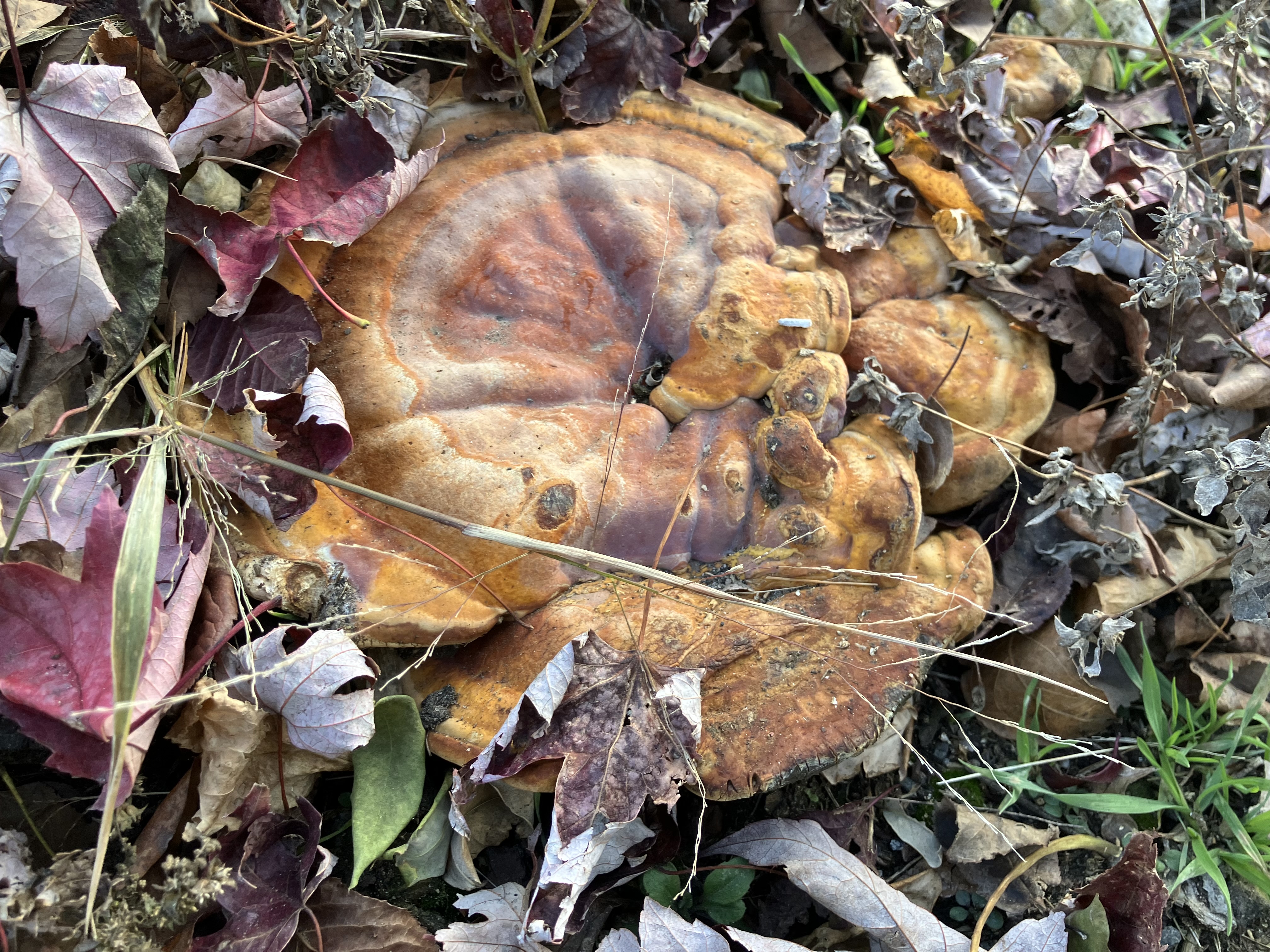
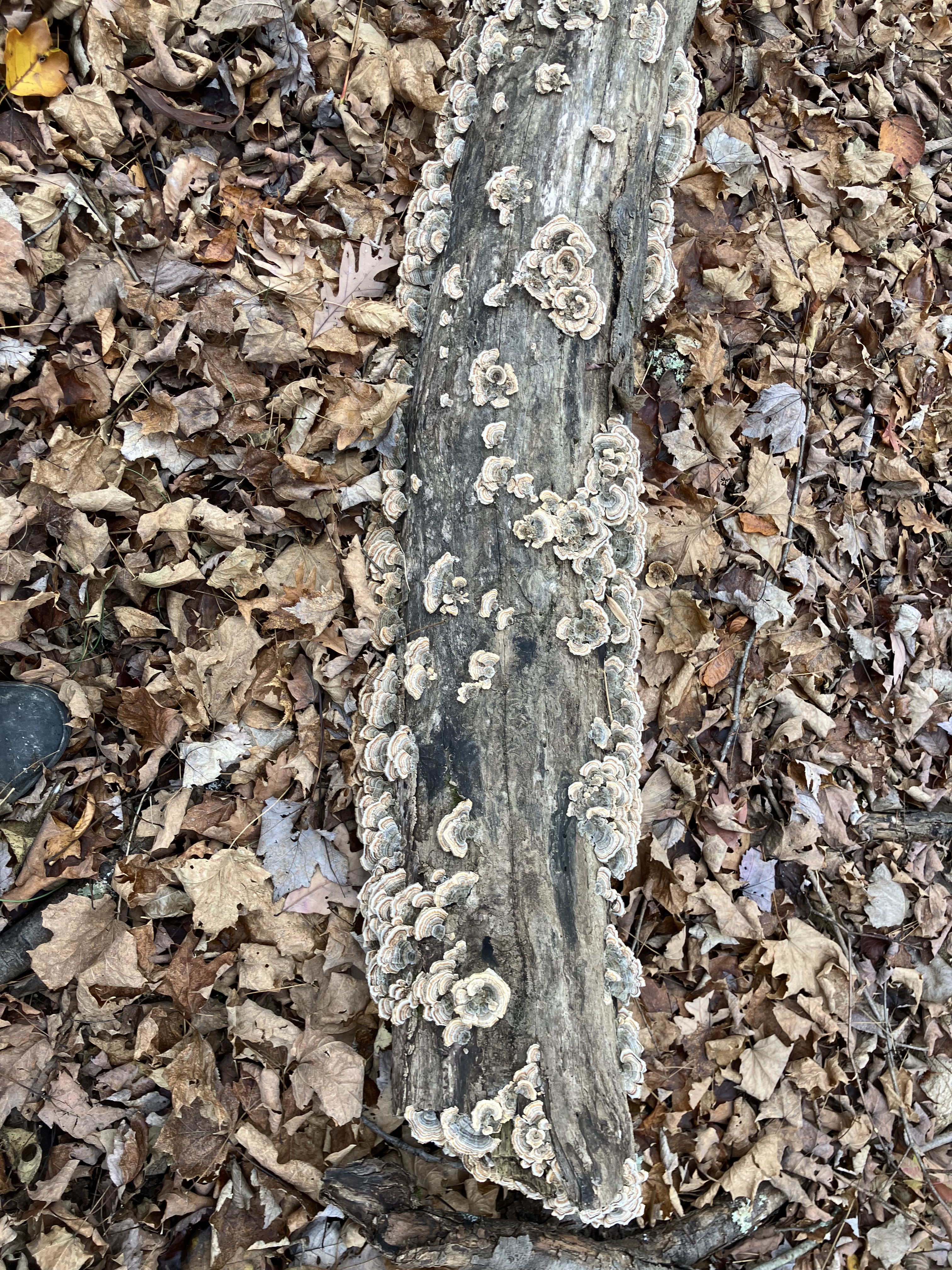
Anywhere you go- there’s a mushroom close by! I’ve just come back from a trip to The East Coast in late November, 2025. There was amazing autumn color still on the trees, and some mycological bursts of bright pigment as well. This Chicken of The Woods was a wonderful example, hardened by time and age, an old one like this is shellaced, not a choice edible, but still some sustenance steeped for a while if you’re in need. It was loose in the ground, protruding from the rotted out oak stump where a city tree used to grow, near a school. Ideally, something would be planted here to replace this fungal habitat, but for now, the mushrooms continue working to transform detritus into valuable soil. If we sit with just this complex system of nutrient exchange, even fathoming for a moment, the layers of evolution involved, out simple understanding of it, not even yet aware of the possibility. Gosh those leaves are so pretty.

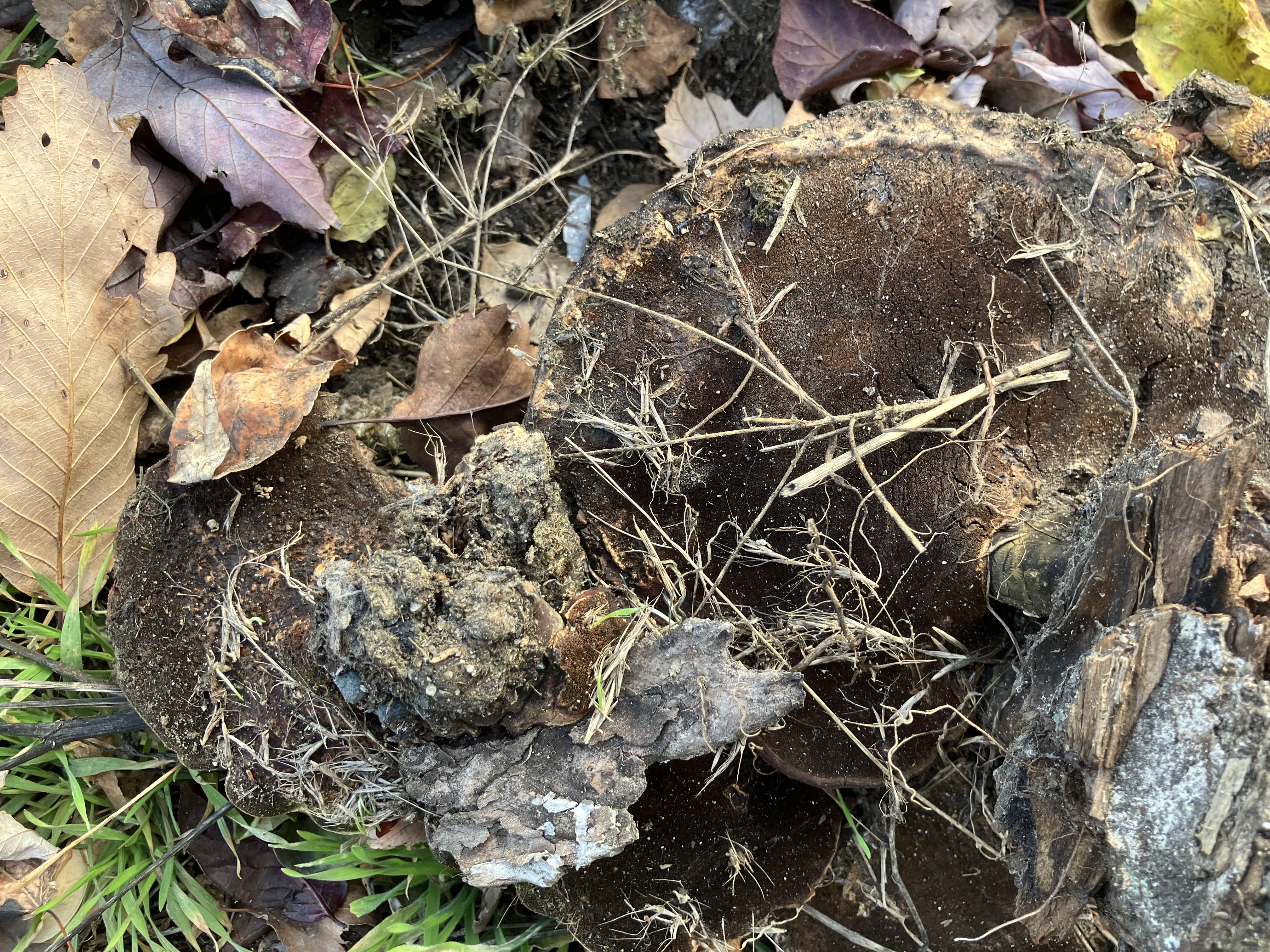
When I turn it over, this saprtrophic mushroom presents a glimpse of the happenings on a mycological level and beyond. This species needs rotting wood to thrive, though its mycelia can travel through and colonize rotting leaves from the same tree- usually an oak, and there are a lot around here- note Quercus montana leaf top left. This specimen is established in the almost gone stump of something, in a planter square between a paved parking lot, sidewalk, and a heavily used blacktop street. You can find mushrooms anywhere, and here, between a boys and girls club and a Moldavian church in West Springfield, an edible mushroom came forth, matured, released more spores, and continues to support mycelia in the soil.

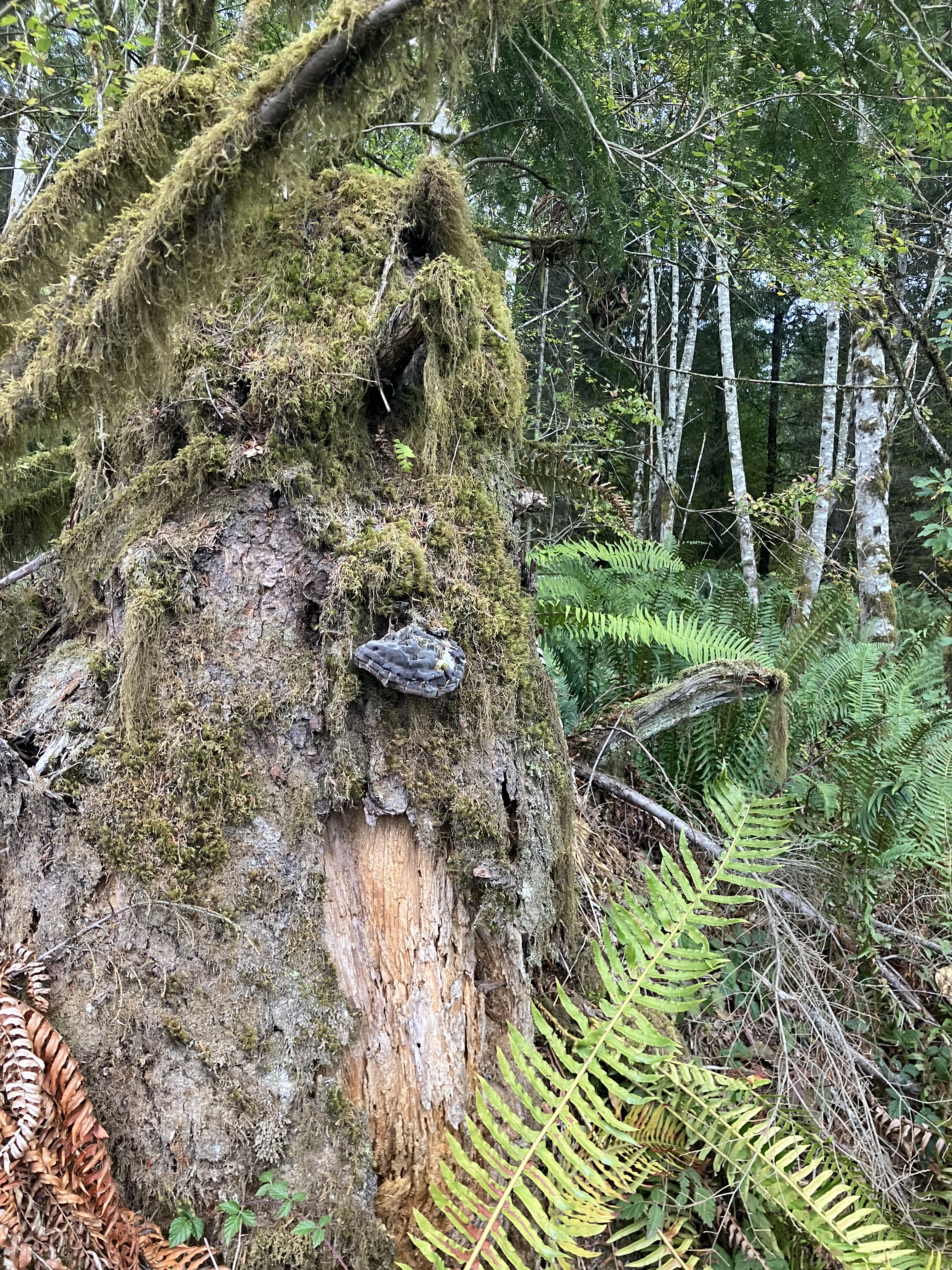
So many of the species on The East Coast are a little strange to me, but I keep my eyes peeled and focus on what a dominate hardwood forest offers. Strolling through a different forest near The Catskills in New York, I could not help but notice all the blooming fruits of fall. You might think of apples and pears, but I was not in an orchard- well, not a recently cultivated one, I did notice many other saprotrophic examples slowly taking apart dead wood in a recovering forest. This particular forest was a Dutch homestead with an established cherry grove. The cultivated trees are long gone, but native black cherries are making a slow comeback. They need light, and are often found in edge spaces. Because this forest has no younger established evergreens, the cherry has continued into the canopy, with the potential to become an old growth tree. Nearby Turkey Tails passively break down a legacy of nutrients for the soil and vegetation that feeds all life on this earth.

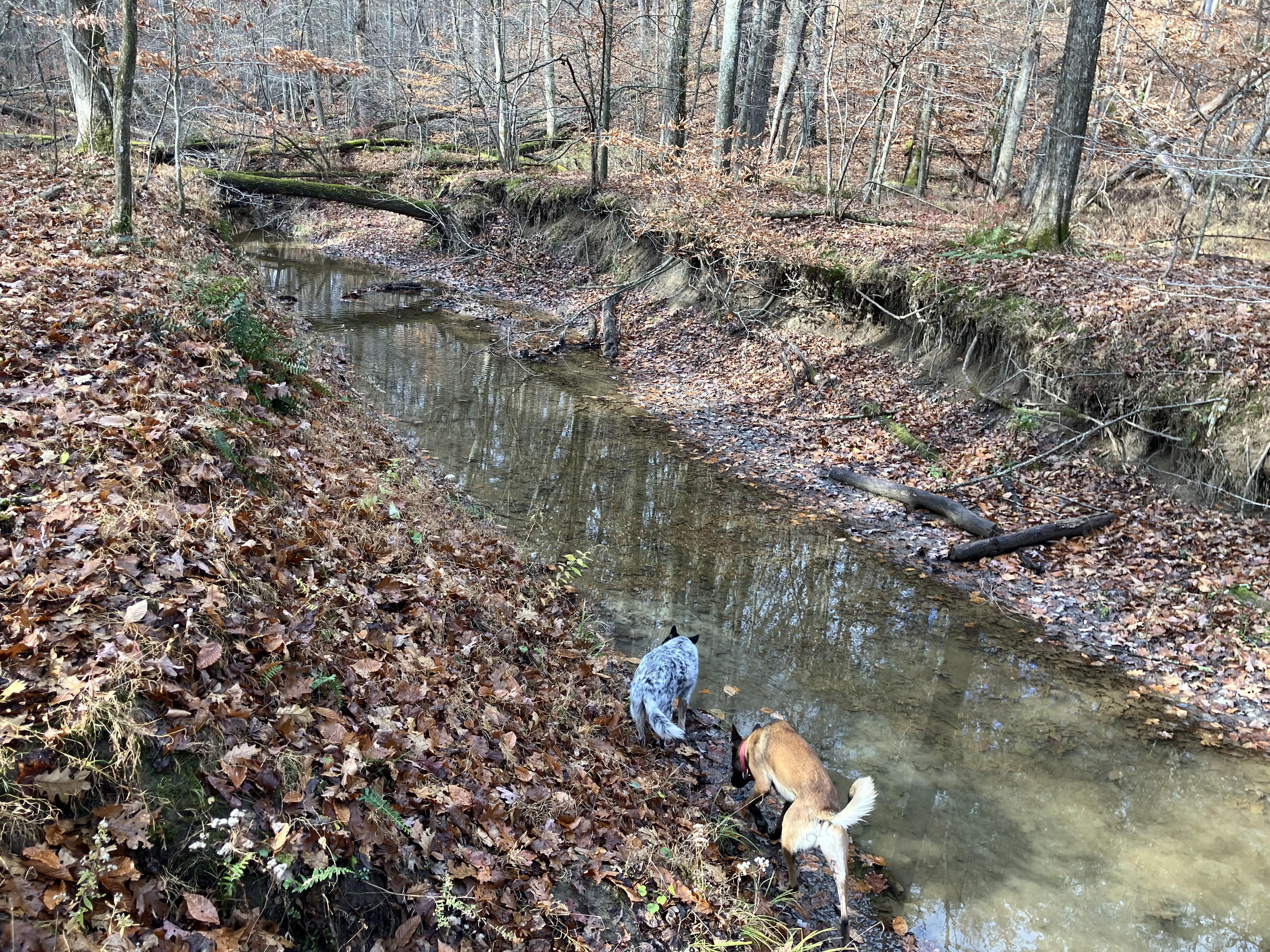
The log hosting this larger specimen, Trametes pubescens, is a bracket fungus enjoying a downed feast that will last many years. There’s a little calling card on this log, which crosses the small stream through a purposely canal drained wetland. The Dutch knew how to make wetlands go away to reveal wonderful topsoil for tilling. Row crops fed families and made abundance for selling in the local community, or keeping livestock, which most families did in the early 1800s. By the 1900s, dairies had consolidated in the bigger river valleys, and pasteurization put commercial milk on trains to go to the big cities like New York. The territorial marking of this turd might come from a fox, most likely vulpus vulpus. The animal is leaving a flag to say “there is a good crossing here”, a direct path above the deeply cut drain ditch that is now eroding away at a rapid rate, pulling in logs that will actually help restore this wetland, in time.

The family that came and dug this drainage came on the heels of a much larger shipping canal built in the early 1800s. It’s historic banks are stones throw, or easy cart ride down the hill, where this famiyl could sell their products, like the cherries, to a canal boat pulled by mules, heading to The Hudson River, a shipping highway before rail, and later trucks haul the world to and from major ports at it’s mouth down in the bay. Coal was streaming out of Pennsylvania along this canal, and all the little town stops along the way bought coal and traded agricultural goods. The Dumond family that lived here in the 1800s worked to make the land as productive as possible in their short tenure. However, they left a depleted landscape with lost wetlands and terrible erosion that is still cutting away the soil today. As trees naturally fall into the path of these active waters, the flow will slow and spill over into the awaiting wetlands. Eventually, the water will return to its old floodplain, but human intervention could speed up this recovery, with debris dams set in strategic areas to help guide the water out of the canal and back into the low lying areas of this forest.
We have dominion over the land, yet know so little about it. The primitive concept of dig, build, control, vs. a more enlightened observe, learn, reflect, fold in brings short term gain at long term greater loss. Humans have the ability to reason out common sense tactics for survival in almost any situation, yet we keep slipping back into reactionary extraction. Untangling ourselves from that economic nightmare now holding so much of the world in the hands of a few mega conglomerates will deteriorate as this wetland did, but the compelling topography of finite holding it all up is crashing. Exponential weather extremes deal catastrophic blows sending our living world back into balance, and like 99% of all life up until now, we shall go extinct. Until that time, we can work towards restoration and rewilding, weaving the natural world back into daily routines and rituals. I’ll take a page from these mushrooms and keep on transforming personal passion into a thriving life in this abundant world.

Connectivity is the key to this thriving, and our own actions can branch out similarly, locally, with people we see doing good work that feeds everyone. None of the leaves hold back on the tree year round, refuse to compost into rich soil, that feeds the mother tree, who grows new leaves every year, knowing they will drop again in The Fall. Someone wrote a poem about this endless giving, as a metaphor for mankind to take and hold close. The mycelium is another teacher, one you have to look closely to see, but she too is ever giving, weaving death back into life, transporting inactive matter to active neighborhoods of complex mineral, vegetable, and animal relationships that make all life possible, please fold yourself right in.

Canopy is very important to the soil in this part of the landscape, abundant in hard wood trees. In big prairie country, the grasslands put down 20′ deep root systems that have similar exchanges of minerals to build better soil, hosting all manner of biological factories under the surface. Grasslands to have a more complex underground system of biodiversity and microbial action, but the forests have an above ground diversity that is just as important. Looking up in to the canopy of this hardwood landscape, I can see trees that have died, and are now hosting all kinds of life, including important nesting habitat for birds in standing snags. These dead wood towers are very important to the environment, and should be left alone if they are not a danger to personal property or a heavily used throughway. Eventually, mycilia will also inhabit these dead standing complexes, helping to deconstruct the wood and returning it to the soil.

As humans, we think we know so much about woods, soil, and water, but nature is so complex, layered, and reliant on community activity to thrive. When people take away one part of these systems, it has a cascading effect on the whole process. We took out the old growth forest, causing huge erosion of the precious topsoil in every forest we cut. Then we killed off all the predator animals, thus removing a keystone part of the life and death cycle in the animal world. Our livestock borough disease, that killed much of the deer and all the elk, as well as the over hunting we did to sell fur, meat, and antler to industrial processing. Not to mention our own sickness brought from Europe to The First Nation People, who died by the millions before the Dutch settlers and colonial expansion began. Not much of this history is taught today, but you can learn a lot by listening to the oral histories still spoken by the descendants of the tribes, that still live in these landscapes throughout America.

Nature is always trying to restore balance, and the mycological friends in these forests show the strength and determination of the natural world. The smaller relics of recovery are just as important as the big flashy conservation tree planting and wetland restoration, and it’s done passively by millions of unseen organisms still alive all around us. I say passively because we don’t have to pay to implant them, work to reestablish the mushrooms, or guide them in what they should do. Nature runs independently of us humans, and that’s incredible to sit with and watch. The more time you can spend sitting and watching, wandering and exploring, the closer to the natural world you become. In fact, we the people are part of the earth’s living system, we’ve just strayed from our original instructions to steward and tend. If you can make time each day to tend, even just observing what grows on around you, you are taking steps towards re-connection and restoration in your self. Once you rediscover the wildness within, you can embrace nature as a part of, rather than separate from your mother earth.

The wilderness of New England still carries many scars of human disruption- from canals to clearcuts, the land is deeply changed by all our extraction and greed, brought on by a complete disconnect from the living world. We spent so much time thinking about what we could change, we didn’t stop to think if we should. Now, the consequences are coming home to roost, and the human species faces monumental survival challenges related to the exponential change nature is now adapting towards, with or without us. Looking down at the rotting logs around me, I stop to thank nature for continuing it’s evolution, regardless of our monkey minds and ideas pushing in. We cannot sway nature too far off course. Learning to see her adaptability and change, embracing it and learning to be with nature, rather than against it, this is the best evolutionary understanding we have. Fresh air to breath cannot be artificially contrived- not in a sustainable way, fresh water cannot be synthesized- H2O is just that, and no lab can conjure it out of thin air. Safe soil to grow out food is not made en mass online. You cannot scroll through different soil options and pick what you like for your home. Terra firma is what it is, and though we learn to amend and cultivate, our tilling abuse and monoculture nightmares are still actively destroying the priceless landscape for the sake of industrial madness. Yet the mushrooms continue, trees grow and die, wind pushed over shallow roots in the diminished topsoil, and water carries off the nutrients needed to stabilize the banks and return the land to wetland recovery. What can we do to work with nature, to re-wild ourselves back into our roles as stewards and co-workers of mother nature?

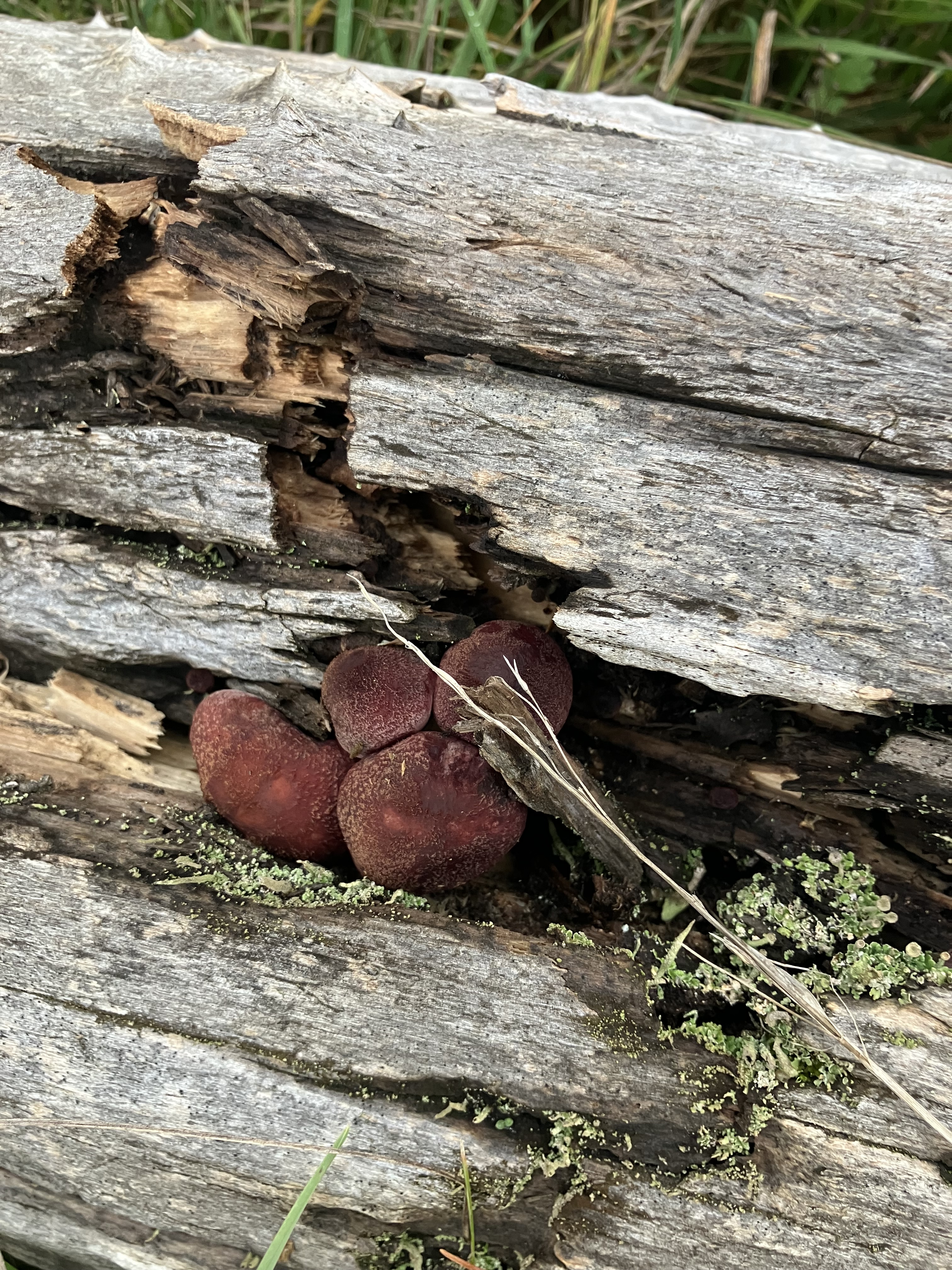
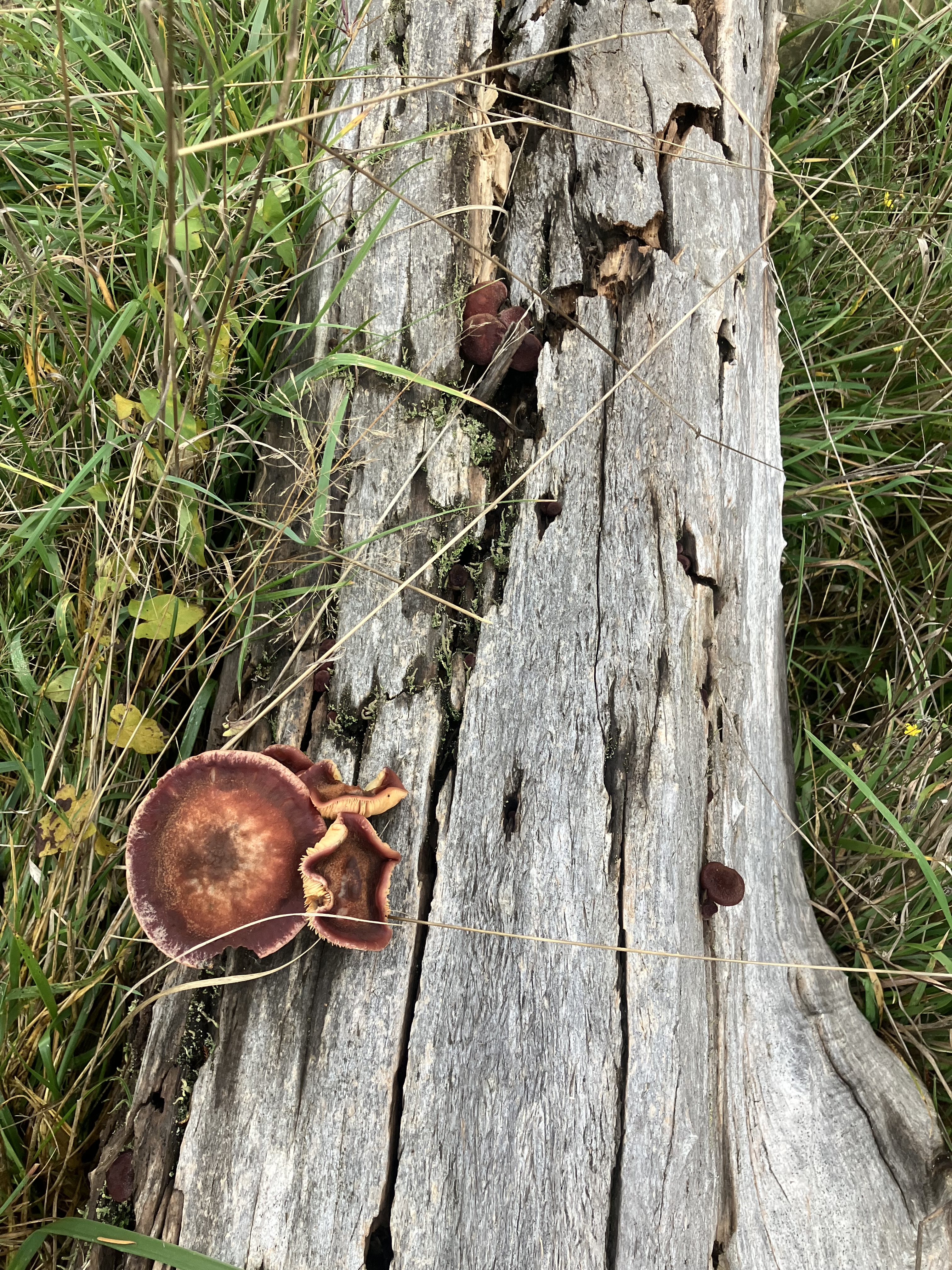
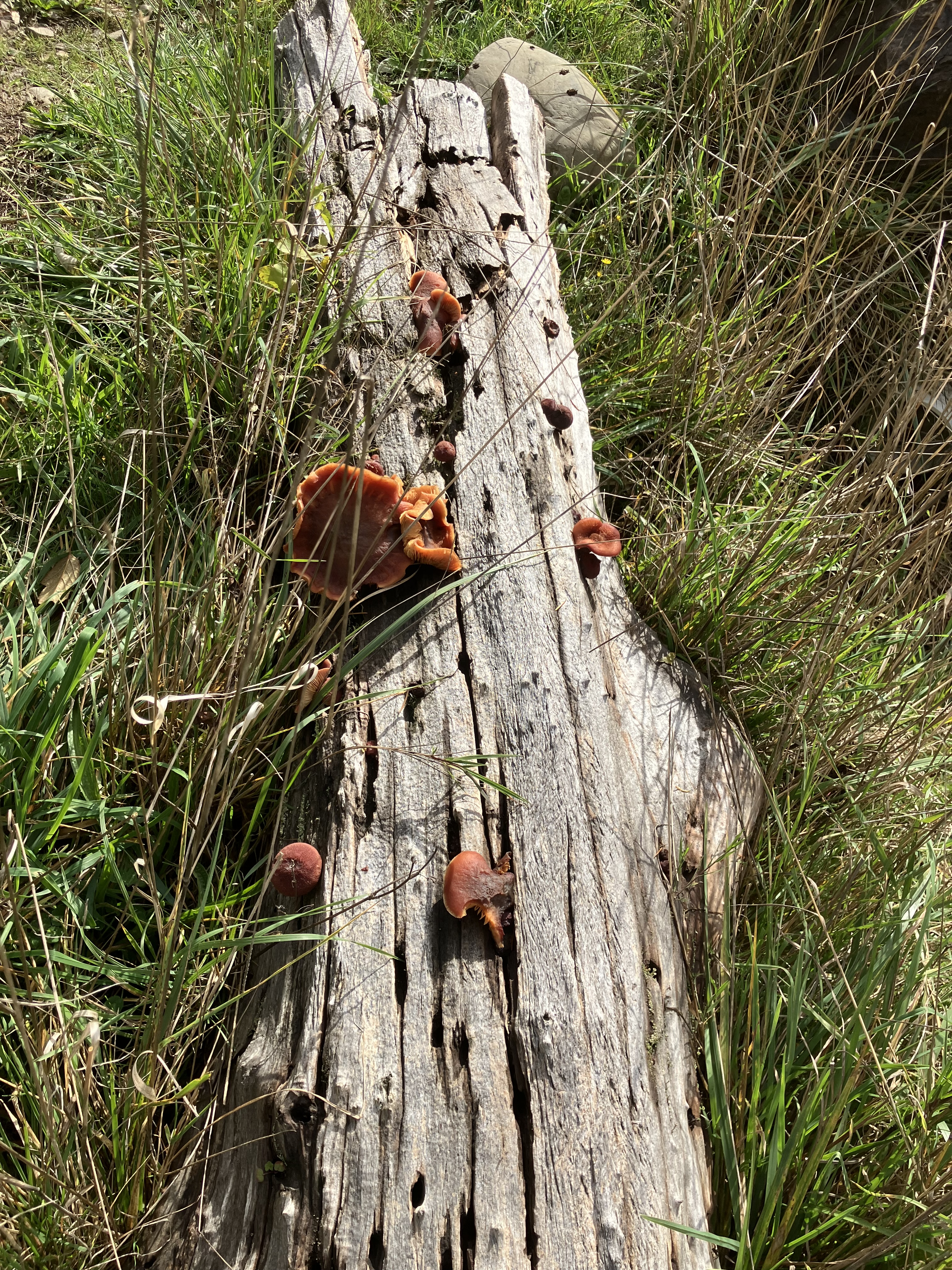
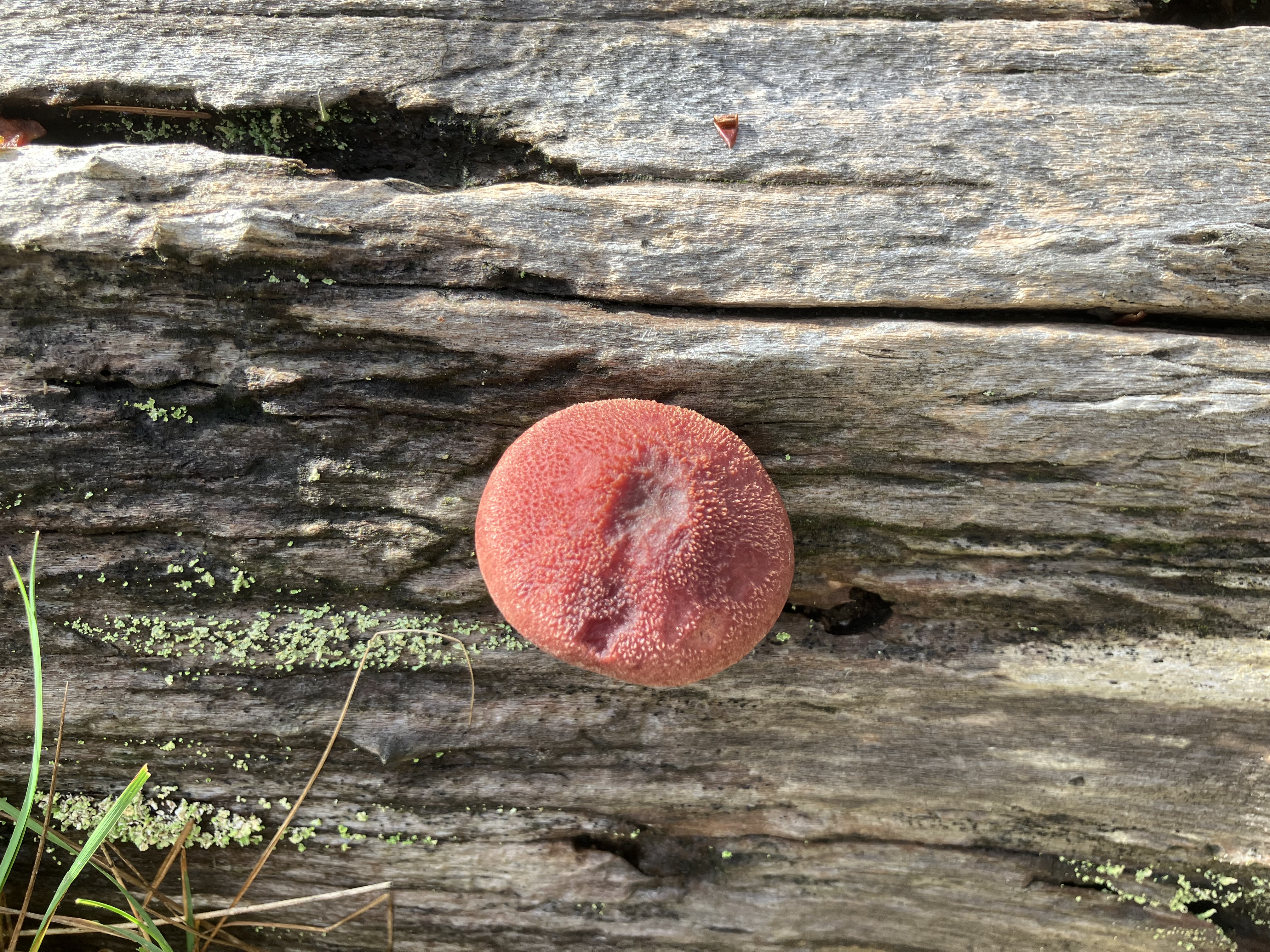
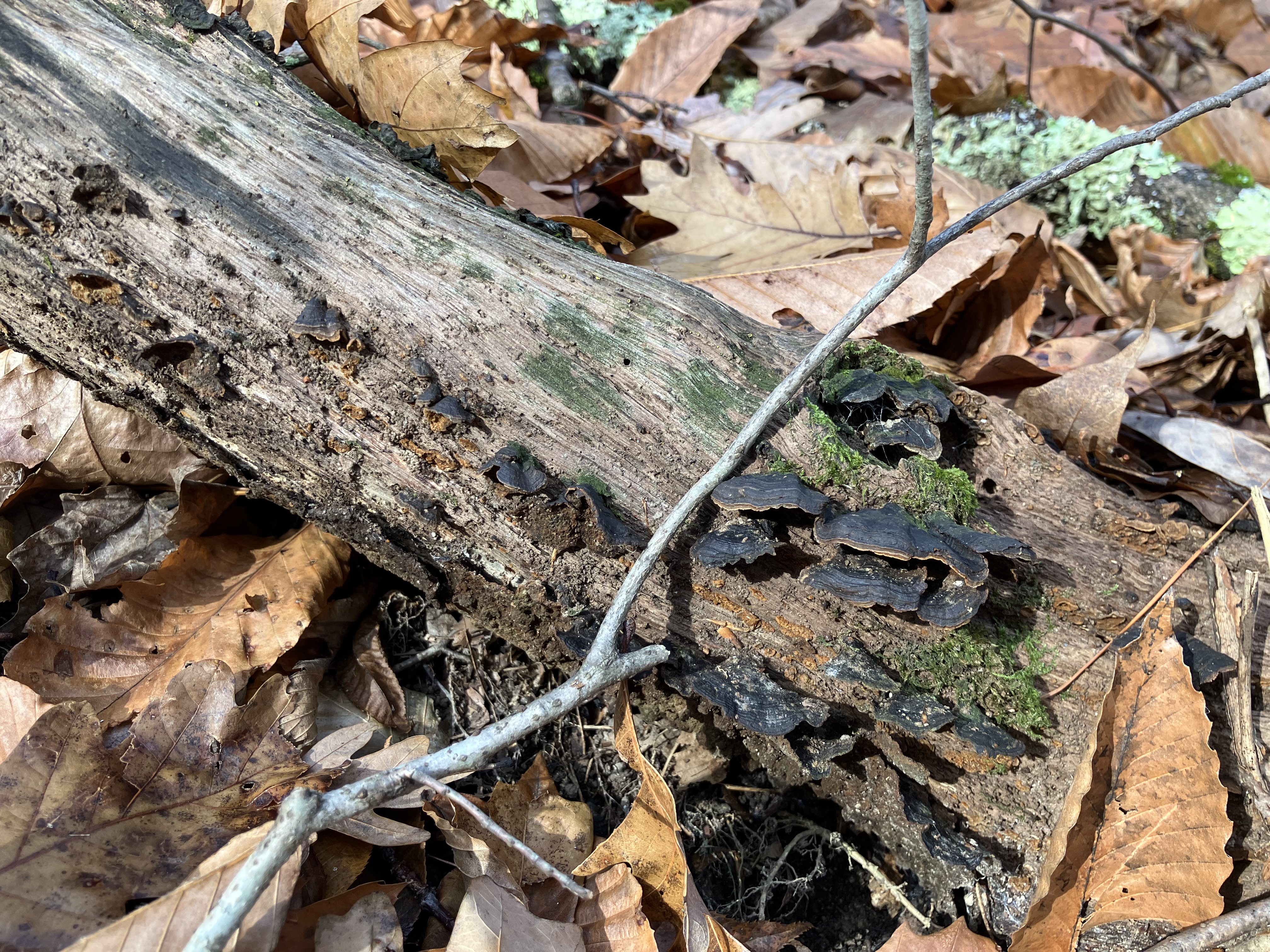
The Oak Curtain Crust pictured above is a fascinating species of mushroom I had not noticed before. It was a beautiful sunny day to capture some pictures of this beautiful bloom. Almost always found on fallen oak logs, the strain originates in tropical regions, and has found it’s way up into New York’s hard wood forests over time. Think of all the wood we’ve shipped all over the world, and you’ll better understand how fungus has traveled to all parts of the world- for better and worse. Many fungal strains caused irrevocable damage to our native forests. In much the same way small pox wiped out native populations of people, fungal strains entered the hardwood forests of New England and wiped out keystone species like our beloved American Chestnut. On the West Coast where I live now, The Western White Pine is gone from our canopy too. Mushrooms are certainly important to forest health, but non-native varieties make short work of the trees when they are not resilient. Over time, American Chestnuts are being genetically modified to resist the blight, but very few native trees remain alive today to carry on resistance. A GMO Western White Pine strain has also been created, and I’m planting them on my land in hopes of helping a crucial tree return, but to what end? Forests adapt naturally, even with chaotic loss, new forms of forest evolve. It’s that human cause that we keep ignoring. Then we come up with our own solutions, manipulating genetics and guessing at what might work. Again, when we stop to think about what we’ve done, maybe we can start by stopping some of the destructive madness of our own actions, and being to accept the consequences. I reflect back to that wonderful speech by Dr. Ian Malcolm in Jurassic Park, we did not stop to think, we rarely do. Take a page from the mushrooms and sit with it for a bit longer. Imagine the outcome of careful thought and gentle reflection. We could reshape our world in the image of nature, rather than grasping at technology as a savior from what could be our own garden of eden.

Tidal Islands of Rowley, MA

Whenever I travel back to New England to visit family and friends, it’s like going to another country. The United States is a young nation on the world stage, but certainly well colonized by the Europeans that flocked here for a chance to start a new life, or in many cases, exploit the natural resources that were already devastated back in Europe. The history is deep- for colonial history, and though the first nation Abenaki had been living in the area for thousands of years, they had been hit with the early viruses that swept through The Americas when the Spanish first arrived a few hundred years before. That’s why the landscape along The Eastern Seaboard seemed empty when European colonists arrived. Millions of people had already died, leaving some of the best village sites available. The European ships found deep natural harbors, anchored, and came ashore to settle The New World without a clue as to who was already living there. Plymouth is on the south shore of Massachusetts, “At the Great Hill”, which is the meaning of the state’s namesake, also a tribe of First Nation people living in and around what is Boston today. The North Shore, where Rowley was founded in 1639, was the home of the Naumkeag people. They were marsh folks, enjoying the abundance of tidal mud flats, oak islands full of turkey, deer, geese, and ducks, as well as endless seafood from the shore and Atlantic Ocean beyond. They called the area “fishing place” or “eel-land”. Names that speak to the important food resources of the area and why they were settled by the tribes.

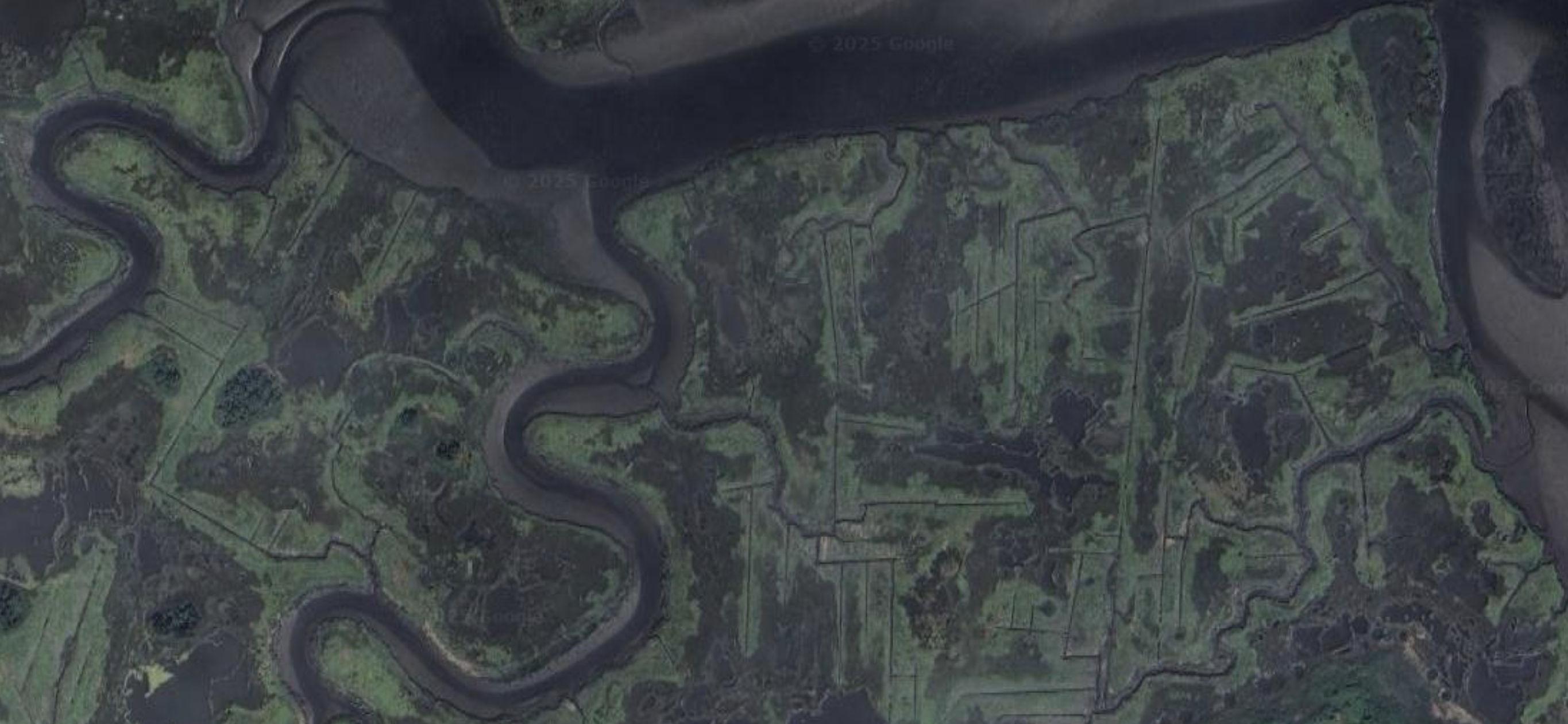
Today, Rowley, and the surrounding area where my family lives, is known as The Great Marsh. Most of the land around our home is protected conservation land, open to the public, allowing access to the tide flats for shellfish harvesting, kayaking, and walking trails to enjoy the splendor of this wild place. During some high tides, much of this area is flooded by brackish water, covering the causeways that we drive to get in and out from our dwelling. These access roads are ancient, with petrified wood below the rock and gravel used to maintain the county road today. In the 1600-1700s, the area was drained by tenacious farmers who wanted to cut and harvest the marsh grasses to feed livestock and thatch buildings. You can still look at aerial views of the landscape here to see the drainage canals and ditches cut through the marsh to keep the land dry enough to drive carts onto, though draft horses wore wooden mud shoes to keep them from sinking in the mud.

When the tides are up, like after the full moon on my recent visit, we try to time our entrance and exit from the marsh to avoid flooding. Still, an adventure through the tides as they change can happen, and that’s why my parent’s drive cars with high clearance. In rare cases, the tides are too deep for any vehicle, thus you have to wait out the flooding on whatever side you’re caught on. Luckily, tides are predictable, so we’re rarely stuck. Watching the water slowly cover the fields, mudflats, and causeway is a meditation of sorts. The water pours over the landscape slowly, but within half an hour, the grass is gone, and a glass mirror of liquid reflects sky. What a magical moment, ending as quickly as it started as the tide changes, and the waters head back out to sea. Our home sits at the edge of this transition zone, and, though my step-father did stay on the land during The 1991 Perfect Storm, he was not concerned, even when the waves were breaking ten feet from the door. Our little island in the marsh is over twelve feet above sea level, with another barrier island further out, sheltering us from the full force of Atlantic storms.

I’ve never been strongly connected to Ocean or shore spaces, but our family home in Rowley is a beautiful place to visit and take in. Sitting in the living-room watching the tides go in and out is a fun past time in our home. With a book in my lap, I read, pausing occasionally to take in the changing landscape around me. In an afternoon, the view will go from golden fields of slat hay to an inland sea, pushing rack up onto the edges of raised oak islands, the trees a testament to enough shore for sustained roots down into the thick marine clay. In the next 50 years, this whole area will succumb to rising sea levels, but for today, the house is safe, and our little island in the marsh remains a haven for family and friends. Below is the view from my reading perch, looking out when the tide is out, and when it’s in and flooding.

These tidal islands are full of mystery, and exploring them can be a challenge, because they are covered in poison ivy, ticks, biting flies, and sink holes out on the mud flats. You can be walking along on the grassy plane, then suddenly fall into a cut through the marsh from draining, which was covered by the long grass that tends to fold over after the floods. It’s such a mysterious place, Lovecraft wrote a short story about the area, using the marsh as a menacing presence over the small fictional town of Innsmouth. Haunting tails abound, and indeed, one of the unfortunate women who was hanged as a witch in famous Salem, came from Rowley, and the marsh. Margaret Scott had married a struggling marsh farmer, who later died, leaving her destitute with her brood of starving children. She would stand out on Rout 1, the first highway and toll road in America, begging passers by for alms and charity. If they refused her, she would curse at them, which was later used against her as testimony to her wickedness as a servant of the devil. Hang her for the inconvenience of being poor and having hungry mouths to feed.

The Great Marsh is no place to be caught on foot in bad weather, and if you don’t pay attention to the tides, you might find yourself marooned on one of the little oak islands for hours. Wading in can be very dangerous, with rip currents pulling you out to sea, thick mud to hold you fast in the flats, and sharp shellfish cutting at your shoes and legs as you trudge through the pungent sulfur smelling sludge. I’ve explored these muddy expanses with and without chest waders, and many do ford the marsh to harvest some of the best clams, oysters, and mussels available. Because the marsh is protected, it’s waters remain healthy, with little agricultural runoff, and no industrial waste to jeopardize the health of the place. There is a local oyster-man who has established rafts of cultivated shellfish for commercial sale. We are excited to support his venture, as shellfish filter and clean the marshes, making the landscape healthier for wildlife and people. The marsh is an important flyway for many birds on migration, and wildlife refuges are established throughout the marsh to protect vulnerable species. There is still some well regulated hunting, but only archery for deer and turkey. The Marsh has some of the best black duck hunting in the state, and, with permission, our family lets hunters come through on the weekends during the season. Dogs are required to fetch the birds out of the muddy flats.

Pictured above is the high tide mark from the back porch of the house. The water is quite close, but no surf crashes, just a slow seep of tidal flats soaking up to the edges of the rack, where phragmites reeds mark the edge of brackish flow. The mature hardwood trees also signal the edge of freshwater growth, and I did not notice any major losses due to rising ocean levels- yet. As I said before, inevitably, this are will one day be uninhabitable, but for now, it’s a spectacular place to visit and enjoy. I recommend The Rough Meadows if you do plan a visit, this Audubon stewarded trail system offers clearly marked routs through the marsh to keep you safe. The area is full of marsh views, oak forest expanse, and wonderful birding. Just make sure to check for ticks when you are done- and don’t stray from the paths unless you want to encounter some poison ivy- trust me, I learned the hard way more than once!

So much gratitude to The Chandler Family for making The Great Marsh accessible to the public, protecting the habitat, and seeing a clear vision of conservation and public use hand in hand. Acknowledgment of the original people who lived and tended this place- and their legacy, which continues today. Let us not forget that the First Nation People continue to live and thrive around us, and we, as guests in their homelands, can offer respect, support, and space to listen and learn about the places we now also call home. Thank you to the marsh, it’s beauty, lessons of change, and rewilding. It will always be a special place to come home to.

Quince Harvest

These are a forgotten fruit in many planned orchards, but I’m here today to encourage you to take a second look at Cydonia oblonga. I’ve planted three in Mom’s Orchard, and this year (3 since planting) they produced their first crop of fruit. My geese shook two off early, I picked one while it still had a lot of fuzz, and the majority I waited until they lifted easily off the branch. This is how I judge most of my fruit, though you can pick early to cold store into full ripeness, thus prolonging the fruit’s life and freshness. Still, I find picking when the fruit is ready to let go brings the best flavor and texture from the fruit, from apples to pears, and even these quinces. My first crop was modest in number, but generous in size of fruit. These are eating quinces, selected to grow large and sport a hefty flesh to seed ratio, great for slicing and dicing into salads, pies, and jellies. My first recipe is a classic quince “cheese”. This is the only way I had ever experienced quinces, but it was a dreamy flavor and texture adventure that I was excited to repeat.

Quinces have a generous natural pectin, which, with a little reduction and sugar, makes a wonderful jello like block of sweet fruit that you can slice and serve, usually as part of a charcuterie board with cheeses and crackers. This amazing fruit tree comes to Washington State and this little orchard spot from a local nursery, but the historical roots of the Quince begin in Iran’s Hyrcanian forests. Their homeland is temperate lowland broad-leaf forests on the south end of The Caspian Sea. The Puget Lowlands of Western Washington are similar conditions, though evergreen dominate, our orchard is broad-leaf dominate, and the soil is amended to suit the fruit bearing verities, which all require more dolomite lime, compost, and leaf mold debris. All of which are mixed and well rotted before application. The Quince had thrived in our soil, and likes a dryer summer. It took off as soon as it was transplanted with it’s root stock three years ago. The abundance of these trees speaks to the health of our soil, and the great conditions for this cultivar.

Above are two different types of Quince, with the larger one being from my eating variety. I say eating lightly, because, through I do love the raw taste, for many, it’s too astringent, but I liked the strange taste of my quince raw. The smaller one is from a different tree on another property across town. I don’t know it’s age or care, but all the fruit gifted me from this tree was this smaller size. I ended up processing them using a grater, rather than trying to cut them up. The core can be a little difficult to cut around as you are learning, and with smaller fruit, it’s just not worth the coring effort. It is recommended that quinces are cooked for best flavor, and I agree. This fruit has such a floral scent, along with a texture mixing pear and apple. The flavor is subtle, citrus with sweet rose water, or a hint of caramel. Something almost ancestral comes out of the tasting, I was enchanted at the start, and found that many quince recipes come from The Iberian Peninsula, and specifically Basque country.

Channeling some ancestral tasting, I continued dicing and slicing, then boiling and blending, ending up with a puree that went into molds to set overnight. The cheese should be firm like jello, but mine did not cook long enough, so even after a few days of sitting in the fridge, the liquid was still too viscus to set- I had not boiled down long enough. The only answer was a trip to the dehydrator. After which, I cut the flat fruit leather into pieces to go back into the fridge and freezer for future enjoyment. The sugar will keep the fruit stable, like a jelly or jam- which I could have made too, but I wanted something firm like the cheese. Net year, I’ll know to cook things a little longer. If you don’t have time for all this processing, you can grate the fruit off after peeling and freeze- that’s easiest with the smaller varieties. I did do that with the gifted fruit, and will look forward to making a small single loaf of cheese later this winter. Next fall, I’ll look forward to another wonderful harvest and some added experience in working with this unique orchard friend.

So much thanks to the abundant trees that gift us these sweet treats at harvest time. Thank you to all the people who carried these cuttings out of The Middle East, and all over the world for humanity to enjoy. Gratitude to the soil here in Washington, accepting this far flung grafted cultivar, and supporting it’s growth on this farm. May future generations have access to this food source and share in the bounty of yummy quinces!

Ulster County, NY Reflections

Being back east is always a trip- both in the actual day long travel by air, as well as driving hours into the real wilds of an old New England woodland. While back east, I had the wonderful opportunity to visit some friends who bought land near New Paltz, NY. They finally got their house built and were able to host me for a few precious days of good reunion. Whenever I am in a landscape, my vision of what is and what was comes to life. This place has a long history of colonial influence and change, with little left of the original landscape to go by. Even in what is now a rural part of upstate New York, the evidence of human induced ecological genocide is all around. Thankfully, land can heal, will heal, with or without people helping, and it’s important to remember this whenever you encounter degradation. What might look like a typical hard wood forest, it a legacy of over-harvest, erosion, and chaos at the hands of early Dutch settlers trying to make a home in a place far from what they knew back in The Netherlands.

We have to first acknowledge the original people of the area, like all parts of America, First Nation’s were here before colonial invasion. The Haudenosaunee people, known as The Iroquois Confederacy, call what is now New York State, and much of the area around it, home. These tribes are still alive and present, both in their native lands, and in communities around The Country. Though we European late comers rarely see these people around, and often think they are gone, the tribes are active and aware, still seeking to be recognized and respected as the original tenders of this space, place, and time. Let us speak these tribes back onto the land, and carry their original instructions of land stewardship and community in our hearts as we stand now in the places they call home.

New Netherlands was New England’s big brother in the rush to settle The New World. Newness has a ripe quality of untouched, unspoiled- words of industrial opportunity and willed aggression. There’s enough out there about this struggle of European dominion over wilderness, played out in The Old World and still felt there today. I’ve written often of the environmental cost of colonial industrial resource extraction and how it plays out in our world today, and this post is no exception. See it.

I stood looking down the sharp slopes, off the ridge that drops dramatically down to the creek below. Erosion hit this place hard after the initial clear cutting of the woods. It’s been cut at least twice, with no sign left of the old growth stumps. Such relics were burned, pulled, or slowly ground down under the hooves of overcrowded livestock. After the trees were removed, rains and melting snow came roaring down the gullies, carrying off rich topsoil and the seeds that would have germinated into new forests. In this particular landscape, now parceled into several properties of a few acres each. The Dutch grave stones tell of one family’s attempt to settle and manage a cherry orchard, shipping the fruit along the canal established in the 1800s, which connected to The Hudson River from Pennsylvania, and offered a direct water rout to New York City, once New Amsterdam. The building materials, coal, and agricultural products that left this landscape for the big city took quite a toll on the living world, but people made a lot of money, and progress was made. The farmers here were encouraged by the profitable markets, and set about straightening the creek and draining this marsh to create more arable land for production. Below you can see the creek and its unnatural straightness. I’ll also share a terrain map to see this creek compared to it’s untouched sister over the next ridge.

The family that settled here came from an ancestry of lowland dwellers; sandy bogs, tidal marshes, and expansive fens bordering the ruthless North Sea back in Europe. They were industrious farmers that reclaimed land by draining it, and that’s what they did here, even though it’s a far cry from tidal shore. Still, there is good soil in wetlands- peat moss and layers of rich organic material that can grow anything. Once drained, the land could be tilled and planted, or turned into good pasture for animals. Dairy was huge in this area of Ulster County, and with the advent of pasteurization, milk could be shipped by train. The area was booming economically, and maximizing anything off your land was paramount. I can only imagine the mud and muck labor that went into digging out these wetlands and establishing the cherry orchard.

By then, most of the American Chestnuts were killed off by blight, and the entire forest makeup shifted. Millions of animals would have starved to death without that crucial abundant nut source, and what was left by the mid 1800s was shot and trapped for meat and the dying fur trade. I say dying because fur trapping had already wiped out the prized fur bearing species like otter and beaver, fox and martin. Without the balance of predators, forest habitat, and healthy genetics from a thriving population, wildlife in the area. crashed, and what we see today is a shadow of what once was. What there is a lot of now, is ticks. I was constantly pulling them off me, shaking them out of my cloths, and checking everything that felt like the tickle of squirming insects on my skin. The ticks carry Lyme disease, and you don’t want it, trust me.

Another imbalance in this wrecked ecology is the age of the trees. There are no young seedlings or saplings in this landscape, well, a few beaches and crabapples, but no pines between germinated two inch seedlings and still maturing 80 year trees. I’ve encountered an ancient Eastern White Pine on the corner of a property in NH once, its diameter was 8 feet at the base. The branches of that majestic old growth pine are the size of the current mature stock in these woods. It’s hard to see what is not there, but young pines are a huge missing piece in this woodland, along with other young trees like oak and cherry. I tried to capture the amount of germinated stock that is present, as well as where it’s missing all together. On a drive through the area, I was able to see younger pines along the roadside in some places, so they should be present in our woods, but they are not. I hazard a guess they’re being eaten each winter by rodents under the snow, but that’s just a guess.

The leaf littler is slowly building up again, covering the ground to protect it from erosion, but there is still damage being done, and ruts of lost soil are growing every year. At the same time, there is attempted healing, as the erosion pulls down the banks, the trees fall in too, making mini dams and slowing the water on it’s way. In time, log jams will cause the creek to jump it’s banks, flood the surrounding lowlands, and in many more centuries of work, restoring the wetlands that once were. It will take more than vegetation to do this work, the native wildlife must return, and with it, the detail work of eating and pooping that disperses seed, churns up soil, and adds vital micro-nutrients to the soil for long term forest health. Vanished species like elk and the billions of birds that once darkened the skies on migration are necessary to return this landscape to what it once was, but this dream will not be reached, so long as people continue to develop and squander the land, rather than working with it, and returning the space to habitat for wild living things.

Like the small steps we’re taking at EEC Forest Stewardship, the small steps in Upstate New York can be pivotal to starting that rewilding. Replanting native vegetation, slowing and sinking surface water, allowing space for wildlife to live, seek shelter, breed, and raise young. Accepting we are only one small part of the complex living earth is the first step to seeing what you can do in your own small way to help return the natural world to a balanced state- and that state looks different to everyone, so finding common goals in your community helps tie together the end goal in conservation and restoration. As I’ve shared with these beautiful friends back in New York, your local conservation district is a great place to start. Most counties in The US have them, so look yours up and support them- invite them to your property if you steward land of any size, and if you don’t have land, you can still volunteer to help protect lands that are in the care of your conservation district, which is still making an important contribution to conservation in your area.

The adult pines are still dropping their seeds into this forest, making space for a new generation each year, and in time, with some help for land stewardship practices, younger trees can begin to return, and a wetland can be restored. Imagine the possibilities once a landscape is back on track to becoming whole. Well, you don’t have to completely imagine, here are just a few examples of active restoration work that has saved wild places all over our country, and the world. Coming back around to this little forest and stream in upstate NY, I’ve shared a vision of BDA (beaver dam analogues). Slow the water, meander it into the wetlands to sink in, and allow the natural habitat to restore over time. It’s a small step in the right direction for a landscape patiently waiting for some TLC.

The people that settled here in early colonial pushed inland to exploit natural resources were caught up in economic schemes for personal gain, and to be clear, that’s still a thing all over the world. But you can stop this cycle by not participating or supporting thoughtless exploitation through voting for progressive conservation minded politicians, donating time, treasure, and talent to your local conservation organizations, and spreading the word to family and friends. Though the legacy of our ancestors has left a lot to be desired, there is always opportunity to change out ways. Please join me in working towards restoration, it’s the best way to heal our earth and ourselves through re-connection to our own rewilding too. Much gratitude to this wild earth for continuing, especially those white pines still dropping seed each year for a new grove of young trees that might one day come. Thanks to all the original people of this landscape, who remain, and keep asking for better stewardship and land back practices that help return our lands to wilderness for a future where people, plants, and animals all thrive together in an intact natural world.

Stream Buffer Lessons

Valley loves out woodland adventures, and shows me where all the good rolling scent spots are while we wander through stream buffer groves at The Snoqualmie Tree Farm near North Bend Washington. On a cloudy afternoon, the rains held off long enough for us to check for some local fungi in our friendly forests. Though the tree farm is an active timber plantation, there are some areas where the machines are kept back just far enough to allow some older substrate and buried old growth legacy come together to offer a little gimps of what could be if the forest was intact. Though this whole area was clear cut at least twice, more recent setback laws have begun to protect certain token areas in the plantation- specifically stream buffers, which prevent erosion in our salmon streams. Thank you fish for protecting some of the forests.

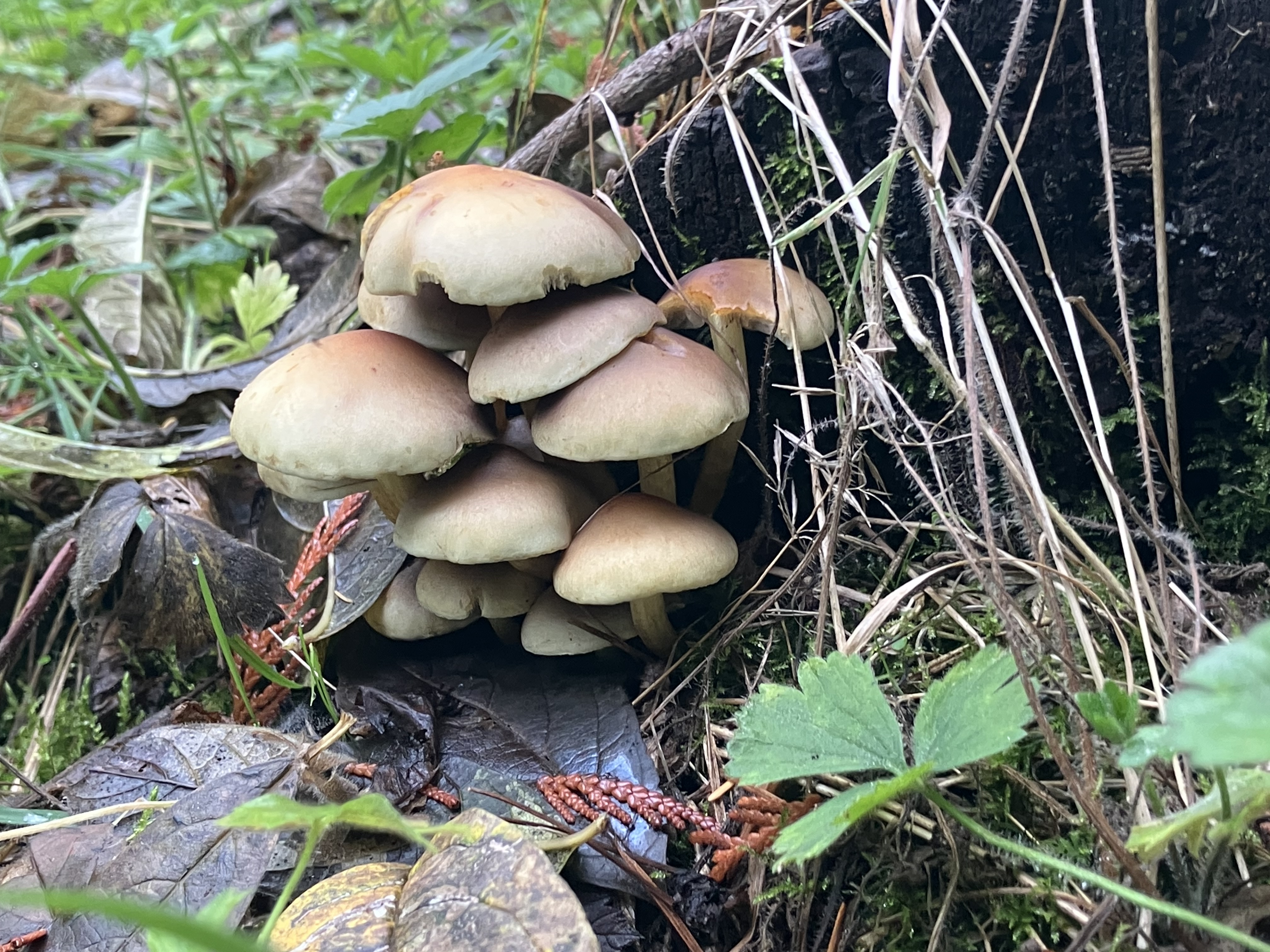
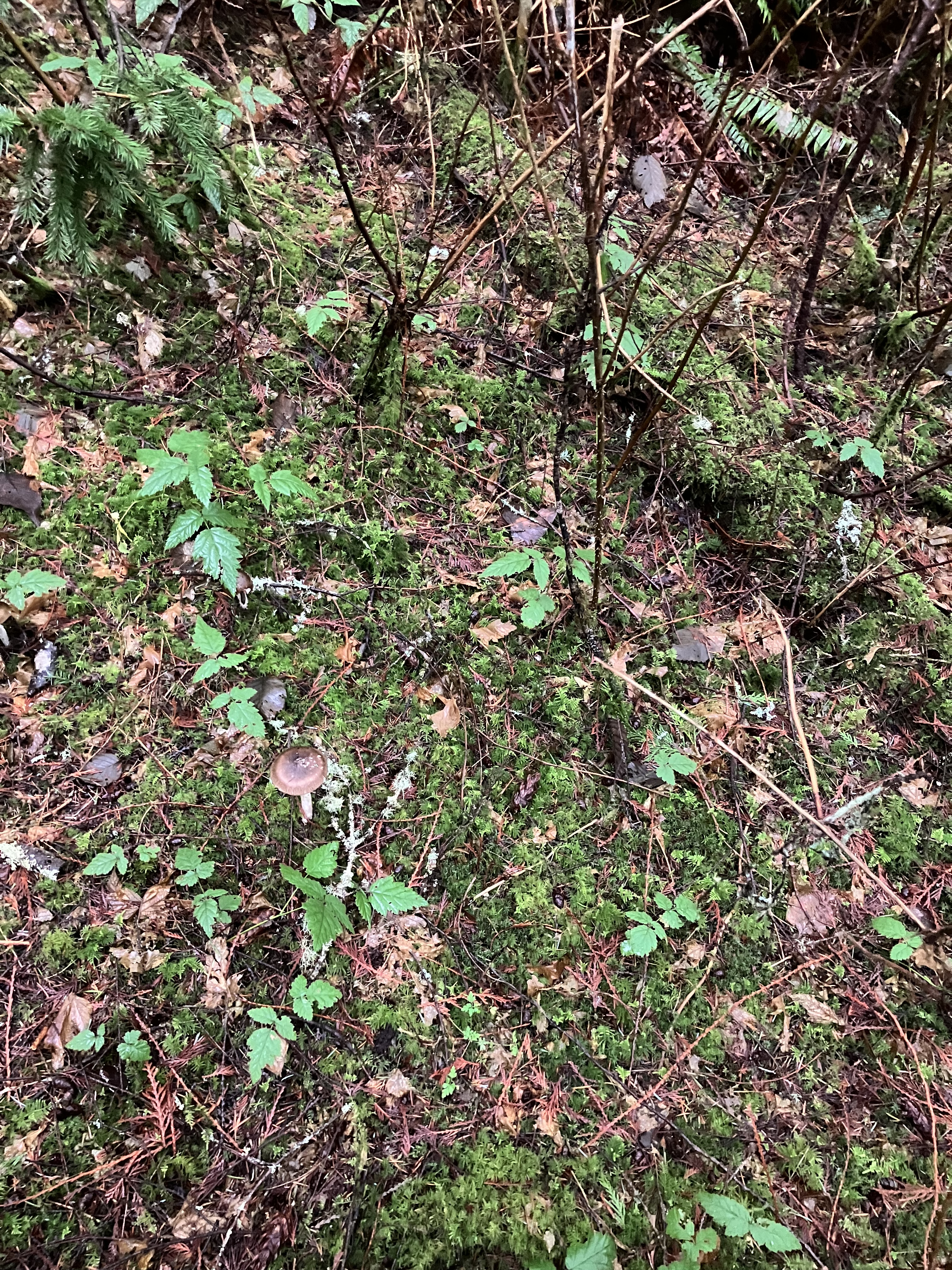
In these less trampled upon soils, mushrooms abound, and I tried to capture a few photos of the unique things growing on in these thin strips of ecological protection. A pair of M. epipterygia brave the forest floor in golden splendor. I love mycena for being small, but colorful. They span the pigment spectrum from turquoise blue to flamingo pink and are often overlooked because they are small. No, you can’t seat them, but you can take a moment to look closely at their nature and makeup to appreciate a fine specimen of mycological diversity on the forest floor. Another potential rare find is some Cortinarius rubellus or deadly webcap. I’m not 100 percent sure, but they certainly look like them. Note Cortinarius is a huge genus under the family name Cortinariaceae. I label mushrooms under this heading if they have particular gill structure and cap shape, but it’s often hard to get to a particular genus, and I’m making a best guess for this encounter.

Sorry when the pictures are so blurry, I’m using my phone camera on uneven ground in a wet environment. I’ve never claimed to be a photographer, so my apologies, but you can see the general shape, color and big gills on this cluster of fruit. Remember, a mushroom is the blooming fruit of the mycelia, the root of the fungus, which is within the sub-strait, and the body of the fruiting mushroom you see above ground. Under the soil, the real magic of a mushroom’s powers are at work, breaking down tough wood chemical structures into digestible soil for the surrounding vegetation, that’s why mushrooms are so important, they break down debris to free up nutrients in the soil, and transport it to the roots of living plants to digest. Without the mushrooms work, none of the valuable nutrients in things would get back to the soil for more growth in living material. The cycle cannot continue without fungal friends doing the breakdown work so the nutrients can be restructured for the plants to use again. Thank you mushrooms!

Valley also helped me take a peek at the work going on underground. We didn’t have to do any digging, an overturned tree had lifted it’s roots and the thin layer of topsoil to reveal what goes on underground. A compacted root ball testifies to the hard glacial compaction just under the surface of this forest. The trees have shallow roots, which topple the tall masts easily once surrounding forests are clear cut. This leaves trees that once stood together standing alone in strong seasonal winds, which blow them down and create lucrative insurance claims for the tree farm. Under these trees we took a look at the soil layers and some mycelia working to connect the forest in a highway of nutrient rich transport lines. That’s the white looking webs in the photo below.
This new soil layer, with the mycology and tree rootlets, is only a few inches thick. That’s an important truth in these legacy timber stands- the soil erodes away with every cutting, leaving rocky compaction for the future GMO plantings. That’s why the tree farms now spread treated sewage from the city in younger thinning- there’s not enough nutrients left to grow our timber trees, that’s part of why the industry is pressing in on the few uncut areas of our American forests left. We are allowing old growth to be cut in Alaska, because not enough people see what’s going on up there. But here’s a quick satellite view, so you can see the activity from the comfort of your own screen at home. Welcome to The Tongass National Forest, where active logging continues, though there are Roadless Rules to “protect” this space. It’s not a place where a lot of people have eyes on things, but Alaska want’s you to know it’s being logged. All these active logging operations are taking what’s left of the soil and clean water through catastrophic erosion, which comes after clear cutting.

Oh, and only a few people- literally 50-60 folks, are employed through this timber grab in our National Forests, even less people profit from the sale of said timber, and in many cases, our tax dollars are actually subsidizing it, meaning we don’t get any money back for cutting this old growth. Hunters and anglers join the fight against logging these national forests, so it’s not just a woke argument people. Please pay attention. The United States has some of the greatest public lands on earth, and we don’t often think about how special that access really is. If you’re wondering, it’s very hard to find statistics on public land in Europe. About 8% is public in Great Briton. Nordic countries allow a lot of public access, but not public ownership. The continent is hard to translate- public access and right to roam– as in, pass through but not linger is more the vibe. Only The United States has the kind of truly public lands of any nation in the world, and we constantly turn a blind eye to the practices of logging, mineral extraction, and oil pumping that goes on within these lands that belong to us, the people. The current administration, 2025, is also questing to sell off those public lands into private hands, and you’re not hearing about that in the news.

Back in my own woods near home, I uncover the legacy of past trees that now form the base of these younger, commercially planted GMO timber trees. The decomposing roots of an ancient forest still nurture these baby trees, helping to prop up a grove of monoculture. An old red cedar, with fire scars remains in situ beneath a toppled commercial fir who’s little rootlets dangle above a 6″ native Douglas fir root that’s still holding sediment, even as it rots away. No new huge root systems are coming in to replace what’s lost. We keep cutting the young stuff now, never allowing a forest’s ecology to recover. How can anyone possibly call this practice sustainable? But industry experts do– our forests are working forests, bringing the next generation of forest products to a box store near you. So we just keep planting, growing, and cutting- taking the majority of the biomass out of the forests, and replacing it with treated sewage- that will work right? ha ha ha

Ok, back to observations and a little less dooms day rant. As I walked through the intact canopy, I noticed something glistening and white in a shady spot of the forest grove and though it was snow. Taking a closer look, I discovered that it was not snow, but a collection of grapple which had not yet melted from a storm the day before. I captured that storm on film at the farm, and share it below to give an example of what was coming down that day, even at EEC Forest Stewardship. These frozen drops are too small to be called hail, but ice none the less, and slow melting at high elevations in the shade. This weather event has become more common in the last decade, and I think it’s a hint of things to come in our area. What if one day these events drop real hail instead of friendly grapple? Our weather is only supposed to get more extreme at Climate Change continues. What will happen to our billion dollar fruit industry when this frozen rain turns to baseball sized carnage? I’ll continue to be charmed by these small pellets, and hope we don’t see the softball sized chaos that sometimes falls in Texas and Oklahoma, where I grew up.

Back at the tree farm, I took a closer look at the soil makeup under the toppled trees on the edge of the stream buffer. The geology of The Central Cascades is a fascinating topic, and I’m always trying to untangle the layers of history locked in geologic time. Under this particular fallen giant, I found a variety of rocks, clay, sand, and ash that are typical in an active logging area. Glaciers brought in most of the gravel, so I can spot conglomerates of granite and basalt from volcanic activity on our Ring of Fire, as well as charcoal and ash from the burning that was done after clear cutting in the early 1900s. It was though then, that burning the clearings to open up the space for agriculture was the best practice for the time. It leaves a legacy of scorch marks on old growth stumps, and thin layers of burned materials on the landscape throughout Western Washington. I find this layer of incineration at EEC too. The sand and sand stone found here reminds us of the seashore, which is only about 30 miles from our forest location, and extended much further inland when the earth was enjoying a warmer period. These sandstones also predate the techtonic uplift that brought this landscape to the 3,000′ of elevation it stands at today. Thus, a shallow shoreline could have been here millions of years ago, forming the beach that later became this sandstone. The looser sand might be part of that beach, or could be volcanic in nature. These are mysteries for me, but I hope, with some time and research, I can learn more about how sand came to this forest and ended up in these layers beneath the trees.

I’m actively crumbling some of the sand and ash from the underside of the root ball of this fallen tree. This is sand and ash, not forest topsoil. There is little accumulated biomass to create soil in this timber plantation. Old growth forests take thousands of years to build up enough topsoil to support themselves and remain rooted. It is speculated that tens of feet of topsoil were lost after initial clear cutting actions in these forests over one hundred years ago. Today, we can see that legacy continue every time we cut again. The landscape cannot support trees without soil, and the treated sewage will not be enough to replace the trees take and sold by the board foot in mills to this day.

Remember, this is all in a stream buffer forest that’s been left for preservation within the timber plantation. The ecologists require these buffers, by law, but they are flimsy, and the forest along these streams is not natural or healthy. At least it’s a green patch in a brown scalping. Here’s the above view of the little grove I’m learning in.

It’s not even extended along the entire stream that comes through. To the right and left of this grove, the water is still on the surface and running, but has no protective buffer. Why? I’m not sure, but I can guess that no one cutting the trees really cared. Who is going to see or comprehend this as an issue when so much of the world is on fire else where? Who among us will challenge the abuse? Who has time? At least you’re all reading this and taking it in. At least someone is showing you, or trying to. This is the slow death of our forests in real time. It’s not just the trees disappearing, its the soil, clean water, and countless layers of habitat vanishing in an instant of commercial consumption. We can’t put it back, not for generations to come. Where are we allowing forest to grow old again? Certainly not in these industrial plantations, and don’t let them try to convince you otherwise. Oh, they do replant, and put in more trees than they took, but then thin them out, spray the forest with chemicals, and mono-crop the place, still calling it forest, but it’s a shell of its former self, just visit The Hoh Rainforest to compare.

There are legacy stumps reminding of us of what once was, scattered all over the land of The West Coast, specifically The Temperate Rainforest of The Pacific Northwest. Those stumps bare witness to the great, complex forest that once was, and could be again if we would just let Mother Nature tend her wilderness, which in turn, protects our drinking water, food crops, and habitation on this planet, within the bounds of her finite resources. Below is a pair of stumps in the buffer, a red cedar and Sitka spruce, entwined together, as most of the forest floor is, these elder trees left their bones for future young saplings to grow up from, as the young Douglas Fir is doing, along with hemlocks, alder, and other seedlings taking root in the less disturbed edges of this stream buffer. These little strips may be small, but they harbor the remnant of young seedlings from the native trees that once stood here. I hope that these token places are allowed to remain less altered, and ultimately the home of future old growth groves, even a few ancient trees are better than none.

Gratitude for the lessons in survival and abundance, even in places where wide spread deprivation practices continue in the form of depleted ecology and removed biomass from the forest. Still, native trees grow, and mushrooms return. May the waters continue to flow, and the soils grow in community with intact forests, restoration stewardship, and science that shows the long term effects of resource removal, and how leaving the resources in their place makes a better world for you and me through the generations to come.

Edges

Often, when visiting the active commercial timber industry near my home, dramatic transitions from row crop trees to desolate clear cuts across the hillside. These edges are stark and formidable. What goes on each side of these patches is predictable. Near streams, there are a few older trees, but mostly third or forth growth, planted in the 1970s or later, after stream buffers were finally introduced to save what was left of our water table after a century of apocalyptic extraction across this landscape. Truly, corperate greed stripped the whole west coast of its forests, where the largest trees in the world still grow, as token individuals, with a few park groves for toursists, and one or two National Parks, where the landscape was still stripped by early colonial extraction for economic addiction we’re still not facing as a Democratic society today, but the forest, no where was I- oh yes, extraction. Our need for paper products, cheap pulp based furniture- your IKEA is old growth from Lithuania and Romania. I’ve seen the videos of 4′ diameter hard woods being trucked into pulp mills that ship raw materials to IKEA manufacturers. They’re opening up another store just up the street- let’s go get some Swedish Meatballs!

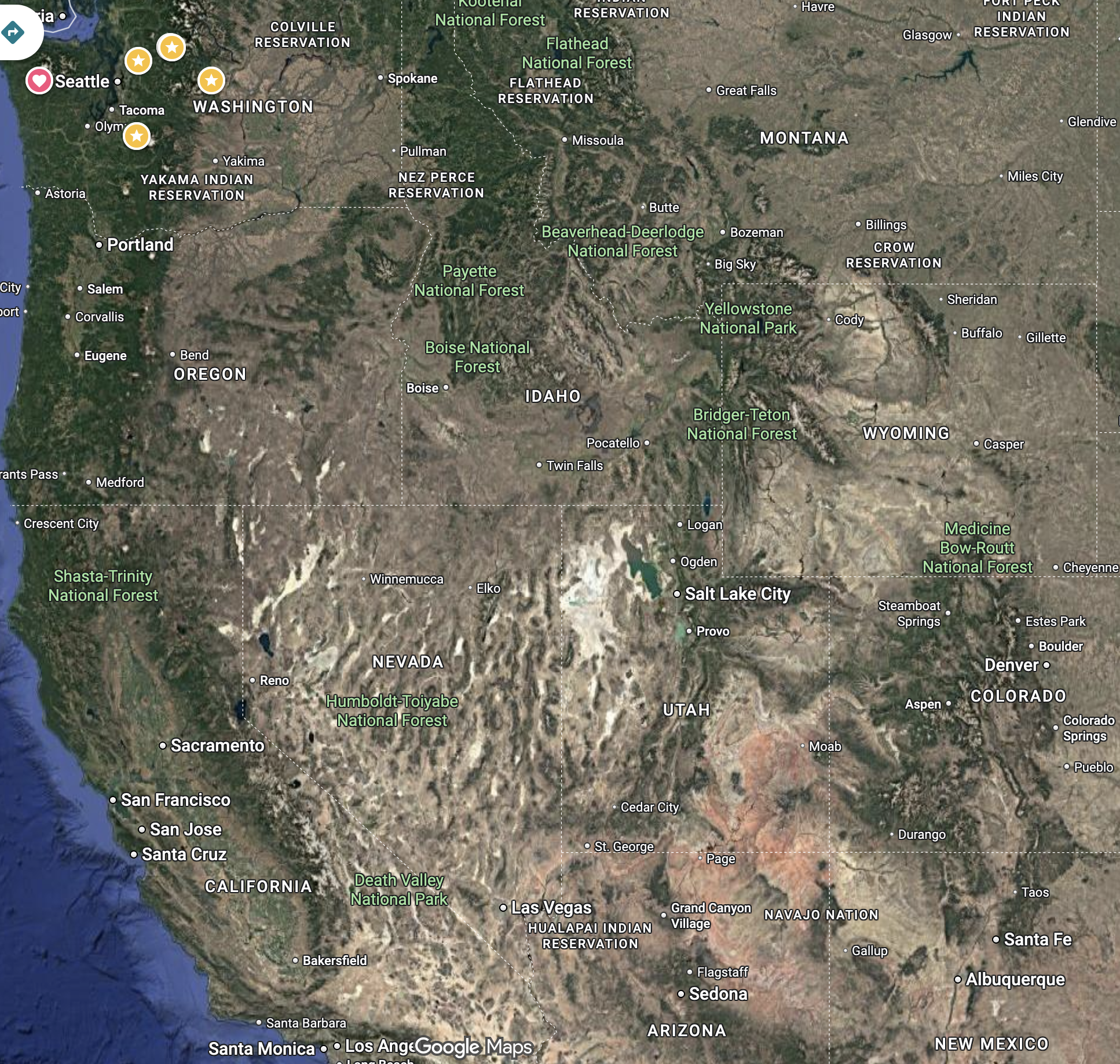
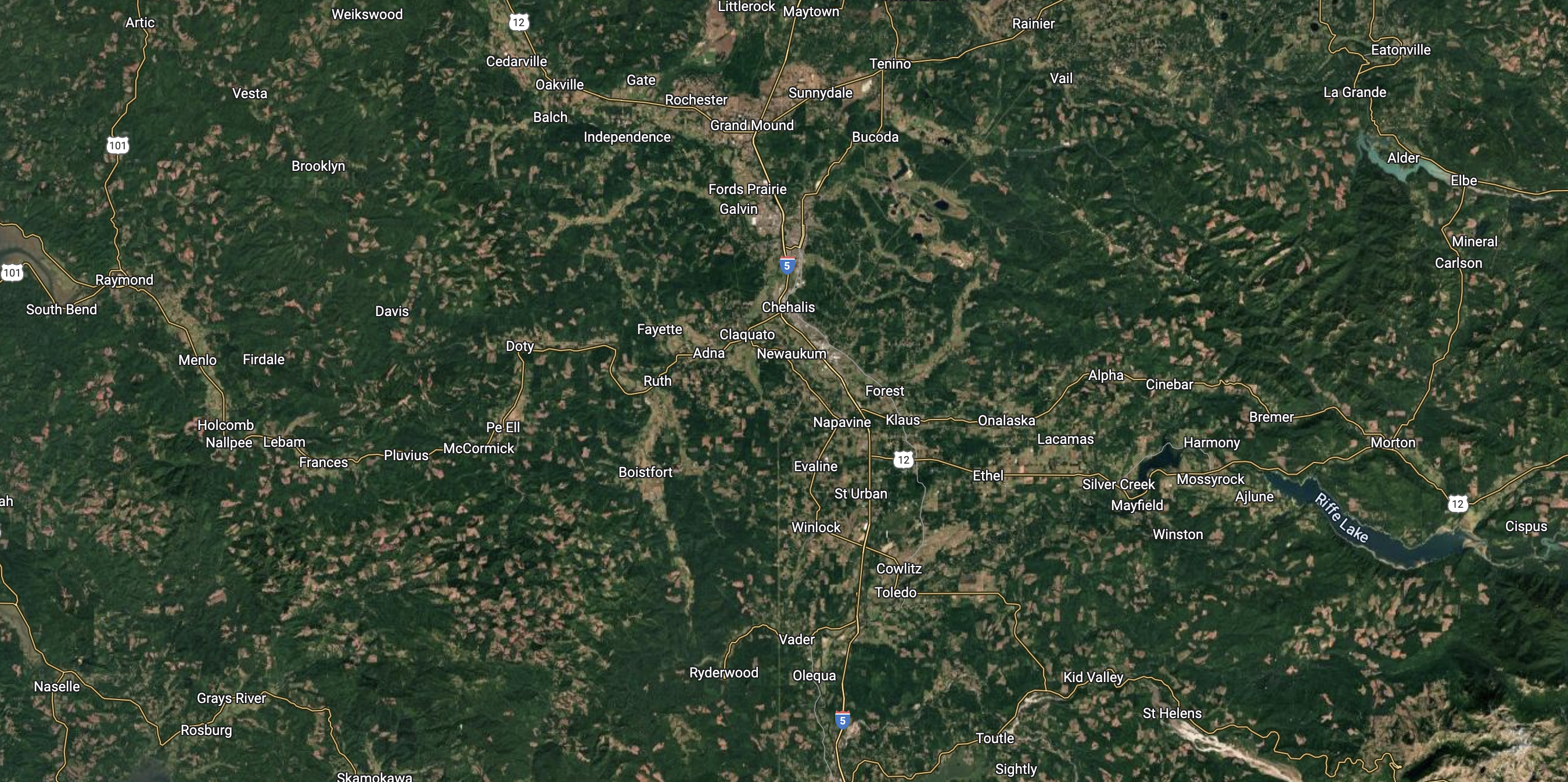
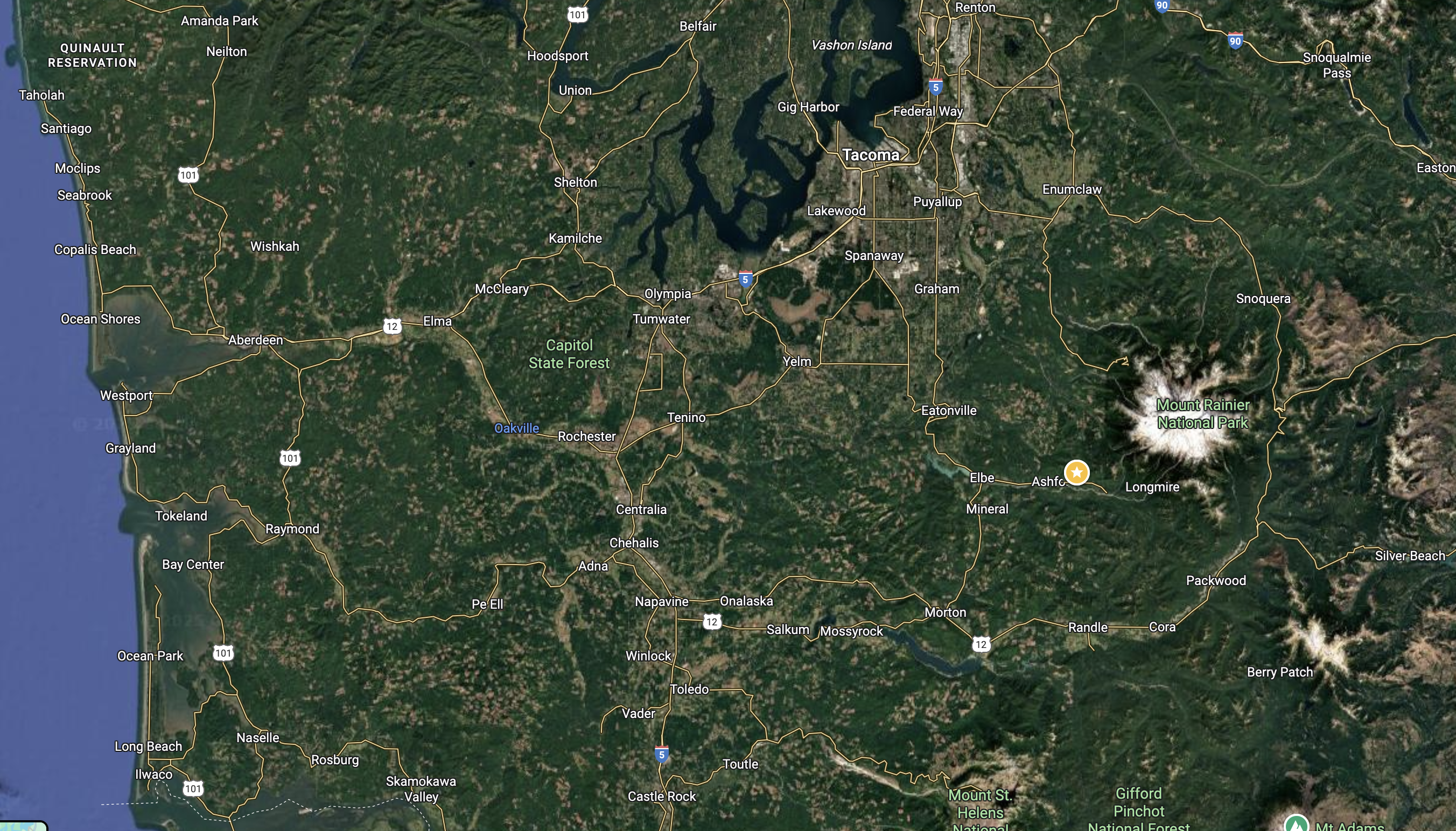
I’ve never been in one of those stores, and hope you all stop going if you can, because the belief in bulk super stores as non-invasive to the planet’s destruction is long gone. I’m still shopping at COSTCO- it’s local. Ha! Just be aware that nothing is cheap- it’s just out of site, at the other end where I’m standing in clear cuts that stretch up and down ridge-lines just at the edge of sight. You can see the cities that are consuming, just at the horizon. Sprawl has eaten away at the forests from Puget Sound to The Issaquah Highlands. The map below is a great example of the edges of wilderness continually pushed back to make room for more human development. Washington state is the most populated state after California, with the least amount of land compared to its western counterparts. Seattle is the largest city, and it’s completely developed as a major metropolitan area, with tendrils grasping vital connection routs of trade and transport along I90- the only east west highway out of Western Washington. The city of Issaquah was bound by landscape, and even still, headed up into the hills to continue development. I’ve driven up onto the steep neighborhoods on the west side of town, and I would not want to be up there in the great earthquake that’s due any day now. The Highlands took a plateau of commercial timber land and made it into a heck of a development, doubling the city’s population in one swoop. Yay tax base! Woe traffic.

The little town of Snoqualmie had a similar problem, and didn’t want to build in the flood plane, so they went up on a ridge and plopped a whole new town which is still building sprawling apartment complexes and town houses. This is the west side of The Snoqualmie River, where more commercial timber lands lay. All of the old growth temperate rainforest is gone, and with the onset of poured concrete foundations and petroleum blacktop roads, won’t be growing back for centuries to come. In the map below I lay out my home in red, the tree farm where active timber harvesting is going on in pink, and the yellow area is fast developing what’s left of wilderness in the buffer between monumental urban concrete, and forest- not natural forest, but recognized tree production and our watershed.

That purple area holds Tolt Reservoir, Seattle’s drinking water. It’s also the water table replenishment for all the wells in the yellow area, including EEC Forest Stewardship. The tree farm uses herbicides to keep its young conifer plantations free of deciduous plants that might compete with the timber. Then, as the commercial forest matures, they thin the plantings and spread bio solids (treated sewage) to add nutrients to encourage the forest growth. Most of the biomass is taken out at each cutting- being the timber board feet sold for profit, and must be replaced to keep soil for more plantings. The historical 10,000 acre commercial tree farm has been in operation as a row cut plantation for 150 years. Only in the last 50, has chemical herbicide been used, along with GMO trees. In the last 20 years, biosolids have been added continuously- along with the heavy metals and prescription drugs that can’t be affordably removed from the city’s sewage. These treatments on the land will end up in our water, the soil, and us.

The transition zones between these areas is hard to see on the ground, but from satellite, you can see the high density development on the west, fade to agricultural centers in The Snoqualmie Valley, where Carnation and Fall City are, into commercial timber plantations, which are being harvested quite heavily in the higher elevations right now- look for the brown splotches far east along the reservoir at the top, and down through two main alpine lakes- Calligan and Hancock. The following pictures of clear cuts and groves is from the south part of that lineup- across from the ridge where the popular Mt. Si resides. The word “Junction” in the middle of both maps, is the heart of the tree farm. This is where the chemicals and sewage are being spread, and it will come down the hillsides and into our streams, rivers, and ocean shores. I don’t understand why we think there is any disconnect, but perhaps hard edges make us thing there is a separation.

The southern most part of the tree farm is a little less known to me, so I’ve taken some time to explore this tip of the forest, where the access road was recently taken out. There is still a way to drive around, but I wanted to take the walk in and enjoy a less accessible area of the plantation. It was cut up, yet there were still some groves left, mainly along wetland areas in the low spots, which should have larger setbacks, in my opinion, and I’ll explain why further on in this reflection. The logging roads are still open enough to make walking easy. So I hiked up the hillside from SLC Lake’s outflow and came over the ridge-line into what I knew would be a recently logged off section of the landscape. It’s always hard to get full pictures of the vast scale in these harvest terrains, but in the satellite image above, it’s the brown spot to the right of Ernie’s Grove. It’s almost the size of Old Town Snoqualmie. Three ridges are cleared, and I walked about two miles through it and still didn’t get to the far side. This is typical now in cutting method, and to their credit, the plantations get new trees in ASAP, then spray, then spray again before the saplings establish fully.

In this bottom panorama, everything behind me not in this photo (except the edges) is clearcut. Before us in the landscape is a recently replanted stand. The older trees below are on a small stream. They are second growth, and span about 50′, offering the bare minimum buffer of 25′ on each side of the year round water source. With only 25′ of forest on either side, the taller trees are left vulnerable to windfall, and so, the edges of all these buffers are usually lost in storms. I’ve seen it enough on this plantation to know it’s common knowledge, yet the buffers remain minimal and to not account for windfall enough. I went down into one of these buffers to mushroom hunt. Intact forest is the best place to find boletes, and I was hopeful some might be popping up in these buffer groves. I’m at about 3200′ of elevation, so the dominate tree planted in these forests is Noble Fir. Looking along streams and creeks is good, because you know there is a year round source of dampness for the mycology to thrive in. This lichen was also happening in the forest, and I was struck by the light pink something pinning off it. I believe it is in the family Icmadophilaceae.

Further on along the edge between the stream buffer and clearcut, I began to notice a familiar sight along the stark barren transition zone- a lot of trees were toppled over in the same direction on the edge of the small woods. When a whole forest of trees is cut, any left standing are suddenly vulnerable to the elements. Where a community of trees once stood together to bare the winds and rains, the cover is gone, and those left on the edge of nature’s fury cannot take the blustery winds and soft wet soil, saturated by runoff form the bare earth in the clear-cuts. This hearkens back to the earlier comment in this writing, where I think more buffer should be allocated. Wind-blow is a think in the timber industry, and can be accommodated for in cutting plans, but apparently, it does not matter in the stream buffer zones. Heck, the plantation can file for insurance claims with windfall, so why not encourage it? That’s what appears to be happening in our tree farm folks, so file that one away with the other “how to exploit local natural resources for profit”. Our wold banking group that wrote the referenced windfall article above really knows how to exploit our environment for money.

Why would the timber industry try to protect these buffer forests to keep the wild water clean and safe? Because people are not up there thinking about it, or seeing the destruction, so they get away with it. It may be just a few trees in the big picture, but it’s also our water, soil, and future survival. These “stewardship” practices are doing mother nature no favors. It’s about dollars and cents- which we can’t eat, drink, or breath. My photos don’t fully capture the destruction of windfall in this small stream buffer stand of trees. In another few decades, as we continue to lower the water table with our overuse of aquifers, the stream here will go seasonal, and the buffer zone will be eliminated, so these trees will get cut again in another generation, and no one will know or care that the stream is gone. We’ll still be buying cheap furniture and ordering more cardboard delivery packages with impunity. Hurray for same day delivery!

It difficult to write some times, with the writing already on the wall for all to see- if you look, but I’ll keep on observing, wandering, and embracing edge spaces in an attempts to be one witness in the woods. These are not pristine groves, or romantic old growth spots, but they are the edge right next to my home, where abusive industrial practices play out behind a thin green screen of forest products. You the consumer will keep on buying what you cannot trace back to the source, and the tree farm will keep offering jobs to low wage earners while plucking the last meat from the bones of our ecological home. More sewage and herbicides in everyone’s water. Just make sure you put your forests into legacy stewardship, for the future logging generations to come- machine operators, not lumberjacks- just so you know. It’s amazing to witness how much we want to romanticize some Paul Bunyan Americana. Good old boys slinging saws and axes, but it’s logging trucks and machine harvesters running rampant in our industrial forests today. The gravel roads are the legacy, and that’s where to find some good fungus, so let’s go!

While walking along the logging roads, especially on the more shaded parts, I saw some wood ear fungi, related to morel. This black specimen- a less common color in the fungal kingdom, is edible, but not choice. You’ll most likely encounter it on gravel roads around Western Washington, but I do have some fruiting up from a large leaf maple fall at EEC. Many cultures use this fungus medicinally. I just enjoy finding it on the trail and taking note of where flushes occur. Since it needs wood, I think bark and logs buried under the gravel roads host the mycelia. Substrates can be hard to sort, making some identification difficult. All mushrooms have required substrates to bloom, and knowing those habitat limitations helps with ID. Mushrooms thrive on the edges of decay, from leaves to rotting trees, these fungal fascinations break down harder chemical compounds, returning them to the soil for other vegetation to grow from. Without mushrooms, our forest floors would be deep in undigested organic matter, unable to release its minerals back into soil, thus, no new soil would be made, and plants would find it very difficult to grow.

As I continued along the edge of the road though the clear cuts, another familiar fungal friend was up and waving hello from the side lines. Clavarioid fungi look like corals, which, in these dense lichen, moss beds, and liverworts do look a lot like reefs. Their bright colors also add a splash in that sea of green. These mushrooms were blooming along the edge of the road cut, under the canopy skirt of fir trees. I believe these mushrooms also like a little light, and need edges where light can come through the trees, hitting the forest floor. Many corals are edible, but not considered a culinary must, so I usually leave them where I find them, appreciating the sculpture park vibe these unusually shaped beings offer in back country settings.

Regardless of what’s growing on in the soil, mushrooms will abound. They can break down diesel fuel, harmful bacteria, and even filter out unwanted heavy metals. Perhaps they can help in mitigating the sludge and chemicals spread through our woods, wetlands, and watersheds by industrial timber companies to scrape what’s left of our natural resources from the landscape. Mushrooms will thrive in most environments, even the polluted ones. But don’t think mushrooms are a cure all. Once they break down harmful chemicals, they store that material in their own flesh, and when that breaks down, the materials go back into the soil too. Unless to dig them out and remove them, the toxins are still where the mushroom fruited. Even if the chemicals are neutralized, they are still present, and, like many forever chemicals, they don’t go away.

If people wish to claim responsibility, which is most unusual, we could recognize these forever chemicals and try not to buy them, or produce them. But REI still sells gore-tex, so we’re still buying and releasing forever chemicals into our environment to keep dry. Oh, outdoor box store is having a sale- let’s go! I want matching rain pants, ok! These chemicals don’t just hurt nature- as though people were separate- it hurts us too. Here’s something to chew on- these forever chemicals are in the sewage, because they are in us, and the biosolids being spread in our forests, are also spread in our farmland. It’s a win win for chemical producers and food production- no wait. We the people are getting cancer! I wish RFK would focus on this for his health care reform, then we might get some where in making America healthy again. If our soils and water found in edge spaces, near our development and sprawl, are not cared for, the pollution we’re pumping out, will wash right back in to haunt us, like London’s Great Stink. With childhood vaccines on the wane, serious illness could soon be stalking our own quiet neighborhood streets, taking us back to the great times of cholera and measles. I’m not kidding- measles is in King County Washington in 2025.

We’ll let this edge crawling ladybird walk us out- there’s always a bright spot somewhere, and in this clear cut, I found a lone ladybird making its way up a second cut stump. This bright red glimmer on a grey deadpan view brought tidings of nature’s restorative way, reminding me that the natural world will recover from whatever out little monkey minds come up with, though we may not survive the evolution. Bugs, mushrooms, and the weather will persist, long after you and I return to the soil from whence we came. Gratitude to all the lessons in nature guiding us. May we have the time and patience to listen, observe, and take in the great world all around us. To the new growth, and old spoke of that wheel on fire rolling down the road.

Fall Deer Hunt 2026

Another year and another Fall Blacktail hunt here in Western Washington. I’d been scouting at The Snoqualmie Tree Farm for a few months and had all my sits picked out. Then, the first week of the three week season, I was at the farm overseeing the solar instillation, and could only get out for evening sits, which is not ideal, but hunting none the less. The first week was sunny, not a great atmosphere for hunting blacktail, because they love heavy rain, and prefer to bed down when the weather is nice. No surprise I saw nothing on my first two sits. By Thursday, the weather was preparing to change, and I was getting psyched up to hunt in the rain- at last. Then, on Wednesday evening, my neighbor texted me this picture of a nice buck in her yard, and darn if I didn’t see her text till it was too late that evening for a hunt. I asked if I could come by the next morning, and she and her husband said yes, so I planned on a hunt at first light Thursday morning.

It was cool and crisp out as I pulled up at the bottom gate of my generous neighbors’ land. Quietly, I took out my shotgun, shooting sticks, and put on my hunter orange vest. Camley, I hiked along the road, then turned up hill towards the gardens and open yard where the deer were said to be hanging out in morning and evening. As the raised garden beds came into view, so did this buck. He was standing there, as if waiting for a meeting, I was right on time. Taking a moment to walk past him and up the hill a bit, I knelt down slowly and raised the barrel of my gun onto the shooting sticks for support. The buck had not moved, so I took aim and breathed in my three grounding breaths. Then, I gently squeezed the trigger. BOOM

The deer took a few stiff steps and turned to broad side from the other direction at me. I shifted over to where I could realign with his movement and took aim again, just to make sure he would go down. I then fired a second shot, because I could not see if my first shot (on the other side) was enough. If the deer is still standing after your first shot, and you can get a second one in, do. I’m glad I did, because the second shot sent him bounding a few steps, then down in the field. With relief, I slowly cleared the chamber of the used cartridge and made sure my gun was fully unloaded. Picking up the spent round, I looked for the other one, but could not find it in the moment. My eyes went back to the deer, who was still down, but more active than I would have liked. One of the neighbors came out to join me, we watched together as the buck continued to raise his head, so I stepped a little closer to get a clear head shot in to end any suffering.

That was my mistake- I came in from behind, and that triggered the deer to get up and run. I was not thinking the deer had this in him, as I’d shot twice with slugs and that should have been enough to keep him down. My assumptions were far from what was actually happening. As the deer rose up to run, I made out my second shot, which had been aimed just behind the shoulder, in the middle of its chest for a double lung target. Well, I was shooting down a steep slope, and had forgotten to raise the barrel a little more to compensate for the angle. When I sight in my guns, I shoot level. I’ve not had any range practice on angles, and am now sure I need to set up some from above and below targets to work on my aim. The buck was gut shot, the last thing you want as a hunter. I was appalled at my bad aim, but pressed to make sure I tracked the animal and didn’t loose him.

Another mistake. It’s never good to chase a wounded animal. They are looking for nearby thick cover to go into for relief. I was worried I’d loose track of him if I could not see him, so I began trailing too close, thus pushing him further into the woods and away from easy access. It’s a common mistake made by armature hunters who don’t want to loose their deer. But it’s counter to what should be done. After pushing the buck up from his lay twice, I suddenly realized what I was doing and backed off. I used OnX to mark where I was and the direction I had last seen the buck going. Then I left the area, leaving my deer to his painful, slow death. It was hard, I cried at my bad shot and poor acruacy, and knew the animal was in pain and scared, but I could not chase him. If the deer left the property, I would have to track down neighboring land owners to ask permission to go in to get my deer. If I left him alone, he would bed down and stay put, allowing me to come back and trail him later.

I spent the day mushroom hunting with a friend, then talked extensively with two of my hunting mentors, who encouraged me to wait at least 5 hours before going back to trail him. That afternoon, I returned to the woods where I had last seen the buck. I had my gun, in case he was still alive, and I had my focus, I was determined to find a blood trail, then track down my animal to retrieve the meat. I’ve never had to trail a deer I’ve shot, because I’ve never had a gut shot before, but most hunters will encounter this at least once in their hunting career. Any ethical hunter will do whatever they can to get the animal back- within legal guidelines. You can’t trespass to get your deer. If it does go onto property you don’t have permission to hunt, and you can’t get the owner on the phone, you have to report your loss to a game warden and hope they can get permission to go onto the private land to retrieve the animal for you- if they have time. The other ethical thing to do as a hunter, if notch the tag, even if you don’t find the meat. I did so, knowing I had shot my deer for the season, and taking responsibility for my actions. Still, there was a good chance I would find him, so I continued my hunt.

This is the screen shot of where I was when I left the deer in the field, and the direction it was heading. I returned to the spot and began looking for any sign- especially blood drops on the ground. Weaving around the area, I became a little confused by all the game trails and recent deer tracks all around. I wondered if my buck was still on the property, but focused in on the trailing and soon, found a fresh blood trail. It was light, only pea sized drops here and there. My mind went into a primitive place, ancestral and raw- I could only think in single words: “blood” “no blood”. That was my mantra. A red drop on yellow leaf, two more on a stick, pointing the way. As I trailed, I also began to see the dragging tracks of the buck, willing himself over logs and through thick brush. I kept following the trail, loosing the blood droplets, doubling back, starting again from the last sign, moving forward. Every once in a while I would look up and around to see where I was. It felt like I was moving vast distances until I referenced some small groves of evergreen trees I’d made a landmark out of. I was only about 30 feet from where I had marked the map. OnX was priceless in keeping me informed about the property lines and where I was. Still in bounds of the property where I had permission, I kept on trailing.

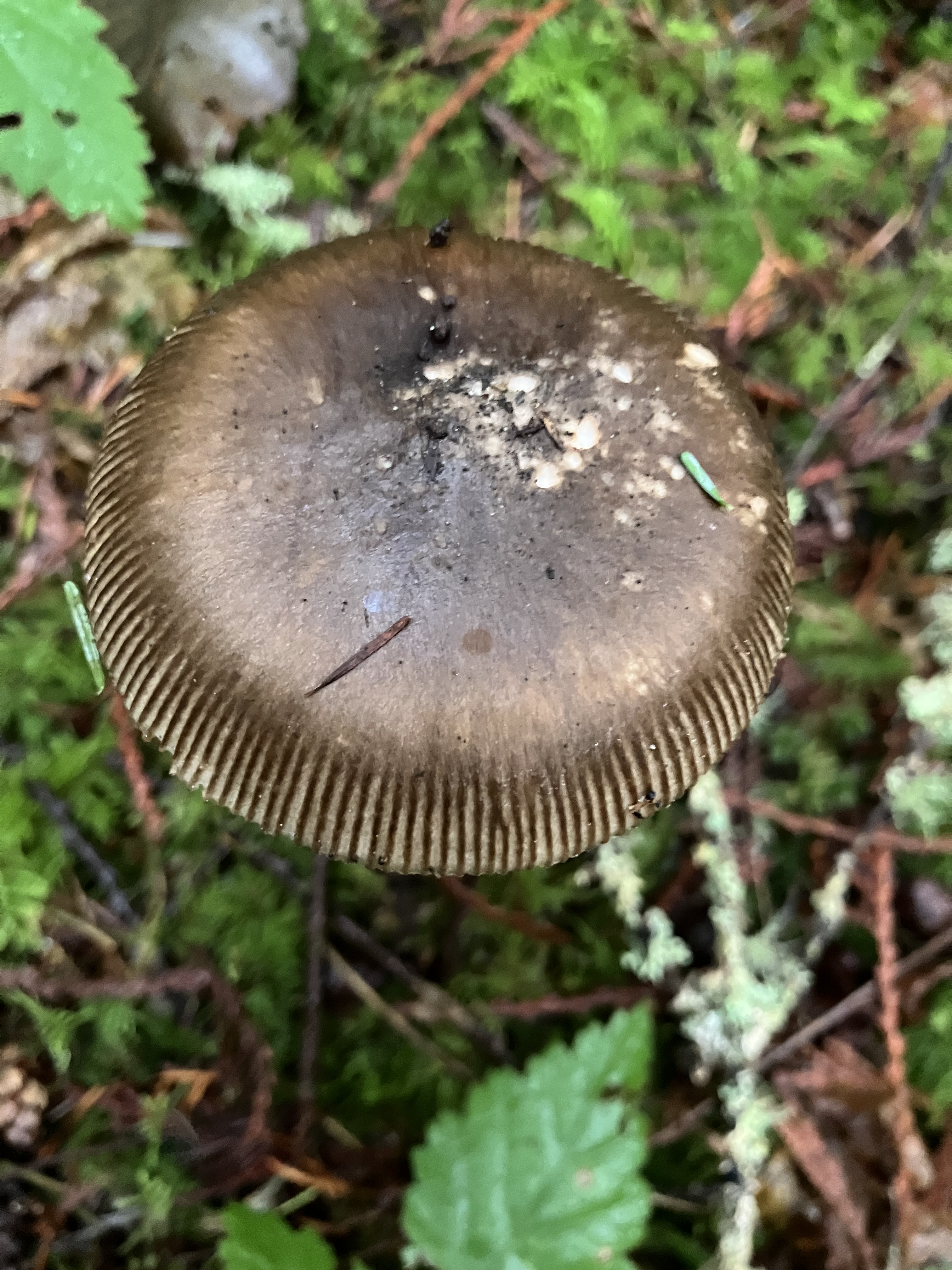
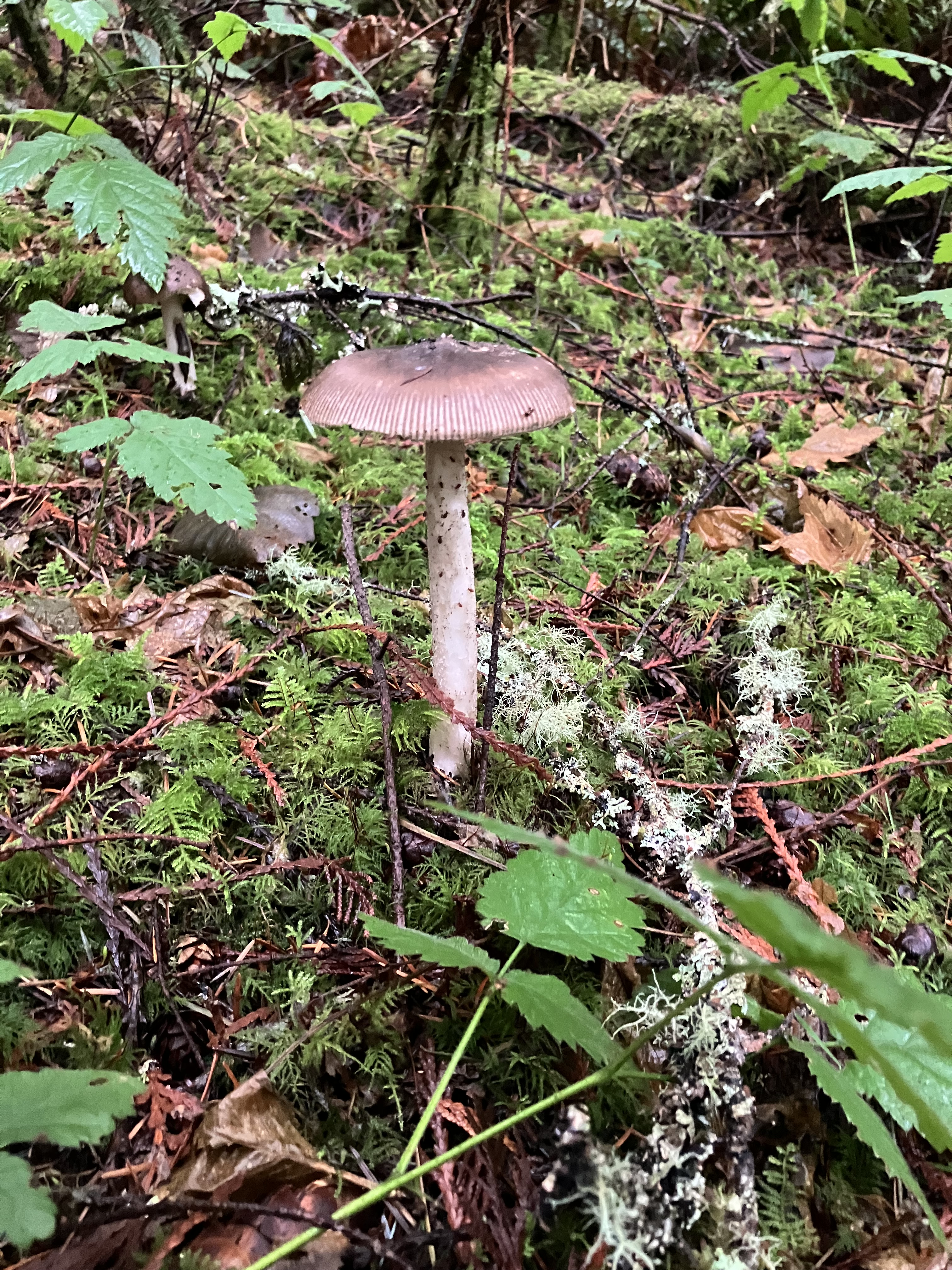
At one point, some mushrooms tried to distract me. The trail did go right through them, and I stopped to take one picture before continuing on the trail. These amanitas were the size of dinner plates, and there were many of them, it was a sight, but I had to stay focused on my deer and finding its body. No mushrooms, only blood, drops of blood that were sometimes bright red crimson, and sometimes the dull dry color of rust. Then I came upon a scattering of red berries, the same size as my blood trail, that was a strain to sort out, but I found the dragging tracks and soon, another blood droplet to confirm I was on the right path. Coming to another clearing, I heard some flies, then I took a deep breath. I could smell the intestine bile, the buck was close. Another few steps and sweeping view lead my eye to him. He was laying in the brush, dead. I was thankful I did not have to shoot him again. As i approached the carcass, I saw that he had not thrashed in place, he had fallen and gone still. It had not been a long, drawn out death as I had worried, but the gut shot was plain to see, and as I began gutting in the field, I observed that the shot had grazed the liver, thus speeding up his death, which I was thankful for.

I also took a moment to check where I was, doubling down on remaining legal in my search. I could not believe where the OnX showed the deer had gone down. It was very close to where I had marked my initial spot on the map, but the trail had wound all over before coming to its end. Luckily, there had been a blood trail, or I would have been searching for a lot longer. There was some pride in my trailing, but mostly the haunting knowledge that I had taken a bad shot, which led to an animal suffering. This is always a risk in harvesting an animal, and should not be taken lightly. The agony of waiting had been some punishment, but I did find the deer, and I was relived I’d not wasted the animal. That was some consolation, and that my neighbors, who had been so generous in allowing me to hunt their land, understood what had happened and were not angry with me. They were so glad I found the buck, and helped me drag him back out of the woods. That teamwork was also priceless. I reflected that people helping other people harvest food was what built tribal connection in our distant past. They also asked for the hide, and some ground venison when I butcher. Its a pleasure to give back, and thank them with free labor and farm sitting support. Access to private land for hunting is a rare gift. I am so grateful my neighbors are supportive and understanding.

Blacktail deer are mysterious forest animals, who live in small territories they do not migrate from. This buck was born here, lived off this land, and probably ate off my fruit trees more than once. In the cycle of birth and death, his time has come, and he will feed me and many others. Then I too will one day return to this earth, and my body will become the land once more, helping to grow vegetation to feed future generations of deer in return. This is that great circle of life we sometimes talk or sing about. When I first found the buck, I sat with him and gave thanks, thanks for a safe hunt, thanks for his gift of food. Gratitude for his staying on the land where I had permission, and letting me find him. The blood trail had started where I marked the map, so I am glad I trailed him to that spot, though I would not push an injured animal like that again. Everything ended up working out, but I learned a lot of new lessons, even after 10 years of hunting, I still have a lot to learn. Thanks to all who helped in this hunt, from my mentors and their encouragement, to the neighbors who support my harvest, to the deer nation allowing me to take another for my survival. May this sacred relationship between hunter and the deer people continue with honor, and ethical guidance. I will work on my aim on slopes, and take a little more time in lining up my shot before pulling the trigger.

Above left is where I left off tracking the buck in the morning, and above right is where I found my buck that afternoon. Amazing how vast spaces feel when you loose something in them. Thankfully, the deer stayed close, and I chose the right path in leaving him time and space to die. It will be a strong memory in my hunting experience, and an important lesson to carry in future hunting opportunities. I cannot stress enough how important it is to follow through with your shot and find the deer you harvest. Though I only had to search for about an hour, I would not have stopped, except to sleep, and been right back out the next day. One of my mentors said he trailed a gut shot doe for two whole days before tracking her down. She was still alive, and made a final effort to escape, crossing a broad river before dropping into the rushes on the other side. My mentor went back to his car, called the land owner, and drove around to the other side to retrieve her. Experiences like this remind us to take time in lining up our shots, not to rush, and to follow through on our commitment to these animals, and honoring them.

Alpine Transition

Up in the clouds again, enjoying the seasonal changes that signal Fall is here. I took my rifle to scout an area I’ve come to a few times, where bear sign is heavy. I tracked a few trails the bears left through the brush, and saw a few fresh tracks, but no bears manifested, but that’s OK, because it’s all about being outside and in the beautiful light of what is affectionately called the “cocktail hour” in Western Washington. At the end of the day, as the sun sinks towards the horizon, it often breaks through under the cloud line, sending radiant light across the landscape, almost like an alpenglow. The magic of this breif but spectacular light show is greatly appriciated at elevation, where I can look across the tips of each peak and turn to look down into The Snoqualmie Valley, and beyond to Seattle, and the Olympics far beyond that on the peninsula, where our state boarders The Pacific Ocean. The splendor of this evening time cloaks everything in warm light, and I enjoyed hiking back out of the back country in the setting sun.

Do you see those mushrooms growing out of the end of that floating log on SMC Lake? That’s a Chicken of The Woods cluster of wonderful culinary mushrooms, which were just past ripening, meaning the mushroom would be very woody to eat by now, so I happily left it to bask in decompisitional glory. You never know where you might find a mushroom around here- especially in the mushroom spring of our forests and fields- in this case, a floating log on the water presented a flush on this still lakeside paradise.

As I continued my hike out, the golden hour fell upon the far shore of Lake Nadeau, the middle lake in my favorite trinity of waters up in the high country. The clouds had really dropped down along the peaks, caressing the ridge line above, enhancing the bright light bursting across the peaks as the sun began to set her course back to the horizon’s edge. A breeze was rippling the surface, obscuring the light’s reflection, but the exquisite color lifted my spirits as it danced across the alpine spruce hillside and red flame of the vine maple along the scree strewn slopes. I was mesmerized by every color with a backdrop of grey granite and black basalt. Quickening my pace to make it back to the truck in time to catch the sunset to the far west, I hoped to catch the red and orange of sunset, setting the mountains ablaze.

Sunset lit up the ridges as I made it back to the truck. Unloading my firearm and picking up an extra layer and my water bottle, I headed to an overlook to see the show. Below me spread the river valley, city beyond with skyline reflecting the glow of sunset, and The Olympic mountains beyond. The sun was setting over Rattle Snake Ridge, across The Snoqualmie Valley. I90 runs below too, and I could hear evening commuter traffic crescendo with the evening light. In a final moment, light drowned out sound as the last rays of our great gas giant stretched out from the dark peak, seemingly consuming the sun into the mountain’s own shadow self; silhouettes on the skyline, consuming the light, dispelling the warm colors with colder blue and purple of billowing clouds beyond.

Witnessing this transition is a rare and precious part of getting into The Cascades. This October has been cold, but sunny on many days this Fall. I appreciate the opportunity to see these transitions as the light shortens towards winter’s long nights. This seasonal change is also signaled in the forest’s own changing color, and the shed of leaves, which will not come into full drop until mid-November. Many of the lowland alders are still green, and will most likely shrivle to brown and fall without much show. Cotton woods are dropping early, golden points across the landscape here at EEC Forest Stewardship. The climaxing fall foliage right now is maple- vine and big leaf. They show red and gold respectfully, and pop in the evergreen forests of The Puget Sound Lowlands. Up in the mountains, vine maple has been red for a while, and will soon drop it’s crimson cloak to shivering bare branches in winter’s approaching grasp. Snow will dust the peaks before long, and my next visit to this place will be in snow shoes. Gratitude for the mountains, colors of the plants, and tracks of the animals. May we all have a chance to wander in such wilderness, with appreciation for the evening light and seasonal transitions.

Solar Power comes to EEC Forest Stewardship

We’re catching some rays- in a very real way, at EEC Forest Stewardship. For a decade now, the vision of green power has been in the planning, and at last, a system is built. Northwest Electric and Solar constructed the large array in the perfect location for sun activity- as pictured above, this sun trap, south facing, highest point on the landscape, was clocking 14.9kW at the time of this photo in late October, 2026. That’s about the equivalent of a home generator’s capacity. This array is larger than our current capacity, so we can still get enough on cloudy days to cover our load. Since we’re tied into the grid, our extra production goes back to the grid, and we get credited for our production to lower our energy costs, or negate them all together. This scale will also accommodate future demand, as prices rise and infrastructure upgrades. Leafhopper Farm could one day power an autoclave for mushroom production, or passive heat to a scaled up commercial meal worm operation. Possibilities are endless with a green energy source like this.

Now, there was a lot of mining that went into this boost to the green energy wash. In the short term, solar panels are built from mined materials and rare earth. Long term, they will continue to produce energy cleanly once in use. No more carbon will be burned for the next 20 years. That’s the limited warranty, the panels will harvest for the rest of my lifetime; by then, we’ll see where the world is with climate change and technology. The science is in on solar panels being a successful way to curb carbon consumption and CO2 release. I’m making enough power with this system to also offset some of my neighbor’s needs, thus extending the impact of clean energy in my neighborhood. At the same time, solar panel demand far outpaces production in the US, where these panels are made, in Washington State, in Bellingham. That’s a big part of why I went with Northwest Electric and Solar; they source their materials in state, right up the road. It’s not perfect, I’m sure most of the parts are coming down from Canada, where mining laws are much more lenient and international Canadian owned and run mines are importing the minerals to supply the manufacturers up north. I’m also aware that the technology my chosen installer uses is TESLA, but it’s the best technology out there today, hands down.

Our first task was to dig and set the footings, because this system is ground mounted. I opted for this setup because our current infrastructure is not capable of carrying the panels safely, and the scale I was looking for required a lot of space, and we have that in a prime spot, so I took advantage of my fabulous south facing top field for instillation. The dig crew carved out 24 footings, each one 6′ down. After years of drought, the layers of sediment were dry for most of the dig- only one low spot was damp at the bottom, the rest was quite dry and easy to dig. We did encounter 3 wheelbarrow sized glacial erratic boulders, but quickly lined them up along the road as a buffer to the solar system on the turn of the driveway. I love featuring glacial boulders where I can to remind us all of what shaped this ridge and the valley below. Most of the dig went smoothly, and a slight hiccups in measurement communication did nothing to hinder the overall build.

After the digger left on Sunday evening, I had a better comprehension of how big this project would be, at least the ground layout. It would be on Monday, that construction would begin on the main aluminum frame to hold the panels in each of two arrays. The team showed up predawn, at 7am to start constructing the scaffolding to hold up the structure. For two days the crew hammered, measured, drilled, and set framing. They worked efficiently, diligently, and to the specs with familiar ease. I appreciated the talent and smart planning the electricians put into construction. Though much of the technical jabber was far beyond my understanding, the crew happily explained things as they went, checking in with me on progress and planning as they went. I was welcomed on site, and happily made lunch each day for everyone. This important investment means a lot to me, and the farm, so being present to learn, document, and be available to the work crew as support ensured my own understanding of the project, face to face relationship with my amazing team, and kept me up to date on progress. Overall the instillation went quite smoothly, and my on site team was wonderful to work with.

After the first few days of on site work, I began to see the full width and breadth of this project, and marveled at what was going to be accomplished. This system would be much larger than my original concept of a solar panel setup from a decade ago. I had pushed for the scale up, to cover much of the properties future needs in one package. I will put hot water solar and a few electrical panels on the pole barn when that upgrade comes, but having a grid connected long term system with aggregation to both meters became the smart design for future planning. I can always add more, and go off grid with a proper battery system. Today, it’s about keeping my overall electrical costs down while returning excess to the grid. The system will produce enough power, even in winter to keep up with the property’s needs and a little extra to give back. We do get credited for the extra power, in case we draw more in winter then we produce. But with the scale of this design we should have what we need during daylight hours.

Why not batteries? The technology needs to get better. There will be storage built in when the designs are optimal, I still see room for great improvement before batteries become a household staple- especially in recycling once they age out. This brings us back to the green wash that comes with solar idealism. Manufacturing these renewable energy sources still costs us environmentally, and the panels will leech, very minuscule amounts, of input materials from the panels themselves, into the soil here. This build is all inputs from outside the land- not holistic at all, but the science still supports this alternative energy in the long run, and I’m already seeing my returns. So much energy comes from the sun, it makes all life on earth grown and thrive. If we turn to this natural source of power, along with wind, we can make a huge difference on our block, one source at a time. As the system continues it’s collecting, I’ll have firm figures to share regarding the payout on this long term investment in something we’re sure to need.

The first set of panels came at the end of week 1. Seeing them mounted gave me such joy. This is the future, and more home owners should be looking into taking this investment and upgrade seriously. As I watched the shade spot grow behind the array, I wondered what king of plantings I’d be experimenting with to replace the pasture in this location. Sheep will still be able to graze around the arrays, but the shade would demand a shift form full sun to full shade. Luckily, a lot of native Pacific Northwest plants prefer full shade, so filling in the soil with proper cover crop will not be hard. I might even use the structure to form shelter- and rain catchment for sure. Because the arrays are neighboring the pillow tank, runoff can be caught and stored in the tank for future irrigation down slope. I will first have to test the runoff, to make sure it’s safe to use- this is the thinking we often forget with petroleum products and heavy metals often used in solar panel production. Unless the panel breaks open, this should not be an issue.

There is still a lot of learning to come. After this new build settles in, I’ll have a lot of fun figuring out best use of the space, optimal growing, and water directing. Luckily, the rain is about the arrive, and I’ll have many months through 2026 to learn what comes next. So much gratitude to my team of electricians and apprentices who worked for 2 1/2 weeks to complete this instillation. Gratitude to the science and intention moving us closer to a better, cleaner energy use culture and way from fossil fuels. Special thanks to the sun, that life giving energy source that has raised countless generations of life on this earth while keeping enough distance not to cook us- yet. An so much good solar power to this home, business, and surrounding neighbors.

Wilderness Wanders

Back in the high country again for the last few days of autumn. Soon snow will blanket these mountains, freezing the alpine lakes, and signaling dormancy for the living world there. The leaves are changing, cooler temperatures and shortening daylight hours calls the quaking life of these mountain forests into final flushed of berries, mushrooms, and wildlife scrambling to harvest the last bounty. I started this adventure at 3,500′, and quickly climbed to 4,000′, where I began combing through the spruce groves for mushrooms. There were pika calling from the rock scree on the hillsides, and recent bear sign on the trail. I began trailing deer tracks up a steep bank from the lake shore, hoping the rout would navigate through the often thick overgrowth of blueberry, salmon berry, serviceberry, and huckleberry shrubs. As I slipped through the foliage, I came upon a surprising species at this elevation. A fat, sluggish guarder snake was moving into a nice sun patch on the forest floor ahead of me.

The snake was one of the biggest specimens I’ve ever seen. So healthy and confidant on the needle strewn forest floor. I pictured this snake borrowing down into the thick duff, slipping deep underground beneath the mountain craigs, through the cracks in the rocks, down into hibernation deep underground, avoiding the winter weather that would otherwise freeze the snake in its slither. Though the day was warm and sunny, much of the vegitation in this area is shaded by taller trees and towering peaks. My hike was a wet one, with my jeans getting soaked, then. after some time standing in the sunlight, drying out again so I could keep exploring without getting cold. Below is a picture of blueberry bushes covered in heavy dew drops right on the trail. This part of the hike was a little overgrown, but flanked by gentle bushes without spikes or spines, making it east to slide through the overgrowth without issue.

The adventure of being outside creates a lot of learning and new unknowns. I hopped around steep slopes on the ridges and peaks of this alpine landscape, finding new trails to shortcut from lake to lake in this trilogy of water features. I was not traversing long distances, but I was hauling myself up and down inclines that I’d prefer to be skiing, if not for a lack of snow and the beautiful thick spruce forest. The cold weather has made swimming in these lakes a little too chilly now, even with a wet suit. I did enjoy gazing into the crystal clear water, studying the reflections of white granite sand on the bottom of Lake Moolock. Rivulets on the lake bottom elude to the sometimes turbulent winds that howl down out of the sky and into these low points where churning waves wash across the lake’s surface and crash onto the shore. Today, the waters are calm, allowing this deeper look into the lake’s composition form shore.

The turquoise water sheltered soft basalt stones and small boulders, making up most of the landscape in these slowly eroding young peaks of geologic uplift. Earlier on my hike, I had observed a similar, though much smaller water feature with white granite and a collection of small pebbles. As always, nature patterns itself in all sizes, offering some order in seeming chaos. Within these two photos, there are strong echos of recent geologic activity, and water, a thing The Cascades are known for. Yeah- the name comes from all the water cascading down the slopes of these temperate rainforest mountains. Lush mosses, large evergreen trees, and wonderful mushrooms everywhere as Fall takes hold.

Val and I continued along the shore of Lake Moolock. I was scouting the best way into the woods from the clearer shoreline. Soon, Valley caught a scent and headed into the woods. I followed, finding a nice game trail with enough space to squeeze in between the thick brush and low branches of the sub-alpine spruce dominate forest. The daylight does not linger as we get closer to winter. I watched my time, the shadows on the trees, and how the afternoon felt. My legs were starting to shake a little when I took steep inclines, so I began heading back towards the car, still wandering through the forest looking for a few mushrooms. Leaves change fast, and many are stripped from their branches when the autumn winds pick up at elevation. Still, the color of Fall comes to Washington, it’s just not as well known as The East Coast. There are wet years when the leaves shrivel and drop in the soaking rains, but this year, the landscape was painted red, yellow, and orange as mainly maples display their pageantry.

Under the thick Spruce canopy, less color abounds, which can make mushroom hunting a little easier, but certainly makes the longer shadows of late afternoon loom. I began to feel a little chill in the air, a signal that evening would soon be settling in these mountains. The rout back to the trail was new to me, but straight forward. I could pop my head out of the forest to get my baring, and sometimes it was a surprise to see how close to the water I still was. Scrambling over a fallen old growth tree, I spotted some mycological activity and dove in, a little distracted by the potential feast from the forest floor. From this modest harvest, I gave thanks for the wild food, and scrambled on down the hillside back towards the trail. Having been in this area many times, I’ve got a good mental map of the space in my head, and though I had not been on that hillside before, I knew the base of it would bring me back to the original path I’d followed in. Having good mental maps is crucial to wandering around in the wilds successfully. Always know where you are going and tell someone else too. If you give poor direction as to where you will be, expect poor response and slow rescuing if you do get lost.

The clouds were building up in the south as I made it back onto the trail, rain was not expected in the lowlands, but high country could turn wicked quickly, and I knew it was time to make my exit. My legs were also getting rubbery, which is a nice way of the body to say “all done”. At this point in the adventure, one might feel pushed to cover more ground and ignore signs that suggest ending soon. I’m not always surprised to hear of people getting lost or stuck because they pushed a little too far, or did not heed their own warnings that it’s time to go. I’ve been there, and been caught in some hairy situations due to poor planning or lack of understanding the lay of the land. On this day, like most, I heeded my own body, the time of day, and the incoming weather and made it back to my truck without incident. I chose not to check a couple of more spots I had been eyeing for mushrooms on this trip. There would be another oppertunity to see more, even if it waited for another year. The great thing about these mountains, is that they will always be here- at least for my lifetime- I think.

On the way out, I took a closer look at an old bear scat I’d seen coming in. The bear had been eating cherries and blackberries- I could tell by the seeds in the poop. Then I looked closer and notices another animal had been gleaning seeds from the scat pile. Three little bird poops lay in the middle of the bear’s excrement. I was not sure what kind of bird, but it was smaller, not a grouse- maybe a jay? Yet another nature mystery for me to ponder, I love these moments of not knowing, questing further into my field guides and studying the images I capture in the field to decipher the mysteries, or not. I have not discovered this feathered friend by it’s droppings, but I now know birds will go through bear poo to find leftovers. It might have even been picking the bugs out too. I’ve seen them to that with horse poop, so why not bear? The next way to find out would be to find a fresh scat of a bear and sit nearby to observe. Our best option to learn from nature is to sit with it and observe. I find sitting for too long a little challenging (unless I’m sitting for a hunt). My wilderness wandering is a little more active observing, and I miss a lot because I am constantly on the move, but I see a lot of terrain, and come upon endless nature mysteries to ponder later on.

So much gratitude for the wild places, having access to them, and sharing them with you, dear reader. May we all find time outside!