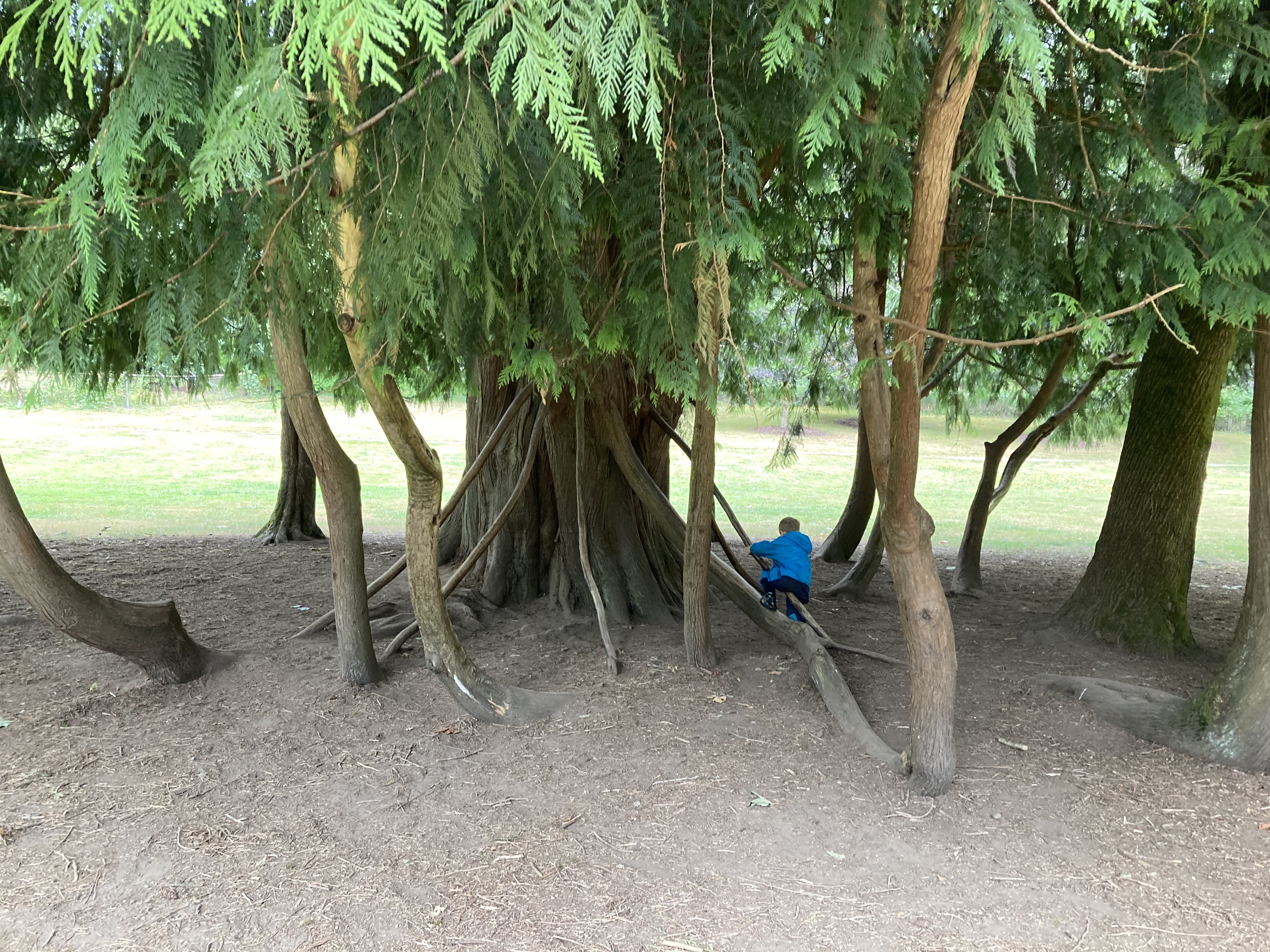
Red Cedars are capable of great feats in adaption to survive. They are often leaning out, way over the rivers and creeks throughout Western Washington, spreading their branches to lend shade to the waters, keeping the temperatures cool for the fish and other aquatic life. When a landslide occurs, cedars thrown sideways downhill will re-root in whatever position they find themselves in, sending out a new crown lead if things go topsy-tervey. Often, when a tree falls over, it becomes a nurse log for other young vegetation. When left to grow upward and stretch existing branches, the skirt of the tree will bend down to the ground and re-root over time. It’s rare to recognize this action in nature, because most of the red cedars were cut one-hundred years ago, and the younger sapling trees around them- the branches that re-rooted, were cut like any other trees in the stand. You have to find protected areas like old homesteads that became county parks.
The picture above is a wonderful example of branches re-rooting and becoming braces for the existing tree, and establishing more stability and nutrient sharing. The smaller branches go into the ground at the curve of the “J” and with the continued replenishment of topsoil on the original homestead where this tree is located, the branches rooted and became maturing trees, growing much larger from their new rooted bases. For this kind of low branch development to happen, the cedar must also grow in an open area, where light is available all the way to the base of the tree. Mature old-growth forest offers little direct light to the ground, and the usual growth patterns of trees within a woodland look more like the following diagram.
It’s always humbling to think Western Red Cedars would grow for thousands of years if left to do so. The lone field cedars with rooted branches, will need the added support standing alone in a field. I’ve also seen branches at 90 degree angles off a tree near the base in thicker woodlands, perhaps where a patch of sunlight did filter through, and the cedar stretched towards it in desperate competition. Up is always the best direction to grow in a forest, and the outstretched branch turns up to follow the light. Even the candelabra shape of ancient trees shows a continued push ever upwards. I’d also like to point out this tree’s preferred habitat in or near wetlands and in flood planes where open edges of water invite the cedar ample space to extend branches into open sky.
At EEC Forest Stewardship, many of our cedars retain a skirt with j branches arching towards the earth. They set a goal in forest duff creation to raise our topsoil regeneration level until these lowest branches are buried and rooting out. This vision is worthy of generational scope, and will take tons of vegetative input to achieve. Starting with layers of moss, twigs and branches, as well as ground-cover plantings mentioned earlier, we aim to recover lost mulch and debris which a healthy forest needs. It’s a grand plan, and I’m sure we’ll have some great examples later this fall as we work to replant the understory. In the mean time, keep a sharp lookout for rooted branches in your own neighborhood or local park. Many species do this, so take note of forest shape, location, and history.
Washington State is truly one of the most diverse bioregions I’ve ever had the pleasure to call home. It’s why I’ve chosen to live here, especially living that life outside for most of work and play. Usually, that outside time is terrestrial, with a few special trips to the western coast or eastern step desert. EEC Forest Stewardship resides in Western Washington’s temperate rainforests, with coniferous dominate stands and alder/maple on the edges. There is an abundant aquatic mix of freshwater ponds and alpine lakes cascading out of the mountains, feeding salmon streams and rivers spilling into saltwater slews of Puget Sound. If you then go a little bit further west, past another great rainforest and towering Olympic Mountains, you’ll reach another shore and, facing west at the edge of North America, you’ll behold The Pacific Ocean.
This vast waterscape holds many great bounties, including crabs, ,oysters, salmon, and mussels near shore. Going further into open ocean takes some expertise and seasick prevention medication. For a very landlocked human, like myself, it was a real edge experience, but to catch tuna for the larder, you have to go our to sea.
Waves rolled our 29′ sport offshore pilothouse vessel neatly over 8′ swells, though bracing against something was necessary, especially when the boat was moving. This footage was taken at trolling speed in deep water. Closer to shore, conditions were shallow and choppy, but we traveled rapidly over the rough water, and our diligent captain knew when to slow down or change angle of approach on the larger waves. It took 2 hours of relatively fast going from the harbor to tuna fishing grounds. Once out, our crew put the boat on auto pilot, dropped in three trolling rods, and began spotting the horizon for terns, and surfacing albacore on the hunt.
We used live sardines as bait, and hooked them behind the gill up through the side. The tuna wanted live, active prey, so the sardine had to swim fast through the water on the line. Reeling out was one of many arts to this fishing skill- and not jerking the live bait was crucial in keeping the action fresh for the hunting tuna’s taste. As soon as the sardine hit the water, you had to let out line and not pull back on the excited, darting lure. When you had a good swimmer, the reel would wind out quite fast, sometimes overturning, which would tangle the spool. Keeping a light thumb on the reel to steady the outgoing tension just enough to prevent overturn took some time to hone. We were often switching poles too, so your working tackle might change from setup to setup. After an initial tangle, when in our first encounter fish hooked all six poles at once; we used a three pole approach to avoid hangups. It also made things easier for our crew, who had immediate oversight of our operations.
By the end of a full day of fishing, our team had collectively harvest 12 tuna and 2 mackerel. This entire catch was divided up evenly, leaving me with 2 albacore (35lbs of fillet and belly meat), and a fillet of mackerel. It was a worthy day of hunting to fill the larder with more delicious wild food. Though this adventure was rewarding, both in catch and learning, I don’t think I would do it again personally, but would encourage others to invest in a one time experience like no other. Our outfitter was professional and successful in connecting us with a very hard to track species. All Rivers and Saltwater Charters also showed great support and care towards the entire party, including a refreshing absence of man-splaining misogyny a woman might encounter in male dominated activities. Our crew of two were diligent, kind, and incredibly patient throughout the day.
Tracking down tuna and catching them takes a lot of experience. I had no idea what to expect, and learned tuna hit fast and run faster; stopping to feed in a moment, then moving on lighting quick once the captured members of a school become apparent. The albacore are not stupid, in fact, a veteran fish- named that because of it’s smarts, took my line under the boat and rubbed it back and forth on the keel till it snapped. The first mate watched it happen and told me there was nothing I could have done, the fish had been caught before and learned the trick to escape. Even once a fish was on the line, there was no guarantee the hook would stick, you could not set it. If you jerked the line at all, your sardine would become inactive, and if the tuna felt the pull, they would spit out the bait. However, with the element of surprise, and the tuna’s veracious appetite, with a little luck and captain’s coaching, we all landed fish, and experienced the fierce exchange between an ocean legend and human innovation.
My first tuna hunt became my first personally caught tuna rolls, which I had never dreamed of. We also smoked the mackerel, basting the honored fish in locally distilled vodka before lighting it on fire and enjoying a spectacular pyrotechnic show. Gratitude to these delicious fish and the ocean for all the great lessons and abundance. Thanks to the experience and skill shared to catch these amazing wild foods in our home waters, and returning safely to shore with catch and camaraderie.
It’s the late season here at EEC Forest Stewardship, things are drying up and options for our livestock dwindles. We’re almost through August, last year, 2022, we started haying in September. There was smoke thick in the air on some days, though today in 2023, the skies have just cleared, and a light damp rain fell in the night. Just a glaze of humidity on the landscape, but something to bolster what’s left of nature’s bounty.
On a weeding of a kitchen garden, morning glory, dock, purple clover, burdock, and cat’s ear filled the wheelbarrow to feed our tethered ram lamb, fattening up for a client on weeds. But the blackberry flourishes on as solid brows, also offering sweet berries at this time of year, though the wet weather will bring on mildew, so picking becomes a priority. It’s that season- late summer, and fruits ripen as reward for our labors. Peaches finished last week, and now apples fall from the branches, while Asian pear’s snap with the weight of abundant fertility. Some of the fruit will go to our sheep and birds, most comes through the kitchen and into jar or freezer bag for the long term larder. We have been thinking of ways to lay feed down for our stock too. Haying by hand has payed off a little for our goats in the past, but the labor to cut, rake, and put away in the loft has remained more work than reward in fodder. It’s easier to chop and drop, returning the fertility to the soil and creating mulch. We’re also on a mission to vegetate the land in layers, which does not facilitate mass mowing, but does elevate the table on multiple layers for grazing and browsing; while protecting the soil and regenerating it’s fertility with shed mulch- even more affective than the chop and drop, it just takes more time to implement.
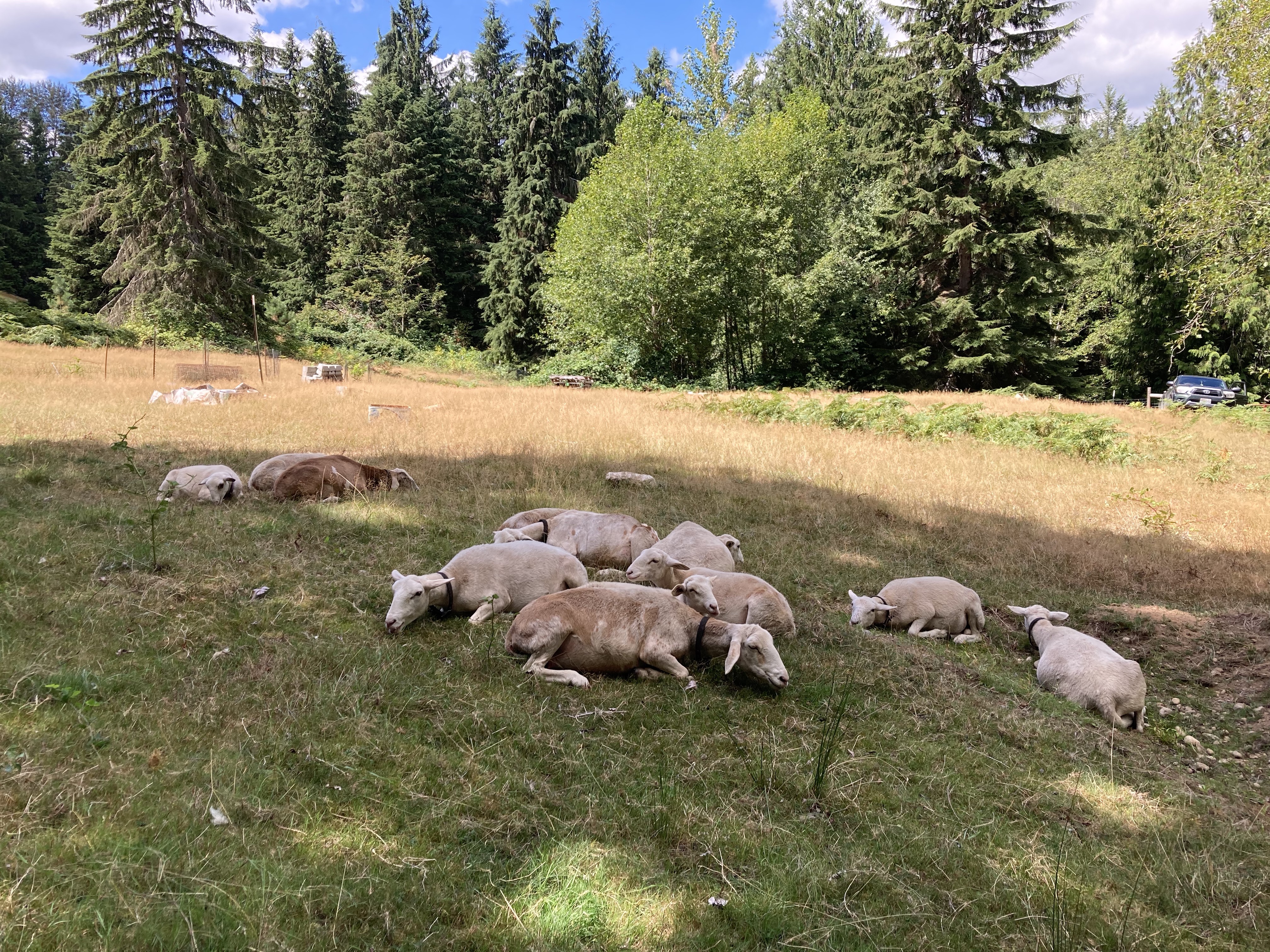
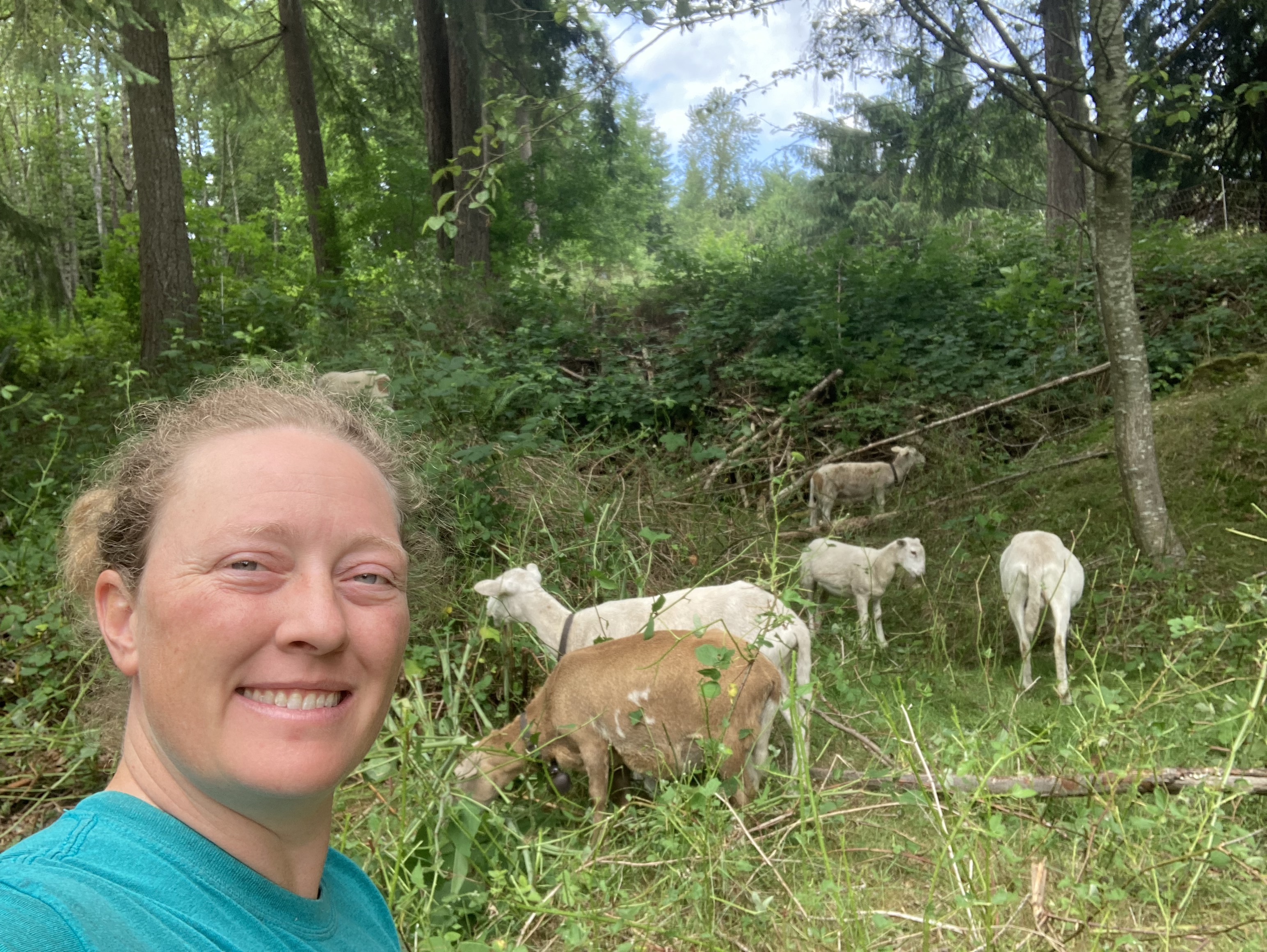
The balance of stock and pasture ratio has finally balanced out, after a decade of experimentation and relationship with this modest parcel, our flock stands at eight breeding ewes and one ram overwintered. This number not only fits within the limitations of our land’s current production capacity, it offers the restoration plantings space and time to grow and establish. This back field, pictured above with the herd during a heat event of 102F in Aug 2023, remains green in some areas where the shade of the evergreens cast relief on the animals and soil. There are even a few rushes popping up to signal groundwater near the surface. As we continue to replant this field with trees, more water will stay in the soil. Oaks and other nut bearing trees are a priority, but until they are established as the dominate canopy, less productive species of grass remain the only sustainable cover for the soil.
I’m very encouraged by the resiliency of the back pasture. It’s been grazed three times this summer, and on this third round, I didn’t subdivide a more formal rotational plan to see how it would manage with the flock at large, and things are looking good. Shortly after Labor Day, we’re moving the sheep back into the upper pastures around zone 1 and our major fruit and veg production areas. The sheep will be rotated in a micro managed pasture system to brows down premo pasture like clover and alfalfa, which we’ve held them off till the last legs of grazing time and to put on a little extra fat before winter. I’ll be keeping a close watch on the land as the sheep graze through to make sure both animals and vegetation get the right feed.
How are the plants fed by sheep browsing? Late summer signals plants to finish growth and prepare for dormancy. The length of days shortens as plants send the last of their energy down into the soil. This action is hastened by the shedding of summer’s growth in the form of seed and fruit. Letting the grazing animals eat that bounty helps crop the plant for winter hibernation while encouraging storage of energy in the rooting body. Your root crops are harvested in late fall when all the densest nutrients presides within. If left underground, the plant will rest in hibernation till warmer temperatures and longer days signal another cycle of growing up to the sun.
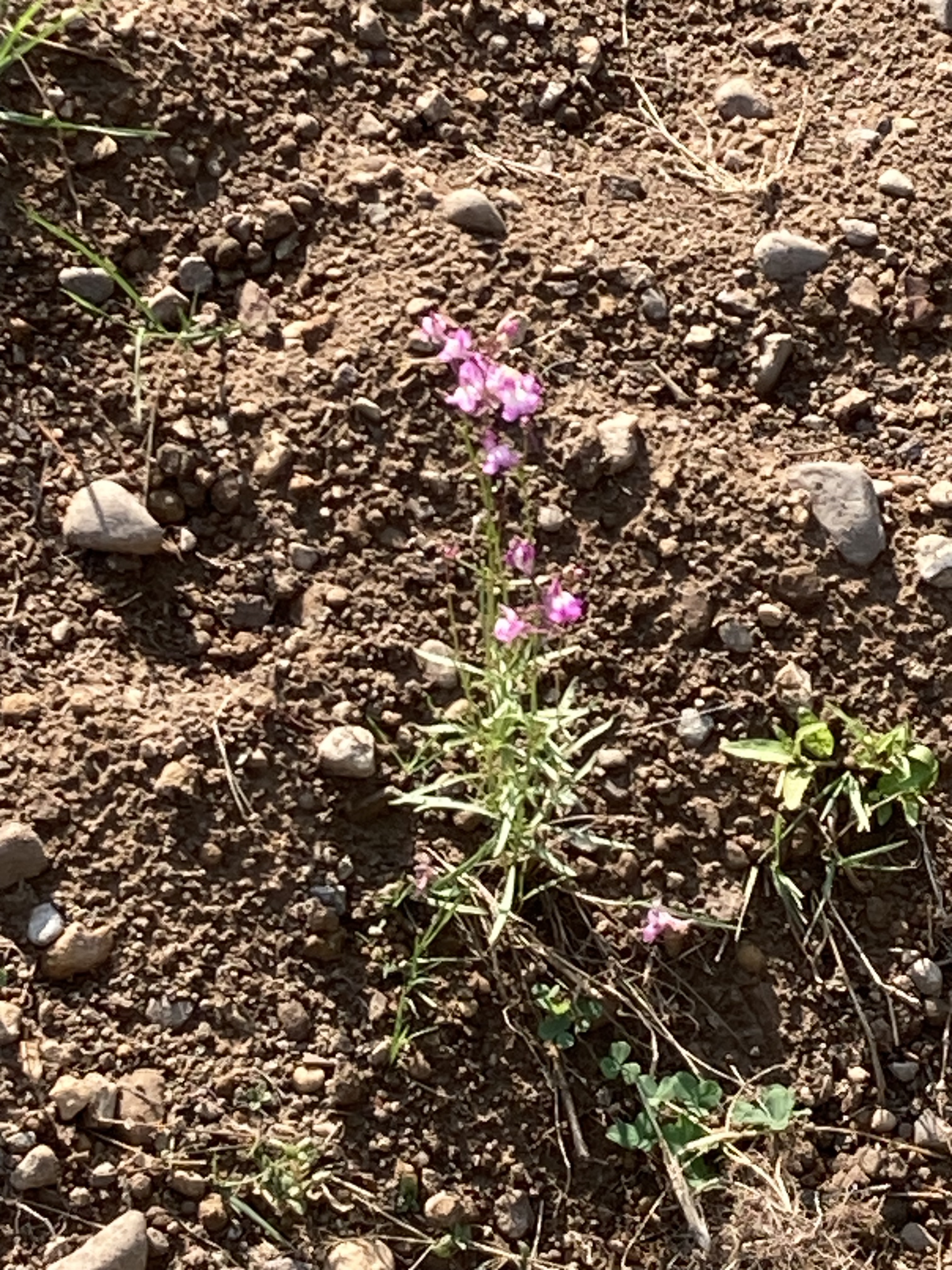
Even with little rain and hot summer afternoons, the wildflowers have reinvigorated one last time. Our exposed soil, parched dust, still grasps some hydration to brace green forage. Clover, clumping grasses, and blackberry continue to feed our sheep and even give pollinators a much needed helping hand. Soon, rotting fruit and roaming black bears will usher the final harvest and overwintering gardens. The chest freezer is already full, and we have a special meat freezer which is already 1/2 full of roadkill venison and lamb. Luckily we’ll be sending the rest of our fall cull on the hoof and out the door quick, with the herd bound for the barn by the end of October. Gratitude to all the working parts keeping the land healthy and abundant.
Leafhopper Farm is celebrating 10 years of producing food, restoring forest, and sharing the experience through hands on learning and this blog. Personal inward journey on this adventure continues in abundance along with meat, fruit, nuts, herbs, and native habitat. The rewards are also financial- we’re in the black, and have at least covered the costs of annual expenses in grain, hay, and agricultural infrastructure. I earn no personal salary on the land- yet; consulting, and some implementation for clients keeps me busy off the farm, and that job could expand, but I want to be present on the land where I tend and live.
Talking with my King Conservation District CREP steward friend yesterday- some wonderful women are coming to address Reynoutria japonica growing in the creek- we shared recent reflections of working outside, and he commented, “you’re so tuned in”. That’s the money for me folks, tuned in. There’s no venmo or facebook, but the turkey vultures taking care of refuse in a totally organic process, gravity fed water systems with rain catch and cisterns supplement a well on still safe to drink water, flowing creek- spring fed, digging drainage, having an animal die and the heartbreak of loss, hard lessons from tenacious “weeds” (I think of them as teachers), the problem is the solution- and finding that solution moments, that’s the life experience I quest for. Gratitude for all that allows this journey.
There is community, in a small network for friends and some woven business relationship in food and labor trade, as well as design of livestock systems, integrated into restoration, with a focus on long term cooperation between food and forest. Fruit and nut trees mingle with maples and oso berry. Evergreen stands harbor rich layers of temperate rainforest, holding water like a sponge. These intricately woven patterns echo in our relationships with each other. One thing I do struggle with in this web of reliance is our collective refusal to acknowledge we need each other, not just use each other when we want, out of convenience; we need each other to survive, but we’ve disconnected from that obligation on so many levels. Some of it, through deliberate conditioning in our culture, to make us more malleable, then easily manipulated by consumerism. Dollars and cents pay the bills, but does this make sense if the quality of life is void?
The experience of turning outward with my livestock operation, going the more commercial rout, would make more income, but neglect the land restoration, and up the outside inputs. We’re working towards low maintenance edible and medicinal landscape with rich, fertile soil. Goats, pigs, sheep, chickens, and soon we hope, geese- have all contributed to rebuilding fertility. There are maturing understory shrubs rising up from the fields, and more young trees to come. These are worthy investments, and work with stocks that underpin fertility, nutrition, and authentic connection to place and time. It is one way of living, with great cost in time, money, and labor, as well as dollars and cents- land taxes, utilities, transportation, and goods still demand curacy economy. I add dividends in new trees established and number of healthy lambs produced. It’s in balance, and the restoration is expanding.
We’re putting up more hard fence within pastures to create long term healthy forest stands. Ten years of browsing mouths pushed back the blackberry, then some observation, swale building, weeding (intense labor with a mattock), and mapping have given the landscape both face lift and water system enhancement- enough to warrant some deep investment in restoring whole groves. We’ll be experimenting with replanting low hanging branches to stabilize and root new trees. Native ground cover like Arctostaphyloos uva-ursi, carpets of moss and branches, along with seedlings of Douglas fir, red cedar, and western hemlock. We’ll plant bur oaks along the south facing slope where sun traps bake the ground in summer heat. Stay tuned for new forest development at EEC!
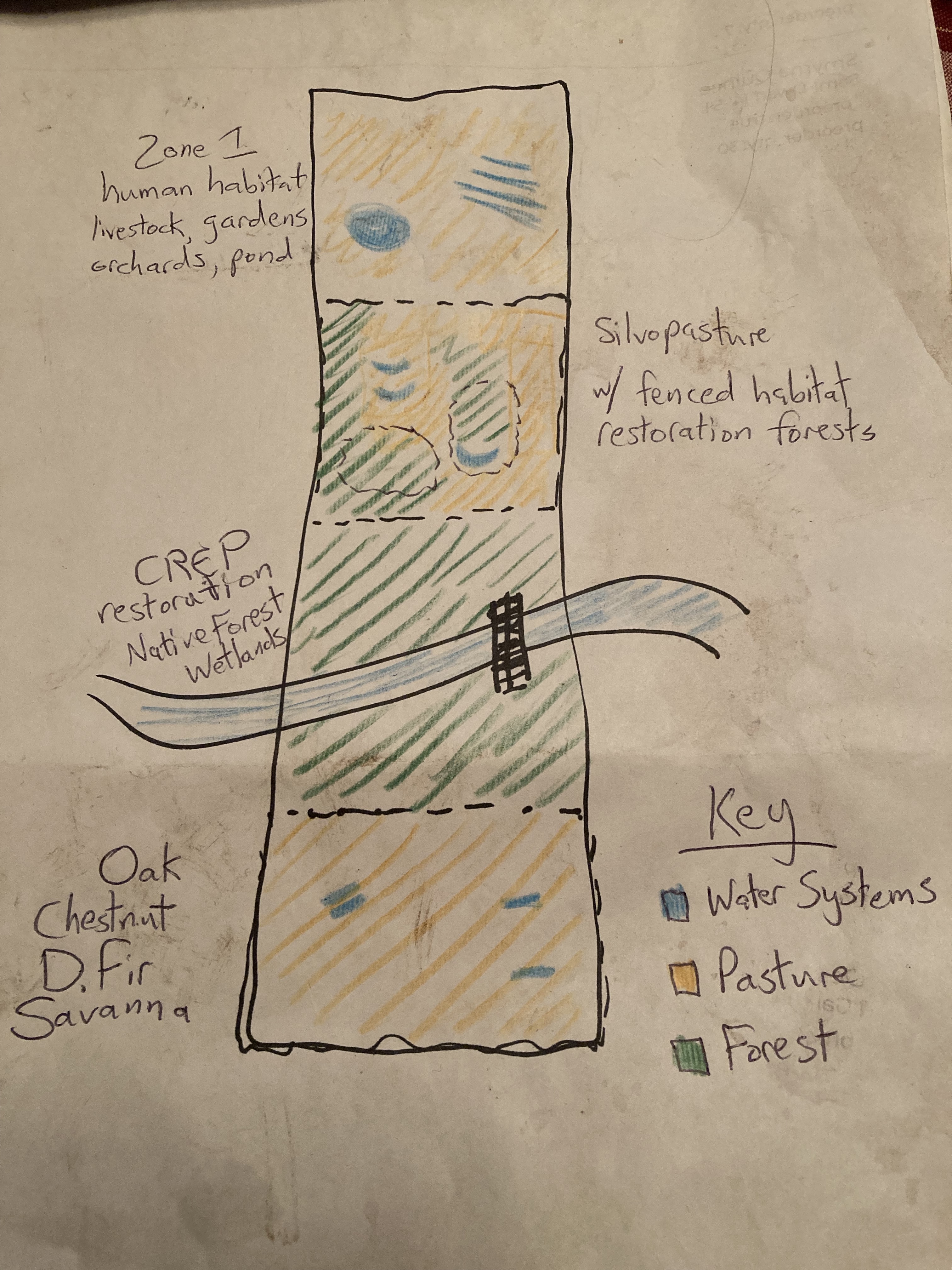
Below is a quick map of the property with the 4 major areas and main focus. The northern most landscape of our property has seen the most change since 2013. We’ve built habitat structure for both people and livestock without pouring any foundations. The pond remains through drought and floods, and still has not reached overflow capacity. The way our climate change continues, it may one day be a mere seasonal seep. Our water table has dropped significantly in a few decades. By redirecting, slowing, and sinking heavy rains on our sloping terrain, we replenish the groundwater enough to keep patches of green around the landscape year round. Our long term replanting vision will embrace more oaks and other drought tolerant nut trees in a savanna setting. This adaptation to dryer, hotter summers and colder, wetter winters predicted.
From 2013-2023, there are countless goals met and challenges solved, while other new puzzles and blind spots arise. Where there were once facility limitations, there are now going concerns. Depreciation in physical structure can be quite depressing, but we’ve made good on our 1973 double wide, which is still the main residency, and holding up, though we could use a kitchen remodel. That’s where we look to the future and plan our next, more established long term living space. We will not plan on pouring a new foundation, but have plans to renovate and repurposed space already available on site, while continuing life in the trailer. We’re so grateful for all our habitable spaces on this land, and living space with enough amenities to be in modest comfort.
This land has hosted up to eight residence at once, but currently works best with four to five. Our tenants have access to full kitchen and bath, with common room and outdoor kitchen with fire pit. There are raised beds for private use, and acres of pasture, creek, and woodlands to enjoy. It took a few years to hone in on best co-living practices, rental agreements, and expectations. One of our greatest learning curves was work-trade. Make sure your worker has a skilled trade. There is a clear difference between experienced an inexperienced work, as those not able to offer work in trade are offering work to learn, which has a different set of values. Many eager young folk have not discovered the difference, and it has been a challenge to negotiate fair exchange for unskilled labor.
Our participation in World Wide Opportunities on Organic Farms for several years also taught valuable lessons. We had amazing experiences with several international folks who enjoyed seeing a smaller, more holistic model in agricultural restoration. There were also some misunderstandings, in which people who came as WWOOFers used our residence to gain local employment, and leave the farm before finishing their stay. This began happening more frequently, so we had to stop hosting. Instead, EEC Forest Stewardship offers small workshops, personal tours, and occasional seasonal apprenticeships through word of mouth, organizations like Women Owning Woodlands and Washington Department of Fish and Wildlife Hunter Education. There is still so much to learn and share- please join us!
Special thanks to family, the people who love and support my joy and vision. Your lives inspire, and encourage me to live my life with purpose and adventure. This opportunity to buy land and create home, would not have come without you, and the resources; which still flow in such abundance. Time, experience, witnessing, unconditional love, and patience have been humbling gifts indeed. Weaving these memories within our lives together, even when not face to face, has deepened relationship I could not live without. Gratitude, and many more years to come!
During the warmer months fishing helps to fill our larder with trout from our local lakes. Some fish are rainbow, others are cutthroat, and many are hybrids. These fish were caught in an alpine lake about an hour drive from EEC. Live worms from the compost, with a fly or spinner lure dropped down deep worked on this trip. Sometimes the fish are kissing the surface, and it’s better to fish on top of the water with floaters. Weather, temperature, light, insect hatches, underwater topography, season, lure type, bait choice, and casting preferences all come into play when fishing. Because of all the variables, there are days of great success- like my partner and I catching our combined limit, or days with no catch at all. Most of the time there is some success, but especially at a new location, it often takes a few visits before familiarity sets in and the fish are found.
Fishing is a wonderful first step into wild food you can harvest yourself without too much trouble. Any line and pole will work as a basic setup, but I recommend some kind of rig which includes a reel. You can still find basic setups for under $40. Hooks will cost another $10 (you’ll want a pack of several), and lures can be bought for under a dollar each, or you can by the parts and make your own. I grew up using a bamboo stick with line from a spool and a pack of hooks. I’d take the stale bread Mom would leave me, and head to my local park to catch carp and catfish. It was a very primitive setup, but I caught and released a lot of big fish. Sometimes I’d have to get creative on the go- with just line and a paperclip bent into the shape of a barbless hook- or my bare hands if necessary. Metal pipes are perfect hiding places for catfish. Tip the pipes into a bucket and you have a nice meal.
As a child, I did not take home my urban fish, they were released back into the waterways where I found them. Only with my Grandfather would we keep and eat our catch. His tutelage on the water was priceless, and I learned how to operate a reel- push button, then flip cast. I learned about setting trot lines, hooking a minnow to catch crappie, and what lure to use on the surface to catch bass. My grandfather showed me where to look along the shore for good casting grounds- overhangs, the lake’s inflow source, or rocky points. Fish gather in schools around good feeding spots with shelter above, like under a log, where lures have trouble reaching without getting hung up. Grandy didn’t always explain why did what we did, but I got the general understanding when I’d catch something.
Today I continue my passion for flat water fishing. The lakes here in Western Washington are smaller, but full of wonderful trout ever eager for fresh worms and a good spinning action through the water. Even when there is not a fish on the line, the location out on a beautiful alpine lake or on the edge of an old mill pond in mossy woods invites patient sits within nature, harvesting good food from the source of all life, our sacred waters. So much gratitude for those who continue to teach others to fish, to the scaled ones who continue to thrive where they can and still come onto the line and into our larder to nurture continued cycles of birth and death to survive and thrive. May we all continue to stay connected to the waters and their crucial place in both the food chain and greater ecological act of potable drinking for all.
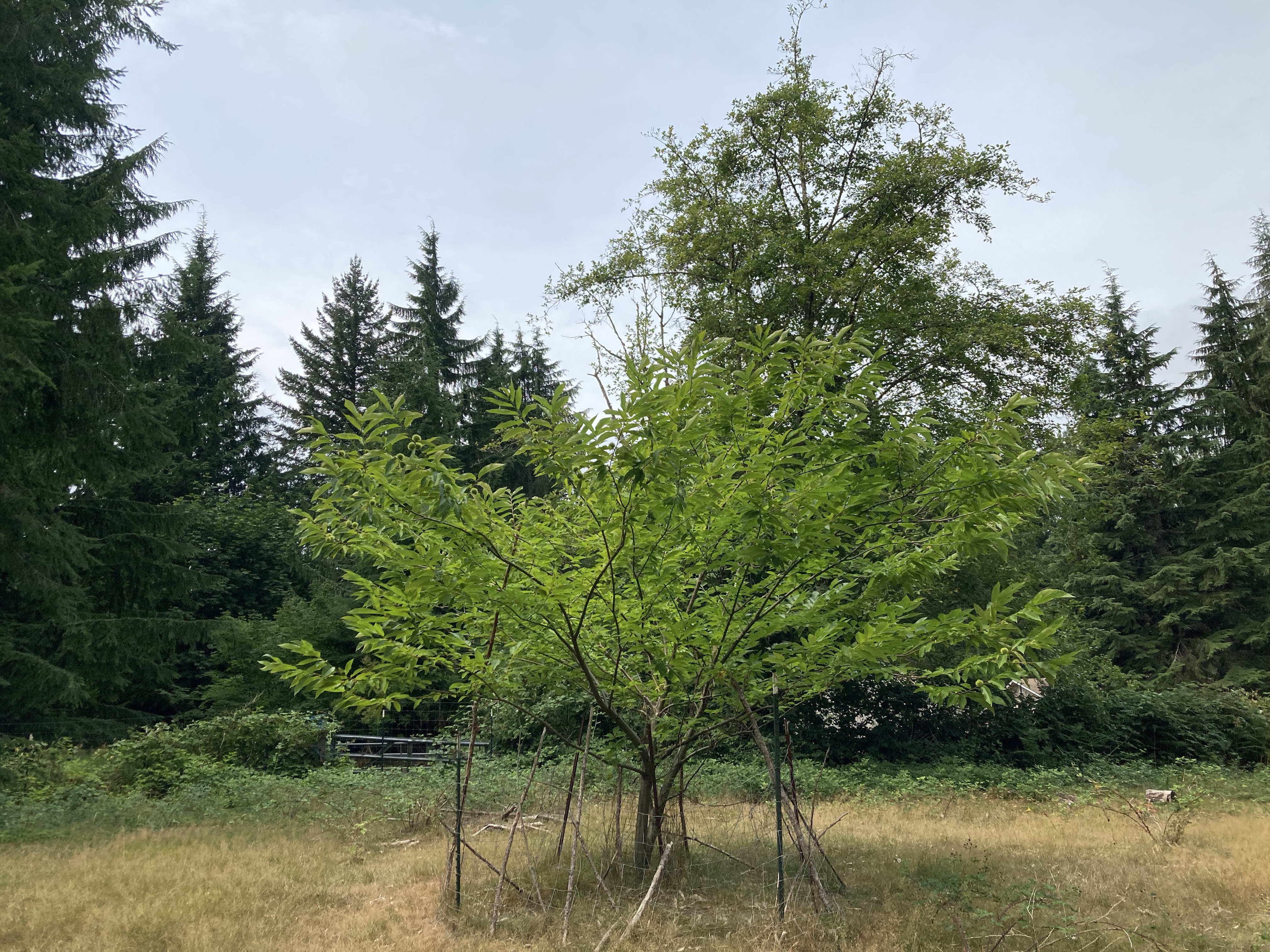
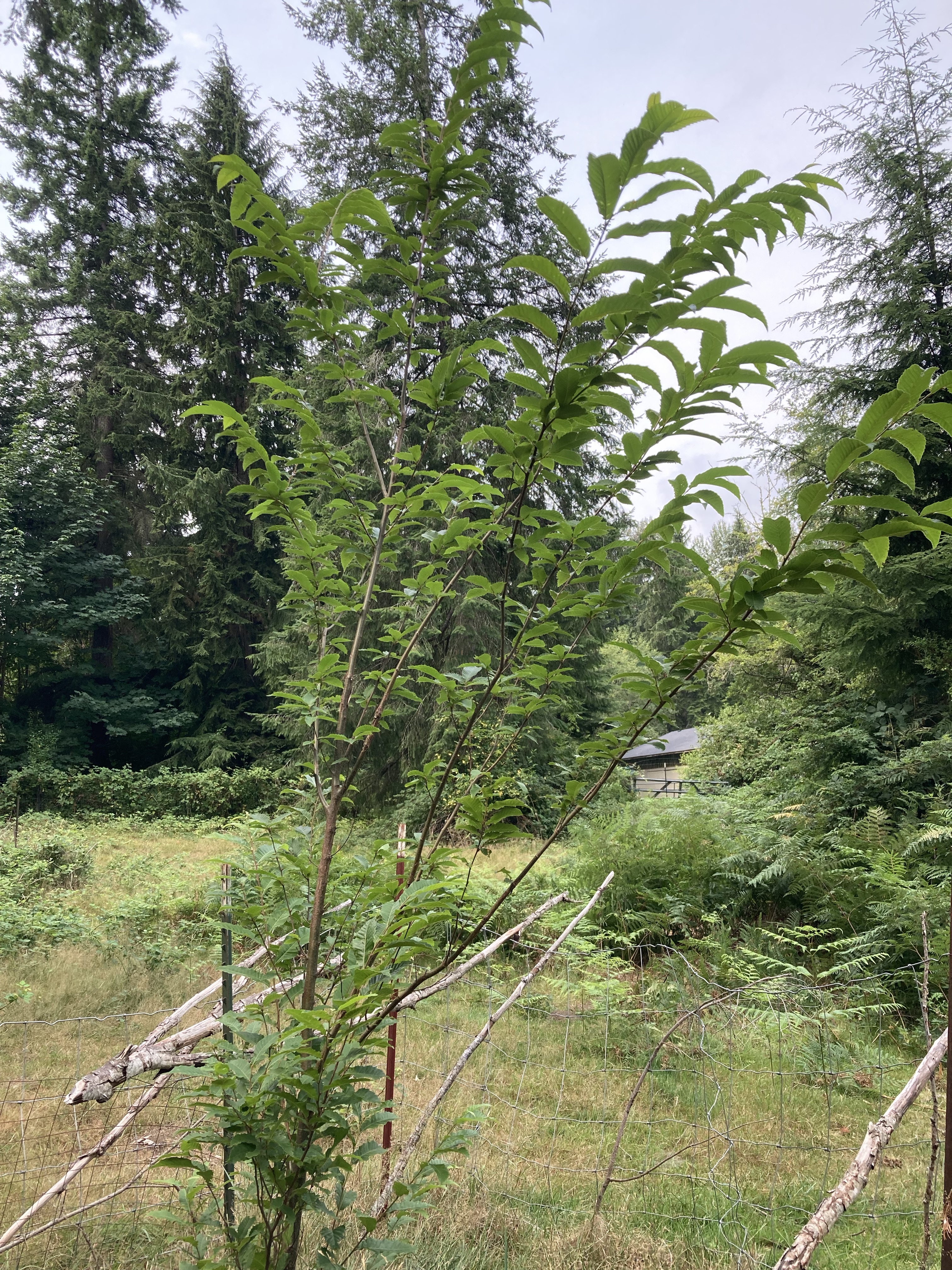
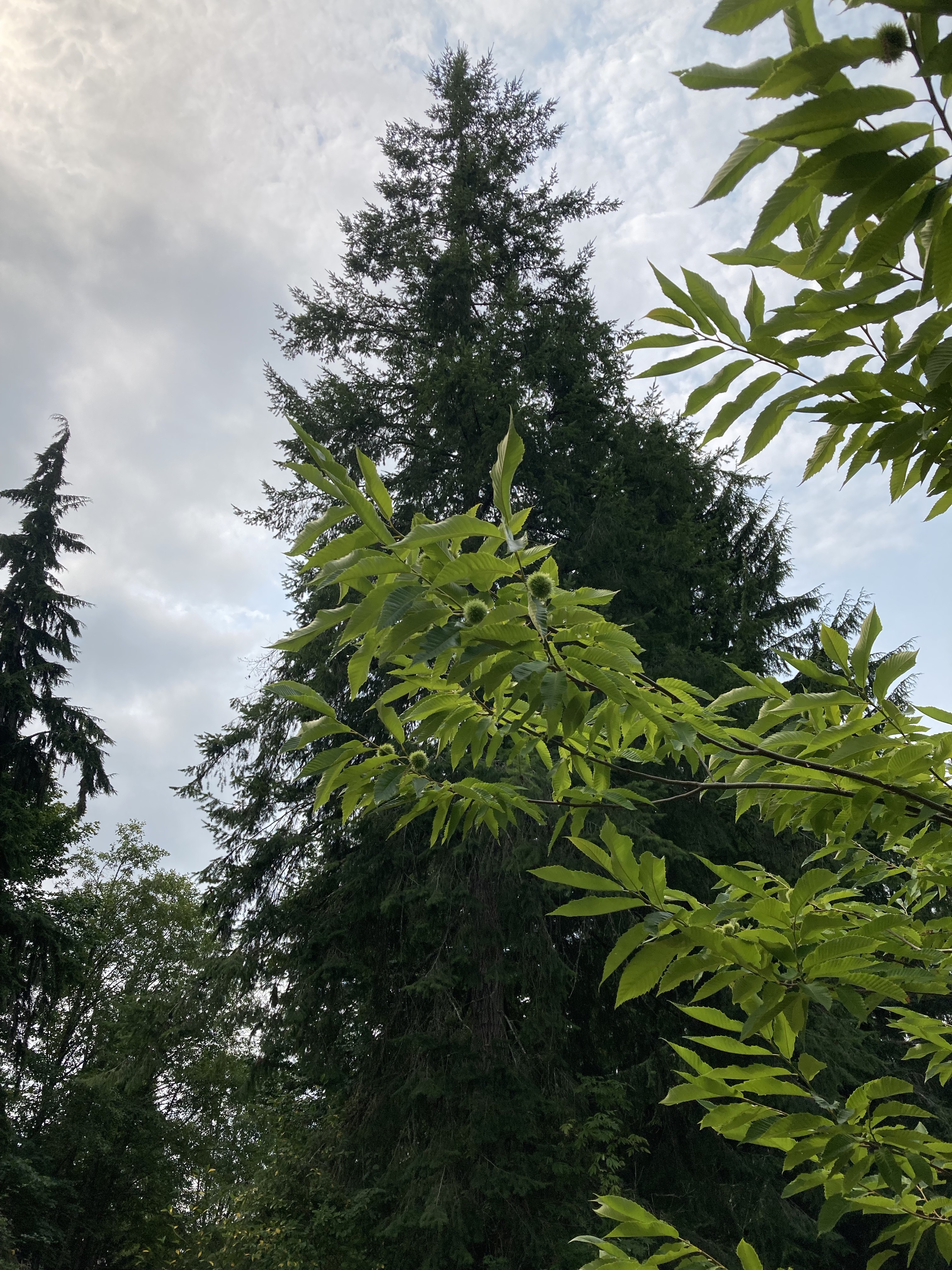
It’s been about eight years since we first planted our chestnuts and the crop this year will be a first. With no irrigation or mulch or other inputs besides occasional weeding, these trees are developing into a future nut factor extravaganza! The Colossal variety has been most successful, and are projected to be early producers. Our other varieties are slower growing, and hold a few nuts, but need more time to develop enough canopy spread to be viable producers. It’s also hard to tell if we’ve lost the graft on one pictured below. It’s got a lot of sucker mess closer to the ground, I’m going to keep observing and hope nuts come on in the next few years. If not, we’ll still leave the tree as shade, deciduous leaf shed for mulch and fertility, and possible root stock genetics to perpetuate for future grafting.
When to gather the nuts depends on when they drop in the Fall.
(4 paragraphs and some lovely links were lost in an epic freeze up of WordPress and I don’t have the heart to rewrite it) in short- companion planting, good fencing protection, and a future plan to irrigate future oak and pecan trees. I’m sorry folks, worked many hours on this post and when it froze up, I was able to copy the last two paragraphs, but not recover the rest. This is my protest to WordPress and some compensation for my loss.
This particular article talks more extensively about companions for fruit and nut trees, and other important topics like pollination and soil health. It’s always good to have a plan for your plantings, but understanding your soil, weather, and seasonal shifts on the ground takes time. Ten years in, we’re finally getting the rhythm of the earth and investing for the most successful restoration in food, medicine, and material crops hand in hand with both native and cultivar species.
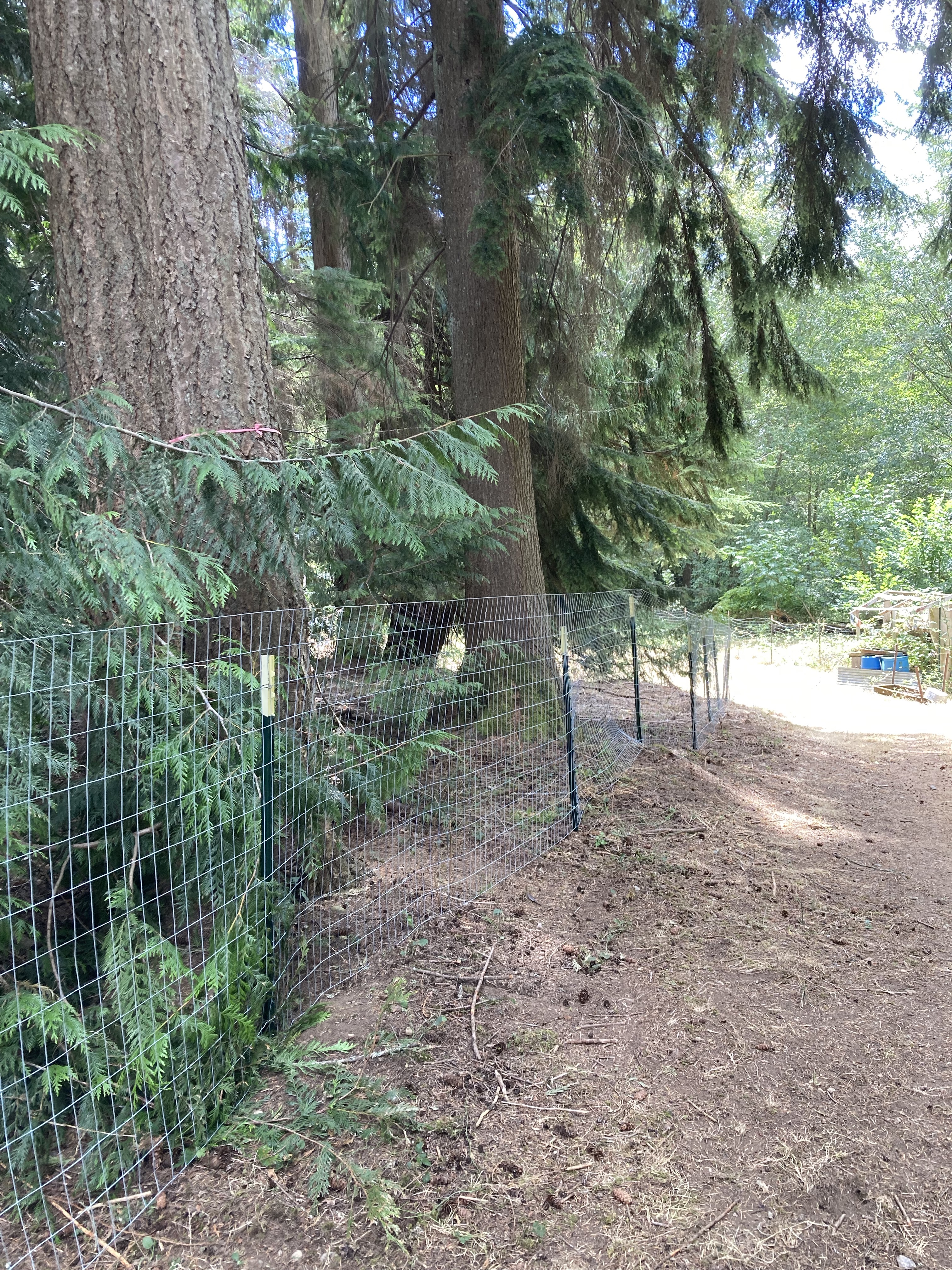
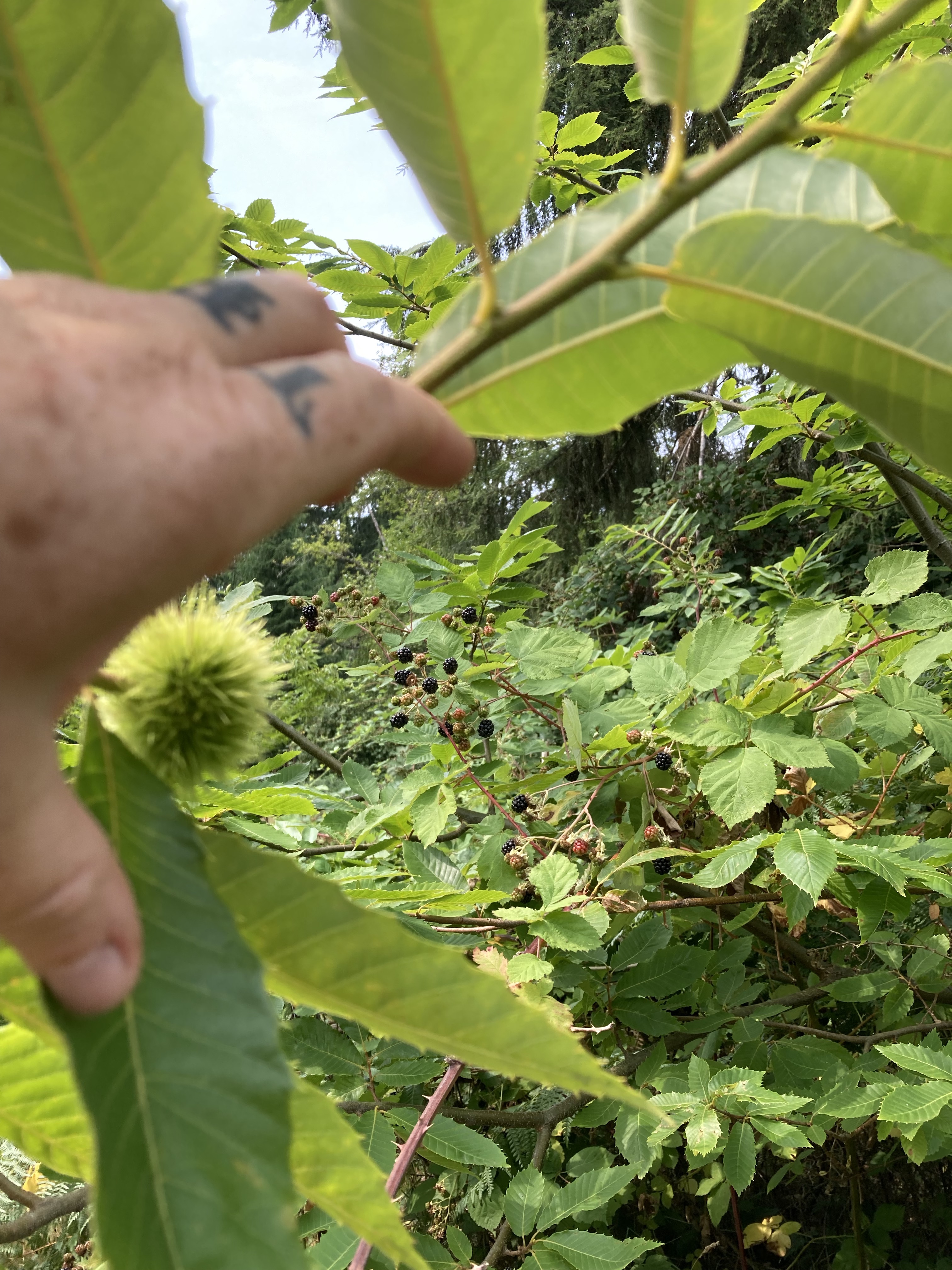
To be clear, we won’t be planting cultivars in the native restoration areas, like our salmon stream wildlife corridor, but in the highly altered agricultural fields, mixing in cultivars improves overall productivity and diversity in a fast changing climate. Navigating the vision of adaptation, human use, and wildlife preferences; we continue to plant, plan, and plant some more. We’re also maintaining boundaries- most of them hard fenced in nature- to keep our livestock from over maintaining- as in predating our more vulnerable crops- like the chestnuts. With good fencing and occasional weeding, our trees are now capable of fending off most browsing, but we’ll leave the fencing to help protect understory verities as they establish. We don’t yet have a bumper crop to crow about regarding our young nut grove, but it’s well on it’s way, and this year, we just might have some sweet chestnuts roasting on an open fire.
When first cultivating the idea of holistic land restoration and producing food locally, I took a lot of time visiting locations around western states in search of ecological location. Political forward thinking, social welfare, and civil engagement also played important roles, but seeing the continued climate crisis looming, I opted for a place with temperate climate and lots of fresh water. The Pacific Northwest, and more specifically Western Washington, offers temperate rainforest ecology with mountains, oceans, lakes, rivers, and mega flora and fauna. When I bought the property in 2013, I could afford acreage within an hour of Seattle- complete with well, salmon stream, and 60-80 year old trees throughout. For someone who grew up in Oklahoma, with dust-bowl ancestry, access to so much forest and fresh water was almost unbelievable. I know if my Grandma was still alive, she would not comprehend the height of “pine trees” out west.
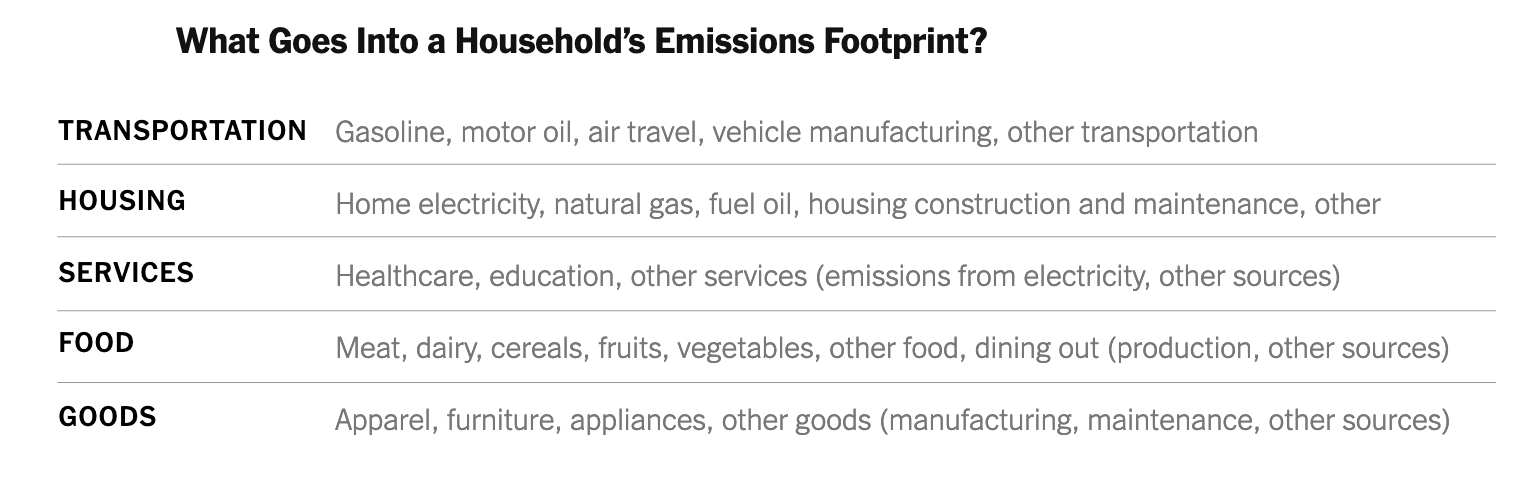
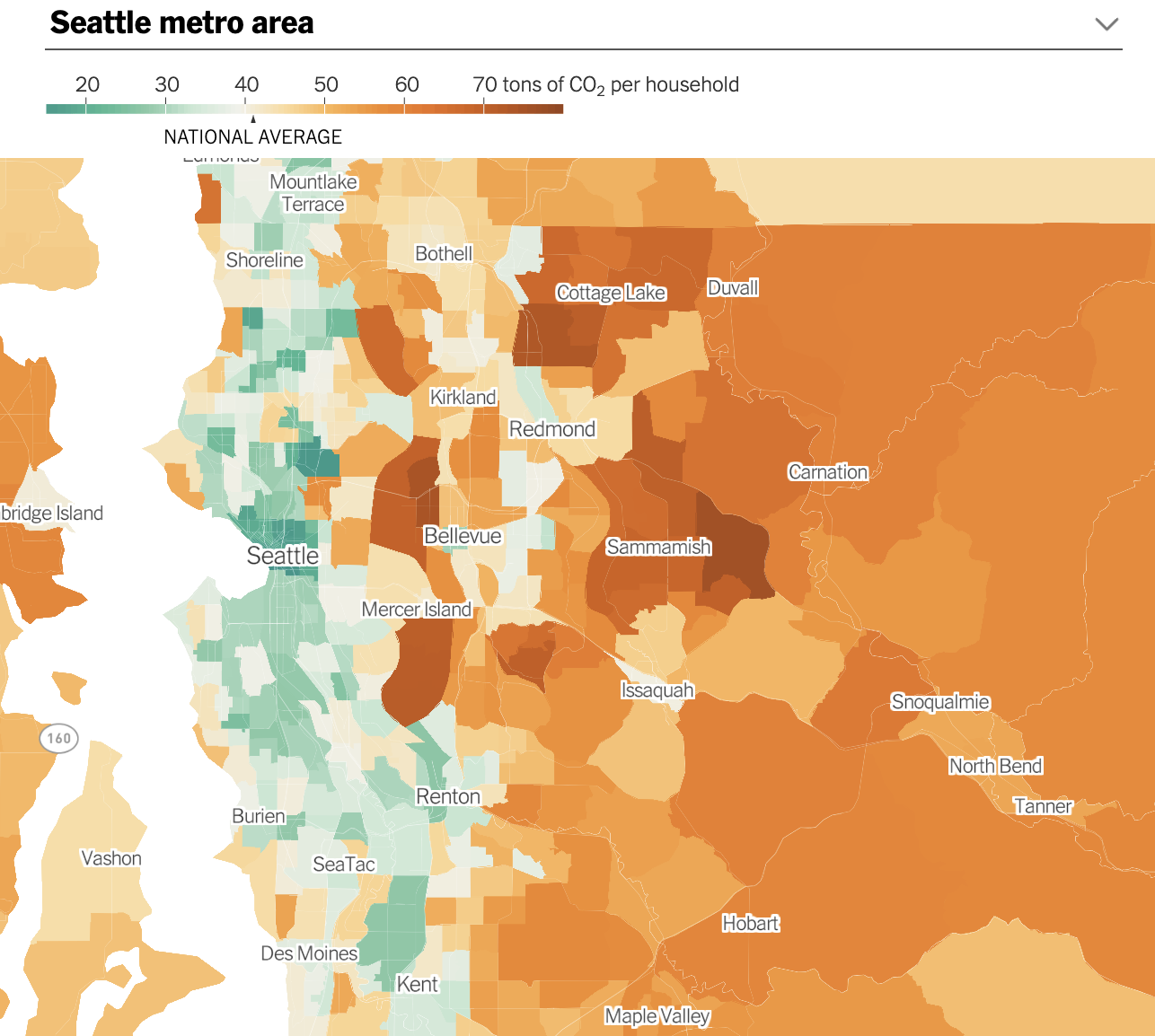
In two lifetimes, humans went from horsepower to combustion technology, which we are still in; tech i runs off petrochemicals- plastic included, and it’s all toxic. Who’s wearing some right now? -most of us, as even jeans are now woven with spandex stretch fit. I’m writing this in a pair of nylon Wranglers- that’s right, no cotton blue jean in this pair of pants, yet still Wrangler stretch fit. Ye-haw! How much stuff has to be shipped to you these days? How much driving around picking up stuff do you do? What are the true costs living rural? I highly recommend checking out the link below for info on your area. There’s a way to measure our consumption now, and these maps are quite revealing.
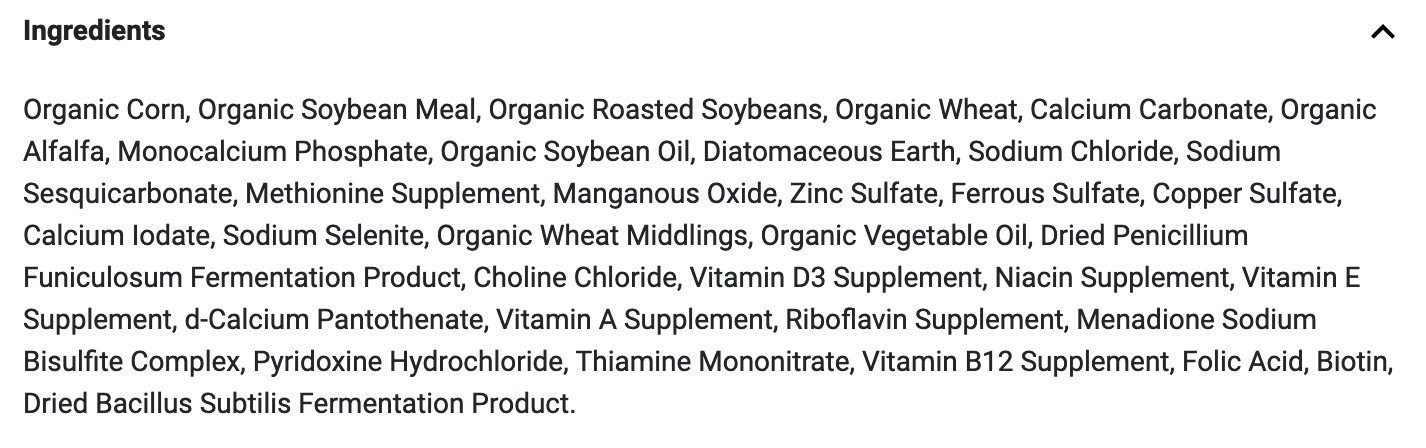
So how does EEC Forest Stewardship measure up? We’re electric and wood heat on the property, there are a couple of two stroke machines on the land which run a few times a year- our chainsaw does the most work at an average of 4 gallons a year. The weed wacker runs about 2. Our livestock does the rest. Hens cost the most, as their total organic and locally grown grain has risen to a dizzying cost in 2023. A 25# bag is $40! Though we go through about 35 bags a year, with a lot of home grown supplement, including our own farmed meal worms. This keeps our chicken operation in the black, and we sell about 5 dozen eggs a week (averaged out). What’s this got to do with carbon footprint? It seems to come down to dollar- the 40# bag of organic generic layer feed at $25 would be the obvious choice, but that bag of feed’s ingredient list says a lot more about the true cost of cheaper prices-
Here’s the list of ingredients from Scratch and Peck-
Organic Wheat, Organic Barley, Organic Peas, Organic Flaxseed Meal, Ground Limestone, Fish Meal, Organic Sunflower Oil, Black Soldier Fly Larvae Meal, Organic Dehydrated Kelp Meal, Essential Oils, Vitamin and Mineral Premix. Ingredients may vary – please review each bag’s label.
The cheaper organic layer pellet feed (so it’s cooked most of the nutrition out), has fillers like Choline Chloride, which is an important component to cell membrane formation, and found naturally in the environment- though when it’s chemically produced in a lab on industrial scale, the whole “naturally found in nature” explanation holds little water. Industrially produced material is high input demand for a factory, energy to run it, manpower to oversee, and the mines providing the chemicals to make something. Then the industrial chemicals are put into all sorts of other industrial products- like commercial layer feed- even organic ones. Many parts of this feed are subsidized, and the more petrochemicals used, the cheaper the outcome- but that too is changing fast. Down the rabbit hole we go- main point still being, cheaper at a high cost somewhere else. Products that have long lists of inputs leave us with a web of chemical plants, mines, truck, train, and plane transport that will leave your head spinning, but the price it right!
Scratch and Peck is a Washington State company that sources all its ingredients from verified farmers in North America. They were the first non-GMO Organic Certified USDA feed company, and I’ll pay a little extra for certified quality, also, to support local businesses. This is worth the price, and it keeps me balanced in my own limitations of scope and scale. There are still mines and extraction economy involved, and ultimately not having livestock at all would be ideal- if the environment had it’s ecology intact and a thriving wildlife system within. I can hope elk one day might come up the ridge, and they are close, but as long as grid property systems exist, migrating species won’t have a chance. Humanity has boxed out wildlife with similar grid demarcations, and it’s through all this data measurement that we arrange algorithms of solution to problems we created. Again, our actions, our choices make or break restoration of these complicated natural systems that we have yet to fold ourselves back into successfully.
Every little step we can take in our lives towards less consumption is a step in the right direction. Knowing where you are stepping off from to start is key. Think about transportation first- it’s the most impactful action each of us takes if we’re using a car. Do you drive every day? If so, can you plan to share the ride with others- especially work or school carpools? Do you practice reduced packaging? Small steps, but for those wishing to make a greater impact, have fewer children. It’s really helpful to recognize limitations, especially finite ones like clean air, soil, and water. These are abstract terms that boil down to groceries, health, and what comes out of your tap at home. It’s hard to grasp things like palm oil and your coffee or coke and the water table of Mexico, but it’s happening all around us in our insulated middle to upper income households. I mean households where there are multiple vehicles, pets, entertainment systems, high speed internet, and a well stocked pantry. If you can check all those boxes, you’re in that upper consumption market- especially if you live suburban.
EEC Forest Stewardship checks all the boxes, but some of the pantry comes from in house, and meat, which is a high carbon footprint under industrial agricultural management. On a small farm with minimal inputs, we’re still supplying a low carbon option marketed to the people who could use more carbon offsets. Ultimately this farm is also moving towards reforestation and habitat maximization, rather than agricultural perpetuation. It’s why forest stewardship remains the focus of this land, using restorative agriculture to quicken the land’s fertility. The good news is farms can stay financially viable using restorative ag, and it works best in smaller acreages of operation, which suits the limitations of EEC.
Micro can become macro when enough plots are participating. Again, city dwellers without land are still offering a huge offset by living urban and concentrating impact. There are other risks to clumping up, and COVID showed us one of those nightmare scenarios. But the risks are less overall if you are agreeing to live in civil society– which does offer a certain level of protection and survival success. We can all say yes to modern medicine, well, most of us. Healthcare is becoming a needless nightmare as well. When we start reflecting on quality of life, especially after a recent pandemic in which our fragile systems, like healthcare, came to light for so many, it helps to recognize the importance of strong community connection hand in hand with ecologically based development planning around the natural structures which are already in place and working without human inputs. When we learn, or at least acknowledge the levels of complexity it really takes to sustain life, perhaps we can understand the impossibility of constant quality while fulfilling quantity. Demand does not mean supply is available, and in nature- which we are still bound to, even with all our technology and inventiveness, a failure in one aspect of the system is manageable, but our planetary environment is currently hemorrhaging. Our best action now is preparing as best we can, while living in the moment.
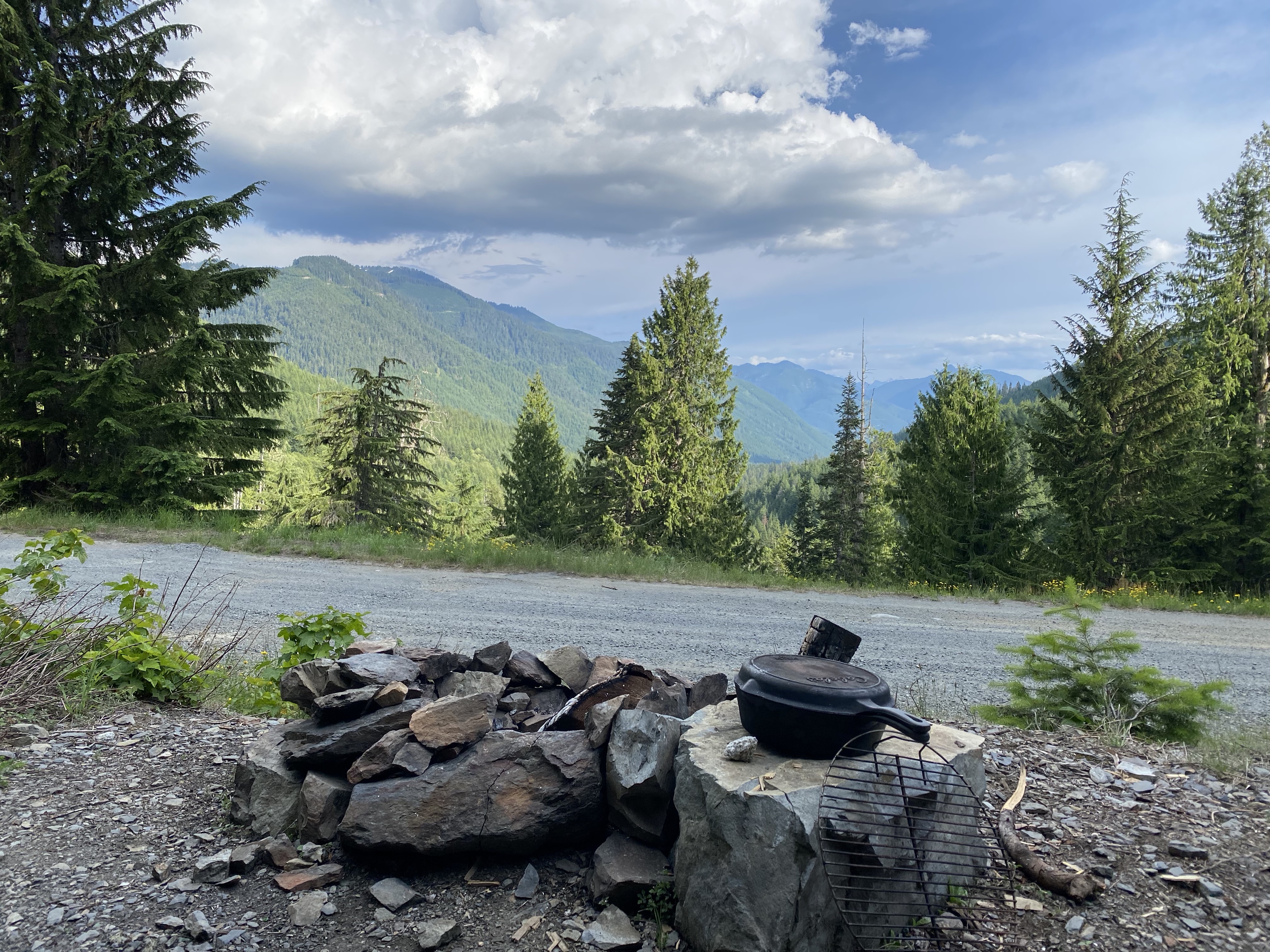
Flying is another huge footprint in carbon emissions, so most of our vacation time is a low emissions state lands visit with spectacular views, open air accommodations, and an outdoor kitchen to die for. In less than an hour drive from the land at EEC, we can find ourselves alone in the wilderness on a grand adventure in hiking, camping, and appreciating our greater backyard. We live here because of the unbelievable ecological diversity found within Washington State. It’s our main destination, which helps with avoiding plane travel, but I still fly to see family, and that swings my personal footprint towards the higher end of consumption. Just two flights- you usually have return ticket, is about 1000kg of CO2, which can be understood better in this graph about 1kg CO2 equivalences. This is more CO2 then many people in the world use in a year, so I am more consumptive, along with anyone else participating in the military industrial complex. Offsetting is great, and it’s a start to at least do some basic calculations to quantify your footprint.
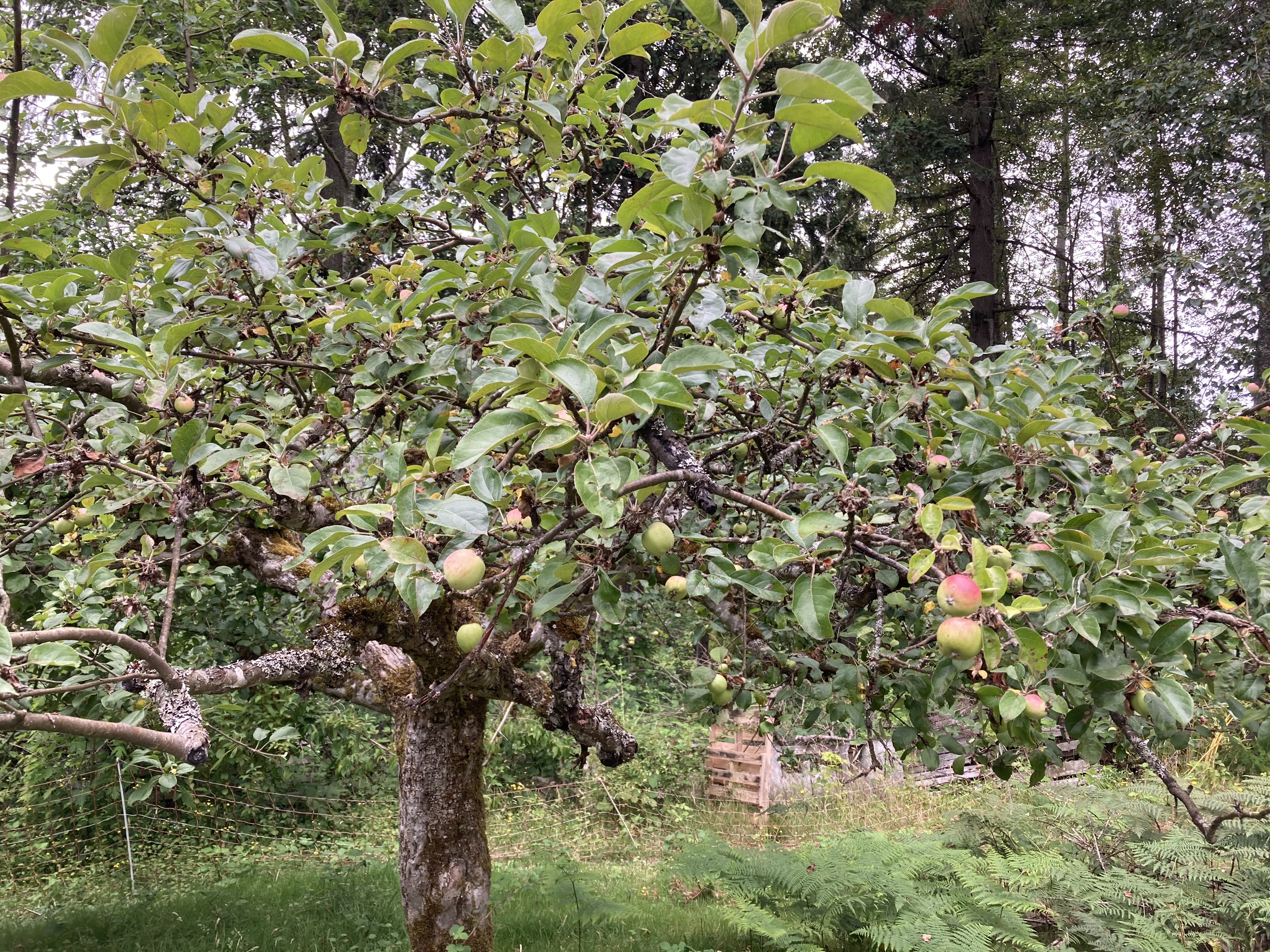
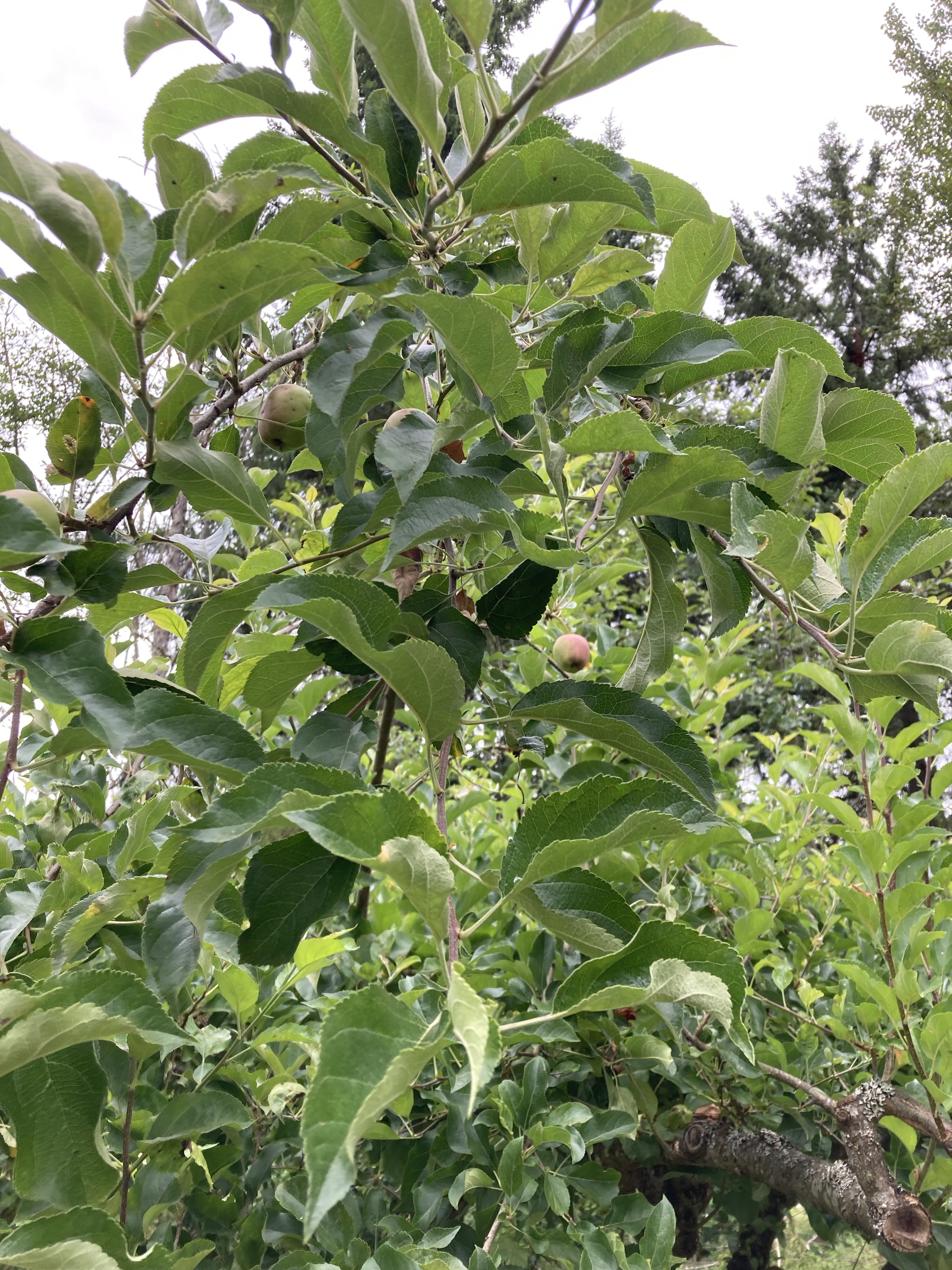
Apples are ripening and peaches are plumping up at Leafhopper Farm. We’re watching the summer drought and maintaining an irrigation schedule to support maturing fruit across the landscape. Apples are well established at EEC Forest Stewardship, with a variety of grafts and root stock to support long term genetic success in orchard development. Most of our apples are dwarfs, which will stay low on the horizon, letting our good southern exposure shine through. The mature, and in fact, declining older trees are on the far west side of our human habitat zones 1 and 2 on the property. Some of the trees support two different grafts on one trunk. This is common in smaller home orchards where space and time management of individual trees is limited. There is some risk in that a graft which fails could mean complete loss of a variety, but the surviving graft will take over and still produce. We’ve grafted a few of our own multi variety root stalks and most of them are still holding true.
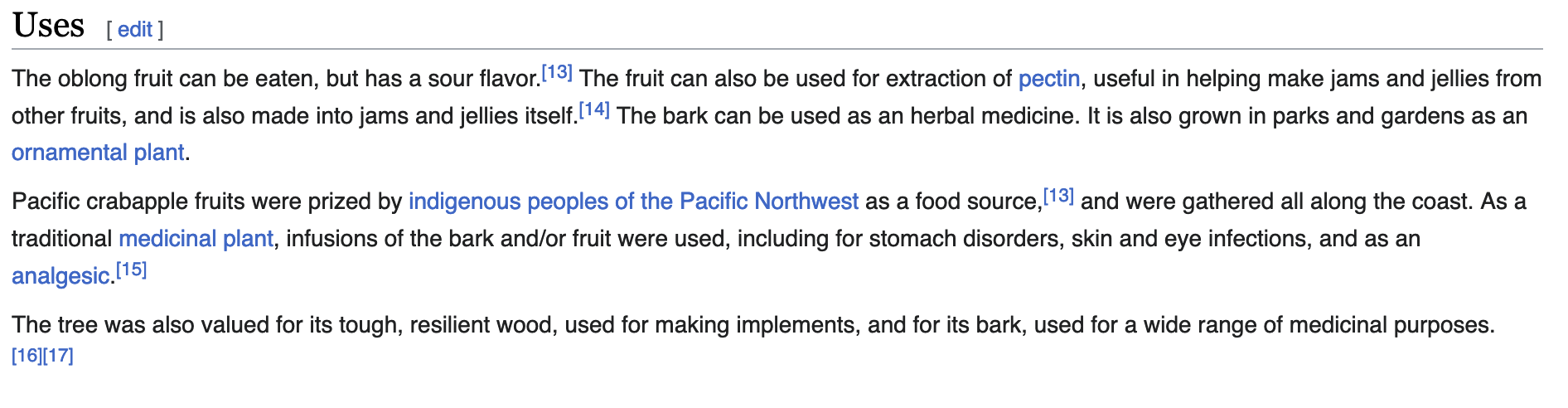
Our crabapple varieties are also thriving. These smaller rose hips (yes, apples are roses) can still be sweet and rewarding as a food source, yet they are more drought resilient and generally hardy. There is a native variety- Malus fusca, which is planted around EEC as well. Our planting plan includes this often overlooked native plant and its important relationship with First Nations. After reading Keeping It Living, and understanding that stands of crabapple were often present at traditional village sites, I began planting them around the zone 1 and 2 areas. As they mature, berries have begun attracting our local bird population. The fruit stays on the branch into winter, and becomes an important food source once snow and ice set in. Below is a good list of known uses of our native crabapple from Wikipedia.
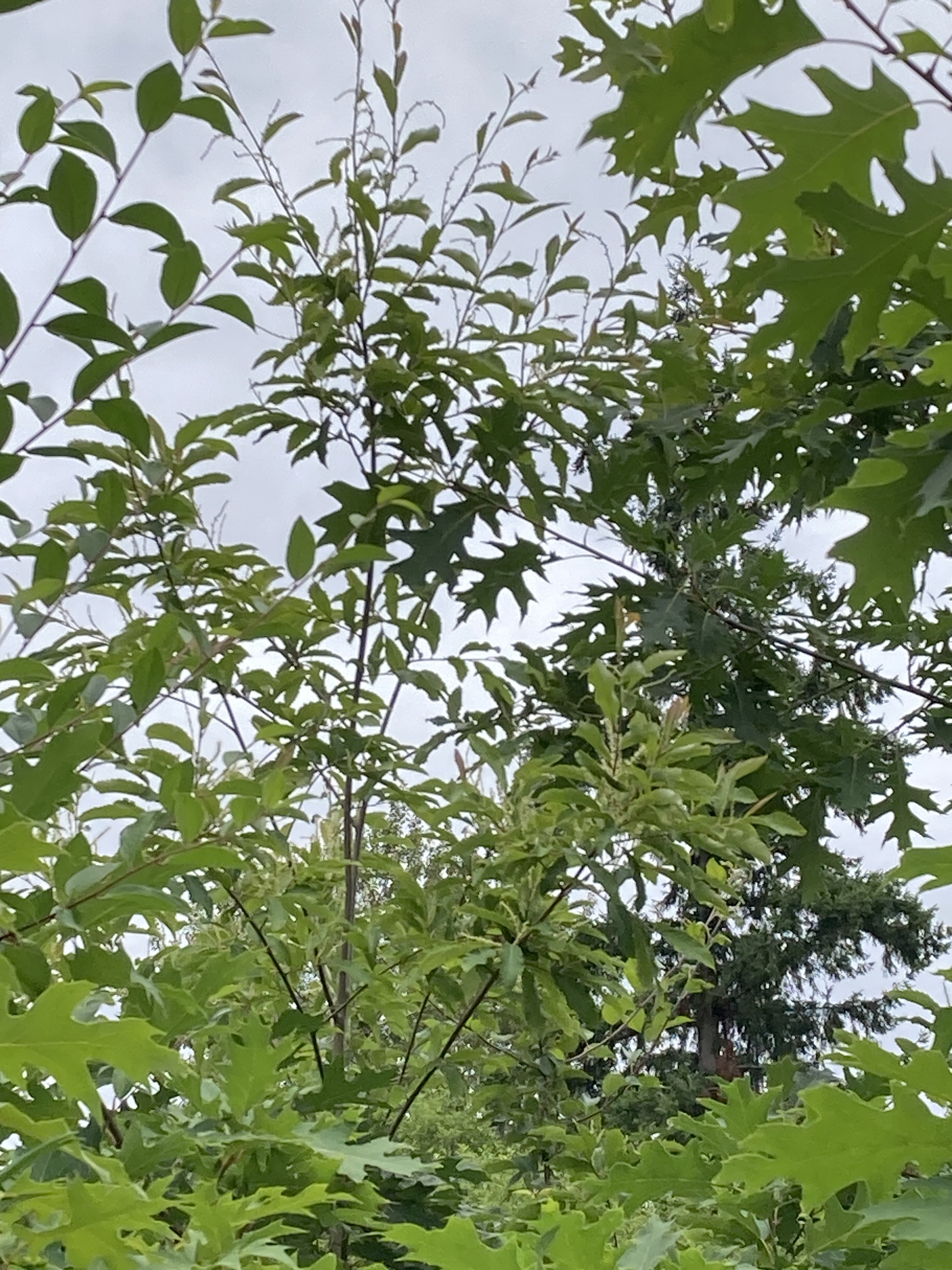
Folded in with some of our crabapples is the illusive chinckapin. We’ve got a few surviving- and even thriving at EEC Forest Stewardship, and this modest chestnut relative might be a future food crop for us in times of need, much like the crabapple. Modest fruit producers can still play a major role in orchard development. The flowers of these species is still attractive to pollinators, and the nuts and berries are often perfect winter forage for wildlife, specifically birds. Also note the acorn bearer in the foreground of the above picture, with chinckapin towering above and sporting its own serrated leaf. Oaks are the future for us here in The Pacific Northwest. White oaks are ideal for acorn harvesting, but even this red is welcome to diversify species. Mixing up your orchard venue adds resiliency against pests and diseases. It adds in nutrient production and creates an intact system of fertility which will bank it’s own soil over time.
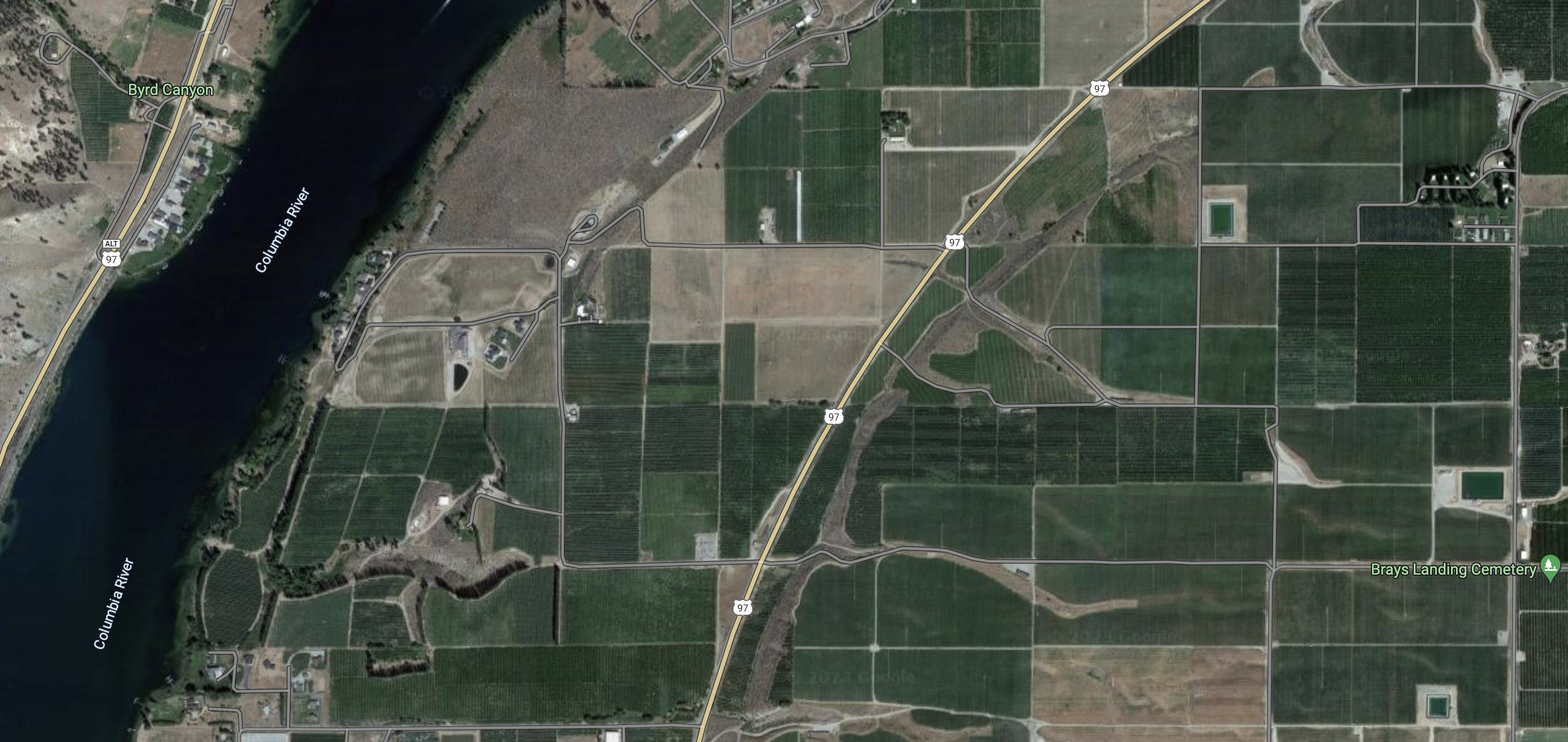
Commercial orchards of today are monoculture wastelands soaked in chemical poisons and often in need of added pesticides because of pest species resistance and dead soil with no helpful bacteria to protect root stock. The rows and rows of mechanically maintained trees is a frightening industrial prospect when viewed from the air.
“Former orchard practices caused widespread soil contamination in agricultural areas throughout Washington. This guidance addresses properties that were impacted by the use of lead arsenate, a pesticide used from the late 1800s until approximately 1950. The resulting lead and arsenic contamination is similar to what is found within the smelter plumes of western and northeast Washington.”
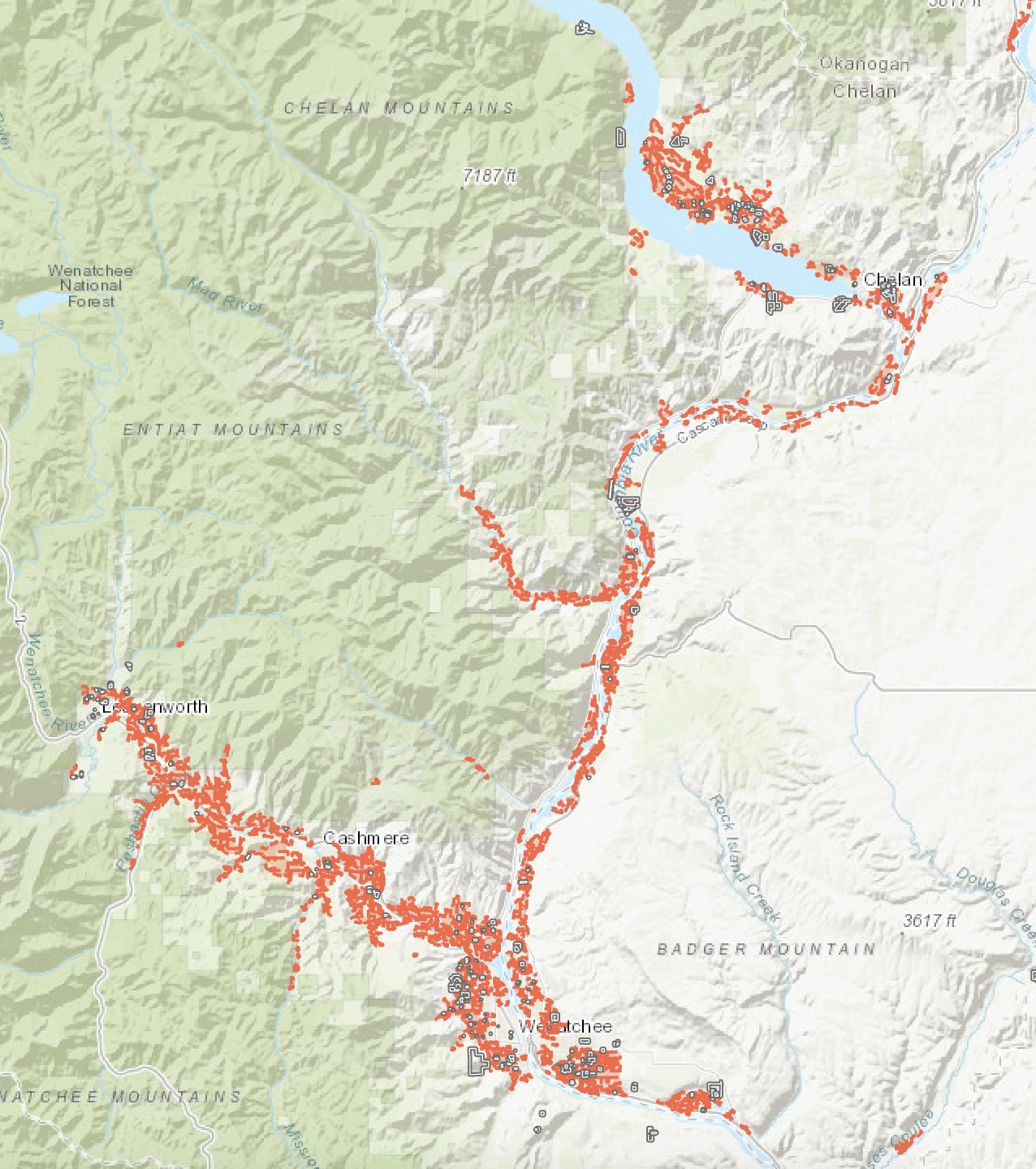
Below is a map of historical orchards from Chelan to Wenatchee along Lake Chelan, The Colombia, and The Wenatchee Rivers. This is the legacy left by industrial farming, and the irrigation needed to perpetuate the orchards, in step desert, included damming The Colombia River in multiple places. But we get a lot of cheap, green power. Well, at the cost of ecological systems like salmon, and perpetuation of expansive settlement in regions prone to fire. Electricity is convenience, and as a Wenatchee elder said in talking about the power lines over a sacred space- “Convenience is what allows you colonizers to be here, take it away, and the land returns to us.”
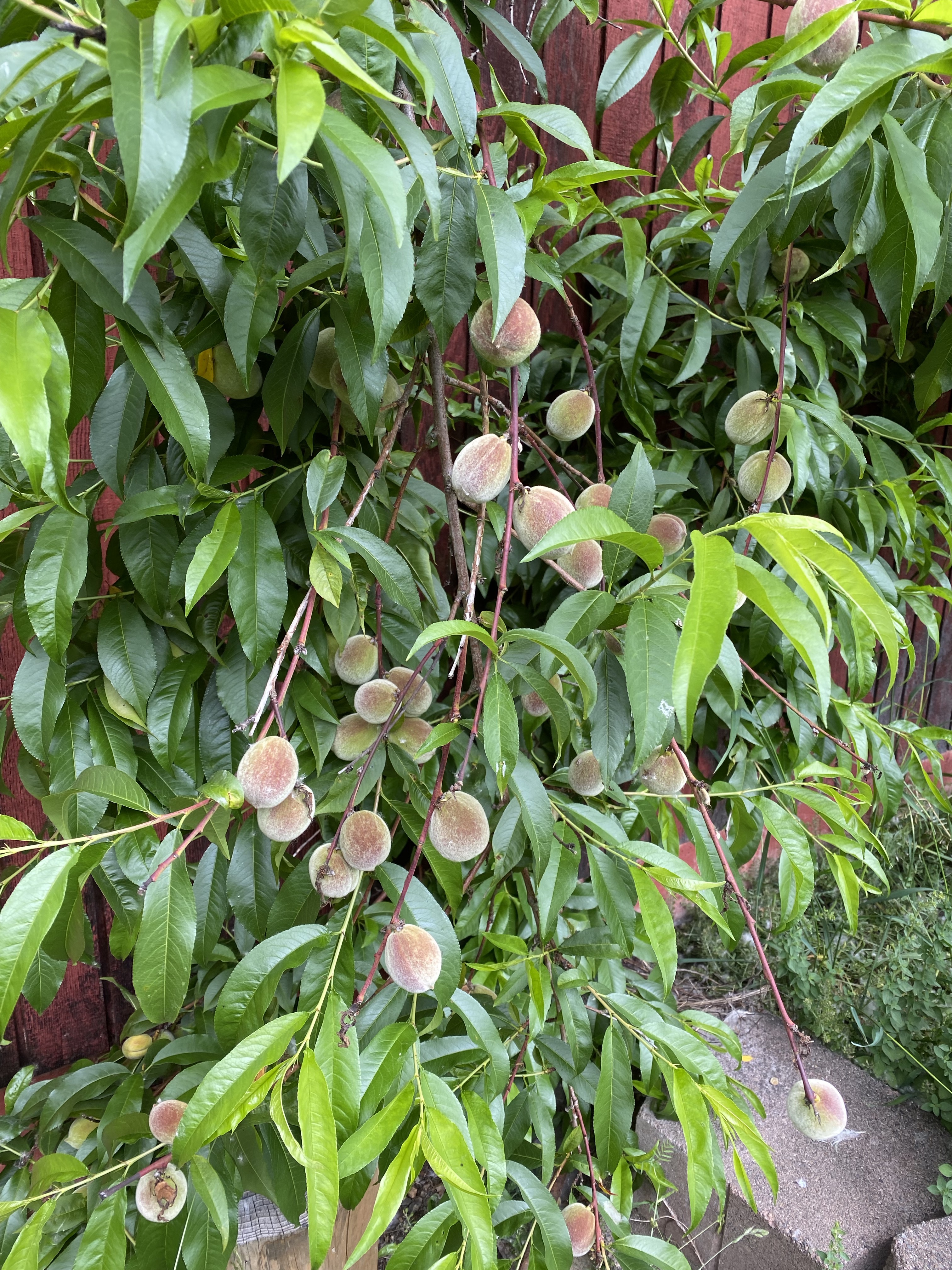
Orchards are such a nice idea, and the history of grafting fruit goes back hundreds of years. Humans have developed a lot of production driven plants to make agriculture more successful- it’s how we’ve fed and grown humanity into a staggering juggernaut, and people are still needlessly starving all over the world. Apples are still pretty cool, and where there is extensive land and water to cultivate sprawling plantations, why not? More fruit more earnings- but also more chemicals, pests, degradation of the environment, and long term loss of fertility. In small scale orchards, like the ones at EEC Forest Stewardship, we neglect the trees to better natural selection. Our peach gets leaf curl, but also gives us a lot of peaches, and that’s enough. The sweetness enjoyed still counts, and in a good year we can put away a few gallon bags of the succulent fruit to enjoy in cold winter months too. That’s enough.
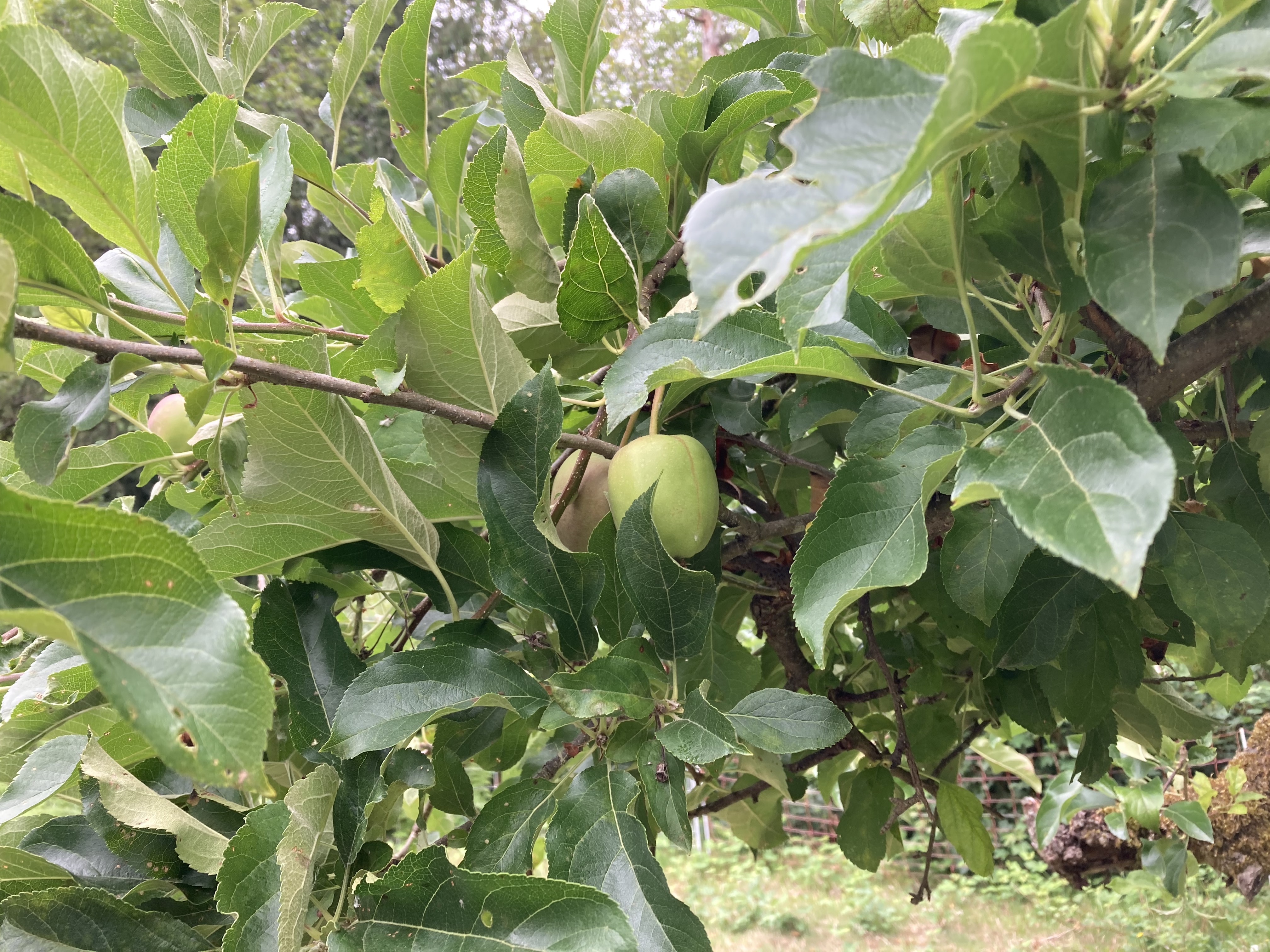
Our plumbs have been teaching a rather important lesson about the vulnerability of grafted fruit. Only 1 out of 4 plumb trees planted has kept it’s fruit bearing strain. I just picked about a baseball cap’s worth of fruit, each one about the size of a ping-pong ball. The branch is withering in our summer drought. The part of the tree which reverted to root stalk, is lush and green, much larger than the fruit producing branch, and thriving though the summer with no problem. Why is the grafted branch so much weaker? Because we selected it for the sweet fruit, not drought resistance. We made a resilient natural thing into a vulnerable, easily compromised low reward specimen- but man, that fruit is good, melts like candy on the tongue. I hope to re-graft off of this branch to take back my other plumbs, but it’s perpetuating that vulnerability once more. Perhaps we’ll save the pits from these plumbs too- plant some new genetic stock and hope one produces decent fruit. That kind of food evolution could take lifetimes, so I understand why people are so into current fruit strains like the most recent here in Washington- Cosmic Crisp.
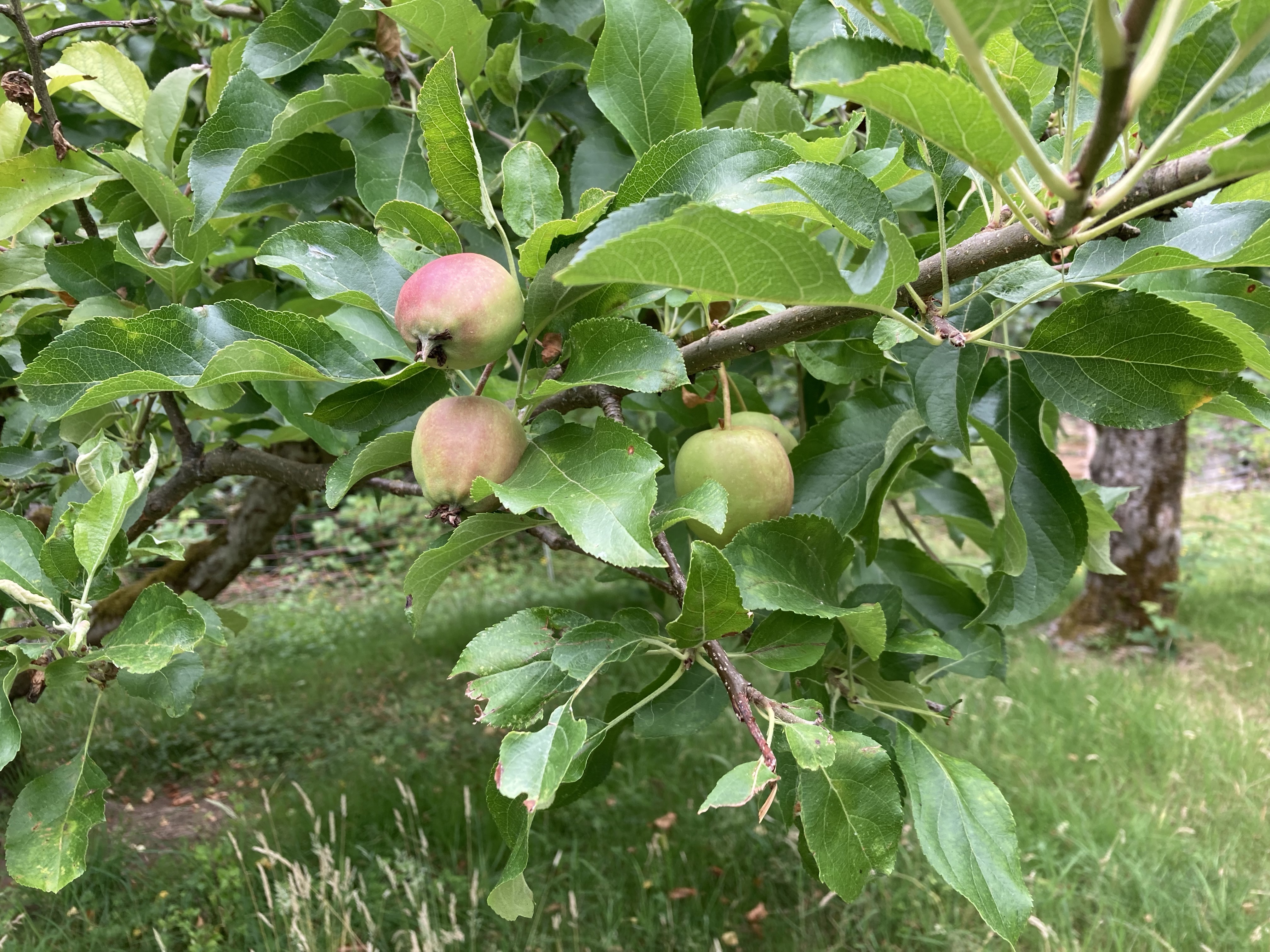
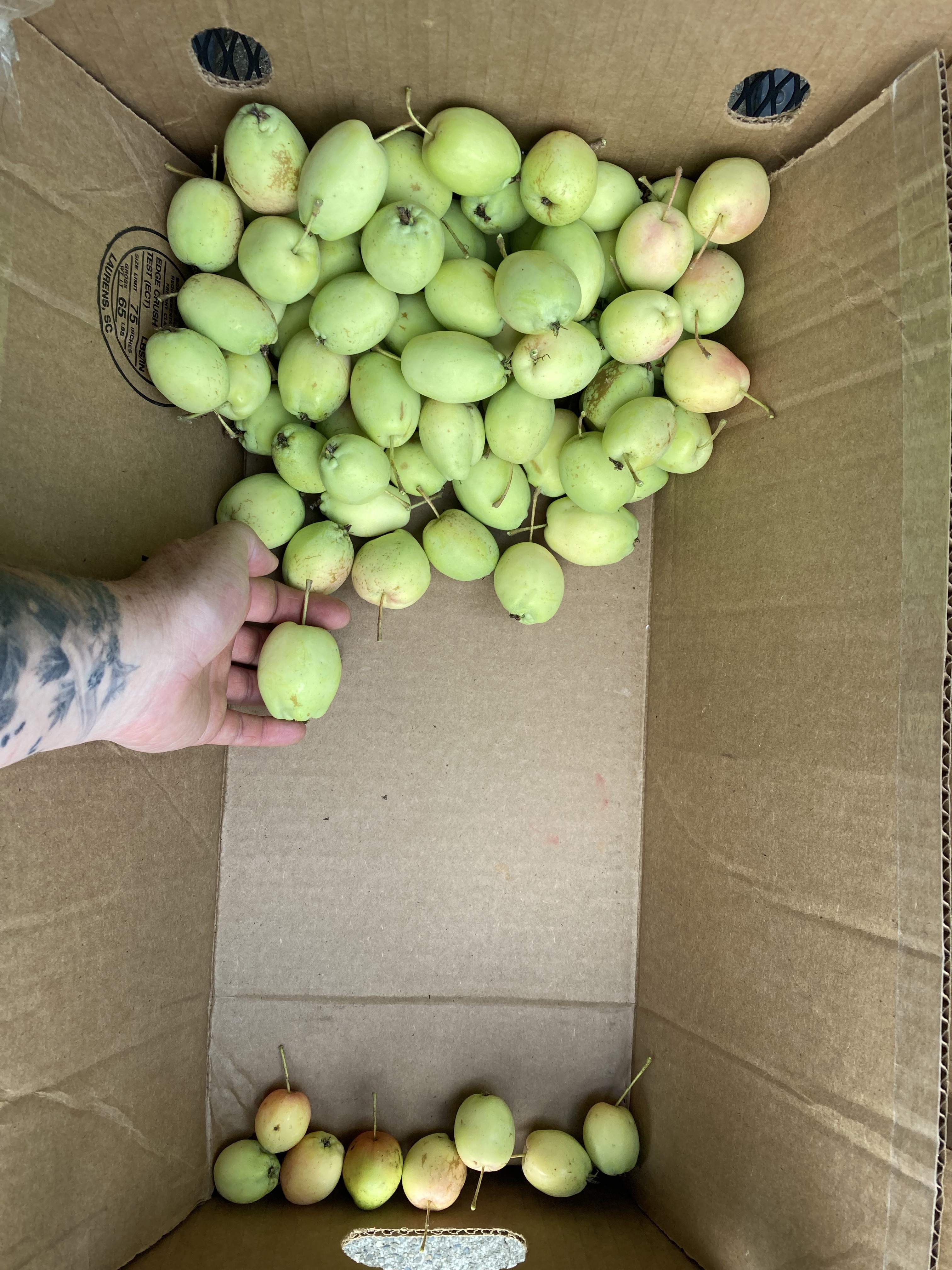
At EEC, we’ve been shifting away from heavily developed apple strains back towards the more primitive crab-apples of olden days. Though the Pacific Apple is regarded as starvation food, there are some cultivars that have decent flesh and flavor. This picture above is a first harvest from our not irrigated tasty crabapple. 3 other varieties were put in this year to compare. It’s a modest producer, but the fruit is sweet, and getting fruit without irrigation is a plus. This tree handles the drought well and graces us with a modest, but delicious reward for our efforts in cultivation. Orchards can be small and still abundant. You don’t need chemicals, but expect blemishes. Pick your fruit quickly too- the birds love predating on ripe trees. I’ve had a lot more success this year grabbing all the fruit at once and letting the under-ripe mature a little more on the counter or in the fridge.
Upcoming harvests include peaches, more apples, and hopefully some chestnuts this fall. Our pears are also looking great this year, and we hope that as more orchard trees mature, we’ll have more than enough fruit without having to hassle with chemicals, pruning, or irrigation as canopy cover spreads, and understory companions move in to complete the ecological circle of nutrient dense vegetation from soil surface to tallest mast in the forest. We’ll keep picking, planting, and preserving!
Wildflowers peak and grasses brown as Summer’s heat sets in at EEC Forest Stewardship. The State is in a drought, our irrigation is on and keeping the crops thriving, though the water table continues to drop and seeps vanish. Green patches are grazed down first, and standing hay is still ignored, but come late August, any stem will do. We’ve been managing pastures for drought, and expect to begin haying the sheep in the barn by late September, though pasture conditions in our region would usually stretch into late October with proper rains to keep the pastures green and lush. Observation like this is crucial to keeping the land healthy and the animals properly fed. I’ve been noticing land around me being damaged by overgrazing and girdled trees. Many folks are not observing the climate changes, and still turning stock out into fields all summer with no oversight. It’s having an impact, and I’ve watched beautiful land turn to moonscape in just a few weeks of animals not being rotated off in time.
Here’s a good picture to show the eaten vs. uneaten swath of land. The left side is eaten thoroughly, on the right, grass is still green and lush. The fence is being moved to open up onto that fresh ground, while the eaten down side will be fenced and rested. Below is another picture of grazed vs. ungrazed. One might think it still looks lush and good under those apple trees- but the unprotected grass outside the canopy is at its limit, so the flock is moved on. That shaded grass will recover faster, but you should base your rotational timing on the most vulnerable part of your pasture, otherwise the gap in quality will grow, and hard hit areas of the landscape will erode faster. It’s sometimes hard to measure exact conditions, and here on the western slopes of The Cascades, our landscape is very non-brittle most of the year, but right now, in the height of summer drought, we are as brittle as it gets, which means poor land rotation can cause great harm. This ecosystem management has become extreme, and without proper grazing adaptation, even our lush rainforests could become deserts.
The heat also makes great demand on our water resources. Gardens get full irrigation every other day, and the young orchard cries out for another deep watering, which will come at the end of August. We’ve received no impactful precipitation into the soil, but a hard rain at the end of July for a few hours charged up our cisterns at the right time. A 500 gallon tank will keep our livestock well hydrated though the rest of the summer- if we get our rain in October, but last year, we had no rain in October, but it did remain in the 90s for a few more weeks. These are extremes for Western Washington, and with a major drought on this summer, 2023, we are not going to catch up in rain missed, for if we do, a true flood would have to occur several times between now and the end of the year. It could happen, as hundred year floods have become 20 year floods, and those 1000 year nightmares are also sure to come. If we did get a deluge in early fall, before the soil has a chance to re-hydrate, the erosion impact could be catastrophic.
Here at EEC Forest Stewardship, we do our best to keep the soil covered. Canopy is optimal, but even with tall trees, no understory will allow erosion through, and since we’re already on a hillside, we have to slow and sink in all walks and forms. Even with our water catchment systems, dusty soil is vulnerable to erosion, so we’re continuing to work on mulching by layering vegetation to act as a sponge. This may seem counterintuitive with all the fire danger out west, but rainforest is more resistant to burning because of the water retention in the soil of deep forest duff. When we remove that forest floor much, the soil dries out faster, and the plants wilt and become brittle tinder. My garden thrives on less water when I mulch, and that layer of protection plays out the same way in the woods. Sheep manure adds to that mulch, but the sheep also denude the landscape, so again, balance in all things.
Warmer summer days turn into beautiful evenings best spent on a lake fishing, when there’s a chance to get away from farming long enough to catch a few trout for the larder and to enjoy this beautiful landscape all around. In less than an hour we can have our hooks in the water at an almost private alpine lake watching the sun dip low in the west. There’s a light haze of smoke in the air, but the mists blanketing the mountains to our east floating on light crisp mountain breezes across the lake, sending a shiver over the shimmering water. Evening light stretches on, allowing us a little extra time recreating in this great place we call home. When it’s hot, escape to the mountains, when it’s dry, water wisely, and move the animals more frequently or reduce numbers on the landscape. Take time to rest when working in the heat, our 90F days will leech the life right out of us. Thankfully, our location offers some climate reprieves- only a few days of truly hot temperatures have arisen- thus far in our summer of 2023. We are not out of the frying pan yet, but with some good preparedness, we won’t end up in the fire. May the cool clouds bring rain and respite to all in need. May the fires that rage in so many places this year be quenched by the sacred waters, which are the life bringers of all things. May the heavens open gently and return the trickle of life to every creek and spring. Keep our soils fertile and our stomachs fed.
Bright sun and early warmth has brought on a fruitopia of young, unripe color signaling the potential for a bounty of harvest this year, 2023. Our peaches, plums, apples, and pears are all developing nicely, while berries abound all around. As I write, at the start of summer, a recent few days of much needed rain are quenching the orchard’s thirst, and we’re still optimistic about our trees and their output this year. Establishing productive trees has taken almost a decade now, and fruit has not been a main focus, but an important spoke on our wheel of vegetative diversification on the landscape. In seeing the fruits of our initial labors selecting the best varieties for our microclimate, while not making pruning and weeding a priority, enough plantings have established to give us some idea of what works and what doesn’t, so we can invest in success for future plantings- when and if we need them. As of now, there is already more than enough fruit to tend on the land. If more people were to arrive and give time for food, more plants would accumulate and more care could be given. This is the beauty of EEC’s development. Scale is so important in design, and knowing the limitations of scale for an individual helps implement manageable systems of food within restoration agriculture. Our eventual plan is old growth forest, with a few clearings to diversify ecology. The agricultural part of the landscape could remain as needed, or be scaled back to make way for more native growth.
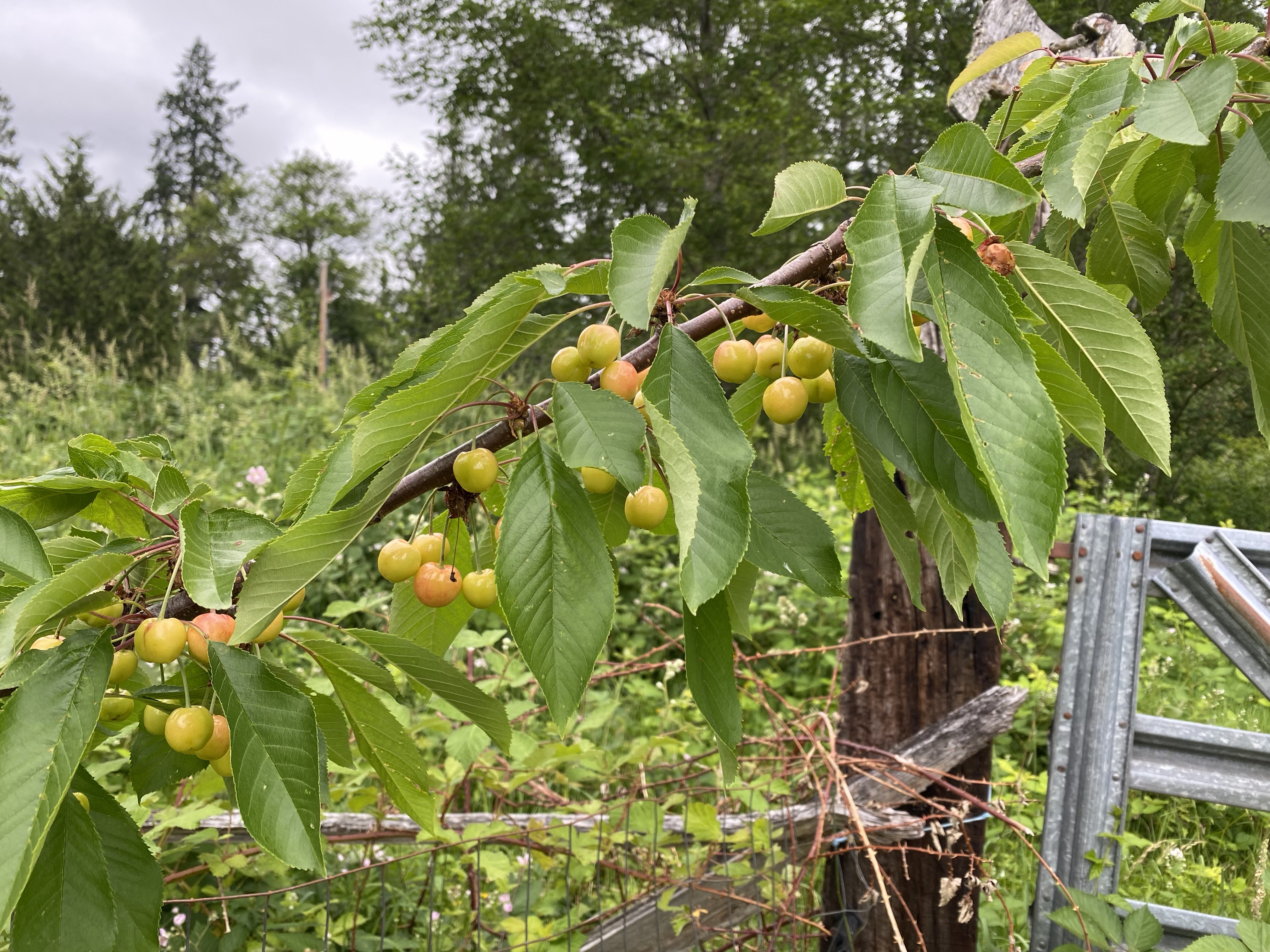
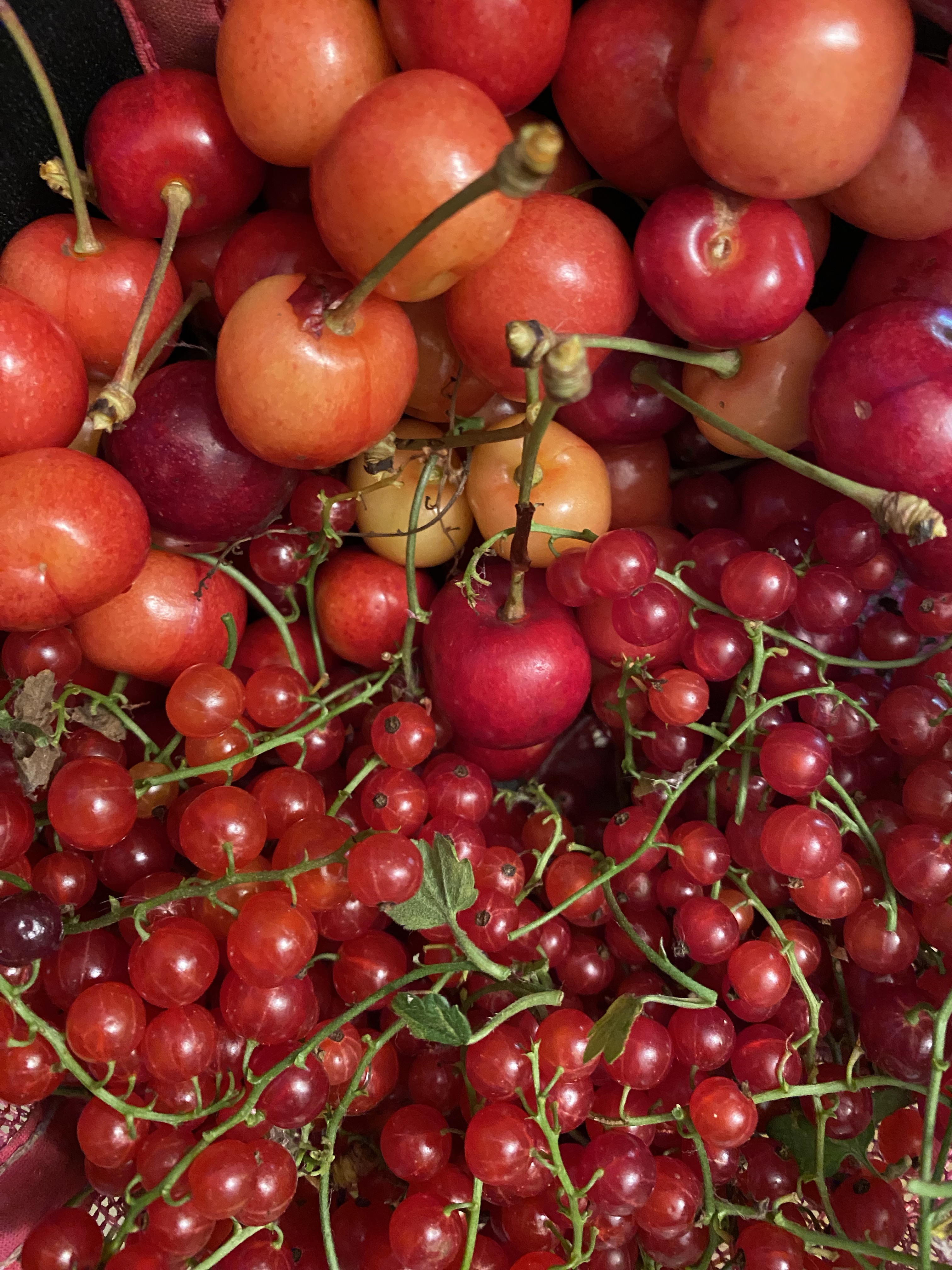
Hosting food forest and lasting agricultural capability is still in the cards, though right now, the general public is not in need of hyper local food resources, because COSTCO and Safeway are stocked plentifully. We’re much more excited to pick our own fruit here, but we still don’t produce enough to last the whole year. As a backup, we still buy additional cherries directly from farmers on the east side of our state, and apparently it’s a state regulation that commercial growers spray certain chemicals on their orchards to prevent the spread of blight and pests. Our cherry trees are not treated- we don’t use any chemicals on our food crops. However, we do get curly leaf, scab, and other bacterial plights which occur naturally in the environment, and help select strong genetics for the survival of a species. Our peach tree is blighted, but we get plenty of peaches from the tree. Our apples have scab, but the fruit tastes great, and we still get plenty of apples, just not on an industrial scale. Commercial orchards have to produce on a given level or fail economically. In our orchard, when we have a bad harvest year, we just have less in the larder, which still hits us economically in grocery bills during the lean times of winter. Remember, grocery stores only have fruit year round because of importing from across the globe.
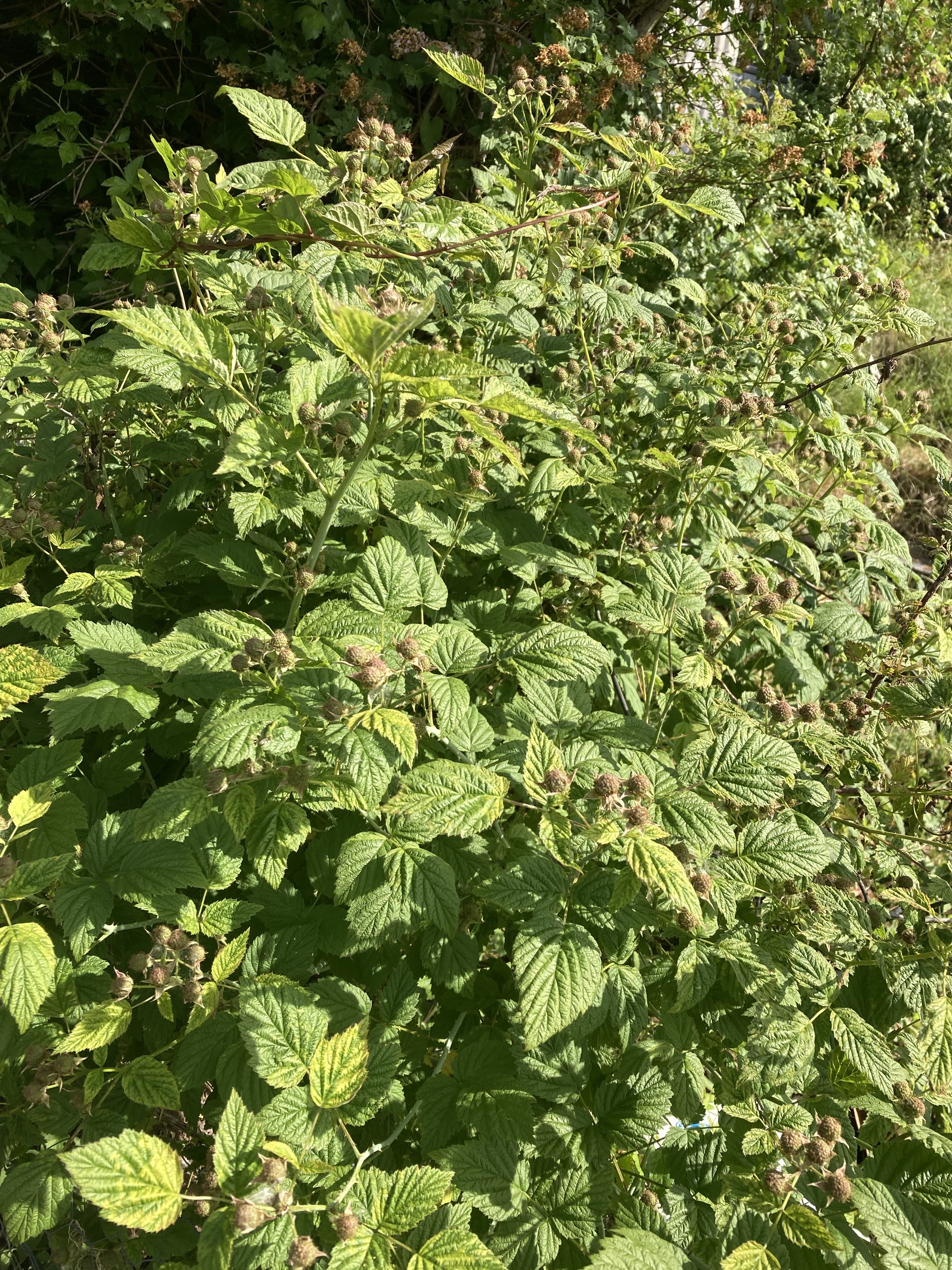
Berries are truly the native fruit of Cascadia. Trailing blackberry, salal, oso, blueberry, Oregon grape, huckleberry, and black capped raspberry (pictured below) are some of the many tasty treats nestled away in the understory of our great temperate rainforest. We’re cultivating a black capped raspberry in the main garden, trellising it up and encouraging replanting of outer tendrils to make more plantings. In the wild, these plants are often overtaking by invading blackberry along forest edges. This powder coated stalk is often thriving on scree slopes or in dappled shad field corners. I rarely enjoy the fruit in the wild, as animals crave this flavor too, and usually hit the bounty of this shrub early in it’s development. Our garden specimen is heavy with green berries, and I look forward to tasting a few in mid-summer.
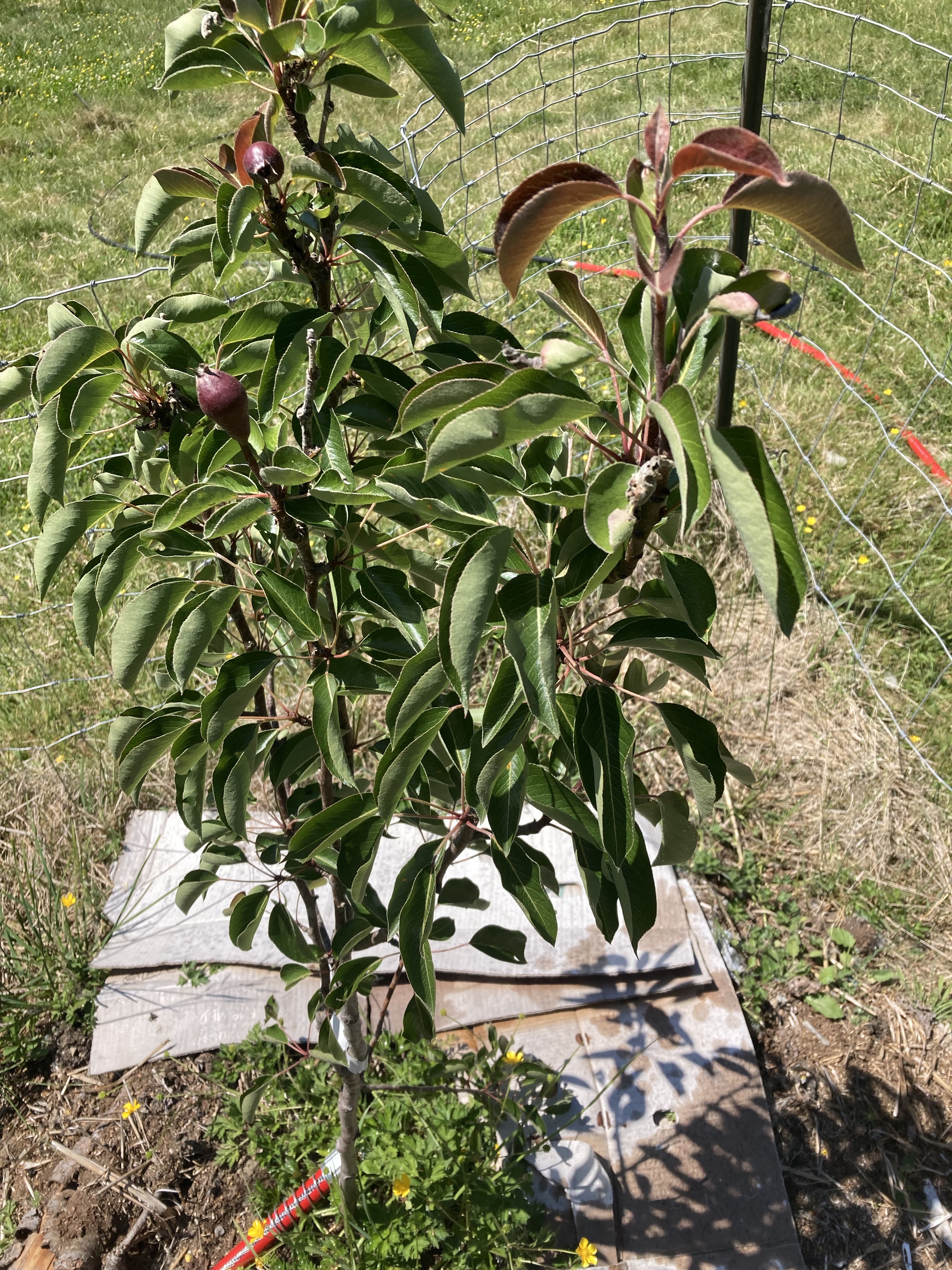
Other new fruits to our orchard include crab apples, some pear verities, and flowering plums. Pears are having a bountiful year, and even a winter planting from Raintree Nursery planted this winter, is offering a modest, but beautiful fruiting. It’s best to pull off the fruit on very young trees like this, to encourage growth in the woody parts of the tree for size. I embrace the Masanobu Fukuoka way with orchards- a very hands off approach. Anyone thinking about fruit cultivation should at least look this guy up. If you’re into restorative agriculture, read One Straw Revolution for some great tips and tricks, as well as philosophical ideas on natural farming. We’re working towards stepping back, allowing nature to step closer. Fruit trees today, oak and nut tree savanna in seven more generations.
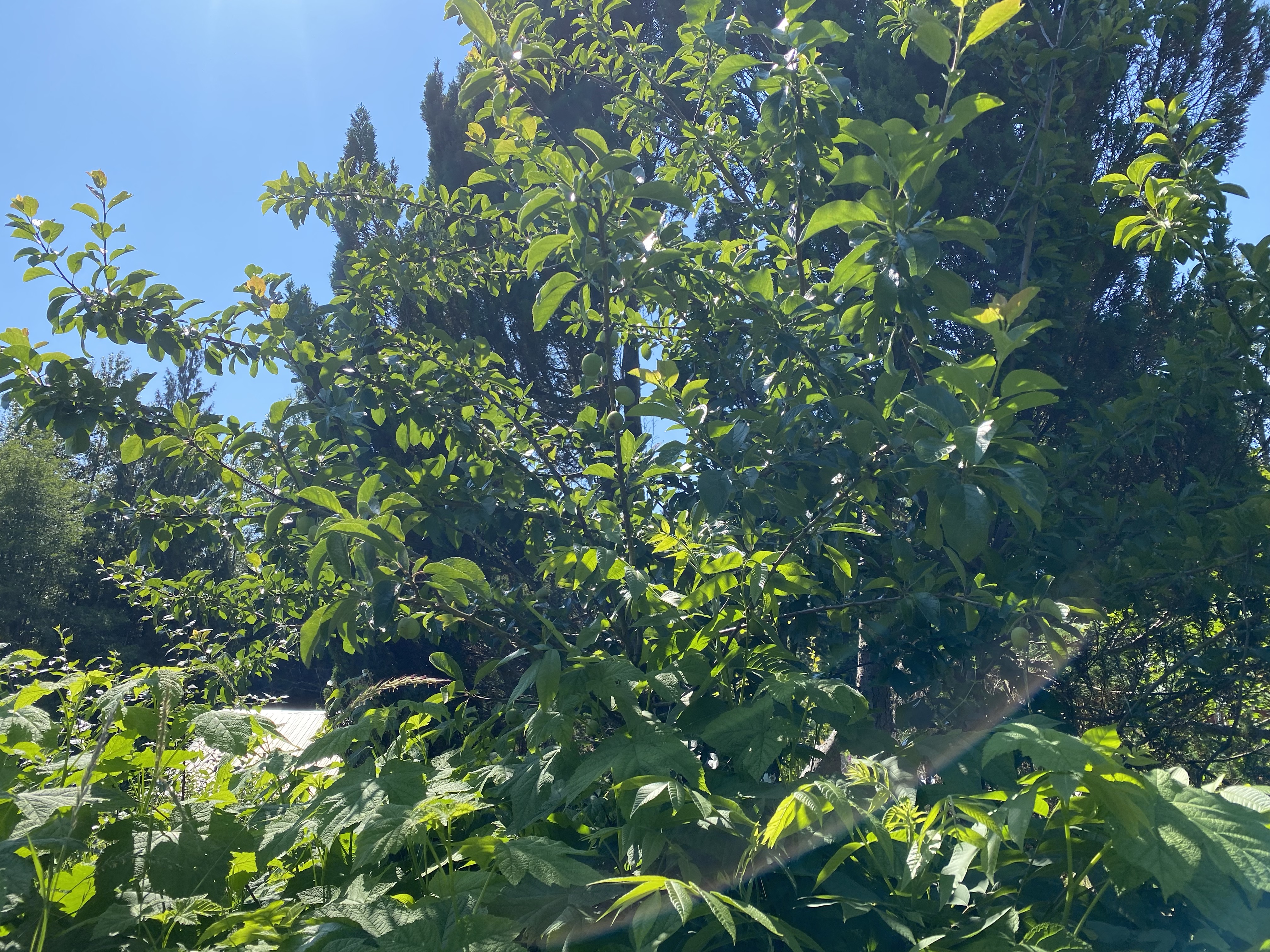
Plumbs are showing up in force, for the second time in seven years. A few of our initial plantings lost their grafts, so the growth now is root stock, which can be re-grafted in future. Grafting is an art form, and stooling, re-rooting, pleachering, these actions craft ever expanding growth of all kinds at EEC Forest Stewardship. Layering species together in more complex networks adds resilience, longevity, and productivity within the regenerated habitat. Orchards can be sterile and harbor deep chemical dependencies on industrial landscapes. Holistic orchards and the departure from row cropping and monoculture will be talked about in my next blog, so I’ll focus more here on our currant fruiting- we did harvest a modest crop of currants this year (2023).
This picture of layered fruits- thimble berry on the bottom, plumb in the middle, and eventual black walnut (in middle at present, center foreground) completes and evolutionary track towards that oak and nut grove savanna mentioned earlier. There are also Nootka roses, a pacific crabapple, and a decorative cypress present in this plant island of zone 3 in our landscape. What a happening habitat! It’s well mulched, on the bottom of a slight slope where water collects, and gets a little irrigation from the pillow tank. We planted squash on the outer rim this year, a sort of experiment in utilizing that irrigation, and space. This is the kind of fruit cultivation that thrives and jives at EEC. We’ll keep cultivating towards abundant harvest and hope these budding fruits mature into blessed bounty!








 EEC Forest Stewardship