The trail-cams here at EEC Forest Stewardship show us glimpses of a rich and thriving habitat for our wild forest friends. This Fall, during the slaughter season (we process our domestic animals on site), we do not waste any part of the carcass, placing awful and bones not used out in a safe place on the land for wild creatures to partake of. By safe, I mean a place away from our livestock and living space, down by the creek in the wildlife corridor. There we know cougar, bobcat, bear, coyote, opossum, raccoon, and more thrive and jive. Here are some recent images of the greater community of animals EEC calls neighbors and friends. For some, these wild animals might seem like a threat or danger, but the animals were here long before us, and we have great respect for them on the landscape. Our hope is to work in harmony with all living things in the forest, creating safe space for all things to live in peace.
We do not over-romanticize our relationship with wild things- they are wild, unpredictable, and a potential threat to our livestock. They are also playing an important role in nature, deeply woven into the fabric of this land. The carnivores among them have predated stock on the farm in the past, but I don’t begrudge them, I understand it’s my responsibility to protect my stock and keep them out of harm’s way. We now have strong fencing, a good Livestock Guardian Dog, and have prevented further loss of domestic life with strong boundaries. That also means keeping our livetock out of the wild places on our land. The sheep and dogs do not hang out in the wildlife corridor, allowing wildness to have space of its own on the land too.
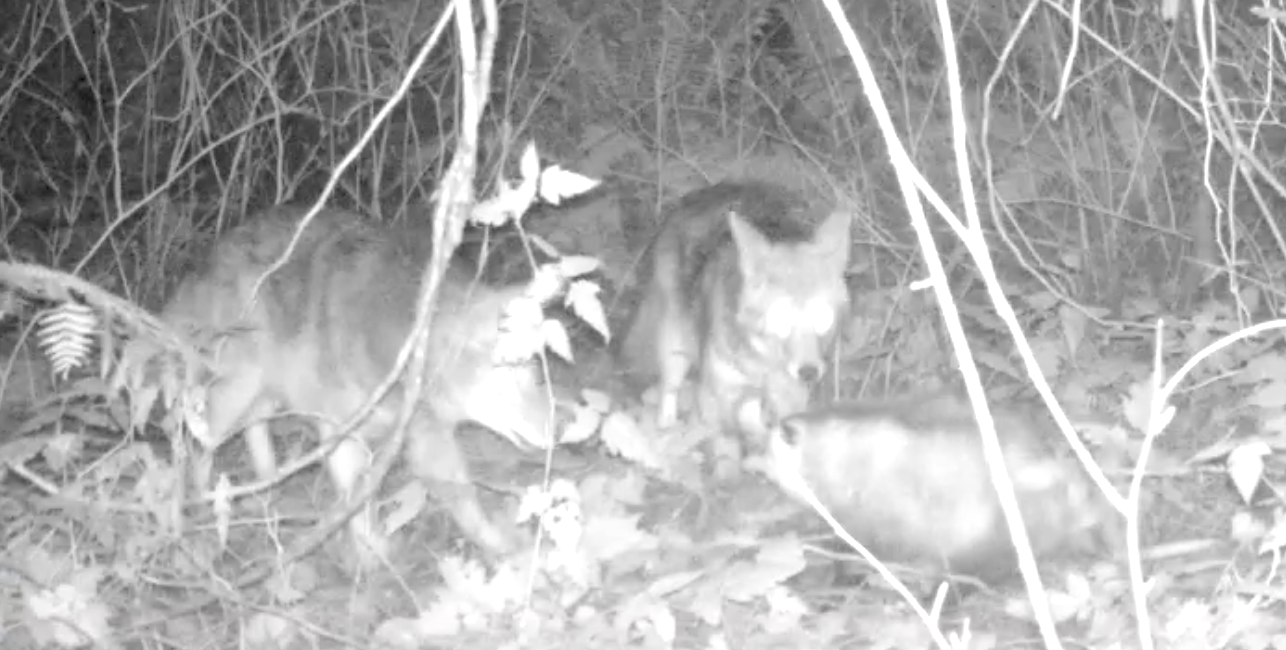
Coyotes attacking an Opossum
Our trail cameras allow us to view the wildlife without disrupting it. We’ve been lucky to see a variety of different species, as well as behavioral action that shows us an intimate way of life few people are privy to. By observing the activity of nature all around, we form a closer relationship to the natural world and our own place in it. If you have access to land and the opportunity to set up a trail camera, I highly recommend it- you’ll learn so much about your area and wild neighbors. You might be surprised to discover some of the animals living close, or you might be a little freaked out. Even in urban places, wildlife thrives- or at least, survives right under our noses (or apartment buildings). Here in the temperate rainforest, we’ve got apex predators and flying squirrels, coyotes and beetles, an elaborate collection of living things which make up a complex ecosystem we rely on to survive.
As the season changes from abundance to dark, wet, cold times of challenge, we recognize that wildlife is feeling the pressure of the changing season and taking in the last of the good life before winter’s lean times set in. It’s important to recognize these changes and embrace them too. People today are far less connected to seasonal change, nature’s rhythm of boom and bust, and the cause and effect these cycles create in our living world. Bears are filling up on a feast before the last berries are fallen from the bush. Coyotes are moving closer to the barn, hoping to catch a chicken that strayed too far from the coop and away from the watchful eye of the guarding dog. The opportunistic opossum creeps along the edges sniffing out food scraps and fallen grain, they have also eaten chickens in the past and will again if the coop door is not tightly closed. These are good challenges to work with as a farmer and land steward. When I loos track of these changes, the wildlife will teach me the folly of my ignorance. If only more people would embrace that learning, rather than blaming the predators and seeking revenge.
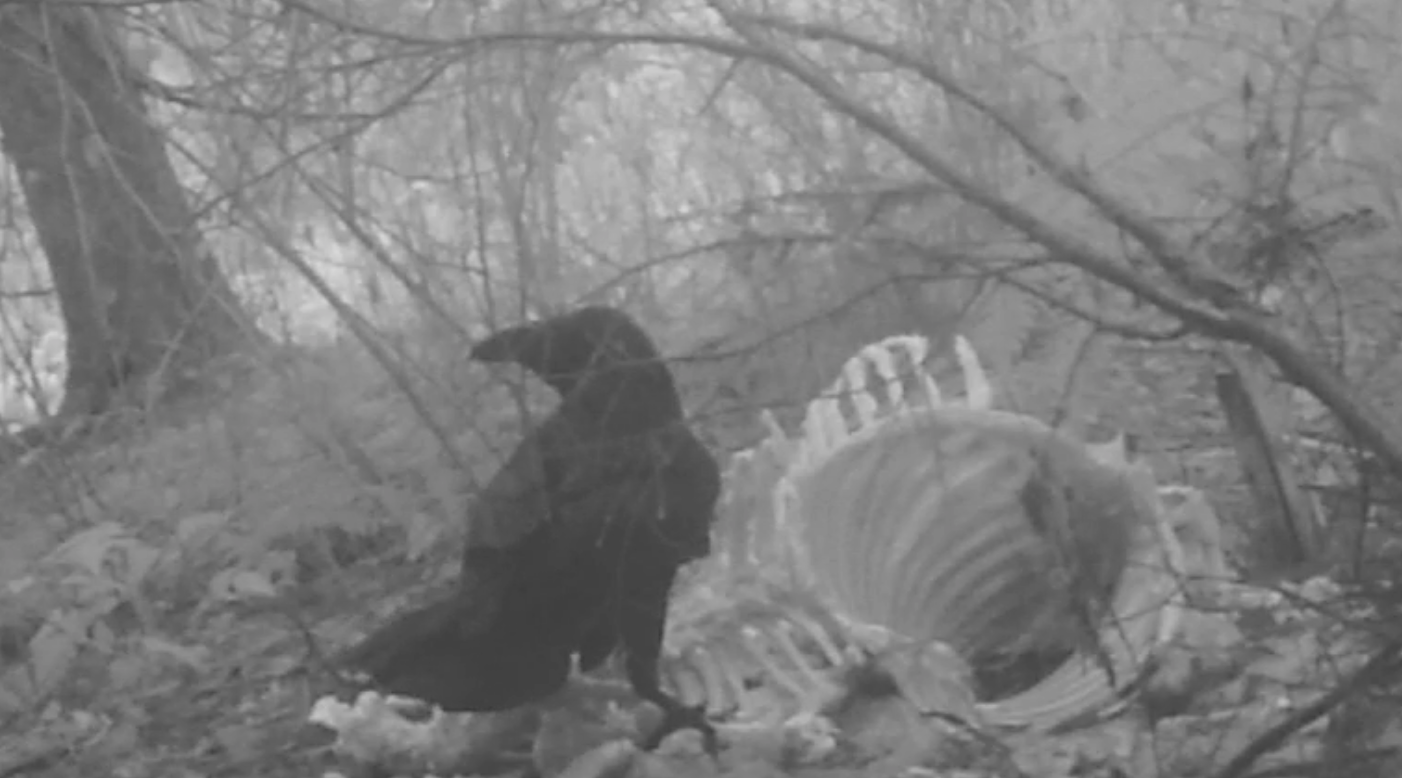
Raven feeding on sheep rib bones
Every friend in the forest has a special place in our world, and though we are often blind to the full picture, we have an important place in that world too. Every time an animal shows its self, there is information to take in. I am grateful to have a chance with each of these encounters, to reflect on what mother nature is allowing me to see. It is also a pleasure to share these images with you reader. In this time of giving thanks for all our gifts in this life, I am humbled by all the opportunity this land offers, my place in it, and the stories to share.
On a family visiting trip we had the opportunity to visit one of my favorite prehistoric sites on earth- Tsankawi, part of The Bandelier National Monument near Los Alamos, NM. This ancient site is home to early ancestors of modern Pueblo People living in The Rio Grande rift. This incredible geological formation of sandstone canyons layered with basalt and pumice from volcanic activity millions of years ago. This magical place awakens such passion in me for understanding human survival and planned settlement within the landscape. Here was a place deeply connected to human life through extended trade- all the way into Central America, diverse natural resources like clay for pottery, obsidian for tool making, and sacred caves weaving together strong spiritual connection to underground ritual. When I step into these cliffs, I see red sandstone like the kind I grew up with in Oklahoma, layered above with white pumice, both soft stones that human tools shaped into dwellings, temples, and other important shelters for human use.
As I child, I would often explore the land in Oklahoma looking for good places along canyon walls to build “forts”. The rough sandstone often relenting to water and wind erosion, shaped into natural overhangs and hollowed out crevices which easily supported stick and debris shelters I erected. At Tsankawi, the land speaks the same language of sheltering in the rock and getting a good lay of the land from the cliffs. Human instinct is on display within these ruins, echoing the struggles of people to survive in a place where harsh conditions eventually drove humans to abandon these sacred places. In walking through these scattered dwellings and rocky paths worn into the rock over time, I sense the importance of location, cultivation, topography, and management of resources. People lived throughout these canyons in large numbers, working together to eek out crops, design water catchment to store as much rain as possible for the drought time, and good relationship with neighbors to ensure peaceful coexistence and support during lean times.
The bottom land below the cliffs channeled water when rains would come, usually catching the heavy storms, only too briefly dumping many inches in a few hours. The rock escarpments shed these rushing torrents in moments, and without planned gathering points along the canyon floor, the water would wash on down the road (so to speak) without offering much refreshment to the small enclaves of human habitation along the way. Rock channels sent the rainwater down shoots along the cliffs and into catchment basins below lined with basalt rock holding back short lived streams to feed meager crops. The narrow canyon floors not only channel water, but also animals for hunting. In a nearby settlement only a few miles away, we watched a herd of white tail does browsing along the stream bed in search of water and lush grass only found along the shaded canyon floor. Again, the topography creates not only shelter and water, but also food. The animals have to approach the water, and the narrow space leading to it offers a predictable path to hunt.
Today it seems we’ve lost out eye for the land and its abundance. Our recent generations have exploited connivance at the cost of longevity. Though our human ancestors who lived in these remorseless places faced far shorter lifespans and little security, they survived, and the evidence suggest, even thrived in these canyons long ago. It was not until mother nature held the rains back, that the people who lived here were forced to move on. What our ancestors left behind shows complex social structures with great connection to place- an understanding and respect for the natural world, and deep gratitude for the close connection with land, wilderness, and the finite resources available. Still, there is evidence of over harvesting for firewood, over-hunting of minimal wildlife on an already taxed landscape, and eventual conflict over food and water. This continue struggle for balance haunts us today- though we ignore these specters with frightening indifference. Here in New Mexico, water is scarse, and getting scarcer by the day, yet people continue to move in, over develop the land, and push strained resources beyond what’s possible to survive. When are consequences felt?
Our ancestors moved as climate changed, and we will be forced on similar paths soon, many people are already displaced by natural disasters, drought, famine, and desperation to survive. Perhaps if more modern day people, especially in economically dominate places like The United States, took time to look back at our past civilizations right here in North America, they would better understand the tough challenges now facing humanity. The ancestors of Pueblo People in The South West are still alive and culturally relevant, though most colonial imports (white people) are blind to their very presence- beyond what Hollywood chooses to romanticize. Right now, the Pueblos are closed to outsiders as a protection against COVID-19. It was a relief to see all the Pueblo gates closed and locked to tourists from the outside. Though the casinos were alive and hopping- welcoming in Those Who Take the Best Fat.
Our lives on this earth are so short- compared to the vast geological time stretching out across the landscape. Fragments of pottery, chips of stone from tool making, even carved shapes on the canyon walls stand as testament to the ingenuity and determined link to survival that all people posses, but without that connection to land, community, the delicacy of nature and her resources, we are doomed to fail in our severance from the earth we rely on. When water out of the tap is no longer safe to drink, when food is full of poison we ingest- growing cancers in our flesh, when greed removes its hideous mask of opulence to reveal horrid face- pestilence and poverty, then it will be too late. Where once people could move on to better pastures, greener places, we will discover- too late- that we’ve poisoned the whole planet, and no place will offer sustenance or sustainability.
The incredible technology and global connection today should be a boon, but our apathetic consumer conditioning, though slipping, remains a mask stuck in place, dimming our vision, hindering cognitive development, and squandering our dignity as the human race. Why have we fallen so far from grace? Nature continues without us, and without us it will recover in time, millions of years in the future, perhaps a new species of people will come across our ancient ruins and wonder at the stupidity of mankind, his blatant abuse of the planet, himself, and his people. Our micro-plastics, polluted landscapes, and cruel handling of each other will not paint a pretty picture on any canyon walls. What have we abandoned in these modern times to maintain comfort and commodity?
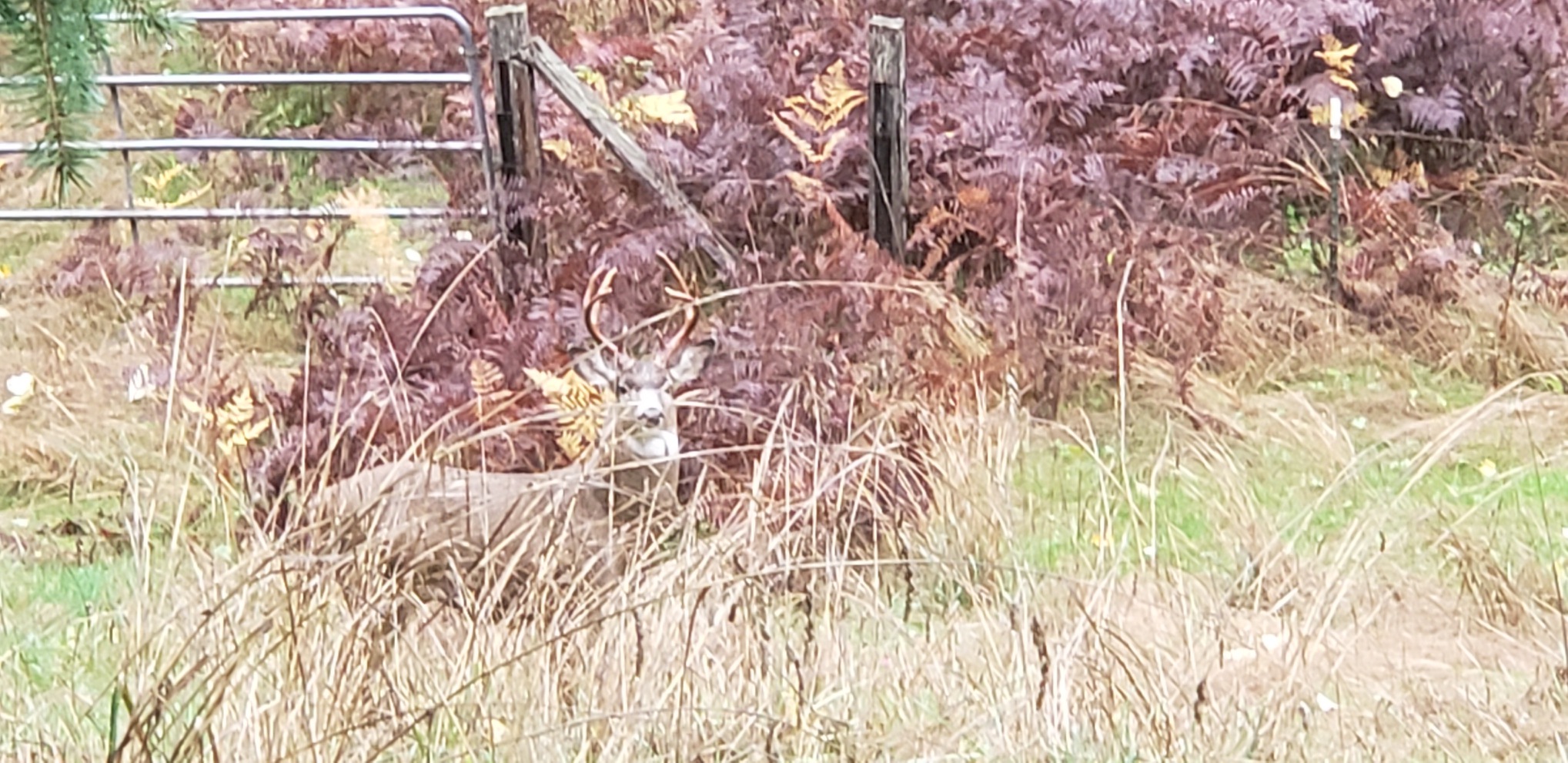
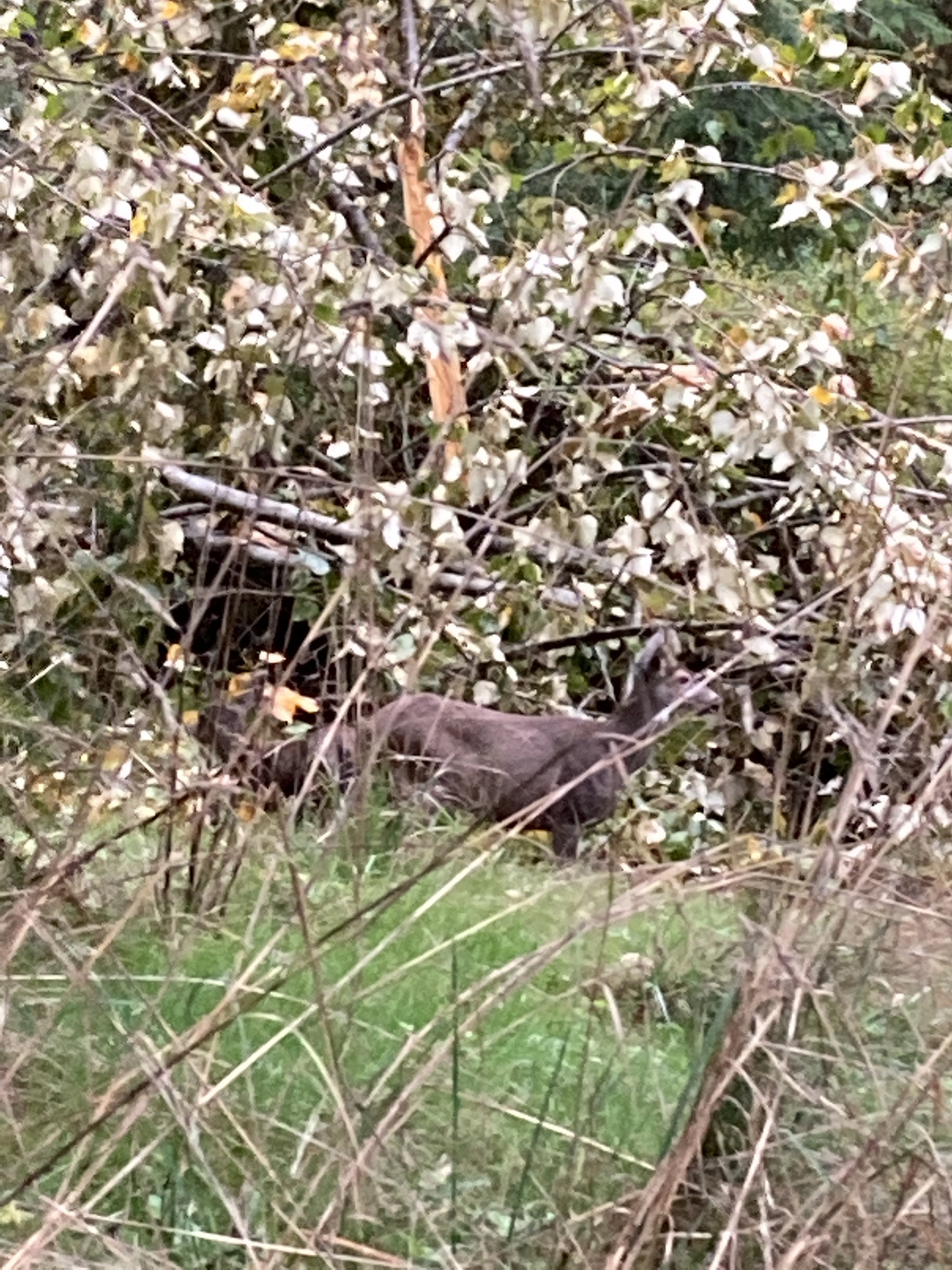
Tis the season for black tail deer, and I’ve been hunting hard for our limited two week season here in Western Washington. The buck pictured above was “shot” by a neighbor’s camera. I have been given the great privilege of hunting their land for this beautiful animal, and so far, he has been MIA when ever I’m around. His harem, on the other hand, has been more than happy to spend time with me while grazing, offering great behavioral observation while I wait patiently for the antlers to arrive. In my GMU (game management unit), you can only harvest bucks- of any age. This mature male has had plenty of years to pass on his genetics, and would be a great source of meat for winter’s cold dark times. The privilege to enter a neighboring property in pursuit of this animal demands the upmost safety and mindfulness in being a good guest. I only hunt in this 40 acre parcel using a 25 yard range shotgun slug. This is not required in this GMU, but should be implemented any time you hunt near a home. Firearms restrictions can be part of a GMUs legal description, but even if it’s not, a responsible hunter should recognize the safety concerns within any location and adapt accordingly.
One of the greatest rewards of hunting is being out in nature. I spend many hours sitting in the wilds, watching, listening, and waiting. I get a chance to sit within the ecology I love, watching the light change across a landscape alive with nature’s mystery. The neighboring property where I’ve been given permission to hunt has two wonderful sit spots where I have spent a bit of time with resident does. The major draw in a ravine near the house is a downed cottonwood tree. It fell in a wind storm last weekend and acts like a bait to the deer. Finding natural attractants in the environment increases your chances of harvesting. In Washington, you can legally put out a certain amount of corn or fruit to bait a deer, but I do not think that’s the most ethical way to hunt, even if its legal. I would hunt in an apple orchard if given the chance, but taking the time to find where the deer are gathering naturally is important in understanding what they need and why.
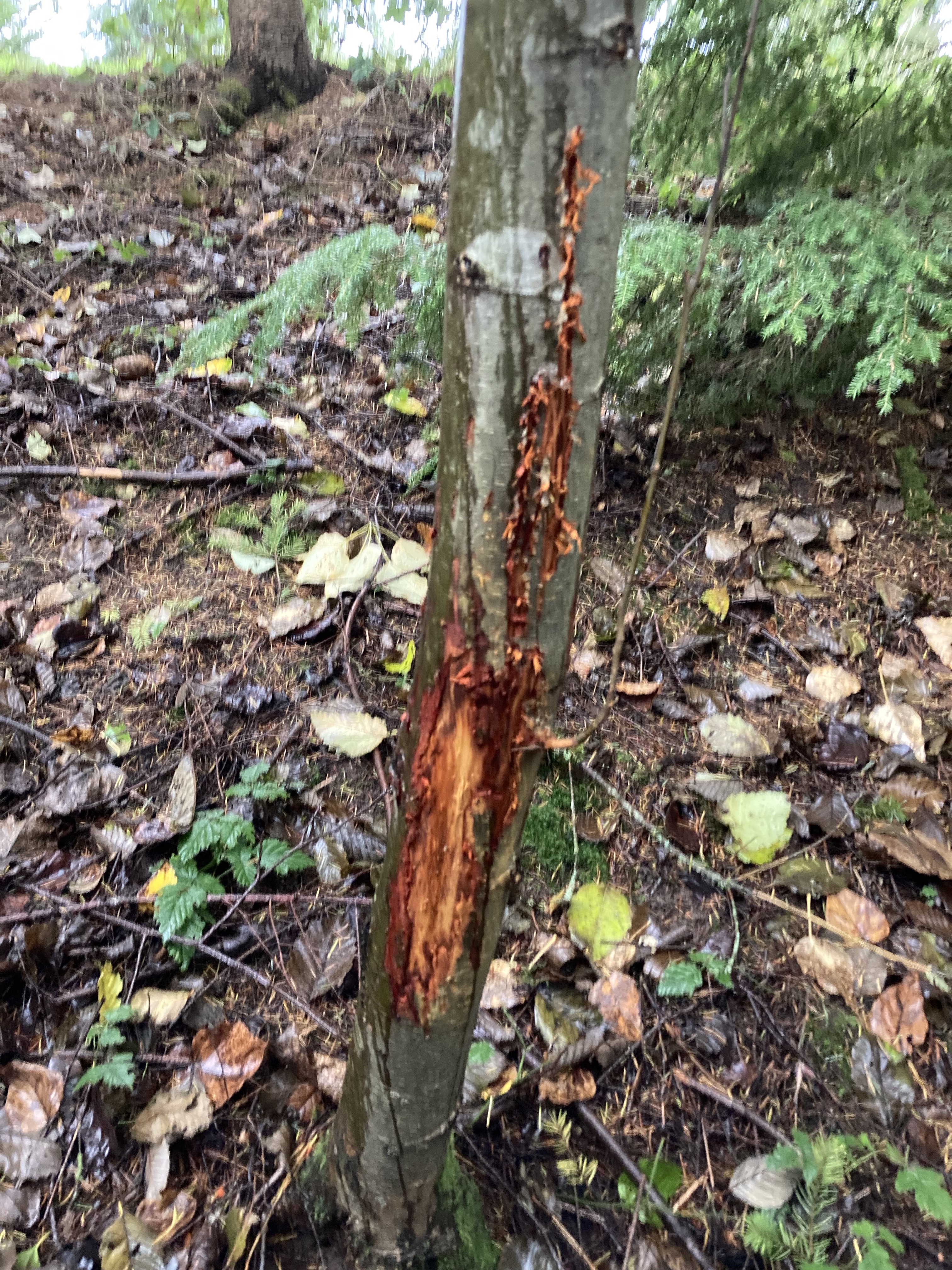
In hunter education, we teach that wildlife need shelter, food, water, and a close proximity between these resources. Human encroachment into wildlife habitat is taking away the resources wild things need to live, so they adapt to our impacts, roaming pastures, jumping fences, and following roads to gain easier access to what’s left of their ecology. In the fall, deer are hunted because they are heavy with fat put on all summer in preparation for winter. In the autumn, does are not heavy with fawns, and the young born that year are old enough to fend for themselves. The bucks go into rut, and begin marking territory and carving out a desirable space for his harem of does to roam. In fact, the does will go where they please, and the bucks must defend a space already chosen by the does. The buck I am hunting near my house has put his mark on a young alder below as a sign to other bucks that he’s the resident dominant male.
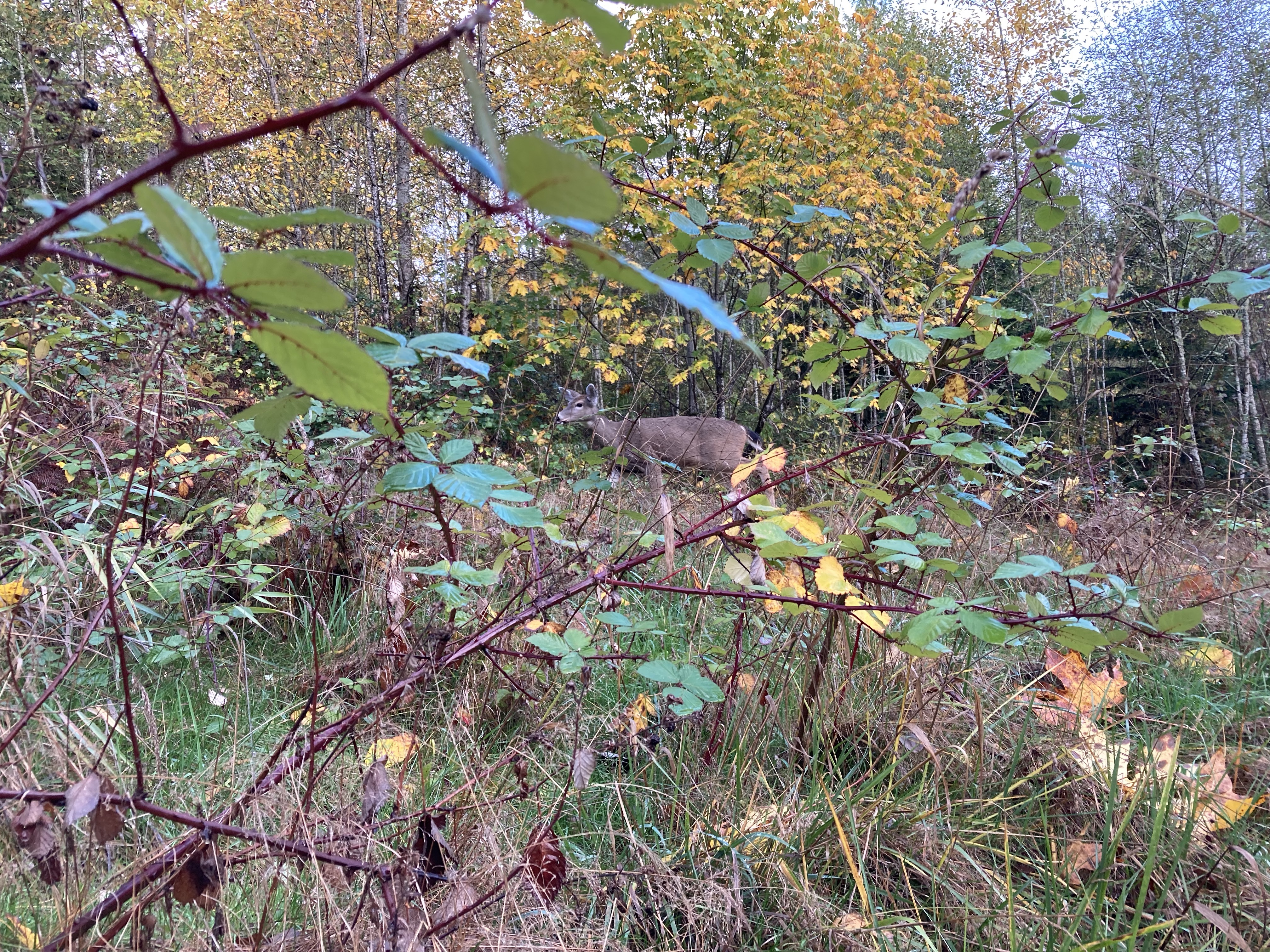
Following deer sign to locate an animal can be tricky. It’s better to look at the bigger picture of a place and seek out active trails and where they lead. You’re often limited by property lines and keeping a safe distance from neighboring houses and active roads. The deer tend to avoid those places too, preferring well stocked larders in abandoned pastures or along hidden trails where they have good cover while moving through a place. It’s hard to hunt a heavily wooded place, but setting up a sit along the edge of a forest can be rewarding. On my second day of hunting my neighbor’s land, I went to explore a lower field and found a field with a calm doe grazing alone. It was a wonderful spot, with several deer trails converging on a field with plenty of good grazing and quick escape routs to get away form any threat. Since I kept my distance and sat down quietly, the doe relaxed back into grazing a while longer and let me observe her. It was the closest I’ve been to a wile animal in a while, and it felt good to connect with her as I settled in.
Deer and full of mystery, and often left unnoticed in the forests and edges all around us. They wander through suburban backyards, urban parks, and even on the shoulders of busy highways. Sometimes they stray into roads and get maimed or killed by brutal automotive impact. For the lucky animals that manage to avoid human induced accidents, the shelter of quiet back fields and third or forth growth forests offer enough forage, water, and cover to thrive. Our neighborhood black tails are habituated to people much more than the deer living further out in the commercial timber forests. These close up pictures and video were taken during an evening hunt. The weather was cool and damp, light showers came and went with breezy wind shifts. The scent of human presence in the wind can turn the deer away from your position, and they will float away without you ever knowing they were nearby.
Deer are silent shadows of the forest, as this doe shows in her amazing ability to suddenly blend in and disappear without a sound. As I sit still, watching her passively while I wait, she turns into a ghost and drifts away into the bramble along a hidden trail I had not yet discovered. This video captures the challenge of even seeing a deer that does not want to be seen. It was tempting to follow the doe on her move up the hill, so I did, and she took me towards the fallen cottonwood where she veered up to the house and I had to step back for safety reasons. Quietly, I took a page from the female ungulate’s book and slowly walked back to the lower field for another long sit. I was sure more deer were bound to move through there, and it would be a perfect place to wait.
Hunting takes time, and the more hours you can put in the field the more likely you are to successfully harvest your food. It’s a privilege to hunt in our country, you have to also have access to a gun of legal regulation, proper attire (hunter orange is required for modern firearm deer season), knowledge of hunting laws, and a Hunter Education Certification from the state. Then there are the hours of time scouting in preparation for your hunt, which start well before hunting season. I’ve spent most years hunting at The Snoqualmie Tree Farm with a recreational pass that allowed me to drive in. This year I did not get a vehicle pass, and instead have been biking in, which is an epic work out before I sit. Still, it’s been another great learning experience, including finding the perfect time to arrive before dawn so I can get to my spot under the cover of night.
Clear cuts offer a great place to have a large field of vision and potential sighting of a deer moving through the landscape. They are open spaces, like fields, which give the deer time to evade predators like cougar, who rely on tree tops to ambush from above, or thick shrubs to pounce from behind. The sun shines down on bare earth, where wildflowers, grasses, ground covers, and bramble become a perfect salad bar for grazers. I’ve been seeing a lot of brows sign on young cotton woods, bitter cherry, and red alder. In a two or three season old cut, the habitat will show obvious deer sign like nibbled young vegetation, tracks, and worn trails. The trails and tracks help you identify where deer are being funneled by the topography. Most animals take the path of least resistance, and you as the hunter, want to find those spots and pick a sit that’s safe to shoot from nearby.
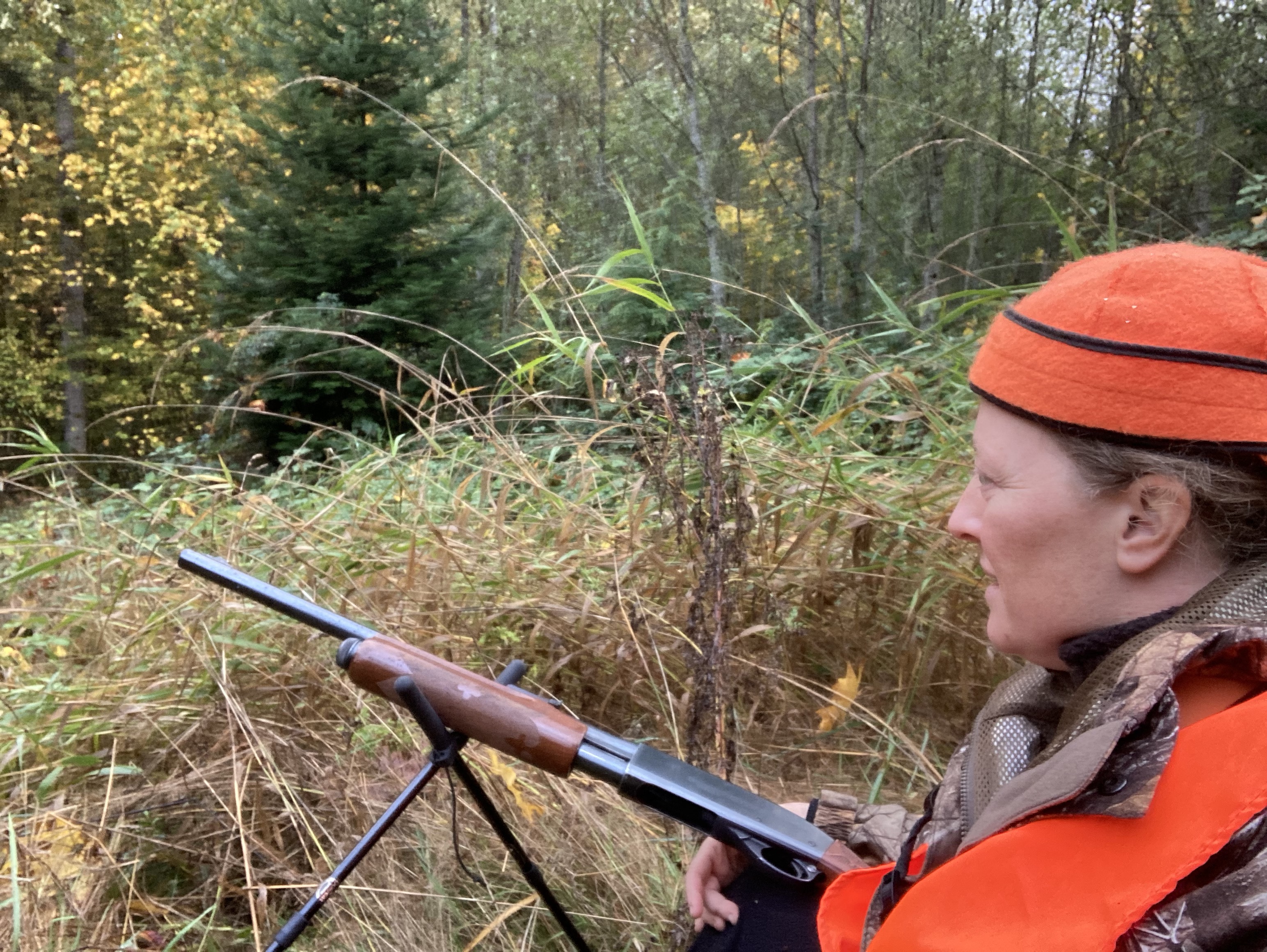
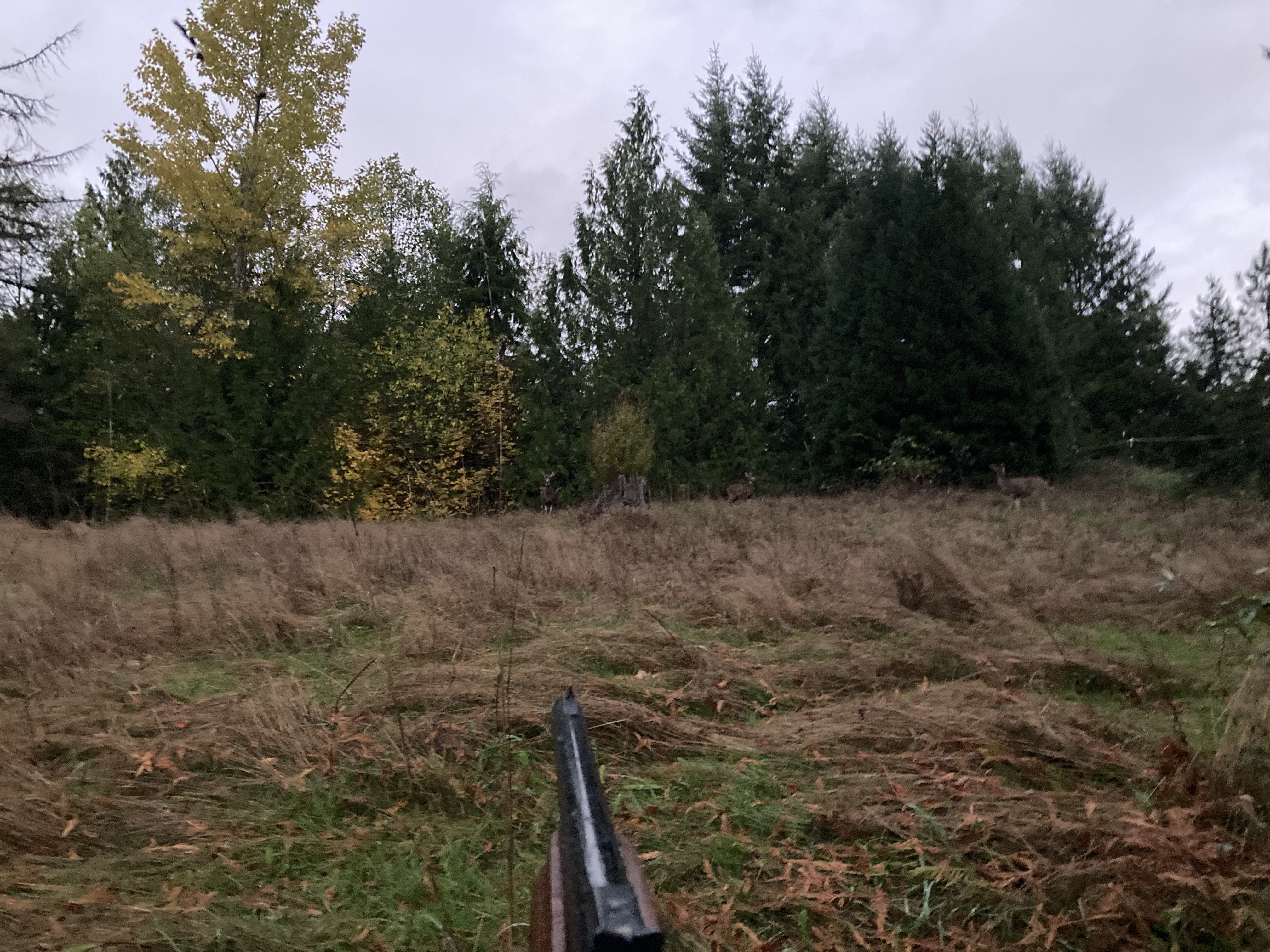
In the picture above, I’m sitting on the up hill edge of an overgrown filed. My field of vision to the west, extends to the other end of the field, and into the woods beyond, which continue down hill for another 100 yards before banking into a wetland and starting up the other hill beyond. I’m using a shotgun with limited 25 yard range, which keeps my shooting arch within the field, but not the forest beyond. I try not to put myself in the woods, because trees block your shot and obscure the deer, not a good combination when you are trying to take a safe, well positioned shot. Another helpful aid in making a clean shot during the hunt is a pair of shooting sticks. The shotgun rests in the cradle of these sticks to steady my long gun when I take aim and fire. Try to always have a brace like this when you’re shooting to improve accuracy. A stump or tree trunk can be used in a pinch, but a pair of good shooting sticks allows you to take a steady shot from almost anywhere.
I’ve mentioned hunter orange and I’m going to mention it again- wear it- even if you’re not hunting, but enjoying the woods during hunting season- please wear hunter orange. The vests are cheap and can be found at most outdoor recreation stores, you can also get an orange vest with reflectors at any automotive store. I don’t wear reflectors when hunting, but if I’m just out hunting mushrooms or exploring the woods, the reflectors are fine. Hunter orange hats are wonderful too, though you’ll still need a vest or jacket to have enough coverage. Yes, hunter pink is also allowed here in Washington. You can mix and match for some of the best color clashing fashion statements ever seen outside a catwalk. Outside of the hunter orange/pink requirements, the rest of your clothing is up to you, but I would highly recommend dressing for the elements. Gloves are always recommended, because if your hands are too cold, you’ll have poor contact on your trigger, so keep the hands warm and dry. Wet/cold feet will also shut down a good hunt quickly, pack an extra pair of socks. Carry a pack with water, snacks, and a med kit too. All this and more hunting pack prep info can be found here.
As the evening of my hunt set in, my slow wander back up to the upper fields towards the house revealed three does moving slowly from the forest cover. They might have been browsing on the downed cottonwood in the ravine beyond. With the waning light, the harem was heading to an open place with good sight lines to avoid predation. My presence, which had been tolerated during the brighter daylight, was now causing unease, and the deer trotted off across the field, staying above me along the hillside until they disappeared into a mowed front yard above. For a few moments more I waited, hoping the buck would soon follow after, offering me a chance to harvest my tag for the season, filling my chest freezer with good wild meat and much gratitude. I was thankful even after the last light faded with the chances to harvest that day.
Though hunting time does not end till 7:15pm, well after dark, I stop hunting when I can’t sight in a deer through my binoculars. That time came around 6:15, a full hour before the legal technicality, but well within the safety limitations of my situation. Again, hunter safety is always relative to the situation, short of fundamental basics like muzzle control. Firearm safety and hunter education are crucial to enjoying a safe hunt. Beyond the rules there are important details to consider which may not be as straight forward as the regulation book. Like mushrooms, hunting takes a lot of learning, and it’s good to have mentors in the field guiding you for the first few years when possible. You can contact Washington Department of Fish and Wildlife for clinics and mentor-ships here. Good luck, it takes a lot of time and energy to hunt, but the reward of being nurtured by wild food, and out in nature looking and listening to the world is a beautiful connection to place and what I call, The Sacred. Gratitude to The Deer Nation and all the lessons they offer.
There’s a lot to say about decomposition, and the importance of breakdown into soil. Why is soil health so important? The chemical makeup of the soil determines what can grow there and how much productivity the land hosts. Though in these times of insanity, not many developers are thinking about fertile soil, so much as dollars and cents. The grave consequences of ignoring the soil comes in the form of ecological collapse. Desertification continues across the planet, and unprotected soil left barren in winter fields of industrial agricultural is only part of the holistic problem. Wind and water events, climate, is revving up, becoming more exaggerated and frequent. Erosion across the world grows exponentially with these natural disasters, far out-competing the limited profit margin of outdated natural resource extraction. Think of farming as a kind of mining, only you’re pulling the mineral and water content form the gold instead of gold or uranium. Then we pour poisons on what’s left, along with other synthetic chemicals which will rip out the last productivity within the living ground before killing it completely. These same chemicals which stop life in the soil, greatly impact human health as well.
At EEC Forest Stewardship, we lock fertility within the soil using simple, small scale organic methods like composting. This method of keeping soil healthy plays out in nature constantly in mycological decomposition, insect action, and many other forms of organic chemical breakdown. Thriving forest do not need chemical additives to be productive, but they do need living soil. With all the food scraps, brown paper recycling, and fruit tree prunings, our small holding produces an endless supply of great soil building material- it just needs a helping hand, that’s part of the original instructions of human kind, in my humble opinion. Our monkey brains are great at understanding soil biodiversity, and encouraging a thriving biome in soil using the abundant organic material “waste” nature offers all around. Often, heavily landscaped terrain involves removing the great compost that naturally occurs in a thriving ecosystem. Leaves, branches, twigs, and fallen logs are crucial soil amendments to keep the earth alive. But manicured lawns demand that all these wonderful inputs be blown into bags using hot air and fossil fuels, then insult is added to injury when synthetic chemical lawn care products are sprayed on to enhance the grass green illusion. Aesthetics are costing the environment its very substance.
Mushrooms are a hidden superpower in the quest for healthy soil and abundant fertility. Though our typical reaction to fungi is one of hesitancy and fear, the mushrooms are there to help, and when and where they choose to fruit tells us so much about soil, chemical composition of the environment, and what needs to happen in the organic breakdown process. Even if you’re not into harvesting wild mushrooms, their place in the food web is crucial to soil productivity, though tilling and chemical treatments destroy the living material within the soil, rendering it sterile. Without a thick layer of organic material breaking down on the surface of the ground, hard earned topsoil erodes away, along with any agricultural productivity or profit. It’s incredible that this concept is still not fully recognize in the agricultural community. Some conventional farmers say without chemical inputs, their farms would fail, yet they fail anyway because the soil is completely depleted of any living material, which is crucial to any production at all.
This process can be turned into an obsessive fixation, and perhaps some close observation is important, but remember, as a lazy farmer, I’m all about hands off approaches that have long term payoff. When designing a system, it’s important to look at scale. EEC Forest Stewardship uses several different methods of composting, depending on a system’s needs. Kitchen scraps are the most continuously prolific compost we’re producing at EEC, but animal compost is the largest by volume. Our kitchen organic materials go into a small bin which rotates around small gardens near the house for easy distribution. The largest composting system by volume is the manure and straw bedding from our barn. This system breaks down in place using a deep bedding method. Seasonally, we spread the muck on pastures, consolidate it into planting beds, and enrich hugaculture berms throughout the landscape.
Understanding what’s in your compost is another important detail for successful composting into fertile soil. Kitchen scraps are high in nitrates, so you need to add plenty of brown carbon inputs to balance the chemical mix. No PHD required, but a basic understanding of PH is, so know your chemistry. Animal manure alone would be harmful in concentration on the ground. Obviously the sheep poop as they move around the land at will, but the fencing and rotational timing of animals on pasture prevent erosion and over nitration of the soil. Again, you don’t need higher education to get rotational grazing, but you do need to be on site reading the landscape and your animals to best serve in ecological restoration. Overtaxed land is self evident, but the balance of PH within soil and vegetation does take some lab work- so soil samples should be taken every few years to affirm soil improvement.
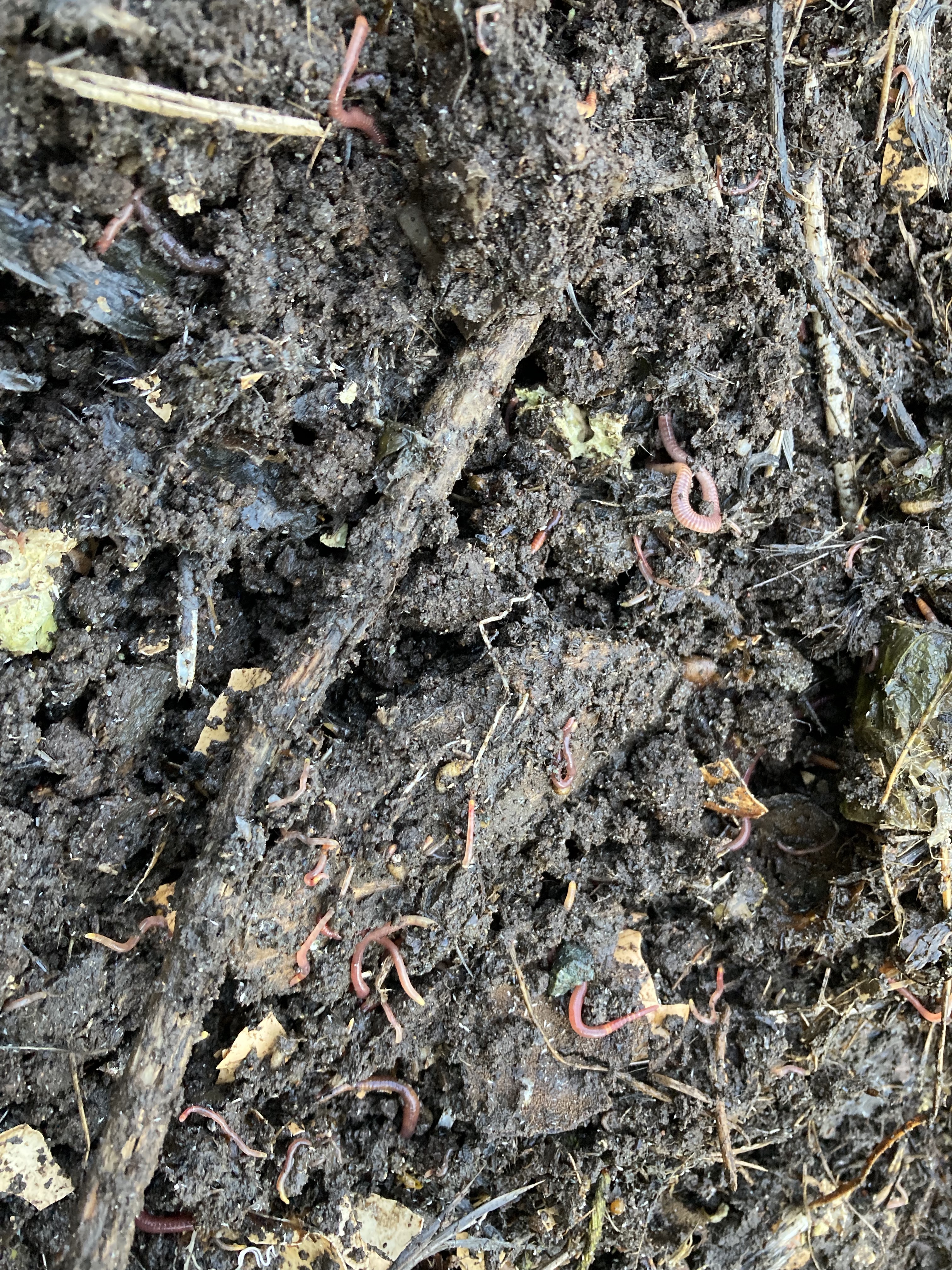
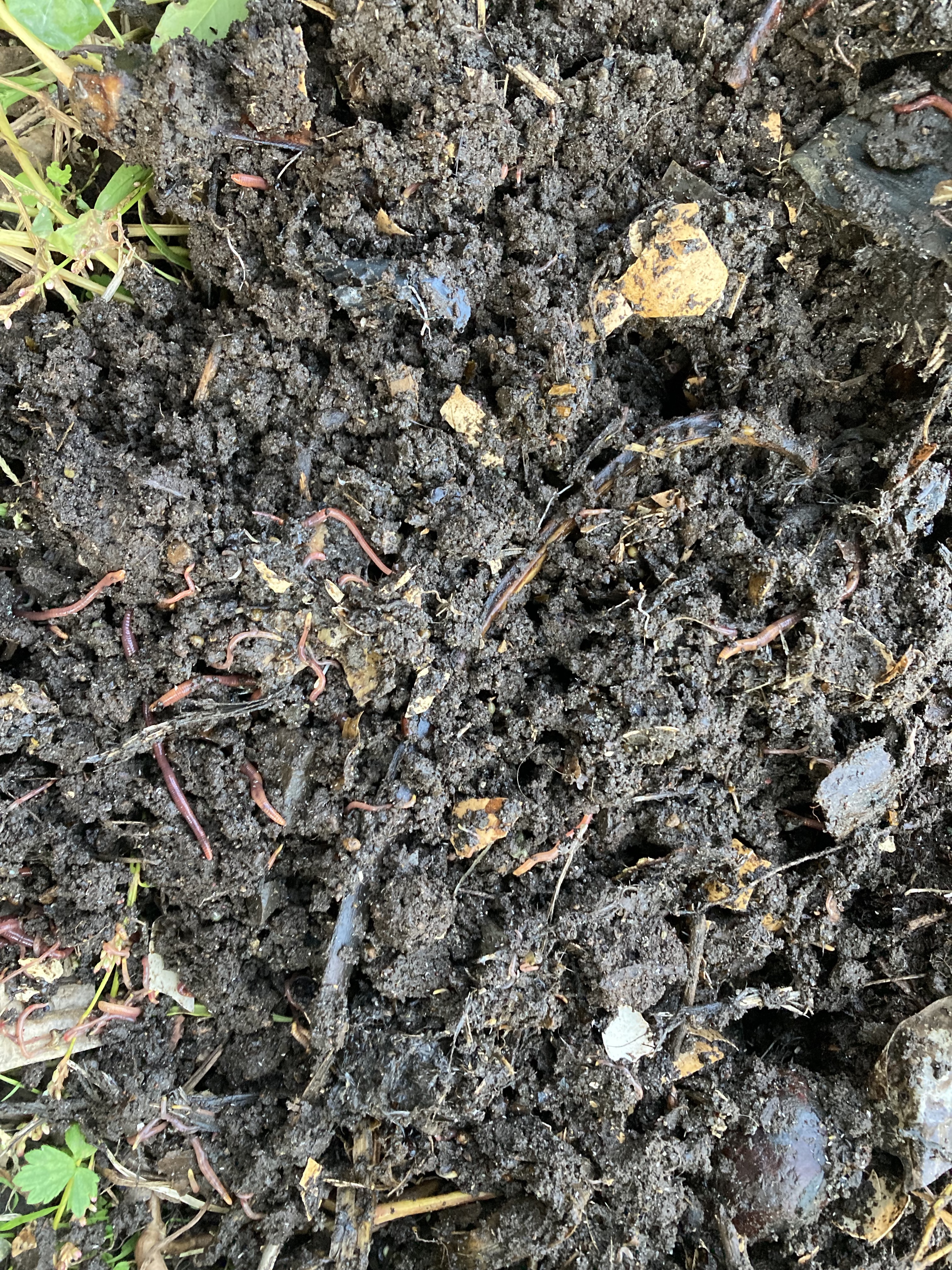
Back in the kitchen garden, I’ve just opened a bin of compost which has sat all summer breaking down. I closed this bin in April, juts the Spring insect populations were starting to hatch out. Active kitchen waste compost will attract bugs- you want this, however, the summer cycle should be furthest from the house, where as the winter bin can be close to the door because it’s cold and the bugs won’t be out. Bin size should not exceed what you wish to lift by hand- mine are large totes which, once full of compost, end up breaking down to about half full by the end of a couple of seasons, rendering it easy to dump. They all have good fitting lids. If left uncovered, kitchen scraps attract rodents, insects, and pets. Since it’s close to the house, it needs to be sealed. Holes in the bottom of the bin to allow worms in and out are encouraged. If worms can’t get back down into the ground freely, they will cook in summer and freeze in winter. You’ll know if you’ve got things in harmony when, after two seasons of sitting without any additional scraps added, you tip the contents onto the ground right there in the garden where you will use it and you see black gold soil writhing in worm activity.
The fresh compost is still in breakdown, and I plan on mixing this rich layer of fertility into already active growing soil, which has spent years adjusting computationally to climate change- from UV rays to hydrological leeching. The fresh compost will replace drained nutrients and bring more living organic matter to the upper layers of sun baked soil. The fresh compost is still a bit nitrogen heavy, so it’s important not to direct seed right into it and expect good results. Folding this hot material into already worked soil is best, and a bin’s worth inoculates a little over a cubic yard of existing garden cultivation. Other than flipping the bin every few seasons and folding it into the existing soil between plantings, I don’t turn my compost, but could if I needed to speed up the breakdown time. When I have to rush a process that would otherwise make its self in its own time, I’m working against the existing natural process, and creating additional work for myself.
There’s one other in between method of composting at EEC which I’d also like to share. Our renter kitchen compost goes into a less active, larger scale system. Using pallets, we create larger compost bins along key-line on a slope behind a building. We’re building up the land by building the pallet bins back to back in a wall of compost. Our manure system could fold into this design as needed. The pallets break down over a few decades, along with the compost. We’ll start planting into it in a few years and the wall will become a nice berm over a lifetime. This terra-forming enhances water retention and soil fertility on a grand scale. Our current berm building is also giving added support to a structure by expanding the ground layer near its foundations. By implementing key-line berms, we catch any rainwater being shed down the hill over open ground, and create great planting beds for new under-story species. We don’t try to plant trees this close to the structures, keeping a good fire brake where we can.
Manure compost is a dance of transitional timing. When I can, I like to let things break down in place, but winter barn muck has to be moved out of the shelter during the Summer months- which is also a good time to put nitrogen on the soil. Barn manure is mixed with a large quantity of straw. If there is no bedding in the manure, you’re working with a very hot nitrogen source, which is never good for direct field application. My chickens help regulate the temperature of our barn manure compost. When I put out some muck, if the hens avoid it, the poop is too nitrogen rich, preventing living matter from surviving. Sterile material is not appetizing to our feathered compost turners, but when the worms are about the scratching comes out, and the chickens spread fertility across the field for us. Because I’m hauling muck with a wheelbarrow, it’s helpful to dump piles once, then let the birds do the spreading out and gleaning. They pick out pest bugs that might otherwise predate on the sheep and our crops. Eventually, we’ll phase out sheep and have far less manure to spread, then we’ll plant forest to replace fields with temperate rain forest canopy.
For anyone seeking soil fertility, organic compost is the closed cycle for any production system. However, when there is more input than demand for output, you can run into a backlog of nitrogen rich material without a home. This is happening in many municipal systems where urban decay holds too much pollution for the soil. Micro plastics, industrial chemicals, and human sewage plague urban environments where pollutants concentrate. These kinds of inputs will not make clean, healthy soil for growing food. Sadly, green washing has put a gold star on urban compost without acknowledging the health risks associated with chemical buildup. Urban compost is then trucked into rural agricultural places as new biomass for depleted industrial agricultural spaces where the urban pollutants can mix right in with industrial agricultural synthetic chemicals to form a terrifying toxic cauldron of calamity. This is where scale fails. Composting works best in a closed system with minimal outside inputs. We put organic food waste, brown carbon like cardboard and yard waste, along with pasture and organic grain fed animal waste in our compost. That’s what cycles through our soil here at EEC, and the results are self evident- we have doubled our livestock production numbers on the land in less than a decade by improving our pastures fertility and ecological diversity. Our kitchen gardens only receive compost from kitchen and yard waste and continue to produce healthy happy veggies for home use. We’ve begun also banking this fertility into surrounding garden beds, expanding our planting space for future gardens, and banking fertility directly into the soil with little physical effort. This is a successful composting system.
So… we’re still not at production yet, and that’s no surprise considering we do nothing to support the trees. Why the hands off approach? At EEC Forest Stewardship, we attempt to acclimatize all our plantings to the ecology of the land, without human inputs, beyond initial instillation. We know that this means we loose a lot of species and have a lower production rate, but in the long run, those that survive will be hardy and successful, if not on an industrial scale, on a small farmstead level which will offer us a wonderful harvest without the pressures of commercial expectations. Yes, this also means we will not ever be producing chestnuts for a larger community- feeding the people- so to speak, but that was never our intention with the nut trees. Our acreage cannot support a large nut orchard for commercial output. We are not in an ideal climate for that kind of production- right now. In future, with more hot, dry summers and colder snow heavy winters, we will most likely become a better ecosystem for chestnuts, and have planned ahead with our early plantings.
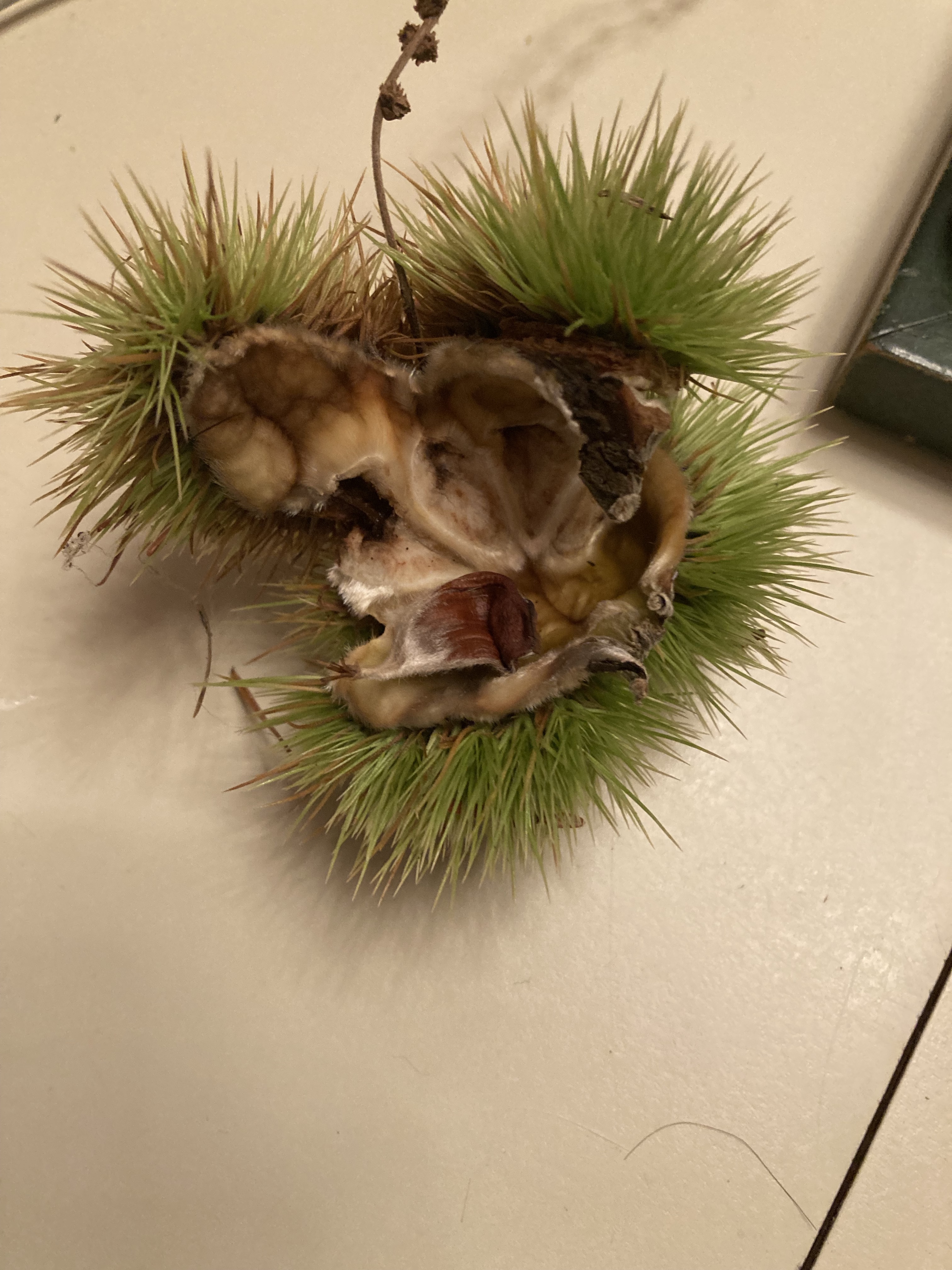
This year, 2021, we saw our first burrs on the nut trees. What excitement- our first chestnuts. Well, after waiting for the trees to shed their bounty, we were able to locate only one burr, with a sad shriveled nut in the middle. Still, we were excited to find a nut husk, and know that the trees are able to pollinate and produce. It being year five, we had hoped to see the start of decent production this year, but we were also aware of the drought, and no irrigation on the nut trees. This reality is part of what the chestnuts will have to adapt to, along with the rest of the forest, which is designed with temperate rainforest in mind. The good news is, even without irrigation, these young plantings are developing nicely, putting on added feet of height each year and spreading out beautiful deciduous canopy to cover our back pasture in much needed cool shade in summer, and wonderful rich carbon with leaf littler in the Fall. Our long term vision is to finish a few pigs in this grove each year, letting the pigs enjoy most of the chestnut goodness, even the drought stricken ones we would pass up. The nuts are just an added bonus, and not a financial obligation we’ll rely on.
The livestock at EEC Forest Stewardship provide our main protein intake. Chestnuts are wonderful food, but not as predictable as sheep. The diversity of a small farm like ours thrives through all kinds of unpredictable change. When the droughts are prolonged, and plants struggle, sheep are also challenged with less pasture, but as the trees shut down nut production, the sheep will keep putting on meat as they graze, and our chosen breed, the Katahdins, are fodder to meat production experts- as in- they put on good weight gain even with minimal grazing opportunity. The chestnuts cannot adapt in the same way, but as they grow and mature in time, their roots will sink deeper into the ground until they find a better water source, and by the time they are great trees with expansive crowns full of nuts, we’ll have phased out sheep entirely, and welcome the nut production when it comes.
Waiting is not the way of our modern military industrial complex, but its the only way with land. Soil builds over thousands of years, and trees over a lifetime, but people have such a drive for instant gratification now, the natural world can’t keep up, and its not trying to. We attempt to dominate with chemical additives and mechanical conditioning, but we’re fooling ourselves with short term gains at the cost of long term viability, and its starting to show in agricultural production world wide. In much the same way civilization has put money ahead of health, happiness, and abundance, our misguided struggles to control have put us at great risk as a species, and we’re still not grasping the whole picture of this complex living system we’re a part of. By diversifying our vision beyond single shortsightedness, we can expand our understanding and cultivate abundance, offering stability instead of empty profits. All the money in the world cannot buy back our natural world, even with extensive restoration like those of EEC, we’re in for some great change, and as of now, humanity is unable to adapt to keep up.
We may not be able to see far down the road, but at least understanding the rhythms of the natural world helps us form a plan. The narrative of the chestnuts tells me there was little rain this year, that the trees are still young, and that we cannot expect a cash crop from our nut trees for at least another decade. That the trees are growing strait and tall with good branching is enough for now. The pasture they are establishing in continued to host our herd of Katahdin sheep, and there is room to plant more trees when we’re ready. A neighbor has been germinating chestnut seed from other established chestnuts in the area, and we’ve put a few of those in to mix up our genetics even more. To be clear- we’re introducing grafted verities that are resistant to Cryphonectria parasitica. The west coast has never played host to native chestnuts, but the climate is shifting quickly, and these new tolerant verities are folding into our cultivation plans well. Within a few more decades, we hope to have a vibrant nut tree population with abundant nut production.
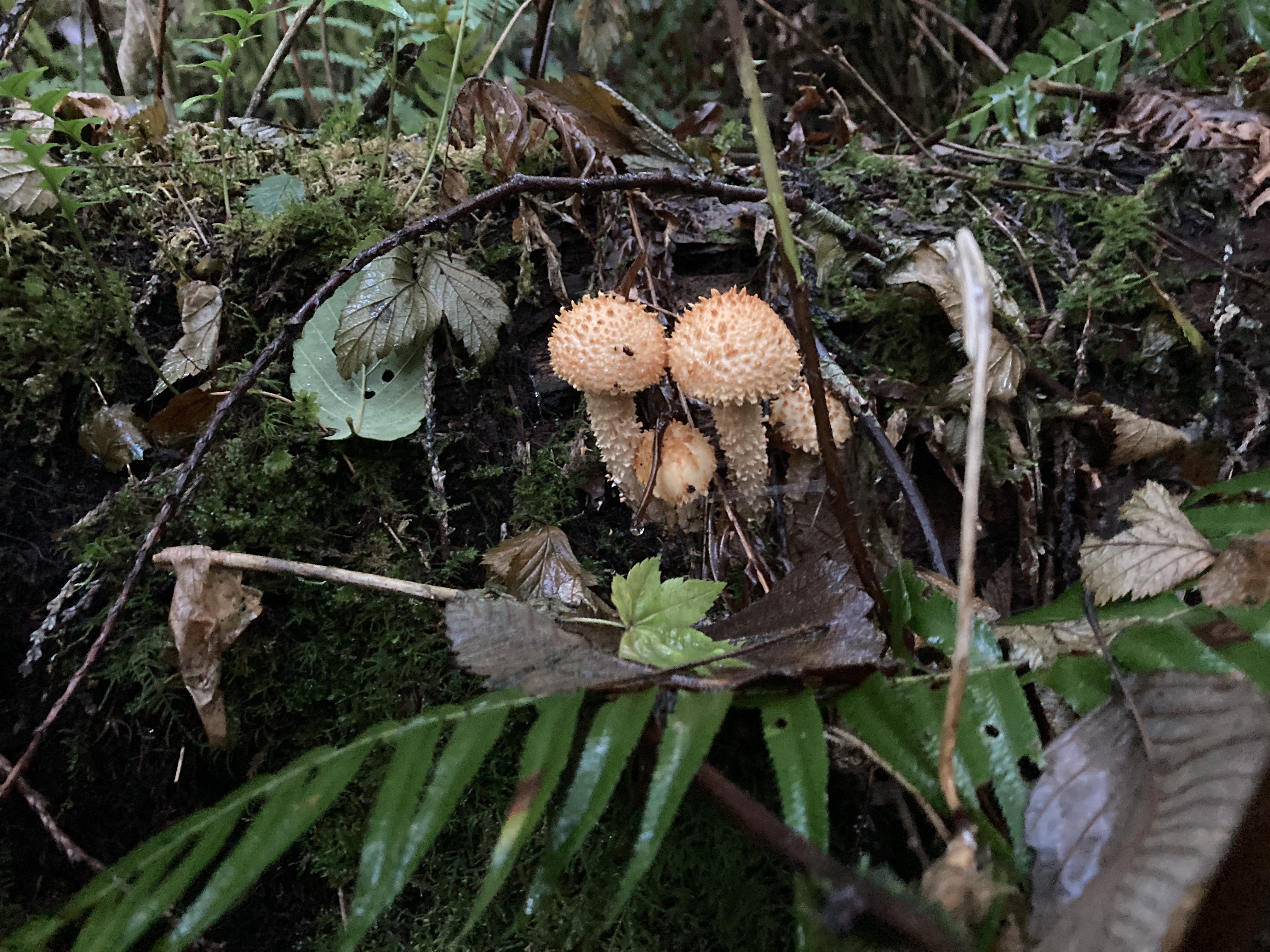
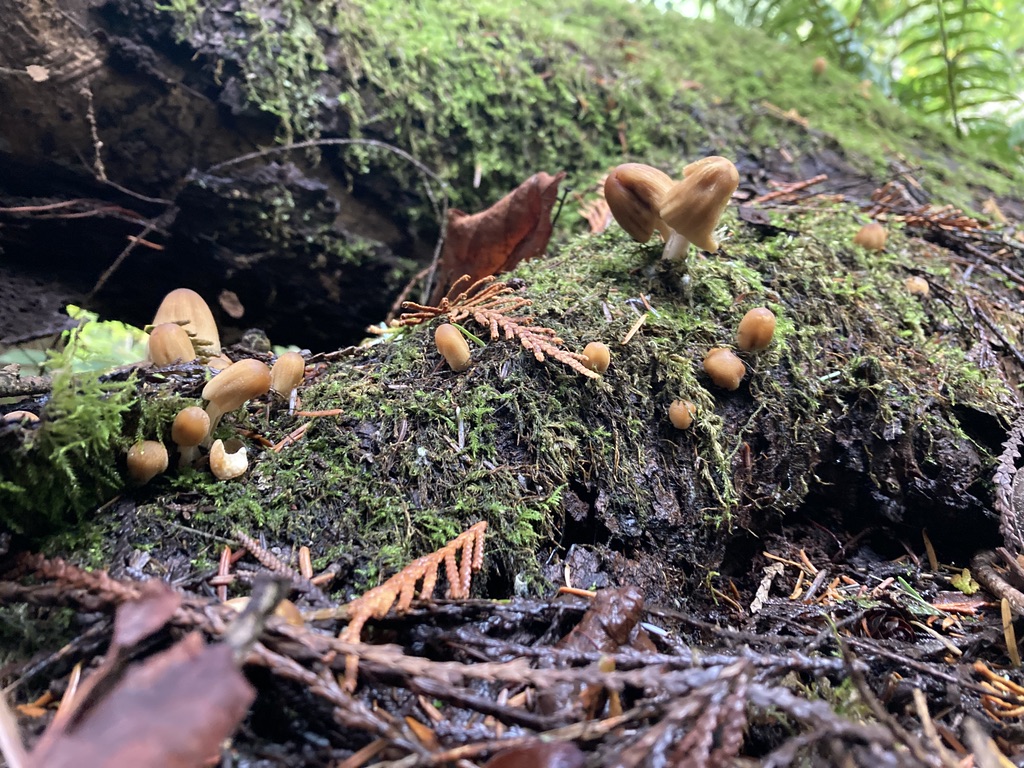
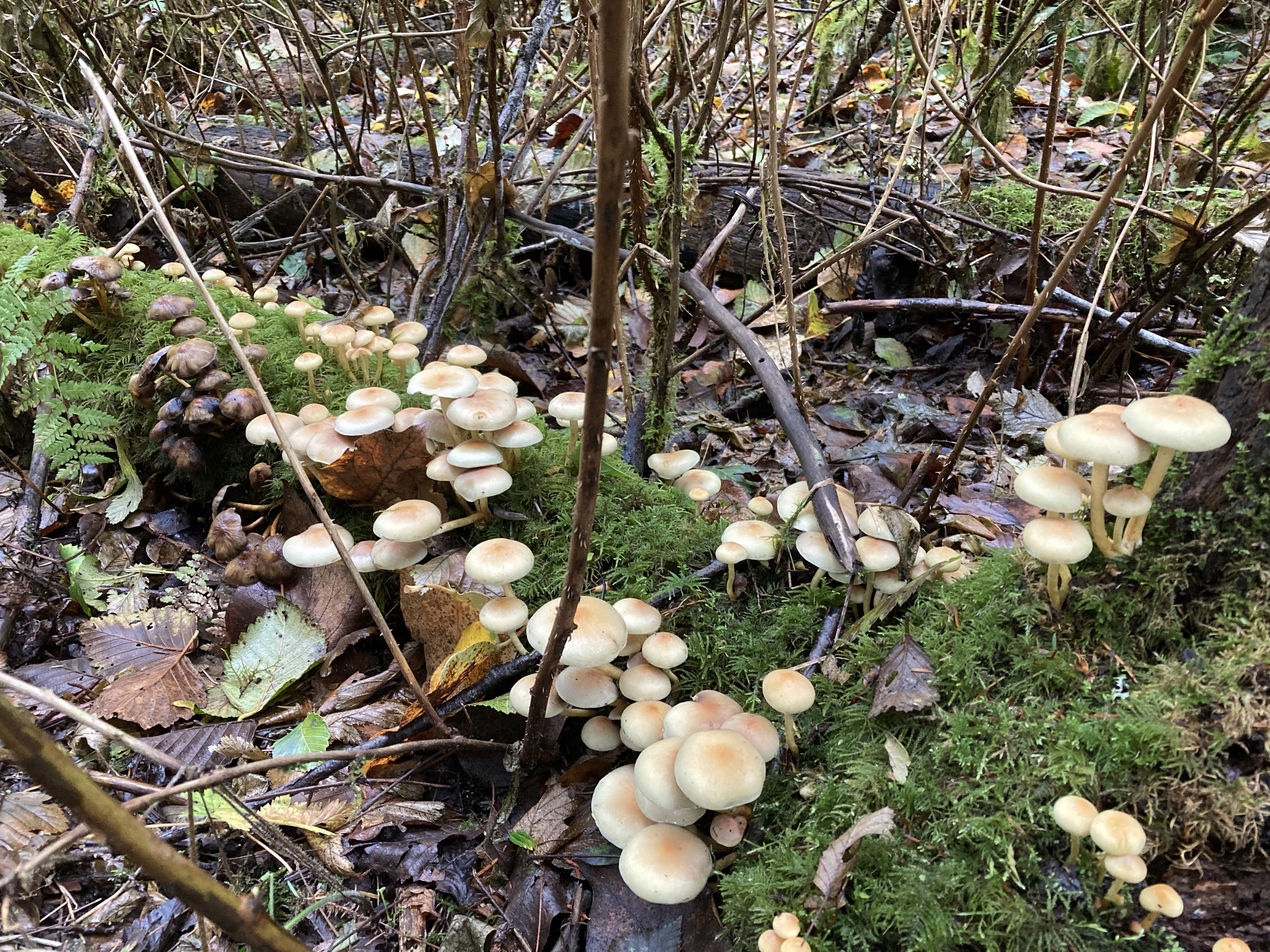
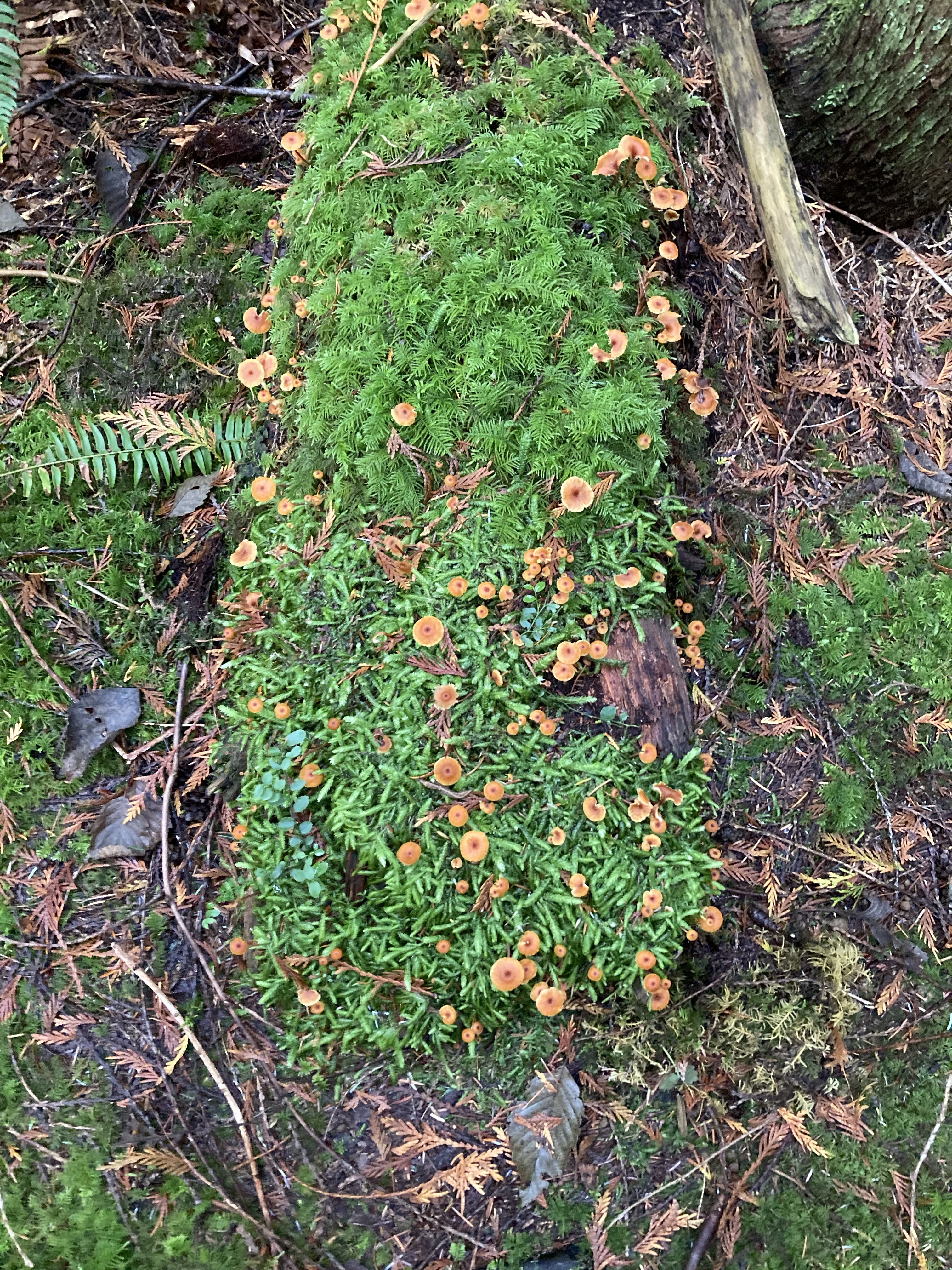
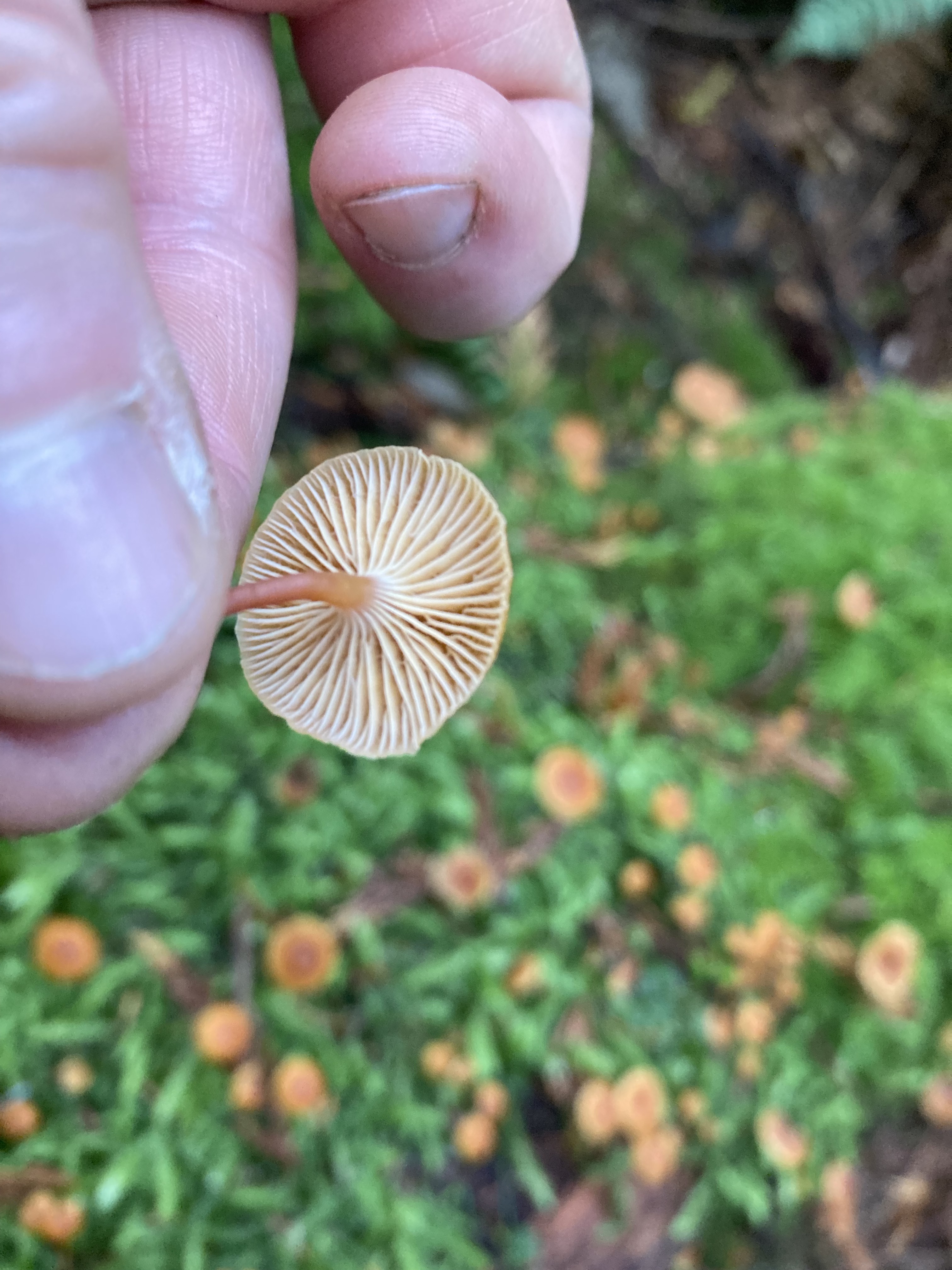
With more great rain comes a bloom of magical mushroom pageantry across the forest floor. In one walk around a local public trail, I captured these images of the wonderful mycological action on the ground. Hypholoma fasciculare springs up along a rotting log in yellow and orange splendor. Note the browner fungal groupings further back and left on the mossy debris- same mushroom, but older. Many verities of mushroom go through dramatic change during their fruiting period- remember, these mushrooms are only part of the whole living mycology- the year round action happens in the mycelium network buried beneath the forest duff. The fruiting body we see may go through several transformations as it blooms, releases spored, and decrescendos back into the detritus decomposing all around.
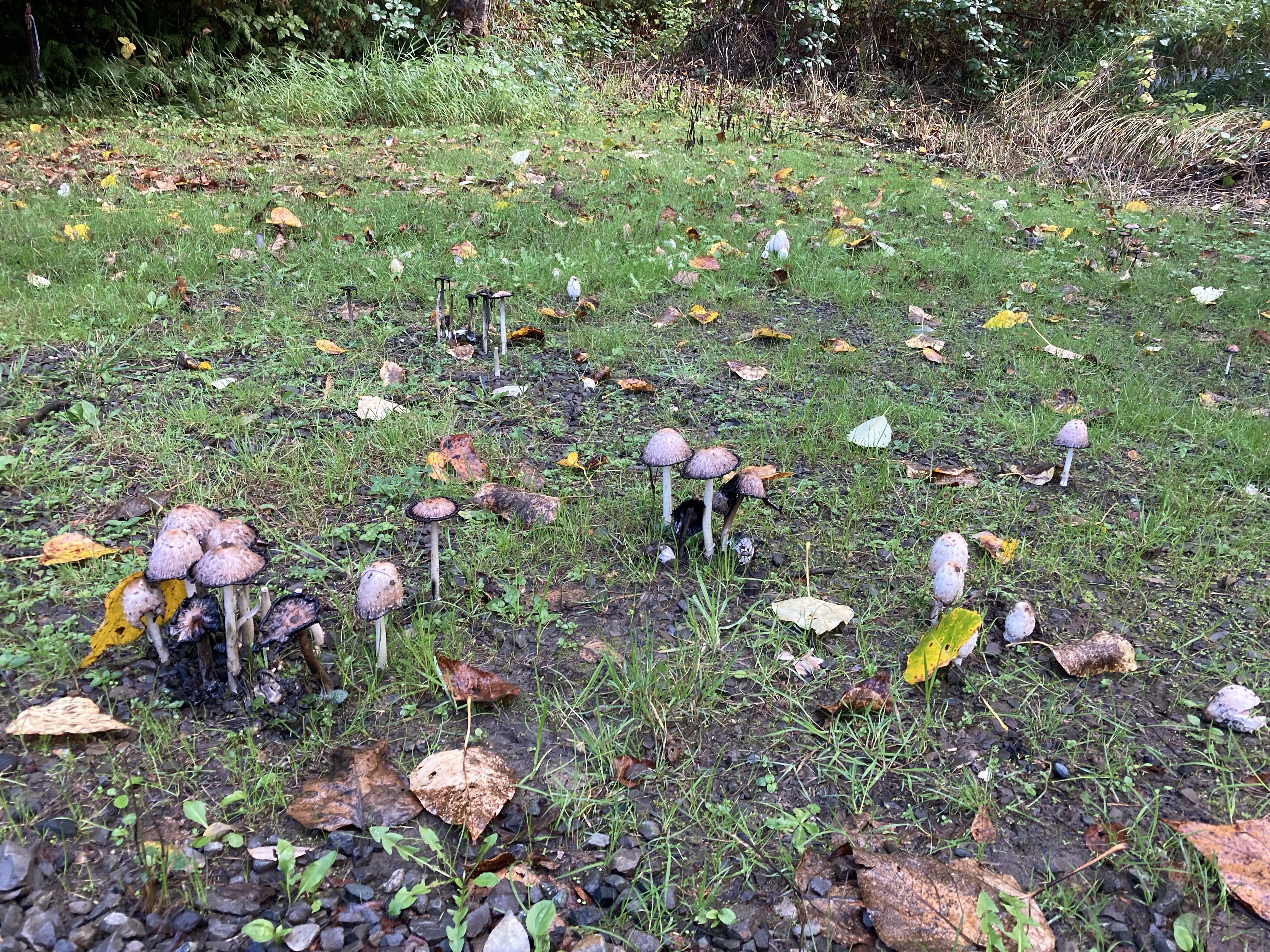
Frosty Bonnet
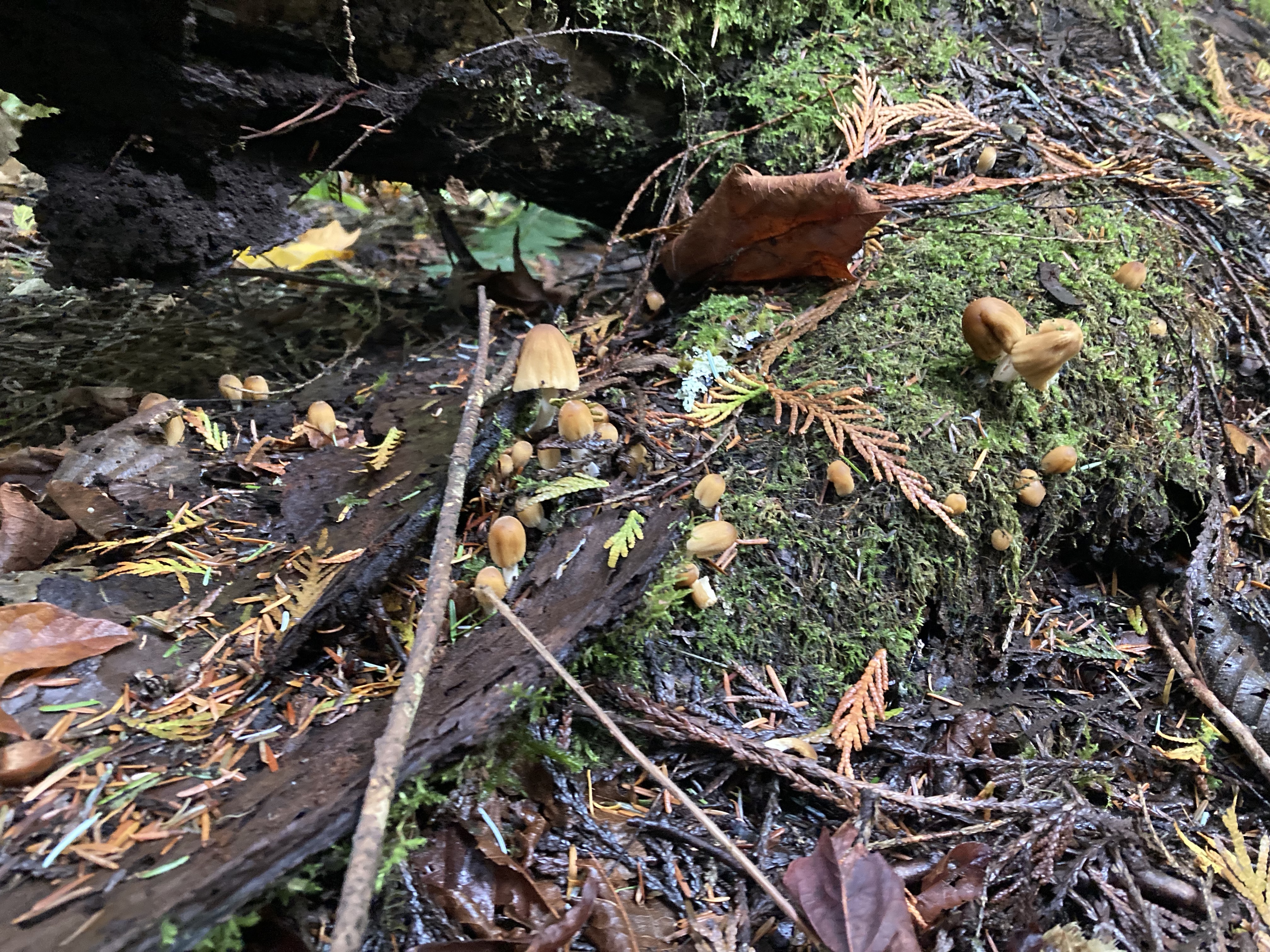
Some mushrooms are very tiny, and often overlooked while wandering the woods. Species like Mycena adscendens can be found on decaying wood, like this Douglas fir cone. The world of mycena is colorful and miniature, often these mushrooms are brightly colored and translucent. Note the viscous surface of the cap. This mycena verity also sports unique gills that are spread fart apart with exaggerated ribbing. I’m sure there’s a much more scientific way to describe this characteristic:
The gills are free from attachment or narrowly attached to the stem. They are up to 0.5 mm broad, distantly-spaced , and sometimes adhering to each other to form a slight collar around the stem. (original text)
The hunt for mushrooms can lead us to many nature mysteries, and it’s a lot of fun to follow out the adventure with a few good field guides once your back home. So often, we discover many new things while outside, only to forget the new friends we met once we’re back inside our warm habitat boxes of comfort, thus loosing out on the continued learning journey. While trying to identify many of these featured fungal friends, I was on the world wide web using basic descriptive words like “small white mushroom” in an image search, which helped me to quickly find something much like what I took pictures of outside. Still, I am always taking an educated guess here- knowing that mushroom identification is a very difficult process, and often impassible to fully key out without extensive knowledge and a microscope. Still, it’s helpful and fulfilling to at least try to learn my neighborhood mushrooms.
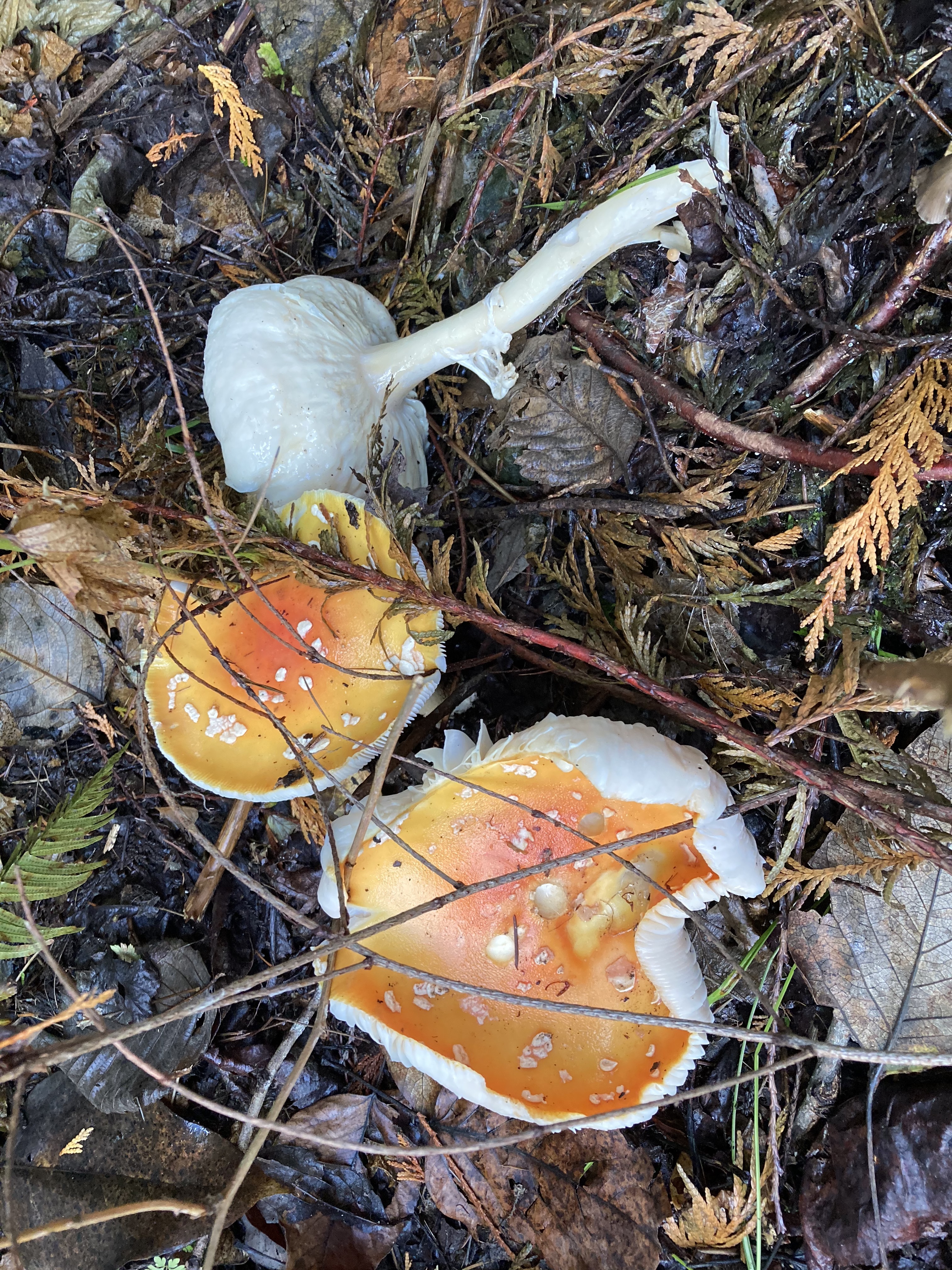
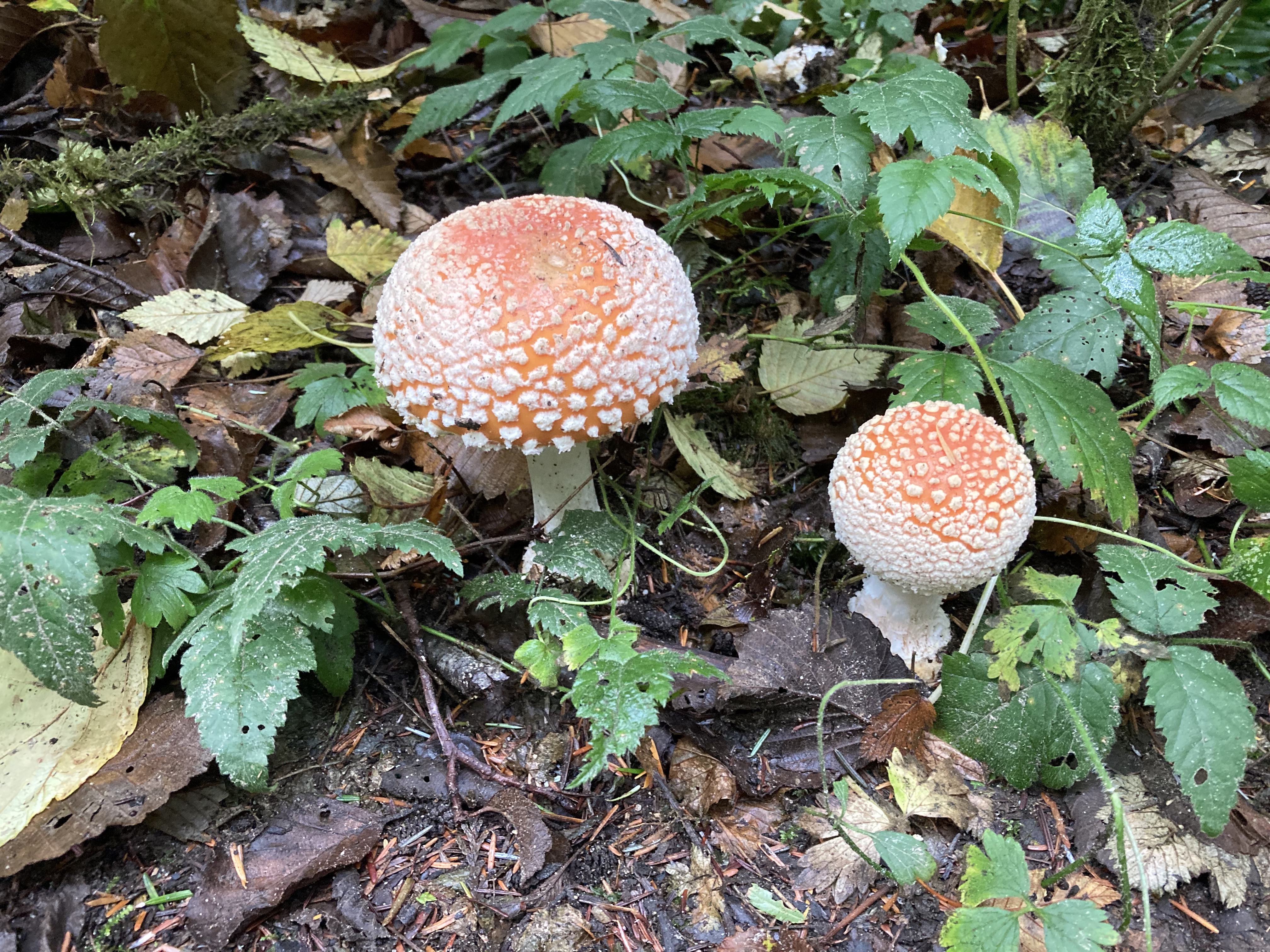
American yellow fly ageric
When I saw these brightly colored “bubs” I knew I was enjoying the company of an amanita species, but could not remember which one- it was too orange to be a regular “fly agarica”, which is the classic red and white mushroom often pictured in fungal artwork. Amanita muscaria var. guessowii is a verity of Amanita muscaria, and controversial in the scientific community because of the hair splitting variation argument, which you can read more of in the link. Mushroom identification is a challenging science, like I said, and it’s still constantly changing, with better DNA research, chemical composition studies, and the continued discovery of never before seen species in the wild. This taxonomy is certainly being rewritten daily, which makes learning the different species even more distressing. Don’t spend too much time getting lost in the name- get to know the greater families first. Picking out an amanita in the crowd is easy enough once you become familiar with its character, in much the same way you’ll learn to know a shelf fungus when you see one. Oh look, a shelf/bracket/conk fungus!
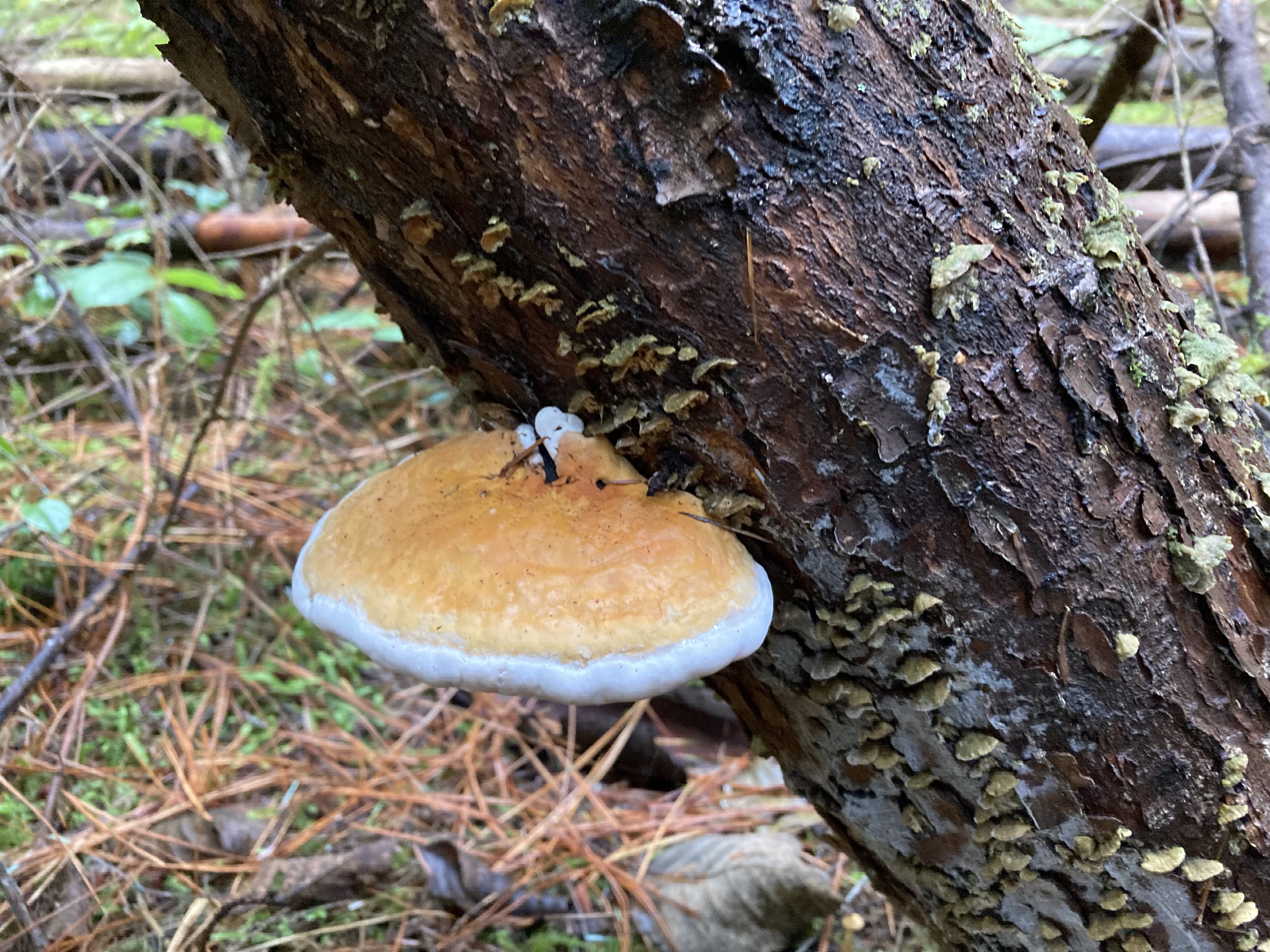
Red Belted Conk (young)
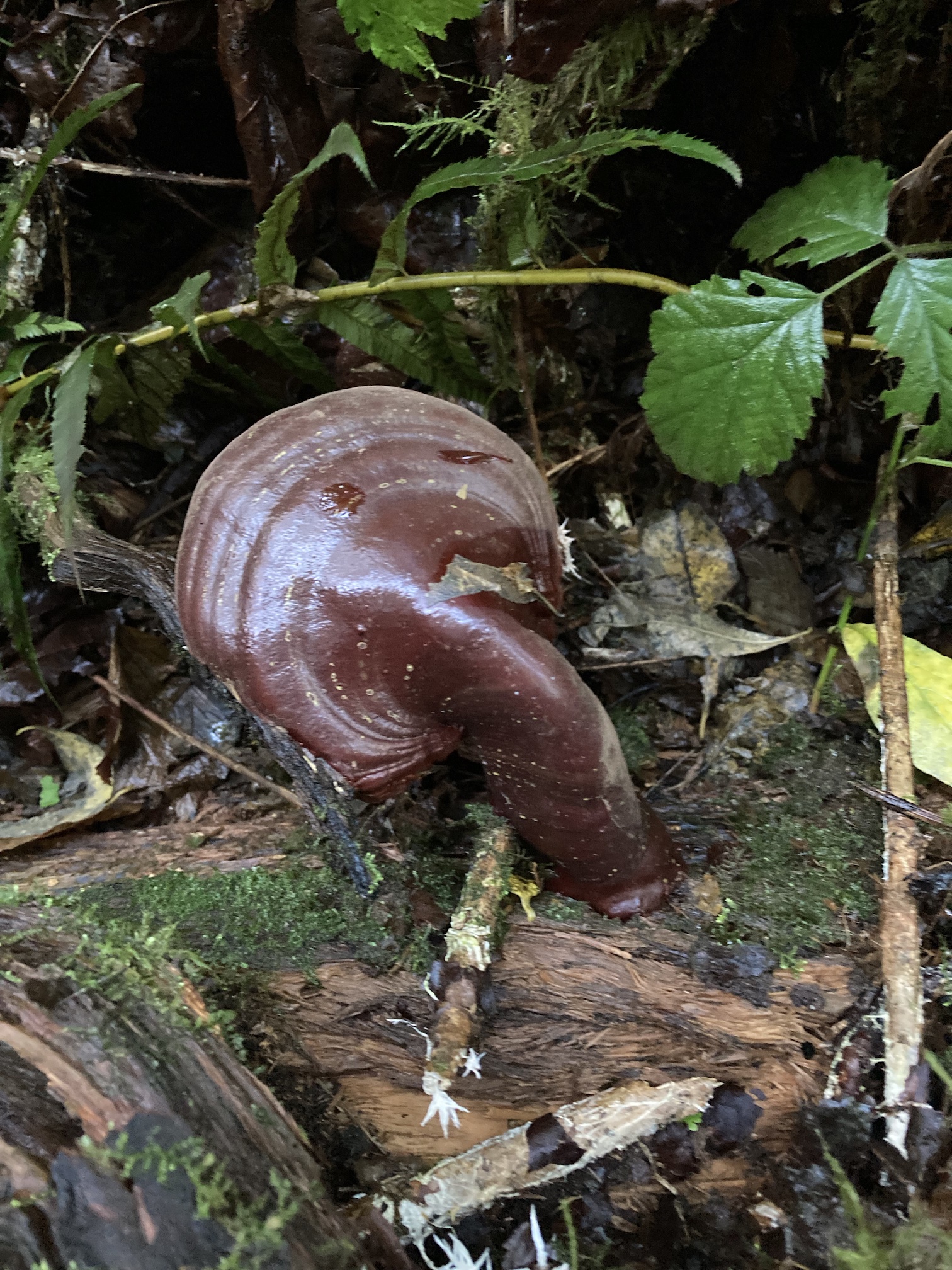
These are a classic fungal friend in most forests- hanging out on the sides of decaying logs and standing snags. The conks are often overlooked, as they are not fresh eating mushrooms, or easy to pull off their woody hosts, but they are wonderful medicinal species to respect. I’m saddened when I see beautiful Fomitopsis pinicola torn off the logs and dropped on the ground- that does kill the mushroom, and it took a long time to grow and form on the log before its life was cut short by ignorant human destruction. Please leave the mushrooms where they thrive on the stand and enjoy them time and time again when you walk by. The brackets are there to stay through the first years of a tree’s decomposition. They are paving the way for other softer species to pick up the task, once the harder resins of the wood are broken down. This example is in co-habitation with other fungal neighbors, a trait mushrooms often share- community.
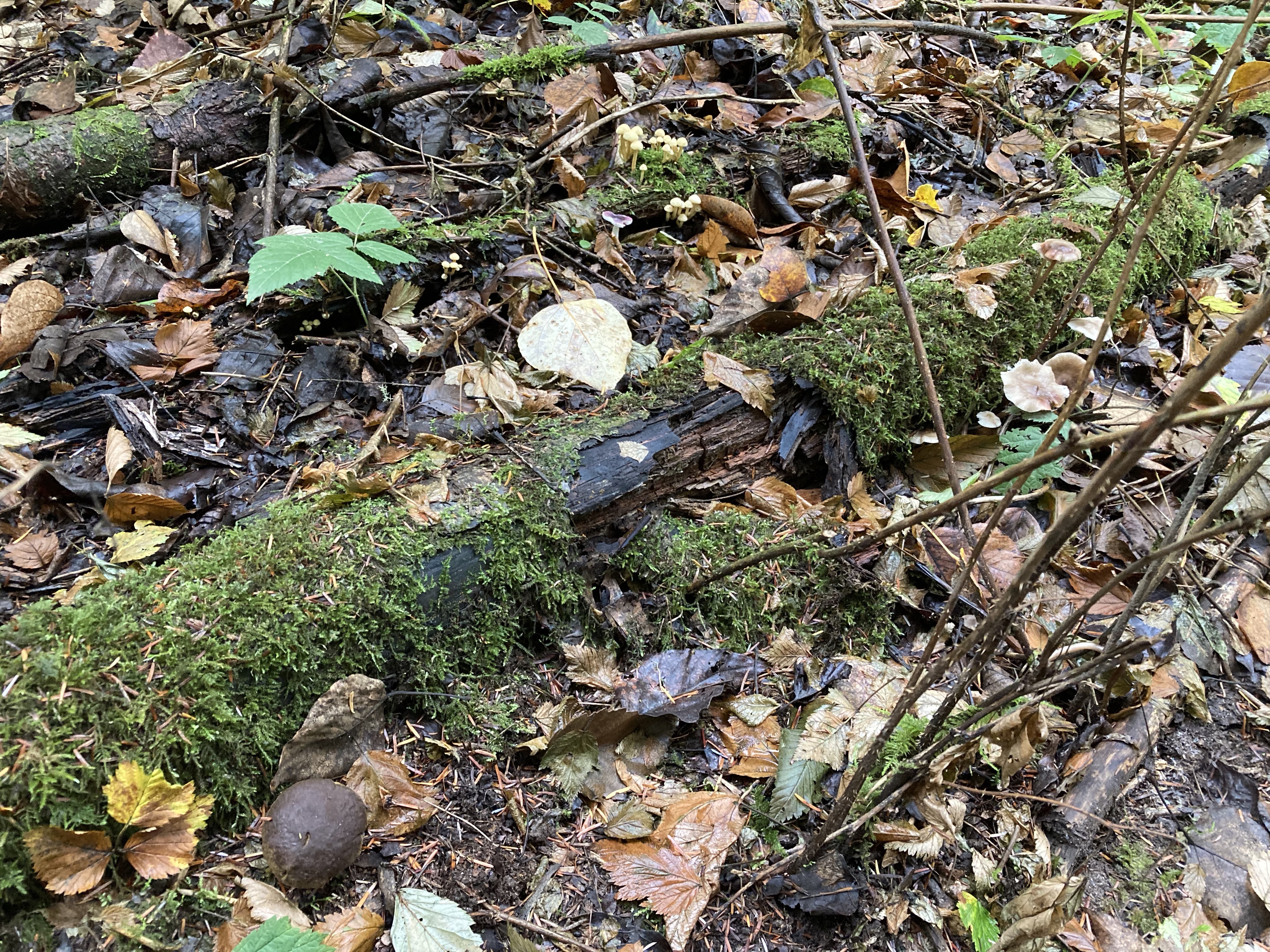
4 species- can you find them?
The picture above shows a team effort in decomposition on an active forest floor. This particular area was protected by a stand of salmon berries (some pictured spiky stalks on right of frame). This overhead protection keeps human traffic from compressing the substrate, allowing a good fluffy soil for mycelium highways to run. There are at least two kinds of fungal feedings happening here- two species are on rotting logs (sulfur tuft and deer mushroom), and two are coming out of the leaf and needle litter in the soil (russula and bolete). Sometimes, its hard to fully identify what a mushroom is truly fruiting off of- forest floor is full of woody debris mixed into the soil, so some species may appear to be growing out of soil, when they are really fruiting from a twig or scrap of bark buried under other things.
Developing an eye for substrates mushrooms colonize can help you find the species you’re looking for. It takes time in the woods looking around, and slowing down to actually see. Our walk took us about 4 miles in three hours- and we were on established trails most of the time. Often, mushrooming takes you off trail and into wild woods, scrambling over hills and under fallen trees, into wetland marshes and over rocky scree. Today’s walk was one most able bodied people of all ages could take- mushrooms thrive in the back yard as well as the back country. Where you find one mushroom, you’ll find many more- they love to congregate.
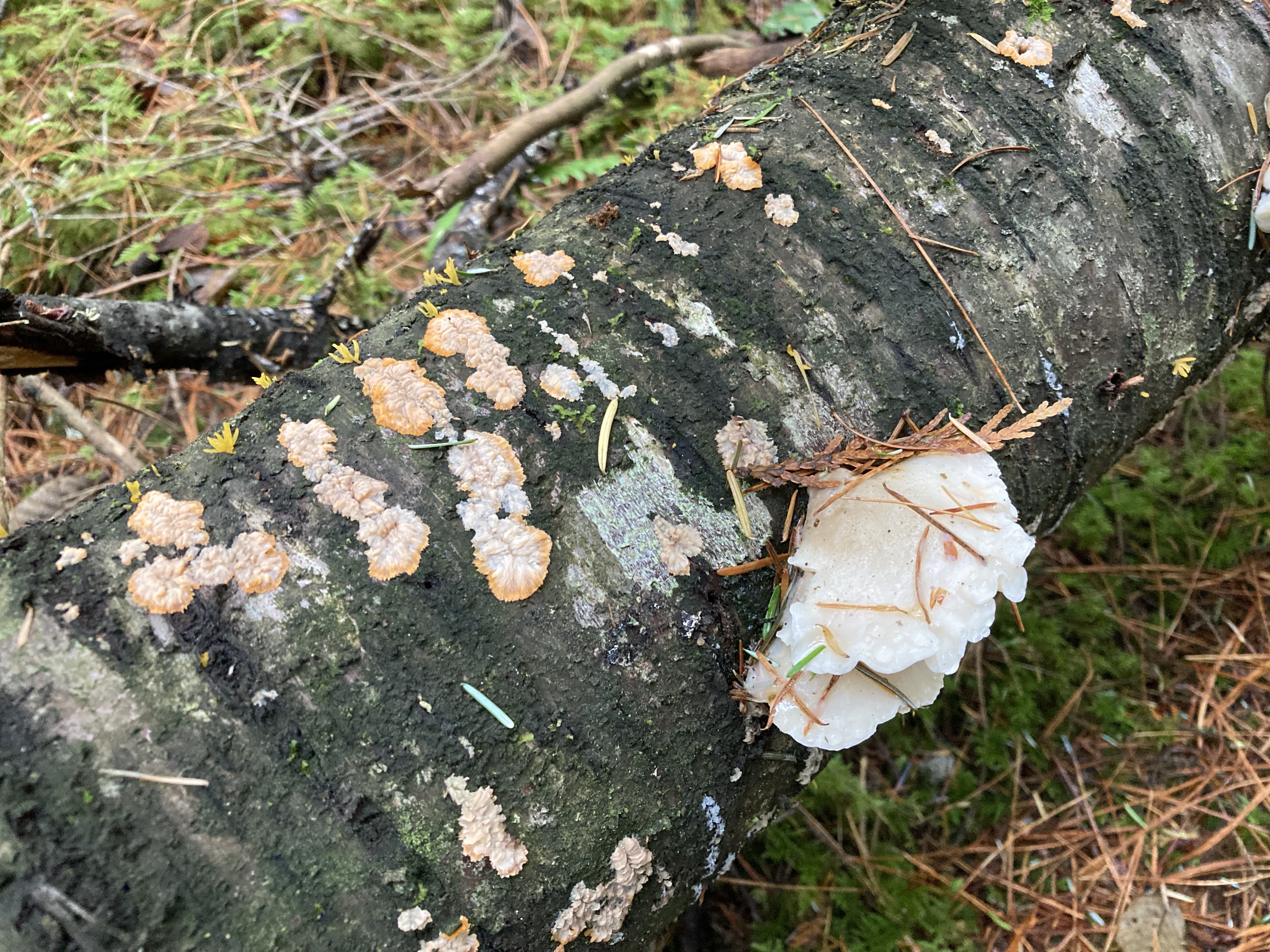
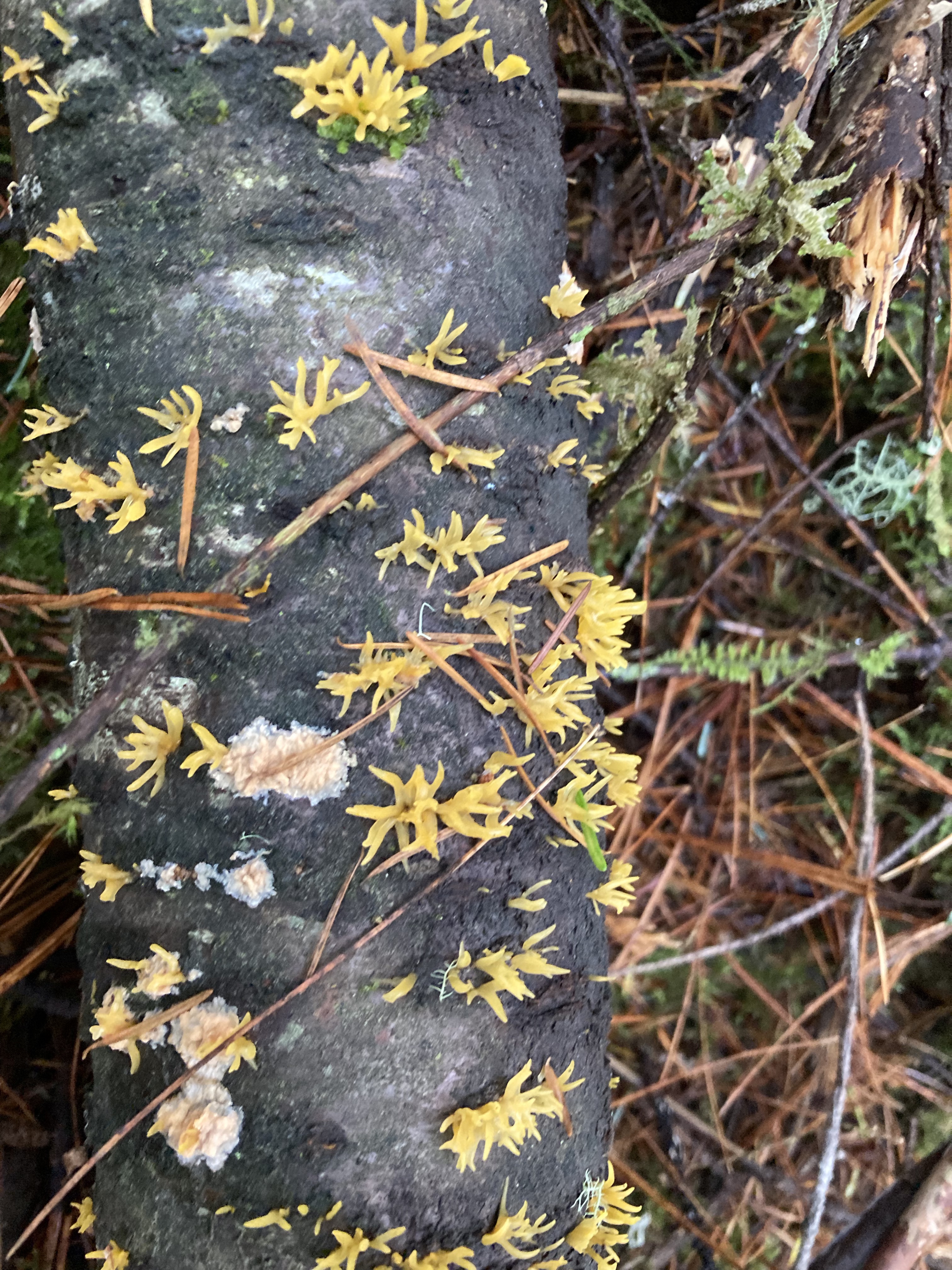
crust fungus, coral fungus, and hairy bracket fungusmore crust and hairy bracket on the same cherry
When you find different species on the same substrate, it does not mean the fungal neighbors are eating the same thing. In a sense they are, all eating this bitter cherry above, but one might be eating bark, one heart wood, and the other, a chemical only found in stone fruit wood. The cherry had some unique species, and the tree its self was a loner in that part of the forest. That made for some specialty wood eaters, and they were nearby in the soil waiting to help. Some might have been present in the tree when it was still standing, and only fruited out after the fall. The reasons for mycological inoculation varies, and many species are still under observation, thousands more lay unstudied or undiscovered. Clavariaceae coral fungi, and Corticiales crust fungi are two families which aren’t on most beginner lists, and even Trametes would confuse, though if I said “turkey tail”, more heads might nod in recognition of that family. I looked at that cherry log and knew I had a turkey tail relative in the bracket, a jelly or coral fungus with the little orange spikes, and though I did not know “crust”, I had seen the variety before on other rotting fruit woods.
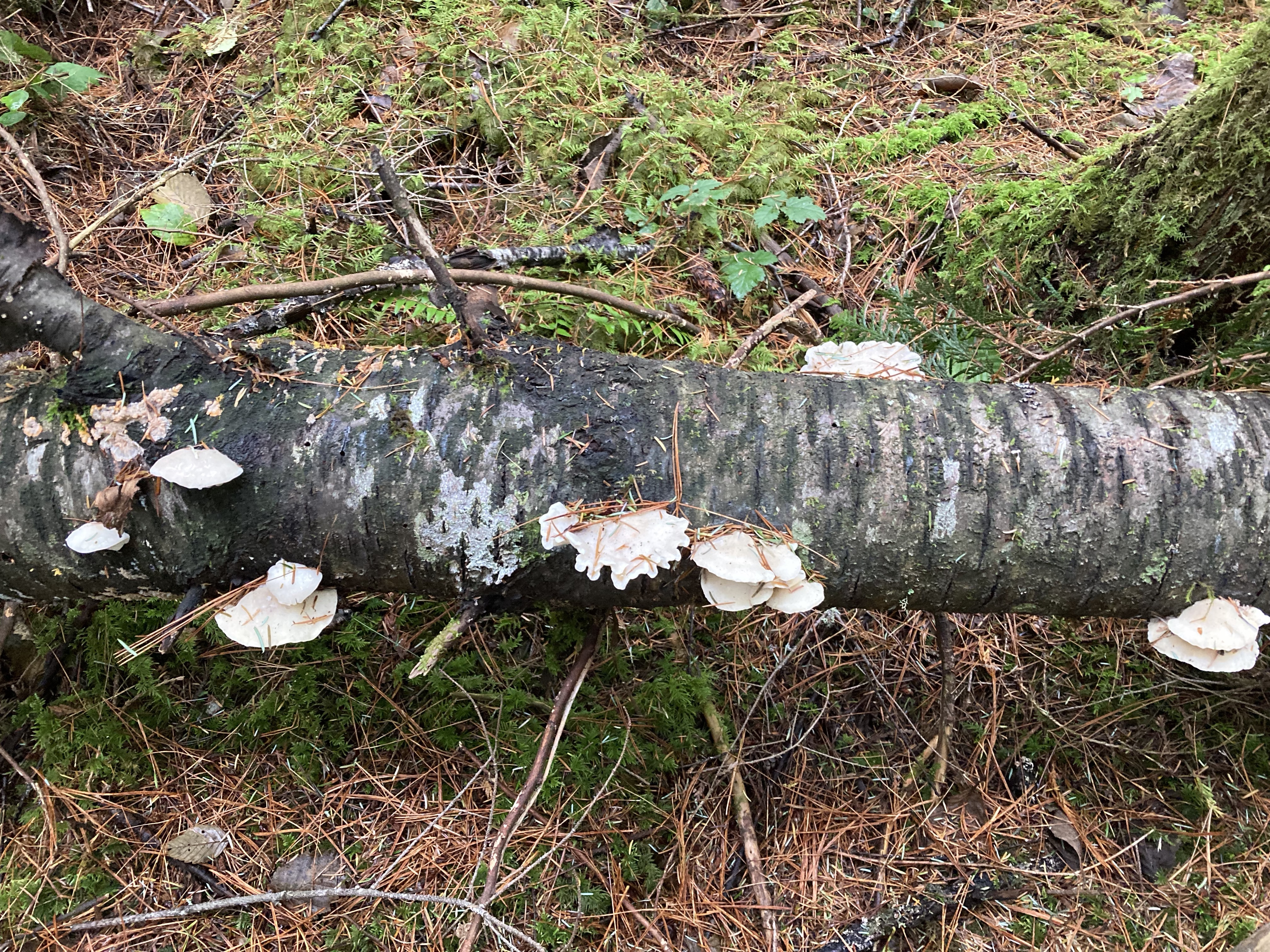
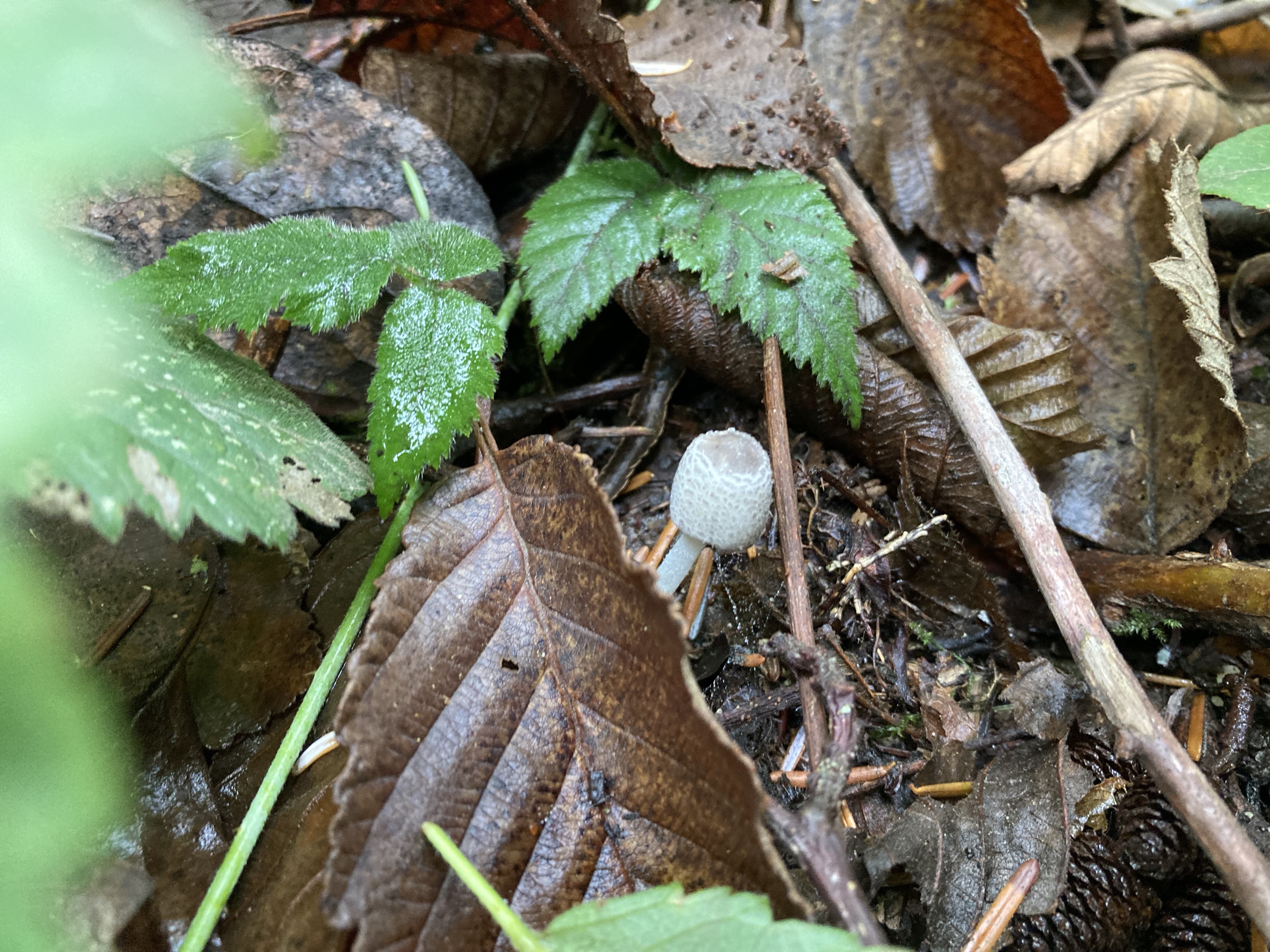
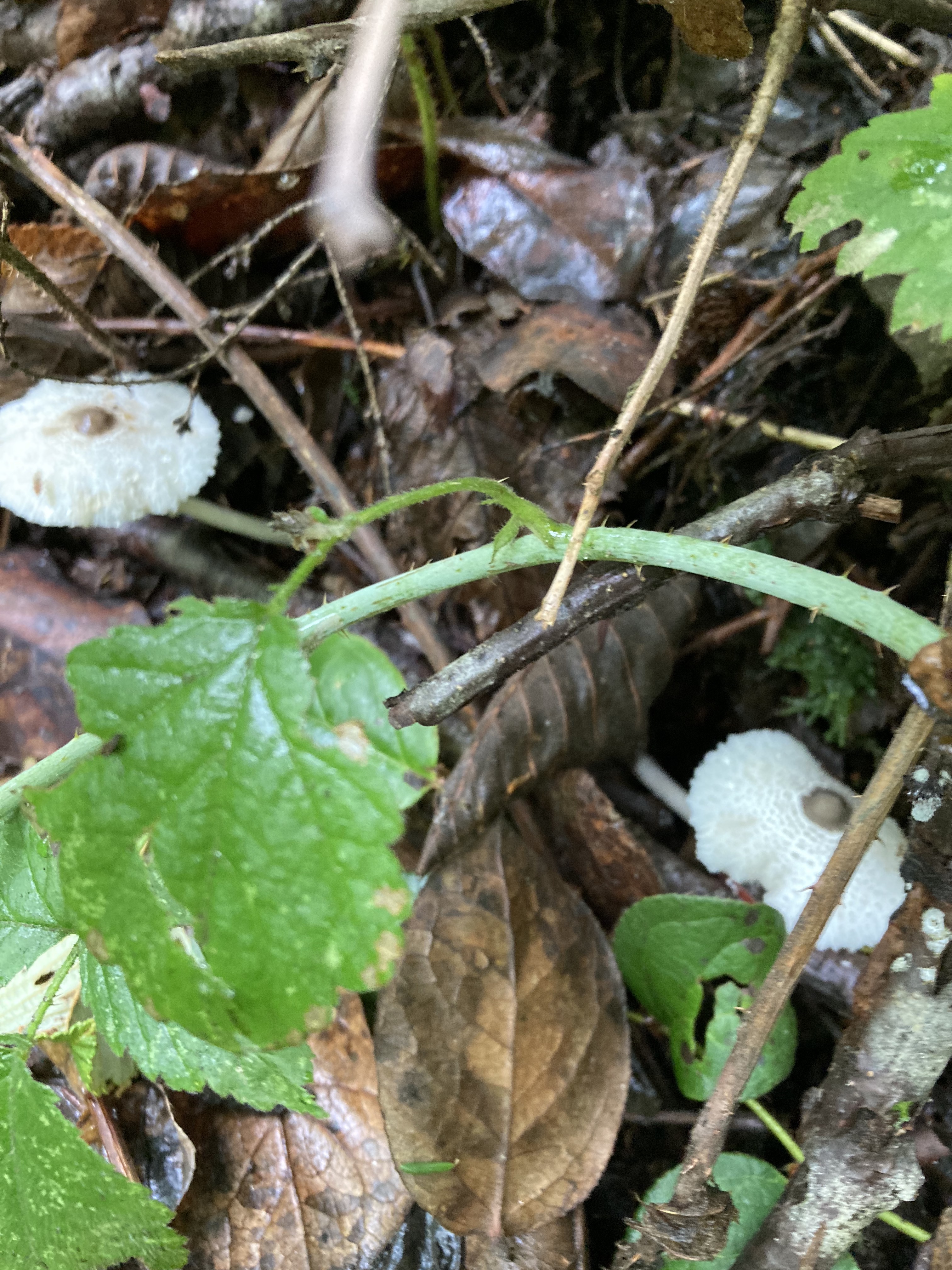
Lepiota, Tricholoma?, Omphalinoid
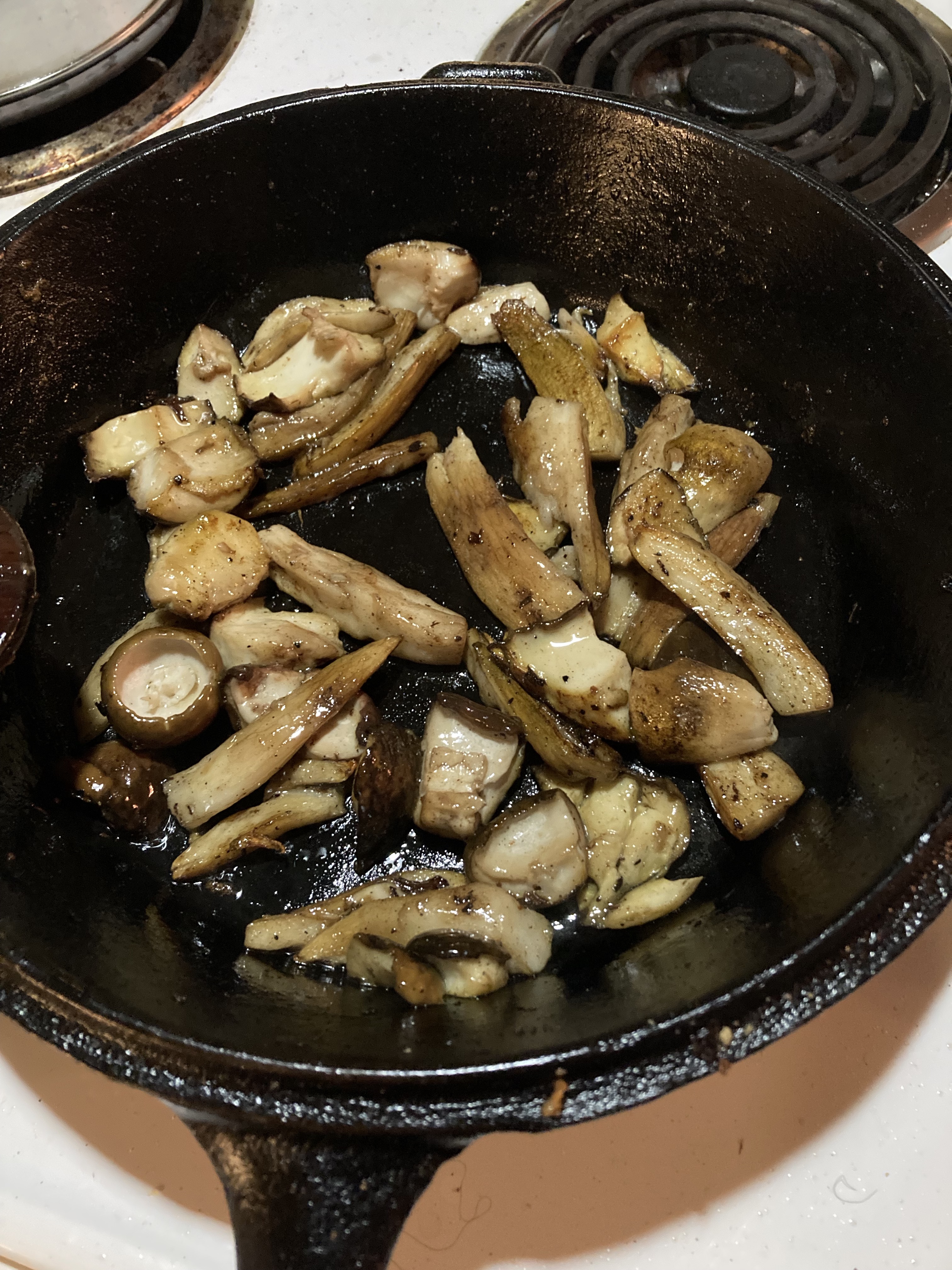
So many mushrooms on our walk- remember, this was about 3 hours in a 4 mile trail system. These are also only some pictures- I actually started holding back, as I knew this blog could turn into a small novel of mushroom overload. If you live in Western Washington, and want a great guide to help to find your way through our endless species- TRY THIS. It’s an amazing key for our bio-region compiled by Puget Sound Mycological Society. I’ve been using it to help key out families and find basic groupings. But hey, even if keying out all the mushrooms in the forest isn’t your thing, it’s still a great source if you get curious, and just taking a moment to notice fungal friends in the woods is a great part of any good naturalist journey. For those looking to expand into culinary mushroom foraging, the food rewards can be amazing, if you take the time to learn.
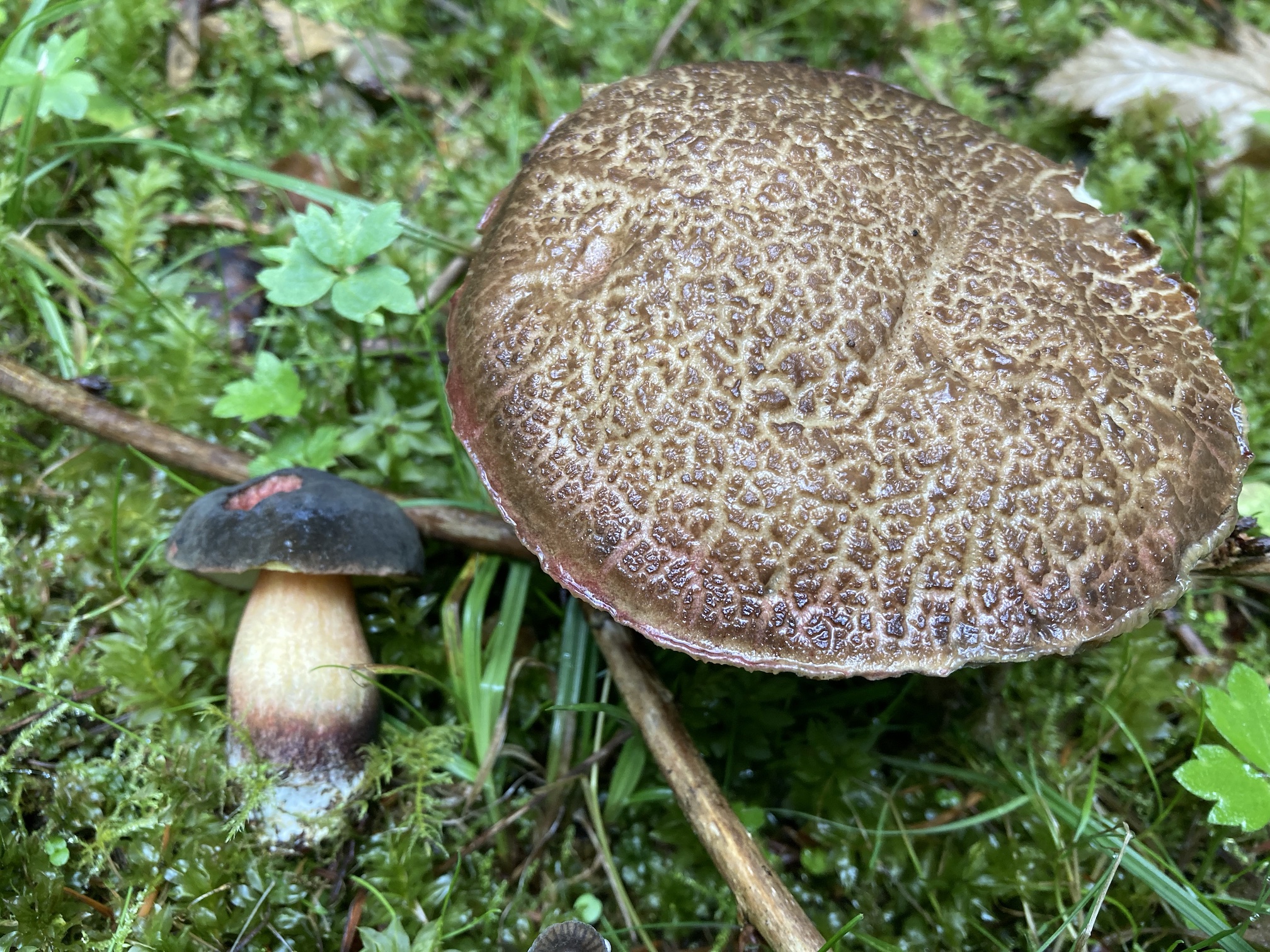
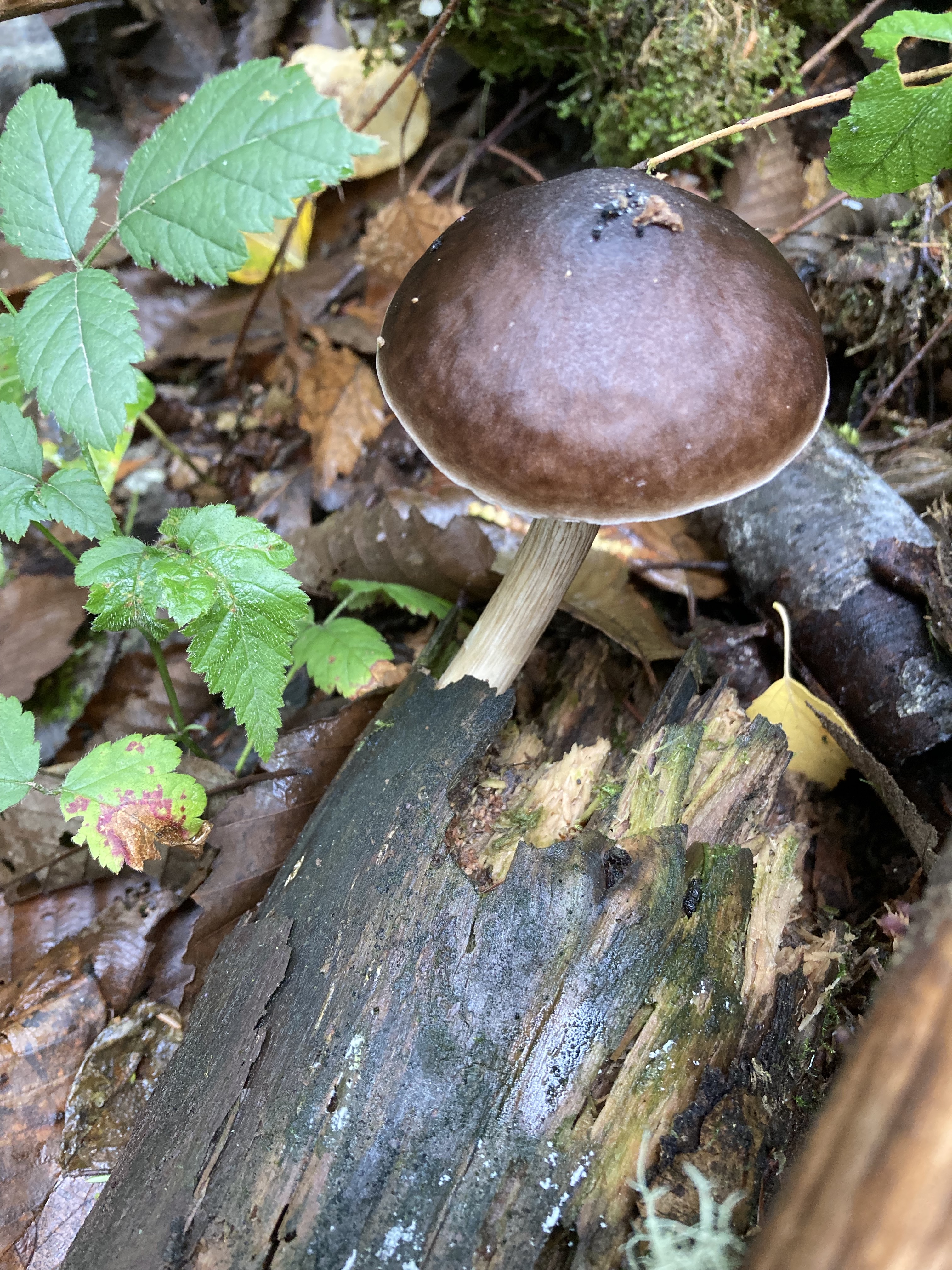
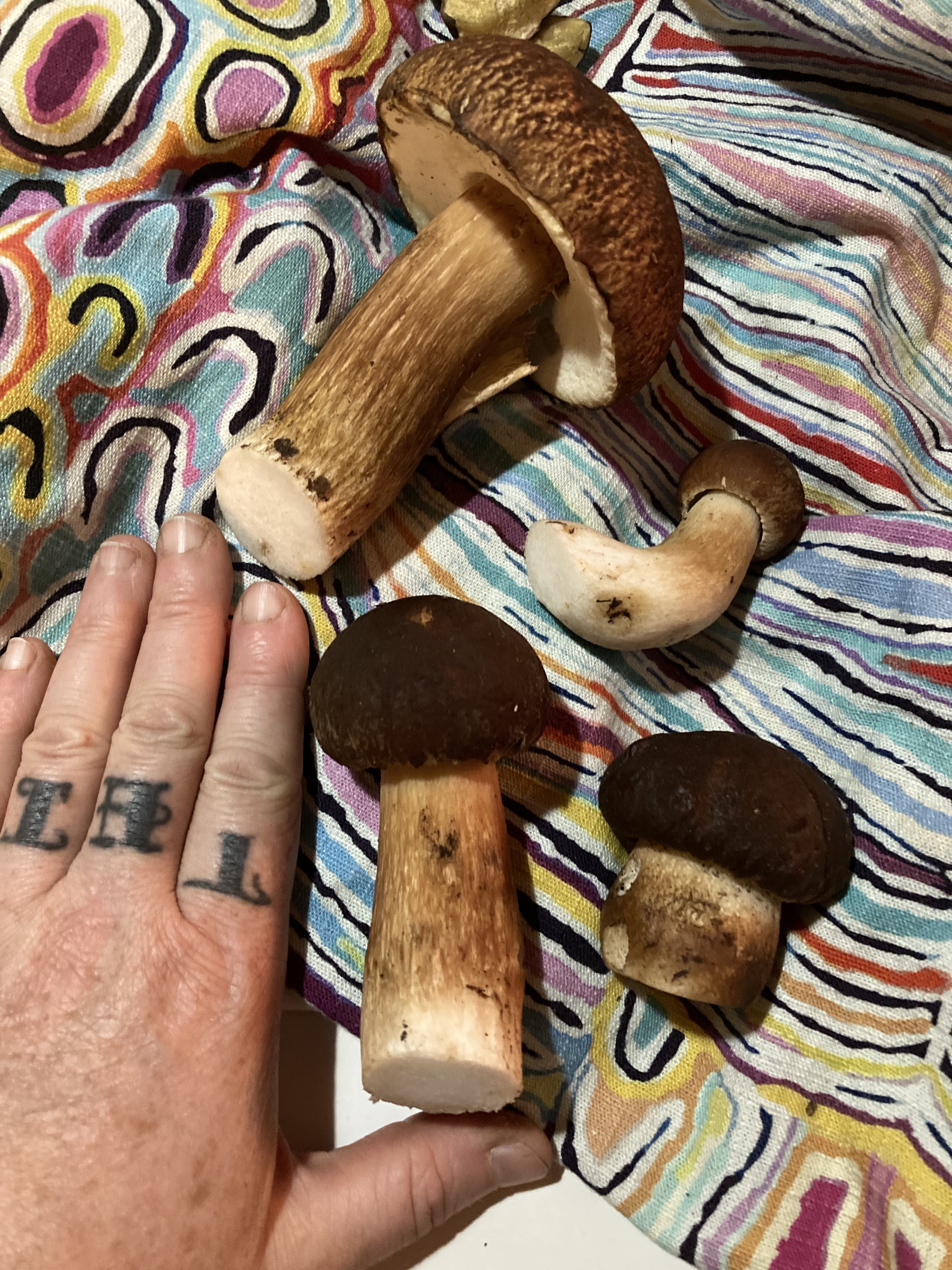
Boletus regineus
These queen boletes were spotted in an earlier picture- did you see the bulbous chocolate cap? Try bottom left of the group pic. See it? Well, I didn’t- at first, and it took my partner to point out the larger flush of these highly desirable edible mushrooms. What a delightful reward, but it was unexpected, and not a requirement for us to get some good fungal learning in Western Washington.
It’s The Mushroom Spring here at EEC Forest Stewardship! We’re out in our local public lands searching for treasure across the landscape (where appropriate). Keying in on human impact will make or break the future of wild mushroom foraging, please know before you go. As an enthusiastic mushroomer, I am thrilled to spot the first golden crown poking up through the duff, but this year, a dear friend who is also a fungal fan, spotted the chantrelle beauty below the trees well before me. The first rains of early Fall signal a rebirth in temperate northwest forests. Beneath the evergreen canopy, secret armies are on the march. Trees shed a lot of biomass, which builds a highway of needles and twigs; lattice network of nutrient exchange, much like the stock market of Wall Street, these orchestrated supply and demand chains pulse living symphonies through rooted nervous systems. Young trees “lay on the horn” and their nearby mothers extend nitrogen, carried on a living web of fungal fiber. These operations remain buried within the thick woody wilds, until cool damp conditions trigger a fruiting fantasia.
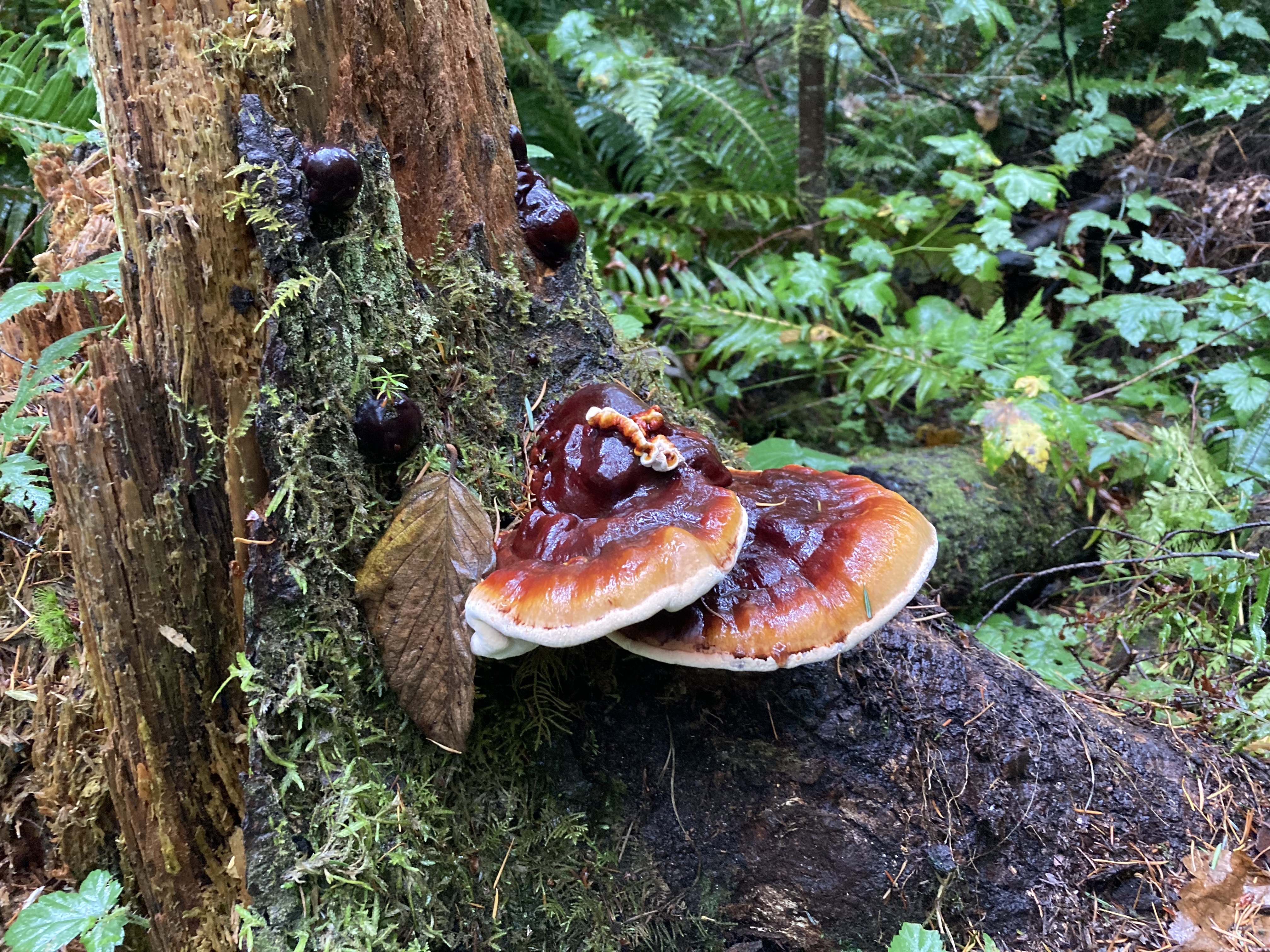
Ganoderma lingzhi
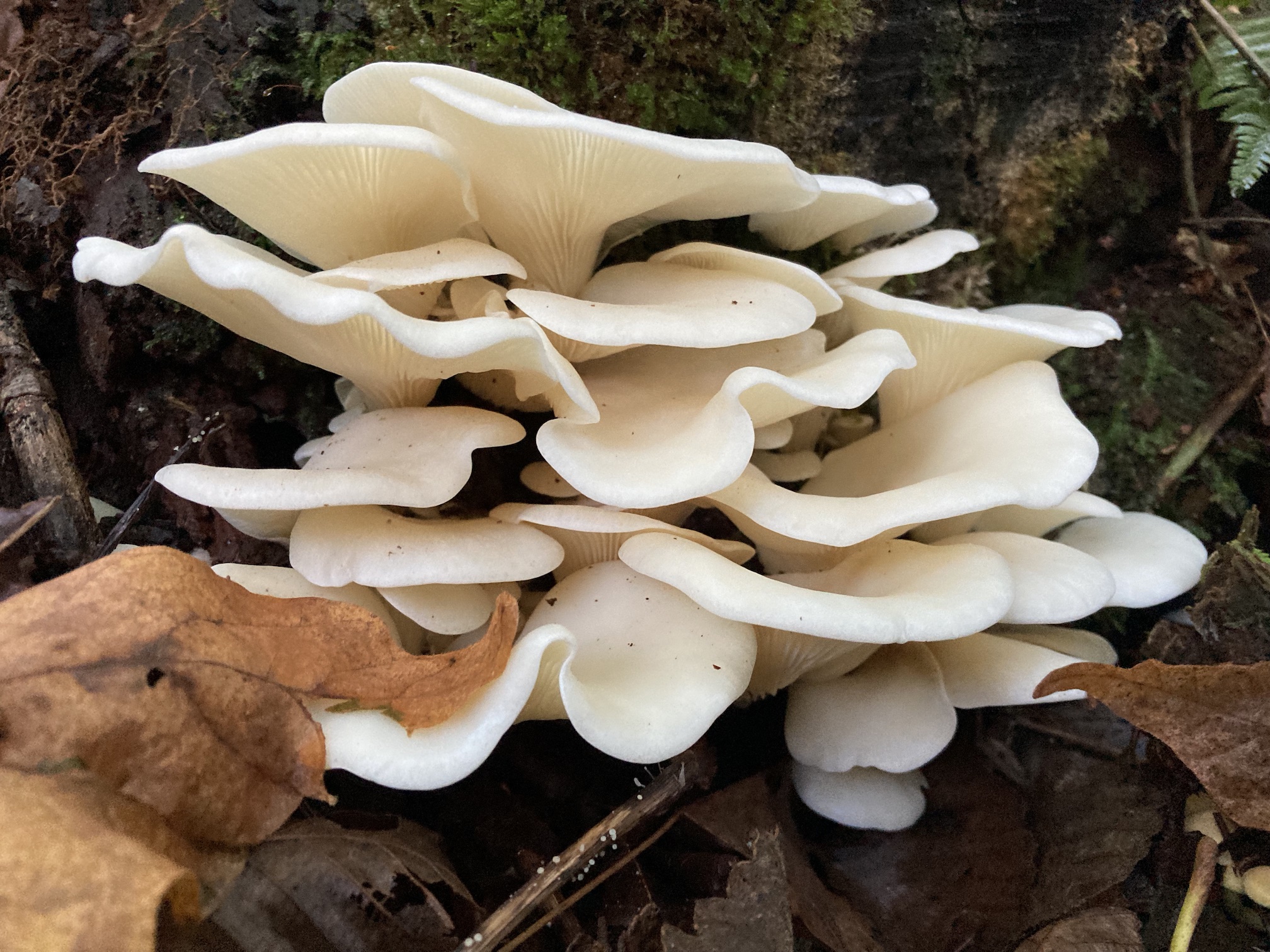
Though mushrooms are active at all times of year, equinox times are exceptional times for these mysterious magicians of decomposition. Here in North America, we’ve buried our ancient connection to this most potent Kingdom. Humans around the world have relied on fungi since the birth of evolution. We learned to leaven bread with wild yeasts, heal infection with mold, and harvest endless food and medicine in mushroom form. These jewels of the land are such abundant teachers, messengers of organically complex chemistry we are still trying to cypher. Mushrooms are ecological indicators in a landscape, sharing information above and below the earth’s surface. They share a close relationship with living matter, especially woody debris, yet are capable of breaking down more than rotting logs. Some species, like Pleurotus ostreatus, neutralize petroleum, and others like it can be instrumental in toxic cleanup across the planet. Here in Washington State, we’ve passed laws allowing mycological composting for human bodies. Imagine all the advantages fungi can offer if we look a little closer.
P. schweinitzii “Dyer’s Polypore”
Forming relationship with mushrooms takes time, and a lot of in the field learning. I’ve talked extensively in this blog about safety and mushrooming, and still advocate experts teaching anyone serious about going mushroom harvesting. This is not a foraging journey to strike out on alone. Even after a decade of mushrooming in one bio-region, I still consider myself a beginner, and enjoy a great shared experience with close friends already versed in naturalist education. Sometimes I’m happy to take a total beginner into the woods for a few encounters, and chantrelles are one of the best to start your foraging adventure with, still, please take your first turn in the woods seeking these golden tickets with an experienced forager. The endless verity of fungi families can invite false identification, leading to upset stomachs or much much worse. Mushrooms can kill, so stick to berry patches you already know if you have any worries- mushrooming is not for everyone!
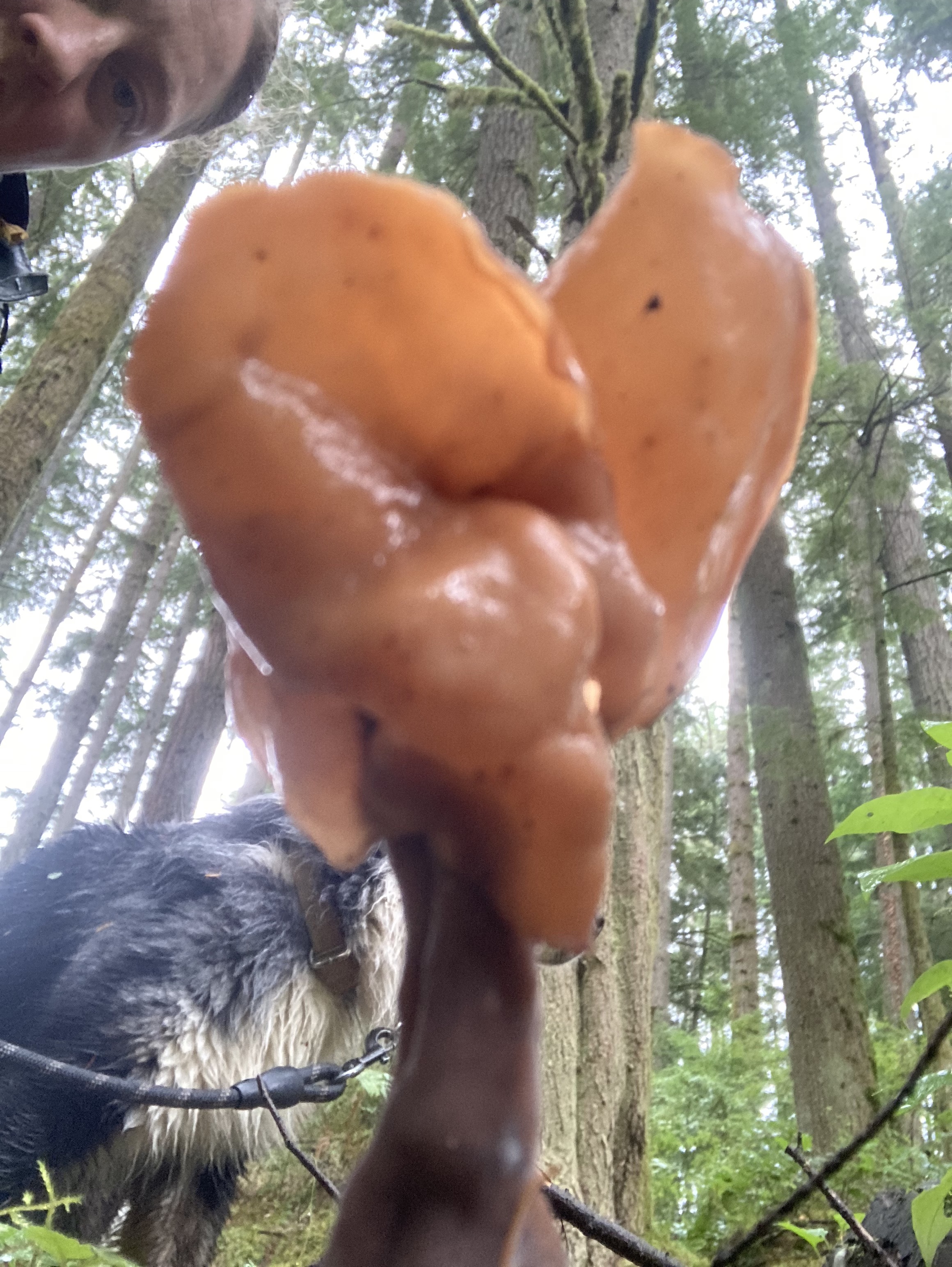
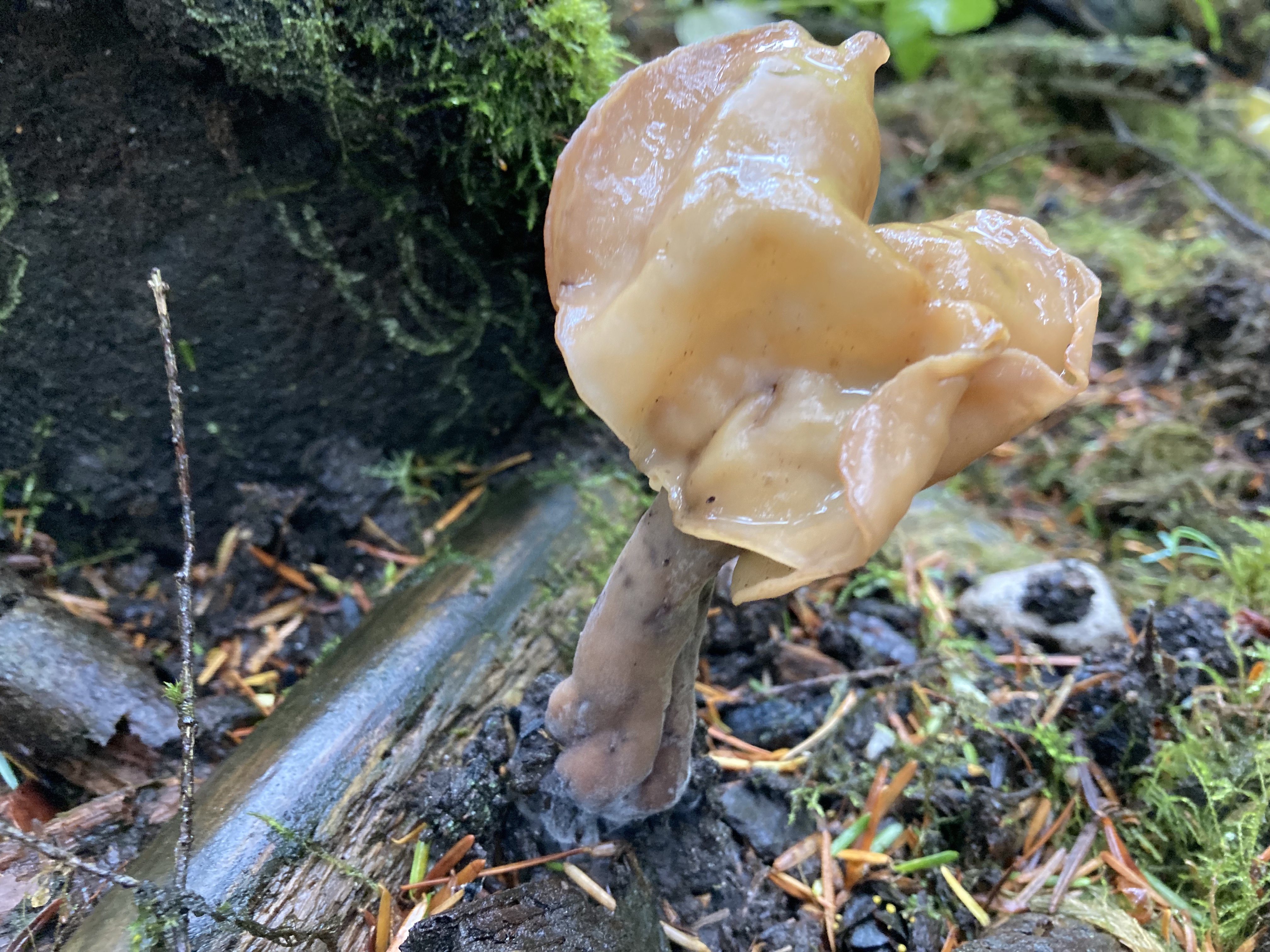
Gyromitra infula “Hooded False Morel”
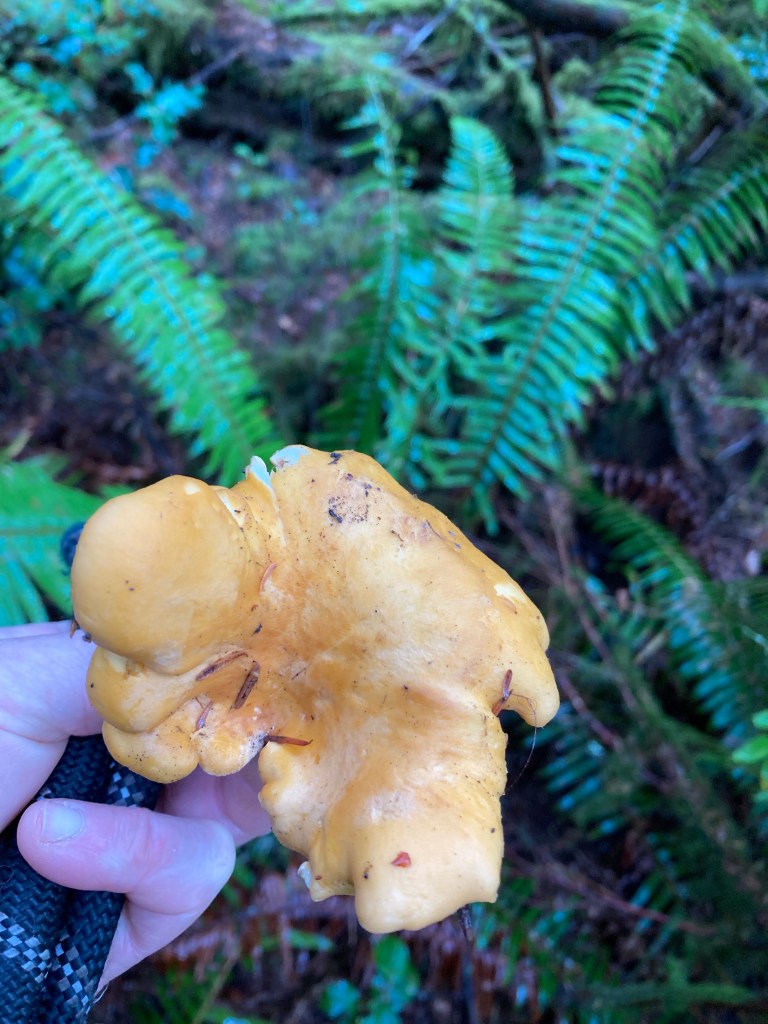
At opening mushroom harvesting day, 2021 (just another foraging day in Western Washington) I came across a great example of “look alike” species. It might not look similar to everyone, but an excited first time chantrelle picker could swipe up this mushroom without realizing the difference. Later, back at home sorting, you might catch it, but if you were to eat this fungal friend, its reaction to your stomach would be vile, and potentially hospital visit inducing. Would you instantly die from ingesting it? No, but long term damage of certain organs could occur. This is an important lesson in mushroom foraging for all to hear- go with a knowledgeable mushroomer and don’t experiment.
Here’s a side by side of chantrelle and hooded false morel to compare. What are the obvious similarities? How are the two mushrooms different? If you were picking quickly, would you notice the difference? I reached for the hooded false morel before realizing it was not a chantrelle. Then I saw the stipe (stock) color, noted the glistening skin of the cap, saw the thin, fragile structure of the mushroom, and took a step back. I knew this “imposter” was related to a morel (Morchella), and most likely a false species. I did not know it was “hooded” or specifically Gyromitra infula. Though some members of the morel family are delicious, this variety is not, and could cause serious poisoning. It’s great to see a less common species from Pezizales, and noted its location in damp mud along a wetland. Right across the trail, less than ten feet away, chantrelles were also flushing out. The yellow, meaty mushrooms belonging to Cantharellus fruit best in soft, thick Douglas fir needle dominant forest debris. They are usually neighbors to salal, and Oregon grape; sometimes sword fern too. Substrate will tell you a lot about mushrooms, so keep an eye out when you locate a strange new fungal friend.
Chantrelles are just the beginning of harvestable wonder in the woods this Fall. More inches of rain are falling as I write this closing paragraph, and I know tomorrow will be another great foraging day to come. Other species to be on the look out for are russulas, boletes, puffballs, and chicken of the woods. That’s a start to the Fall lineup in Cascadia as we enter into one of the most wonderful seasons of the year- a welcome return of rain; brings a full foraging basket and gratitude for wild abundance this way. Safe harvesting to all, and good learning through observation as you listen to the mycological song humming through these temperate rainforests.
Washington State drought maps reflect another record breaking summer of heat. Our numerous beautiful rivers are vulnerable, shallow bathtubs, not suitable for salmon spawning. Temperate rain forests are visibly stressed; under-story plants wither, their roots parched through twelve inches deep in crackling needle duff. Dust kicks up as livestock roam barren pastures that look more like moon scapes. Even here at EEC Forest Stewardship, sheep have been hay rationed to prevent weight loss going into slaughter season. Our pond is pea green soup with only a few feet of moisture left to keep fish and cattails alive. The creek is now truly creeping along, keeping a few deeper pools viable for trout fry. This salmon waterway has also remained cool thanks to an intact forest canopy of shade through summer’s scalding intensity. Crayfish, mottled sculpins, fish, and our endangered freshwater muscles all crowd together in an attempt to survive.
Wildfires have been increasing, and again, without rain, this trend will continue to climb. At EEC, we’ve continued to work on drought resilience, from water catchment and retention to selecting drought tolerant species for long term viability. Oak savanna is looking like the best option for future forests here in Western Washington. Our weather might eventually look more like that of California, so western hemlock, Sitka spruce, and even red cedar will not be planted. Douglas fir is also drought tolerant, along with shore pine, and even western white pine might make a return, we’re planting it at EEC in small numbers. Young trees will have to receive irrigation to survive their first few summers; our pillow tank had played a vital role in establishing an orchard. After the fruit trees can stand alone, the tank can be moved to another location to water young forest plantings, or remain where it is, and offer gravity fed drip irrigation to whatever need water the most.
Though much of Western Washington’s climate change struggle revolves around heat, like most of the world, we’re also continuing to receive long periods of precipitation. EEC is located in the foothills of The Cascades, which create a massive Orographic lift right over our habitat. Along with the rains, we are starting to see more snow too. The Jet Stream does a lot to dictate temperatures and moisture influx to our region. Right now, as I write this post, we are getting rain, measurable precipitation for the first time since June. It is the end of September, and about two inches is expected to fall over the next few days. It will not make up for the drought, but it will throw a lifeline to the ecology of Western Washington. In these unprecedented times, we must adapt or face critical failure.
For EEC, this failure would look like a catastrophic loss of plantings, causing a severe financial deficit, but also an ecological interruption in reforestation for the greater ecosystem. Already, plantings put in across several acres of our stream buffer have taken a real hit from the dry heat of two summers in a row. Though most still survive, they face an uphill battle against mounting climate shift odds. When rains do come, the water is fast and furious, running over the parched ground without much time to sink in. Without slow, deep moisture events, our aquifers cannot recharge. Without plentiful ground water, species like hemlock and cedar, who rely on wetlands to thrive, will continue to recede. A row of ponderosa pine planted eight years ago, are finally taking off; well adjusted to the weather extremes. They are certainly more adapted to snow, which will come with more frequency as our dramatic weather continues.
Last winter, 2020-21, we had some big snow storms. This was a great recharge to our aquifers, and a slow drip moisture bank for the plants. Unfortunately, the snow also creates other challenges, including structural failures if a roof is not pitched enough, or hazard conditions for travel and local access. Having lived in New England, where snow is a normal occurrence, I’ve got some awareness of precautions and solutions, like chains for the truck to get out of our driveway without a plow. I’ve also overwintered on the east side at elevation, enough to know when it’s time to shovel off a barn roof or clear walkways and entrances to keep building accesses open. Usually, the snow melts within a few days, but a couple of winters ago we had a snow that stayed on the ground for over a month, and that was a real setback in pasture management. Valley farmers saw their tractors struggling in the marshy soil well into May, and a lot of fields missed Spring planting.
On the last day of September, 2021, we received another weather front with more rain. Grass is up three inches in the back pasture, and I’ve begun moving hoses from sprinkler setups to cistern catchments in anticipation of good roof runoff in the heavy rains. In EEC’s design plan, we redirect all water from hard surfaces, like roofs and driveway, into our pond. It spent the summer dropping, and bottomed out at about 4 feet, just enough depth to keep our fish alive, but inviting an algae bloom. In the past two weeks of rain, the water level has risen about six inches, and we’re expecting another half foot in these next few days. It’s the first time we’ve had so much direct catchment, and fingers crossed we’ll have a full pond this year by the end of winter. It will be a huge milestone in water management at EEC Forest Stewardship.
The only thing constant is change. Yet as humans with such advanced cognitive attentions, we often struggle to see change and adapt to it, or are we just adapting constantly, regardless of perceived change? That’s the philosophical question, but how does it relate to the picture above- a human created trail for access into an established camp site along Evergreen Creek in The Central Cascades? Someone had hiked in to prepare the area for use in future, showing no obvious sign of actually camping in the space, but hacking several trails to the site, and from it, into the woods beyond. I took a picture of this part of the trail, because I’ve been here in early Spring. During that time, this whole area is inundated with water, and you can see to the right in this picture, there is a more warn trail strewn with rocks, which turns into a stream during heavy rains. The man made trail on the left stays above this stream until a necessary crossing, in which a log has been laid across the flow of water, which will create a block, thus complicating the flow of the stream and causing more erosion and a wider crossing in future. It’s also going to turn into a mud pit this fall, when perhaps hunters will come use the site as a base camp.
In looking at this man made change, there is a familiar narrative of misguided augmentation on the landscape, causing detriment to the space, and in direct opposition to the intended benefit for the person. It’s classic human error due to complete lack of observation, connection, or understanding of the land; beyond creating a direct line to the destination. The trail will grow over in time, but the erosion of the area will worsen, and the access in will become more difficult to traverse. We’ve all been short sighted, but instead of acknowledging mistakes and learning from them, people now, more often than not, blame the other and deflect responsibility. It’s no wonder people have stopped critical thinking to sort fact from fiction, learning from history, or learning at all. Before this narrative explodes into human regression, let’s return to the land. Grounding is about slowing down, feeling, being open to deeper perception, though life is not always ready to accommodate.
This writing is about making hard choices in response to important change, and how hard it can be to accept or even see the big picture, which informs our decisions. To be clear, individual perception is always limited, but when there are multiple eyes on the situation, while becoming more complex, allows for greater understanding. When you add the rich tapestry of language to share different perspectives, you have a much more successful outlook. Community is imperative for us as a species to survive, yet we are also incapable, as individuals, to fully comprehend global thinking. We’re in a rough growing period right now as the human race, trying to see broader, more diverse perspectives, including under represented voices, and still holding clear personal vision. This kind of demanded flex in our thinking is not new, but the acceptance of it when there are so many other perceptions- many of which we’ve never encountered before, can be overwhelming.
Turning now to personal experience, I was recently planning a high hunt in late September. It’s called the high hunt because only lands at elevation are open to the hunt, so you have to get up high into the mountains for a chance to harvest a deer. It would be my first time attempting this feat, which involves hiking into the back country and potentially hauling the animal out under difficult circumstances- similar to the ones at the man made trail on Evergreen Creek. Hunting in the back-country should not be done alone, so my first plan was to invite my partner and a couple of friends out to join me. The two friends are on a learning journey with hunting big game, and also enjoy camping. The only dates they had available were the final weekend of the high hunt season, so we made plans and saved dates. Well, the friends ended up in schedule conflicts, and my partner got a new job- which is great- but his new schedule shaved off a day of the hunt, and I later found that the dates of the hunt did not include Sunday, which gave us just Saturday to hunt. Add to that hunting in an unfamiliar place, hard to access, on a weekend when everyone would be out- not just hunters.
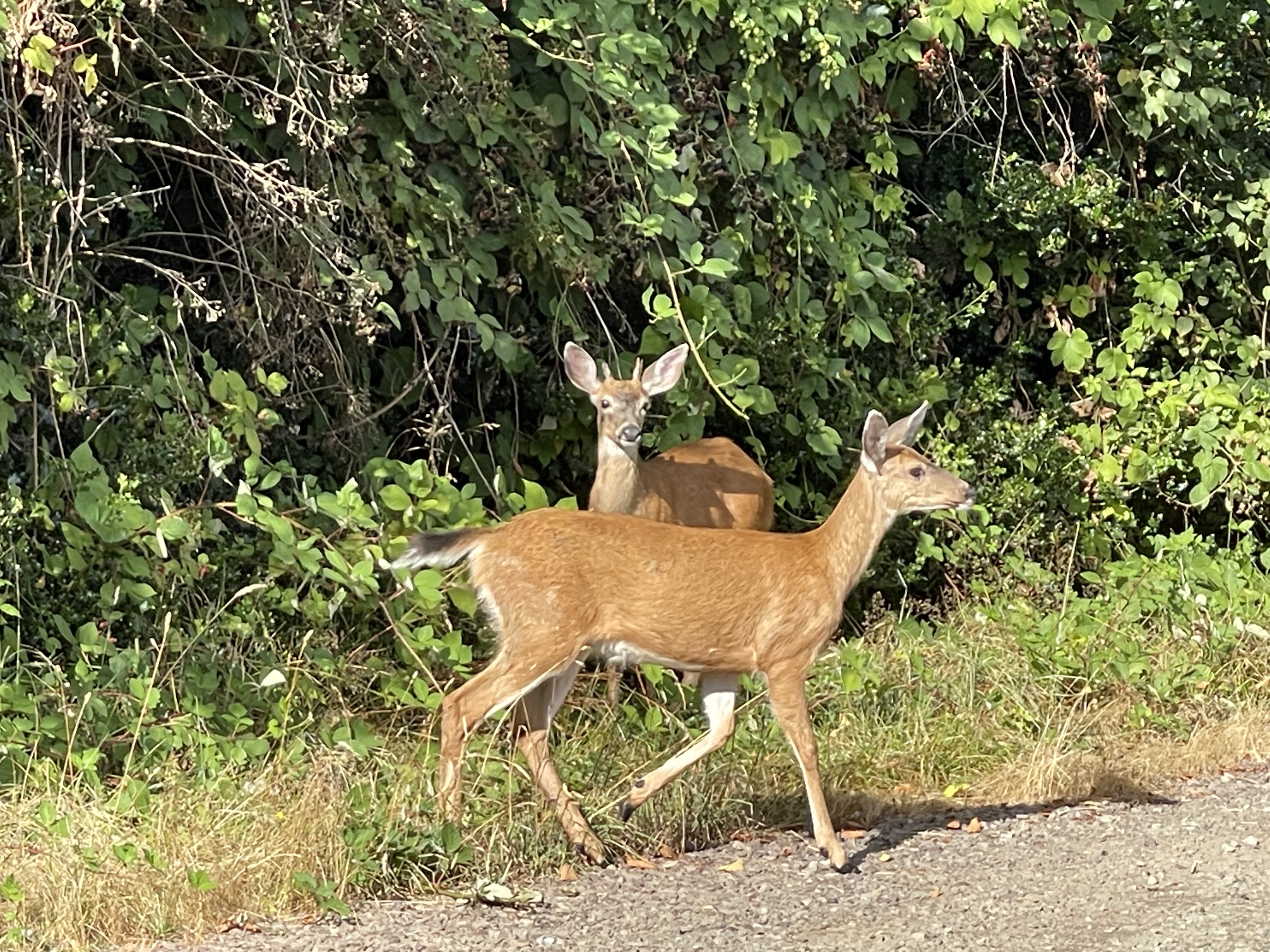
a pair of black tail deer yearlings at EEC Forest Stewardship in September 2021
In trying to rework the plan, I tried setting things up solo, so I could leave earlier, have a day to scout the area, and take on the challenge of being there by myself to at least have the experience. This was only adding more problems to the mix, and when a tenant called to tell me he needed to drive a truck in and out of the sheep pasture (while the sheep were in it), I began to think this trip into the back-country was not viable at this time. Too many plans were changing, and I realized putting myself at risk, on top of all the other compromise, would not be safe. It’s hard to acknowledge change- especially when it means giving up personal passion, for me, hunting. But it’s not a total loss at all. That’s the important forward thinking that can help us adapt with grace. Regular hunting season in the low lands, which I always plan for, and have a rhythm with, will happen. I’ll be home to help my new tenant, and have a good weekend of time to work on the land while the weather holds. The high hunt can wait another year, and I can commit to the occasion by planning further ahead, scouting locations better, and knowing what the true limitations are. Knowledge is power!
There were so many blocks preventing me from seeing the most simple solution because I was caught up in the narrative of failure. That’s a big hindrance to people accepting reality these days, from what I’ve personally experienced, and publicly observed. The situation of hunting, at all costs, could have cost me dearly. To not go alone would have curtailed the hunt to less than a day. We could still go up Saturday and scout the land, we might do that as a day trip and still get a feel for next year. There is always a bright side to any change, that’s important when it’s constant. At this time in seasonal change, slowing down mimics the greater environmental change. As my garden goes to sleep, dropping hard grown seed and composting back into the soil, I too put certain work to bed in preparation for Winter. Just think of all the chaos when plants can’t adapt to seasonal changes in time. I don’t want to get nipped in the bud by a sudden frost if I can help it. The wisdom to recognize change takes practice, and in our short sighted struggle to be right, we often overlook obvious warning signs. In back-country experience, this is often called “the human factor“. It is on us to recognize change and adapt to prevent a cascade of trouble.















 EEC Forest Stewardship