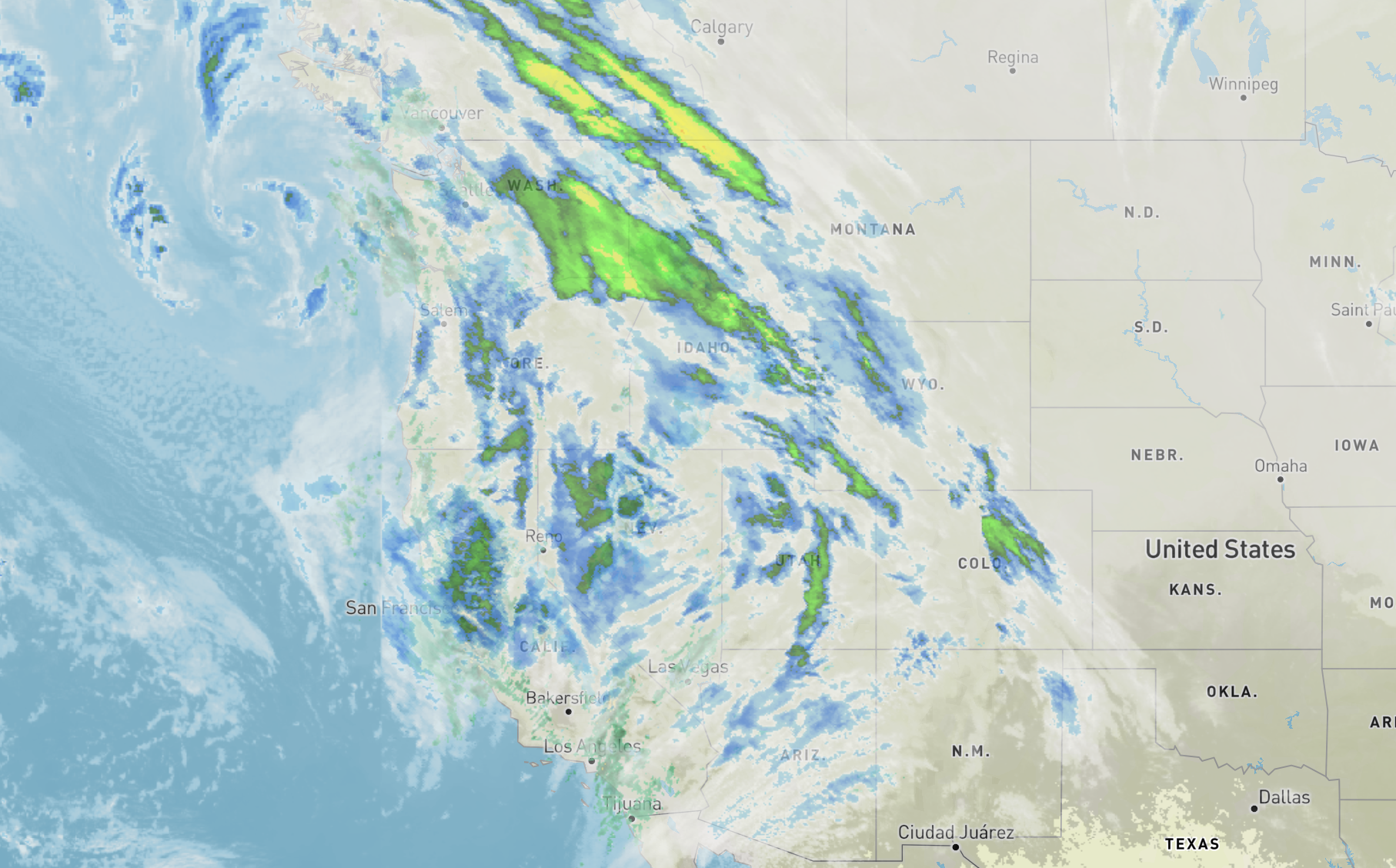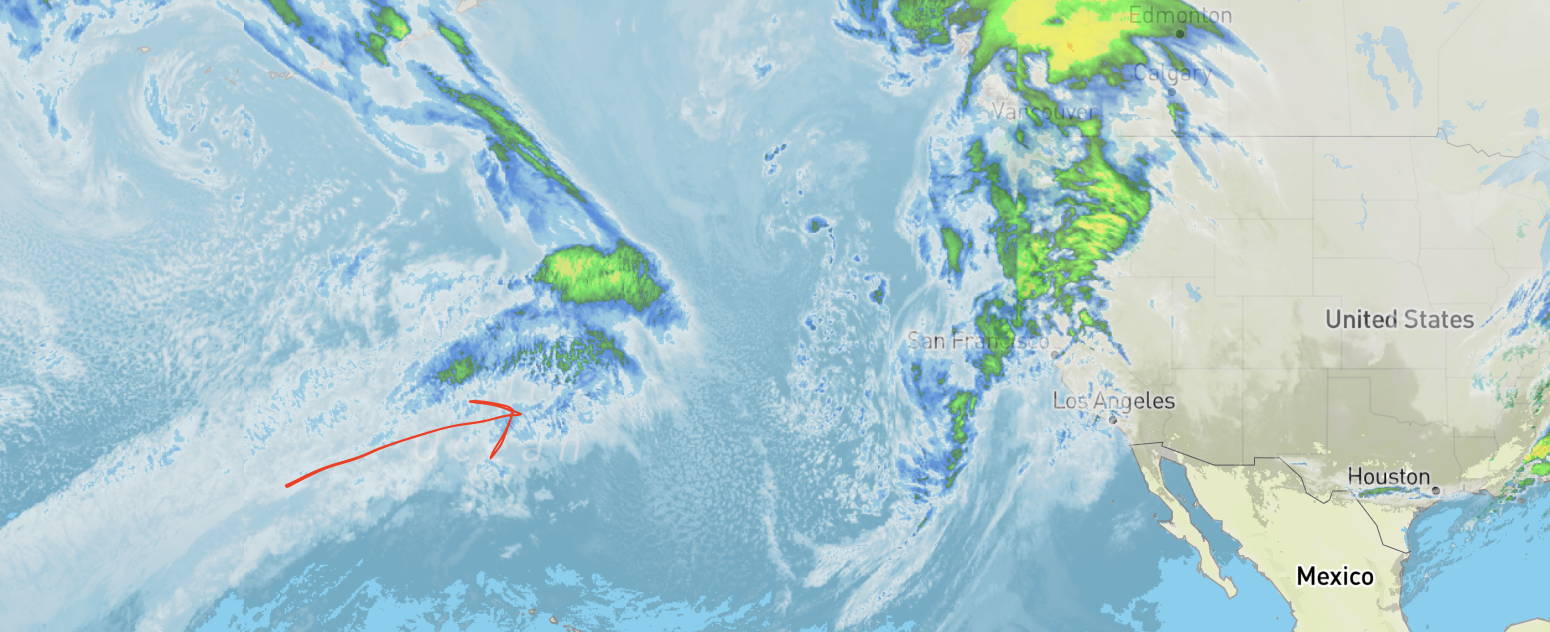
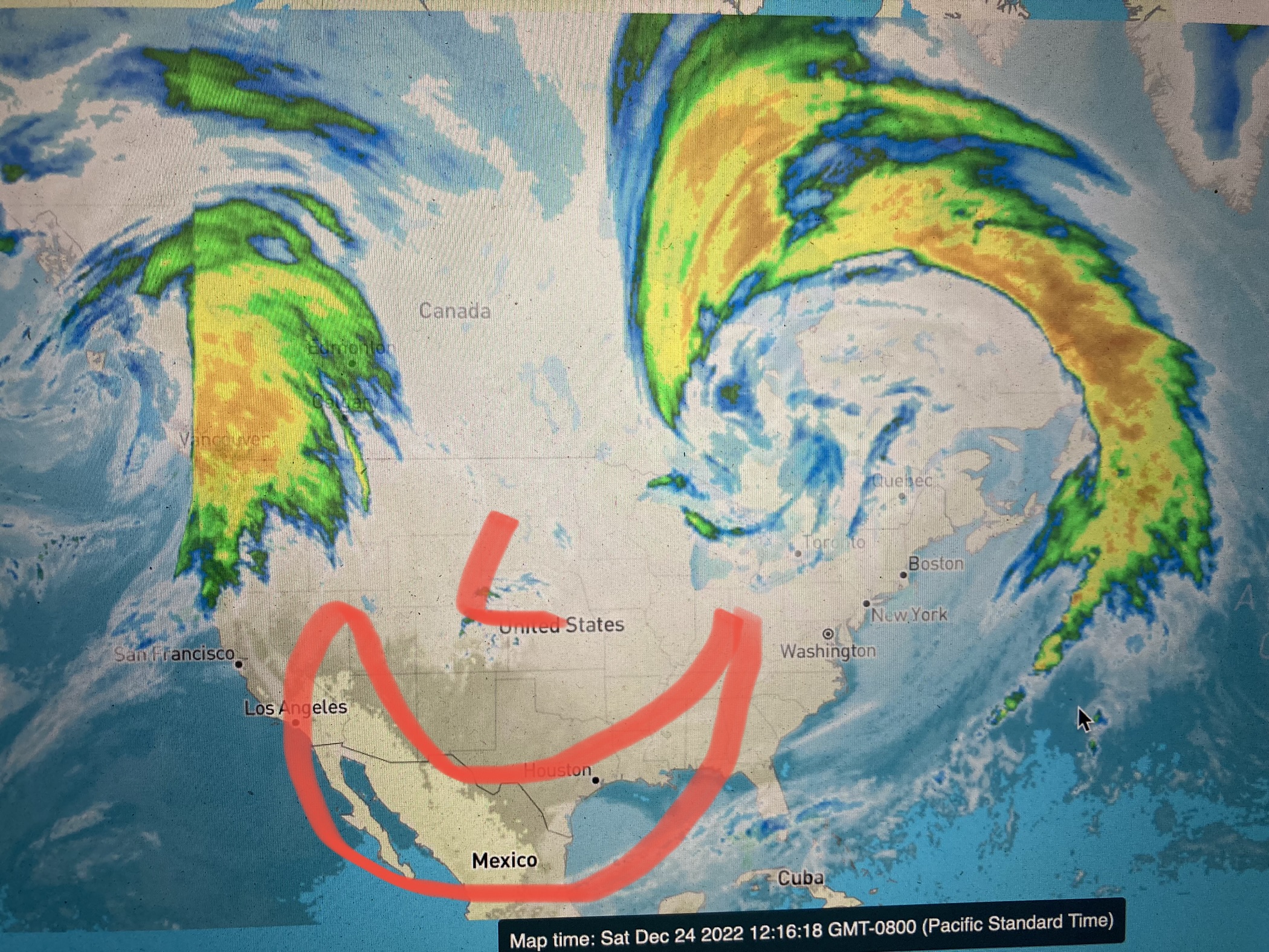
Snow is always a treat here in Western Washington. Our warm ocean climate rarely delivers the right conditions in the Puget Lowlands for a winter wonderland. In November 2022, a winter weather advisory went into affect, and snow began sticking to the road and trees with enthusiasm. In just a few hours, our landscape was blanketed in gauzy white flocking. The animals were tucked away in dry barn and our cats had tucked up on the porch in comfy quilted chairs. I got out the snow shovel to monitored paths and accesses around the property keeping doors and walkways open. Snow can turn from fluff to cement in hours here, so active clearing saved hard labor later. Our driveway remained easily passable with four wheel drive, and no one missed work or play.
At the farm, chickens rebelled against the cold footing and hung out in the covered sheds and barn. The sheep lazed away at their hay and rested in fresh straw bedding. I’ve been forking loose hay from a big round bale, and refreshing my skill with a pitchfork. That same fork helps me clear ice out of the drinking troughs. Cold weather, even with beautiful snow, makes livestock systems more challenging. I could get water heaters, but we get so few truly cold snaps like this, I can handle ice breaking for now. Back in Vermont, I used an ax all winter to crack ice half a foot think. Here in Western Washington, it’s not more than an inch thick. If we drop into the teens, I carry hot water from the house to top off overnight troughs, keeping them from freezing. We’re not there yet this winter- thank goodness! Snow like this does a lot of insulating. It’s helpful for re-hydrating the soil with slow drip too.
The winter splendor of snowy days is charming, so long as you have a warm place waiting your return. Gratitude for home, wood stove heat, and the time to enjoy winter weather, rather than fighting it. There was plenty of extra work brought on by the snow, but it’s playful atmosphere was not lost on humans or furry friends. The dogs were especially frisky and light. Gill seems to use the fresh powder as a sort of bathing while basking enjoyment. He’ll lay down and rub through the snow on his sides and back, rolling and swimming through the frozen water. He could also just be playing around. Maybe a little of both. Valley does this too, only she prefers running, and goads Gill into occasional romps that end with a stalemate. Movements are a little more exaggerated and carefree, but action in snow does take more energy too. We all got a workout running and chasing around the land.
The slow watering snow brings for the ground is greatly needed. Moisture has only reached down a few inches since the fall. Frozen water sits on the surface and then drips into the soil during warmup periods of the day, refreezing in the evening to slow the saturation. It’s brilliant for ground that’s been parched by summer heat and sun. It feels like the future climate for our region will continue to shift in this direction of more extreme climate change. Winters will be colder, with more snow and ice, and summer will be hotter, with less rain and more triple digit highs. Banking water in the soil is the only way to combat these weather stresses on the landscape. Our swale designs support the slow and sink method of tending water.
Rain events here have shifted from weeks of misty sprinkles to afternoon deluges with an inch or more at once. The landscape this year was so dry, the fall rain ran right off the hillsides and into the rivers heading out to sea. At this point, snow was the only way to slow and sink water efficiently. Snow like this in November is as wild as the 90F October days with wildfire smoke this year. I can foresee, in another 5 years, smoke all summer into 90Fs October, burns continuing on the west side, and come November, snow on the ground for months, much like New England. It’s the kind of weather livestock cannot thrive in. We’re keeping that in mind as we plan through the next few years of EEC Forest Stewardship. Tree planting is becoming the next big shift, shrinking the farm production for more forestry restoration. That remains the ultimate goal of this great adventure at EEC Forest Stewardship.
Winter months offer a little more time for reflection, planning, and enjoying the moment. Cold, crisp evenings outside while flickering firelight keeps spirits warm and bright. May all who read these words carry warmth in their hearts, abundance in life, and joy in the days ahead. Happy New Year from EEC Forest Stewardship!
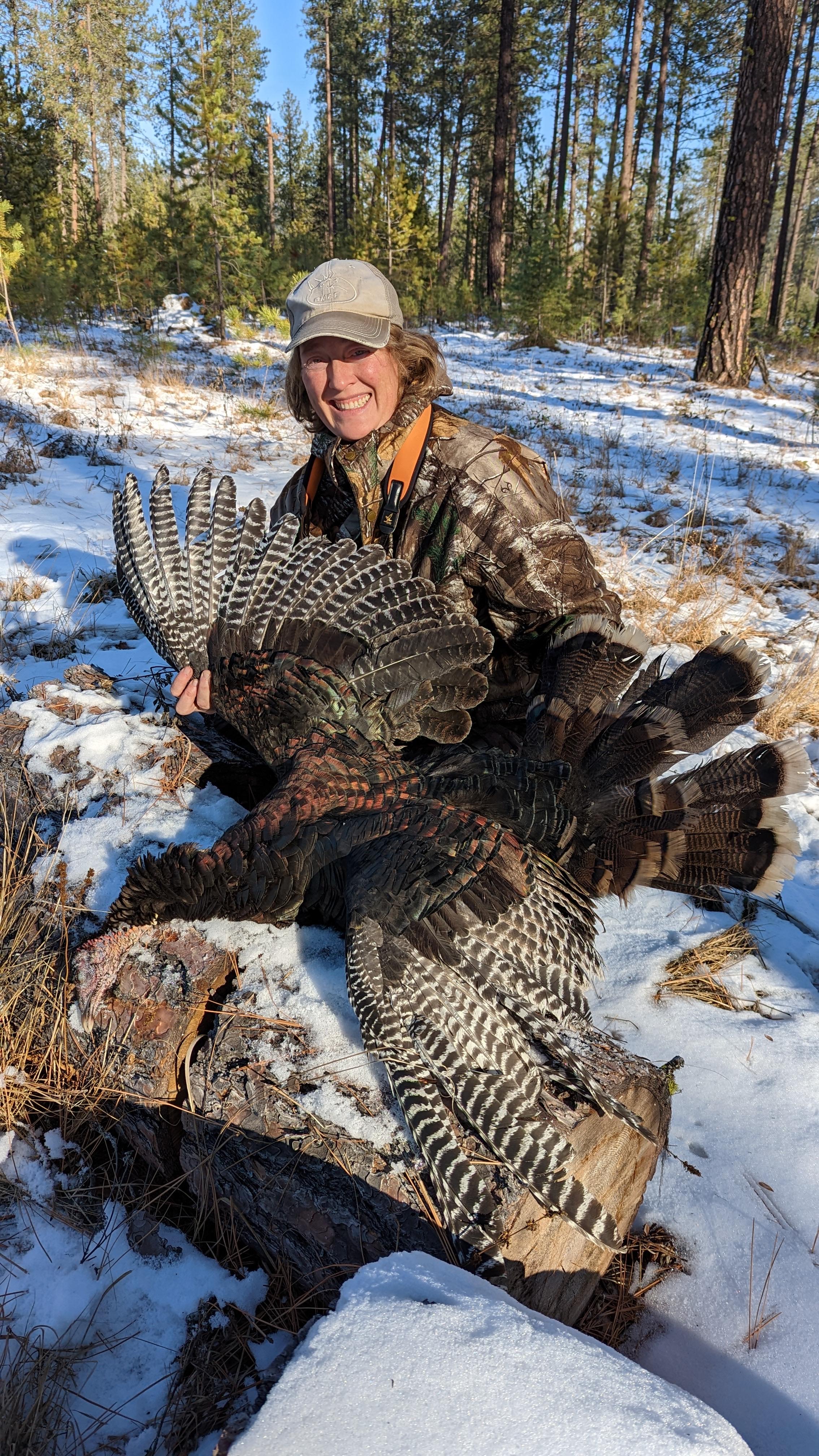
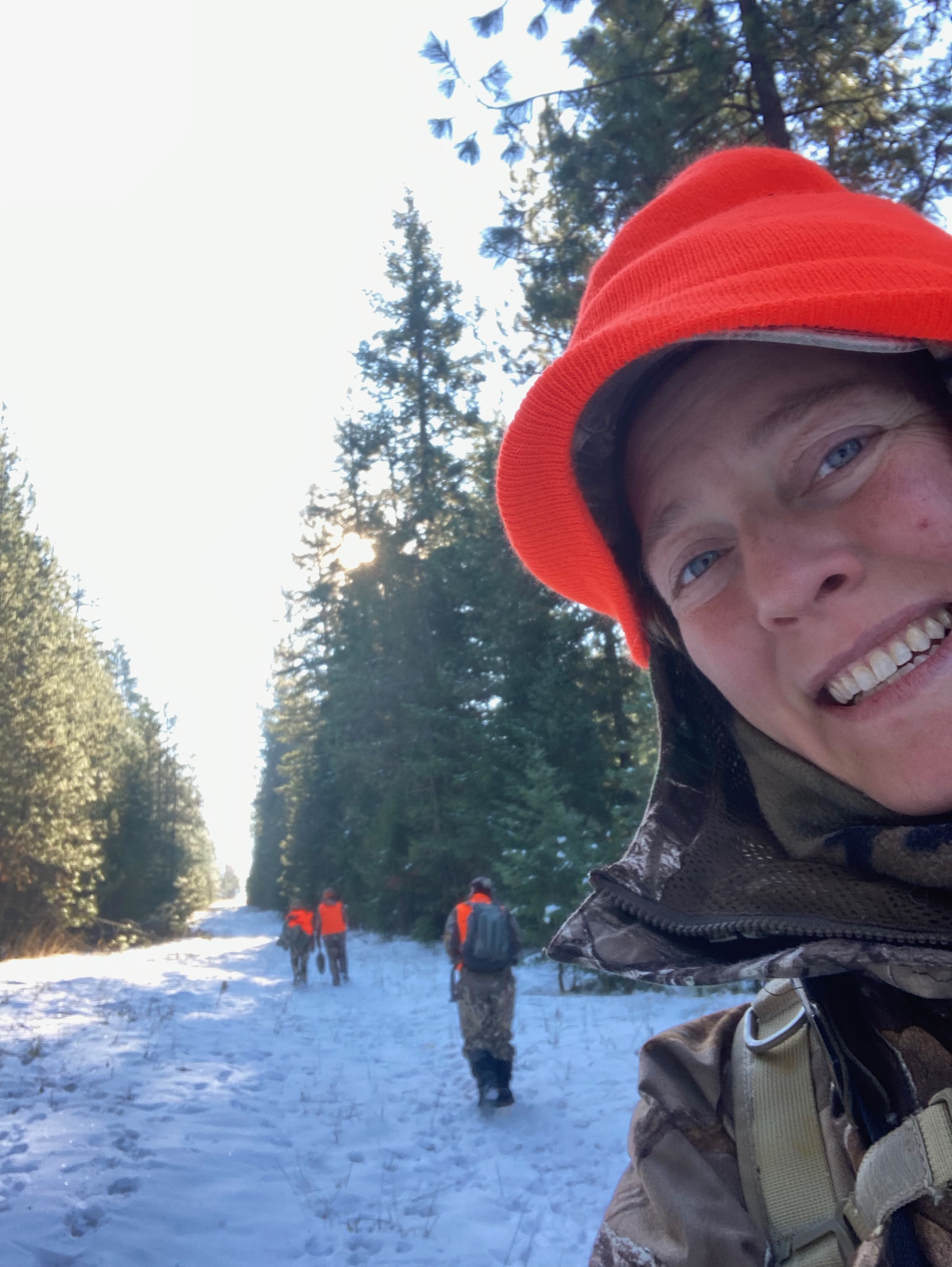
Gal’s Turkey Hunt 2022 was a great weekend of tracking and snow sitting with evening feasting, wine, and games. During the early afternoon of the first day out, I spotted a flock of Merriam’s Turkeys from the truck as we were driving to another hunting location in Northeastern Washington. Our mistress of the hunt checked her online mapping ap to make sure the land these birds wandered was public, and indeed, a square of state land surrounded our sighted quarry. We planned a two pronged approach and began a deliberate stalk towards nearby ponderosa pine grove. The trees would offer shelter and hiding from the astute birds. Turkey are difficult to sneak up on, and an ambush setup is often more successful- especially in the fall. Spring turkey season is another routine all together, but back to our hunt. Two of our party were not hunting that day, and took a walk around the power line road to block a potential escape rout for our targeted flock. Then the chaos began.
I’m an experienced deer hunter, and usually approach the hunt quietly, sitting in one spot waiting for the animal to walk by. In theory, turkey are similar, and you scout tracks in the snow during fall hunts to locate high traffic areas the birds are accustomed to. Turkeys love routine, and stick to it, if you avoid disrupting their flow. We had set down in the middle of the birds’ larder, and tracks were scattered everywhere. This was reflected in the flock’s movement, they had already circle around behind us, crossing the power-line road and out maneuvering us. I watched birds running behind our non-hunting “beaters” as they motioned to us where they were heading. We’d reached the grove of pines, but had to retreat back to the truck and road to cross over in pursuit of our flock. Birds were running all around, and it felt like total chaos. It was also the first time I was hunting with a group of people, which meant a lot more communication and distraction.
Our new grove of trees across the power-lines overlooked a hillside covered in kinnikinnick- a ground cover with evergreen leaves and red berries in the fall. The snow was still shallow enough to reveal much of the ground plants, which also invited the turkeys in to feed. Deep snow inhibits the birds’ movement, and the hunter’s. We lucked out that weekend with no fresh snow, but enough on the ground to track, and relatively warm daytime temperatures in the 20s with shining sun. It was heavenly hunting weather, and great foraging for the turkeys too. By now, the flock had regrouped in the thick forest just to our left. We took up sits against trucks and made sure to all be a safe zones of fire from one another. As we sat, my hunting partner began calling the birds in. I call using my own voice, but most people use a calling tool. The call should interest the birds and encourage them to come over and see who’s calling, but it’s no guarantee.
For us, the birds didn’t call back, but the began flocking towards us, seemingly indifferent to our presence. That was strange, as turkey are infamous for being shy and running away from strange changes in their routine. These birds were caught up in the feast of berries, and kept inching towards us without a care. My hunting buddy whispered- “Take the shot if you’ve got one.” Well, I saw a bird coming out of the brush and pulled the trigger. Chaos ensued. Birds exploded up in all directions. My hen popped up too, but came down again and I stood to get another shot off before she could fly. Even then, the turkey got into the air once more and took off towards the thick cover beyond. I followed her flight path with my eyes, noting trees and fallen logs as markers till she was out of sight, then I turned to check in with my hunting partner. “Should I run after it?’ I asked. “Yes.” She answered. It was an important safety check in. Never run out in front of fellow hunters- that would be in violation of your zone of fire.
With renewed tracking drive, I took off towards the direction my bird had flown. Second really did count in getting to where the animal might have landed. My shotgun was empty, so I unloaded the empty shells and picked them up out of the snow as I slowed to enter the brush. The visibility was low, but I put a new load in my gun to make ready in case I came upon my turkey unexpectedly. Approaching steps from behind told me my hunting buddy had caught up. The dense brush went for only a little bit, then I stepped out into what looked like an old logging road. Across the clearing, I could see another line of trees. Heading towards them, I saw my bird moving and raised my gun again. Pulling the trigger, nothing happened. I thought maybe I still had the safety on, no, it was off, so I took aim again- nothing. I was beside myself now, wanting to finish the hunt and claim my bird in a good way. Then my hunting partner was at my side, offering me her gun after watching my struggle from behind. I took her shotgun and took careful aim one last time. The turkey dropped, and I ran to it in gratitude.
As I stood, surrounded by other supportive women in the field, the harvest felt very special in so many ways. It was my first successful bird hunt, my first turkey, and my first ladies hunt. A group dynamic is so different, and great for turkey hunting. I would not like having a group involved with my deer hunt, but without the group support in the turkey pursuit, my success would not have happened. I ended up being the only successful harvest in that two day hunt. Turkey hunting is hard, unpredictable, but a lot of fun and good learning. Turkeys in Washington state are introduced, and out-compete many native species of ground bird like grouse. Hunting them helps to reduce this impact, and graces our table with wild meat. It meant a lot to have the additional support and expertise from my fellow hunters in the field- and an extra gun. Why had my shotgun not fired properly? Well, when I reached in my pocket to grab a new shell, I grabbed one of the empty ones I had just picked up when I unloaded. Classic mistake- and an important lesson not to repeat.
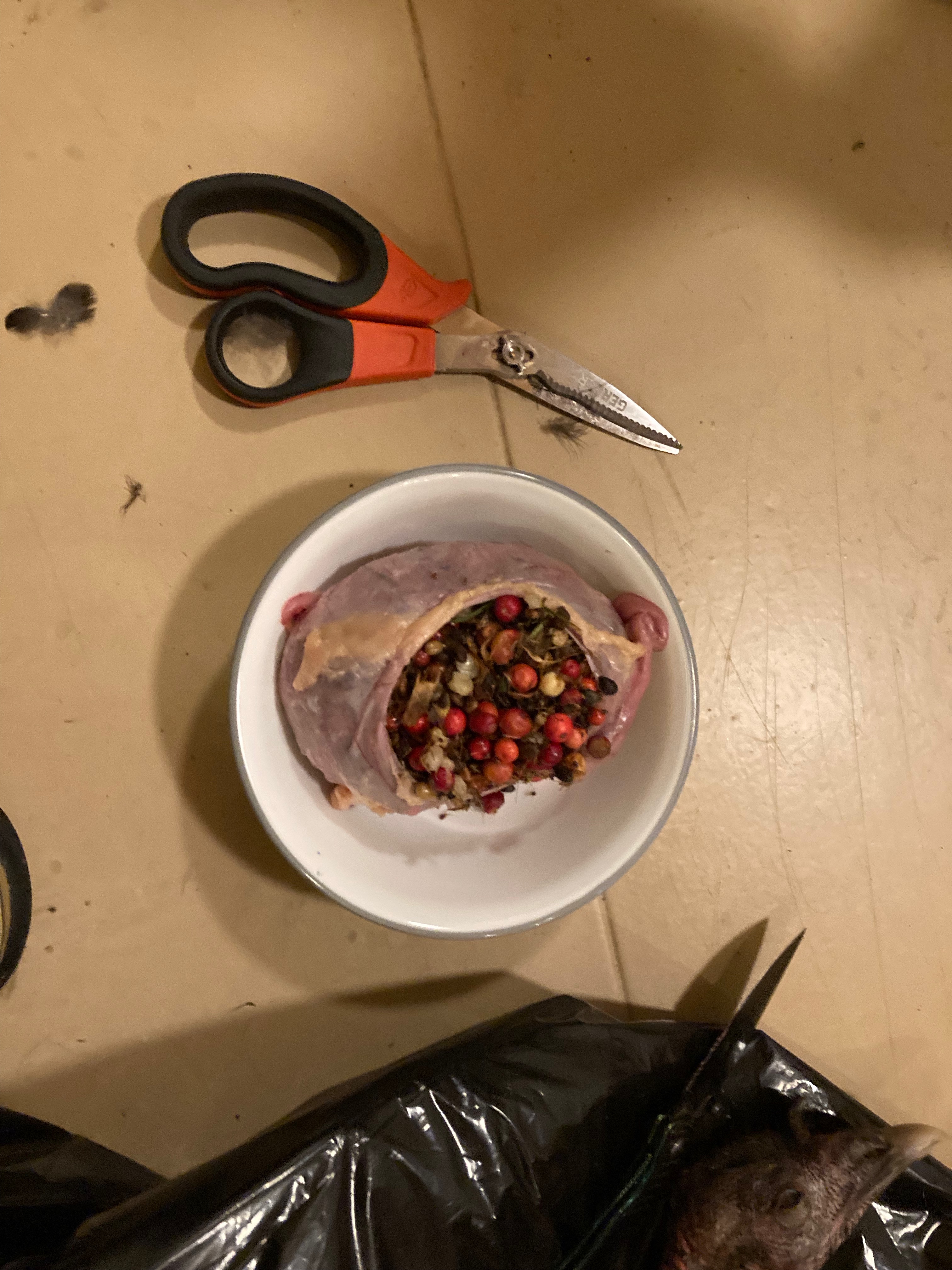
When I got back to the house and plucked the bird, I also took out the crop for a better look and what the turkey had been eating. Sure enough, the organ was full of kinnikinnick berries, which I’ve brought home and planted in my garden. The carcass weighed in at 7 1/2lbs dressed. That was the perfect size for our modest Thanksgiving. What an honor and pleasure to enjoy wild turkey! Brined and baked with so much care and gratitude, the meal was delightful and the turkey sublime. Gratitude to the bird nation and all the gifts and gentle lessons it offers. Grateful still that our hunt was safe and fun, that I received a bird for my work, and that we all shared experience in the field. We’re hoping to make this an annual tradition for women to gather and hunt together sharing love and support in harvesting wild food.
There’s a legacy here of ten years in deep relationship, perusing and learning the art of the hunt; accepting so many beautiful lessons, and reaping the rewards of hard work, focus, and vision. Sometimes my sight was clear, and the harvest successful. Other times, my sights remained empty, and I came home without wild food from a crucial source of protein, greatly appreciated in lean times. The abundance of EEC Forest Stewardship, specifically our Cascade Katahdins at Leafhopper Farm, provide additional support to our pantry, stocking the larder with enough diversity to sustain through a few years of missed fertility. This year’s challenges included a large wildfire near our home, driving the deer away for the first week of our limited two week season. Climate change is the single greatest threat to our survival right now, and the scales are tipping.
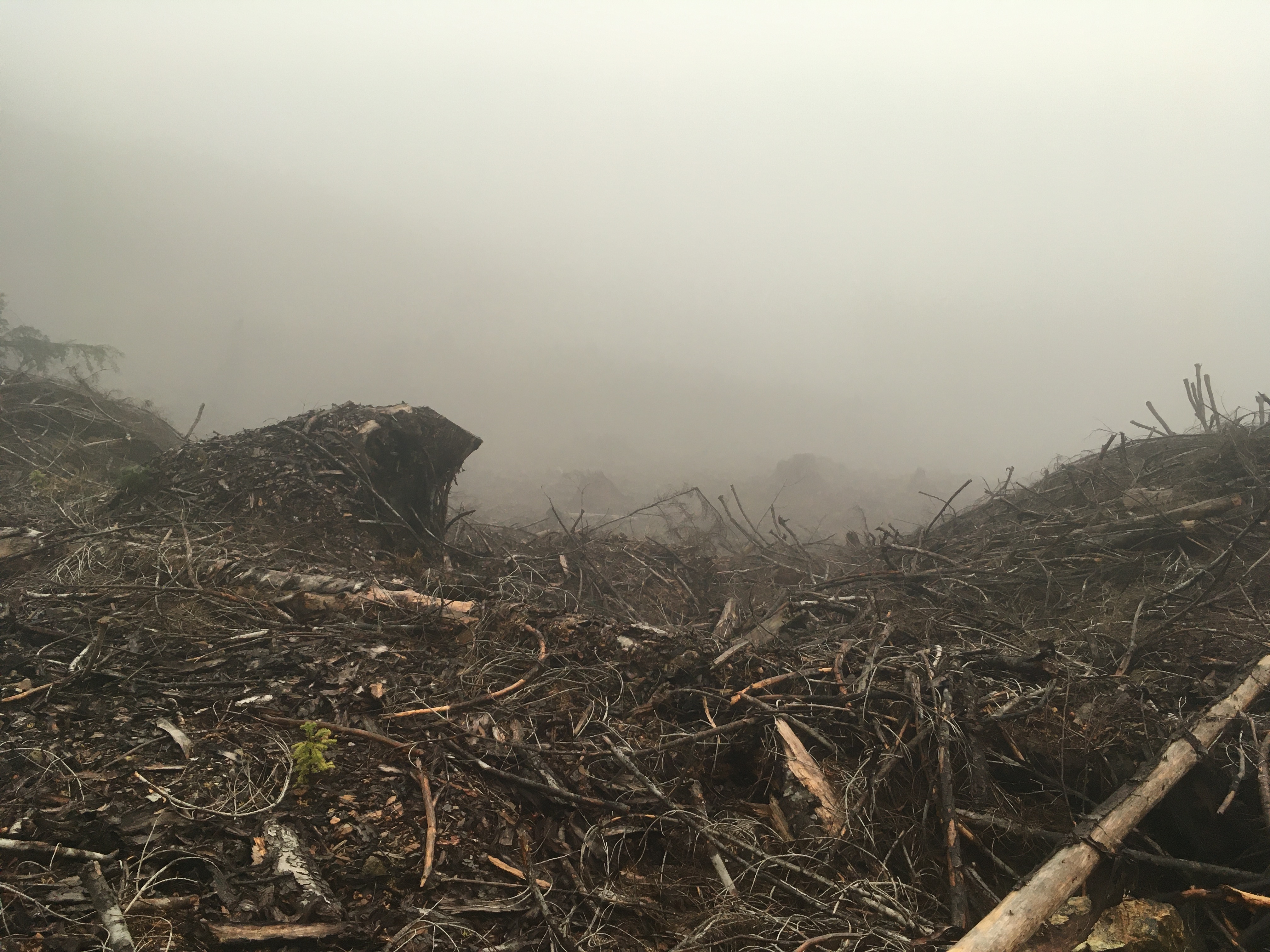
Through a decade of perusing blacktail deer in Western Washington, I’ve come to love dark, cold, wet predawn silence. Every prick of rain drop sound crashing through the leaf litter and drawing my awareness ever deeper into the edges. Clearcuts are good habitat for deer, if tended as wilderness, where native plants can collect and thrive, with water retention and diverse replanting after a commercial harvest. Repetitive logging over a forest before it ever nears climax, preventing an established ecosystem to replenish the nutrients carried away in timber tonnage, is not good for the deer, or the forest, or any ecology that is balanced and abundant. Spraying treated sewage on the land is also damaging the soil and water, adding perception drugs and heavy metals in concentrate to our hillside catchment basins where the valley rivers come from. Those valleys are full of poison now, which is tainting our crops and livestock food resources and pressuring wildlife.
My first deer hunt, I was in Snoqualmie Tree Farm with my beloved hunting mentor and deer medicine friend. He had coached me through several days of observing deer brows along the roads, then finding the heavily used trails connecting habitat resources. I’d take long sits atop slash piles, watching as still as I could, only moving my eyes along the forest edge, hoping to see a buck walk out into the clearcut. The mind will always try to see what it wants, and my spotting glass focused on many seemingly active movements that emerged as stumps when I focused the gaze. Always have your spotting scope handy, it makes sighting a great sport, and teaches the eye a lot about depth and range. On the evening of October 31st, 2013, after days of spotting, waiting, and learning to sit still, I was atop another slash pile in Snoqualmie Tree Farm, waiting for that buck to wander through before last light of the last day of blacktail season.
It was not too surprising to hear another truck beginning the long haul up from the foot of the foothill I was perched atop. After all, my mentor and I had recently driven up here for a good spot, and we did not own the mountain. It was poor timing really. The driver was road hunting, driving along the roads before dusk hoping to catch a deer on the move. It’s not the most ethical way to hunt, but more successful, and on the last day of the season, understandable, but not mindful of hunters who are having a sit. As the vehicle rounded the switchback and rose into the far right of my field position, I unloaded my gun. There was an active hazard in my field and I deemed the situation unsafe. My gun action clear, I proceeded to step out of the field, knowing the newcomer was unaware of my location. I didn’t want to call out and spook off the potential harvest for anyone. Slowly, I walked up the road and around another switchback, which took me out of firing range and back to my mentor, who was waiting at the truck looking very confused.
We both heard the shot as I reached him. “That was your deer.” he said. “I know,” I replied, “but the shot was not safe for me, I’ll take the karma this time, and hope my other hunts reward this act of kindness.” My mentor was less forgiving, and as we drove by the other hunter, who was busily gutting a nice two point on the road, he shook his head. I was thrilled for the gentleman elbow deep in his excitement. I waved and wished him congratulation on a successful hunt, and I had no other feeling but that in the moment. I could see how my joy would be, the wonder at harvesting wild food, connecting to place and an ancestral legacy. “My first hunt!” Cried the man as he awkwardly embraced the animal. “My first deer!” He announced again, looking back over his shoulder at the driver side of the vehicle where a woman sat proudly. “My wife is here with me, we’re so glad.” My mentor was still shaking his head, but I congratulated the successful hunter again and left him to the hard work still to come, in the dark. At least is was not raining.
My second hunting season was successful. I went on my own, every morning, to the same dead end clear cut where I parked my truck at the head of that dead end and walked in a mile to my sit spot. It was cold, dark, and invigorating. Most predawn times there’s so much energy building up, like a long dormant seed finally quaking to life, just before that explosion of sprouting- germination. I’d sit into first light with the binos on an enormous old growth stump that towered above the slash and muck left by the logging machines. There was a little brook and some lovely green strips on either side about 1,000 feet down the hill from my perch. That morning there had been light rain, and the does were moving in, like that had the past few days, towards the end of my window to harvest a deer. It was the last day again, and I wondered if I would experience what most hunters of this illusive ungulate species experience- an empty tag.
The relationship with this small herd of does had included several encounters at close range. They often entered the clearing from the edge just below my stump. I had chosen that spot for that reason, expecting, then confirming the flow of deer from the edge, down towards the wetland strip, which was a perfect bowl, and safe shooting field with no roads. It was just getting light enough to see down into the wetland where the does were already feeding quietly in the mists. I began spotting each individual animal with my spotting scope, one, two, three, four does, all mature and confidant in their meandering graze across the lush vegetation. It was really a wetland, and should have been part of the greater wild water setback, but with wet soil came abundant growth, and these deer were familiar with the larder zone. My attention was suddenly firmly shaken into focus, as my binoculars revealed another ungulate form emerging from behind the familiar does. A modest set of points flashed, then hid again in the brush as the animal browsed.
I’ve never harvested a deer based on the size of its antlers. The object of hunting blacktail deer for me, is wild food, nature connection, and conservation. In my hunting encounters, taking what is offered is usually a good action. If you take no action when the opportunity presents its self, you may not get another chance for the season. Personally, I also think the deer know, being in a predator/prey covenant with humans for thousands of years, knowing deep in their being, the exchange taking place. I never take a shot at a running animal. The bucks I’ve had the privilege to harvest for food have all been standing broadside, looking at me head on. It’s a magnificent scene to encounter, with powerful intention. Following through the cycle of birth and death, seeing the death of a landscape as the backdrop of this experience, there is a feeling of end, with the last of the light stretching into final harvest before the cold hard times of inward reflection begin.
That cold October morning in 2014, I looked through my scope and took aim at the buck blacktail quietly grazing a thousand feet down the hillside from my stump perch. The rifle scope was close range, and I had to take my time in setting up a good shot. The animal paused, letting the other deer pass him and move ahead. Then he looked up the hill directly at me and I began a deep breath of concentration. Inward draw and the flick of ear, flash of bright eye in the pink light of dawn. An exhale lets finger arch and a light pressure releases one of the most impactful actions a human commits- combustion. This particular explosion sends a lethal projectile at blinding speed to a roughly 4×4 inch vital organ area on the deer’s side. If the shot is correct, the animal will drop to the ground and die very quickly from loss of blood. My buck did indeed fall, collapsing under the sight of my scope, which I’d kept glued to in preparation for a second shot if needed. The buck was not moving, so I unloaded my rifle and plotted my hiked down to the awaiting quarry.
Moving through a recent clearcut is no easy feat, and I knew the real work was now about to begin. When I first approached the deer laying in the slash, my instinct was to move on in search of my deer, which must have run off on down the hillside into deeper cover, because it really could not be that successful a first shot from so far above, but it was, and I had to stop and reassure myself of this incredible moment. I’d just harvested a wild food source of great sustenance for my winter larder. This beautiful food, grown in the forests surrounding my home, this abundance to celibate and be so thankful for was the fruits of my labor and learning. Then, as I later hauled the carcass out of the clearcut, pulling from the antlers in a slow drag up the hill to the truck, the mists and rain began to close in. In a moment of resting to catch my breath, I felt a strong fulfillment in self-sufficiency and personal growth connected to a deep ancestral calling.
To hunt, to gather and harvest wild food, was a crucial part of my identity and drive. I’d come back to these same feelings and experiences with every hunt, every opportunity to connect with the living world in the cycle of life directly. My predation of the deer in line with legal hunting supports a healthy ecosystem in my immediate area, as our encroachment on wilderness de-pleats the habitat animals need to survive, including predator species, some of which have been completely exterminated from our region, thus perpetuating high birthrates in prey species like blacktail deer, which then overtakes the carry capacity of the landscape, ending with population crash and mass die off. Hunters harvest the overflow numbers within a given population of deer to reduce winter kill from starvation, and habitat degradation. Hunting regulations, including harvest limits, are determined by scientific observation and research done in the field by wildlife biologists. So far, no hunted wildlife managed in these scientific methods has gone extinct. Restoration has remained successful in hunted wildlife populations throughout the United States, with numbers continuing to rise and stabilize where carry capacity allows, but human encroachment still remains wildlife’s number one threat.
Hunting remains a personal choice in connecting to wild food, nature, conservation, and personal growth. Each lesson in tracking, sitting, listening, and connecting to place, wilderness, animals and plants forms a tighter relationship to the land and ecology I’m a part of. It’s so rewarding too- harvesting food, gathering abundance from the land in thanksgiving, this is a powerful set of original instructions I’ll continue to follow as long as the privilege allows. It’s also important to give back, and teaching hunter safety certification for my fellow citizens is a way to pass on the knowledge and experience to future generations who wish to peruse their own sacred covenant with the land. Gratitude to all the mentors, teachers, family, and friends who support my hunting journey.
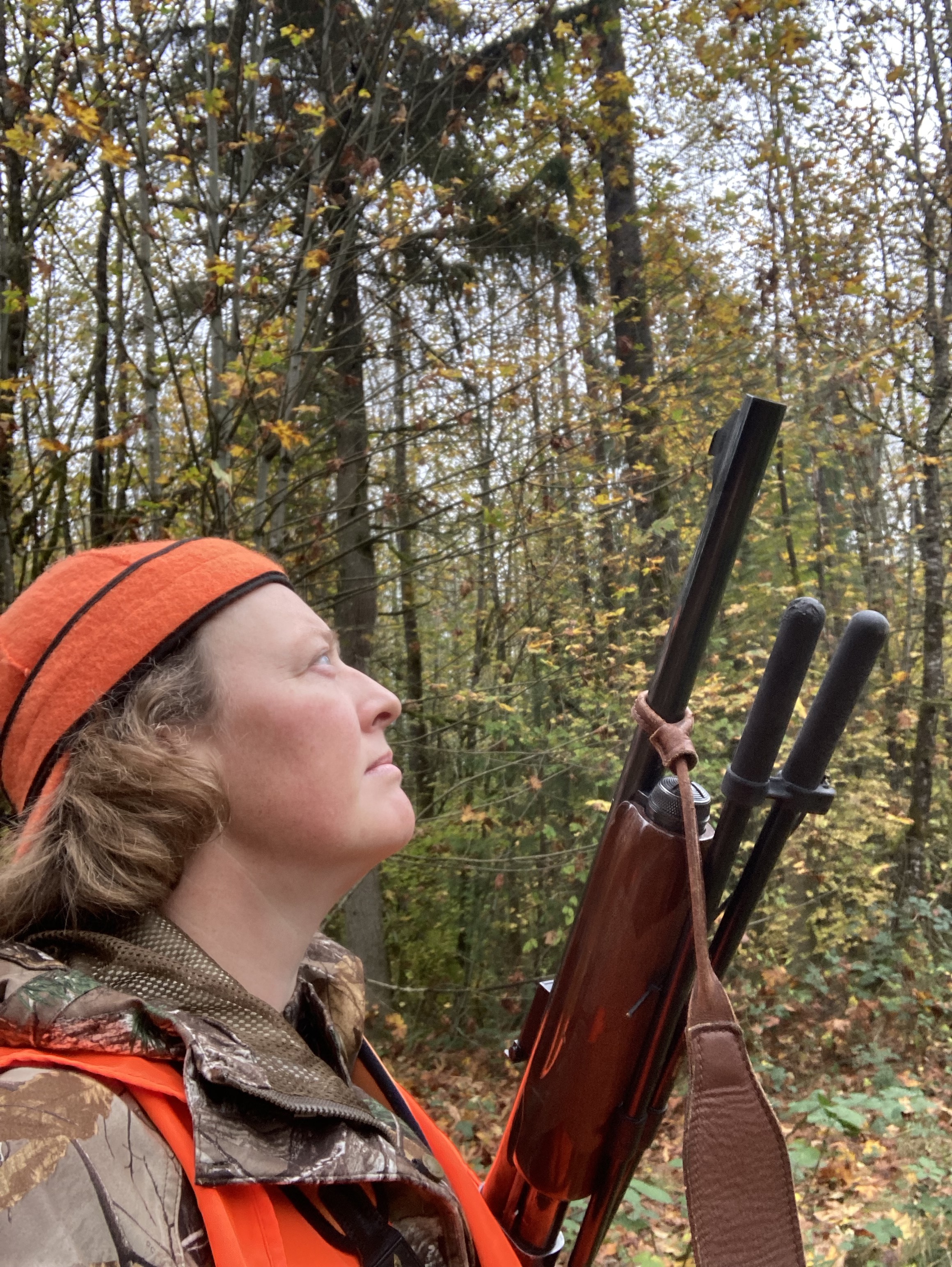
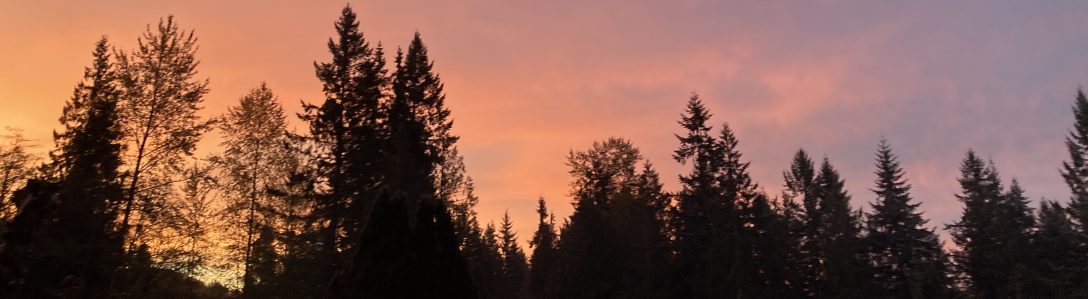
This year’s deer season was short and bittersweet, but such learning and reward in experience, no matter how brief. Opening weekend, I was at home preparing for my hunt on Monday at Snoqualmie Tree Farm. I took a walk around my own land wearing hunter orange and carrying a long gun, to avail. It was a red dawn, the sun was orange, never quite lightening to a golden white, and by Monday morning, the air was thick with smoke, and the tree farm was closed indefinitely. The cause- a wildfire between Lake Phillipa and a ridge line just above Lake Calligan. I’d spent that summer fishing trout in Calligan and scouting nearby clear-cuts for my hunt later that fall. The area abuts The Alpine Lake Wilderness, offering a large area to hunt in both private and public land. The fire started opening weekend and ended my first week of hunting season with the worst air quality on the planet for three days straight. The fire is still burning a month later, but at least the forest is now open.
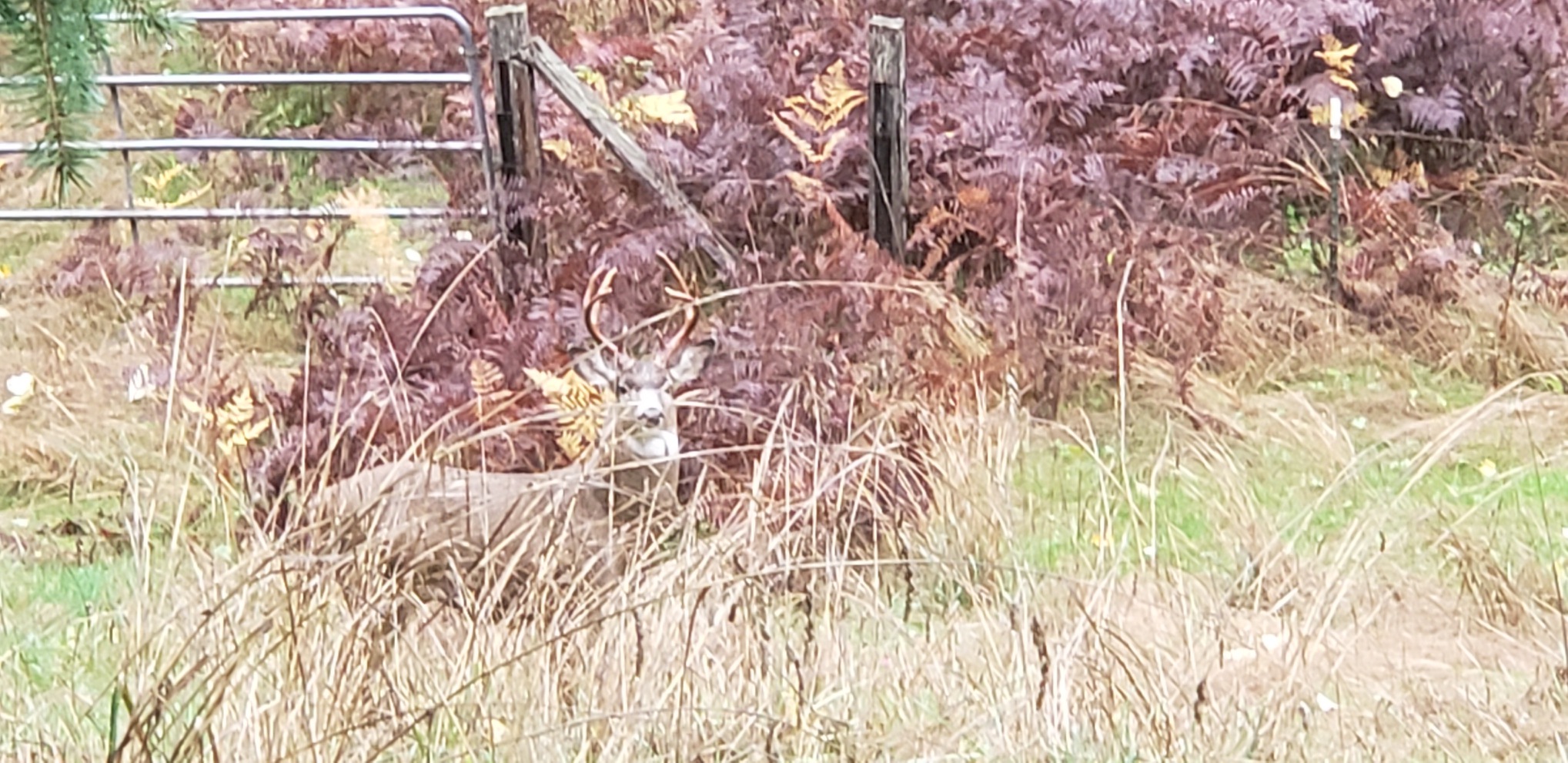
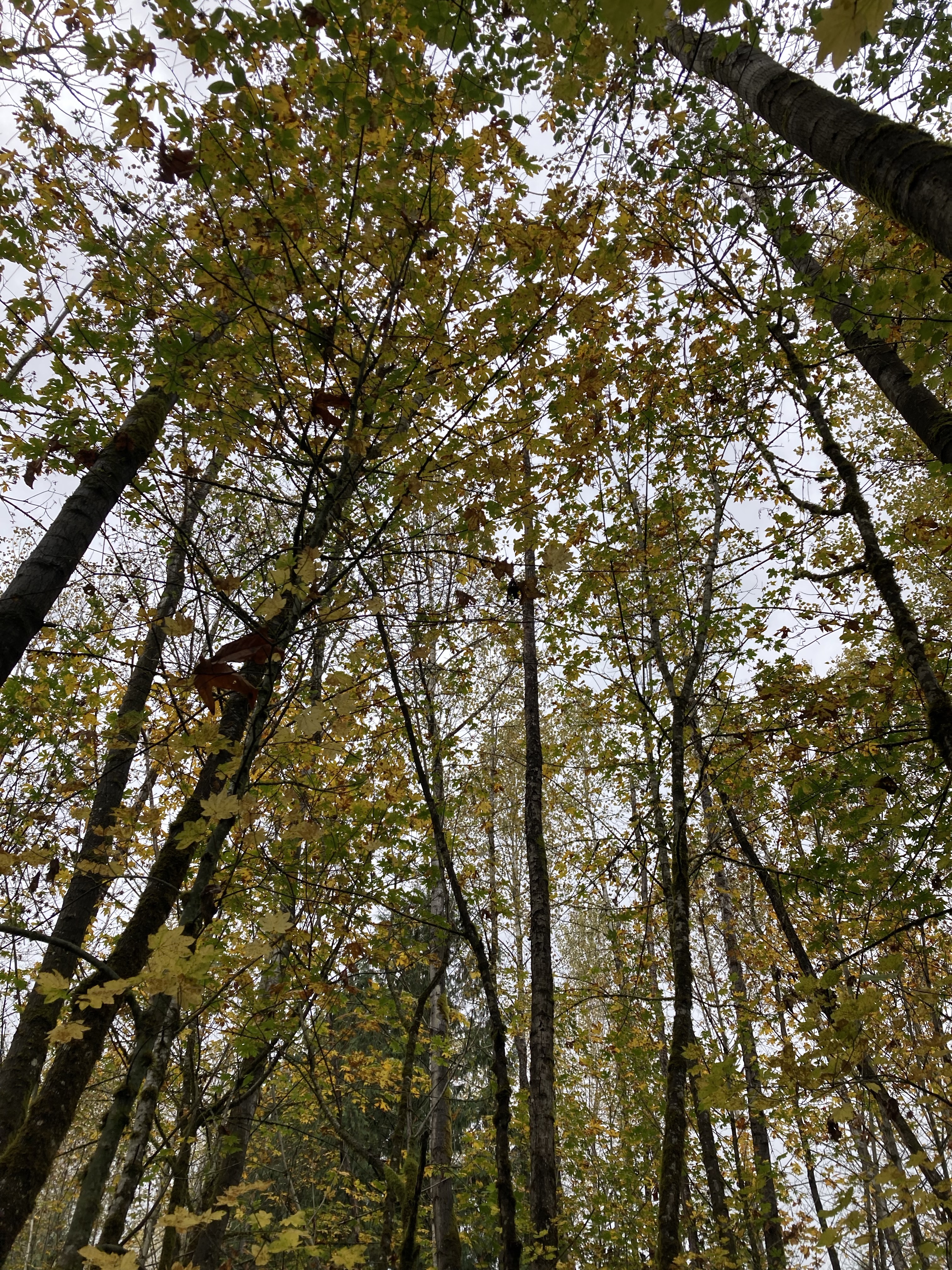
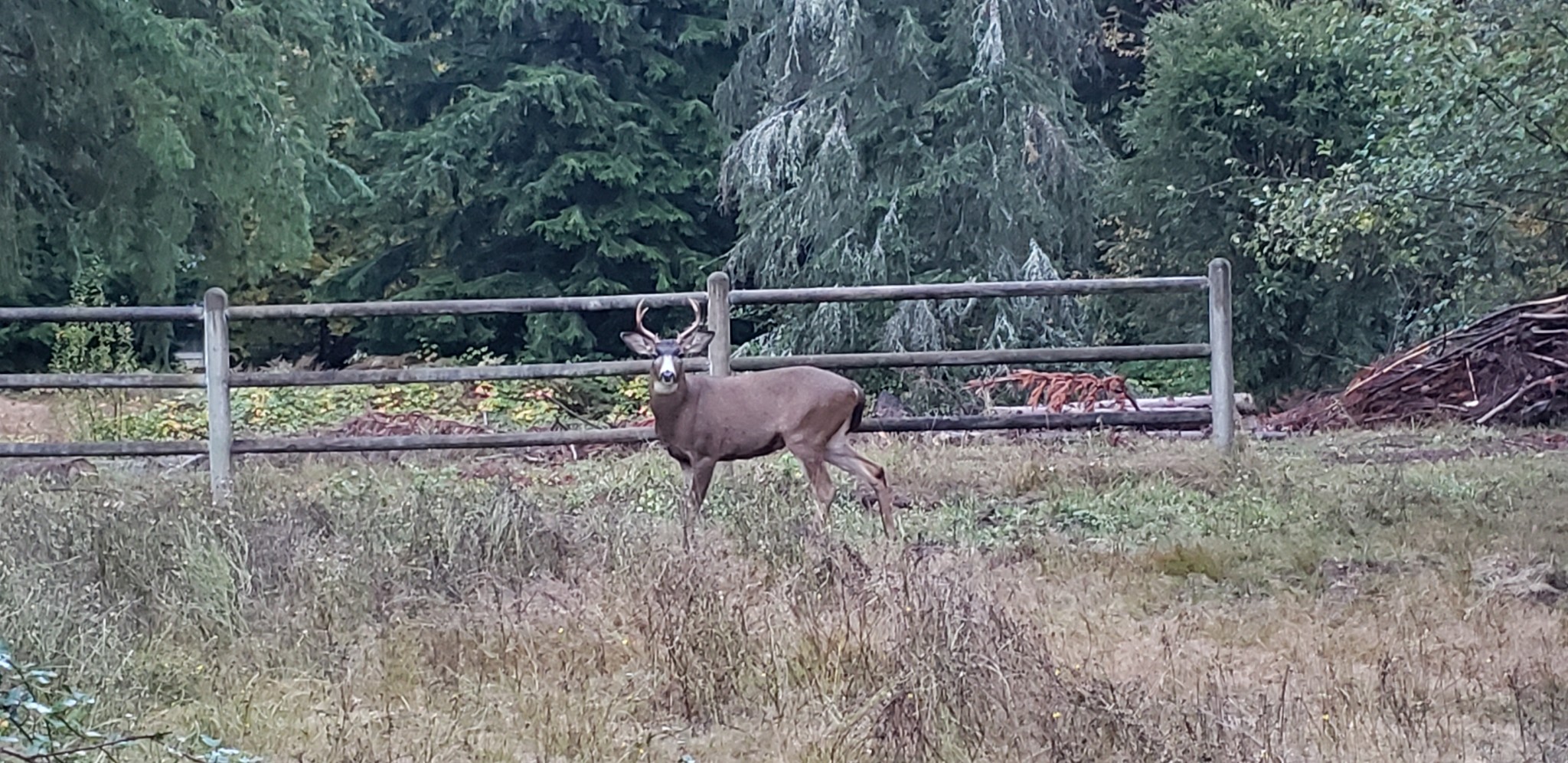
During the last day of the season, October 31st, I had a morning to hunt, and spent it at a neighbor’s property where they had sighed a most unusually marked blacktail buck. He had a white nose, which stood out as a unique identifier in the field. He was beautiful, mature, and a great candidate for harvest, but it was not meant to be. I sat listening to him walk through the woods in the falling leaves, sitting in a golden mantel of maple and cottonwood shed. The heavy rains during the night had driven everyone into shelter, and with the coming light, downpour reduced to trickle, and the deer were up moving to eat. I knew I’d catch my buck on a traverse from one larder to another, so I set up a long sit in the young deciduous grove between two pastures. I had a spot in the crossroads of several game trails. My breathing slowed as the sound of approaching hoof falls drew closer. Then, the wind shifted.
The sudden stamp of a stiff leg shattered my ambition as, in the next seconds, I listened to a new pattern of hoof beats pronking away into thicker cover. The moment of success had slipped away in my scent crossing a most attuned nostril a tip white blazed nose. I didn’t even gimps a tail flash as I stood up from the blind of fallen logs. It could have been mindset preemptively, thinking too hard about the animals movement, sending out energetic rings of pressure, alerting the prey animal’s instinct to check the air. The environment we cannot control, nor how we’re perceived within it. Beyond setting intentions and doing my best to blend in, it was merely a shift in barometric pressure which cost me the element of surprise. Standing up did not help, but I was limited for time, even in the final day of hunting deer for the season. Still, hearing the approach, knowing what caused my premature unveiling, that was a good set of lessons learned.
I also helped teach an hunter education class during the week of fire, thus certifying a few more safe hunters for the field, even if I could not be in it. I also saw a lot of bucks along roadways during the rut. We’ll keep our eyes peeled during these colder months and hope to harvest some roadkill to make up for the missed buck harvest. Late season, which is 3 days in a limited area above snow line, I’ll be with gal pals hunting turkey on the east side. It will be worth it, and a lot more good learning in new hunting pursuit. Gratitude for all the learning and opportunity in hunting this year. The deer got a year off, but next season, I’m committed to deer and elk season without interruption, and hope to have a turkey by the end of this year. Thanks to all who mentor and share the hunt.
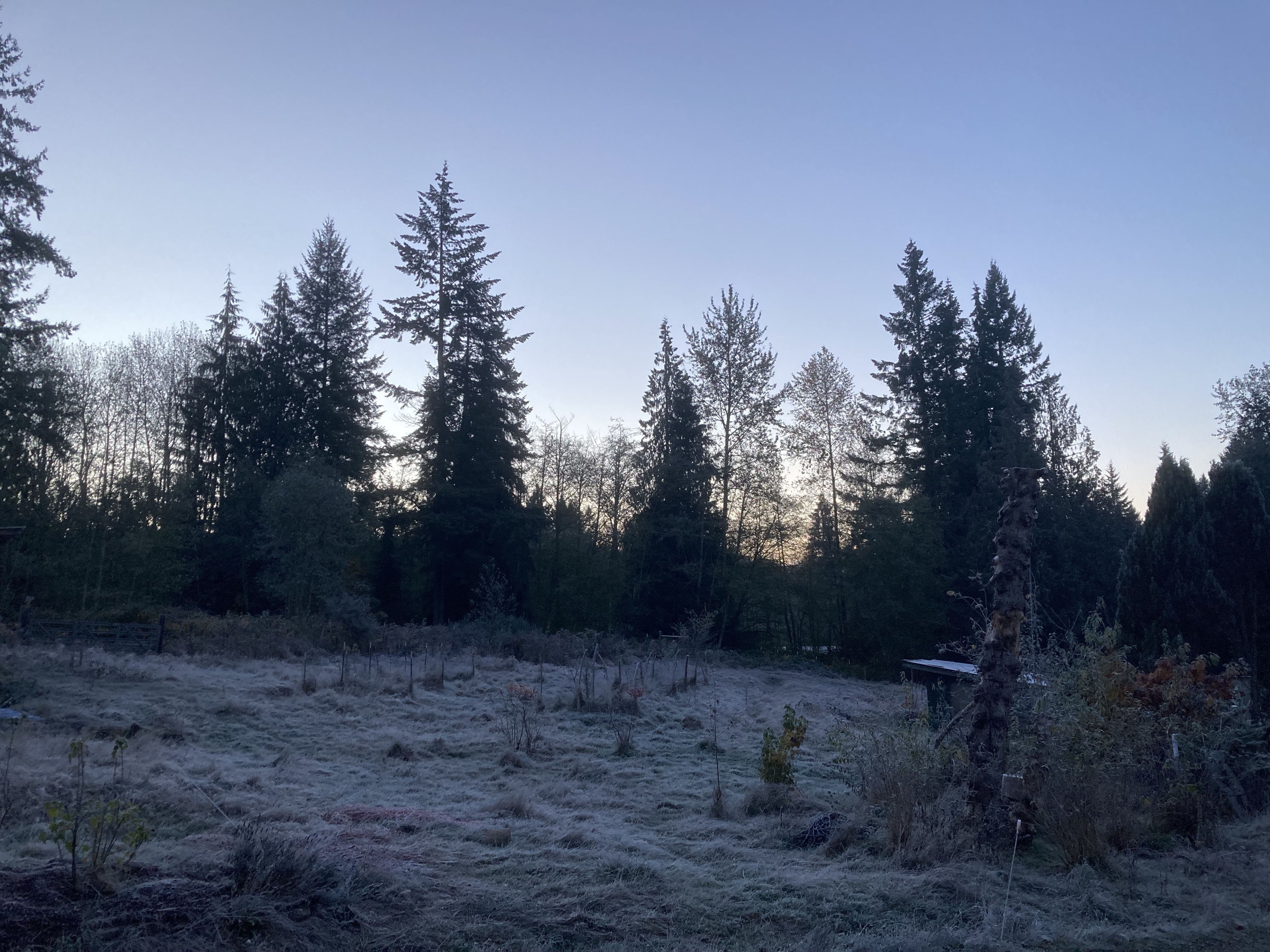
This morning in early November, we woke to a hard frost spread across the landscape, an icy cloak of wonder. The cold seasonal snap sends shivers up spine and stalk alike. Our garden is letting go the last harvest for a while in wilted chard and kale. Our young grape vine finally turned yellow, but still clings to the broad, serrated sun catchers, leafy sails which will turn to parchment in time and drop to the earth. Plant sacrifices of fertility back to soil are a crucial exchange in equal give and take within an abundant ecosystem. Animals give digested vegetation too, no living thing acting within the lifecycle of our planet can take without giving. Even carnivores give back plants, through the flesh of the grazers they consume. Seasonal cycles dictate much of this recycling in all it’s forms. Though plants are most affected by light, and give up more in the fall, reclaiming the sacrifice in spring with new growth, perpetuated through complex nutrient trades in the soil and through sun, rain, wind, and even fire.
The cold signals nature’s shift into quite rest. Almost all plant growth slows to a stop. This morning, all the livestock water troughs were frozen, water- an element of change that can take any form (solid, liquid, gas), chooses it’s hardest form today, which demands the most work out of my chores. Removing ice, refilling water, and maintaining hydration is challenging, but the elemental change freezing water, and the crust of firm resistance strikes back on bare knuckles, I’ve forgotten my gloves. The animals are restless, no one rushes the troughs, but cold also hinders hydration, which means you should drink a bit more if possible, but the animals are waiting. Food drives all the little feet pacing at hay creches, awaiting fresh field fodder. I’ll let the ladies have a few open days of grazing, now that the vegetation in our zone one spaces are retreating, leaving the last forage before a long put-up in the barn.
This slowing of life into literal ice crystals signals hibernation, inward focus through the dark times in preparation for new spring growth only a few months away. It’s a very fast turning cycle of seasons, though we humans often ignore compelling change. Nature is tuned in, offering so much insight into adaptation, resiliency, and balance. I’m also deeply appreciative for the vivid color, vast landscapes, and vistas of each season’s gifts. Frost is fall’s first real shake up, sending plants into stasis wildlife into hibernation. At home, our hearth is lit, bringing the warmth of wood and comfort of fire light in darker times. Outside, the sheep lay close together for warmth, their fleecy coats offering perfect insulation to winter’s coming cold. Katahdins come from Maine, and handle the cold brilliantly, especially with a warm barn full of hay and straw. Lambing is only a few months away, so the ewes are fat and round, showing off the abundance of our fields and forest browsing.
The gardens are on pause, at least most plants are dormant, but some stragglers hold on, and winterize by slowing down, but not freezing out. We’re still picking kale and chard leaves, though some are a bit wilted. A cold frame will extend our plantings, while others will be left to the elements, including seed shed for next spring. Our most successful garden verities reseed each year without our help. Kale and radish are good cold weather self perpetuating examples every lazy gardener should tend. Under the shelter or our porch, potted wild ginger remains active, and some hollyhock on a south wall garden has leafed out with enthusiasm. It might regret this late arrival in another month of freezing temperatures, but rain is due next week, and the temperatures usually rise above freezing when clouds insulate our region. Western Washington remains temperate when the rains stay.
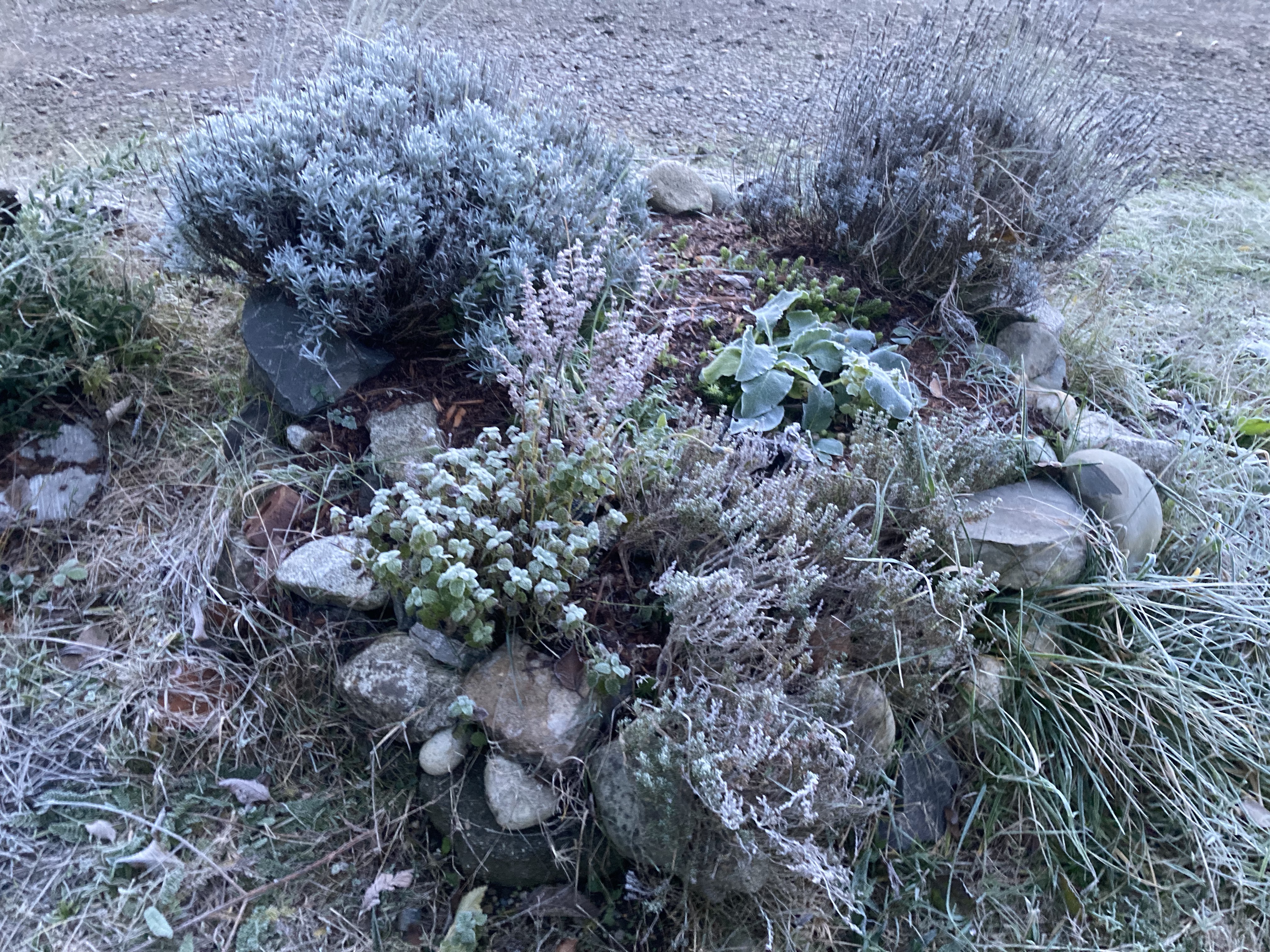
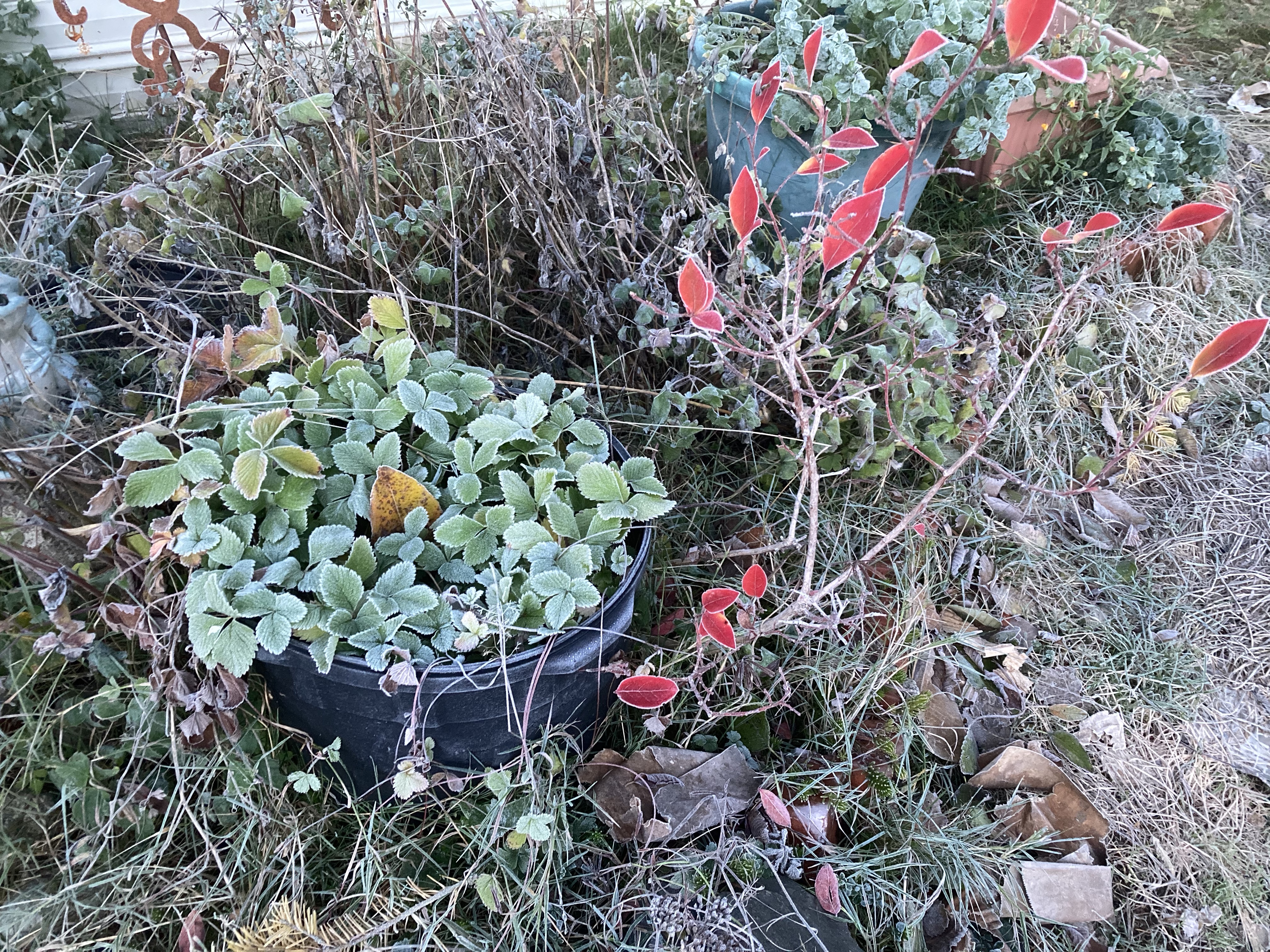
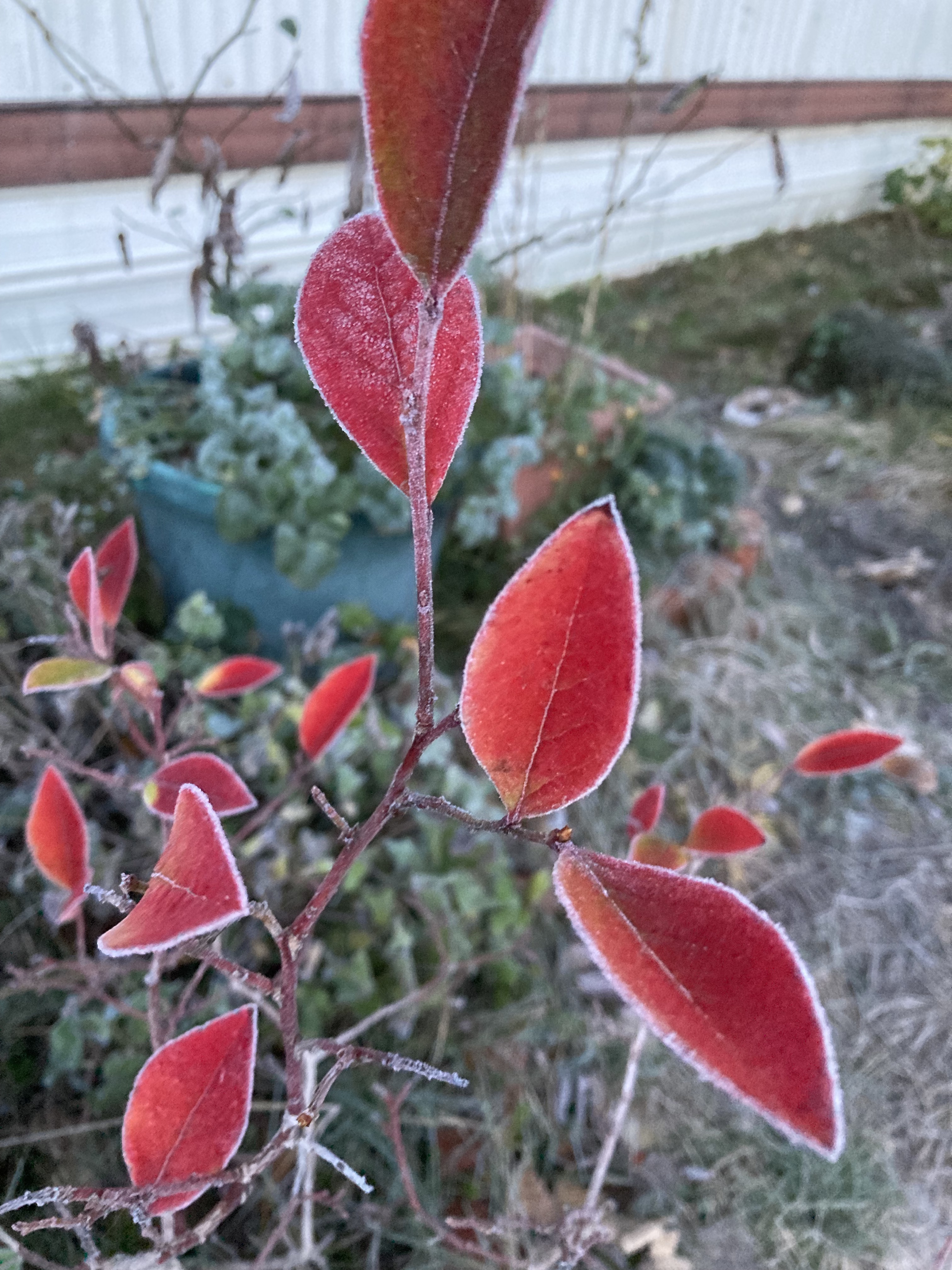
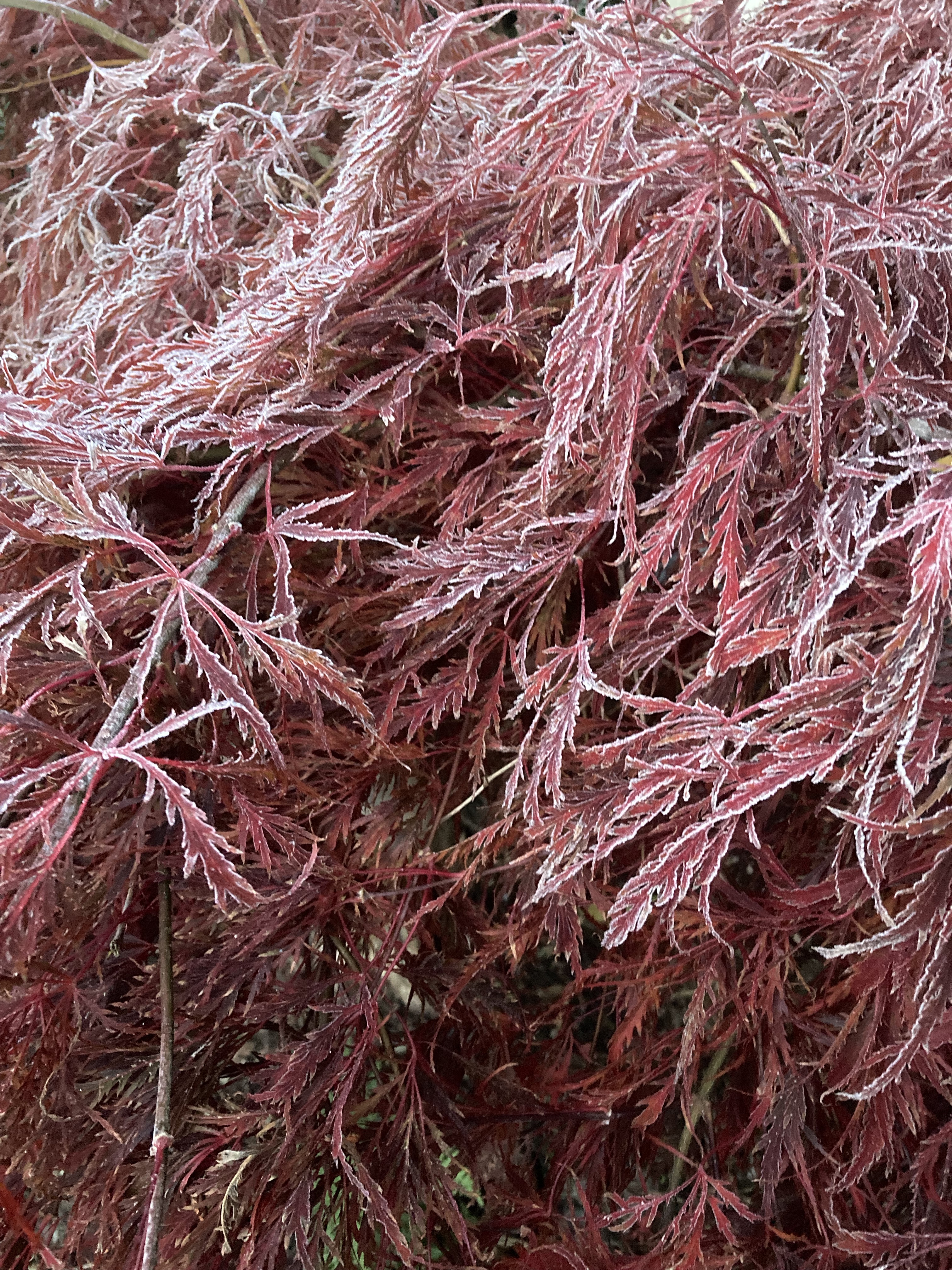
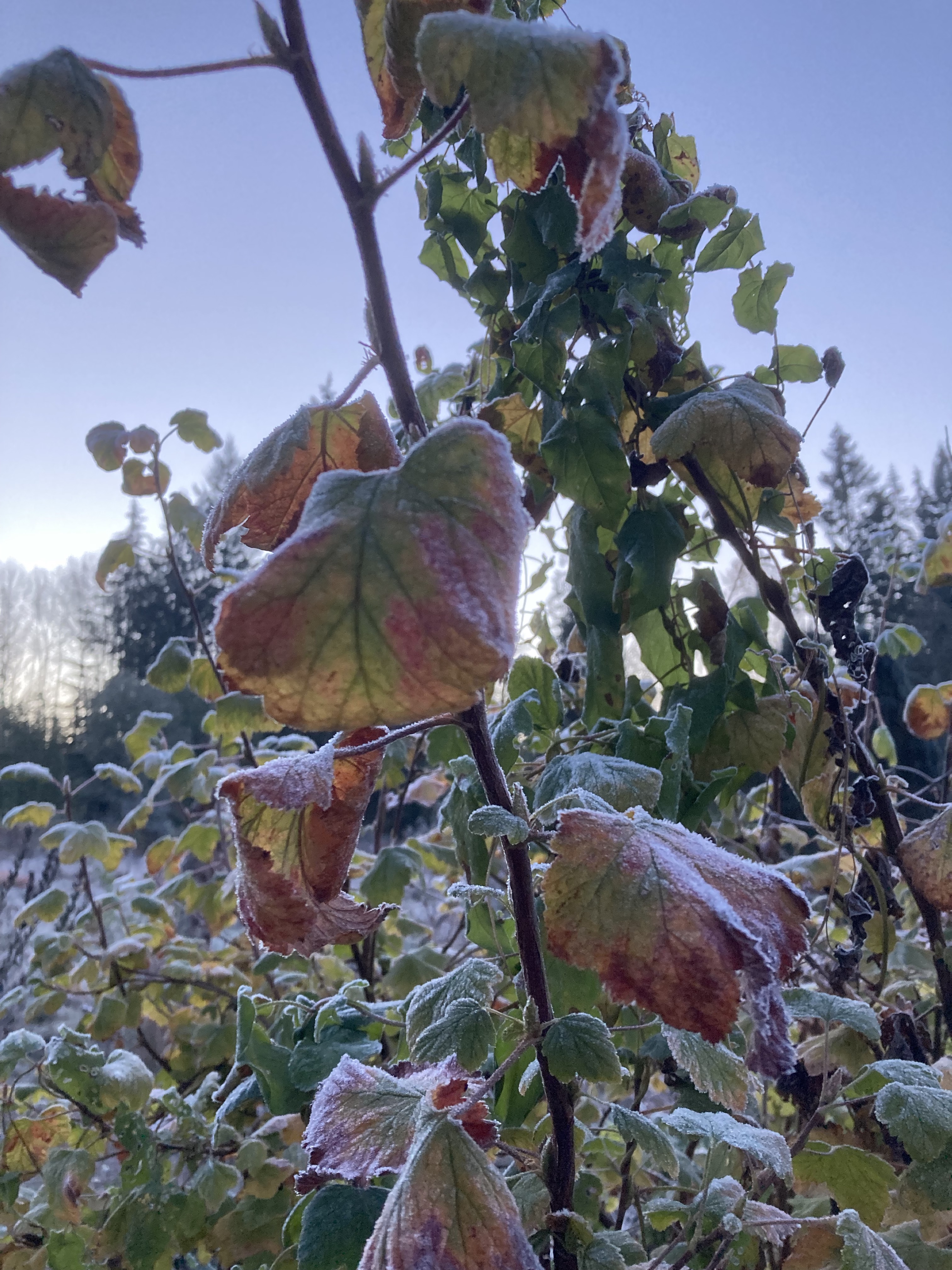
November tends to be our coldest month, with week long freezes and iced over water troughs. But it’s particularly dry this year. We’ve had little rain this month, and the high pressure system seems to stall out over us, keeping the insulation blanket of cloud cover at bay. This leaves the ground cold and frosty by morning’s first light. The crisp outlines of ice on leaf tips catches like a diamond glaze in golden dawn’s bright glimmer. Autumn color in western Washington can rival any, with fiery Japanese Maple and yellow asparagus sprigs. Even red flowering currant sports a splash of red, green, and gold in a post modern mashup that could hang in The Guggenheim. Add frosting and you have a seasonal festive feel that pushes back against the cold with warm pigment and glossy magic. Later, as the sun’s warming rays melt back Mr. Frost’s touch in coils of rising steam, the change remains palpable, numbing fingertips and reddening cheeks in the delight of fall.
Adding occasional outside inputs keeps the soil recovery going here at EEC Forest Stewardship. This is organic mulch from a vetted source- proper decomposition timing, weed seed free guarantee, and strictly bark composition. This mulch is a weed suppressant and ground cover, mainly for our trees, and their roots near the surface of the ground. We’re also reinforcing weed prevention and moisture retention for perennials in established beds like our herb spiral and keyhole garden. Mulch is a great way to keep soil and plant roots cool and moist, also insulating the ground from extreme temperature changes. Intact forests produce most of their own mulch and compost, along with the contributions of all the other life contributing within the forest floor, from beetles and mycelia to elk and forest grouse.
Because human development alters the forest composition, though removal of the canopy, compression on roads, and the desire for a clean cut lawn, forest debris is lost as an alarming rate. Here in Western Washington, where a once vibrant temperate rainforest evolved within the environment for thousands of years, the landscape relies on a thickly carpeted forest floor to protect against erosion and provides banking of long term fertility to grow healthy trees and diverse understory ecology. Our panhandle has seen the worst of erosion and compaction from vehicles, so we are focused on that area with mulching to renew topsoil for the long term health of some beautiful trees still surviving on the edge. We’re also putting up physical barriers near the bases of these trees to prevent further compaction and erosion. In future, we’ll also plant more understory companions to strengthen the landscape’s adaptation. Already, the roots of this Douglas Fir and Big Leaf Maple, pictured below, are getting some much needed support to their root structure.
We’ve layered the mulch with some well aged sheep manure and straw to add additional nutrients for the soil. It’s a great way to spread biomass where it’s needed most in rebuilding a thriving forest floor. Leaves are the natural builders of fertility, but people see that debris as litter, and want it cleaned up. This is a tragedy for the forest, as over time, compaction of the roots due to a loss of topsoil will kill the trees. Stressed trees are vulnerable to diseases, which hastens the decline of a tree. Leaf blowers add insult to injury, blowing hot air on the exposed roots and drying out soil which then blows away with the leaves and grass cuttings to expose even more of a tree’s delicate root structure. What should you do? Leave the leaves and grass clippings around the trees! And MULCH! By tending your forest floor in this way, you retain the nutrients, biomass, and organic breakdown process of the living soil, which in tern, offers a balanced soil composition for all the other important, often unseen tree allies, like beneficial insects which will predate upon pests to protect the tree.
Mycological support, which I’ve mentioned in other blogs, can only thrive in decomposition. Without the leaves there to breakdown, the decomposition stalls, and bacteria has to work harder, often developing into infection for the tree. Take a walk in any healthy forest and you’ll feel your feet sink into the soft loam under the leaves. In The Ho Rainforest on our peninsula, many feet of debris lay beneath the canopy. hundreds of years of trees shedding needles, branches, and some fallen trees turned into nurse logs cultivate the health of a forest and allow each tree to mature fully into a giant old growth masterpiece- though you rarely find them in high traffic areas due to compaction.
I know of two accessible hikes where you can find a truly old growth tree right on the trail. Above is a picture of one, a Douglas Fir on West Fork Foss River Trail. This giant is on the edge of the footpath, within a mile of the start of this hike. It’s a great tree to see, and as you take a moment to appreciate the size and age of this wonderful elder, look up to see why this tree stands today. Most stand alone old growth trees found in an otherwise clearcut forest were left because they were already damaged in a way which compromises their timber value, thus making the task of felling them a loss in revenue. The Foss River tree is missing it’s top, common in left behind old growth trees in our region. Other evidence, like this standing dead snag below, show the evidence of a missing top, perhaps already infected with a bracket fungus, and showing signs of heart wood rot 100 years ago when still alive. These are natural ways a tree can fail in time, but cannot be prevented with mulching.
Erosion and root exposure caused by human activity is preventable, both with mulching, and giving a tree more space at it’s base for debris. With enough duff protecting the tree, compaction and erosion will be eliminated all together, allowing a long, healthy life for the tree, and a future forest, if left to seed and grow new young trees, to help restore the ecology of our temperate rainforest home. Bank woody debris around any trees you tend, keep the leaf litter, branches, needles, and twigs to build up future rooting space for a growing network of water retention, mineral exchange, and living soil full of everything a healthy forest needs. With a forward thinking vision of soil production through decomposition, and the help of our fungal friend who break down wood into soil, our forest ecology around the world will thrive.
Fungal friends are thriving across the landscape at EEC Forest Stewardship. Mushrooms can be found at any time of year here in Western Washington. Western Hemlocks are in evident decline due to extended heat and drought in our once temperate rainforest hillsides. Dead branches, standing snags, and fallen trunks host endless habitat for wildlife and mycological feasts. Bracket fungi, conks- like this Formes fomentarius parasitize stressed trees. It huddles with a Trametes hirsuta? I’m not always sure of specific characteristics, but the orange one is Trametes as much as the grey hoof is Formes. This is mushrooming 101, EEC at the fall equinox, 2022. Our mycological spring is awakening, though these two wood eaters are operating year-round and fruit at any time, many species need cool, damp conditions to bloom out of the forest floor and into our foraging larder. Look to the hills in October after the rains start and you’re sure to see some real mushroom beauty on display. It’s not all culinary, but you’ll be wowed by shape, texture, and color as seasonal wonders of the mushroom spring abound.
Red belted conchs like these, pictured above on a failed western hemlock trunk, are common in the woods throughout all seasons. They feast on dead wood and break down hard wood fibers, hence they themselves are very hard and woody. When they die and begin decomposing, their structure rots like wood, becoming porous and brittle. These beautiful fungi also produce important condensation, which looks like sweat. Fungal exudates conduct minerals and chemicals out of the decomposing wood. Western medicine is studying these liquids for health innovations, such as the treatment of diabetes. Mushrooms hold a lot of medicinal potential within, but the same chemical structures that heal, can, in the wrong amounts, harm. There are also a few deadly toxic species of mushrooms, and countless others that will at the very least, give you terrible digestive upset. This is why mushrooms are best observed, but left to the work they are doing in situ.
Mycology is colonial, communal, social- mycelia is plural in nature. Recognizing the deep interconnected activity of mushrooms in the environment is a model of helpful hints in earth care. Decomposition takes time, and mushrooms are cleaning up forests like other scavengers of the living world. There are fungi which actively harm living trees, and here’s a great webinar on western Washington’s current verities and what role they play. Because of commercial timber mono-cropping, natural cycles of climax and decay over thousands of years is reduced too 40-60 year old continual harvests of young trees. The immune system of the forest is kept working at triage level, weakening the ecology, the complex life systems of nature. Natural protections fade, leaving the young trees vulnerable to disease, and helpless to defend against it. We may have scientific short term solutions, such as more cloning of the trees, but forests, if left to grow and evolve through generations of people, reserve a history of resiliency to protect against infection. Forest products come from logs, the majority of living biomass in a woodland. The majority of the physical biomass, logs, are taken away from the land, and GMO Douglas fir are mass planted for another crop of board feet.
Mushroom personality is often overlooked, and the importance of mycilia networks within the soil of forests are paramount, yet never studied to determine the state of most commercial timber industry stands. Mycological activity within all forests can tell us so much, about nutrient density in the soil and wood, how strong trees’ immune systems are, and what weaknesses they may succumb to. As mentioned above, infected trees are telling more about a larger forest’s health, and in places with continual impact, certain mushrooms cannot survive. In places missing mushrooms, there is less efficient biological breakdown of carbon, less water in the soil, and far less diversity of microbiology in the soil. When soil is less productive, what grows in it will decline, and our pacific northwest temperate rain forests are vanishing. The tree farms are not living forests, they are commercial stands of mono culture. Still, you’ll find mushrooms there.
The language of fungi is still seeking a Rosetta stone for translation, but interest in the properties of fungal chemistry are peaking scientific interest, and as our understanding of mycological complexity grows, we are learning that the mushrooms have much to teach. Our own neurology is plugged into mushrooms, and physiologists are looking into the use of “magic mushrooms” to help heal PTSD, Depression, Eating Disorders, and more. All our medicines come from nature, so it is up to us, as global tenders in deep relation with our world, to see how connected all living things are in sustaining life. Our shortsighted “stewardship” has led to ecological collapse through increasing degradation of natural habitat renamed natural resources, to be extracted for objects. From solar panels to smart phones, our consumption culture will be it’s own downfall. Fungi will be right there with us, though once the forests are gone, we’ll meet them more often in the form of molds.
Ok, it’s no Sepp Holzer, but for a first time build, at no cost in material, I’m happy with the first draft. Rustic is passable award, the construction took only an hour (after 15 min machine dig, pictured below). Logs were gathered, roof was scrap, and dirt sculpted beautifully into bunker. Why this shelter? Our LGD Kangal has been digging holes and establishing his spots on the landscape. K9s like to den up, have a place in the earth to retreat to for shelter, protection, and surprise. Gill has had a year and a half to stake out his territory, view all the vantages, and select a den spot. He chose this area, near a large cedar, next to the gate that’s closest to the barn, and on the high ground. How do we know this is the place? He’s dug in the most, lays there when napping a lot of the time, and we can see it from the house to have direct check in.
After the initial dig, Gill came in and marked the area, dug a bit himself, and spent a lot of time laying in the dirt pile. When I constructed the roof, I put an exaggerated overhang on the north and south sides of the structure, so Gill will have above ground dry space to enjoy when he’s not feeling a den up vibe. This initial roof design might fail in a big wind, so I’m calling this the first draft. I’m also unsure about water flow during a heavy rain event. When the wet weather return, there will be a few more adjustments in construction related to drainage. That’s adaptation! So far, the den is dry and the dog is lounging in the outside dry space. We’ll add straw and see if the additional insulation works to coax him in. But with temperature still in the 50s, Gill’s thick undercoat is more than enough insulation, which might be why he’s still outside the shelter.
Many dogs love a good den up space, underground, with good sight lines. Wild K9 species often dig dens, and need them to survive in bad weather. Though Gill does come into the barn when the weather is extreme, he prefers being out to free range in one of his large fenced paddocks. The trees there offer good summer cover, with shade and low branches to hide under, but in winter, we wanted to make sure Gill had additional hard shelter, and specifically a dug out space to insulate against both cold, heat, and rain. It’s fancy and fun, but practical and cost effective too. If Gill does not take to it, the young lambs next year might, and I know the ewes will explore the new shelter in Spring. We might have to construct additional design to keep sheep out, but allow dog in. Usually, that involved a sized door that is too narrow for the sheep.
If this shelter works for Gill, we’ll plan another in the back field too. Though in winter, the sheep are in the barn and Gill is close to the sheep. I think that’s another reason he’s laying on the north side of the shelter space- the sheep are just north of him in the barn and he can smell and hear them. As this shelter idea evolves, we’ll come back with report on success and added construction to improve on our concept. I think it’s going to be a great habitat for our 120lb four legged security friend. That piece of mind is worth the extra effort to offer above and beyond comfort and care.
At the end of September, 2022, the land was still green and lush here at EEC. The sheep were browsing happily on blackberries, hazel, reed canary grass, and more. It was peak growth across the landscape, flora and fauna ripe in preparation for harvest. We picked our apples and pears, picked hops, blackberries, and salal; fermented wine, froze gallons of future pie filling, and dehydrated future sweet winter snacks. Then, at the start of October, when the expected rains didn’t come, we set to culling animals quickly, to save pasture and manage limited hay ration for the coming winter. The back pasture is in its final grazing stage, and on October 17th, 2022, we’ll put the sheep in the barn for winter because of pasture shortage, and no rain. This is the second year in a row we’ve had drought caused pasture rest. We’re not letting the landscape turn to moon dust, as many livestock systems often do at this time of year. Grasslands are most vulnerable in drought, as the roots are weak, and grass grazed down to the root will cause the entire plant to fail.
Overgrazing is common in pasture systems with too many animals, but it’s also caused by not adapting to the seasonal extremes now challenging western Washington, temperate rainforest farmers. Where three years ago, in a good mild summer after excellent winter rains, Leafhopper Farm produced 17 lambs and supported 23 sheep. It was a boom year, but by the end of next summer, 2021, the ewes were in the barn with hay at the end of September, and the cost for hay this winter, compels the shrinking of the herd back down to only 8 animals. We can pivot like this to stay within the limitations of our landscape, but many other animal operations do not adapt numbers to suit the environment, they overtax the environment to suit their financial ambitions, or obligations, and do not follow the imperative limitations of finite natural resources.
Leafhopper Farm has honored it’s lambing contracts for 2022, but has stopped taking deposits for 2023. We’ll still be selling lamb next year, but by invitation only, due to supply limitations dictated by the weather. The Cascade Katahdins remain adaptable and healthy, thriving on a rich mixture of vegetation in the lush times, and browsing what they can from blackberry bramble one the grass dries up. As the shepherd, I make the calls on when these animals come off the pasture, to save the soil and plants. Once rain returns, in gushing torrents more and more in past years, we’ll see flooding, and loos soil on hillsides washes away in heavy rain. This is why it’s so important to leave some protection on exposed pastureland. EEC Forest Stewardship builds up thatch in the fields, and rotates livestock off the grasses before they are grazed down to the root. We adapt these management choices to the needs of the land, not our own assumed profits. This keeps the financial strain on the farm light, and our risks low.
In future, Leafhopper Farm may look very different, without affordable inputs, the sheep system would shrink to a few animals for farm consumption, and our food production focus would shift towards meal worm operations. We would retain some sheep for browsing and grazing, but plant out the back pasture into food forest. We’d start the transition of our middle pasture into food forest with more earthworks prep and mulching. The flock would stay at 3-4 animals, and we might fold a couple of goats back in to help with browsing efforts in the field. Chickens remain a key staple in our restoration agriculture endeavors, producing a lot of good soil turnover, fertile poop, and much needed insect pest management. They also offer eggs and meat at affordable input costs, though with careful planting design to favor grains, the land here could sustain them if we downsized the flock to about 10 birds. Knowing the sustainability of scale within the landscape is key to holistic farming. Environmental change demands fast adaptation in scale, often asking us to rest the land, especially during climate extremes.
It is mid October, 2022. There is a 1,200 acre forest fire in its second day about 15 miles from us. The air has been thick with bitter ash for weeks on end, and I’m inside today as much as possible, with air quality being extremely bad. Living in NYC was not as bad, but close, and all the time, where as with rains on the way, we should have a fresh breath by next weekend. The start of fall has been dry and warm, with temperatures in the 80s last weekend, shattering heat records by almost 20 degrees. Many trees and shrubs stand in brown, crisp, drought stricken shock. This carpet of grey flakes, like a death shroud, finalizes a costume macabre. At least it’s the right time of year in spirit.
Death of one gives rebirth to another, and I can hear morels shuttering at the thought of recently burned forest floor. The ash falling here might encourage mycological unicorns from the soil in coming years. The rains will wash much of it through the soil and into silt at the bottom of Seattle Sound. Hopefully, our swale systems slow and retain some of that microscopic fertility. It’s going to be like this more and more often where we live in Western Washington. Fire is an old friend to this region, ask any old growth Douglas Fir, if you can find one. It will most likely carry scorch marks at its base from past forest infernos. Droughts will continue, and oaks should be planted in place of cedar and hemlock. We’re looking more and more like southern California every year.
It makes we wonder at keeping animals in it, as our flock is breathing that outside air right now and baring it, as there’s not alternative options at the moment, and the back pasture is still plentiful. Grazing is the priority, and maybe there’s a little mineral flavor, like pepper, in the field. We’re also aware that emergency evacuation plans might need to activate, should winds pick up before coming storms. Rain will ultimately quench the fire’s thirst, but there’s a lot of crispy acreage between then and now. Our flock is small enough, both birds and sheep, to pack into the truck and tied in kennels atop my partner’s sedan. We’ll be able to relocate all our stock in the event of catastrophic evacuation, but we’re not packing up now, and don’t see a need to given the forecast, and King County fire protection. It’s a well funded civil service in our region, with good reason.
There are a couple of major river systems between us and the blaze, we’re in the smoke, which is never fun, but we’re not under burn threat. The map below shows the rough distance between us and the fire, we’re north of Carnation. Note all the ridges and water features across this map, all hindrances to fire spreading rapidly. Vigilance is important, but panic is unnecessary. The sheep are chill, chickens are foraging, cats are napping, and dogs are laying low to avoid unwanted exhale in the bad air. We’ve all taken the cue. Hunting is certainly curtailed, though I’ve got everything ready and will sit mornings and evenings here on the land. The fire is in the tree farm where I hunt, which is closed as long as the fire burns. Maybe the wildlife will come this way while avoiding the smoke and cinders? Either way, the habitat destruction will not be good for this year’s herds.
Domestic stock like our Cascade Katahdins, get a good meal in every day, regardless of smoke or fire. That’s the pay off of raising animals in captivity, but it must still remain adaptable to survive. Our ewes that put on the best pasture weight, have twins, and remain easy to handle, are a top priority in herd selection, and those traits remain constant, no matter the change in climate. Superficial traits like color, tail length, and coat condition are unimportant, though if I’m splitting hairs, the less wool in a coat, the better. This relates to flavor and what the body of a sheep puts it’s growing energy into- wool or meat. Lanolin, found in wool sheep, effects taste. Hair sheep have far less lanolin, remaining light in flavor, avoiding that mutton taste often found in adult sheep. Wool production also takes away from meat production in an animal’s body. Meat sheep should be growing a healthy frame of future food, and for Katahdin, that should happen on a diet of vegetation, without grain supplements.
Leafhopper Farm Cascade Katahdins will continue to thrive at EEC, and lessons of holistic land restoration abounds. Sheep add fertility in grazing cycles of manure and vegetation harvest. That natural input is more important to this land vision, than meat production. It’s why we are not registering our flock. We do sell breeding stock for small farmstead and homestead systems, and will focus on producing more sheep to other shepherds in our area as needed, but maintaining a commercial lambing system in current input price inflation has moved to the back burner. It’s another great example of adaptation in these fast changing times. We won’t burn the land with overgrazing, and keep a close eye on the fires at hand.
EEC Forest Stewardship is getting some surprise earthworks at the end of September 2022. Our luck in having a neighbor with excavator and a week of time to share in helping us get some swales dug in our fenced pastures a decade ahead of schedule. The neighbor has been very generous with his time to come over, and another neighbor was generous enough to let us drive the machine through their property into our back field. Cooperation like this between neighbors is so special, and we’ll continue the generous exchange with pet and farm sitting, labor sharing, and even free consulting in land design and animal system setups. It’s a win win for all involved on the land.
What are these earthworks for? Well, our main goal at EEC is to slow, sink, and save water. Swales are the fastest way to collect large volumes of water sheeting off the landscape, preventing the loss of freshwater from the soil by stopping it’s run down hill. Catchment systems like this store the water in the ground by slowing it’s flow, holding it, and letting the moisture sink into the soil slowly. We’ve got some pasture space where water sheets down hill during heavy rain events, leaving the land and flooding into the creek and away from our soil. When this landscape was covered in temperate rainforest, the rain was sunk and stored by large trees and their elaborate web of roots and forest duff which acted like a huge sponge, soaking up the rain and slowly drinking from it all year. Now, with so much forest removed, much of the rains sheet off the dry soil and leave the ground parched. Swales start the process of retaining water, which supports the planting of new trees on the down hill side of each new earthworks feature.
Swales do not have to be deep too work, but they should always have a berm of the dug out dirt piled down hill of the swale to support the slowing and sinking of the water. Another important design feature of swales is being on keyline in the topography. This means the bottom of the swale should have no real slope along its length. If there is slope, the water falling into the swale will be channeled, forming a current which can erode the ground even more. Swales should not create flow, but slow and stop the water along the full length of the swale. Diversion swales are dug to move water, to drain a wet area, or send water to a larger collection point, like a pond. Keyline design moves water through swales slowly to spread it across a larger landscape. We are not trying to move the water away, so we dug the swales with as little change in the base topography as possible.
Because these earthworks happened on short notice, we did not have time to use accurate measuring systems like an a-frame to accurately map our topography first. This means we’ll be doing a lot of observation this winter to see what the water does when it flows into these swales. If the dug space fills up nicely with no overflow, and the water sinks in, we have dug the swales evenly enough to retain the water, which is what we’re going for. If the swale fills, spills over, and allows the water to keep flowing down hill, we’ll make the swales a little deeper next year and address any low points or slopes sections with better leveling measurements next summer. It’s a bit of a risk, but again, we didn’t dig very big swales or very long ones, so the water should slow, sink, and save in the soil nicely.
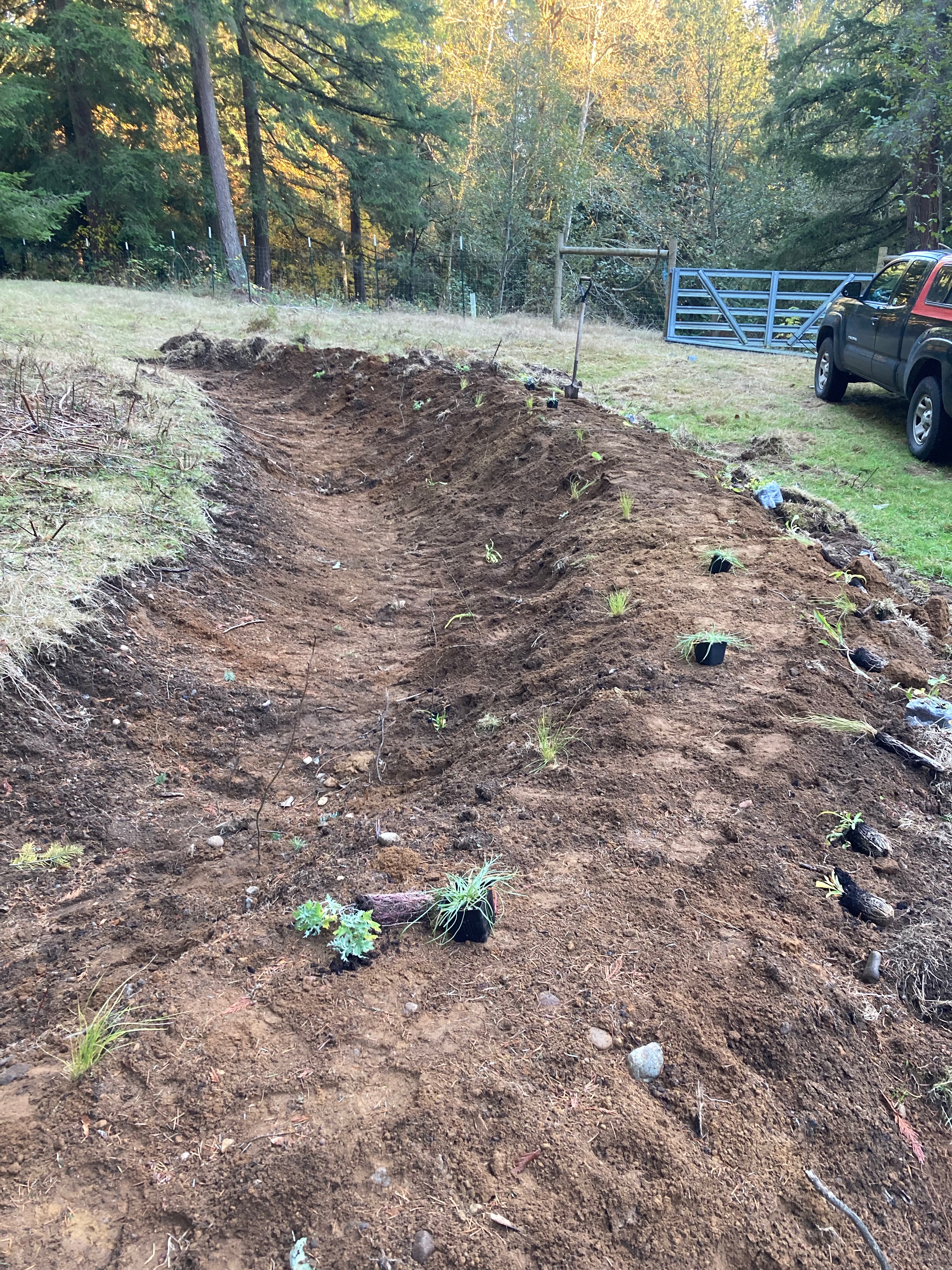
We did put in one catchment basin in a seasonal wet space where we want to direct the water away from our road. This swale will move water into its center, which we dug just a bit deeper and wider to collect a larger volume. This winter we will observe how much water fills the basin, and if it’s more than the ground can hold, we’ll plan to put in a culvert to send the water on down to the creek when it overflows. Before putting in this basin, the water would sheet across the landscape here and soften the ground where our road crosses. Though we don’t drive on this land in the winter, we’d like to firm up the road’s base by directing the water into another space nearby. This basin may become a small, seasonal pond with wetland plantings. It’s hard to imagine wetlands here in late summer. All the soil was dry and easy to dig at this time. In future, with the help of these swales and catchment basins, the ground will retain more of that crucial winter rain to counter our growing summertime drought.
One other earthworks feature we implemented was a waterbar on the road, just above a major topographic change into steeper slope. We’re hoping that by diverting the water above the hill, we can prevent it streaming down the road, cutting into the land and eroding the ground where our vehicles drive. I installed another bar above, near the barn last fall. I dug it by hand, and it worked beautifully. We channeled that water into the pond, and prevented more erosion down hill. This waterbar will do the same, though we’re channeling into the woods, where it can sink into the trees of a more established forest with sponge capacity. We’ll still be doing a lot of observing to see how much water is moved, where it goes, and if the forest capacity is enough to slow and sink the flow. If not, we’ll build an additional catchment basin with controlled outflow to prevent future erosion. Again, all of these earthwork features are to catch and keep water on the landscape to strengthen water retention in the soil. If we move it away from one area, we have to have another place ready to receive it.
Working with the landscape like this takes a lot of planning, observing, and mapping of your topography. Moving water across contours can be a tricky thing, that’s why we focus on sinking the water in, not sending it away. There are strict laws here in King County Washington regarding moving water across your land, especially if your sending it off your property onto someone else’s. That’s against the law, and with good reason, imagine what would happen to people living far below someone directing all their water down hill? Flooding out your neighbors is a serious thing, and the laws protecting against it are very important to be aware of- especially in a region with a lot of rain. As the weather becomes more and more extreme, we’re seeing first hand the volume of water increasing across our property. Last year, our well established swales filled to the brim for the first time. Luckily, they are built to overflow into each other and down to the pond, which has never reached it’s outflow capacity. If it does, there is a catchment basin below and a slow meander down to the creek on our land. There is also a backup overflow basin off the pond, which could hold additional flooding in a major weather event. So far, we have not come close to this kind of event, but we’re prepared none the less.
Observing the flow of water into your earthworks is crucial to knowing if they are preforming correctly on your land. If the swales channel water into a torrent of moving erosion hazard, you may be in for some bad flooding. That’s part of why we did smaller swales with limited movement across the terrain. These earthwork features are there to catch and save, or direct minimal flow off roads and into intact forest land that will soak up the excess. If we do note any flow, we’ll map those spots for future swales and/or redesign existing swales to better hold and sink. One other crucial thing to think about in designing swales is access. Once you put in a big ditch on the land, you can’t drive through it any more. If you have livestock, make the swale edges gradual, so an animal can crawl in and out of them without struggle. That’s why our swales are gradual and shallow. We don’t want to trap our sheep in a hole. There’s a lot to think about when implementing earthworks on your land. Laws, terrain, machinery, and access all dictate much of what you can do. Be sure to also map soil types and existing water flow before digging.
Almost ten years of mapping, observing, and planning made it possible for EEC to say yes to earthworks on short notice. We do not recommend just bringing in an excavator and playing around- you might end up with a seasonal stream in your back yard that flows into a neighbor’s basement. Scale is also important- if you have minimal acreage, hand dig your features and create small catchments that cannot flood. Our 10 acre parcel has room to host bigger features, but we still start small and do a lot of mapping to better understand what’s already going on. The changing weather extremes also play a huge part in how our earthworks succeed. We plan all our earthworks to handle the catastrophic flooding potential that could one day become the norm in our region. The sequestering of water in the soil also helps protect against summer wildfire threat, keeping our ground damp and less prone to drought. These advantages and more make earthworks on the landscape a crucial part of our restoration goals here at EEC.