So much gratitude for this learning opportunity and the energy to share. Narrative of place, connection to food, producing it, and enhancing vibrant community through shared abundance- these are foundational principals held at EEC Forest Stewardship. In taking the time to listen- the voices of soil, water, air, and light give and give and give- freely. The cost is cooperation, giving a little back, sometimes a lot, then taking more. So much rings true in this impactful share by Jon Shellenberger, of his ancestral connection to place and people. He offers much in this teaching of lineage and the attempted colonial deconstruction of tribal identity. So much good knowledge of land and food- the deepest survival in us all if we are connected to place in such a way. In this hour long lecture at Washington State University in a geology classroom, a fellow academic, who is also deeply connected to place and treaty rights, explains how these legal constraints make or break his ability to access food his family has been cultivating relationship with in place for thousands of years.
Why a geology classroom? Jon explains with delicate truth how colonial reinterpretation of value in land, dividing it into squares for resource based extraction and the parallels with treatment of the people living there in deep relationship with a complex living system they participated in as part of, and relied on to survive. He walks through land management to benefit resources for human use, management systems implemented by tribes long before colonial “discovery”. Shellenberger weaves the imagery of his ancestry and the connected bands of people throughout what is The Colombia Valley today. These images of the land and its caretakers, people living in a connective community, rather than an individualistic mindset cultivated in western consumerism culture for commercial earnings.
Opening up to this lesson, and others like it, helps broaden understanding of place and people. Thank you all for taking the time with these words and Jon’s offer on the human perspective.
Younger plantings along our hedge edges are ready for laying over to encourage horizontal growth and a hard, natural barrier. The young hedge pictured above has been growing slowly, and finally has a few lead branches ready to pleach over in a partial cut near the base to bring the growth down low to the ground. Suckers will shoot out from the base next year, while the long leader, now laying sideways, also redirects it’s growth to the branches now pointing up as new leaders along the trunk. It is easy to manipulate shrubs and small trees when they are young, shaping the growth to suit your natural fencing needs. There is a pallet fence backing the young hedge as it develops, but that dead wood will collapse and compost soon, while the living fence will strengthen and grow for many lifetimes. The controlled horizontal growth will also create a living wall of food for our sheep, who love browsing broad leaf plants as much as grazing grasses.
In less developed pasture edges, like the one pictured below, I’ve pleachered some more mature bitter cherry trees to mark out a new line for hedge development. Cherries sucker out very well, and by laying these trunks, we’re shaping a fresh hedge line, which we’ll plant into with a variety of other species to diversify the vegetation within our living fence. This hedge will also keep sheep from grazing down a steep hillside beyond, and protect an already replanted stand of mixed broad leaf species like cascara and Sitka alder. Sheep can be quite lazy, and it takes very little barrier of branches to deter them from pressing into the vulnerable forest undergrowth. Ideally, I would have dropped these cherries a few years ago, but life can get very busy here at EEC, and the hedge is still set for replanting down the road.
Hedges can be tight and neat lines on pasture edges, but at EEC Forest Stewardship, we prefer organic, wavy shapes offer up more surface area and space for diverse species. Over time, the hedge will expand and begin creeping into the clearings where in time, more forest will be replanted after grazing animal systems are phased out. A healthy landscape like this should maintain some open spaces for transition from canopy to field, but in time, the trees will grow and shade out open land. By then, many of the hedges will be lost in the folds of evergreen canopy. For now, they build hard edges of habitat.
Some of our ancient apple trees got a trim this year too. Pruning is very important in maximizing fruit production. Since EEC is not about maximizing, but rather, diversifying, we are rather lazy about pruning, and phased out the practice completely in new orchard plantings to allow the tree it’s own selection of growth and shape over rushing fruit harvest. There are some very exciting alternative cultivation success stories with not pruning fruit trees at all. Masanobu Fukuoka’s One Straw Revolution gives a wonderful take on non-pruning in his masterpiece on natural farming. The trees at EEC, pictured below, have been pruned all their life and then neglected for a decade. I’ve been slowly cutting them back into shape, sometimes preforming minor tree surgery- taking off a large branch, to help re-balance the tree’s structure to let in more light and air. But these older trees are in decline, and I’ve begun harvesting cuttings to graft onto new root-stalk to continue already successful varieties on our landscape.
Pruning lets in more light, encouraging buds to form, which produces more fruit. Pruning a young tree will hasten fruit production, but commands continual pruning every year to maintain the ideal shapes for commercial production. Take industry out of the fruit tree’s development allows the tree to naturally select it’s own shape and production without human ego assuming we can do it better. There are many cultivars that cannot survive without pruning, so be aware that if you choose the lazy rout and let the fruit tree fend for its self, you will loose more trees, but the ones that make it will be a good foundation for future grafting to replace the lost varieties. You’ll have to wait a few more years for un-pruned fruit trees to develop a good fruiting crown, but letting nature work in her own time usually reaps great reward in the long run.
Remember that most fruit trees have been grafted, and come from lineages of heavy cultivation. Apples are not a far cry from Malus sieversii, their Kazakhstan ancestor back in eastern Europe. Varieties today are countless, and have all manner of make and use- from baking to cider. Though the best fruiting varieties are grafted, you can still plant apple seeds and get fruiting trees, but they will most likely not produce very appetizing eating apples- if they produce anything at all. Still, out of every great apple strain there was a tree from seed originally. We’ve lost so many heritage apple strains, but some are being rediscovered here in The Pacific Northwest. In my own research in seed planting, I came across this video by Stefan Sobkowiak, which give a great explanation for planting seeds and what happens. Most domestic fruit seeds behave similarly, you must graft to get a specific type of fruit consistently.
Pruning is a tool for shaping growth of any vegetation, and will impact growth rate too. Pleachering brings out suckers while pruning usually removes them. There are many kinds of shaping techniques beyond these two examples. The action of shaping growth is high maintenance in the short term, but you can also choose to not prune, or pleacher once and let the horizontal growth go. At EEC, we’re always embracing less work, so I do not plan to lay hedges more than once, as the long term vision here it to let the forest return. Fruit trees will get shaded out, and hedges will melt into the forest understory. Being able to picture the development of your tended space through many seasons of growth will help in determining when you should- or if you should make cuts. Most pruning and pleachering happens while the tree is dormant, so plan on an active winter schedule in your orchard or along your hedgerow to have lasting effect and healthy vegetation.
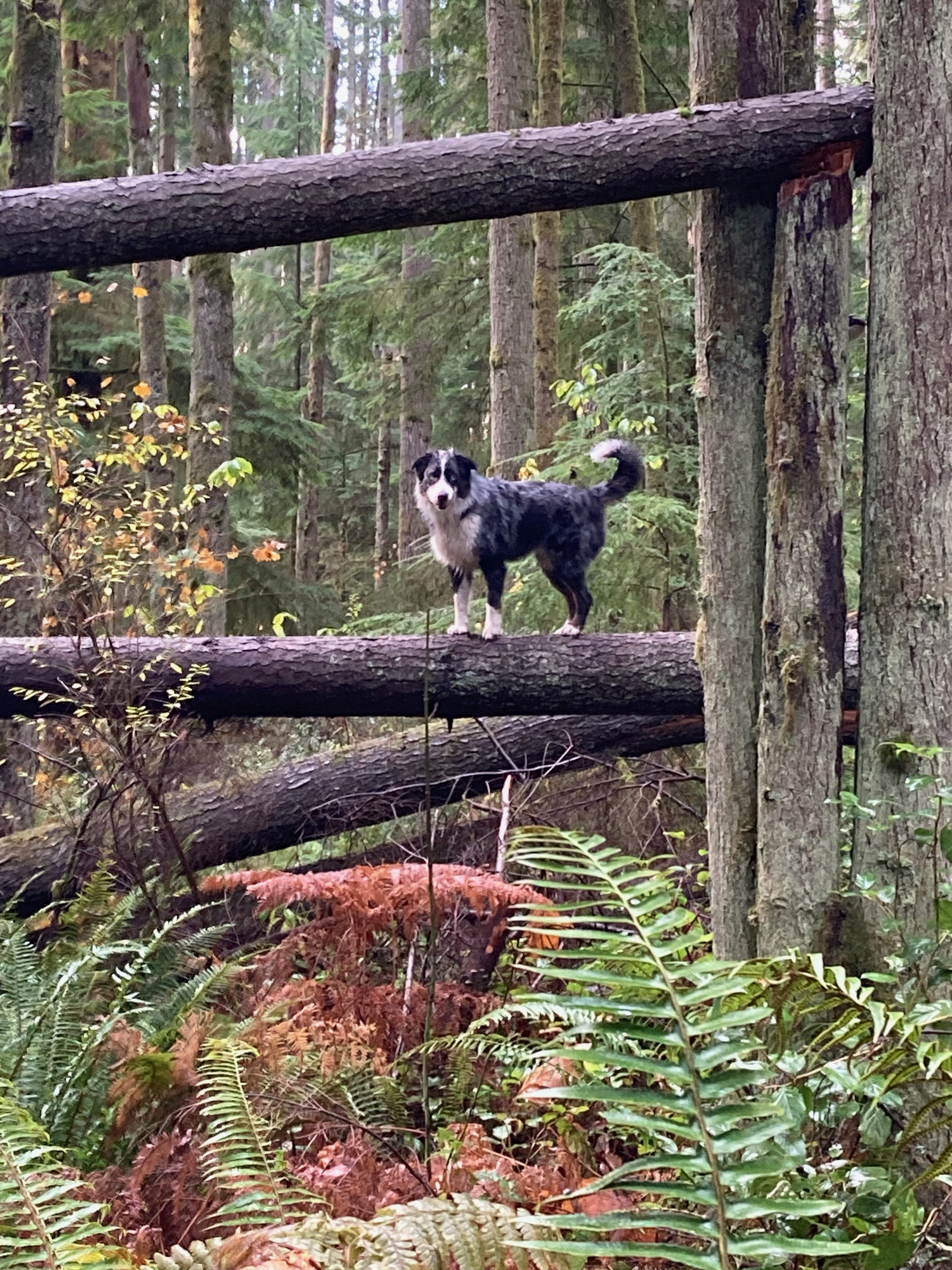
It’s great to visit other local woodlands in the area of EEC Forest Stewardship. Washington State, like many western states, has what’s called a patchwork land development system contrived by the federal government when railroads pushed west. Even in highly developed suburbs of Western Washington, the checkerboard of some parcels still remain forested public land. You can find a great interactive map to learn more about public land in Washington here. The patch wandered today, was once actively logged through the first half of the 1900s, then became an urban park, part of a larger wetland area around a lake. The ecology is indicative of a natural reseeding after two commercial logging endeavors. A lot of wood has fallen in this forest, as no natural thinning activities have occurred- like elk browsing, wildfire, or thousands of years of old growth development, which was disrupted with the first cutting at the start of the 1900s.
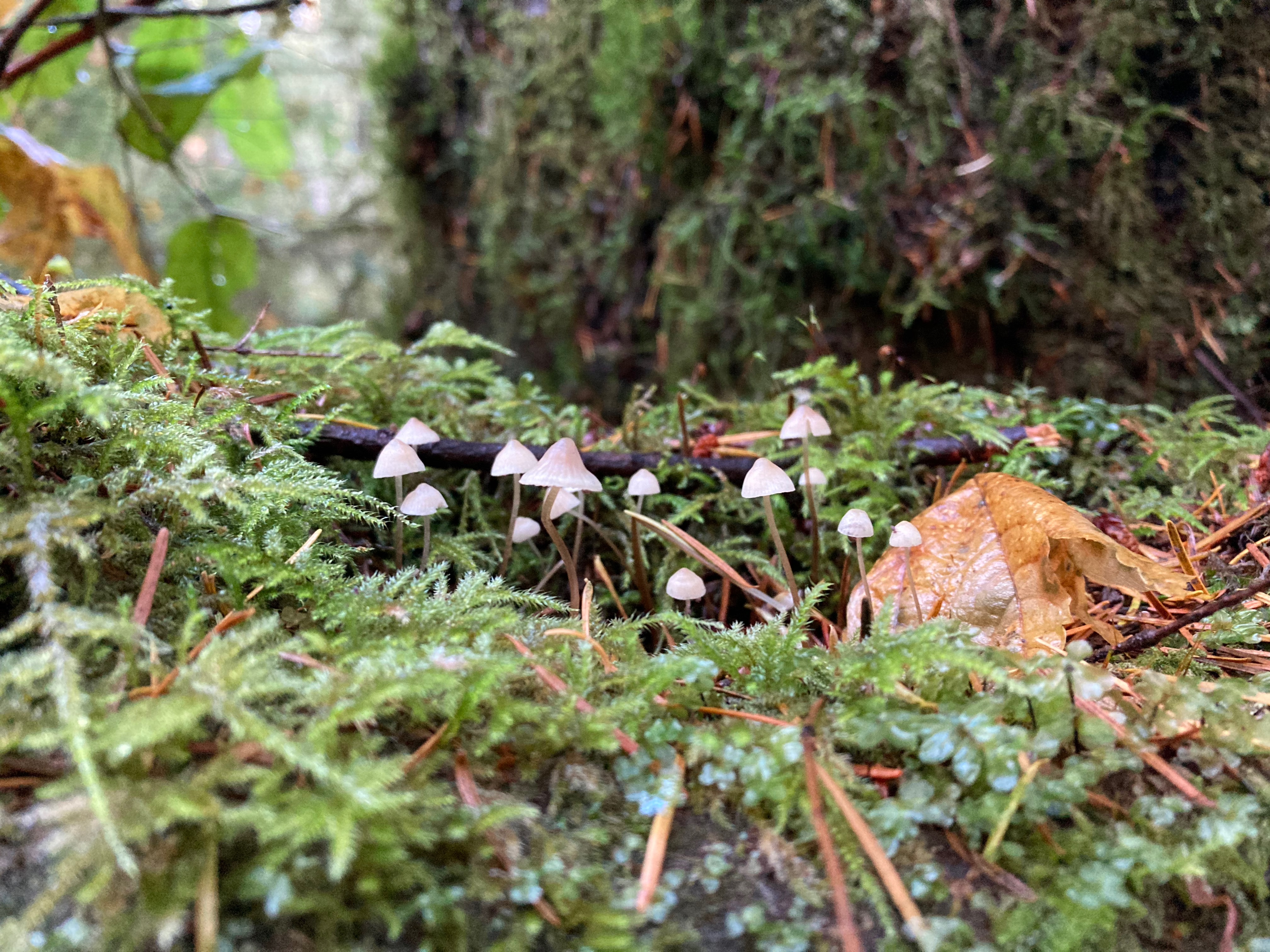
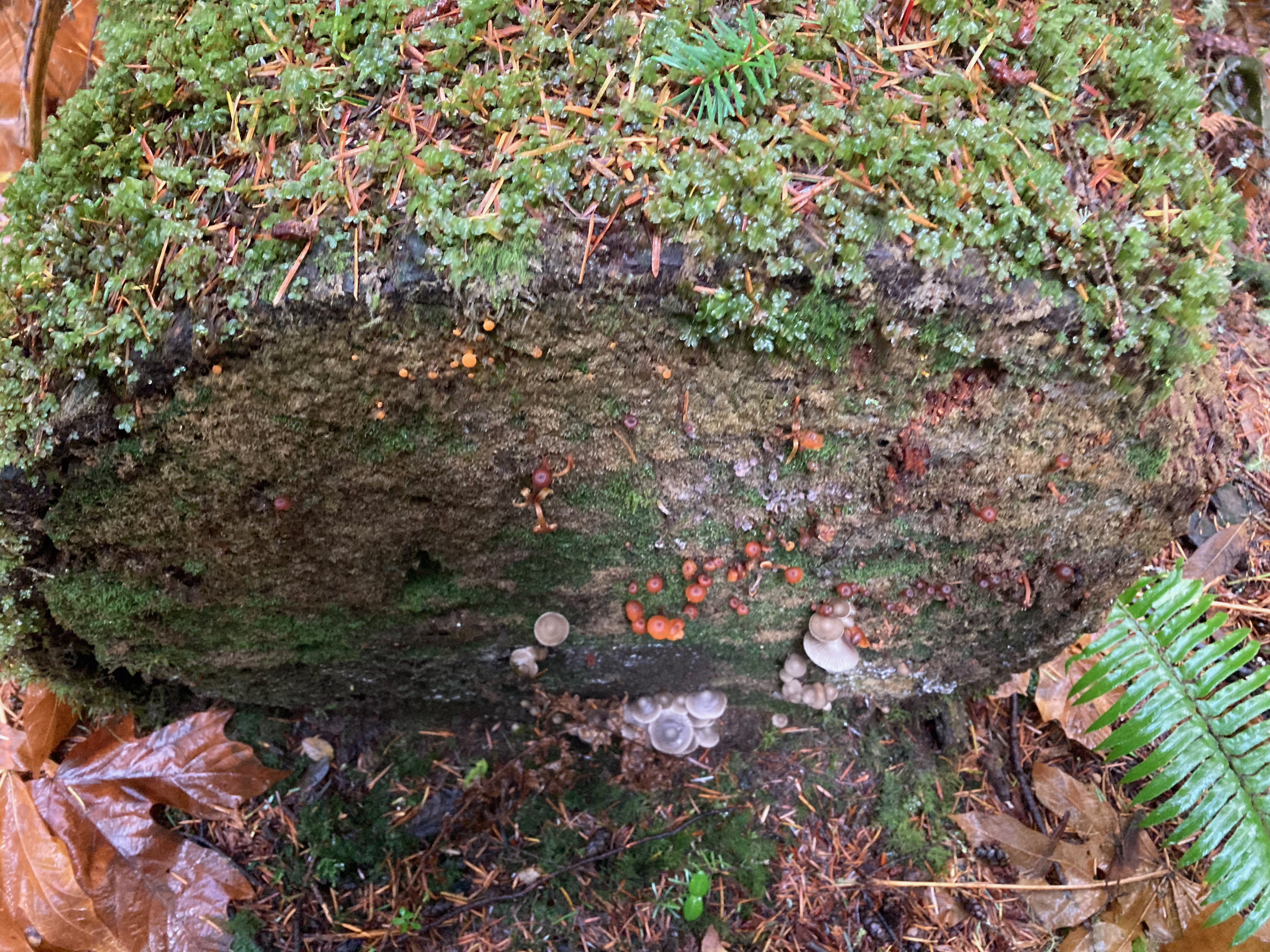
Mycology is present, and helping to break down the woody debris laying all around. Mushrooms play a vital role in developing soil in a forest. The fallen logs are full of tough fibers and tannin, which delay molecular breakdown. If the debris sat on its own, even in the wet environment of Western Washington, it would take so long to decompose, most of the nutrients would be lost before turning back into productive loam for the future old growth forest trying to return. In 4th generation timber stands, there is a noticeable lack of topsoil and nutrients in the ground. The industry now pollutes the ground with treated sewage, to replace badly needed nitrogen, to make more trees grow. This mono-culture catastrophe will never recover in that kind of short sighted industrial management. Fungal factories are still hard at work in commercial forests, and can be severely detrimental to profits in these fake forest when mycological outbreaks happen across the anemic stands.
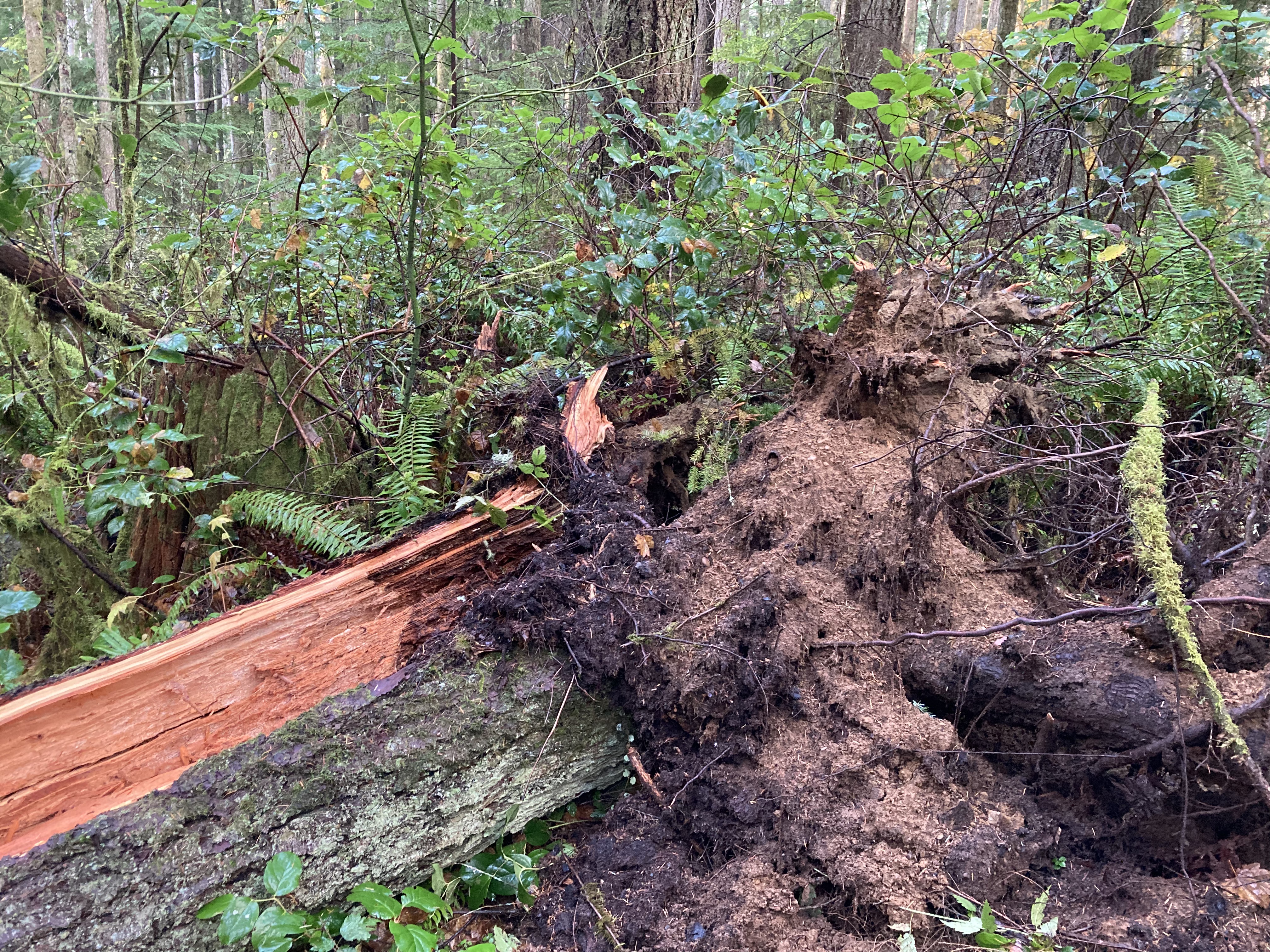
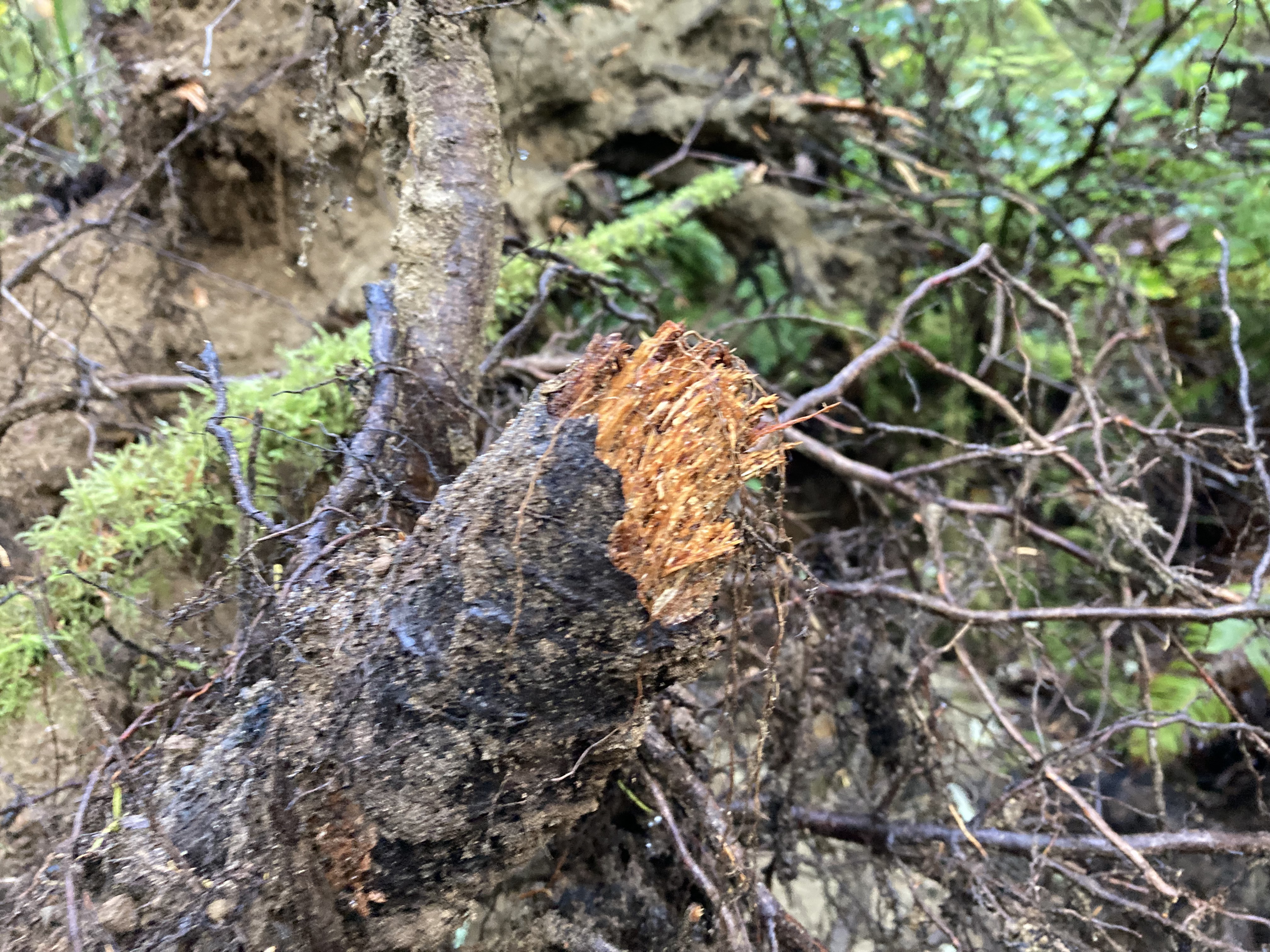
Within this park forest where my wander too place, tale tell signs of fungal infection appear. Laminated root rot is rampant in The Pacific Northwest, partly due to mono-culture, and I believe, partly due to a loss of ecological players, like millions of elk, which browsed across a rainforest mega-complex now reduced to a herd of a few thousand in tens of isolated groups. Megafauna cannot survive in fragmented habitat, current “mature” forests are not even a shadow of what once grew and thrived across The Pacific Northwest. Mycology is trying to correct the strange human induced kerfuffle that still is ecological genocide. There are trees in this suburban park forest failing because of fungal parasites, but not all the trees are infected. Because of profit loss in commercial groves costing mere millions of trees- considering the loss of forest due to logging in The Evergreen State (at least 60 billion board feet in 100 years). 500 board feet is about one “mature” (NOT old growth) tree. Calculating the value of a single old growth tree today is complicated, in the 1970s, at the height of clear-cutting the last large stands of old growth in Western Washington, industry didn’t really care.
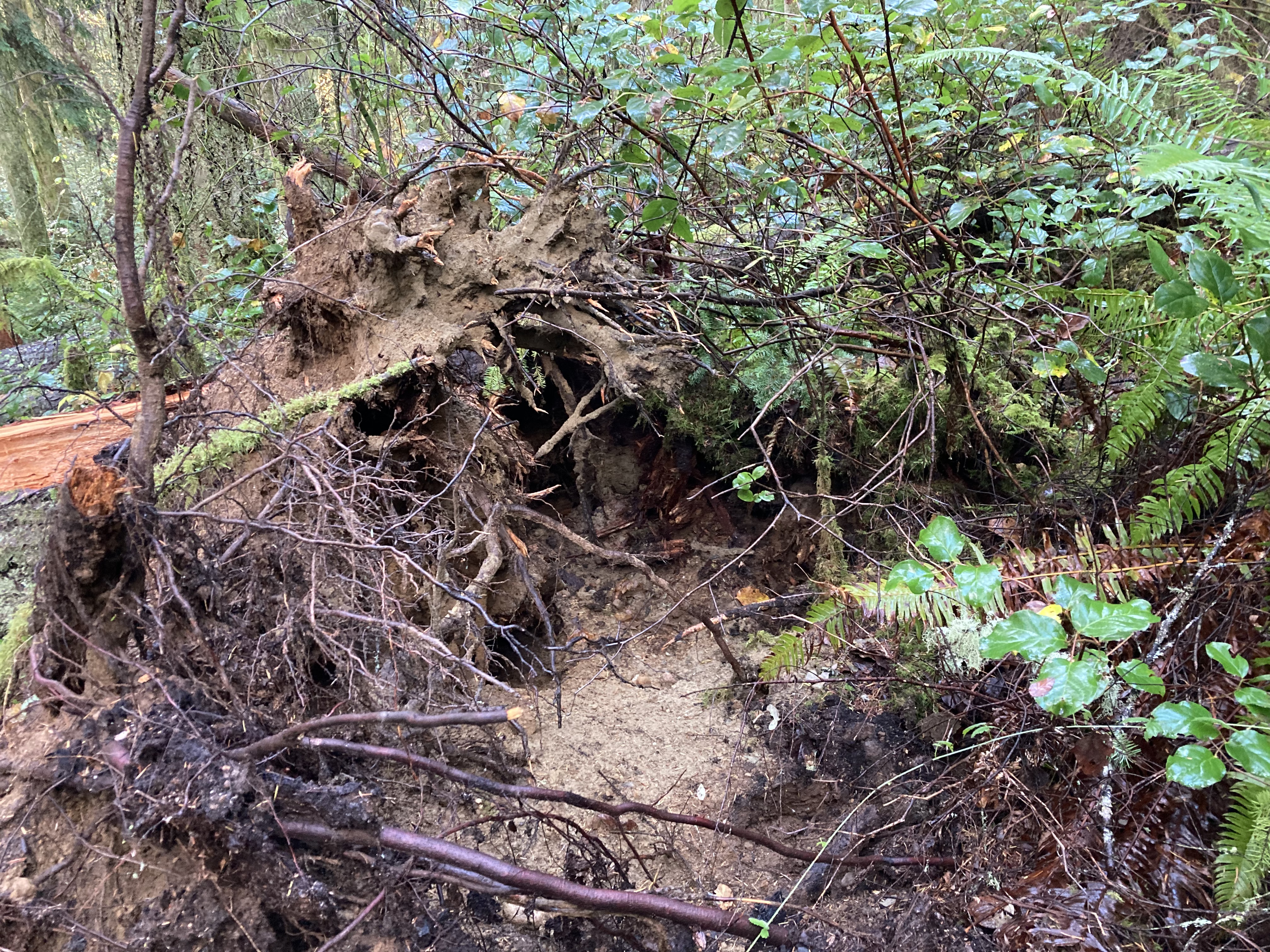
Fungal invasions of today are helping to open up long term old growth areas in the same way beaver, weather events, and geological upheaval do. Clear-cutting is also part of that cycle, if kept to a scale comparable to the other natural cycles it could mimic. Timber industries love to talk about how their forests are renewable. Green washing consumerism teams up with timber industry forest replanting as “plant a tree” carbon offset glitter, and, as the washing implies, it’s not all gold (profit). The cost in biomass lost from the landscape through a century of tree removal is immeasurable. Board feet does not include erosion of silt into streams- unless you want to look at salmon population crashes, but then you have all the hydro power to contend with. What a web! Like the mycelia that brought down the tree below, there are a trail of clues to help us unravel cause and effect. It will be interesting to watch this forest evolve. There could be a logging date in future for this plot, most state land is in a timber harvesting forest plan.
It’s a comfort to know that, no matter what the state of a forest, fungal friends will be at work shaping and remaking habitable space. The lessons they offer in ecological partnership are humbling. Humanity has the adaptability to fold back into the landscape in much the same way. Working within the limitations of environmental factors dictated well beyond our control, evolving in close relationship to place and the layers of intricate cooperation necessary for success. Learning from environment while being in it- bare feet on the ground, cuticles peeling back after immersion in acidic soil. Muddy knees and scraped ankles wading around in blackberry, struggling to get past the edge space, transition from field to forest. The flashes of mycology host knowledge banks about the environment, chemical signatures, decomposition age, geological record, transformation in progress, blueprints of potential. Most of us are just passing by and don’t stop to smell the roses.
At this patch of state land, the clearing is blacktop with neat upper class homes- 1990s build, with park land surround. There’s no blackberry, but cement ecoblocks hold demarcation at one entrance into forested public realm. No camping or large gatherings, it’s a jogging, biking, ride your horse, walk a dog or two on leash setting. At this moment of exchange, after a dry, hot October, the mushroom fruiting was modest, but very much in action through a period known as the mushroom spring. I enjoy coming to this forest location because the ground cover is thick with a range of fallen debris and lots of wetlands to keep the ground saturated, even through drought periods. That’s another reason this forest was not developed. It’s part of a larger wetland area that acts as a drainage catchment for the surrounding neighborhoods where the forest was cut and a lot of infrastructure went in, removing the crucial sponge on the landscape which best worked in a rainy, cool climate. Consequently a lot of rain runs off the buildings and pavement, with no sponge left to soak it up, so overflow is diverted into designated wetland areas.
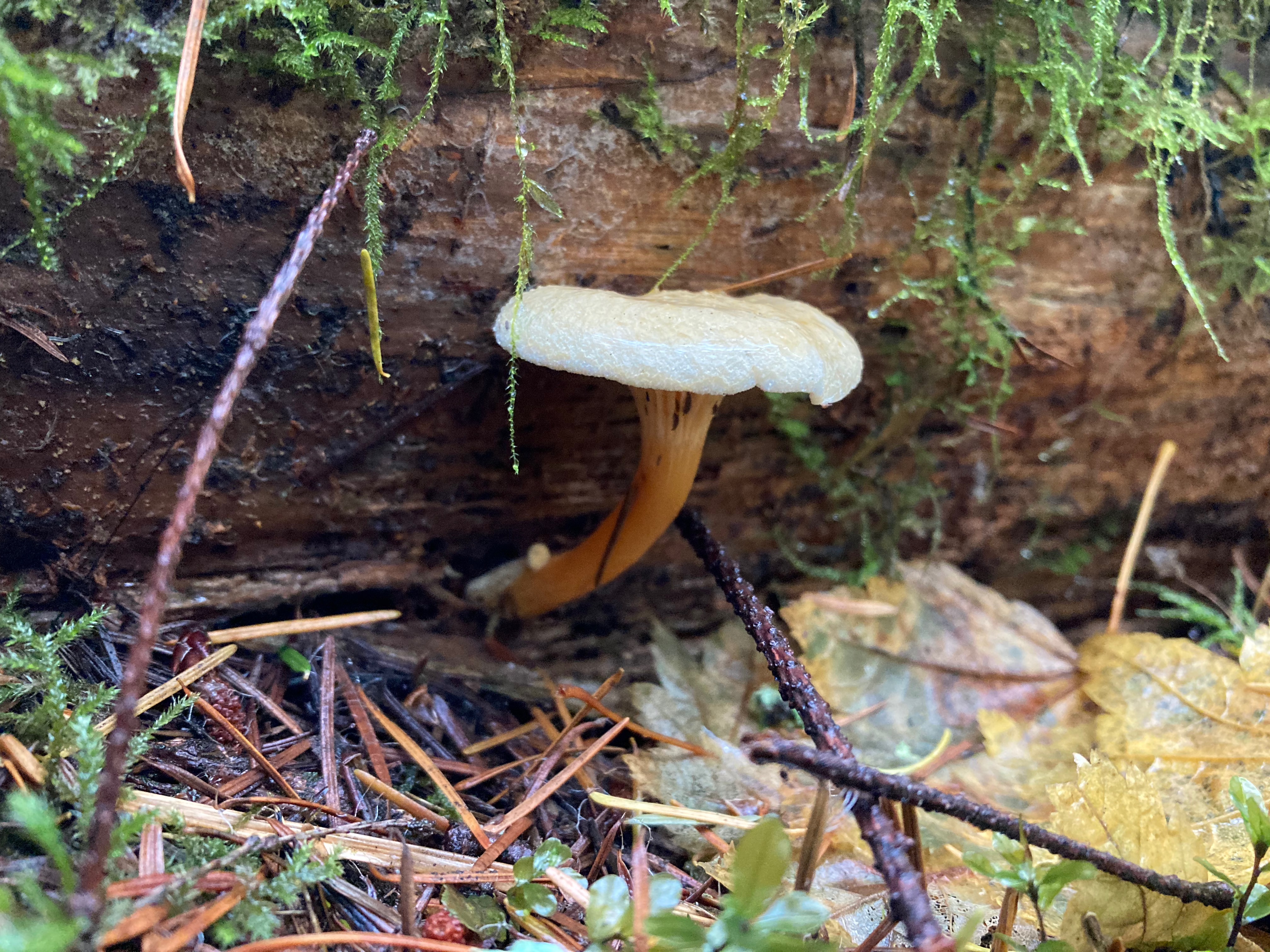
There are a great set of paths through this wetland area, and most of the trail remains above flood areas. That’s a sign of smart trail design with thought and care, unlike much of our development to date, which sprawls at best. The trail has a main rout through the public land into a greater lake park, with multiple entrances. Winding makes the journey longer, but there’s still a good buffer of forest without much human disturbance- for a suburb. Deer brows through, as they traverse the rest of the neighborhood, but they have to keep moving through, as the patch of forest is a larder stop with finite resources, and somewhat limited verity, but restoration planting has occurred, slowly diversifying the ecology for a more adaptive and productive forest. The diversity of fungus within most forests, boggles the mind, and yet, without old growth, there’s a marked difference in scale. Fruiting fungus- like the capped mushrooms we’re most familiar with, are much larger in old growth settings that I’ve observed. Chantrelles on the other hand, don’t pop up in old growth often, as they prefer younger, disturbed areas, like commercial fir stands, especially the 15-30 year old plantings. So again, every species has its preferred environment. Since this suburban public land forest is mostly fir, 20-30 years old, we’re in a chantrelle habitat, and I’ve found them here in past years, but this season, with the drought still on, it was the surface verities, mostly wood eating verities (not chantrelles), which were blooming in the light rains that had finally come.
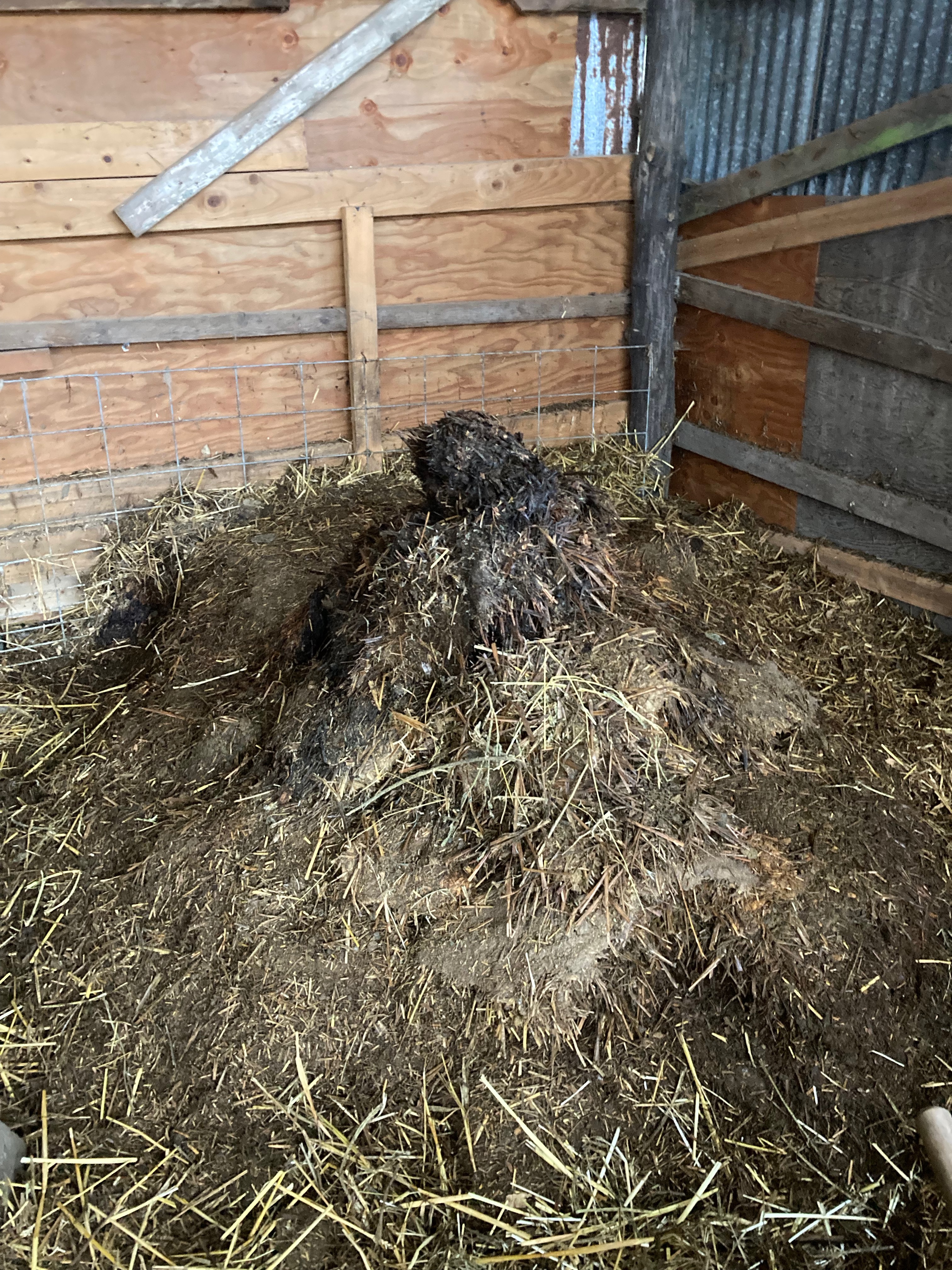
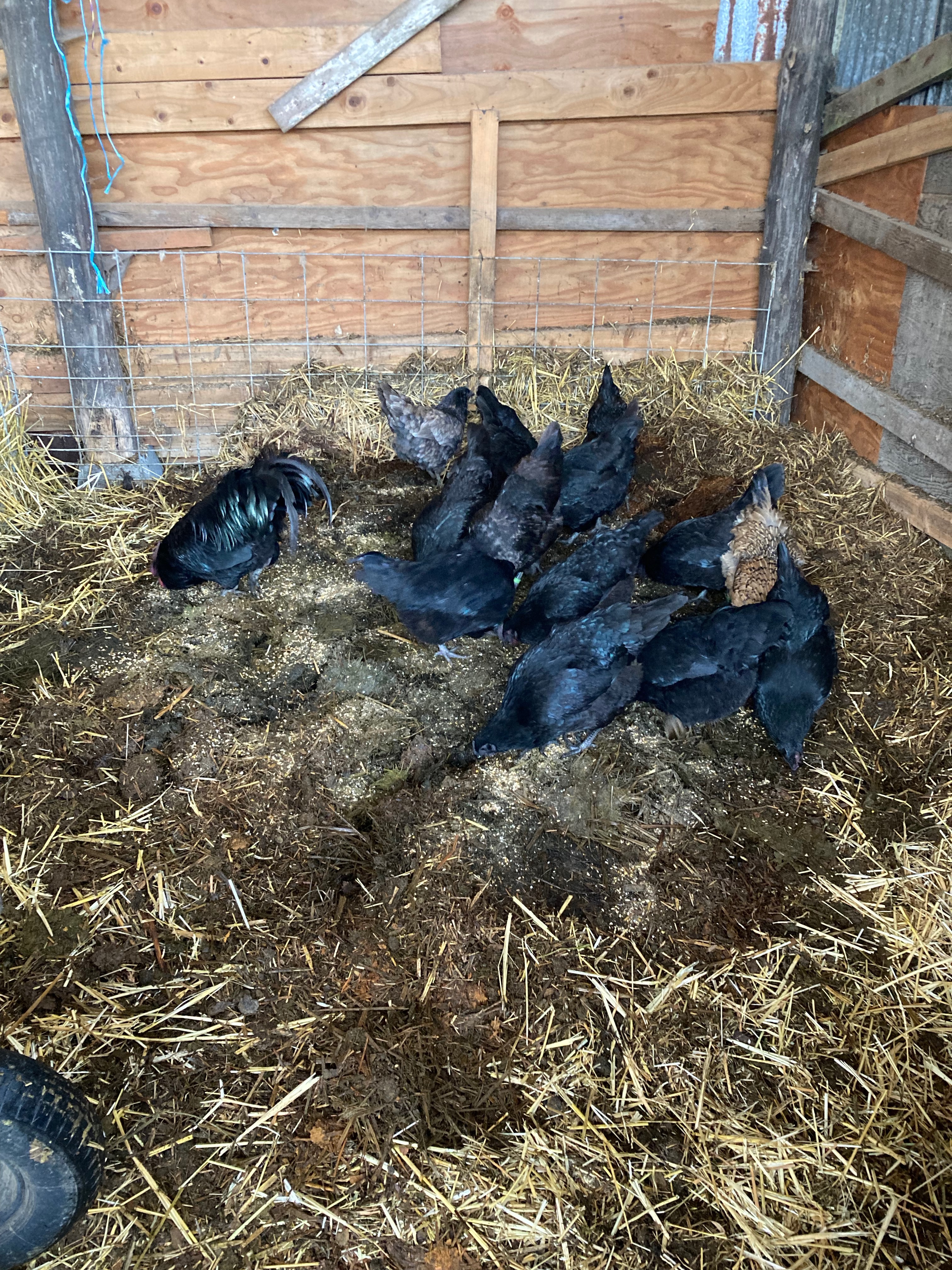
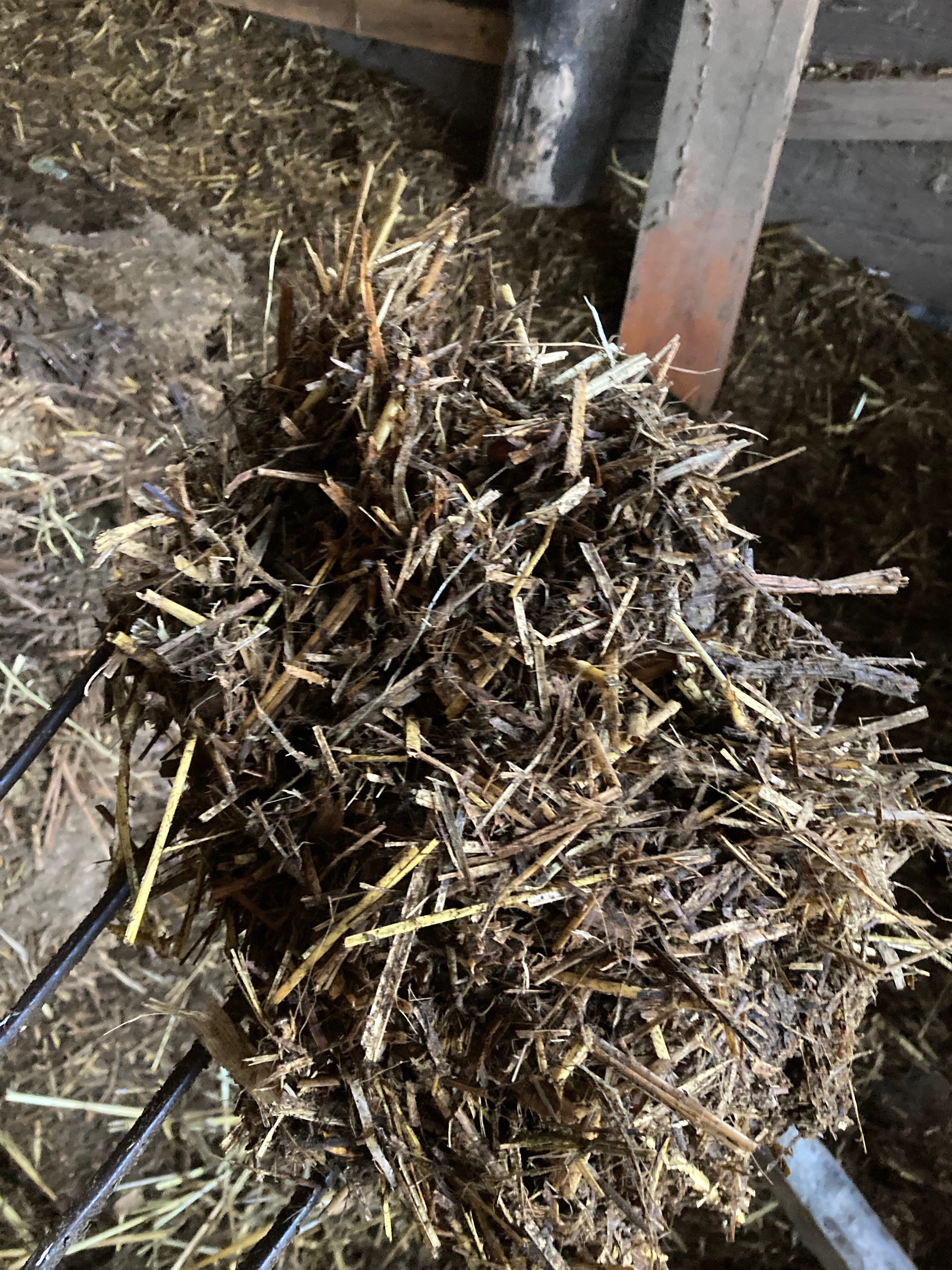
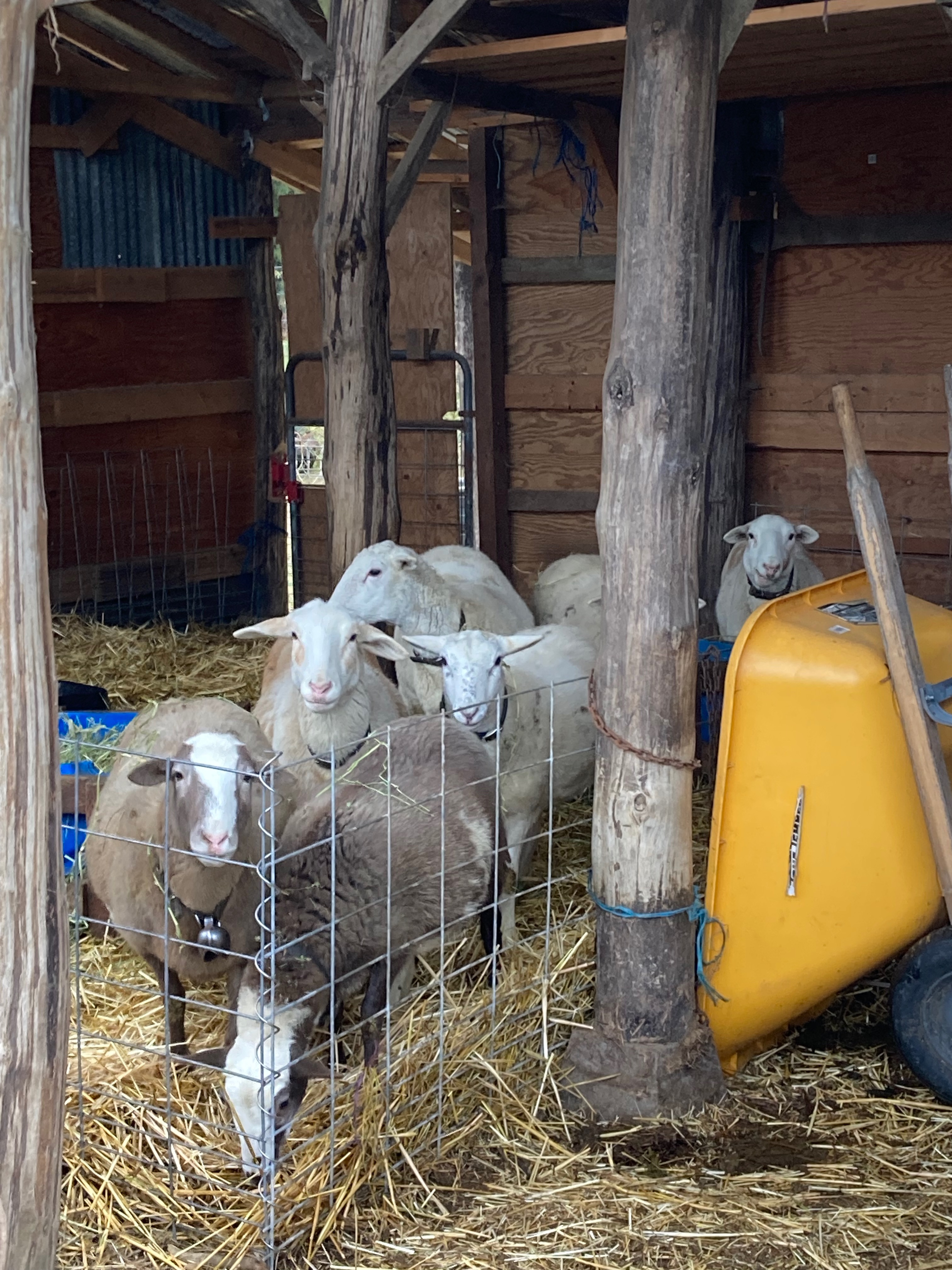
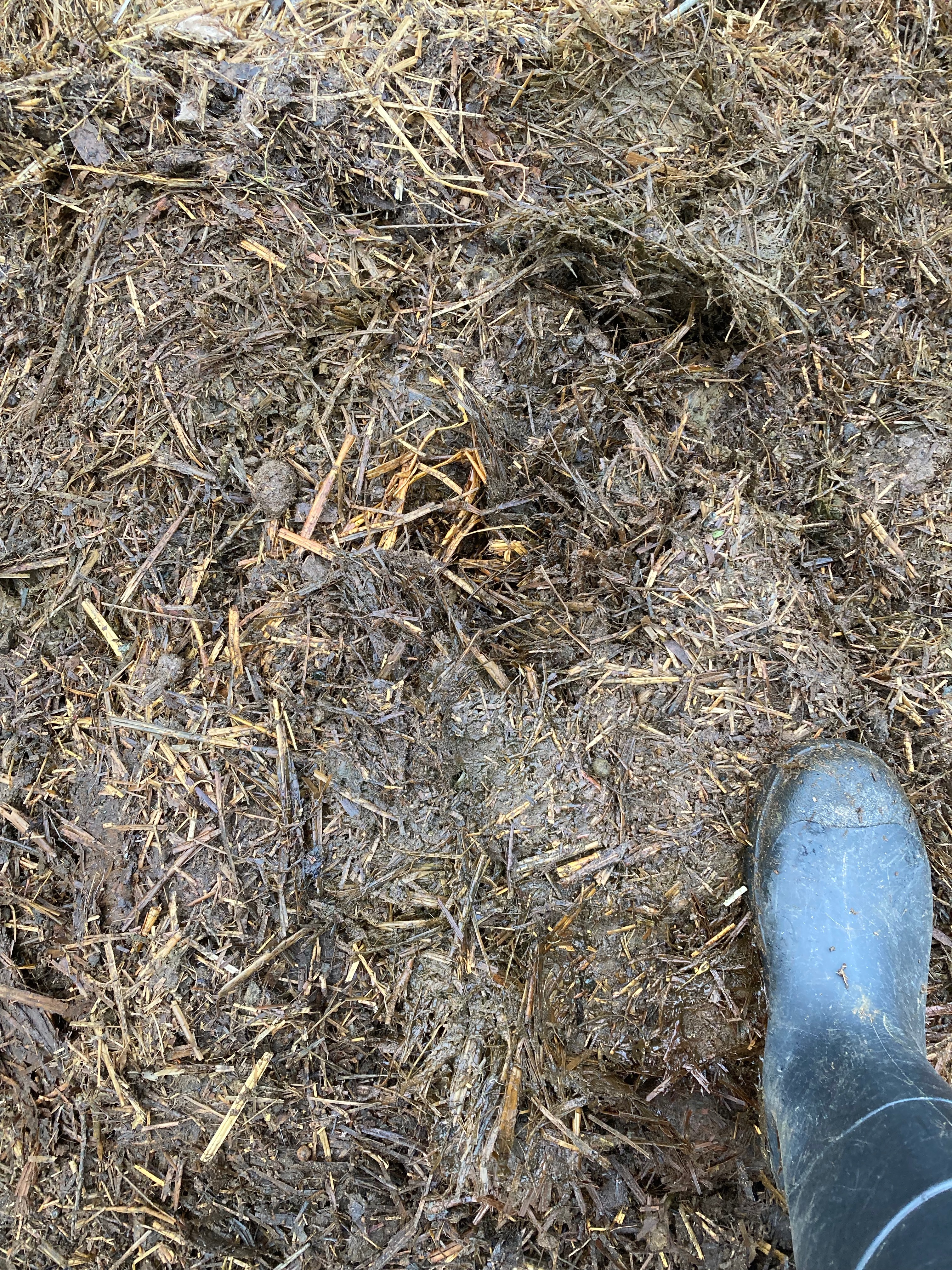
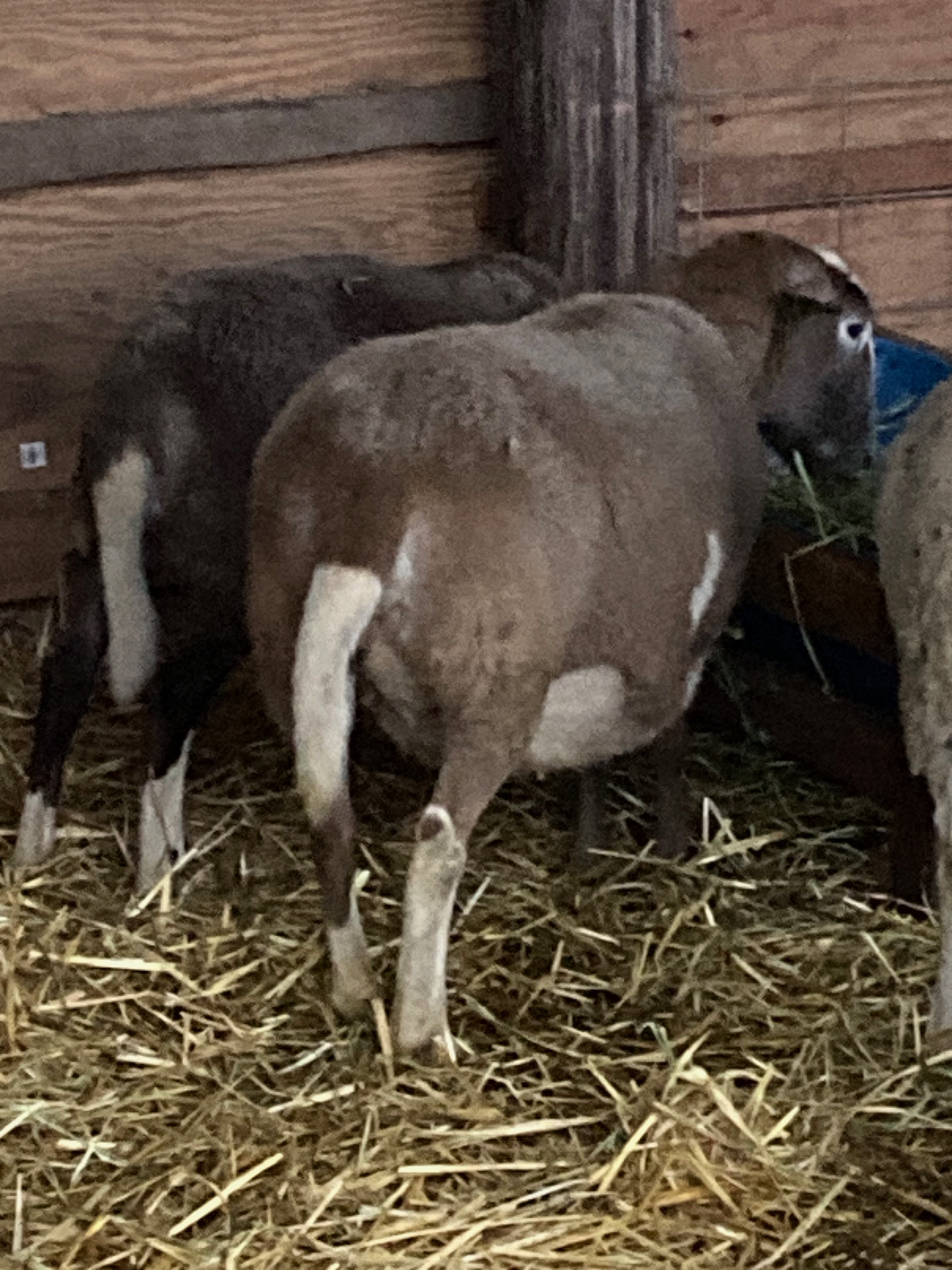
Many might bulk at the manure pile in their lives, but at Leafhopper Farm, it’s black gold with a few helping “hands”. Our deep bedding method supports manure breakdown with healthy bacteria. To maintain this decomposition, there has to be good air flow in the barn and turning of the bedding. Our chickens are great at turning, which can only be done in relatively dry bedding, so our sheep have to be out on the fields before the chickens can get at it. Once they move in, the compost gets an initial flip, then the fork takes a turn. At this stage, the manure is now broken down with straw and wood shavings to a fluffy mulch. We’ll get a lot of good soil for the gardens, and other planting areas on the landscape. Getting the animal to bedding ratio down is key to a successful deep bedding operation. In our barn, we’ve found that eight ewes is a great overwintering number to allow space and breathability to the straw that’s laid down. When we overwintered 12 ewes, our bedding input was too high, and we struggled to prevent anaerobic breakdown- which creates unhealthy off-gassing of ammonia in the barn. The sheep need dry, clean bedding which is demonstrated in the picture below. There is at least 4 inches of clean, dry straw on the ground for the ladies, allowing hooves to stay dry and clean, preventing hoof rot, encouraging aerobic decomposition with good airflow through the fluffy straw, and providing additional warmth from heat released during proper bacterial decomposition. On top of all that, we get healthy soil full of beneficial bacteria.
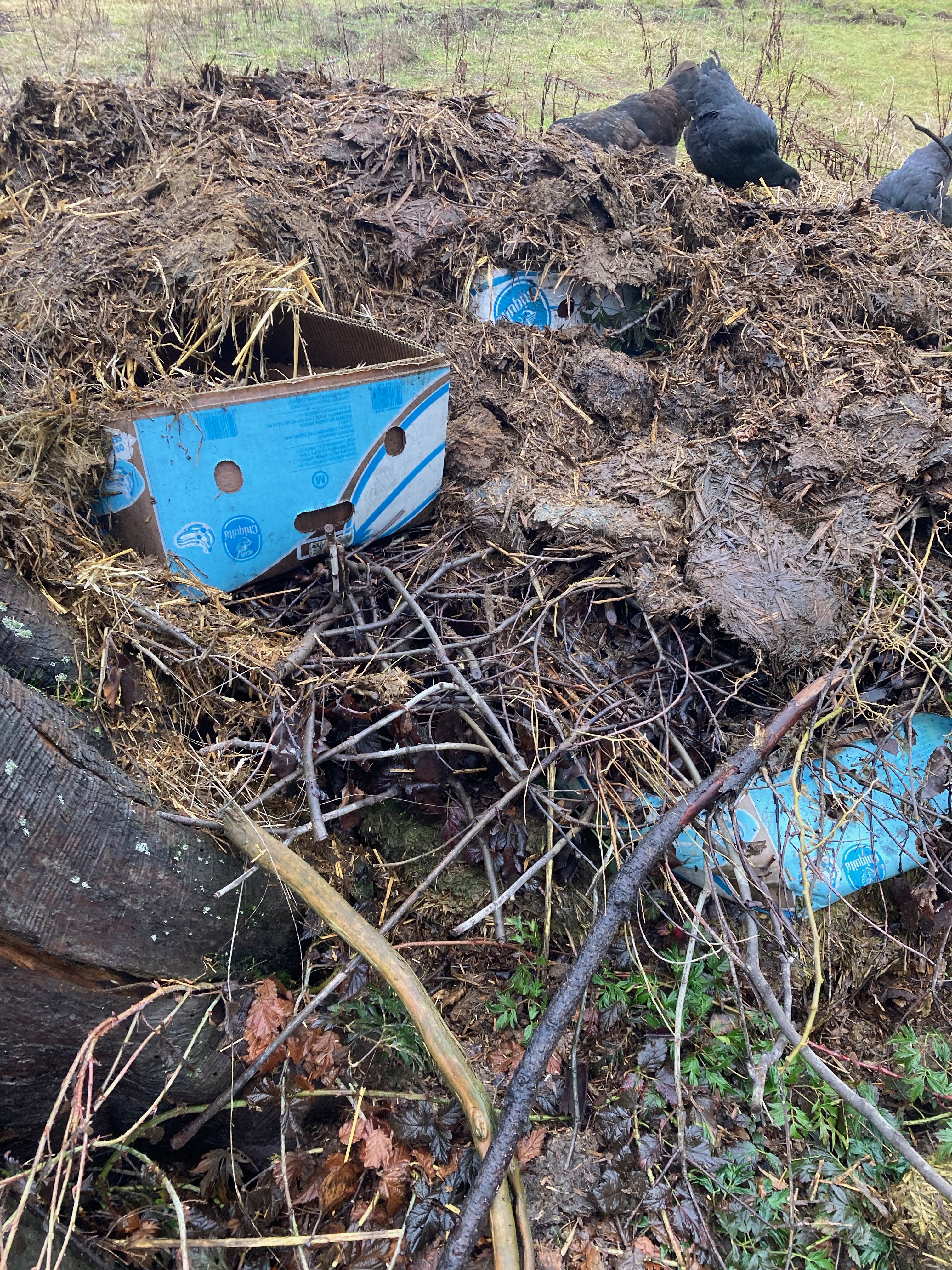
Some of our manure mulch is being staged for new native plant beds of shrubs. These now two foot high piles of seeming chaos are actually full of good living things like worms, fungi, and carbon breakdown. The straw, cardboard, and woody branches fold in to add additional carbon to the maturing soil. This spring we’ll spread an initial cover crop into these planting mounds and by fall of 2023, we’ll set root stock of hedge species like hawthorn and bitter cherry. Fruits from these two species will feed our chickens, and wildlife. We’ll coppice the shrubs for more carbon to compost back into the soil or to burn as kindling. There is endless possibility in utilizing manure as compost, folding in the physical work and cooperation with other systems like the chickens and sheep, mimic the restorative cycles of a balanced ecosystem. Elk, deer, grouse, and geese would have all been present in vast numbers playing the same roles. Seasonal migratory patterns would move the animals on, preventing overgrazing and the need for barns.
In winter, when things are wet, the sheep come in to prevent erosion on the landscape. From November to April, the land rests and recovers while the sheep laze in a warm, dry shelter with endless food. On sunny days when they get a little frolic in the field, it’s hard to coax them out of the barn, which speaks to the inside comfort. Manure build up is a consequence of having any animal shelter. It should always be a top priority in any animal system design. Too many times I’ve seen poorly implemented animal systems and the manure is usually a root cause of livestock system failures. Industrial farming is infamous for this. Though capturing and efficient production language is used often, the scale is truly mind boggling, and its long term impact, especially with the effects of climate change. The dairy industry alone has some staggering statistics on environmental impacts. Moving away from large scale would mean shrinking many other scales, including that of humanity.
Scale can flex, has to flex, to survive. In this holistic system, manure cannot outpace decomposition and redistribution within the physical abilities of a single person. In this climate, on less than 5 acres of pasture, 8 breeding sheep are a good balance. We’ve spent 10 years working out ungulate herds in restoration rotation- meaning the land improves with animal impact, becoming more diverse and resilient to climate change. Sheep do work best, though goats are helpful in initial clearing, but will brows lower skirt of trees and debark fruit trees over time. You can tell if a pasture is overgrazed by the health of trees within the pasture, if any still survive. Over time, debarking will girdle and kill trees, leaving a pasture barren of natural shade and shelter. This opens the door to erosion, and on hills like ours here at EEC, the loss of topsoil could be monumental.
The manure and straw has become such an integral part of retaining fertility in the soil while producing topsoil foundation for future forest. Here in Western Washington, where there are intact second growth and old growth forests, the ground is a thick tangle of roots, fallen branches, and nurse logs supporting new baby trees under a protective canopy. The ground is well littered with fertility, building topsoil naturally from intact biomass that has remained in place without erosion damage. For clearcut land without the rich biomass of a forest, the fertility remains bleak, and in active agricultural fields, heavy reliance on costly chemical inputs to revive dead soil enough for crops. Those crops are mono-cultures, destine to be shipped away, removing any fertility that was present, much like the removal of the trees in a forest. The topsoil here at EEC is very thin in some places, so thin a tree trying to root in would find it impossible to break through hard pan after only a few inches of root anchoring, preventing stability for long term old growth development. This is why the manure input is so crucial to restoration of forest. Without the buildup of topsoil, the forest will take many generations of trees growing and falling over each other to repair the ground and replace the thick mat of fertility for large, old growth to return.
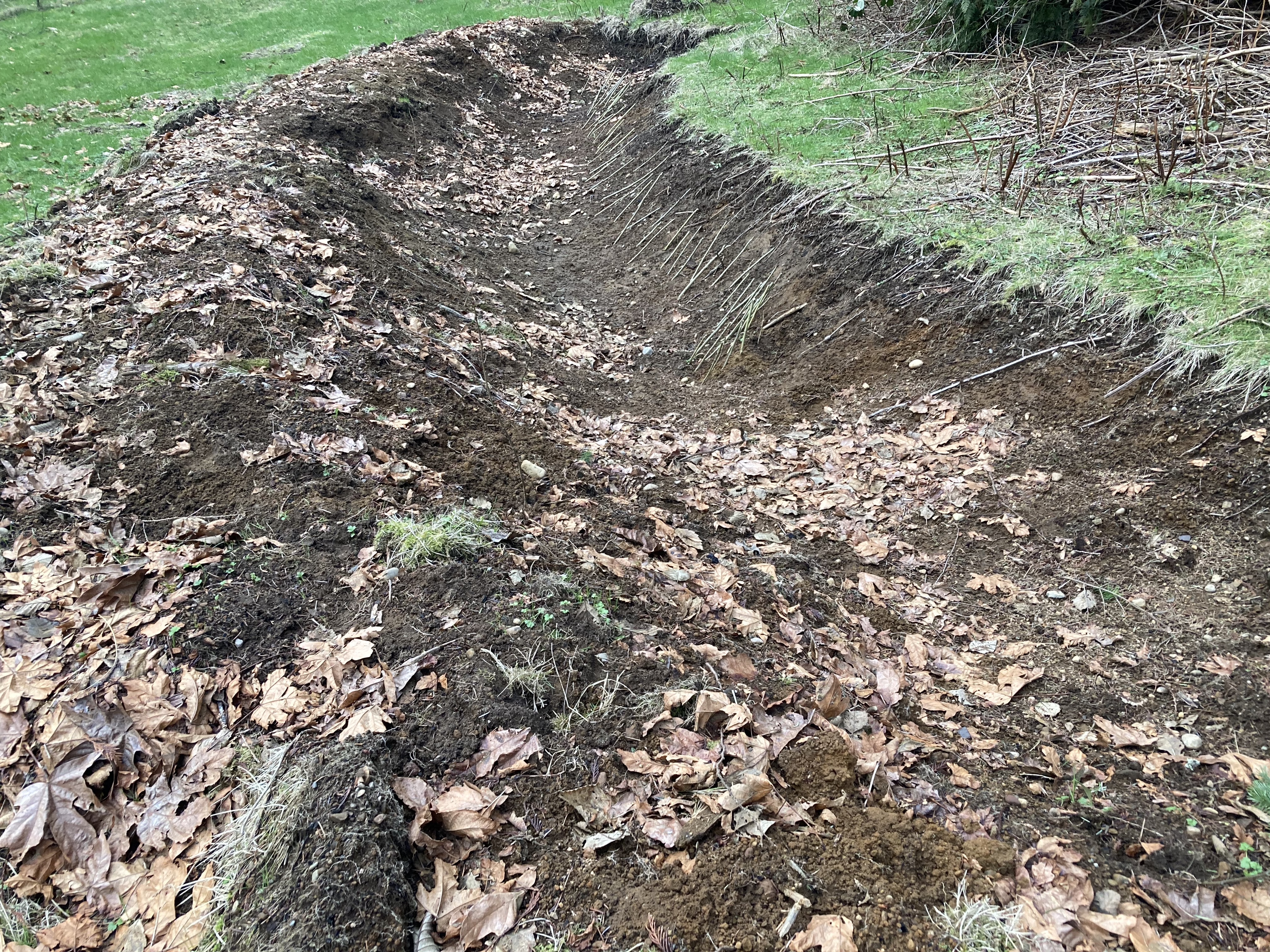
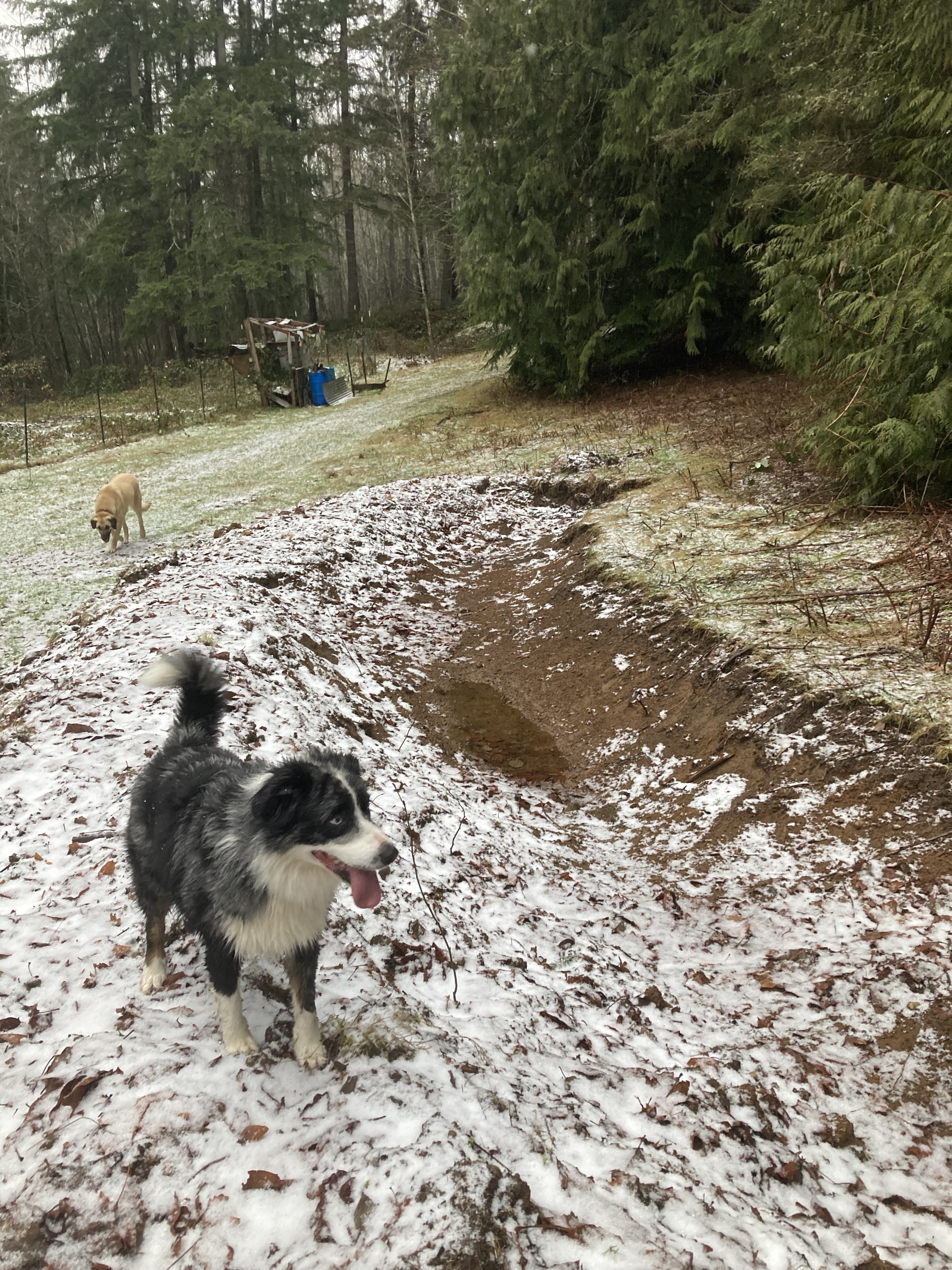
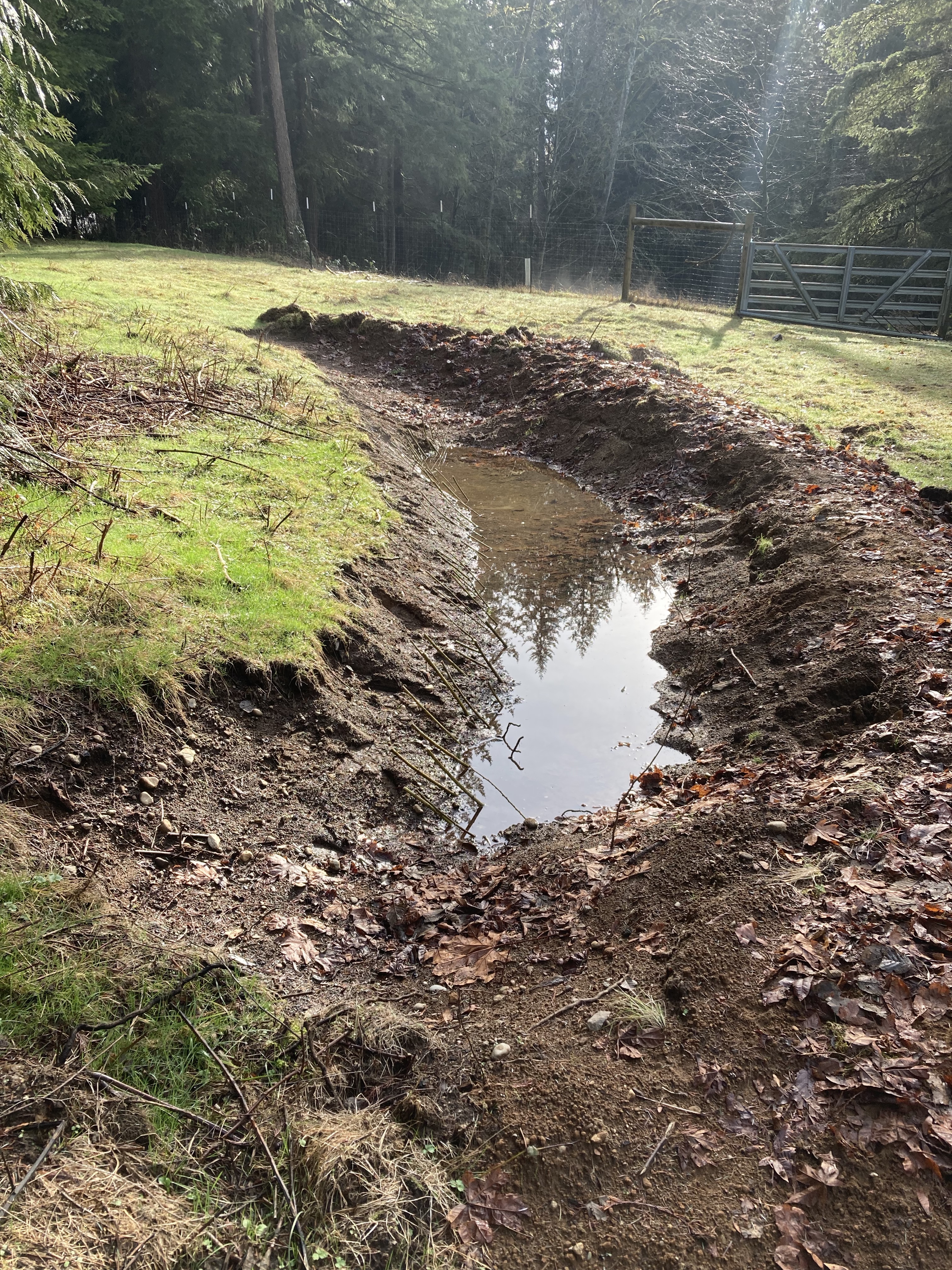
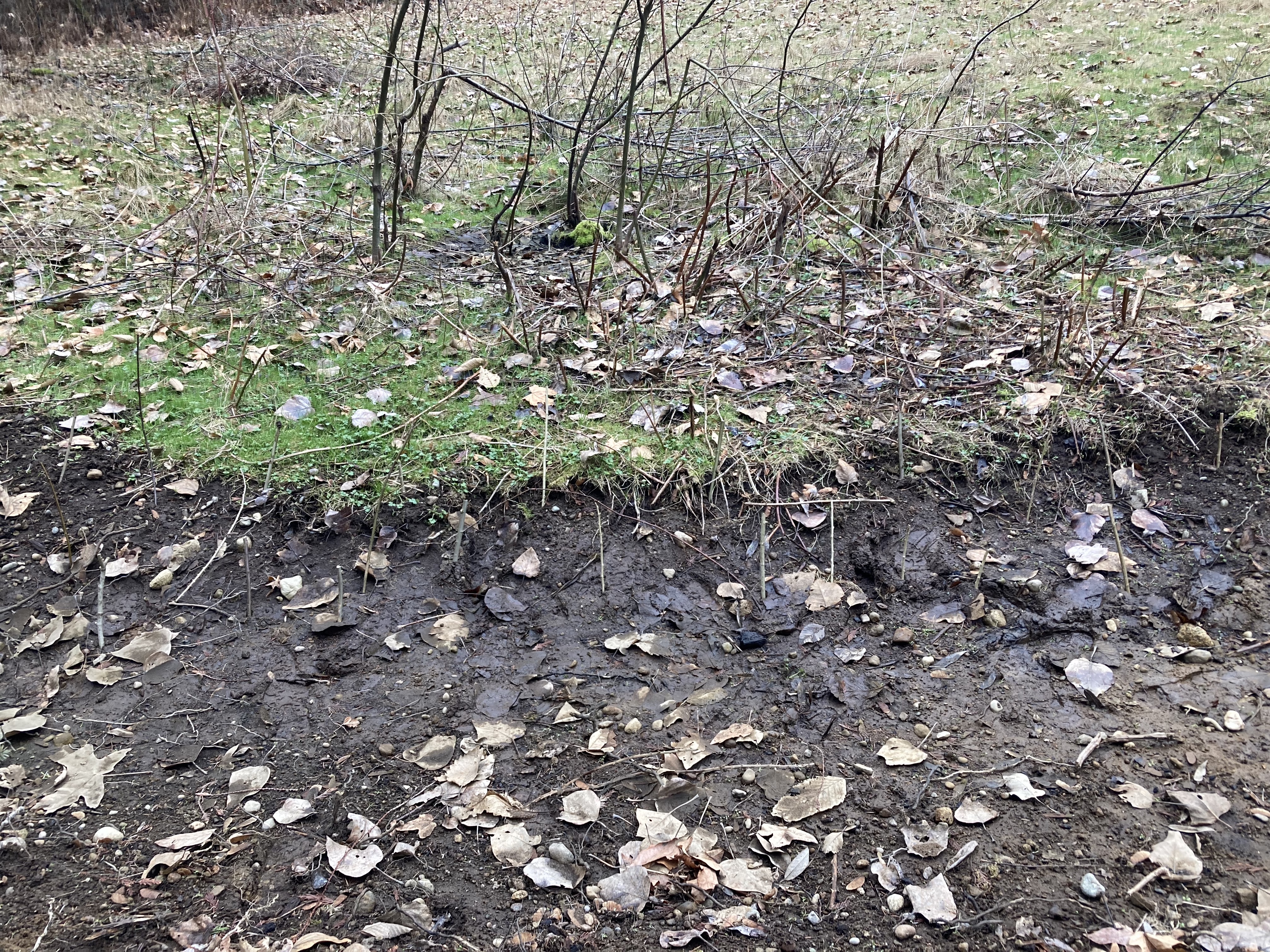
New earthworks update and new plantings abound at EEC Forest Stewardship. We’ve been monitoring water across the landscape and establishing new willow stands for future crafts and medicine. In late winter, willow starts- cuttings of stem about 3/4″ thick and about 18″ long are sunk in the swale to establish hold on the upper bank. Over the next few years, we’ll be adding debris in the swale to build up mulch and soil for the plantings. The down hill and south facing sunny side of this swale is planted with a verity of other native ground covers and trees. The next phase of developing this space will be soft fencing- electric mesh, which will be hot when the sheep are in this hard fenced pasture this spring. Guarding new plantings has always been a challenge. Even our LGD Gill is known to dig up a recent planting in fun and mischief. It could also be the alluring odor of fish emulsion often used to bolster starts.
This swale is communicating a lot in its first year; our lack of rain so far this winter, soil compaction and a lack of organic material on the surface of these pasture spaces, and how much runoff comes from the hill above -even with a forest buffer. From water table to runoff, this area of the landscape is a seep in the wet months, and will catch a lot of water in major rain events. But the water is going away fast, stopping and dropping into the soil instead of coursing down to the creek all at once and flooding down to the sound and out to sea. California’s recent flooding was a master class in poor water retention, preventing the recharge of major aquifers. Even in Western Washington, a temperate rainforest, the water is running off the hills and out to sea with similar effect, though we have been slower in discovering this loss because we still get a lot of rain.
More snow in winter might help in addressing some of the harder rains we’ve been experiencing. Hard rains, much like those in California, run off the barren land and into swollen rivers which are diverted and hindered by man’s fool hardy belief in dominion over natural systems that are so complex, we are still trying to comprehend them. Earthworks are manipulations to the landscape, which is already severely altered by clear cutting, and detrimental animal husbandry for a few colonial generation. The swale encourages renewal of natural resources which will ultimately fill in the canopy and encourage enough biomass to support climaxed old growth forest. Where wetlands lay, forests thrive. We can speed up time by mimicking some natural systems- like a fallen log or uprooted tree, which makes a hollow in the ground with a pile of soil on the usually down hill side. These landscape features in a forest are called cradles and pillows.
Dips and mounds across the landscape create more surface area for growth and catchment for moisture. The micro-climate diversity formed by cold sinks and sun traps on south facing slope offer another layer of diversity in ecological possibility. Shore pines tolerate late summer drought while willow will soak up moisture and hold the sloping terrain. You’ll often see old willow in active floodplains laying over on their side, completely re-rooting along the trunk and throwing up countless suckers which develop into new trunks in time. The willow stakes are placed leaning in against the bank they are closest to. This bank is on the north side of the swale, so the willow will want to grow downhill, towards the light and away from the bank, but the initial root set will encourage the trunk of the future tree uphill, into the bank for additional long term rooting. I’ll control this optimal shaping with pruning for the next few years. The plantings in the downhill mound will also grow up and shade out the south side of the swale, forcing the willow up to remain in the light.
After a large rain event, this large swale holds water for a few days, but the continued drought makes our soil very thirsty, and the slowed surface flow has time to sink in. The willow stakes will set in this wet weather, but will also need additional mulch cover by late spring to survive our hot summer drought season. There will also be an electric mesh netting system protecting the young growth of these plants, preventing sheep from grazing them down. It will take a few years to establish the planting, but once the shrubs and ground cover established, the livestock will be allowed through on occasion. The restoration of soil, vegetation, and overall rainforest canopy will take generations of human time, but the long term abundance will sustain even more generations to come.
This is the vision of short term terrain change and seemingly disruptive upheaval. To be clear, we would not dig swales in wetland terrain. It would be a tragedy on several levels to take heavy equipment into soft ground. Machines are utilized on heavily used landscape with long established compaction. Swales break up topography and soil composition. Most earthworks should play a role in restoring long term adaptation for maximized success in natural abundance. This landscape was once capable of fully self perpetuating temperate rainforest, but it took millions of years for the geology to establish, and thousands more for terrestrial vegetation of today. In a few generations, human consumption wrecked ecological systems, converting what was a fully sustainable system for food, water, shelter, local survival and thriving ecology, into a wasteland of catastrophe, which reverberated throughout the greater ecosystem. The Sound is full of once abundant topsoil from the surrounding hillsides. Weiss Creek, on the landscape of EEC, was completely filled in by sediment within two major cuttings of the forest in this area. By the third generation, a dredge and resetting of the stream course revived the small creek’s flow into The Snoqualmie River, which also endured a few generations of man’s hubris.
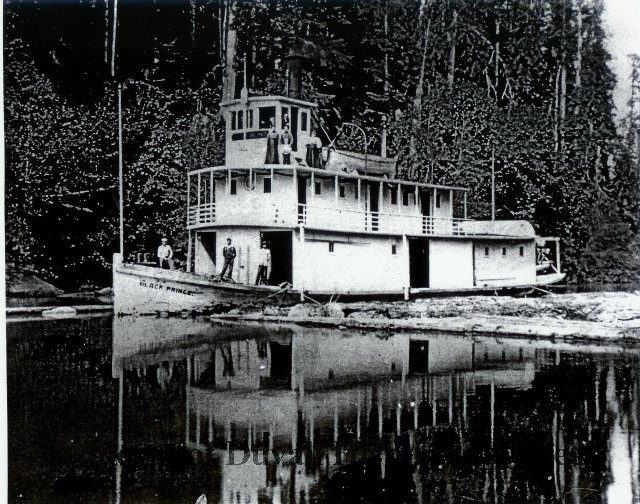
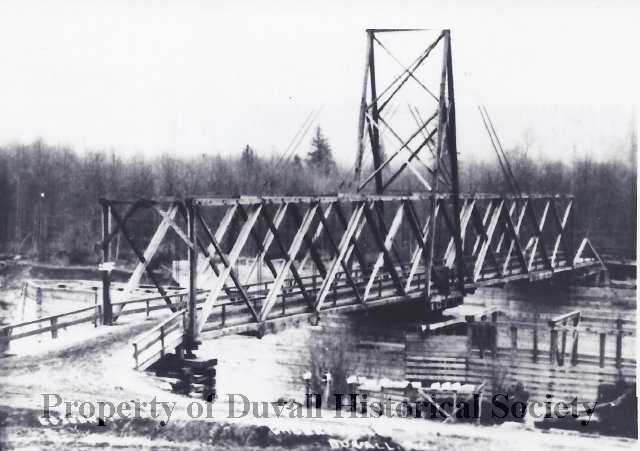
Black Prince steamboat on the Snoqualmie Cherry Valley Swinging Bridge, Duvall, WA 1909
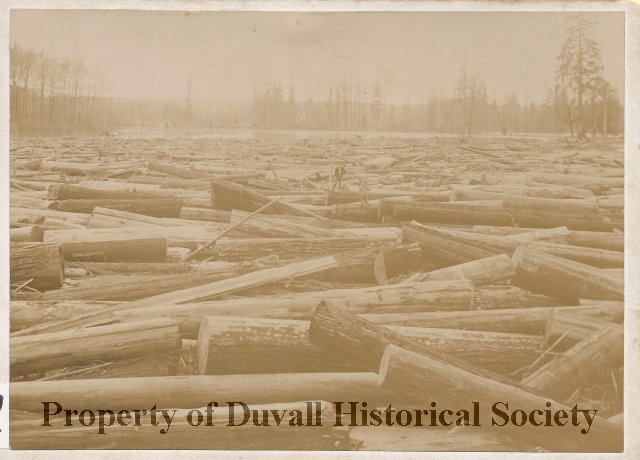
Imagine log jams like these in The Snoqualmie Valley, carrying the massive biomass out of thousand year old forests, now leveled by human hands and early coal powered engines. There is a very old railroad grade through EEC Forest Stewardship, which once shipped trees from our hill down to The Snoqualmie River, where it was floated to nearby mills. Often times, abandoned logs would jam up the bends along the massive river valley during major flooding events. Try to grasp how much nutrients- by the ton- was sent off the hillsides and down into waterways soon choked with debris. Now long gone, the mass of missing forest has been replaced by pastures, buildings, roads, and fencing. Forests have begun to regrow in some areas, but not enough to replace the canopy. Climax forest is a long way off. We’ll never see the land like it was before industrial tree farms took root, but we can take a trip to The Olympic Peninsula for a glimpse at what might one day be again.
So the swales help return the landscape to abundant forest by slowing water, banking nutrients, and hosting a diversity of vegetation and micro-climates to enhance long term forest growth and natural resource protection. We’re cultivating a giant sponge of debris, fostering the foundation for old growth magic in a few more lifetimes. Plant a tree today, stake willow, dig a modest swale in your yard and fill it with mulch and nice garden plantings- the scale is what you can manage, but in disrupting our continued degradation of place, and renewing those resources, so precious to our own survival, we can do some mending and setting the stage for nature’s abundant return.
At the end of the first week of January all the ewes are looking good as we move into lambing season here at Leafhopper Farm. Alfalfa ration remains steady with an occasional loaf of organic bread as a treat. All the mature ewes who have lambed before are showing belly. The first years look round, but determining by looks alone is no guarantee. Large sheep operations use ultrasound scanning to check pregnancy. This is important to determine lamb numbers, barren ewes who should be culled, and saving on feed. In a small flock like Cascade Katahdins, bread for good fertility, mothering, and food conversion champions- meaning, these sheep put on weight with minimal inputs- they don’t need grain. Katahdins are independent birthers- meaning humans don’t usually have to lend support. They are also great mothers, rarely refusing a lamb. These qualities make the lambing season a welcome time, with little stress- thank goodness!
As we move through January, appetites grow with belly size and I have fun speculating on twins vs. singles- remember, we don’t scan. But we’re not betting the farm on our lamb production, putting everything on one system, especially finances, is not cultivating diversity of resources, something any growing asset will need. The ewes need a few other minerals, which are crucial outside inputs for raising healthy Cascade Katahdins; iron, sodium, selenium, manganese, and Vitamin E are some of the most important in our region. A red/pink salt block covers most, and additional range blocks every few months add protein to support good lamb development. The sheep could survive without the range block, but optimal health is preferred to survival in a domestic setting. Wild ungulates don’t get salt or range blocks, but also know mineral location on a much broader landscape, and have adapted to life in the environment with what’s available. Copper is toxic to sheep, and you should never feed sheep goat or cattle supplements without first checking the label, because copper is necessary for those species.
Our fist lamb of 2023 comes into the world on January 25th- a healthy ram we named Otis Redding. His mom was a second time mother of a single, which is not optimal breeding, but the ram lamb is turning into a fine looking fellow and we’re happy with her offspring performance. The ewe is only three years old, but her lamb from last year is in the herd with great prospects too. In this herd, production is important, but the health and quality of lambs is just as important. The mother has two teats, and producing two healthy lambs is her optimal design. Single, large lambs are ok, but this ewe may not be in the herd for much longer, unless she produces twins next year. These herd decisions are hard, but keeping productive genetics in domestic animal system is a crucial part of what makes domestication applicable. We’ve optimized the inputs and have to get equivalent out. Wild systems are not held to commercial standards and have unpredictable margins which cause population boom and bust cycles, which humans have struggled to remove themselves from with stability. Domestic systems are stable only with the outside inputs. Have we lured ourselves into too great a false sense of security?
Leafhopper Farm LLC has been hosting successful animal systems for ten years, and the few outside inputs for our livestock have remained constant, even with price fluctuations, political turmoil, pandemics, and climate change. There are weakening links in supply chains, and costs are rising beyond our scale of productivity, but the lasting contributions of these domestic affairs will offer enough foundation to foster the return of temperate rainforest to a small patch of The Pacific Northwest. Dung, browsing, breeding, and becoming food for the community is an honorable life and death of sheep. It’s why we raise them, slaughter, consume, and shepherd Cascade Katahdins here at EEC. Gratitude to our working flock, and all the new life of 2023.
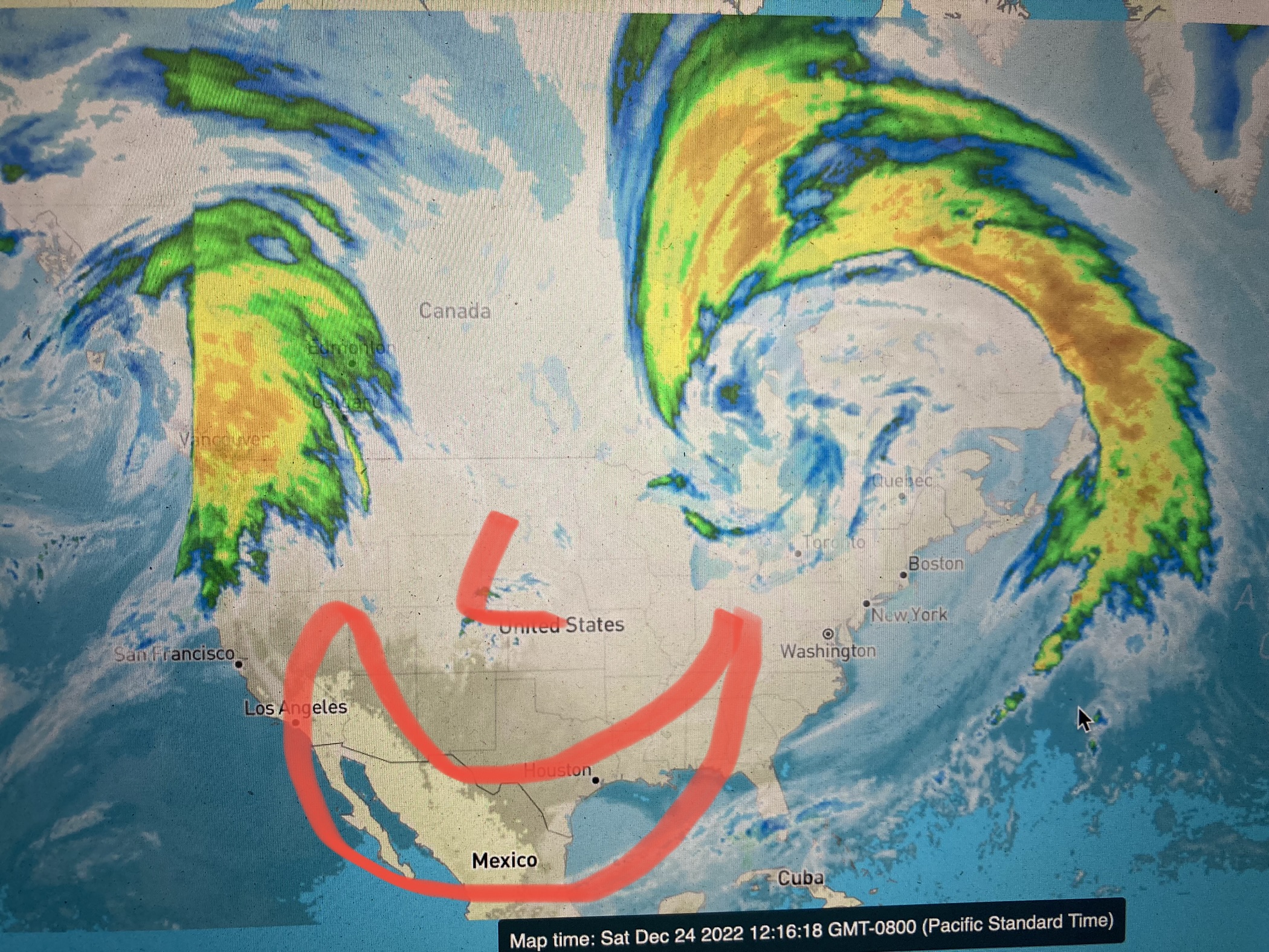
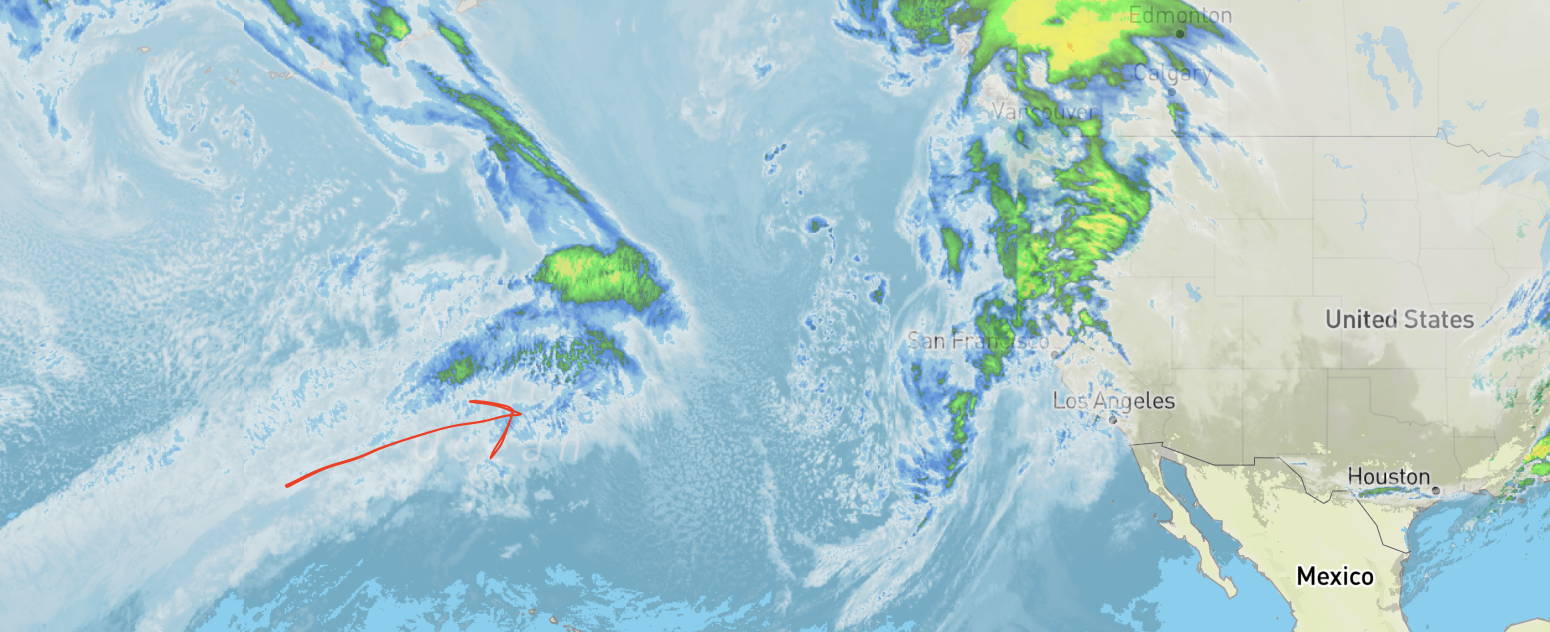
Well, climate extremes continue to escalate around the world. In late December, this satellite image captures the epic storms moving across North America. While we hunkered down for a few days of snow and ice, The Grate Lakes area received record breaking snow and blizzard conditions which killed several people caught in the weather while trying to get home from work. Our own radar reads were not too agro, but the collective patterns are growing stronger, and later in 2023, California began to experience unprecedented storm fronts that keep on coming. What does all this mean for EEC Forest Stewardship? Hold on to your hats folks, it’s going to be a bumpy ride.
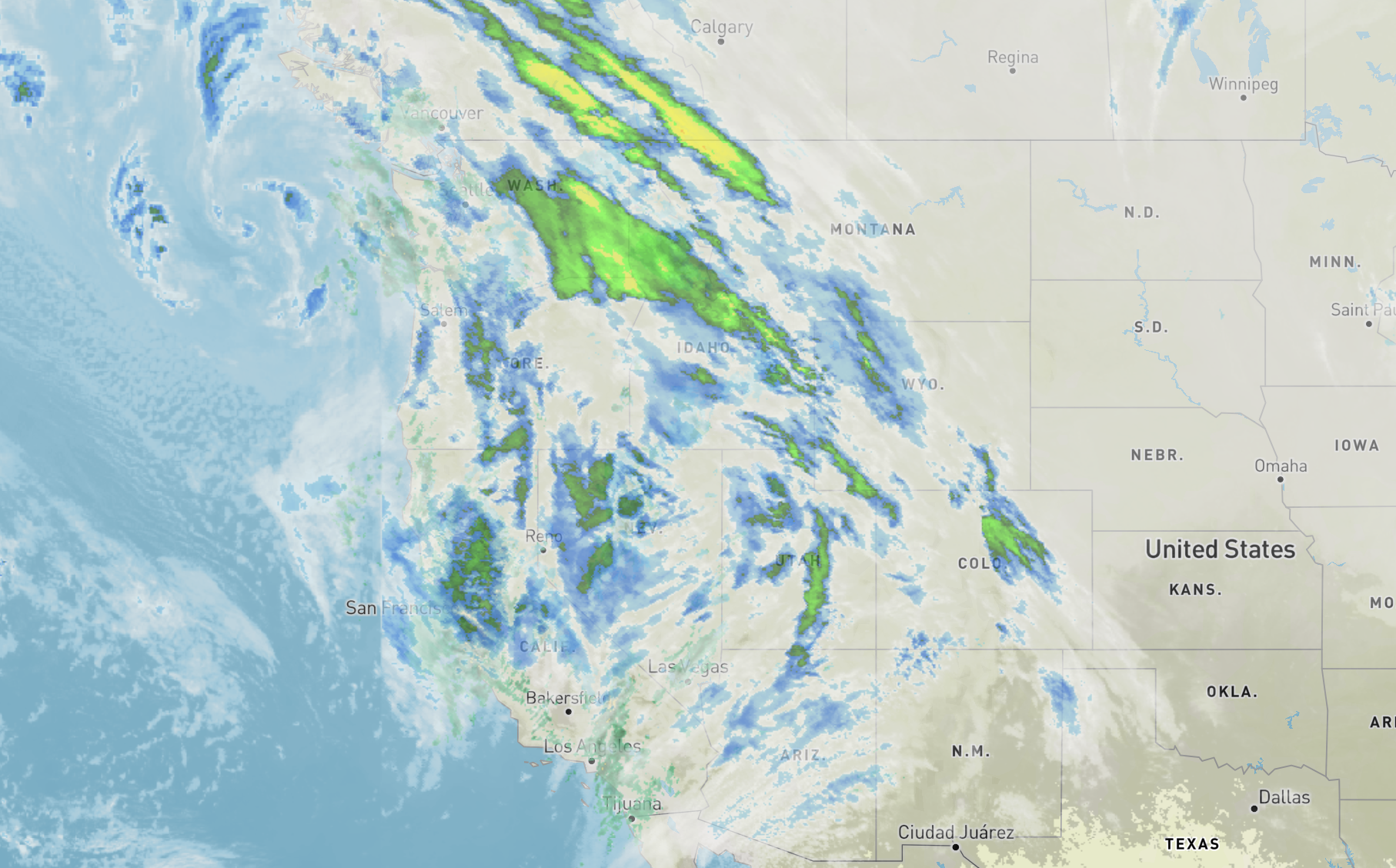
Our fruit trees were less than productive this year- drought, smoke, and grapple during flowering all played a role. Alfalfa crops were less productive because of late cold and wet spring weather, costing more and causing our reduction in flock numbers. Our chickens didn’t get broody this summer, many native plantings failed, and overall stress from environmental change effected all living things. We’re fast adapters here, but the intensifying storms will continue to erode stability across the planet. The earth is a closed loop system, so what comes our way will keep coming back around with the seasons. Right now, the rain is here, though it took its time in coming. We endured wildfire and 90F in October. November and December were colder than normal, and now we’re in a typical winter, but most of our rain is still somewhere else, and that somewhere right now is California.
The west coast experiences atmospheric rivers in winter thanks to our neighbor, The Pacific Ocean, and her weather patterns traveling up from the tropics in what is called “The Pineapple Express“. These rain events can last for days, or weeks. Western Washington is usually ready for these rains, with a temperate rainforest eager to catch moisture and bank it in the soil. This year’s climate change pushed the rains south into Cali, and boy did the heavens open up. Though CA has been in a very bad drought for many years, the rains were more a curse than relief, as the parched land has been unable to cope with the deluge and now, whole cities are evacuating because of floods. From wildfires to raging rivers and landslides, our southern neighbors are on a rough ride. With over one billion in infrastructure damage already, and more rain on the way, you can see how the continued building in catastrophic weather events compounds to overwhelm our vulnerable civilization.
These weather events will continue to compound, and ecology cannot keep up any more than our infrastructure. What’s the plan? Apparently, throwing money at it. However, the money going into “solving” climate does not acknowledge what’s funding climate change. Our developed world will not let go of fossil fuels in time, and I’m right there in the problem, consuming like all used to ease and comfort we enjoy though the rosy glasses of prosperity. Going electric has become the answer, but it’s only another folly, without infrastructure or enough renewables to power all the future cars, homes, and businesses we continue to build and develop. Exponential growth does reach its climax, then erodes away. We are eroding- and the literal ground dropping out beneath us seems compelling, but will not change the outcome of our actions, which are already at work and unstoppable.
More mining will be needed for more solar, wind, and thermal energy development. Plastics are irreplaceable in our daily life, and plastic is fossil fuel. The microplastics are in us already, and won’t be removed. The oceans are acidifying, and currents slowing down, slowing the storms that travel across the planet, allowing rains to stall over the land and dumping those record rains. Hurricane Harvey is a great example of this catastrophic event, which caused over 100 billion in damages. Even the winner of Power Ball can’t afford that kind of expense. Though they could fund the rebuilding of California’s infrastructure from these recent floods.
There is no stopping our current global system from continuing its rampage. We’ve passed that point, so most countries are dropping the idea of curbing emissions– especially the developing ones. Other nations are starting to cry out for compensation. Pakistan was hit with monumental flooding in 2022, then argued that top developed nations emitting the most pollution should pay up for damages. Rightly so on one hand, on the other, economic progress and share holder dividends. If we reported daily cost of climate change like we do the ebb and flow of the stock market, people might better understand the impact- especially financial, this wacky weather has on us all. The markets will not outpace mother nature. It is our financial system which is destroying the earth, so why not change how we operate? Because we can’t, especially fast enough to shift the course we’re on. So why care?
Things are still heading in the right direction. We’re past denying there is climate change (for the most part). America is trying to shift the narrative away from big oil. People are less violent now than ever, and more willing to cooperate in crisis. Though I’m not wishing crisis on us to make the world a better place. We’ll keep seeing great change in consumer products available. Out little farm is shifting away from livestock in the long run, as input expenses will become unforeseeable, like hay this year. I recommend all farmers look at growing bugs as food in future. Can’t predict, but we can plan ahead and have options to pivot towards as the change ramps up. I know it’s getting hotter in summer, dryer, and colder in winter here. We’ve stopped planting hemlocks and selected oaks. The change in hardiness zones will cause ecological collapse of many species, and it’s already in progress.
Move with the change or be consumed by it. We all die in the end, so live richly while you can and be prepared for the shifts to come. Accept reality, work with it, and be grateful we’re still living in a relatively survivable world. Technology has helped us map the changes, and could offer more solutions, but it’s still based in an extraction economy. What instead? I’m not sure, but here at home, we’re planting as much diversity into the soil as we can, slowing and sinking water for drought resistance, and pitching our roof lines to shed snow. It’s the people who can’t adapt facing the real struggle in climate change. Maybe we do owe Pakistan, and should start paying for our consumption on another level. A climate tax on all luxury goods. No insurance for building in flood prone places- using current climate mapping. Though I heard an argument once by a developer who said because septic systems can now be build air tight, homes could go in on the flood planes. Such madness!
Hey, because we can- we should! No, but the problem is the solution, and flooding brings a lot of very good things to the landscape if we learn to live and work with the gifts of weather, rather than fearmongering. The news was calling Cali’s atmospheric river out like it was some king of new monster coming from the deep. The rains have been monstrous, but the development in California has been too, and the water management poor, so you get serious reactions once flooding begins. Small steps, make small changes to help prepare yourself and your community for these weather events. People in Buffalo died in the cold, many of whom were expected to stay at work or loose their jobs, but they lost their jobs anyway, because they lost their lives. It is these short sighted mistakes, which will be our end if we cannot begin to comprehend the strengthening extremes facing humanity.
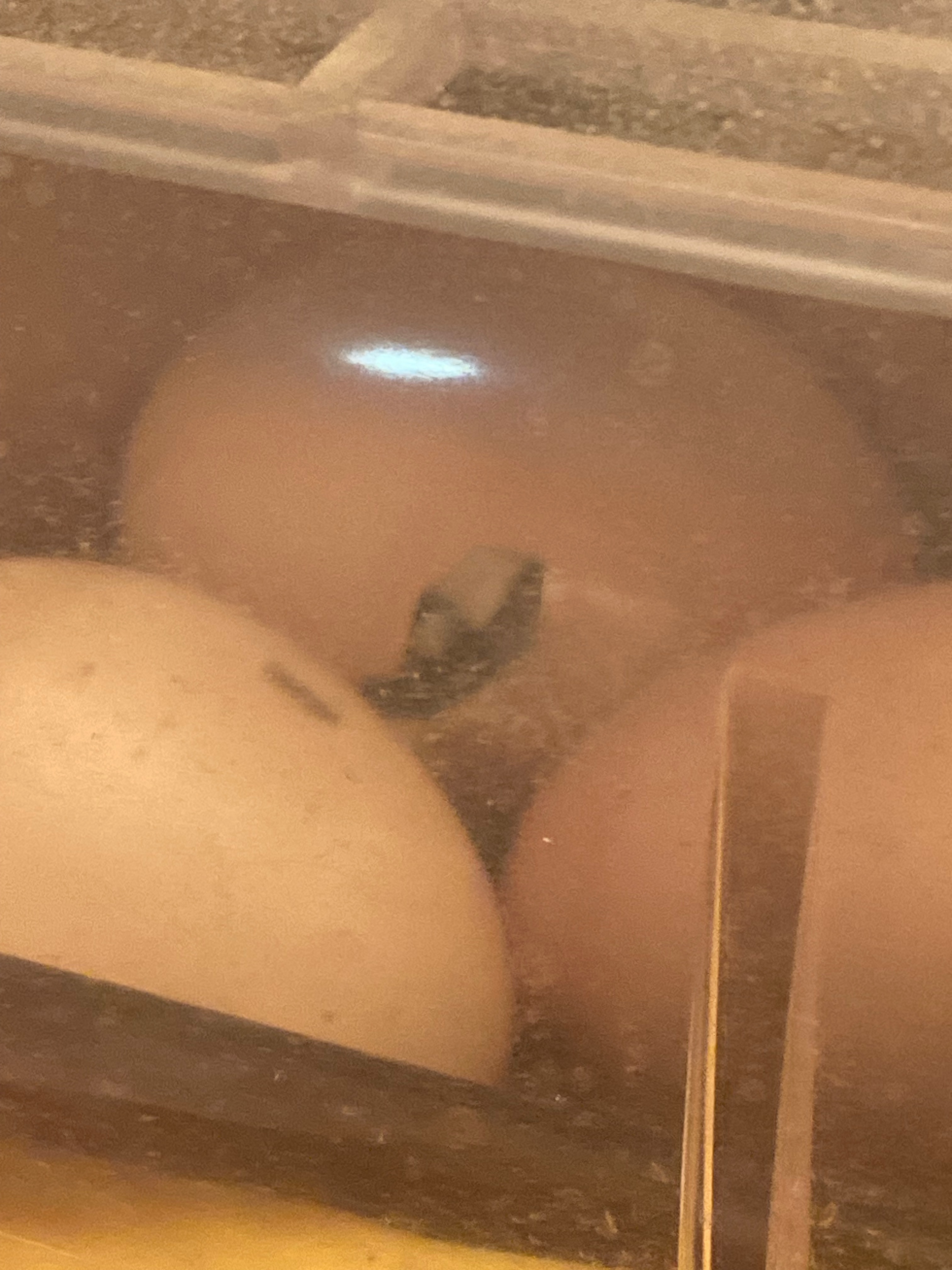
Baby chicks hatched on December 25th! We had a very low success because the temperature shifts froze a lot of the eggs before they were gathered for the incubator. It’s a big winter moral booster to have chicks in the house at the darkest time of year. The sound of peeping and chirping brings smiles and a warm feeling of joy. The little flit and flight of young life scratching around brings a liveliness into the home when most needed. It’s also the best time of year to hatch out chicks for a layer flock. What?!? Yes, by the time these birds reach maturity in mid-summer, they will start laying before the fall. If you let chicks hatch out in the warmer months with a broody hen, your chicks will start laying as winter sets in, and birds slow production in line with the darker times. This means your egg production will not really expand for yet another year.
Though our farm does not work to force maximization for profit, we do find our birds have better success and development if we hatch them at this time. We’re currently incubating a second round, and have a much higher success in fertility this time. Ironically, in a way, we also received a flock of 10 birds needing a re-home. Current flock is at 30. This next hatch out will grow us to 40, and that’s a few too many, so we’ll cull and/or sell some adult birds this Spring. We also donate a few birds to a wilderness survival class at the local nature school nearby each February. EEC Forest Stewardship supports nature education, hands on learning, and slow food. Happy to supply healthy animals providing healthy food to our community.
Our in house setup is modest. We’ve been using Brinsea products, and can’t say enough about how great they are. The brooder has eliminated fire hazard caused by heat lamps- trust me, the heat lamps are serious fire hazards- we experienced this first hand. Out Brinsea brooder remains effective and safe. The incubator is great too, though I will say newer design options have improved. When we’re ready for our next investment, we’re sticking with Brinsea, as it’s worth the price for durability and reliability. Why do we not use hens to brood naturally? Sometimes we do, but to enjoy winter chicks, we use the mechanical devices to improve hatch rate and have the most control over when. This summer, 2022, we did not have a hen raised clutch. It was most likely related to the hot temperatures and smoke. The birds are sensitive to environmental change, and smoke this summer darkened our skies, changing the birds’ rhythms in subtle, but noticeable ways. Egg production this summer was a little below normal rates. I’m purposing the smoke dampening natural light played a role, but I can’t find any studies to back this statement. General stress from hindered breathing would also effect the birds.
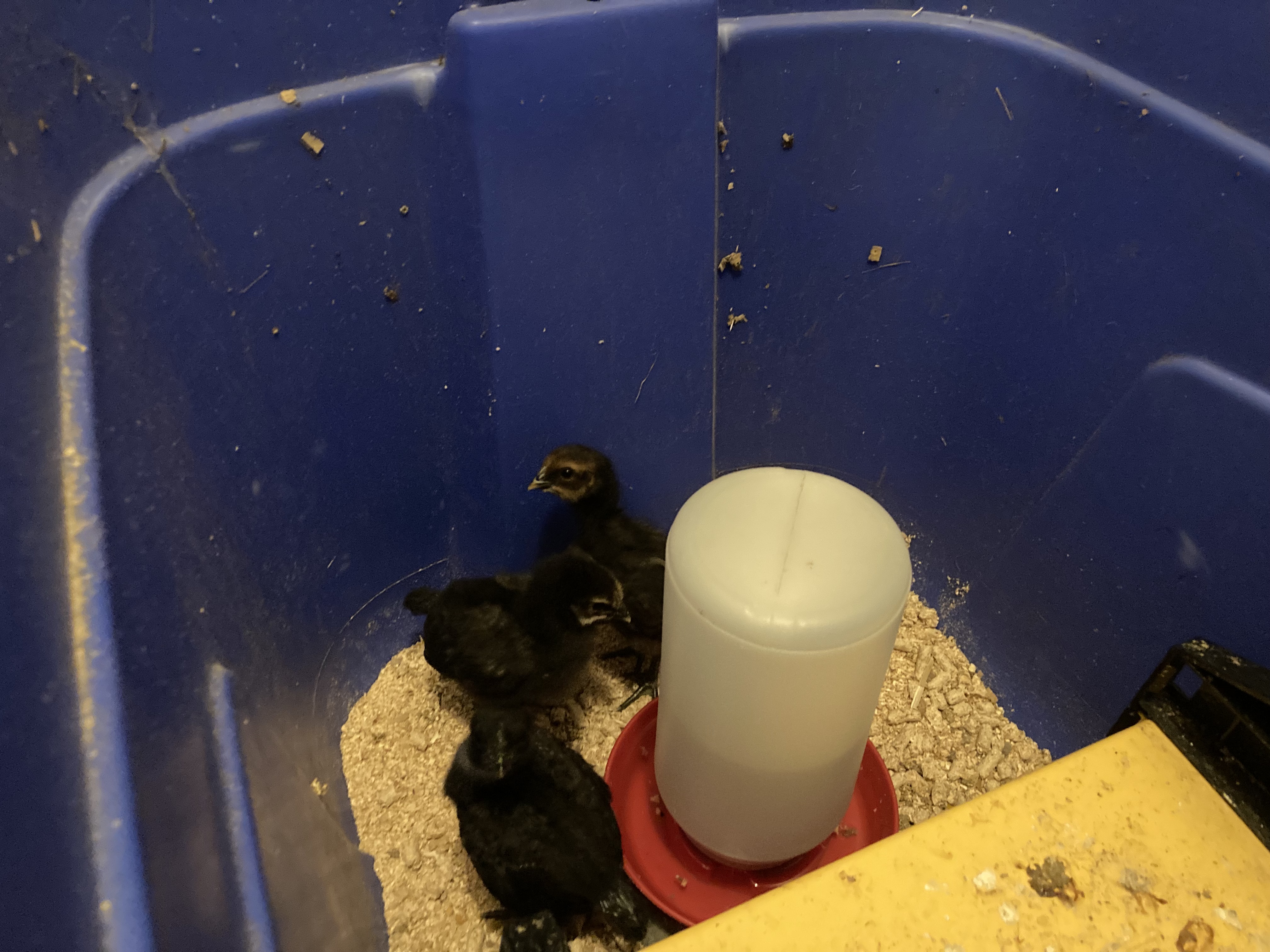
Right now, there is no smoke to hinder our flock, and the chicks are developing nicely. The next clutch to hatch will be much larger, and time in the blue bin will be limited by quick development. The three pictured below are still in the bin at this age, only because it’s only 3, and there’s enough room. In a few days, they will be moved to a larger pen in the pole barn to continue growing. At 2 1/2 weeks, they are fully feathered and have enough body mass to keep warm without the brooder. We’ll continue daily monitoring- including feeding and water refresh as they continue to develop. Moving these older chicks out makes room for the new babes to come. Different aged chicks don’t mix well, the older ones will bully and even kill younger birds, which is the nature of survival. By six weeks, the chicks are teenagers- big enough to go in with the adult birds, as long as there’s a good number of them to flock together for safety. A single young bird would be attacked if alone. This trio should be enough ‘bulk” to muster against the older gals once they reach teen hood. By then, the other clutch will need the pole barn enclosure. I’m not particularly happy about having a double clutch happening. Timing is not ideal, as the new chicks will need a lot of space and these three current babes are such a small flock to have the whole barn, but we’ll solve for that when we get there. If we need to make multiple enclosures, we will.
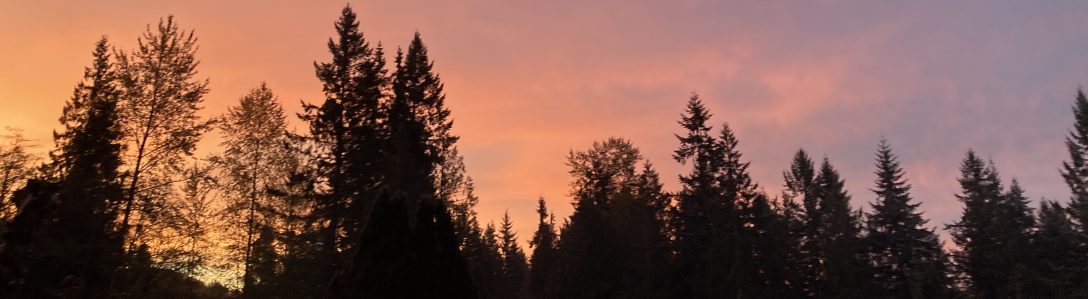
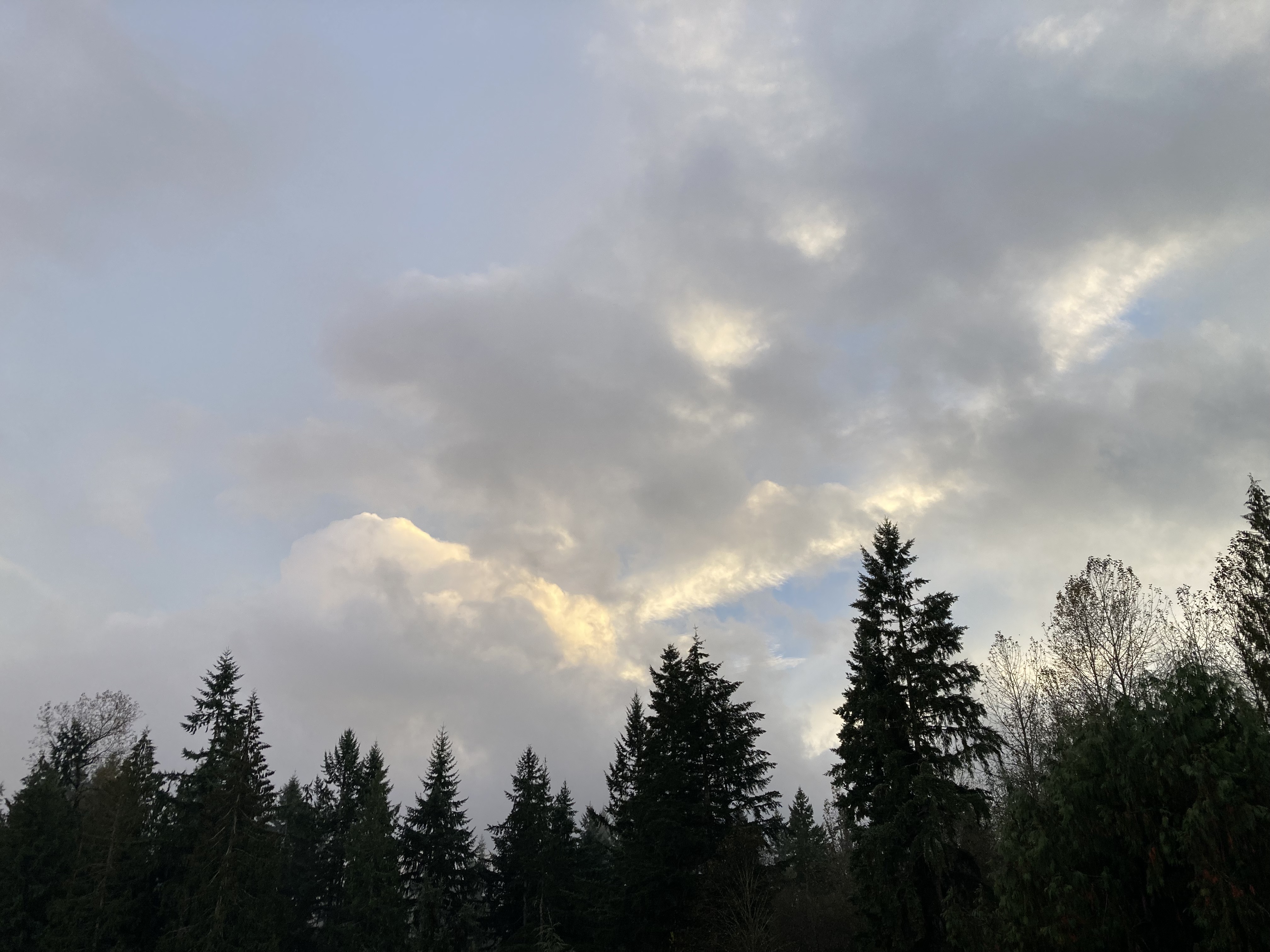
Fire lights up the sky, not like the licking flames from summer, but in that time of year when light grows scares, and the colors of dawn and dusk signal compelling transitions of life. Red alder and black cottonwood shivering in bare branches to reveal impressionistic masterpieces with every dusk and dawn. These are some of my favorite times of day, and usually correlates with animal chores on the farm. Waking and returning to dreams the transition places in life which are starkly marked by the return and removal of light. So much happens in the natural world at these two points in the cycle of our planet’s rotation. Life is compelled, yet in a state of change, vulnerable, and there are opportunities to see, to witness dawn chorus, twilight colors, so many shades within the forest too. You can see in the field, then step into the canopy returning to shadow, yet the golden light still filters through once dawn breaks into day. As night folds her wings of darkness over the land, in winter, through the skeletal frames of some trees, we can see a little more color and brightness bringing comfort in these cold times of dormancy. The heavens never rest, after a parade of stars, another dawn reveals the changing landscape with her rosy reflections. In the cold months, rising mists from moist forests and wetlands crate a tangle of sky and earth. The low clouds obfuscate reality, moving the skyline down into a lake’s reflecting surface, sipping the warm hues of morning as ducks splash down to feed.
We live 30 miles from a large body of water, and 150 miles from The Pacific Ocean to our west. This makes sunsets amazing, and the afterglow lasts after the sun drops behind the horizon, continuing to reflect form vast waters. Often, lavender tucks into peach watercolor flames. Silhouetted evergreen giants lean towards western winds, whispering evening chorus into light’s last symphony.
The gaze is often drawn to warm tones, especially in this place of evergreen moss and dark, wooded groves. Fleeting visions of fiery shrubs and electric green broad leafed ground covers in the garden- even the old tin roof seems to glow with the changing western sunset. Moisture in the air extends the pantomime of color. Clouds spread golden rays out of a late Turner feeling sky. Another spectacular impressionistic sky by Mother Nature. This particular landscape in Western Washington has enough open clearings to offer skyscapes. It’s surprising how often we forget to look up and appreciate the heavens. Often, throughout most of the day out skies remain overcast and grey, but when the clouds part, a cascade of pigments abounds. Dramatic cloudbursts climb over the trees chasing the winds far above. Sunset catches across billowing tops, spilling into forest crowns, gilding them majestic gold. These shows come and go quickly, so take a moment as the day opens, and another at it’s closing to appreciate and applaud natural light at its most active.
At the time of winter solstice 2022, the land is locked in ice and snow. Cold blue sky has only just begun a retreat in the face of first dawn. At it’s most southern point, the sun touches her lowest point, and still erupts in warm glow from the east. Preparing another day though even the shortest of her treks across the sky. Gratitude for each light’s return, and for the amazing color and emotion brought across this landscape with each dawn and dusk.
Oxbow Farm in Duvall, WA has supplied EEC Forest Stewardship with gathered wild seed of a number of native wild plants for a major fall replanting project. These babies have been carefully germinated and coaxed through the initial development into plantings stable enough to establish in the wild. There are a number of wetland specific species heading to our salmonid stream and CREP buffer, while others are more suited to savanna grasslands, and will be planted in full sun on well drained hillsides. It’s always a good idea to make sure you’re land has suitable habitat for the species you want to establish. You’ll also want to make sure where you’re planting is safe from predation. Instead of trying to keep deer and rabbits out, I try to over-plant species to create abundance where some of the plants will doge the grazers and survive. Since these species do survive in the wild, they should, en mass, be productive here on a landscape embracing restoration. Still, I did put a few plants near the house in our kitchen gardens for added protection.
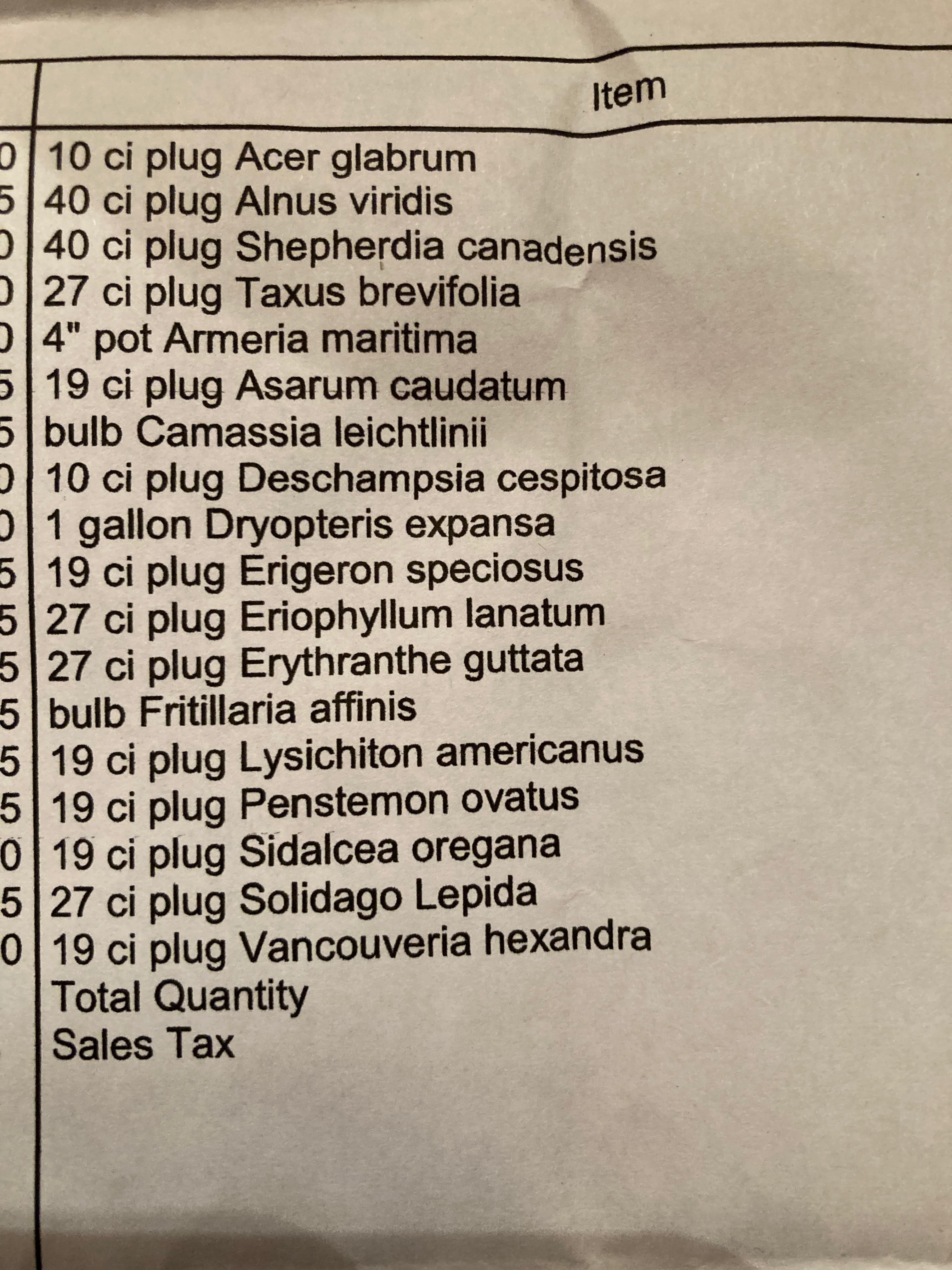
For years now, most of our native replanting stock has come from Native Plant sales- usually hosted by our local conservation organizations. But in the past few years, these sales have run out of plants early on, and not offered enough diversity for our restoration ambition. Oxbow was able to source an impressive variety of species- especially ground covers. They could also offer larger bulk numbers, which fits in with my over-planting scheme. This fall’s order was the largest, with about 400 individual plants in 18 species. What a range! Some, like Acer glabrum, Douglas Maple, should be common in our area, but you can never find them in a native plant sale. Others, like Anaphalis margaritacea, can be identified along most logging roads in clear-cuts late summer, but have been quite a challenge to establish. All are nestled safely in for winter, and hopefully we’ll have a lot of new growth at EEC come spring.
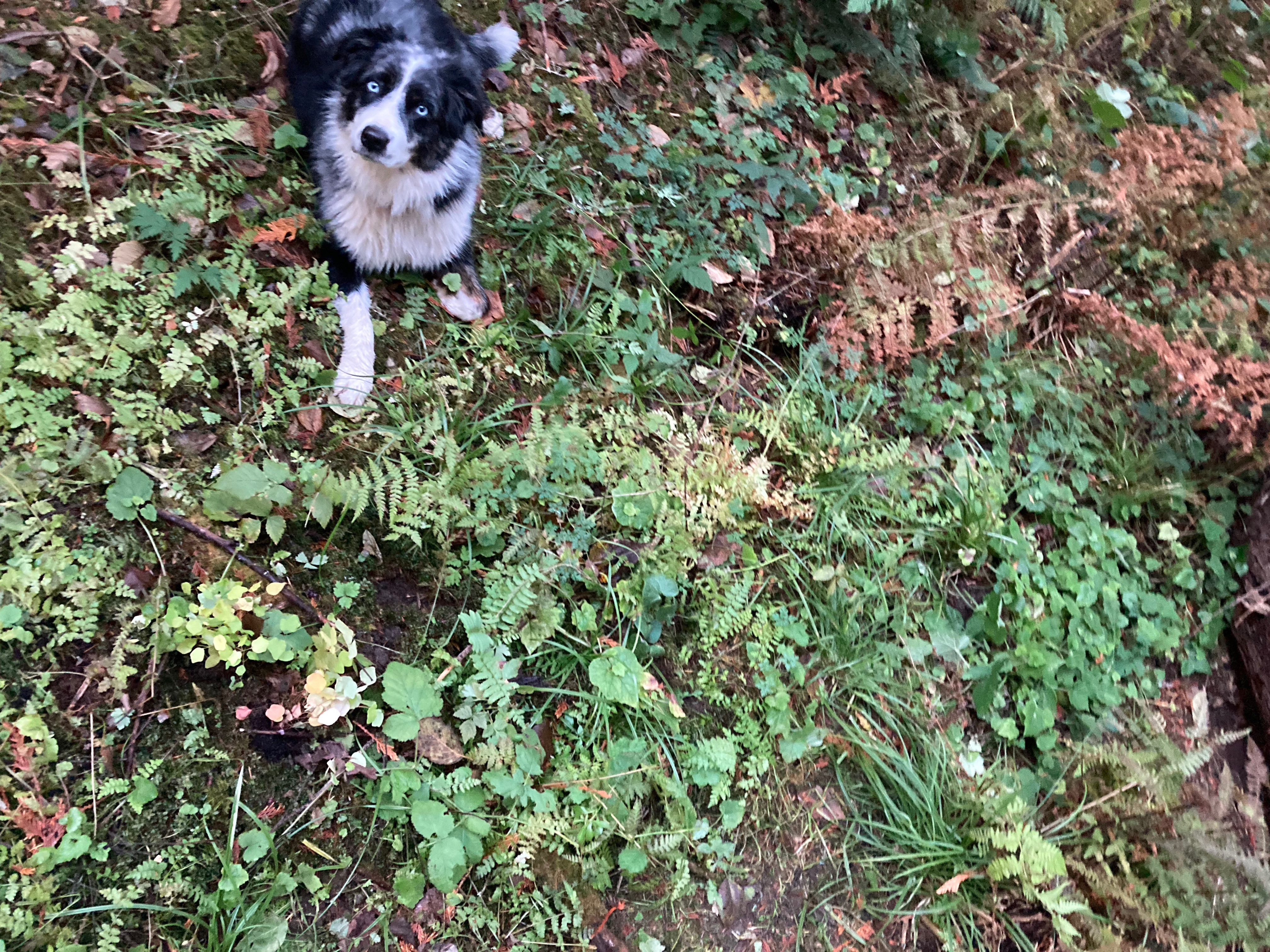
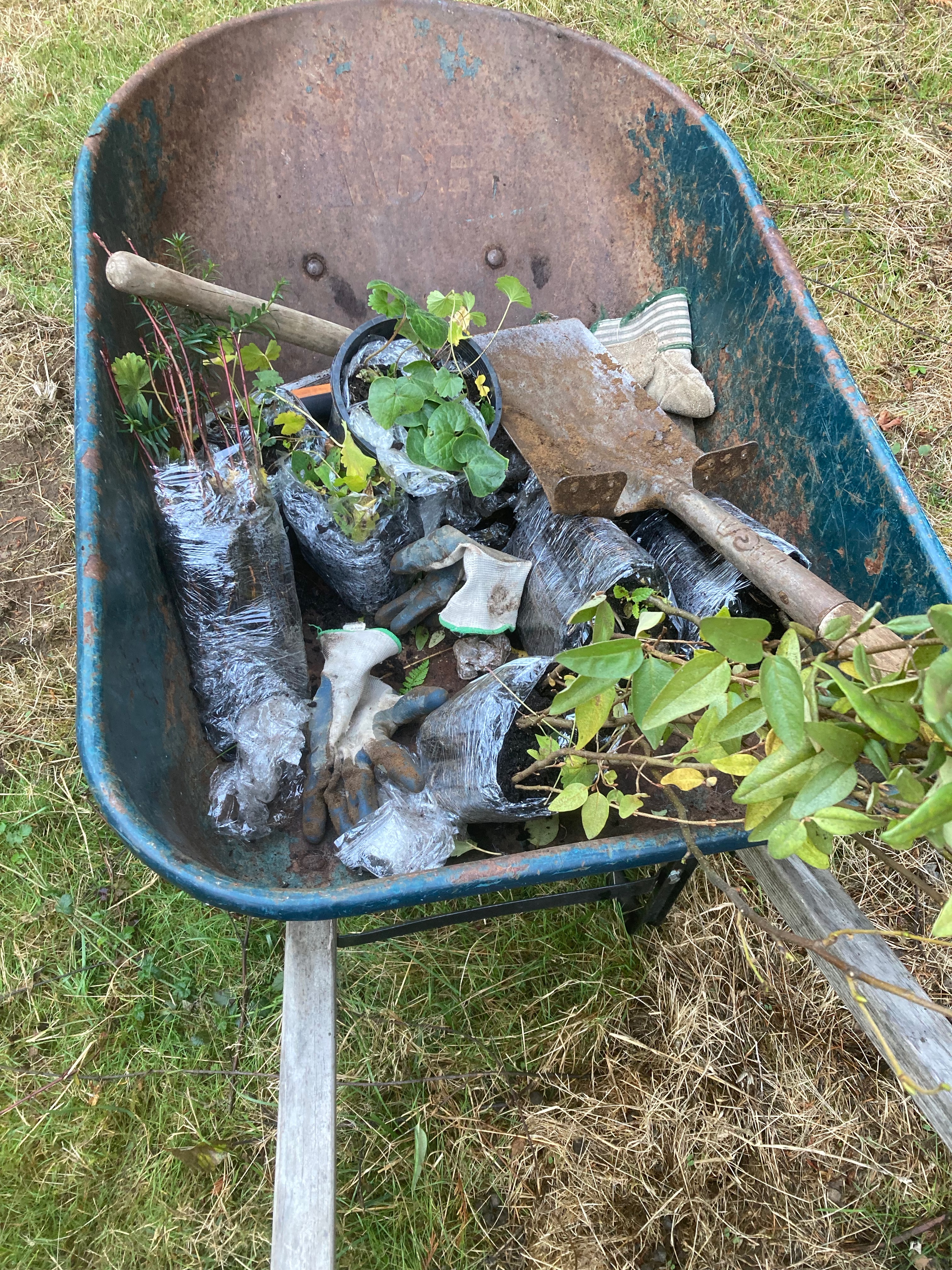
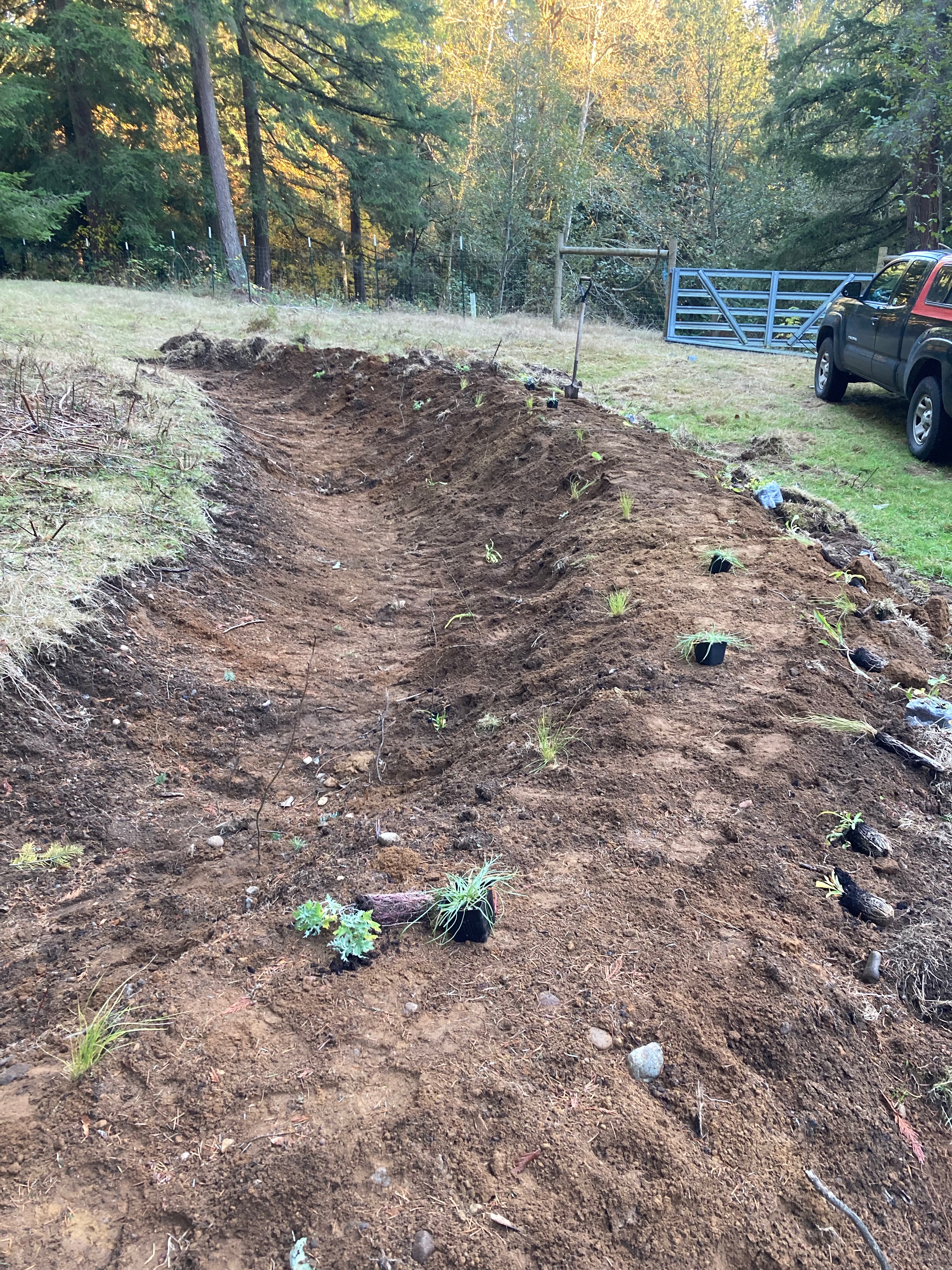
Distributing these “plugs” around the landscape took some good mapping of ecology to make sure each species had its correct climate needs. A lot of plants went into our protected CREP area by the creek- wetland species like wild ginger were tucked away in the thick bramble to protect them from deer predation. It was still very dry in the soil in early November, but established species in the wetlands helped identify where new wetland friends would best live. Valley, our Aussie cross lays at the edge of one such planting. See how many verities you can identify- including the ginger. There are three fern types too. The sedge let me know this was a wetland area. Rushes are also helpful guides in finding your wet ground.
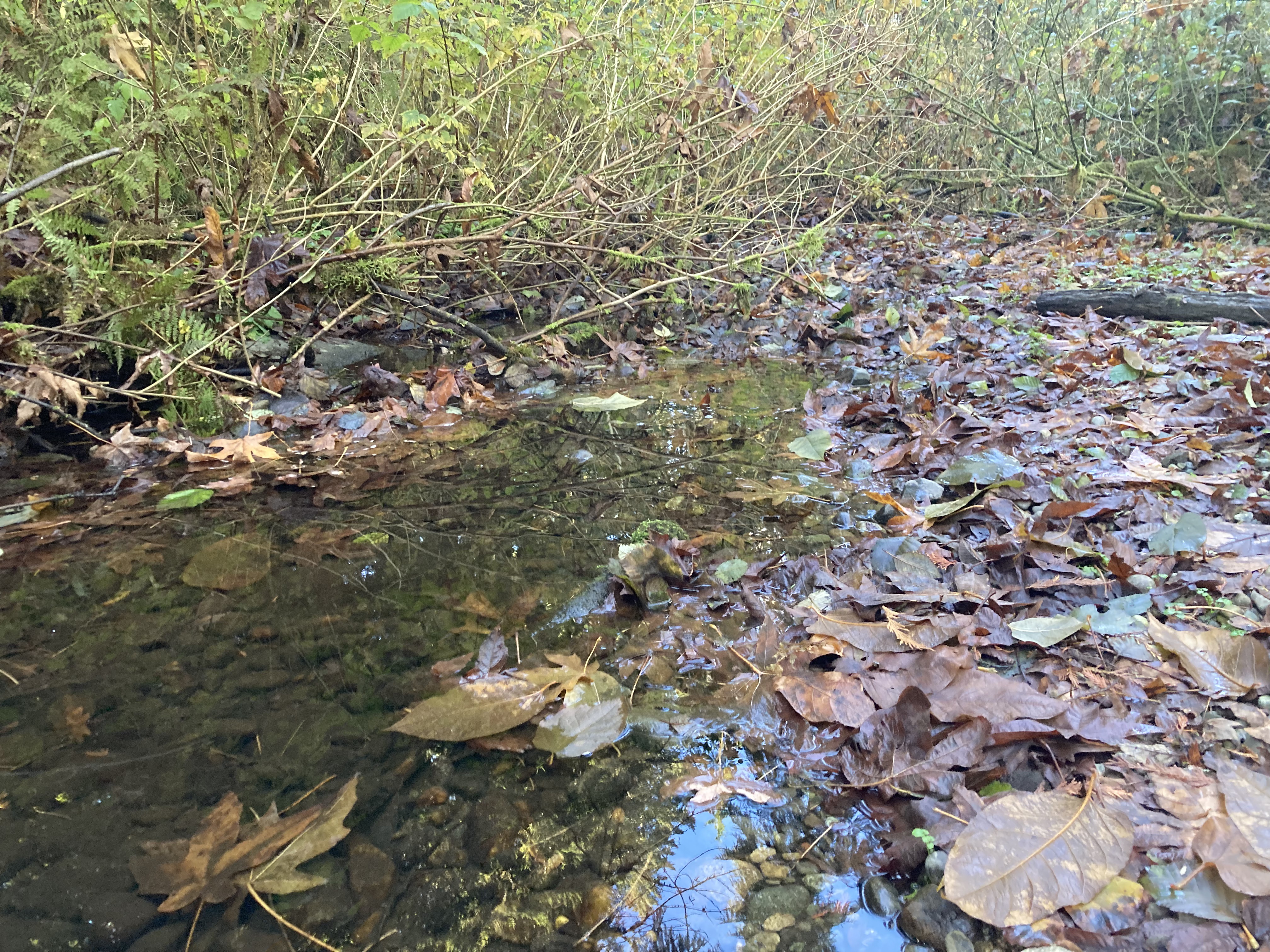
Planting directly into stream beds is risky, as winter floods can drastically change a landscape near its banks. A few plugs went into muddy creek bed, but most were put in on seeps on higher ground. I rarely go into the creek wetlands, as that space is heavily impacted by any foot traffic. I’ll try to get back down there in spring to check the plantings, but for the next few months, plants are in and set. It’s a little challenging, not being able to measure progress immediately, but nature cannot be rushed. She’s better left to her own. With a little bit of encouragement, she can repair sooner, and that’s the plan with all the inputs of new vegetation. In ten years, there has not been a lot of diversity without bringing the species in. That’s the challenge with human induces habitat change in these forests. The forests were removed twice, sometimes three times, and bulldozed, burned, then grazed out. Seeds tried to sprout a few times, then failed, and no new seed came. Much of our forest today here in Western Washington has been reduced to mono-culture Douglas fir timber stands. What appears under the industrial lumber is of little concern, so many species are lost.
Weiss Creek, our salmon stream, was also lost during Weyerhaeuser industrialization of the landscape. Erosion filled in the creek with sediment, and it’s flow clogged up, turning the water course into swampland and erasing the fish paths to breeding grounds upland. This is a snapshot of the ecological destruction reeked upon these pristine forests, and the people thriving within them. Legacy is not always good, but can be repaired. That’s the mission at EEC. We’re bringing back lost species and offering a fresh start, in hopes that by the end of this lifetime, we can give back the land better than when we purchased it. We’ve recently contacted The Snoqualmie Tribe to learn more about the possibility of leaving our land to the tribe in trust. They have an Ancestral Lands Movement, which we’re hoping to learn more about in our quest to give land back to the people originally living- and still living there. The Snoqualmie Tribe is part of a greater Lushootseed speaking people in this region who have tended and thrived in the forests and waterways here for thousands of years.
Take a moment to think about where you are right now and who lived there before you. Think of colonial development moving in, for us in North America it’s pretty clear- 1492 onward, that European gluttony drove exploration for wealth and new land to own and exercise dominion over. This often celebrated global grab was directed by short sighted vision and perpetuated cruelty and abuse of the noble savage- both land and people. Cut the trees and burn the ground, drive out the natives and bring in the cows. But there are a lot of great historical reads out there for your education if you don’t know what I’m talking about, or wish to quest for enlightenment. Know place, history, and self. Why are you here and what did you get for it? What will you give? There are only 400 plants today, but 400 tomorrow, another 400 after that, and in a few more decades, my life is done, and another generation will inherit. But it will not be children of mine. My ancestors are back in Europe, and another trail can be followed from there back to Africa, but 40,000 years ago in my ancestry is lost. The Snoqualmie Tribe never left, and continue to thrive here, where I sit now. Land acknowledgment can be enough for some, but knowing how important land is, I cannot ignore that this place, where I sit, was taken long ago, and should be reunited with the people who have tended and celebrated here, always.
I’ll plant, plant, and plant some more. Move some earth to slow the water back into the soil. Roots go down, down, down, into the ground. My lifetime is now rooted here, what privilege, and the gifting back, returning- this is an honorable vision, a righting of wrongs. I did not cut the trees here in 1900, but others like me did, not The Snoqualmie Tribe. The Lushootseed speakers continue to weave their lineage, around all the colonial baggage coming in still. Be proud of ancestry, but also recognize the history you’re woven into so deeply. We’re all in, like the forest, full of many kinds of plants and animals form all over. But the invasives have changed this place forever, and not for the better. Please acknowledge this truth and start the healing. Plant love, seed learning, and harvest understanding through the whole process. Growth takes time. Another swale, more grasses, shoots, and leaves covering bare earth. Scars across our hearts will keep the memories of what was, and what can be again.
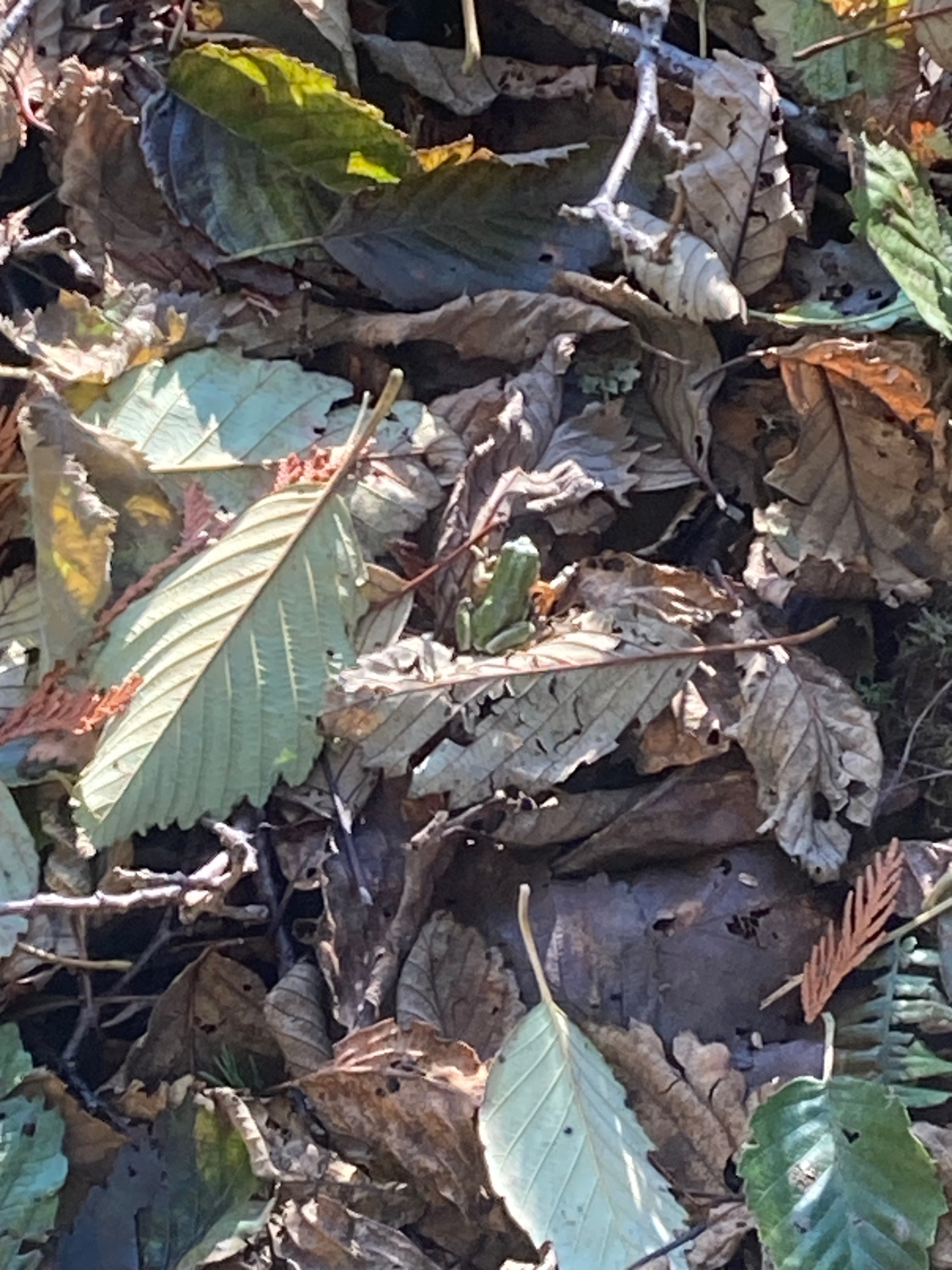
As I worked at replanting, this Pacific Tree Frog appeared. The living forest is alive, in small ways, as well as towering trunks and lofty bows. So many layers of complex ecology, with a few surfacing signs that the original people are still there, thriving, adapting, and ready to come back when invited. I plant them in invitation, thanking everything for being present. Even the Japanese Kotweed is telling us something- disturbed soil, too much sun on a ground that should be shrouded in old growth. The same with blackberry- you won’t find it in a deep, dark forest of older stands. Bring back the trees and you have layers, diversity, and balance in the intended ecology. Where the forest thrives, birds sing, bugs hum, and the joyful spirit of nature abounds. Slowly the vibrant colors of life return. Planting, planting, planting love and gratitude with every handful of soil.










 EEC Forest Stewardship