It’s just the start of work to solidify protection of mature forests in King County. Please use this as an inspiration in your own county, town, or back yard. Planting a tree is worthy too, but keeping the ones we have left, epically in ecosystems which remain undeveloped, is crucial to salvaging what’s left- truly, left, of our living planet for ourselves, and the future generations. Call your council members and ask what the strategic plans are to ensure the preservation of your ecosystem. It’s not just trees, but wetlands, deserts, shrub step, grasslands, all the growing things left, and there are islands of green spaces, even in urban places like New York City- I know, I worked in Central Park, for the Conservancy. Making a contribution in time, money, and social awareness within your community can save what’s left, and make a difference in future planning for the restoration of our environment, and the social capitol our wilder and truly wild spaces offer in un-calcuable dividends in what we truly need to survive- clean air, water, and soil.
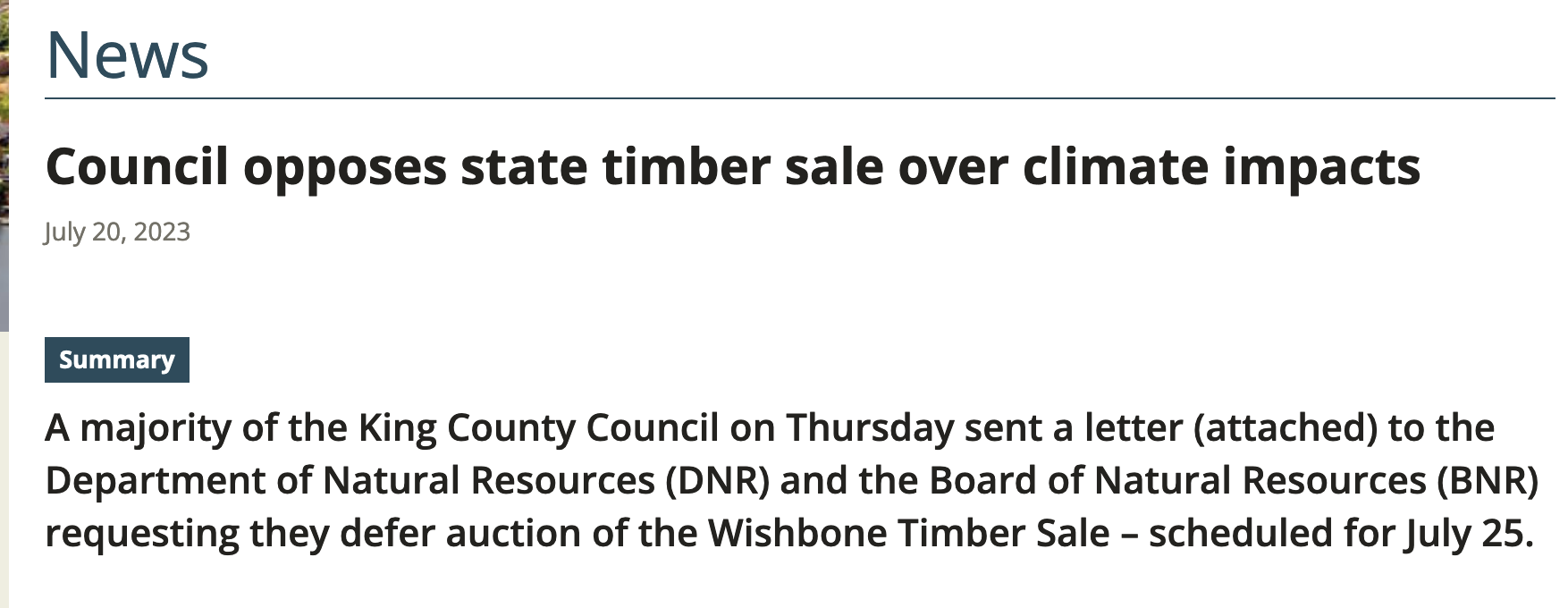
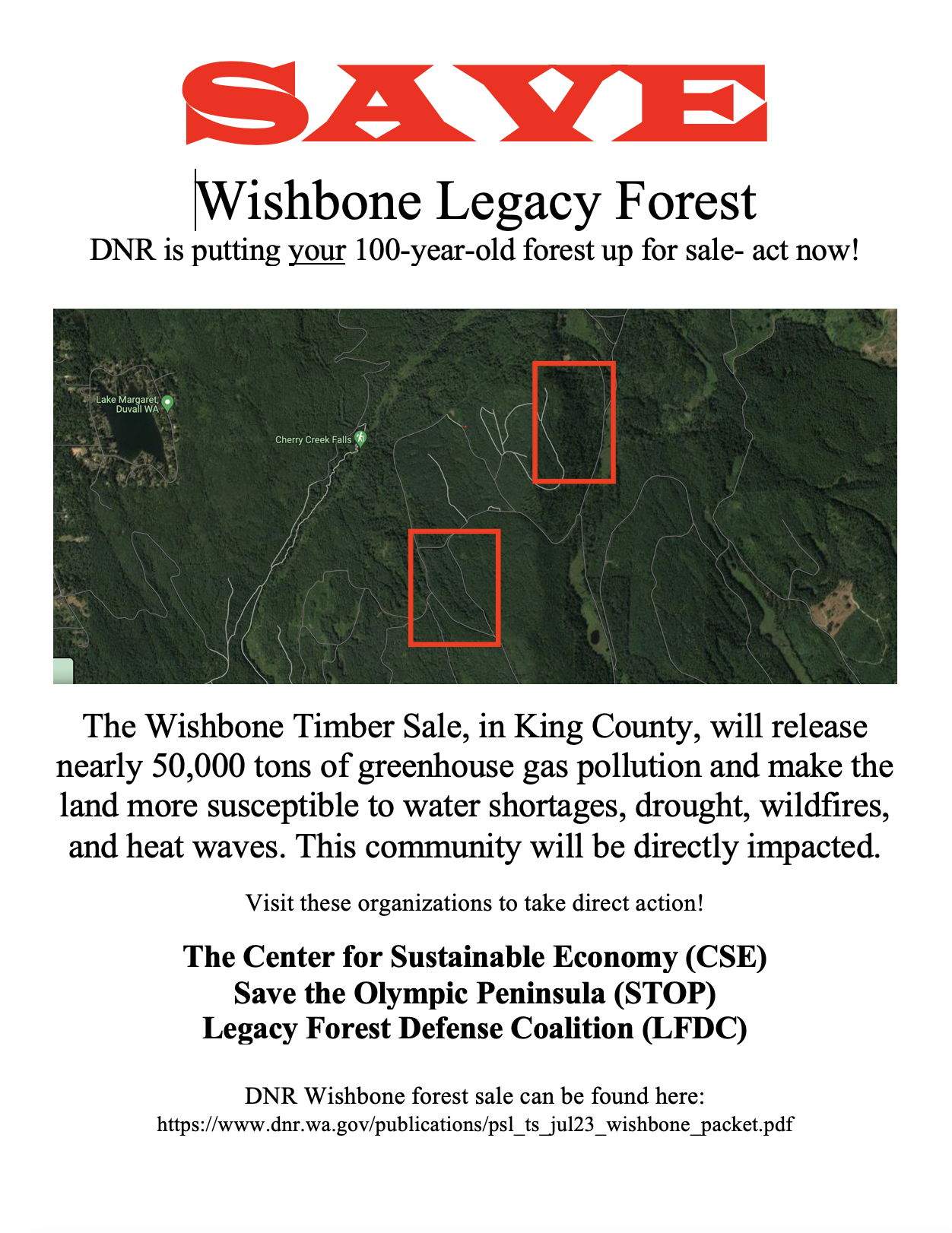
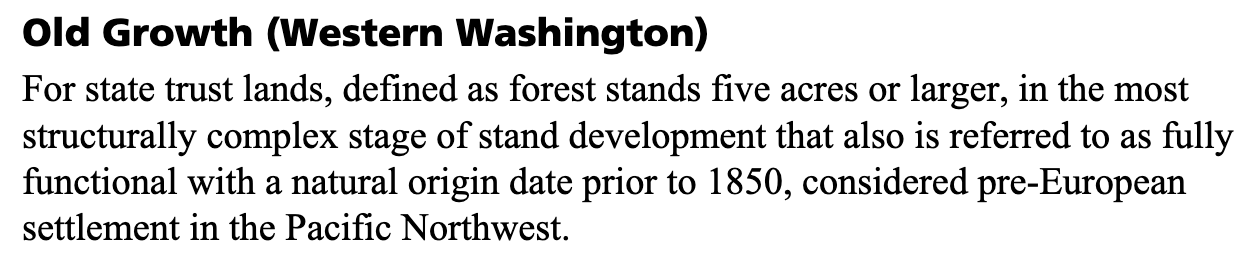
Here, in King County, right now, 100 year old forests, deemed “Forest Legacy“, are being auctioned off by The Department of Natural Resources to timber corporations. Our forests, owned by the people, for the people, are being cut for “sustainable energy“. After Biden’s climate pledging, he came to Washington State to let the country, and the world know sustained timber production would contribute carbon offsets for companies, and offer protection for old growth trees. Here’s the DNR definition of old growth-
Two key things stick out for me- “prior to 1850”, and “5 acres or larger”. There are very few acres of land left in our country not cut since 1850. This date is selected (for Western Washington) based on per-industrial logging. Not much land here was saved from logging, so the only way to bring back old growth is to let current younger trees grow. So, the 100 year old stands, which are moving towards older, not the thousands of years true old growth was, but something moving towards older, these forests are not old growth, and will be cut. Where are the acres for future old growth happening? No where. Forest Legacy does not mean an old growth legacy for the future generations, it simply means the commercial timber rights will be honored, and the land will not be developed. What a joke- no ecological protection, just commercial revenue. What about carbon sequestering? Sure sure- it’s in the wood, and even after that tree is cut down, that carbon is banked- in construction, of more development. Ironic really, and nothing new in the co-opting of sustainability by extraction industry.
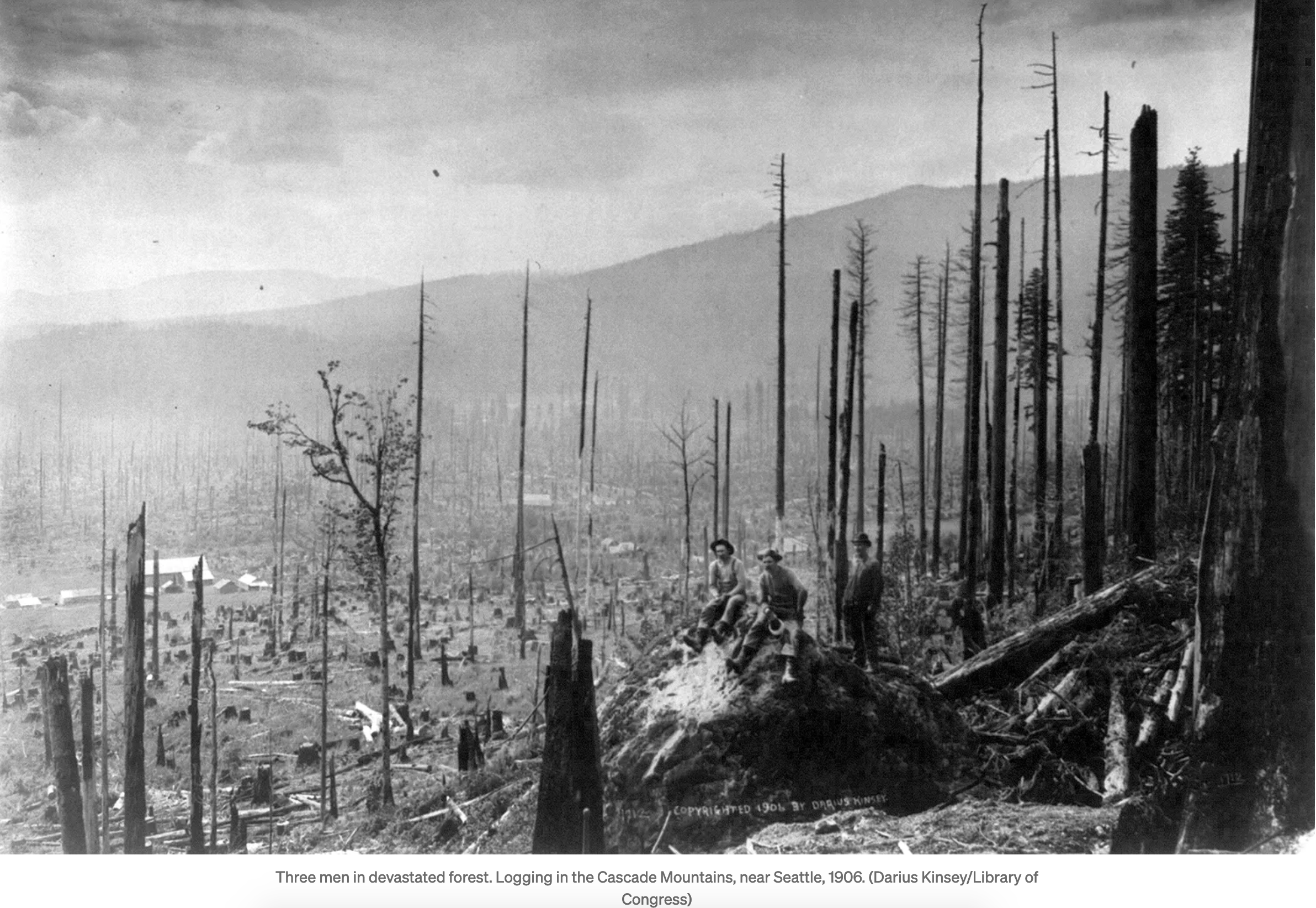
Most of the commercial forests cut today go into “per-manufactured”, “multi layer” construction materials- of solid wood. What? multi layer is particle board, or veneers, or a stack of 2x4s compressed together under extreme pressure and pumped full of laminate chemicals. But wood is sustainable- we can just keep planting new ones after we cut and haul off the old ones right? What? Where does the fertility to grow these new trees come from? An intact forest has hundreds of years- no, thousands of years worth of decaying biomass in the soil from continued lifecycle of trees that fell and lay down their fertility to make more soil for future trees. When you take the trees out, you take the fertility and carbon with them, leaving the soil that’s left to erode- as happened in the early 1900s as timber harvesting became industrialized with the arrival of rail and coal power. Even today, 80 year old trees at EEC Forest Stewardship have a 3-4 foot drop from the base of the tree into it’s root ball.
What about fire danger? Well, intact old growth forest holds a heck of a lot of water- like a sponge, that 4 feet or more of forest floor mulch is soaking up the water and keeping it on the landscape, in the soil, and replenishing the water table. Once it’s cut and gone, the rains rush down hill to the ocean, leaving the land more vulnerable to fire, and drying up wells and waterways, making the land impossible for any life. What about the need for paper products? The US has so much land, so much ability to produce enough for our country, but we are lazy- not wanting to develop new forests, we look to the old growth that’s left and think about the short term gains. Sadly, the land is already spent, and what’s left, the very last, is being carved up and sold off. Can you help? YES! Contact local organizations like:
Legacy Forest Defense Coalition -Also involved in the litigation to save WISHBONE, this oversight group holds timber companies and The Department of Natural Resources accountable by outing the sales of old growth trees.
Center for Responsible Forestry -Creating better guidelines for the timber industry to protect what’s left of our climaxed forest ecology.
Save The Olympic Peninsula -This 501c3 is working to protect natural resources for public benefit instead of corporate greed and commercial abuse. They are also supporting the litigation over WISHBONE.
My partner called me on the way to work, early this morning, to tell me he’d seen a dead deer on the road near our house that looked intact. I promptly grabbed my truck and headed out to check the carcass. It was 54F outside- cool and dry, ideal “summer” conditions for road kill salvaging. Note- salvage tags are legal here in Washington- but you have to file them ASAP with WDFW. Not all state allow this activity, so know the laws where you live. Please also know the risk of salvaging meat and do not attempt without some experience, especially if it’s a warmer time. Bacteria can set in fast, and road kill usually involved some serious blunt force trauma to the animal, with a high probability the innards will rupture and spoil a lot of the meat. Not only was our deer fresh (still warm in the chest), on a cool morning, with a broken leg and some minor lower back bruising. The intestines looked intact and the carcass was not bloated at all, so I hoisted this amazing gift into the truck and got her hung in the garage for a full inspection.
Opening up the cavity, in a normal gutting routine, the animal was undamaged inside- yay! The smell from a ruptured intestine would be enough to let you know if there was compromise. With a great fresh meat smell in the air, I gutted, skinned, and cleaned up the beautiful doe and hung her in the walk in to fully cool and set. What a great spot by my partner! He’s not a hunter, but that doe in the cooler is one above my count this year. Gratitude to the animal, her life on this landscape, and her death being salvaged to feed others, rather than rotting in a ditch- though the dead always feed the living, and scavengers have a sacred role to play too. They will also receive some of this meat in thanks, along with bones and hide, so nothing goes to waste. It is always better to salvage what you can from nature’s bounty, and recovering almost a whole deer is certainly an unexpected boon to our larder in 2023/2024.
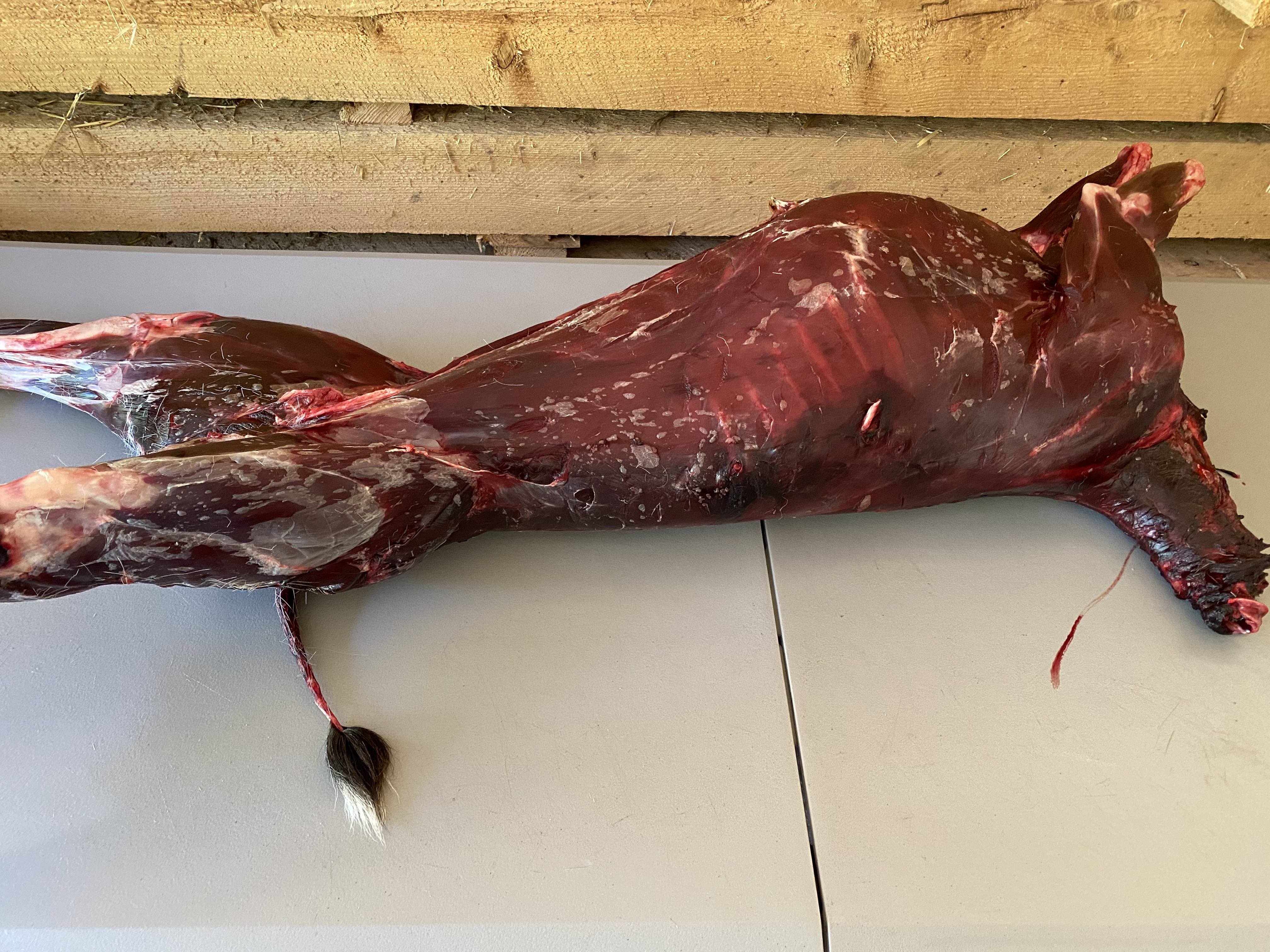
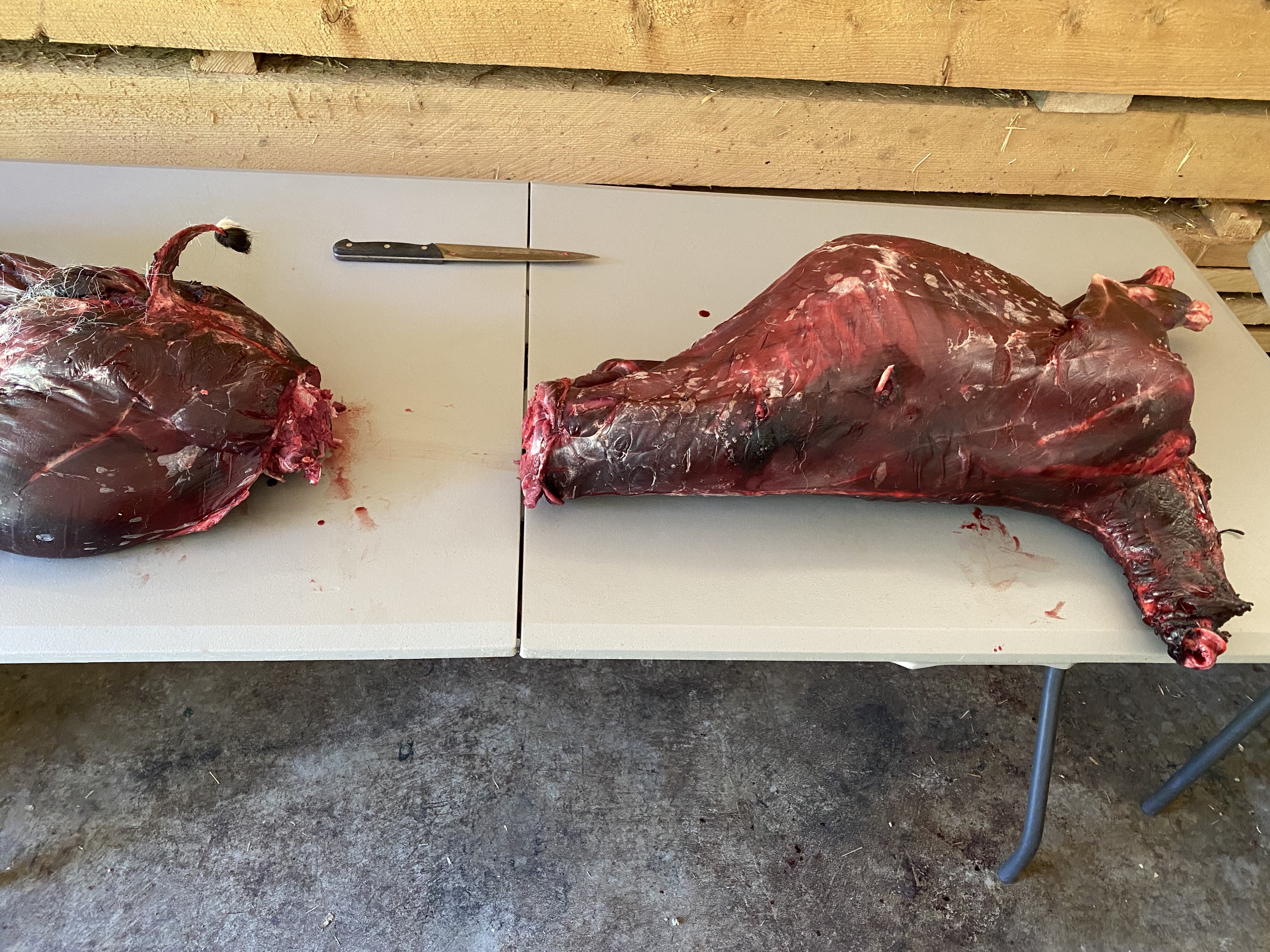
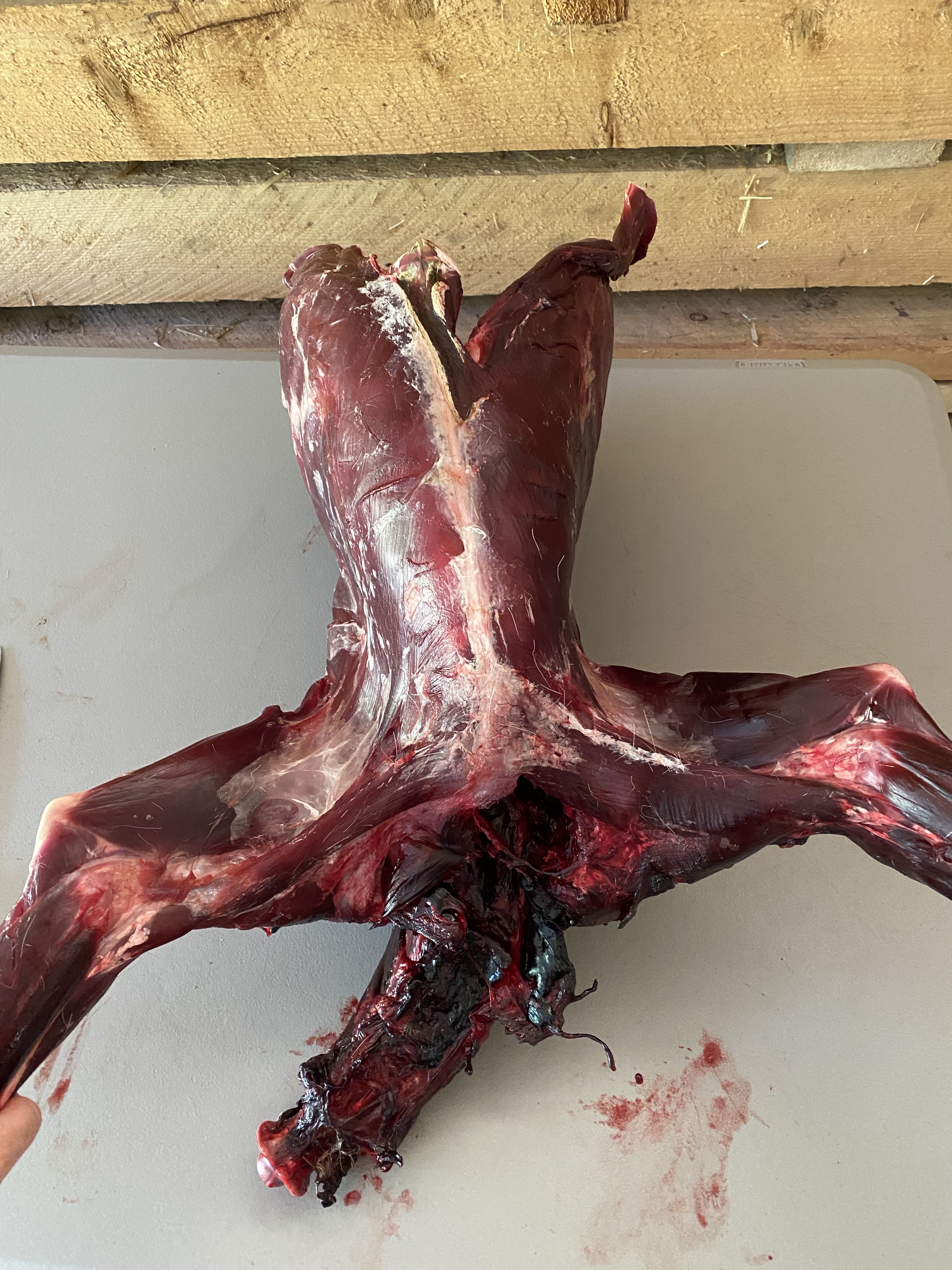
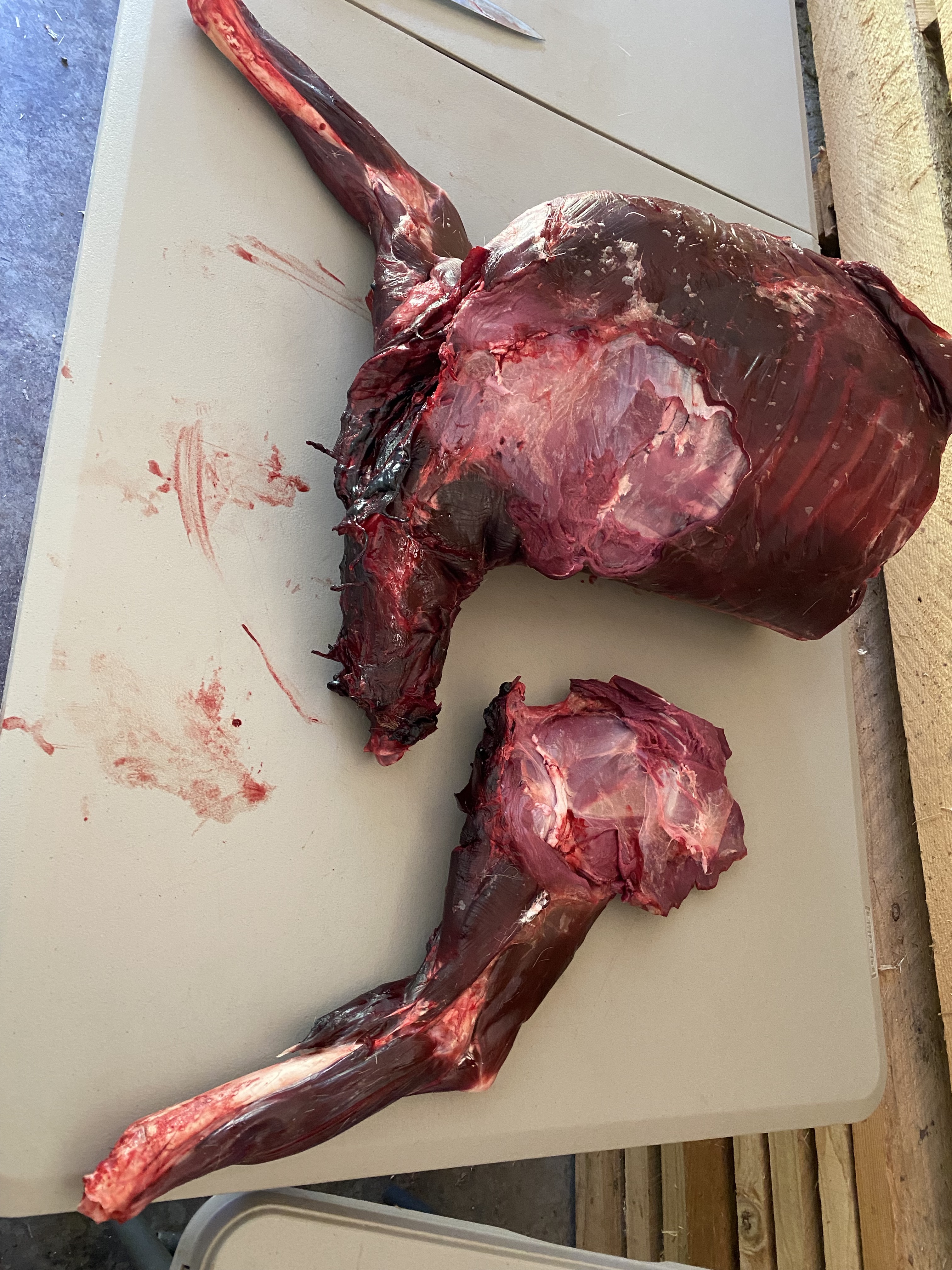
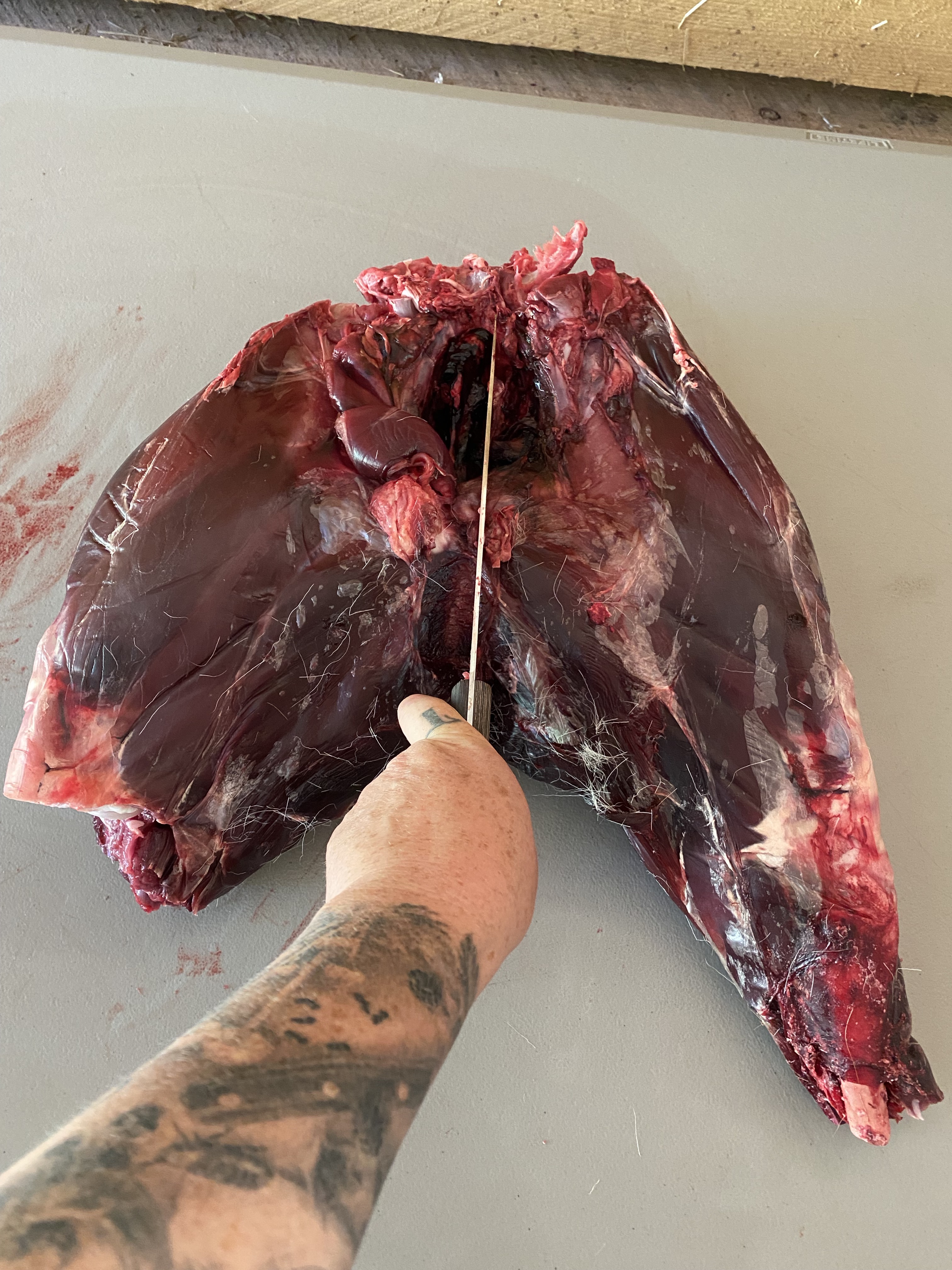
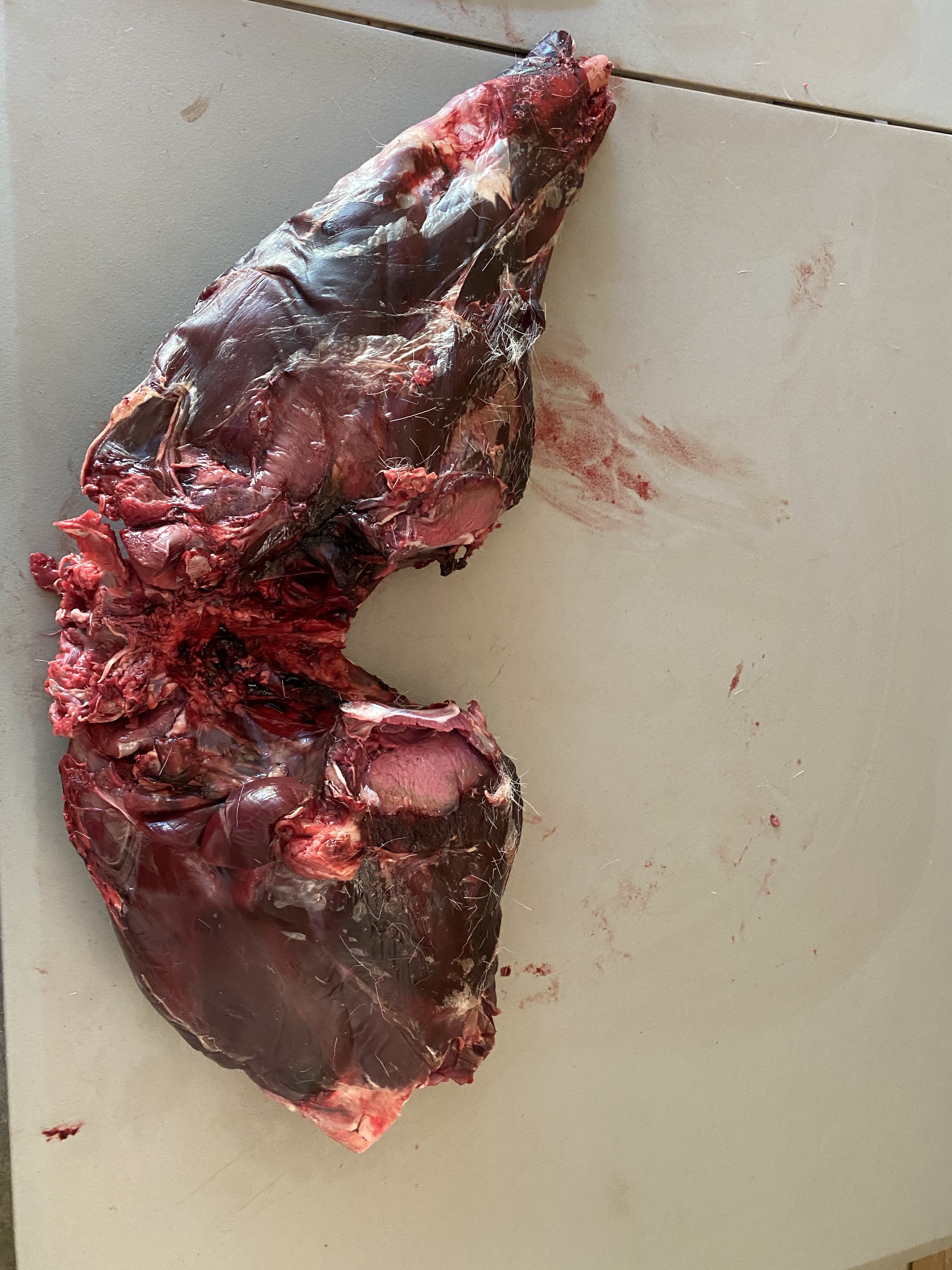
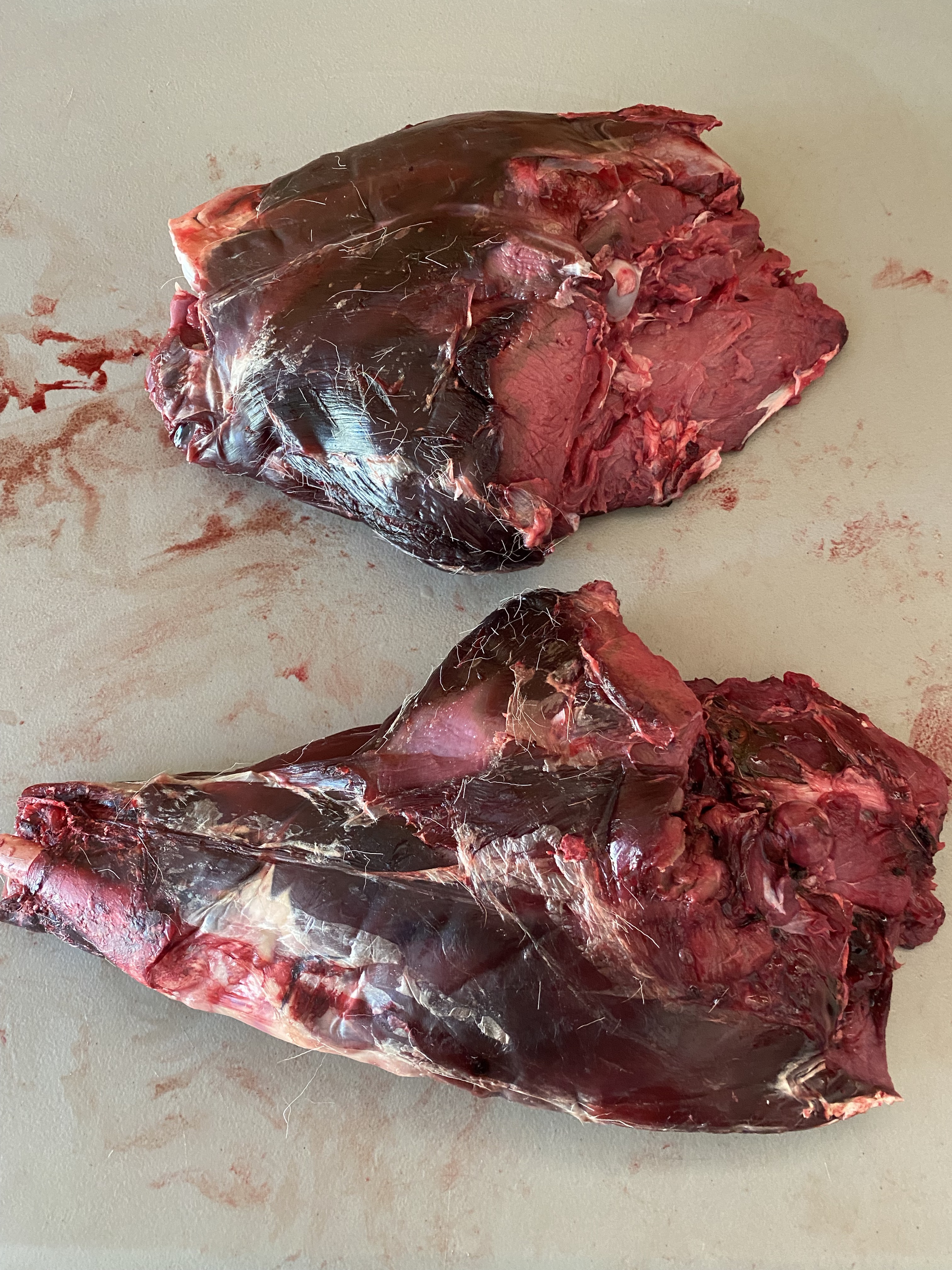
After the carcass hung in the cooler for a week, it was time to butcher and freeze the meat. I always start by separating the carcass into two halves at the loin. Then I can put half back in to keep cool, thus giving me more time to work on each part without worrying about spoilage. I’ll keep the front half out to work on first, separating the loin roast, shoulders, and neck into good family dinner portions.
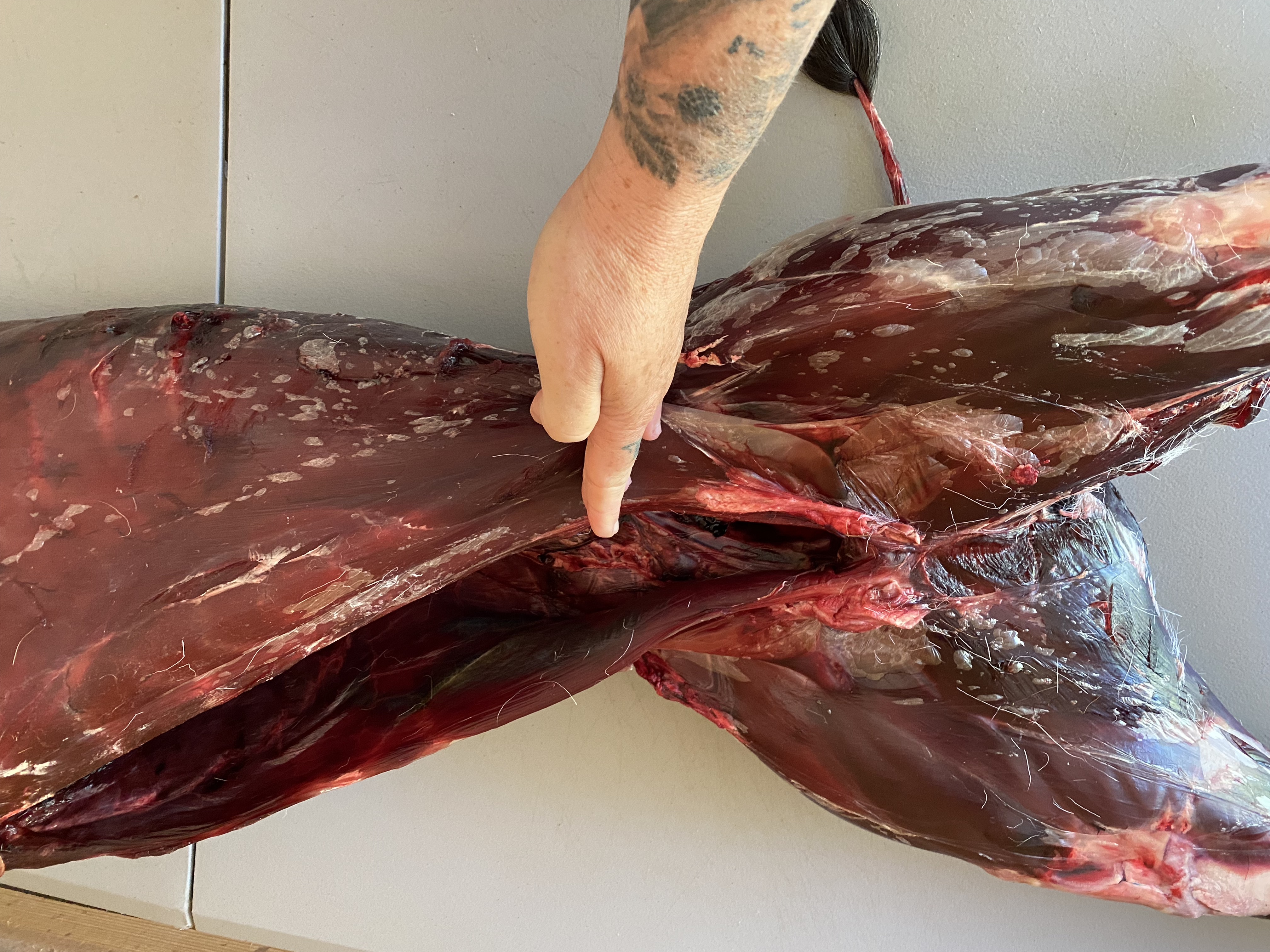
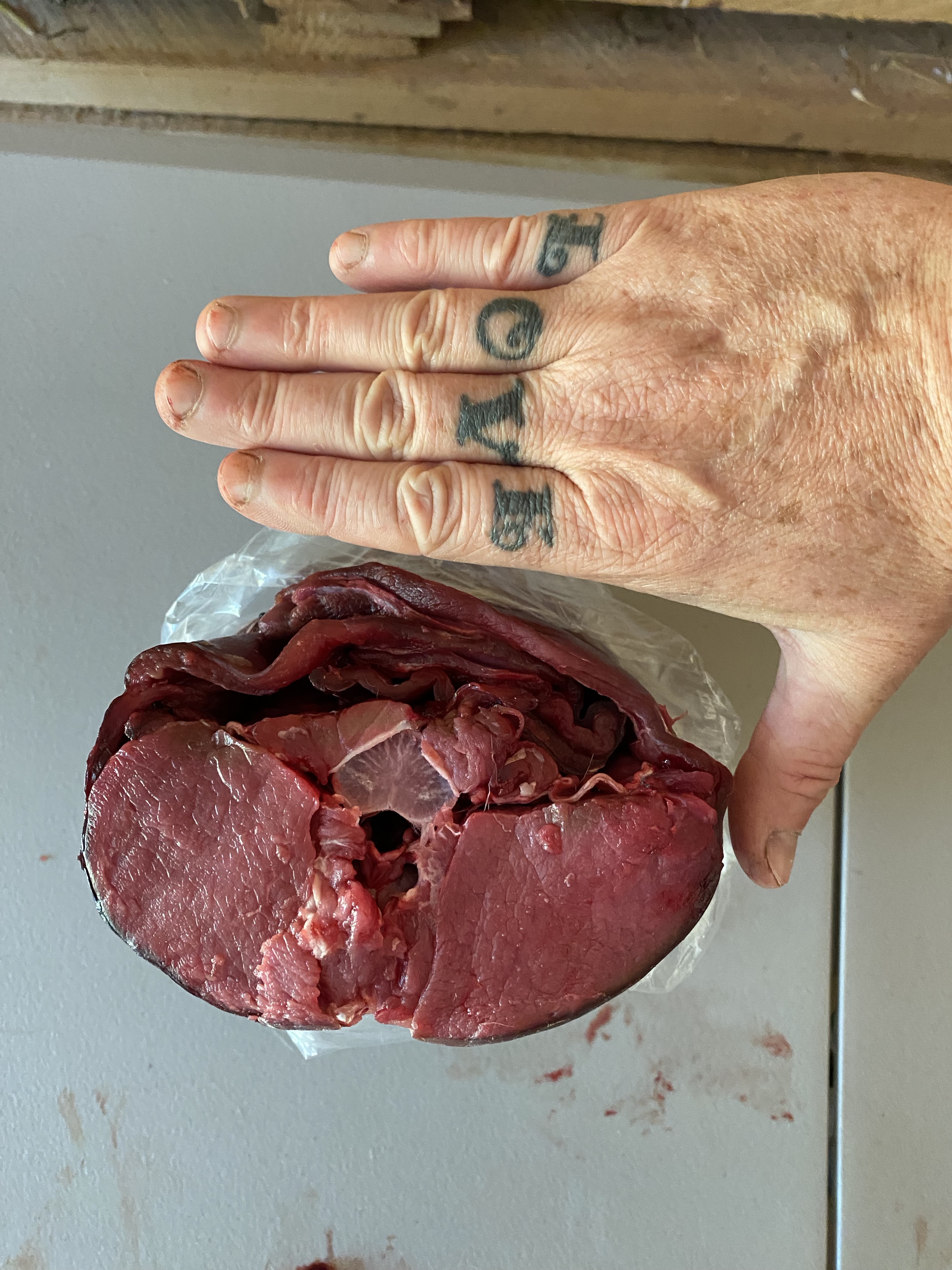
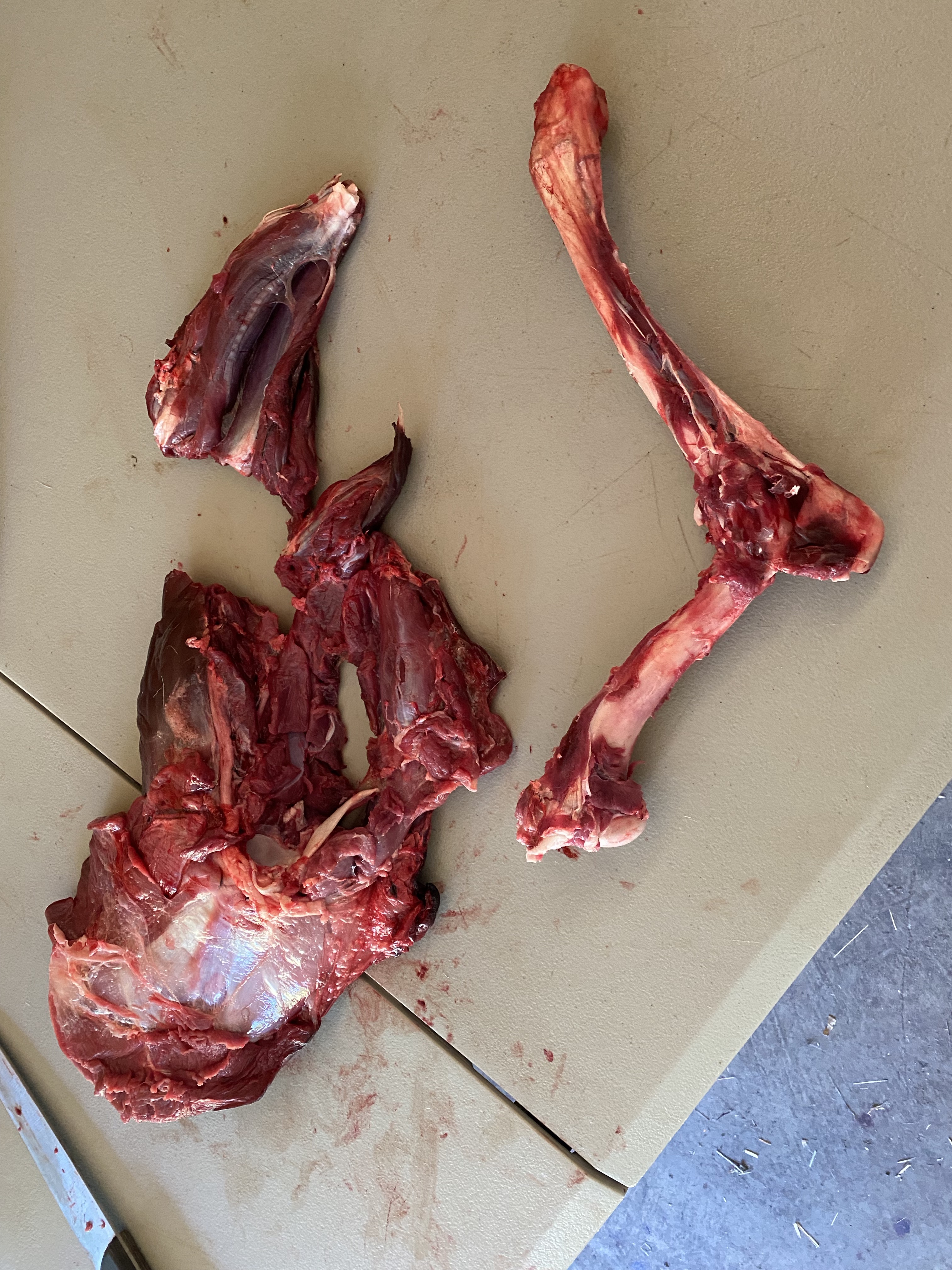
The loin roast I cut her (with hand above), had the best cuts and a cute little heart shape in the bone. Back-strap and loin cuts are dreamy, and putting them together in one single package makes for a great shared meal with friends and family, giving a real wow factor to the meal. We’ll still have some good back-strap on it;s own in another cut later in this breakdown. With most roasts I leave the big bones in for flavor, and also to save time in the tedious process of de-boning. You loose a lot of meat de-boning, and less cuts means less work and less chance for bacteria to get in. Separating the front legs from the ribs gives you two shoulders to work with, followed by neck removal. I usually leave neck together and use as a soup stock item. You can cut most of the neck meat from the bone if you want to save freezer space or avoid those complicated vertebra.
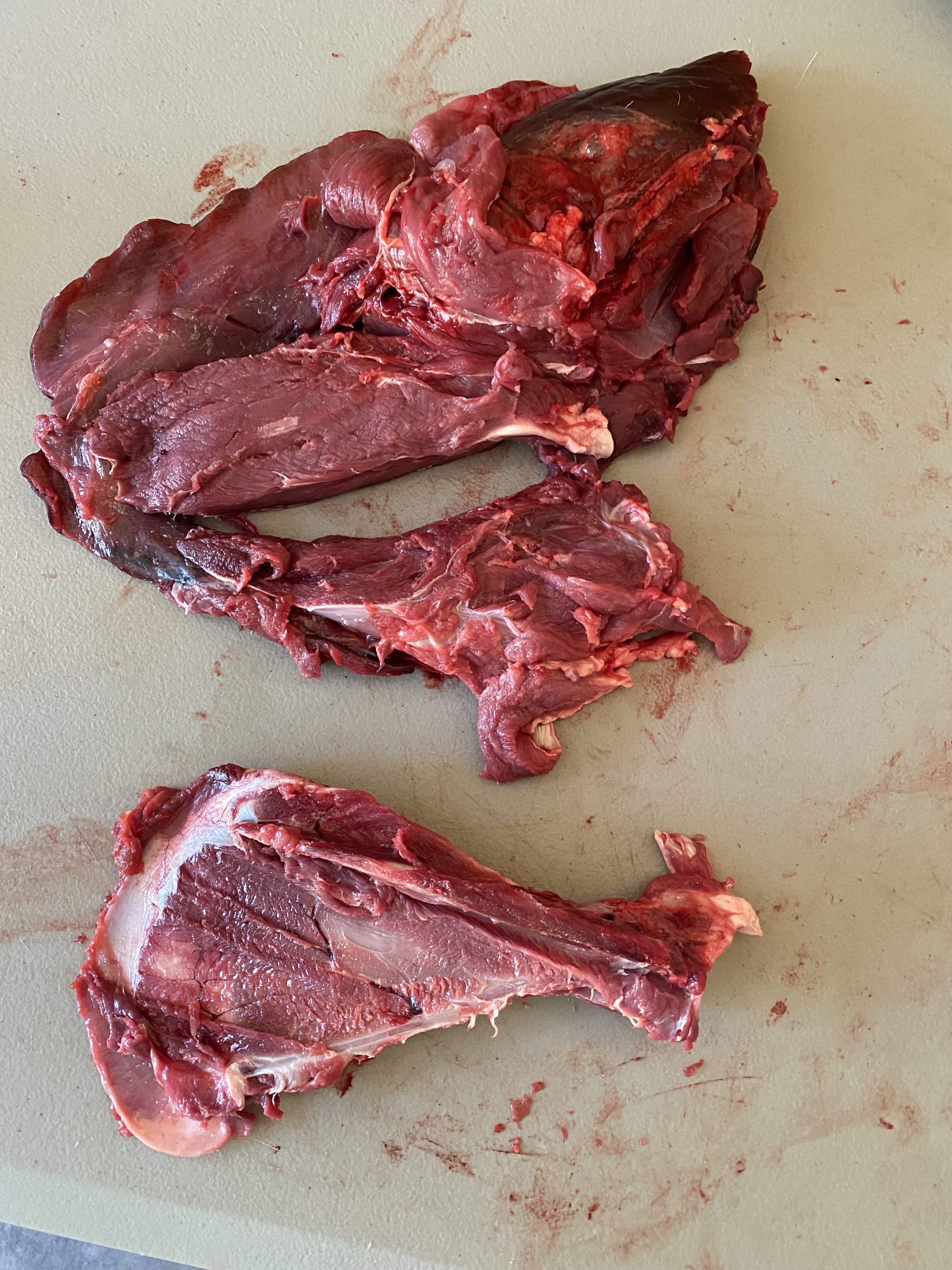
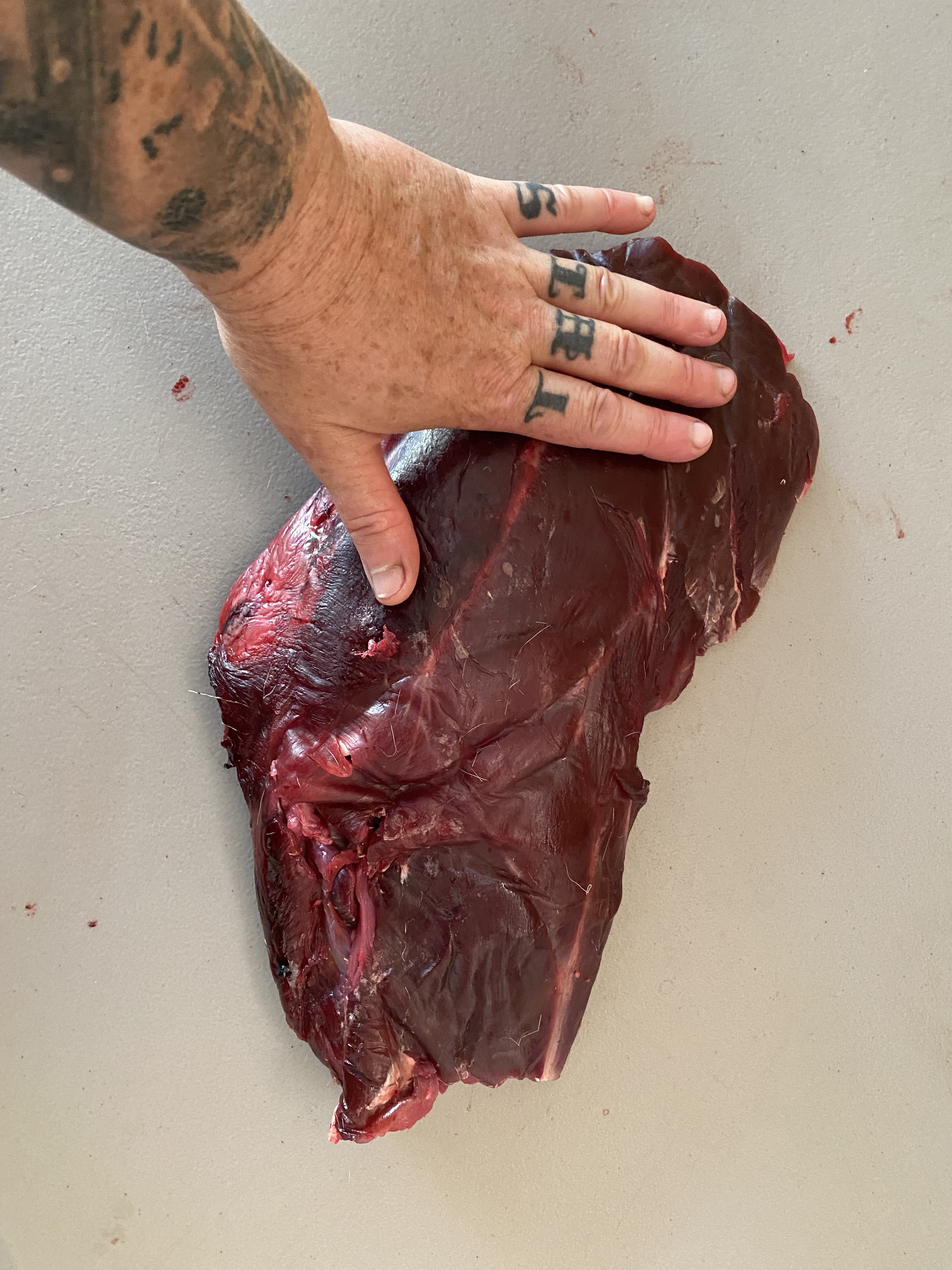
Next we turn to the front legs, often underappreciated because of the scapula bone, but shoulder roasts are delicious and easy to carve out once you find the right approach to the cuts. I’ve done two different presentations of the shoulder- one with bone in and one with bone out- I know which one I like better- what do you think?
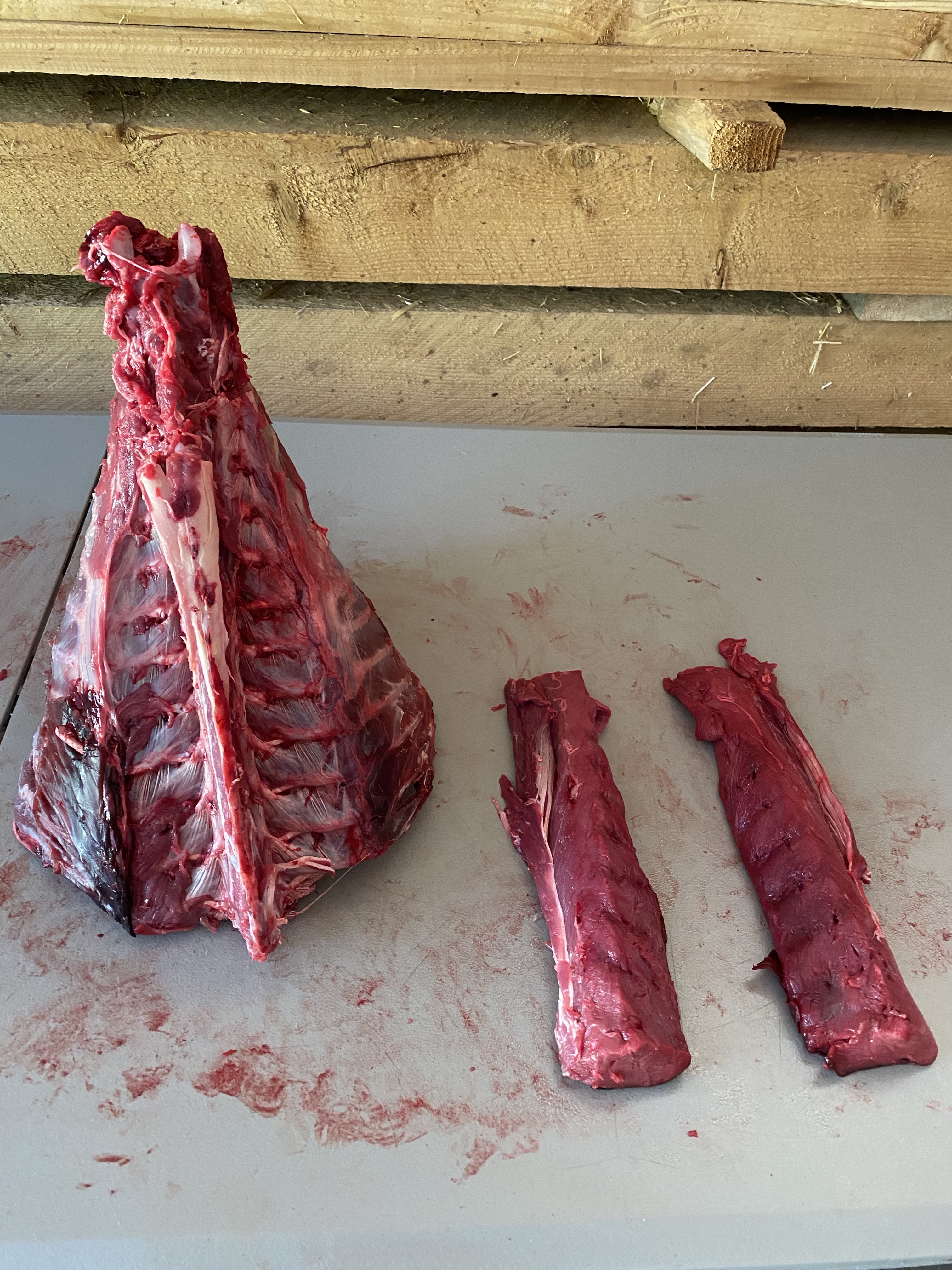
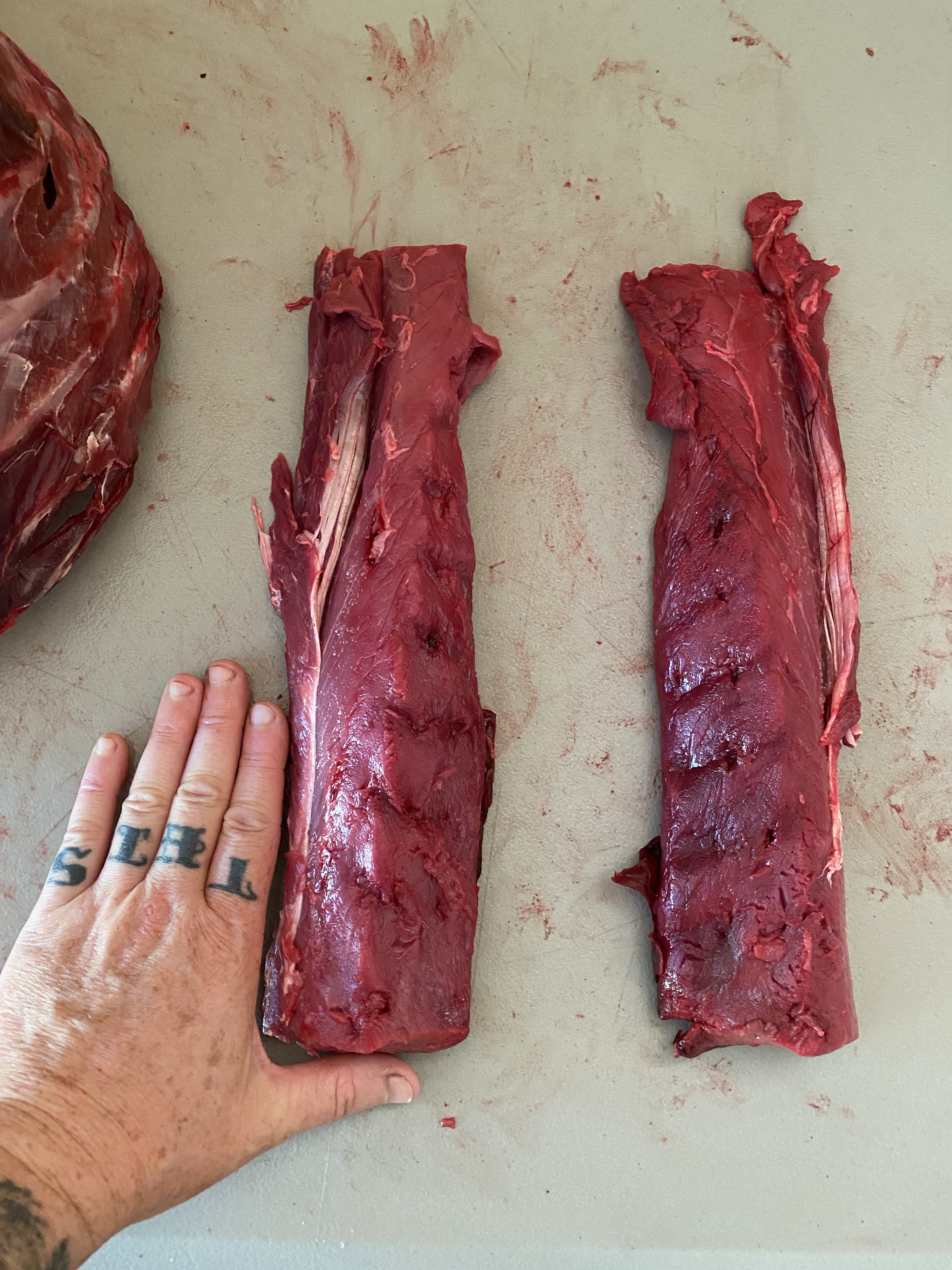
Shoulder bone in looks so good- and reflects the typical cut you would buy in the store. It’s easy to wrap and cook too. Great way to keep as much flavor and meat together for taste and presentation. Because we’re working with a damaged carcass, some of our cuts are going to be a little different, but this doe was only damaged in a few places, so most of the meat will go in the freezer. Take a look at these two back-straps- that’s some delicious, melt in your mouth cuts. The meat is fresh, red, and lean. I’ll pack them together in one package and then cut them into fancy medallions for a meal when I unfreeze them. Again, you don’t have to cut the meat into smaller servings until you are ready to use them. This also prevents freezer burn.
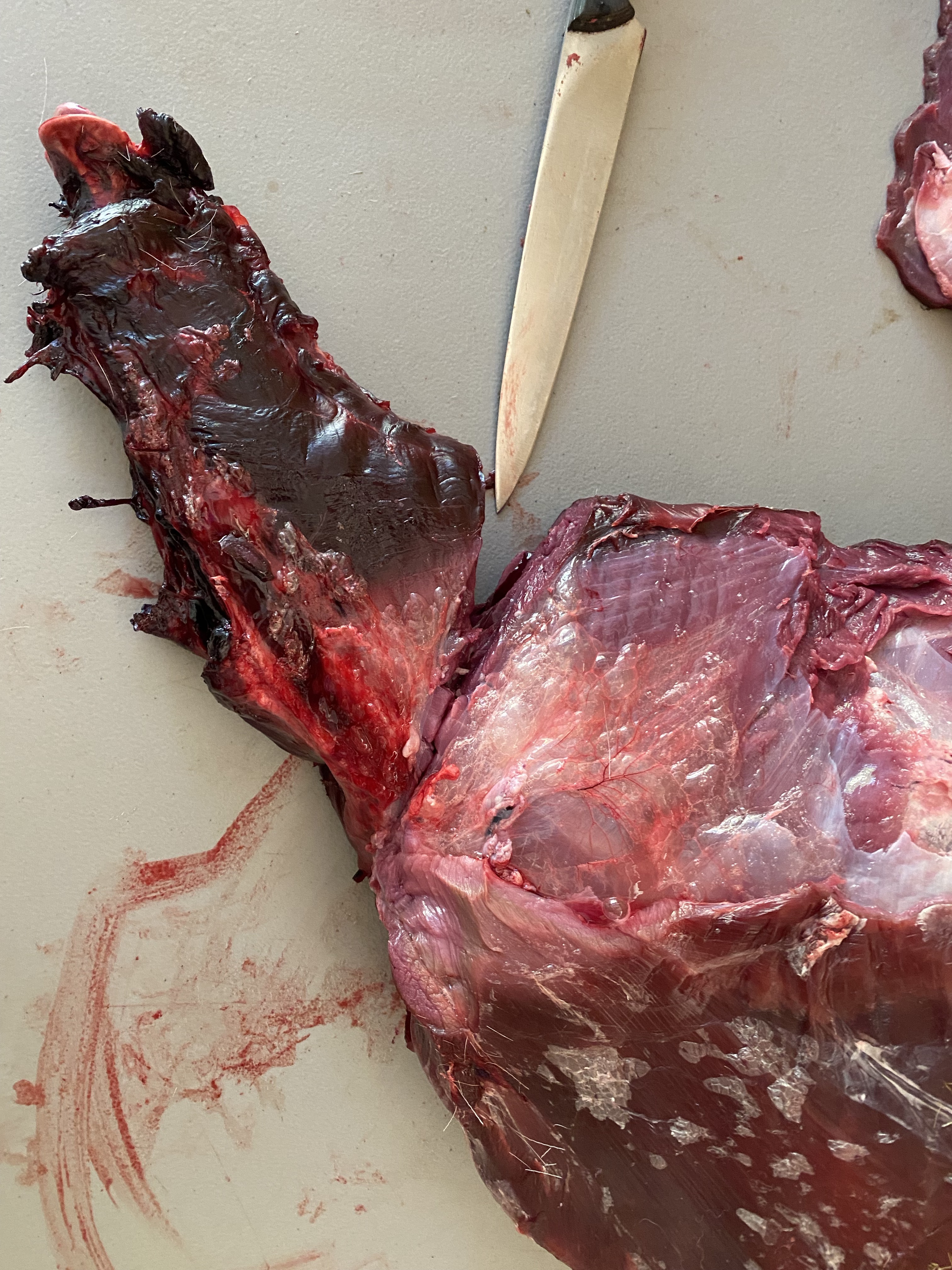
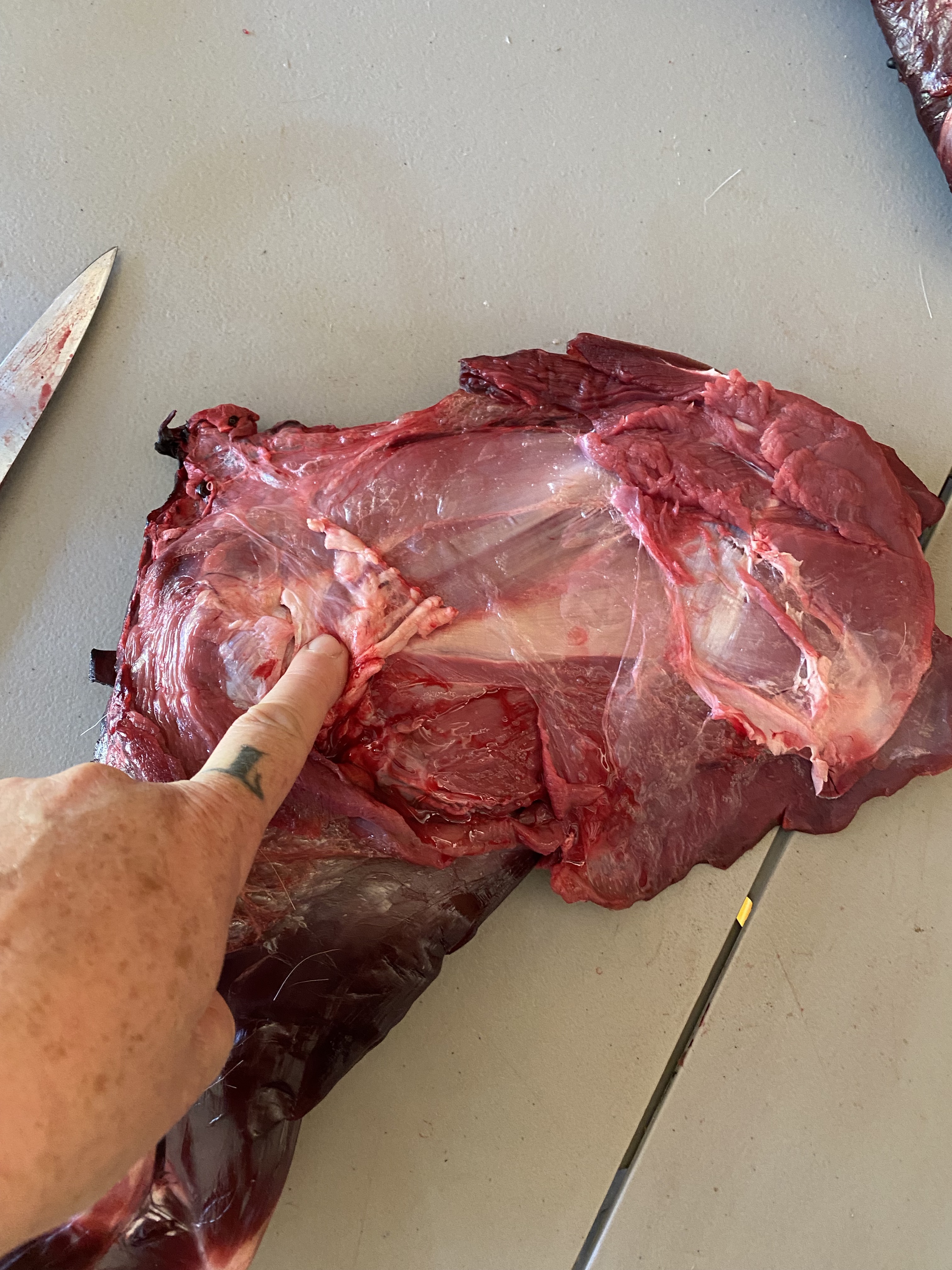
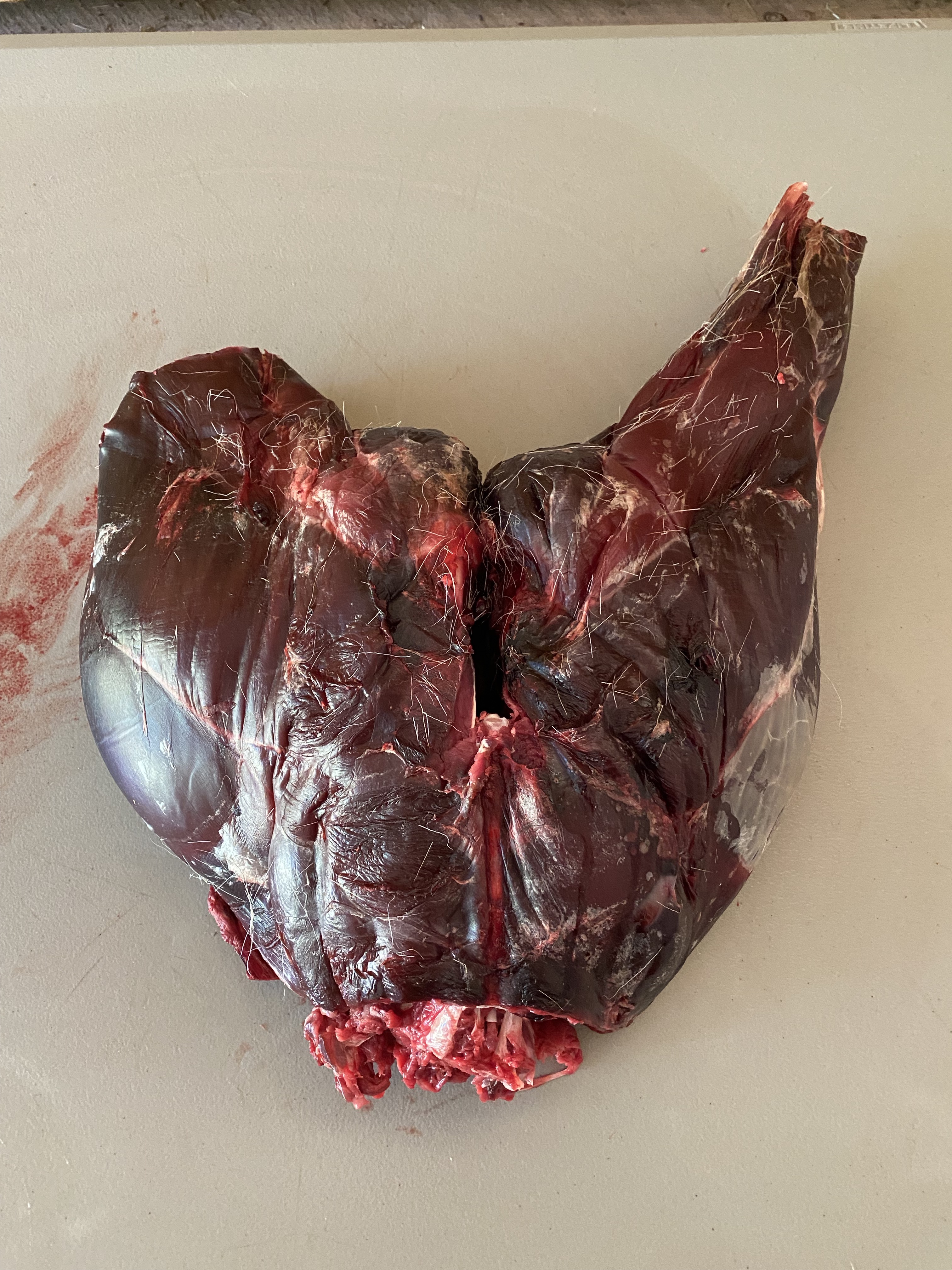
Rib cages are often a challenge, and though I love roasting a rack after I’m done butchering, this rib rack will go to the scavengers to reflect my gratitude for this abundance of wild food. I did scavenge more meat off the bones for our grinds bag- always good to put the trimmings in a bag to grind later for deer burgers. On my sheep, I take the time to carve off the brisket, but deer have little fat in that area, so it went to the woods to feed others. There was also some bruising in the ribs, with a few cracked from auto impact. Bone fragments can become a real danger in the meat; swallowing one can injure a person, so a lot of caution goes into cleaning a scavenged deer. As I began on the back half of the carcass, I found another major injury, which was the cause of the deer’s death. Her right side took full impact, breaking the right metatarsus, cracking several ribs on that side, bruising the lower back, and, as I cut into the pelvis, shattering the right hip entirely into fragments, which I only discovered once Ii began butchering the hind end- can you tell just by looking?
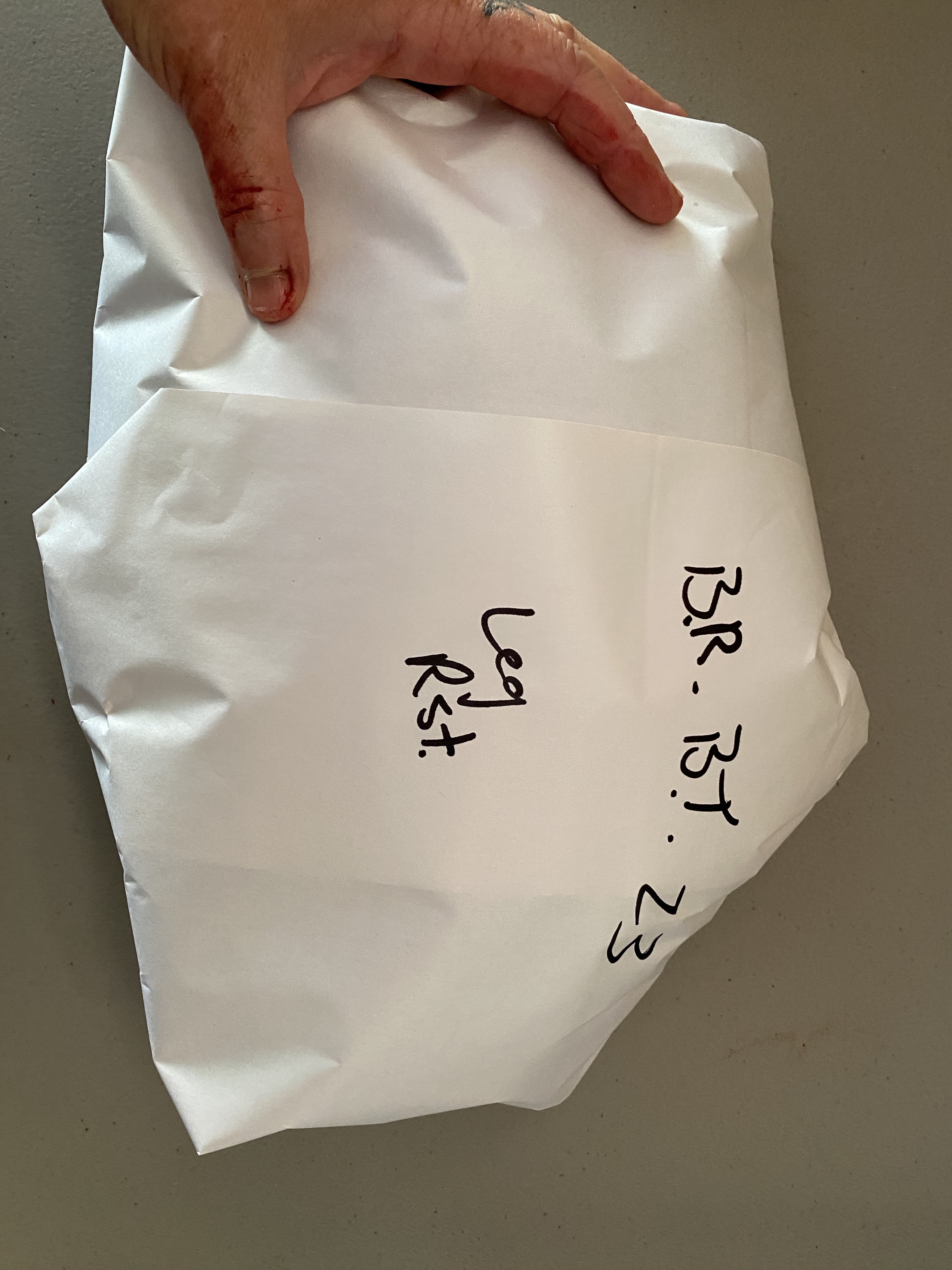
Leg roasts are the largest cuts I make on an ungulate, and it’s a great cut if you can split the pelvis well. I often use the edge of a table as leverage to separate bit bones. It saves on the knife sharpening, my hands, and take apart time. Some people like to carve it up for all the nice little stakes you can get out of those big muscles, and hey, stakes are good, easy to cook, and approachable for those who don’t want a lot of meat at once, so go to it if it’s your thing. Really, if you’re the one cutting it up- do it your way. I like big roasts and less cutting, it also makes wrapping a breeze. I wrap all my cuts in plastic cellophane to keep the freezer burn out, and cover in lined butcher paper for long lasting freshness. Bone in cuts should be eaten within a year, but if you take the bones out and wrap well, frozen meat will stay good for many years. We tend to eat ours in a timely way, but still wrap everything to last.
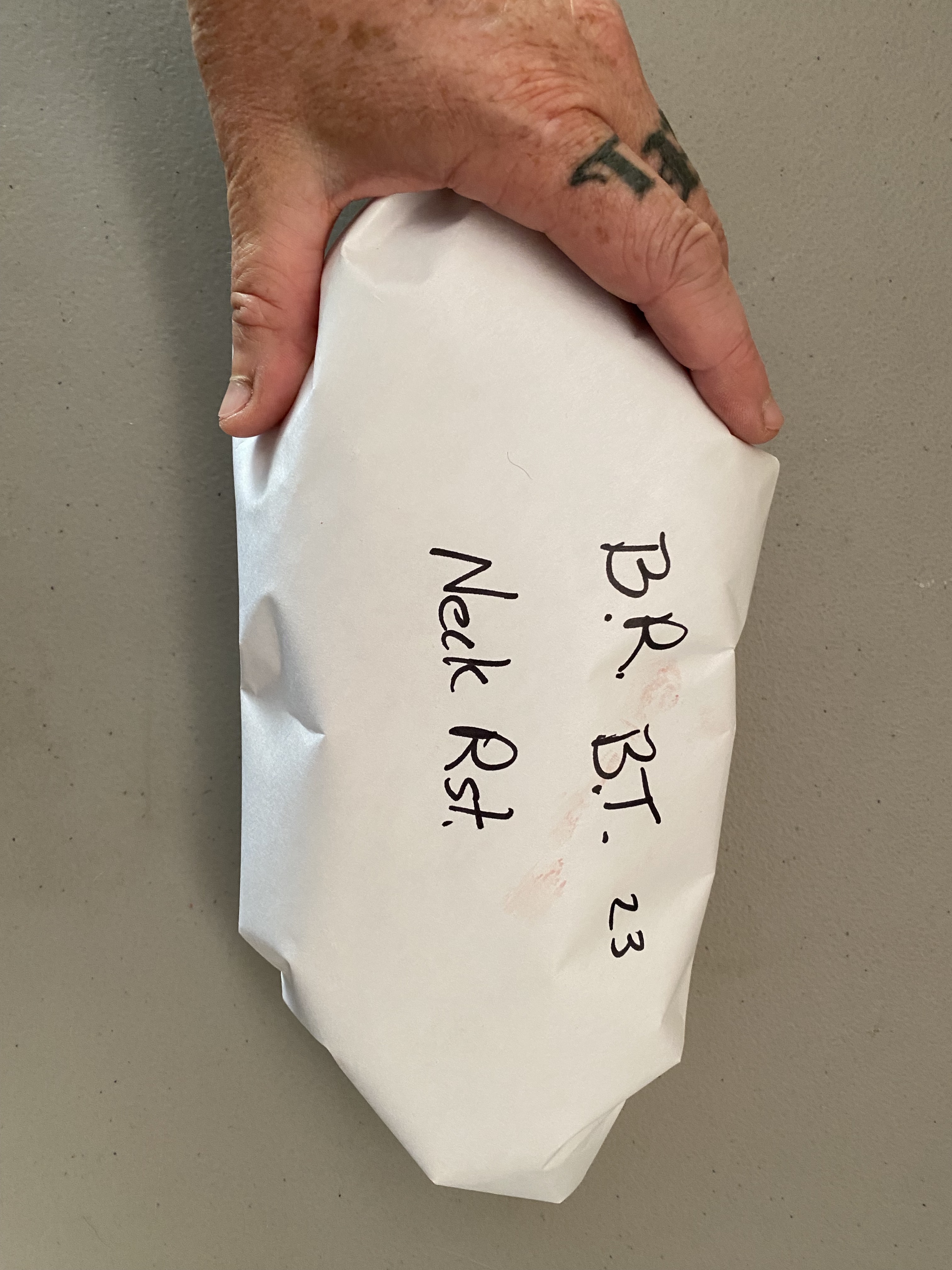
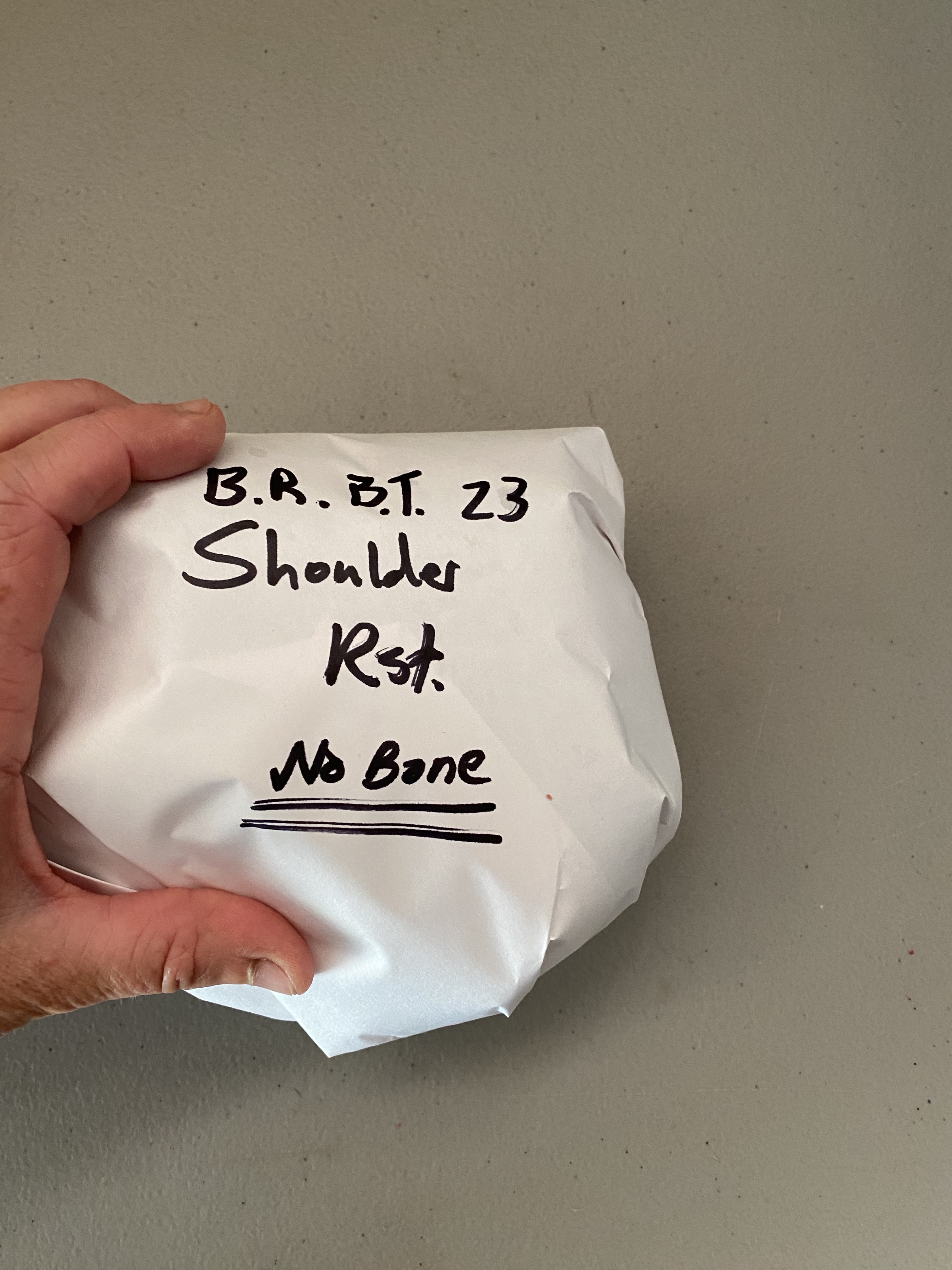
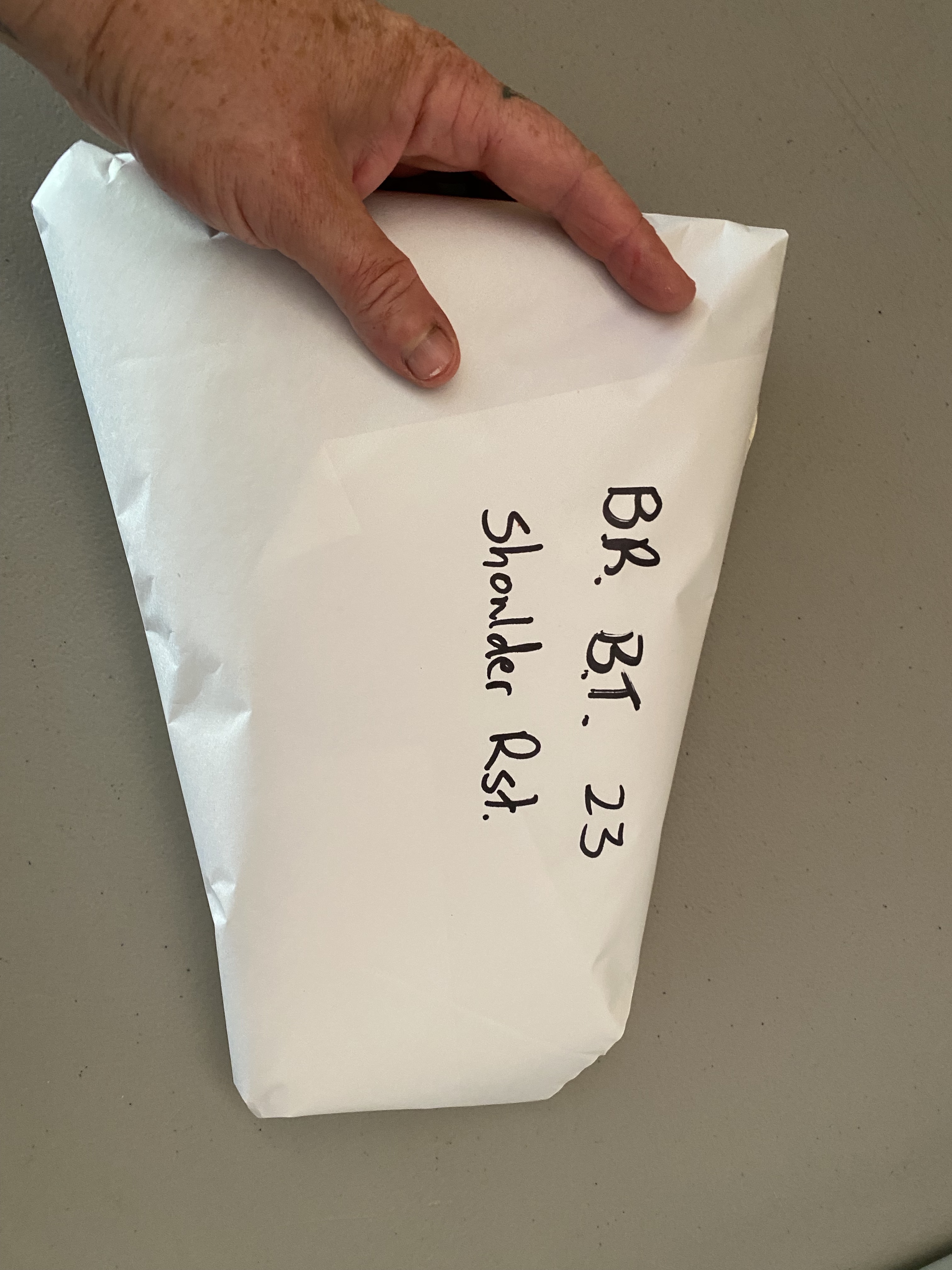
Labeling your cuts to keep a single animal together and to know what’s in each wrap helps when you’re stacking a lot of different things in your freezer. B.R. B.T. 23 means Big Rock, Black Tail 2023. I know where I salvaged this animal (big rock rd.), what species (black tail deer), and what year. Some people put months down too. When I label with Rst. (roast) that means bone in. If I leave the bone out- I say so on the wrapping. Any cuts not a roast are labeled with part names, like back-strap or grinds. Grinds go in a zip-lock to freeze. I’ll grind all my meat at once later this fall, after slaughtering season is over and all the need to grind meat it bagged and frozen. Freezing meat breaks it down a little more, making it easier to feed through a grinder once defrosted again. Pro-tip: cut grinds up well, ,or clog the grinder with sinew and enjoy the headache of constantly taking your grinder apart to fix the blockage.
Well, that’s a short preview of cutting up a salvaged deer. Thanks for your interest and support in harvesting wild foods of all sorts. For those seeking wild meat, but unable or uncomfortable with hunting, this is a great way to enjoy some good venison, and help prevent waste in the often violent death of animals on roads. Again, this encouragement is for deer salvaging, where it’s legal, when it’s the right time, and the carcass is intact. You can still learn and practice butchering on a bloated deer if you want, and I have- any learning is better than none, and experience is the best teacher, but stay safe and know your own limitations- also remember those around you, not everyone is ok with the smell or mess that could happen with roadkill. Be mindful of your surroundings and keep your area of butchering clean and sanitary. Have the freezer space ready, and know what you’re going to do with any leftovers. We put our bones and viscera in the wildlife area of our property, near a trail cams so we can capture images of the other animals feeding and thriving off this windfall. Turkey vultures, bears, coyote, opossum, racoon, mice, crows, ravens, and all the bugs and insects are feasting away, and so will we.
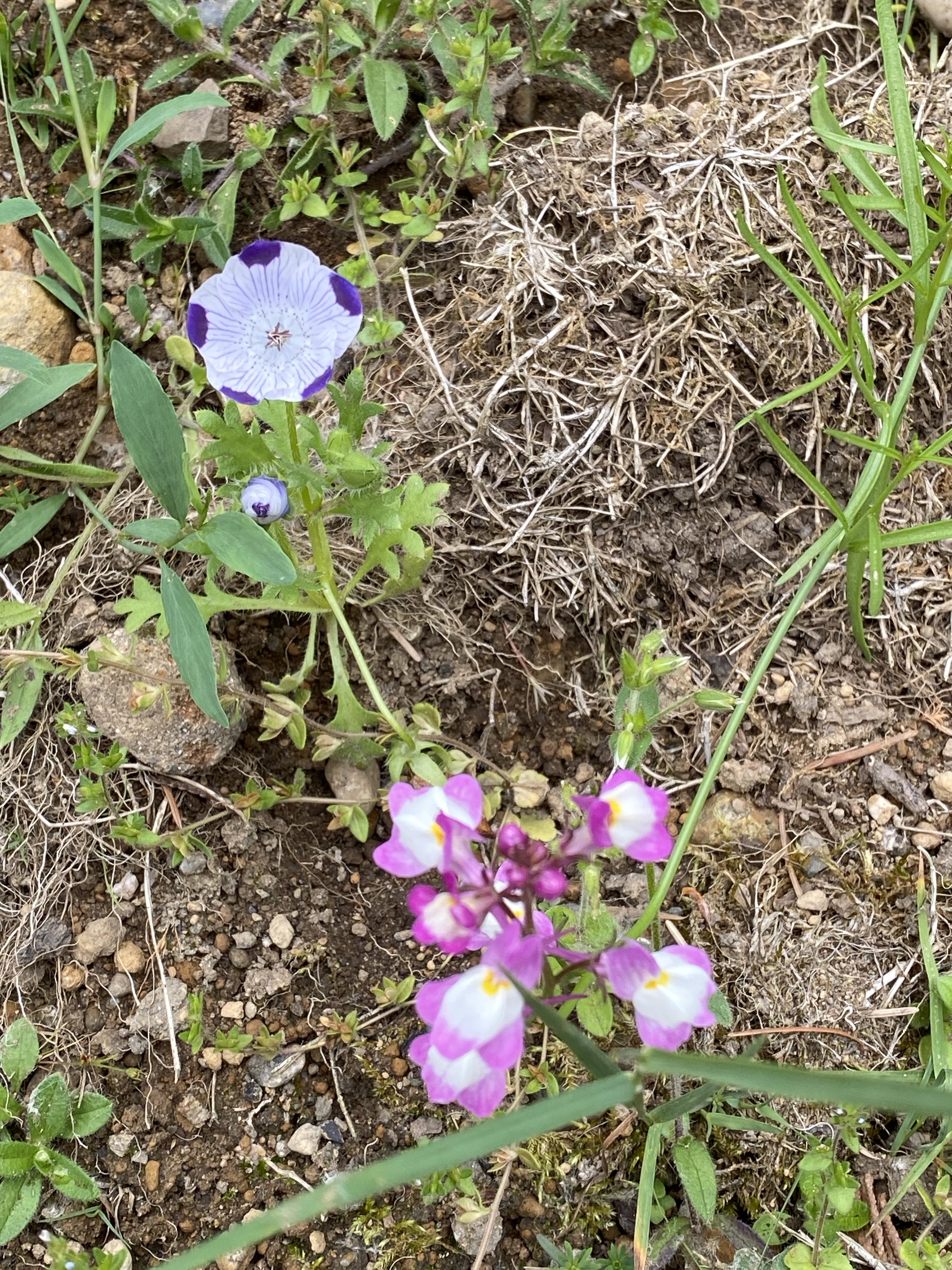
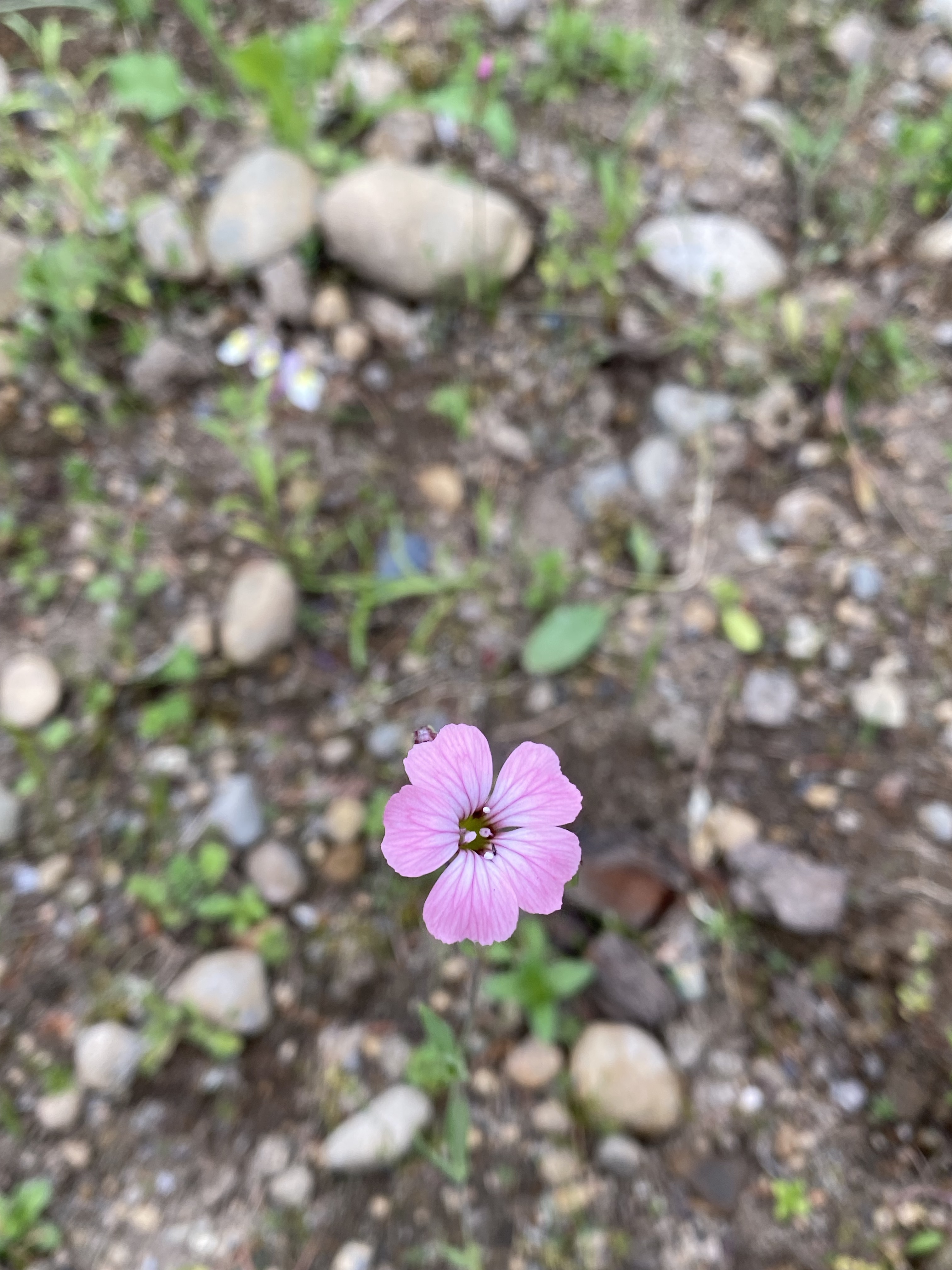
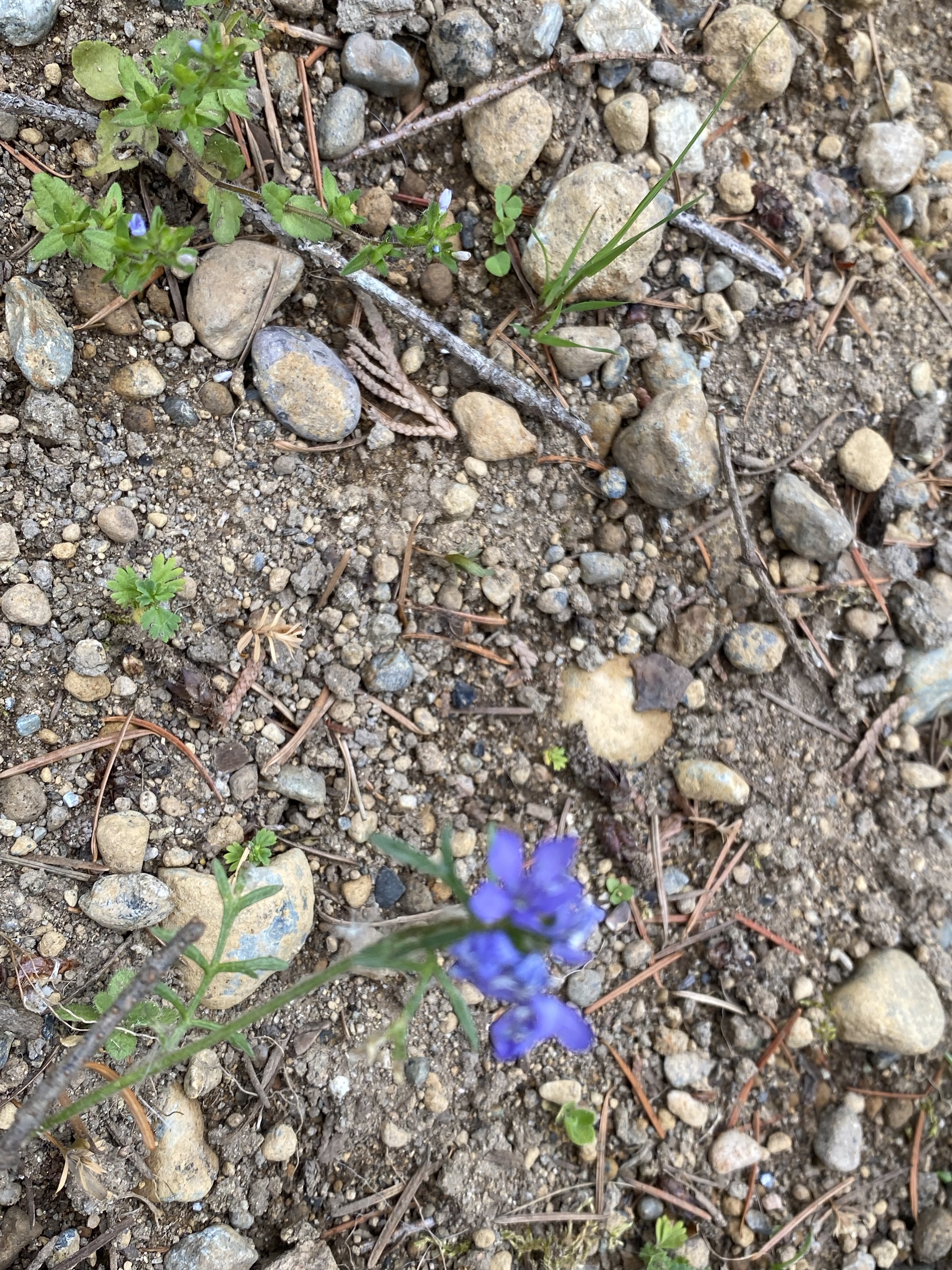
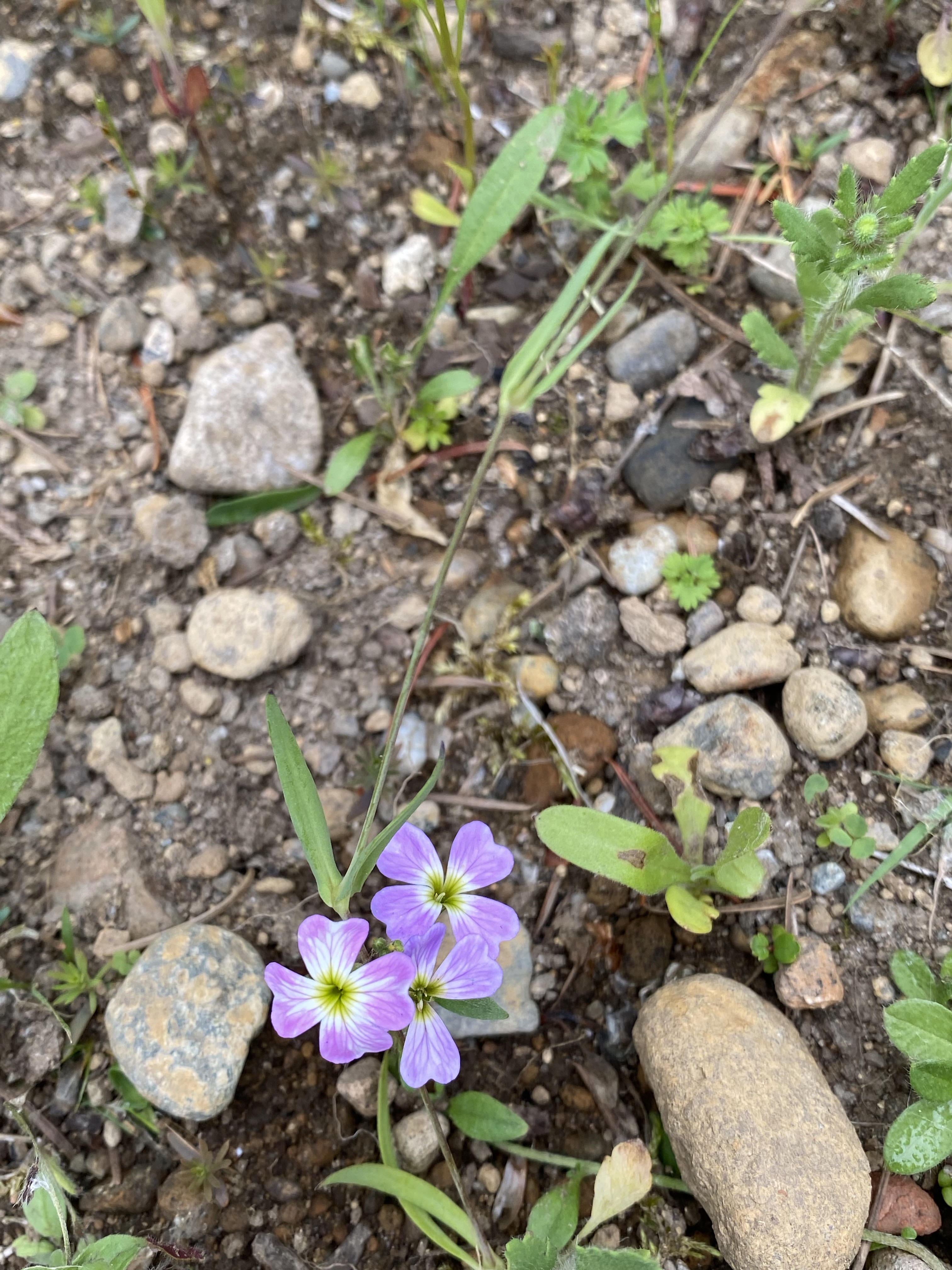
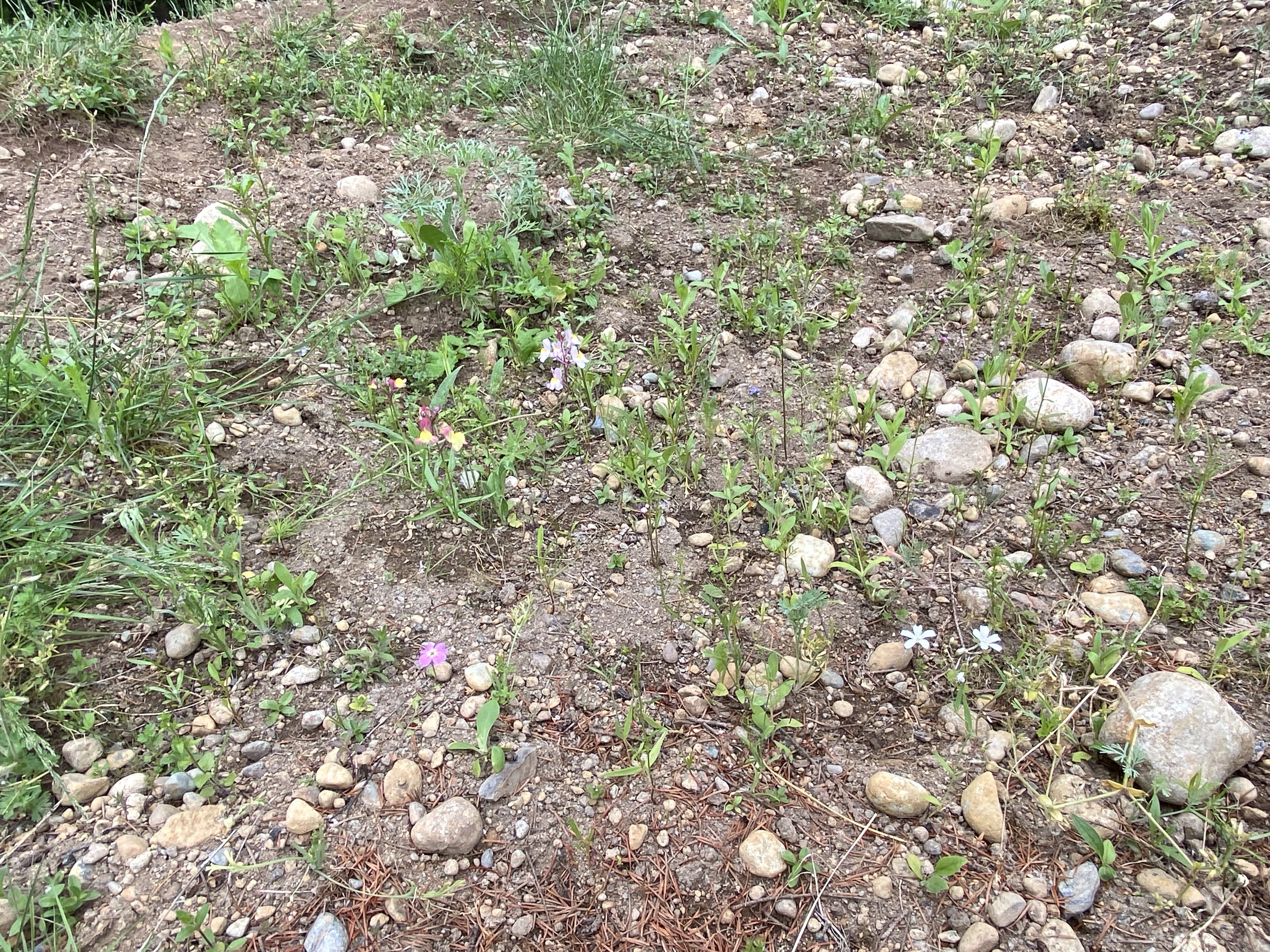
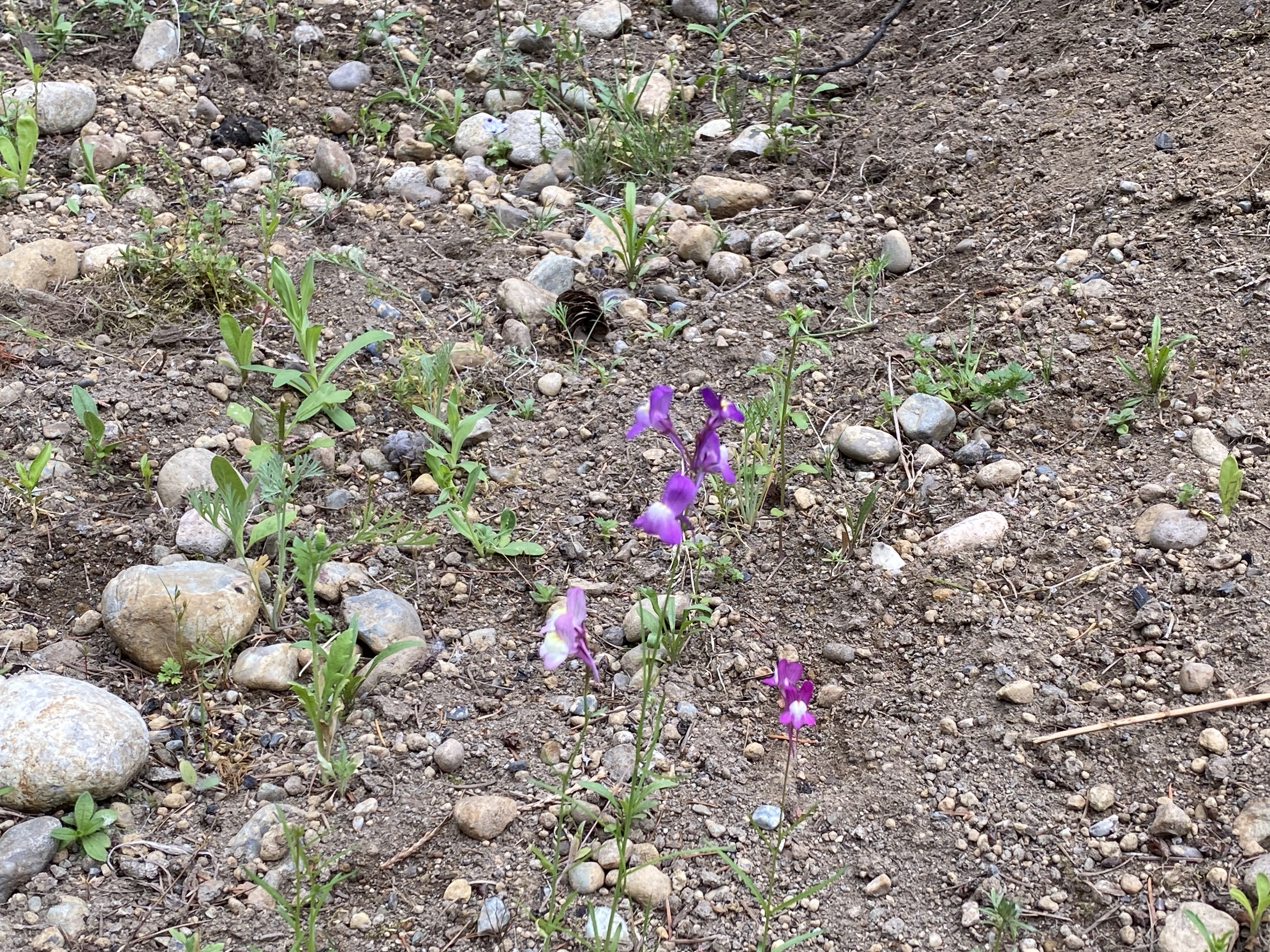
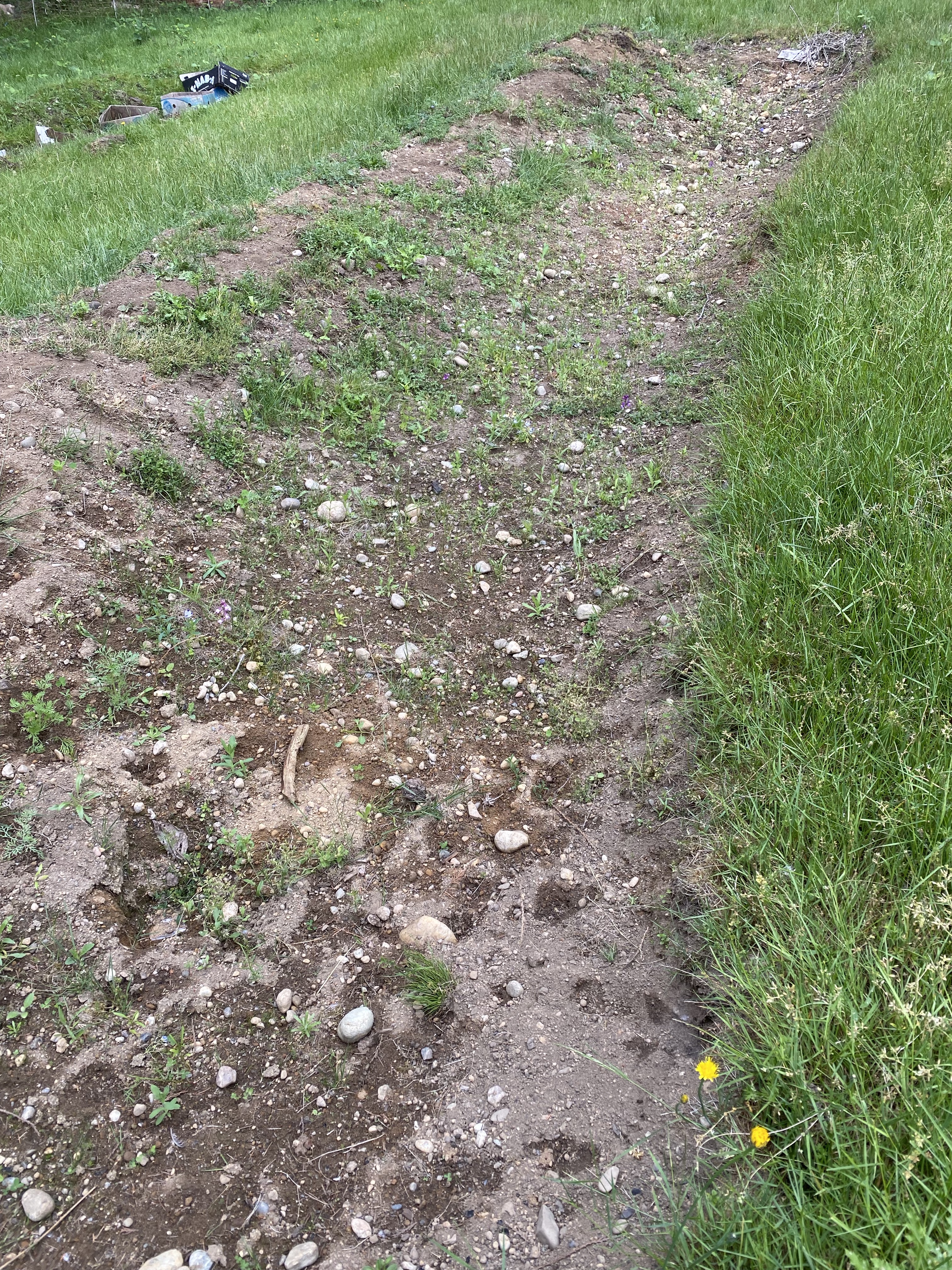
The small colorful smorgasbord of Spring wildflowers unfolds here at EEC Forest Stewardship. Seeds hand cast in April, germinated through May, and are now bursting with colorful blooms. This mix of Northwest native verities like Nemophila maculata and Collinsia heterophylla pictured above, offers familiar species of pollination crops with their intended pollinators. Note- just because something flowers, does not mean it’s feeding the bees and hummingbirds. Many cultivar decorative landscaping plant verities look abundant with blossom, but no charming summer insect buzz abounds.
This patch of diverse wildflower spread covers last summer’s earthwork swale project. There’s a lot of glacial till around here- down slope from what was a shallow glacial lake. Compacted clay mixes with the last vestiges of old growth loam, most of which can now be found filling in Puget Sound. The pebbled surface created an abundance of micro climates in a larger water catchment space specifically designed to slow and sink water. The clay dominate soils sheet water down any slope, preventing retention at the surface, which allows water to permeate deeper into the ground. These wildflower seeds found the right mix of sun, moisture, and shade to make a go of it. Bare open ground and a few days of rain summon seeds sewn in April of this year to live. Flowering has continued through most of June, and at the start of July, and our summer heat, we’ll expect to say farewell to these gems for the rest of summer. Perhaps, if there’s another good rain in the next few weeks, we’ll enjoy a revival. Tune in for more bright color and blooming fancy here at EEC Forest Stewardship.
Cascade Katahdins are chowing down on blackberry in another summer onset of overgrowth. A weed-wacker is assisting in breaking down some of the cane to mulch. Overall clearing success continues, with the slow, manageable replanting in hazel dominate hedge,, big leaf maple deciduous edge, and Quercus garryana savanna. The sheep love everything they can sink teeth into; filling a complex gut. Katahdins are browsers, so they really get into bushy places and nibble away the green wall into more of a collapsed lattice that is easy to chop and drop. This sheep is a best friend to our forest in recovery. After seven years of goat clearing, the Katahdins moved right in and, using the goat accesses, ate there way through the gaps and clearing edges to keep pushing back brush with enthusiasm. We can’t say enough about this breed in Western Washington and how perfect it is.
The work right now focuses on an area we’re prepping for our future Cotton Patch Geese. The small paddock takes about three days for the sheep to eat down, but more work could be done with electric mesh pressuring. With a little more weed wacker work, the pasture will open up enough to host almost a half acre of grazing pasture, but Katahdins are not put off by bramble completely, and enough of a dent was done in this grazing cycle to make the mechanical clearing work manageable. We’re also monitoring a knotweed stand, which is cut down and eaten regularly. The Katahdins also love this invasive as a snack and have kept much of it out of our pastures.
This enclosure was once over head height in blackberry, with a resident Aplodontiarufa, who left soon after the goats moved in. I had hoped to see it down in the creek buffer, but it could have been predated, especially as we opened up the space. Mountain beaver are one of those prehistoric creatures you didn’t know still exists- especially when you realize they are almost blind and deaf. Sadly, these animals are considered a pest by the timber industry, and are often poisoned and treated as vermin. They play an important role in aeration of soil, and swordfern control, and are actually a threatened species. This animal has a very intimate, and ancient relationship with temperate rainforests. The impacts of my domestic stock on their relationship with the landscape cannot be ignored. This specific area of the land is a major replanting zone for our restoration forest plans. We hope that within this lifetime, we’ll have a fully planted stand in this space to celibate.
The sheep play a role that can be too much of a good thing, and it’s so important to know when these veracious browsers should be pulled off the land to give the plants a break. It’s also crucial to keep an eye on the types of plants you’re letting your animals onto. The major pasture areas at EEC have a legacy of overgrazing. There’s not a lot of ground cover or sapling trees present. Moss has a firm hold in the shady areas, and blackberry thrives on the sunny clearing edges, hoping to close in on any open fields. A few oso and elderberry shrubs are established above browsing height, but still take a browsing hit from the sheep- filmed above. If the sheep stayed on this pasture space indefinitely, that oso would be pulverized and eradicated. To establish any ground species where sheep graze, I have to hard fence the space or hot wire during the growing season. Sheep will eat anything lush and green- especially young growth, like new starts. My gardens are all hard fenced to keep the sheep out, and you should fence anything you don’t want them getting into- because they will.
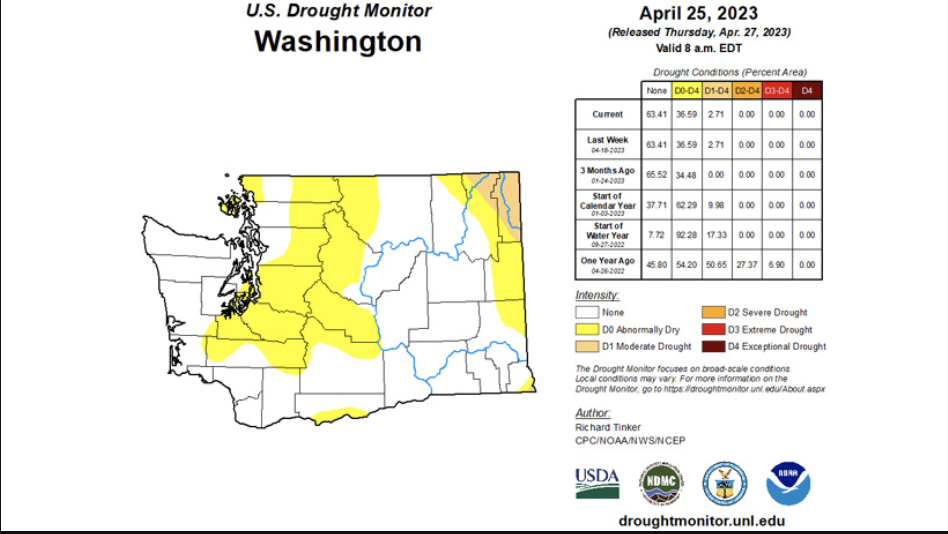
Below is a photo of where the sheep have browsed (on the right of the fence), compared with where they have not grazed on the left. You can still see some green in the eaten area, but it’s lost it’s lush spread, and need a break from grazing before the sheep start grazing down to grass root base and push down branches of the young trees and shrubs. Our brows crowd has no limitations of it’s own, so it’s up to the shepherd to move the animals and gauge the land’s plant phenotypic plasticity. Drought is making our pastures more vulnerable to overgrazing, so the sheep have to be rotated more often, shrinking the amount of pasture time we have avvailable for the animals, meaning we have to reduce numbers of animals. Commercial operations (USDA “small” operations are 500 animals) can’t flex instantaneously to those fluctuations, and are often denigrating their lands under the increasing pressures on our environment. This goes for all agriculture, not just livestock.
I’ve been witnessing more and more surrounding properties with livestock showing the tale tell signs of degradation in gurtled trees, moon dust pasture lands, and compacted bare soil. People seem oblivious to the drought conditions in our area, and are not planning for 90 degree six month summers. They are not irrigating, and are not taking their stock off the pastures soon enough. Here at EEC, we are doing all we can to prevent degradation, replant and restore through rest and rehabilitation. If we took all the livestock off the land tomorrow, we’d still be obligated to mow the pastures to keep them open under our agricultural agreements with the county (detailed in our open space plan which you can find here under parcel ID: 292607-9035) Below is the main agreement page.
With the help of our Brows Crowd, we will keep restoring the landscape with responsible livestock systems and some wonderful long term vision of restorative planting and tending towards abundance. Gratitude to all involved in supporting this process, from Mother Nature to my own Mom, the sheep, pollinators, wildlife, winds, waters, and woodlands- all is good and gracious in this place.
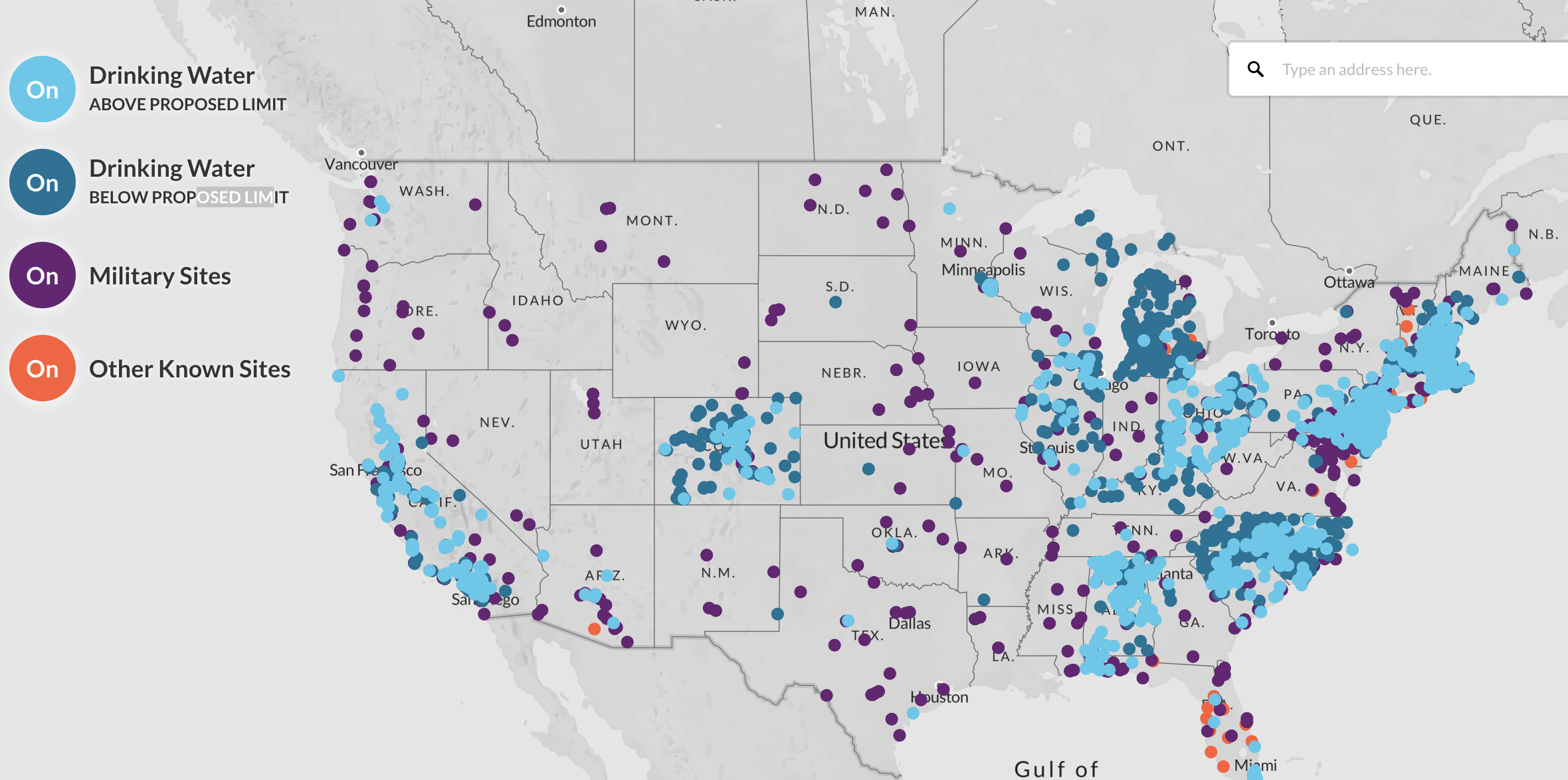
PFAS– it’s over folks, the true cost of our modern conveniences are here and real. The chemical revolution has successfully brought full contamination to our soil and water and it’s going to poison us all. Look at the map above, an interactive version can be found here. Above limits are everywhere- but specifically, they are in the major agricultural areas of our nation and we are all eating them. You and your family, me and mine, are all eating PFAS, which are chemicals that cause cancer, infertility, and birth defects. This is a very real problem that is slowly coming to light in our country, and the most recent cause of mass toxicity is bio solids. The following video helps you understand how this contamination happens and what it means for our long term health.
Please watch this and learn why our water and food are toxic. Lymphoma is a huge side effect of PFAS, and my last dog died of it. She was born and raised on the east coast, but spent her last years here in Western Washington with me on this farm. We do NOT use bio-solids on our farm, but nearby commercial forests are, and no matter where you look, PFAS are present. Products that use PFAS or related chemicals are NOT regulated, so they are everywhere and in use. They are also in all of us, like the microplastics, so get ready for some serious health issues. Remember the movie Erin Brockovich ? Those are similar chemicals to PFAS, and usually used in the same manufacturing environments. The corporations are not stopping the use of these chemicals, and in fact, upping the use and still dumping them in waterways, and sewage treatment plants, which don’t treat for it. Please be aware of this toxic mess in our food and water and write your local legislators to make sure they know what it means to support the use of bio solids in agriculture.
EEC Forest Stewardship does not use any PFAS, but it’s most likely here, like everywhere else. For those of you now concerned about what you might be eating and how much you might already have in you, there are blood tests to find out, but discovering where you picked them up might be more challenging. This post is not meant to panic anyone, but it is a way to express the cost of our careless consumption, and to warn of the contamination in all our food and water. This is an environmental concern with long term consequences we’re already experiencing. What happened to the beef farm in Michigan can happen here too. Though the bio solids are being used a few miles away, it travels in the water and gets into surrounding soil for many miles. What can we do? As I said, write your government reps, if you have the money, get some testing done- water and soil, and report your findings to the EPA. Let’s ask for limits to be set on PFAS and prevent the continued contamination.
The heat is here and while Gill dozes in the shade of his beloved chalet, sheep nibble green grasses and sip cool water hauled from our stream or pumped from the well. Fleeces are on the way out, having shed out through rubbing on fence line and stump. Lambs have grown so fast, now fully weened and fattening up for a good harvest this fall. The subtle flavors of black, salmon, salal, and oso berries with lush pasture grasses and scattered forbs has crafted taste like no other in a lamb bred for good weight gain on forage. EEC Forest Stewardship strives to build diversity in ecology through replanting of native species, and long term topsoil restoration with the help of our domestic animal inputs, which speed up our forest’s return with ample fertility. Summer offers a fine example of nutrient energy bursts into full fledged growth at the start of the warm months.
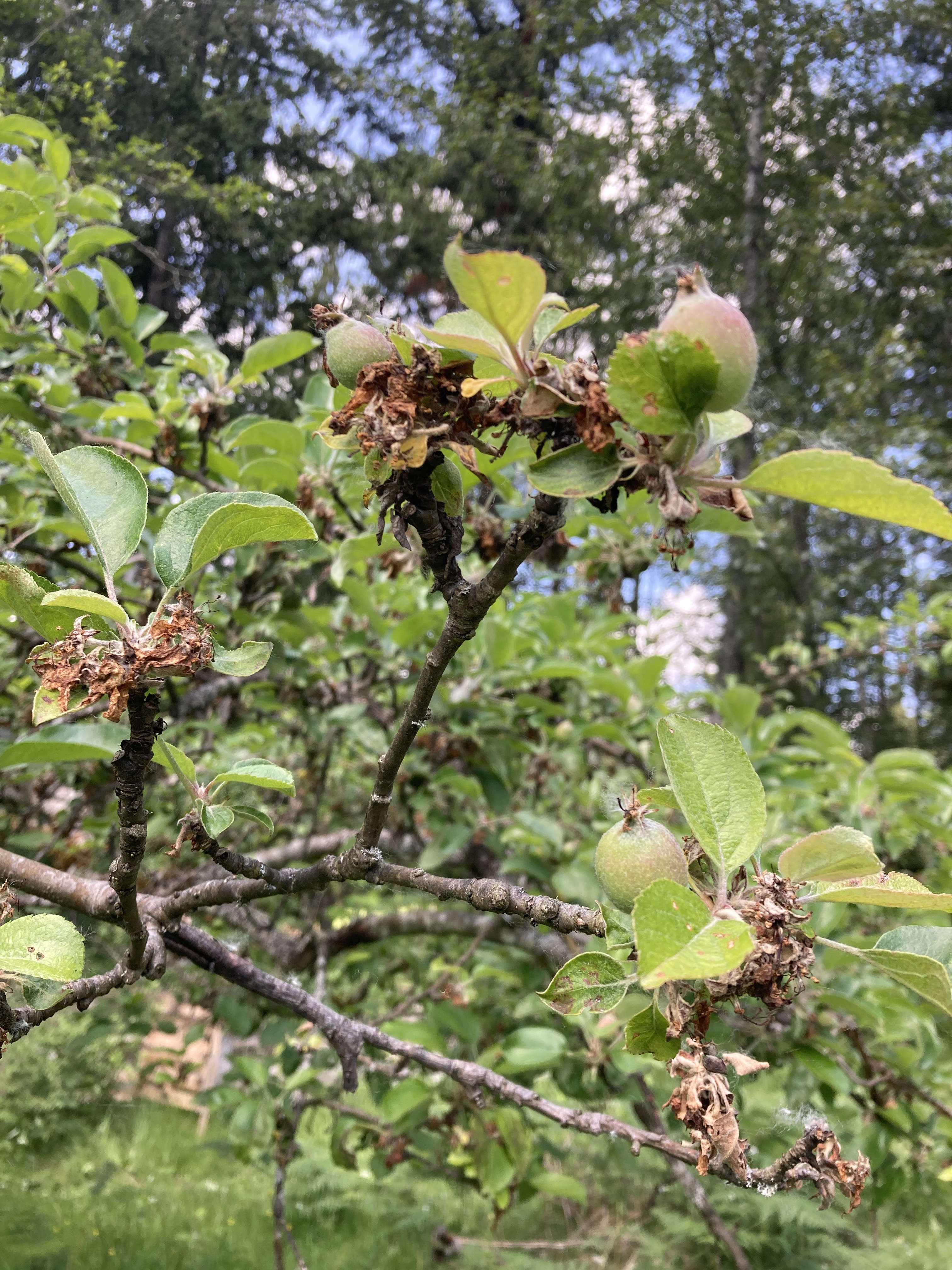
Fruit is on the vine- or branch in this case. Our apples are a mixed bag, with some strong looking contenders, yet the strange fall of last year. Record 90F heat in October did a number on deciduous orchard trees around the state, leaving dead leaves on the trees. It did not seem to disrupt initial blossoming, but pollination might have taken a hit. Single apples are forming, but it’s a noticeable drop in production for these older trees. Still, the select fruit should have plenty of energy from the tree to grow. Orchards demand a lot of water to bare high yields. At EEC Forest Stewardship, we’re focused on food forest development on a manageable, even neglect principle, though we’re still irrigating the young trees to help them establish. We do not water our mature trees, but a few are fed by gray water runoff.
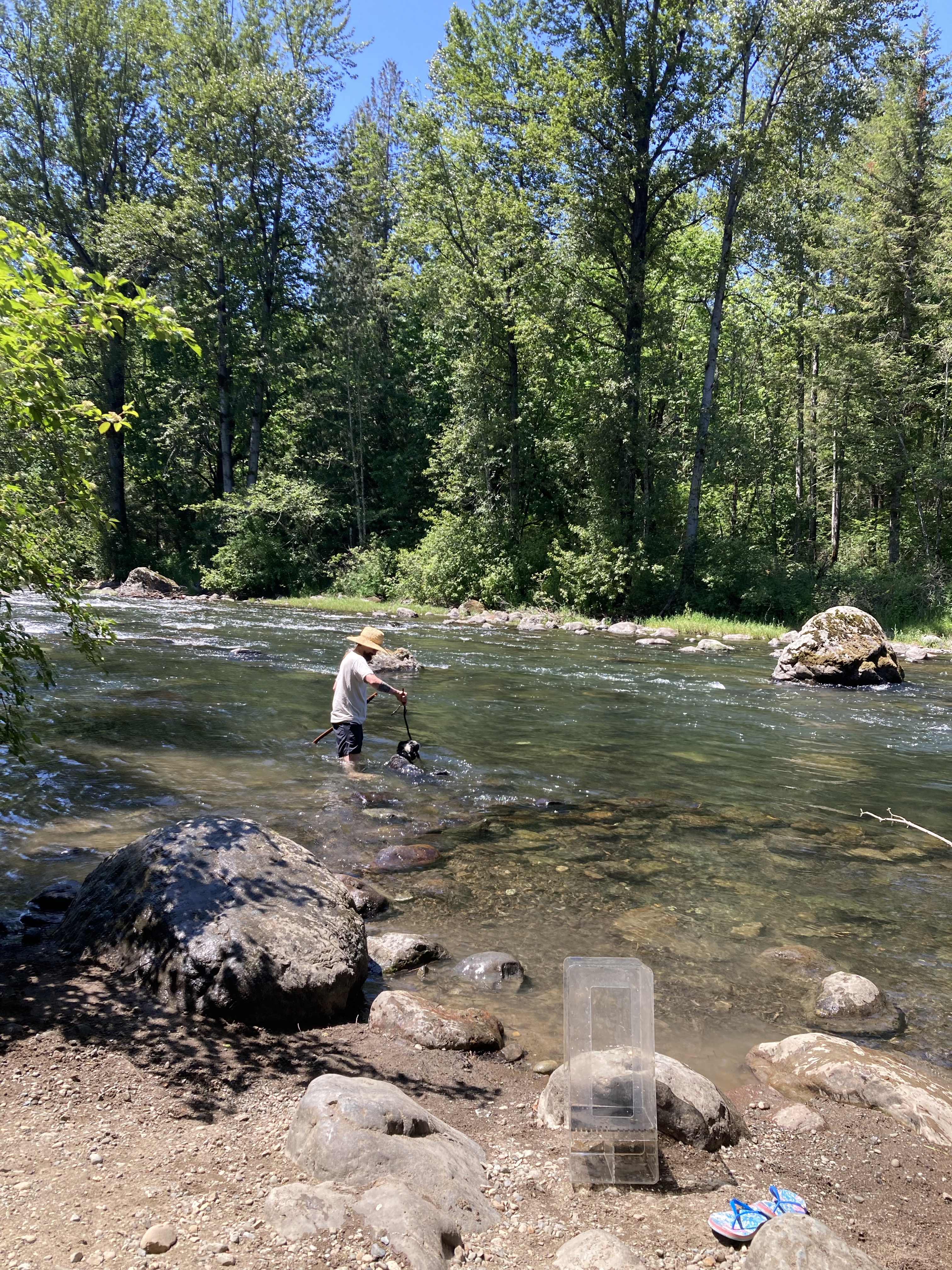
Taking some time on The Green River, we enjoy the unusually warmer weather to get into some wild water that remains ice cold through the seasons. Even the dog had to jump out often for a warmup in the sun. We brought along a plastic aquarium to take a peek at underwater life in the river and witnessed a lot of Caddisfly larva- good indicators of the water’s clarity up stream. Valley enjoyed some good stick time in the current, but found a daunting challenge in trying to swim upstream. We also tried a bit of trout fishing, though nothing took a bite at the line, so with think they were full up on Caddisflies.
With the heat on and pups lazing in the shade, it feels more like late summer, though we’re still waiting for the solstice. Taking more frequent breaks from the hot afternoon temperatures means more time to catch up on blog posts and buckle down on belated spring cleaning inside. The 80F days are also sucking up what little moisture the soil has left, and there’s still many months of heat to come, with no rain in the forecast. This is shaping up to be another record shattering summer here at EEC. We’re mulching, irrigating, and planting as much as we can to beat back the heat. Thankfully, there’s a healthy well and bubbling creek at hand.
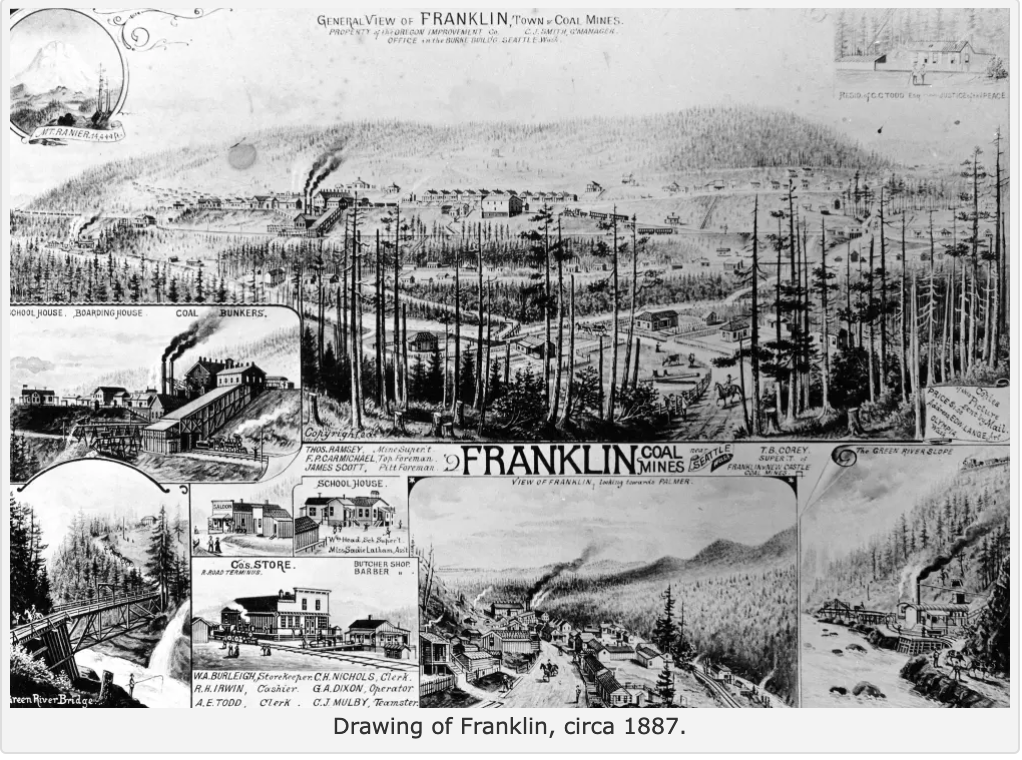
In the continued adventures of exploring new parts of Washington State, we took a weekend tour of The Green River Gorge; staying in Kanaskat-Palmer State Park, and visiting the abandoned mining town of Franklin, now owned and managed by the state. Ancestral home of The Duwamish Tribe, now The Muckleshoot, there is only the watershed title left as any legacy to First Nation People in the area. Dubious treaties restricted and removed tribes from their ancestral lands. Tribes thought they would receive reservation land around The Green River, but by the 1880s, corporations had founded towns and dug mines deep into the area with no plans of giving up the land to “savage Indians”.
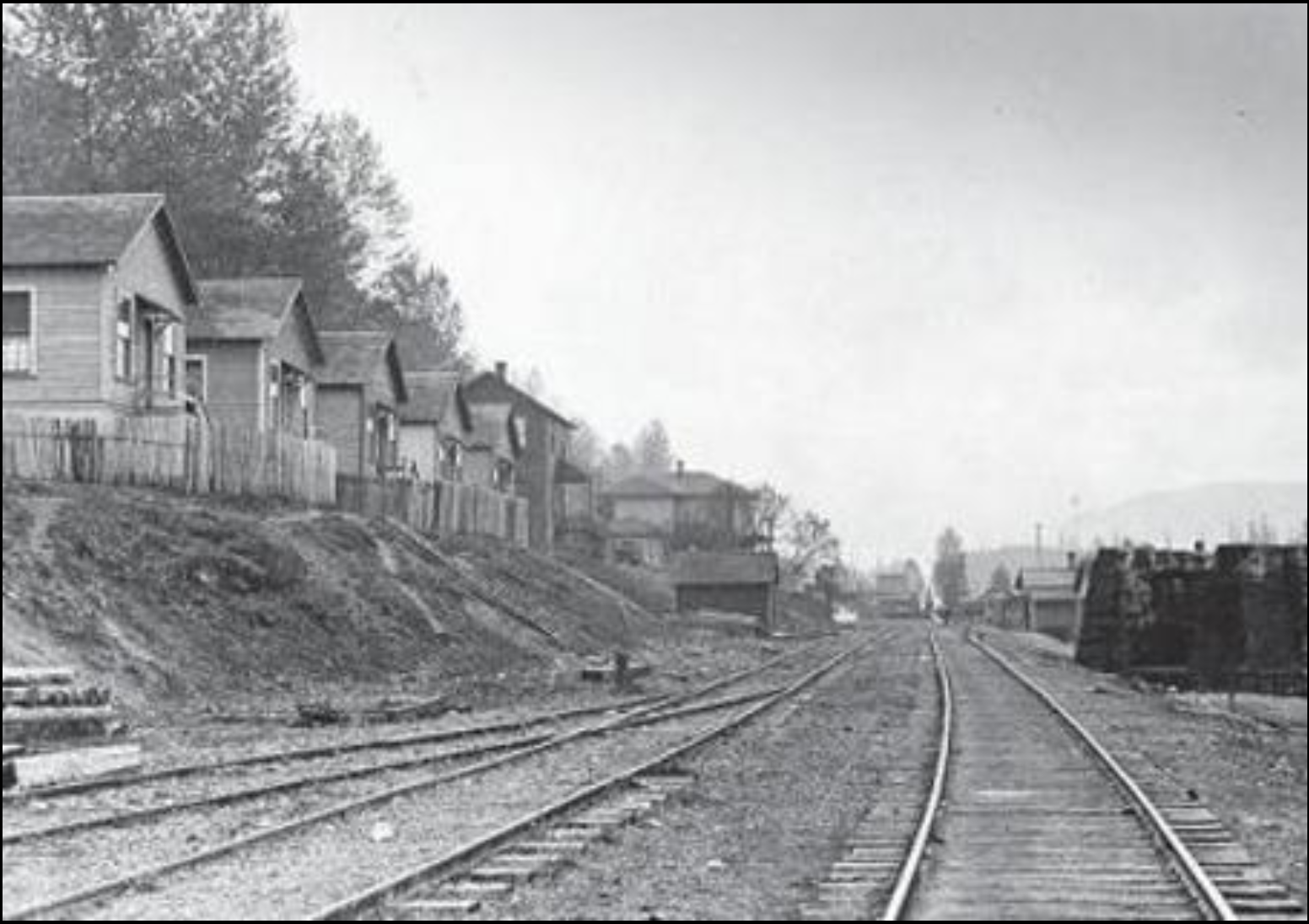
One such town, Franklin, WA, struggled with miner strikes and eventually, in the 1890s, black miners from the eastern US were shipped in to cross the picket lines. Ernest Moore wrote about his African American family in Franklin coal mines, though the book is now out of print. The town was failing again by the early 1900s, as the demand for coal waned, but during WWII, fresh demand for coal sent the miners back down dilapidated shafts to dig. The pits were plagued by fatal accidents, and poor construction, paired with amateur diggers after the experienced miners went off to war, continued to degrade the land, people, and settlements. Below is a picture of Franklin, with row shanty housing built atop mining tails, and empty rail lines.
White colonial narrative and ownership weaves a toxic trail of resource extraction left by careless plunderers and labor abuse practices. Though the river today looks quite breathtaking, and the gorge holds deep etchings of geologic time, scars of mining, railroad, logging, and abandoned settlement remain haunting reminders of abuse the landscape endured through industry. The area’s natural beauty was preserved in 1973, after the last active coal mine closed in 1971. Still, the land had been raped by industry, and such violent treatment of the earth caused long lasting consequences for the miners, their families, and the surrounding population though the generations. None of the commercial entities which originally founded the mines are around today to take responsibility, yet today’s companies float a similar river of greed with no care of human or ecological devastation. Who’s still buying most of what they need from said corporations? *raises a hand*
For our outing into this history, we walked Franklin’s overgrown streets, where domestic roses twine up young alders and through old stone and brick foundations. Arsenic seeps out of the old coal seams, and it was that neighboring chemical poison, which ultimately killed many people in Franklin and forced the abandonment of the town. Today, down the mountain from the old mines, there is a natural spring many people gather water from, yet no one seems to care about the surrounding toxic nightmare that slowly continues seeping into the groundwater. Shanty villages of broken down RVs and blue tarps nestle nearby. Many of these destitute people can trace their lineage back to miners who were exploited by industry, just like the land.
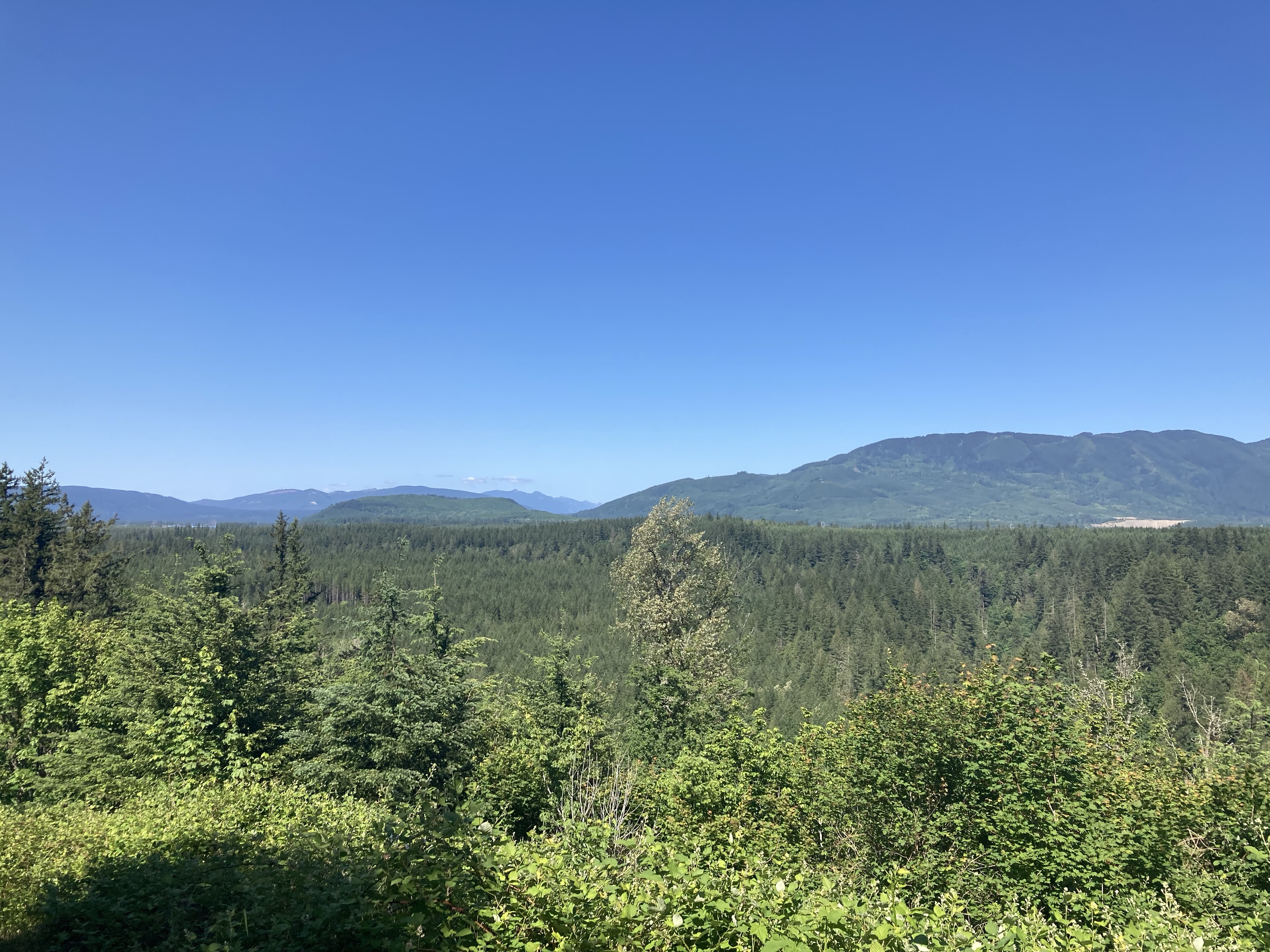
From the mountain that once hosted Franklin, you can look out across The Green River Valley and still see corporate greed at work tearing up the landscape and building elaborate structures to propel profit for the few at the cost of many. What really struck me, in the one night we spent in the area, was the energy which spoke volumes of the abuse and pain still flowing through the river today; nightmares. I had very unsettled dreams, full of miserable people waiting in long lines to get a pay check, or struggling to get out of the mud, children crying and women screaming, it was palpable. Many people received violent deaths in the mines, but many more were slowly poisoned by the pollution of the pits, and the arsenic released by their digging. Green River Gorge is a beautiful river today, but the surrounding history of extraction haunts the hills with ghosts long troubled by greed and carelessness.
If you find yourself in the area, bring something to smudge with, and expect disturbed sleep, as the unrest in Franklin continues, along with the legacy left by careless taking and giving nothing but destruction in return. Now the state is left to continue cleanup, and though there are some nice walking trails and mountain views, the soil is soaked in coal ash and littered with the ghosts of people swallowed up by the mines or sentenced to slow death by poison. Such abuse still persists into modern times, though now instead of mines we have microplastics.
Gill is our amazing Livestock Guardian Dog. He is a Kangal, born on the streets of Istanbul, and rescued through an international group out of London, who exports the dogs to breed specific agencies like Anatolian Shepherd Rescue. In North America, Kangals have been anglicized into a shepherding breed, but they are Turkish in origin, and are called Kangal Çoban Köpeği. These are serious working dogs that need a real job, not a home pet lifestyle. Our 5 year old male, Gill, came as a rescue with no prior sheep experience, but his instincts kicked in immediately. These instincts can be traced back over 5,000 years to The Bronze Age, when herders needed dogs big and brave enough to scare off bears and wolves. The large carnivores predating livestock were driven off by the huge, ferocious K9 guardians, beloved by their humans. The relief pictured below comes from Mesopotamia, and shows one of the earliest renditions of a massive livestock guardian dog with his handler.
Though Kangals are fierce and brave, they are also extremely gentle and intelligent. This breed of LGD does not bark aimlessly in the night, but alerts with a variety of different pitches and intensities, depending on what he’s encountering. After two years of working at EEC full time, Gill is well settled and very selective about barking. He knows the deer that move through, and rarely alerts at them. He knows all the neighbor dogs and does not react to them, even the ones right on the other side of our fence. The other day, I watched him laying and looking on as a neighbor rode her horse right along the fence line. He observed, but had no reaction. Gill knows what is a threat, and what is a normal passing activity. Not all LGD are so aware. If you are in the market for a working dog for your farm security, there’s a lot of research to be done.
EEC Forest Stewardship is fenced with 6′ high woven wire stock fence. We have sheep, chickens, cats, clients- with children, who visit us regularly. Gill is a saint, vetted for all this activity and work. We had to slowly introduce him to other animals, including Valley, our true shepherding dog. To be clear, Kangals do not and should not drive or chase the sheep. When Gill puts out a true bark warming of eminent danger, the sheep flock to him for protection. He stands in the middle of them watching to make sure no danger is dumb enough to approach. Our fencing is mostly there to keep him in and at a safe distance from passing predators. Gill is not allowed to free roam, he would roam far and wide if let loose. He is also never taken on a recreational walk off site. Kangals can be socialized to other dogs, but they are very territorial. and might react to a badly behaved dog in public. Kangals demand respect and authority, and will make decisions on their own if they perceive a threat. Where they are allowed is there territory, and they will control it. Safe, well fenced, spaces give Gill free reign without the stress of new and untested spaces with too much unpredictability, which would cultivate insecurity in the long run.
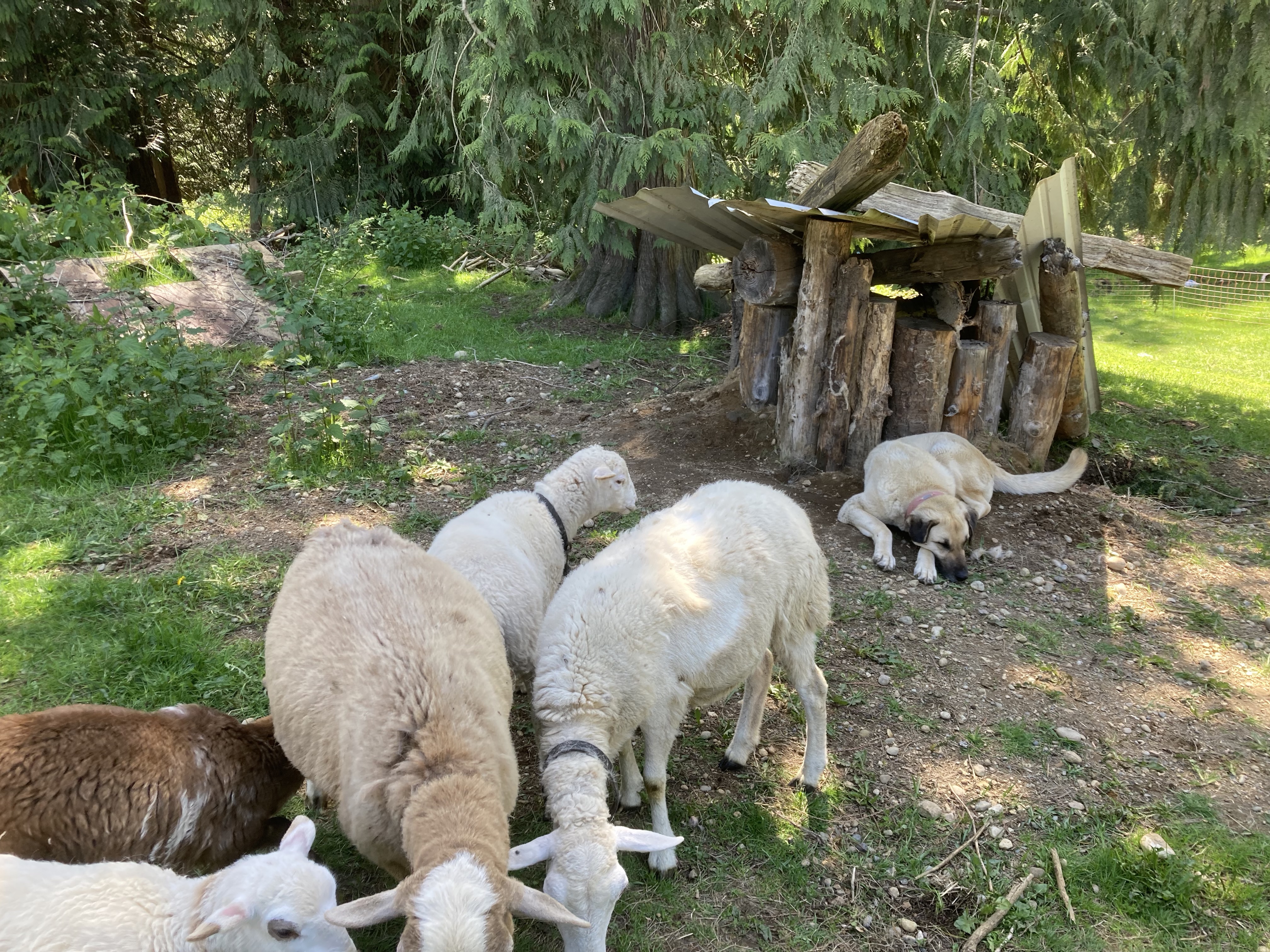
I can’t say enough about how crucial stability and leadership is with this breed. Gill has absolute trust in me, which I earned, and maintain in a close working relationship with him. If I asked too much of Gill, like going to an off leash dog park where he might encounter unbalanced dogs in an unsafe place, he might react badly and lose my trust. It is imperative to give Kangal dogs a safe place with good work, that feeds their instinct to guard and chill. The picture above is our flock and LGD situation most of the time. Everyone is resting and relaxed. Gill chills by his chalet, listening, but not anxious at all. He’s such a good boy, and his state of mind reflects the well balanced life he lives. When he came to us, there were subtle insecurities, and he barked a lot more the first year as he adapted to his new surroundings and settled in. We had to teach Valley protocols in his space too. One major rule is no toys in the work space. Stick fetching is allowed, but if Gill takes the stick, it’s his, and Valley knows to relent. If she didn’t submit, and we didn’t back him, Gill would be confused by the pecking order, and that could cause mistrust between the dogs.
Valley agrees to respect Gill’s space, not just because he is bigger, but also because he respects her work too. Gill knows when Val is herding, and does not disrupt her seeking control. How amazing is that? This huge protector knows the difference between another dog moving the sheep, and a coyote chasing them down. This might seem obvious, but a lot of LGD breed would kill another dog messing with their sheep. Our other boundary with Gill, which is very important, involves keeping him out of the main human territory here at EEC. We do not allow Gill in the zone one (daily human action) area of the property, where the cars, living spaces, and gardens are. Our Aussie Valley, is allowed in the human spaces, so she gets a Gill free territory of her own too. Gill understands that he’s not in charge in that space, and though he will bark at someone driving in to let us know, he accepts that it’s not his space to control- but only because he is not allowed there. These kind of subtle but crucial divides in work space keep both our dogs in harmony, and capable of playing nice on the job.
Training is constantly happening within our pack; it’s just as important for the people involved to behave well too. Most basic behavior training works well with both dogs, but there are some major differences which become very apparent when misused between the breeds. Valentine is a physical dog who does not shy away from collar grabbing in the heat of the moment, but if you grabbed at Gill without thought, he would slink away and avoid. This is a simple difference in instinct and drive- Val is a doer, Gill is a watcher. Knowing these breed personality differences helps so much with successful training. Characteristics can be discovered and worked within mutts too- but it’s sometimes harder to find all the traits in a mixed pup. Breed character is also some guess work, but Gill’s 5,000 years of developed guardianship and alertness as an independent flock friend is silent stealth with ambush ferocity. Valley’s recent 200 year development as a sheep driver, for Basque herders in California, counts on people signaling her to work.
Trying to reprogram Kangal instincts seems somewhat cruel. Gill loves sleeping out- feeling the air on his muzzle, being able to stretch and roll in the earth. Replacing such deep nature connection with four walls and carpeting, with background city noise, would drive his sensitive alertness crazy. Urban Kangals are often known as barkers, and I know why. Gill will go off if there is disturbance, like a bear rolling up to the fence line once or twice a year. When he hears them in the creek area, he’s less aggressive, and only gives a short warning bark to alert them of his presence. Gill does not free roam the wildlife habitat area of the creek, but passes through on a leash when we move the sheep to the back pasture. He’s much more vocal back there because it’s the least human engaged space on the land. Near the barn and human habitation, he’s got our scent keeping most predators and wildlife away. Deer still brows through- Gill only alert barks at them if they are crashing through the undergrowth, which is rare. He knows the local fauna well. Kangal bark tones are diverse, and clearly tell you what kind of a disturbance is going on. If a Kangal was in an urban place hearing so much action, it might struggle to sort danger from passing disruption and remain on high alert, bringing on anxious barking, which creates a nuisance.
When I take Gill to the vet, he is often much more anxious because he is exposed to a lot of change and strange all at once. He’s an angel with our vet and any techs who handle him, and he tries to be quiet, but still gives little alert yips in the parking lot while we wait as other pets come in and out of the vet’s office. The vet and I know he would not do well waiting in the building, but he’s a real champion in the checkup room with his health care friends, who know him and his breed and what to do. Gill is not people adverse- he’s very friendly and social with folks- which is also often misunderstood in LGDs. Some livestock guardian breeds are used to ward off people; and those are often the ones, I find, that do a lot of anxious barking at night. Kangals in Turkey work with the flocks till they are too old to keep up in the fields. Then. they retire to village life, and watch over the elders and the young. Kangals are not personal protection dogs and should not be trained to become aggressive with people.
In singing the praises of our dog, Gill, the Kangal, I hope to let other flock folks know how amazing this breed is with sheep, but to also let dog lovers know this is NOT a bring home to your backyard or family home pet, but a working animal with a close connection to being out with the sheep in a well fenced, extensive acreage- along with lots of training and socializing . Old dogs could acclimate to a large home with well fenced back yard. Do not buy an LGD breed without lots of prior dog training experience and a job for the pup- with livestock! Do look more closely at the Kangal for guardianship of flock and farmstead, which these amazing dogs preform when supported and respected by people they trust. Gratitude for the generations of shepherds and villages who worked to create this breed.
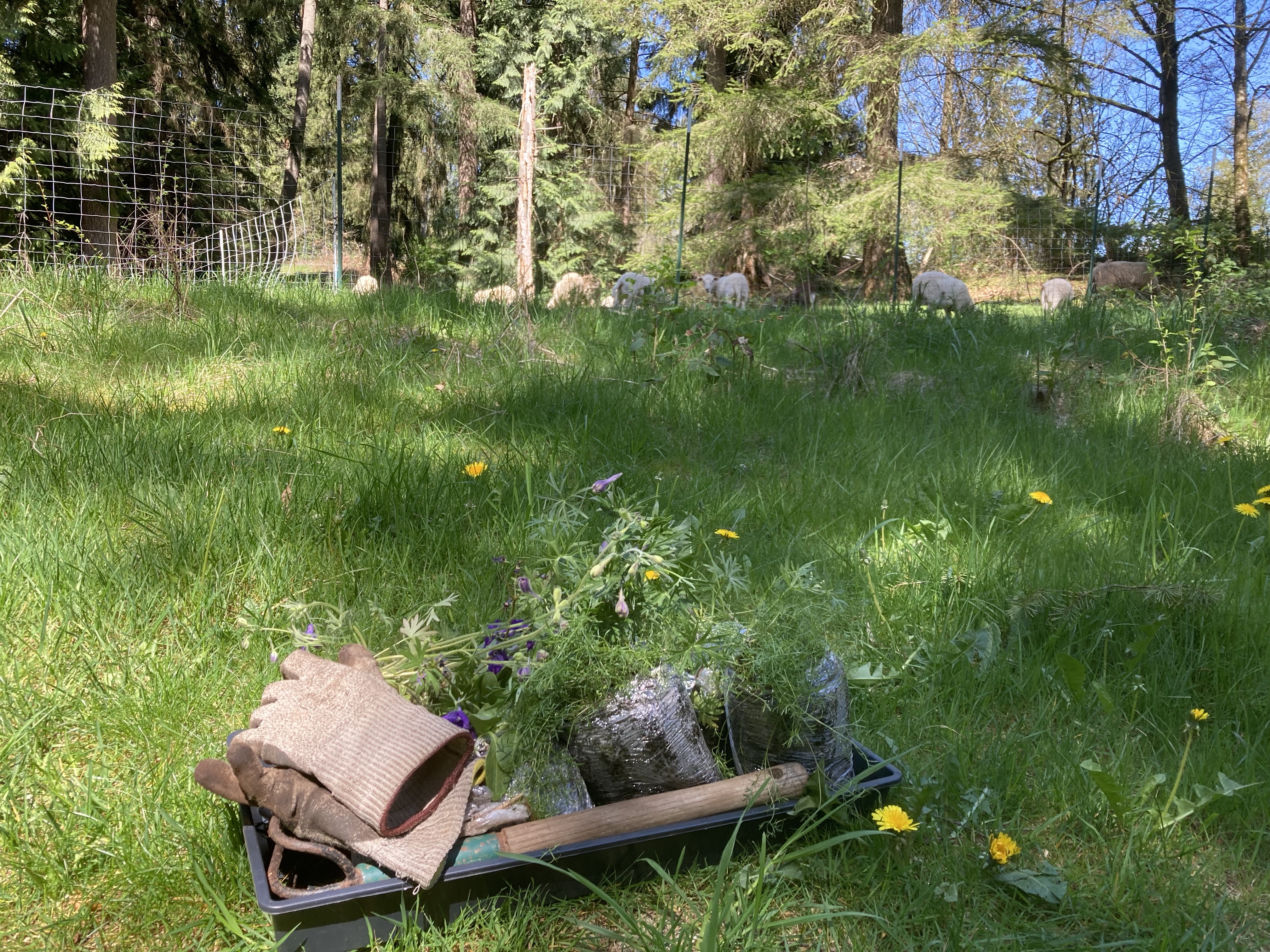
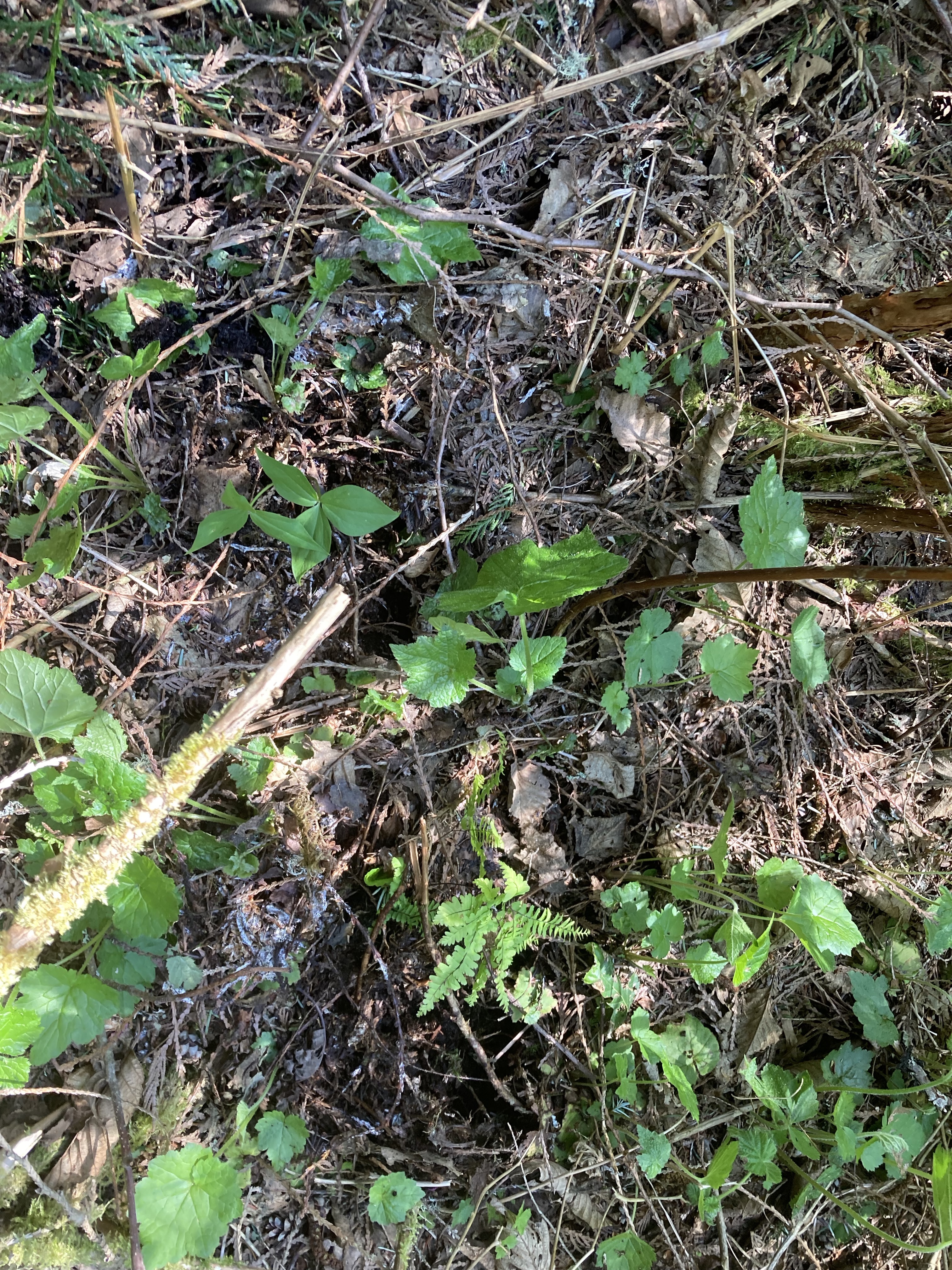
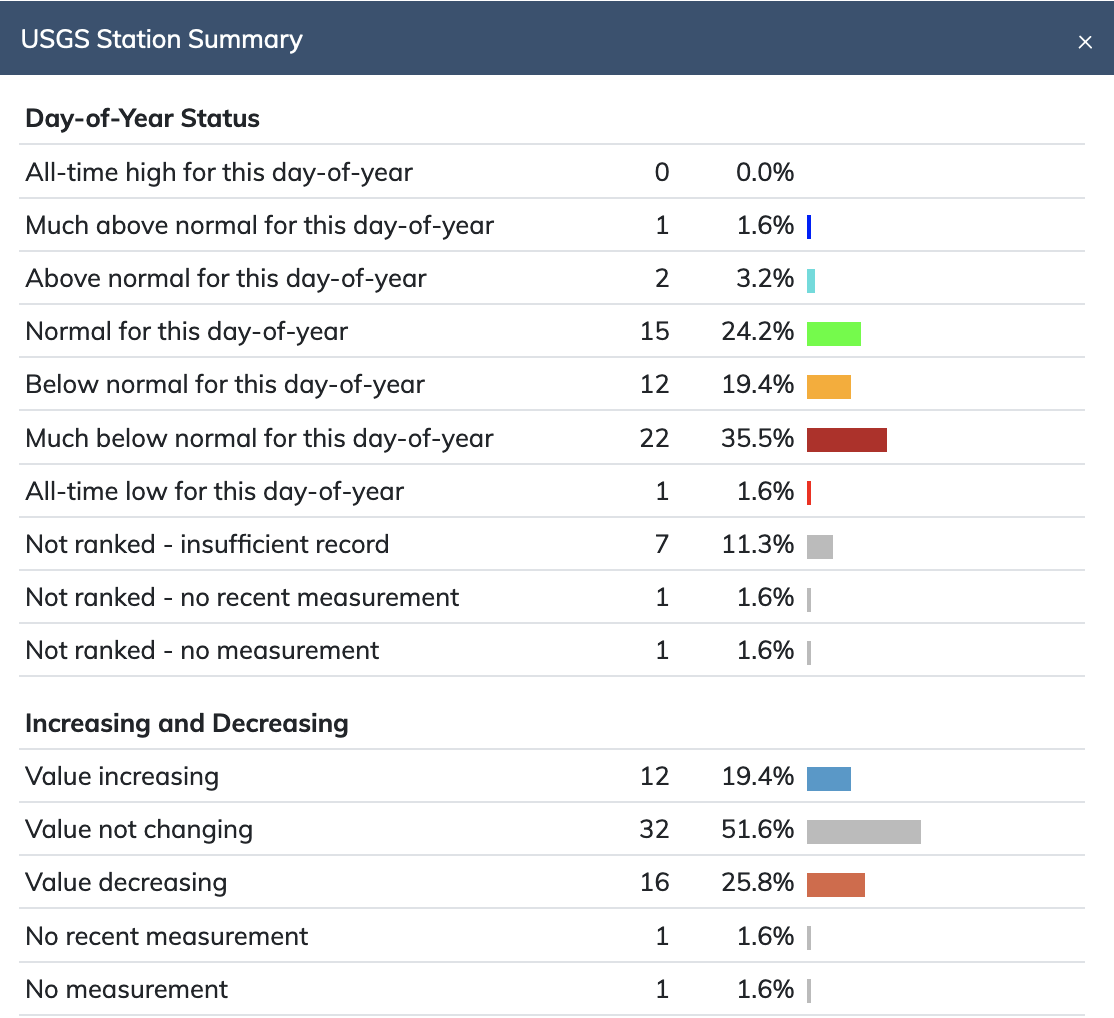
It’s a blossoming time for native planting here at EEC Forest Stewardship. We’re watching lambs grow on green pastures and rooting more wonderful flowers like bird’s foot and shooting star. These wonderful plants are helping to diversify our understory variety and encouraging native pollinators across the landscape. Some of these plants are eager for sunlight, while others, like trillium and maidenhair fern prefer the shady wetlands of our creek. It was particularly exciting to plant the first trillium back on the land here. Slowly, over the next decade, these rare flowering gems will take root and spreed, but it does take time. It is often said that planting sooner is better, but learning the land and where to plant for success takes time and patience. Even with 10 years of observing and mapping the land here at EEC, climate change throws a wrench in every year. Many of these cool weather plants are going to fail in the long run. Our damp forest floors are drying up. Right now, May 2023, Alberta and British Colombia Canada are on fire to our north. Down in California, flooding continues after the state received most of our winter rain events- known as atmospheric rivers. Without that water, our temperate rainforests are hurting as we begin the warmer months in earnest.
The weather cannot hinder our replanting efforts, we’ll keep rooting into the soil here with as much divers adaptation possible. Nature finds a way, and our support in offering species that are at home here is on the right track, but we’re also mixing in some more drought resistant species like oak and lomatium. As the next few decades unfold, EEC will keep on planting and protecting, with extremes in mind. This week temperatures are in the 40s at night and 70s during the day, but in just a few days, we’ll be experiencing our first real heat wave, jumping into the 90s. The newly planted natives will experience quite a shock, and those not in a place of irrigation will be watched closely, as new plantings are very vulnerable to extreme temperature changes while still struggling to establish their new roots. This kind of heat spike is not typical, but compelling changes in our climate of once temperate rainforest. These hot flashes, combined with a missing 4 inches of rain this winter, will put a strain on already stressed ecology in our region.
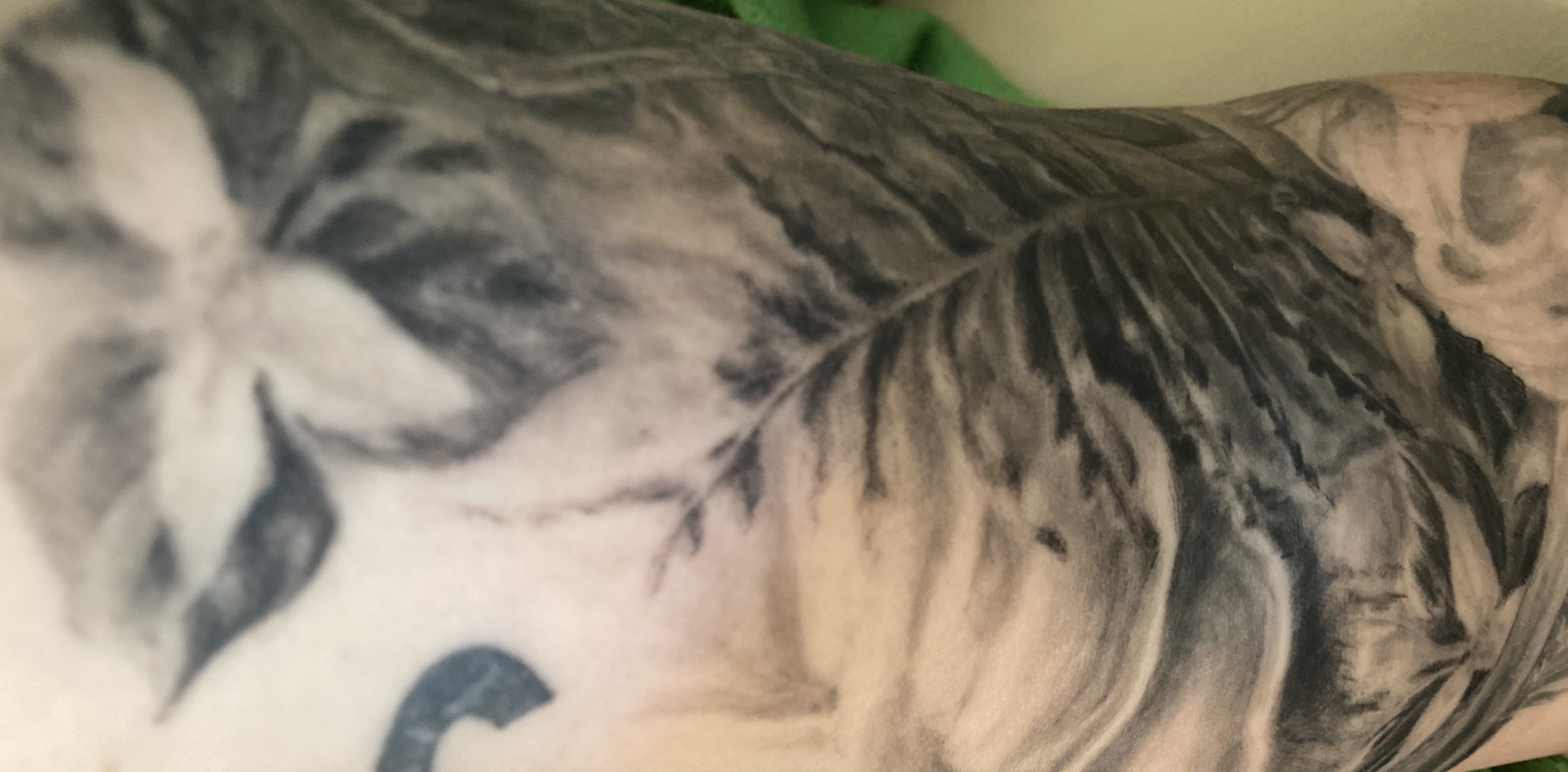
It’s always better to do most planting in the fall, as temperatures are cooling, not heating up, but new growth happens in warmer months, so these new natives will get a chance to hit the ground running and we’ll be out with water buckets hauling to help make sure this important investment in restoration survives abnormally dry spring conditions. There have been some morels out though, so not all is dry all the time. I’m still hoping for a cooler spring, like 2022, but I think we’re in for another scorcher. It’s hard to see the future, of course, but the days of cool morning mists and fern filled forest floors is slowly retreating. Below is my tattoo of our temperate rainforest floor, with trillium, bracket fungus on a log, and sword fern reaching up from the mossy ground. These images of a wet, wild place with Jurassic evergreen growth are symbols of abundance. Cultivating the waters ensures survival. Planting the foundational forest structure now will help protect soil dampness and the environment necessary in hosting the beautiful flora represented in this body art; hopefully not destine to one day be an historical record, rather than a reflection of what continues to thrive.






 EEC Forest Stewardship