The Farm Bill?

This video caught my eye on the tube and so I took a moment to watch. There are a lot of mixed messages in the information, and some outright contradictions that the journalists who compiled this information do not pursue- maybe they will in future. I’m going to point a few things out and try to address them.

Commodity crops (soy and corn) vs.

The 1996 Farm Bill removed regulations on how much of certain crops could be grown, in favor of how much a farmer could make in the global market. This took larger, mostly corporate farms- the top 2% of farms, a lot of income. This happened because of corporate agricultural business lobbying for more government subsidies to make more profit. Let’s take a deeper look at these top percent of agricultural business, which dictates The Farm Bill.

Check out the #1 agricultural corporation in The World, Cargill– specifically it’s criticism arounf child labor, union busting, land grabs, and deforestation. These are the guys pushing palm oil over jungles and cheap child labor for investment gains. Number two in the world of agricultural big business is our old friend Monsanto– which merged with Bayer (#3).

John Deere is #4, and that’s all heavy equipment for the industrial farming- no small farm can support such massive machines, yet most of the technology that helps larger farms today is run by this company. They are in trouble with The Feds over right to repair and walked away from DEI. To name a few issues not in their Wiki page.

I would divide farming definitions of size by heavy machinery used. If you use more than a couple of tractors to do your farming, you are not a small farm. For people who use no large farm equipment (Leafhopper Farm LLC) in their practices, there is already the reward of not getting caught up in the costly nightmare of large equipment and the fossil fuels to run them. Yes, those who grow in that way are producing little in comparison, but if everyone with only a few acres practiced small scale- or were compelled to as part of the responsibility of owning farmable acreage, there would be an abundance of food in our communities, and we could move towards free food for all. I truly believe this based on my own production.

The #5 largest agricultural business is Syngenta AG– which has all the chemical fertilizers and seeds. Its stock is owned by a Chinese state owned company. People are so worried about Tick-Tock, well this company controls the majority of toxic chemicals used in food production. Do your own deep dive on these horrific affairs.

#6 is the main drive behind commodity crops in the US- Tyson Foods Inc. The meat industry is controlled by two main players and Hormel is the other one. We grow all that soy and corn for the animal feed these companies control. The video points out that The US is the top world producer of meat, and that industry gets $64 Billion in trade from it. Your local meat growers, who do not export, are not getting any say in The Farm Bill, and certainly won’t see any revenue support from it. Take it from a local sheep producer like me.

Now that you understand who the real players are, think about how much government subsidy is really going to them. As the video shows, many mid-sized farms that are still family owned, rely on the handouts through these big corporate influences running the show. Almost all farms have to get at least some of their inputs through these companies, and so they defer to those interests, because the big companies are the only ones representing themselves in congress through lobbying. There are individual farmers that still spend their precious winter months off in D.C. trying to protect family farm legacies, but that’s not where the money is. As Locust Farm’s owner said- he gets about $500 a year in federal support, and that’s not enough to cover anything.

About 9 minutes into the film, bio-fuels are briefly mentioned, and that’s another critical part of the Farm Bill web they should have looked at a little more closely- but it’s not related to their alarmist title “Why US Farms Are Struggling” if you think farming is only about food. Fuel is what runs most farming today, and that fuel is also starting to take priority over food. We can’t eat fuel, and it’s production is killing the environment which is our food, and water, and air. We are animals that can’t survive without clean environment.

At 9:30, the medium sized farm owner went into the small town economy talk, which again, this video seemed to step right over and not address. But pivoted back to human health, and it’s here I would like to make another point. The family farms that are bought into financial ties with these controlling corporate agricultural businesses can’t escape. They know that all rural business is tied into the corporate web, which they are beholden to. If they break from the norm, they have no income, and the rest of the town business goes bust. They already are bust. The medium sized farms are debt slaves. They pay any profit back into the farm for the massive inputs industrial farming demands. It’s a loose loose for farmers and the land, and it’s killing both.

For the little farms still being family run, suicide rates are high. This video does not get into this sad fact, but it must be mentioned here. Besides all the financial worries, farmers rely on the seasons and weather patterns, which are now becoming extreme. For corn and soy, this is not so scary, because the commidity crops are protected by The Farm Bill. But for the food crops that we really need in day to day living as people, there is little support or care, because salad greens and carrots are not profitable in our current federal programs and we can just import cheaper goods. How is that helping the farmer? The video does go there at 9:40, but then allows The Secretary of Agriculture, Thomas J. Vilsack, to “see things differently”. That’s it? WTF? Where is the journalism here?

At this point in the film, I was wondering what this was all about. The title is “Why US Farms Are Struggling”, yet this film is trying to talk about The Farm Bill as… good or bad? I think bad, but it’s so illusive on a real point beyond things are messed up and small farms, which grow most of the actual healthy food for us to eat, are not going to be around much longer. That is true, the way things are going environmentally. But when you go to the grocery store and reach for something that is no longer there, what then?

I’d like to close this little exploration with another video to help us see what’s happening in a close allied nation to our own. One we are working very hard to open more food imports to- England.

I’ve been following Flank Farm for a few years. I like that it’s run by a woman, trying to survive in the small farming world, and that the second generation is trying to help bring the story of family farming to a wider audience. England just passed a budget that will deeply impact family farms. What this woman farmer shared at 6:00 is what I think about all the time in farming. Our food web is vulnerable in so many ways. We can’t eat money. What will happen when food distribution is disrupted again like 2020 and COVID? For England, a small island nation, the affects are tremendous. Here in The US, we are building similar cracks in food systems by letting big money control our basic needs. The corporations are not living people, as so, they devour us as their income. Start planting your gardens now, and connect with other growers. When this system fails, backyard gardens and a few fruit trees down the street are all that will stand between our society and starvation. Get planting now and learn what’s growing on locally where you live.
Hops and Holly

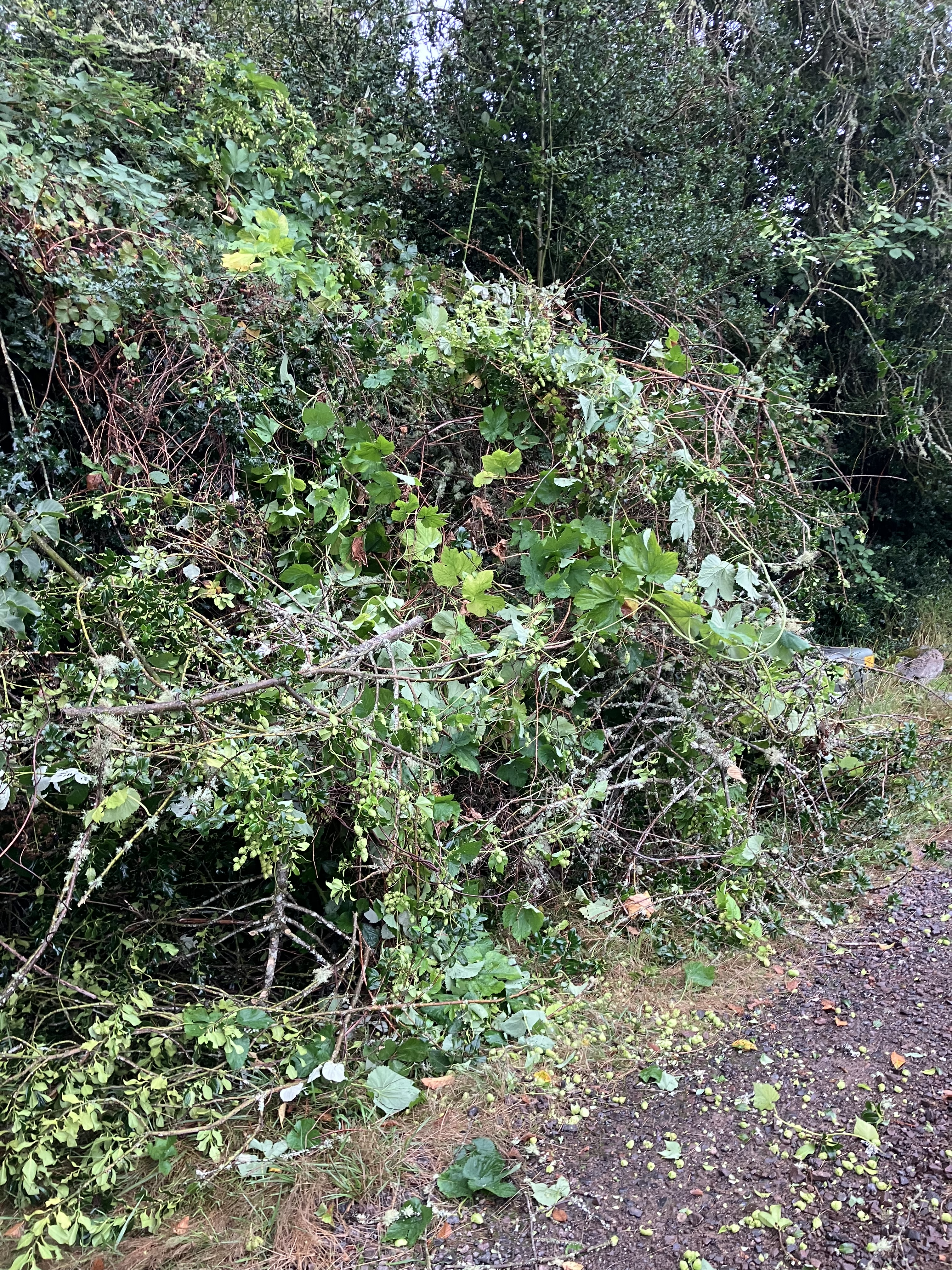
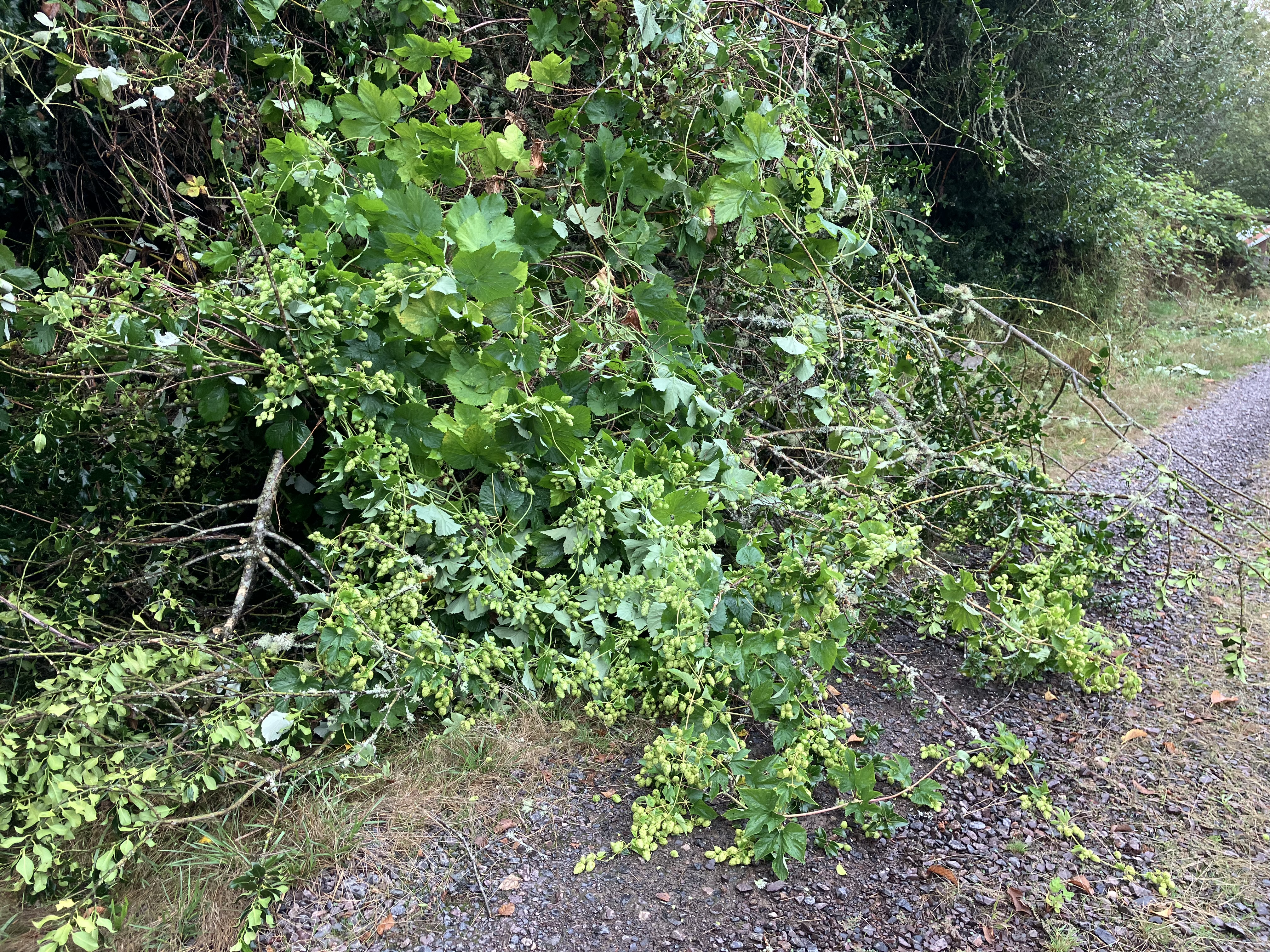
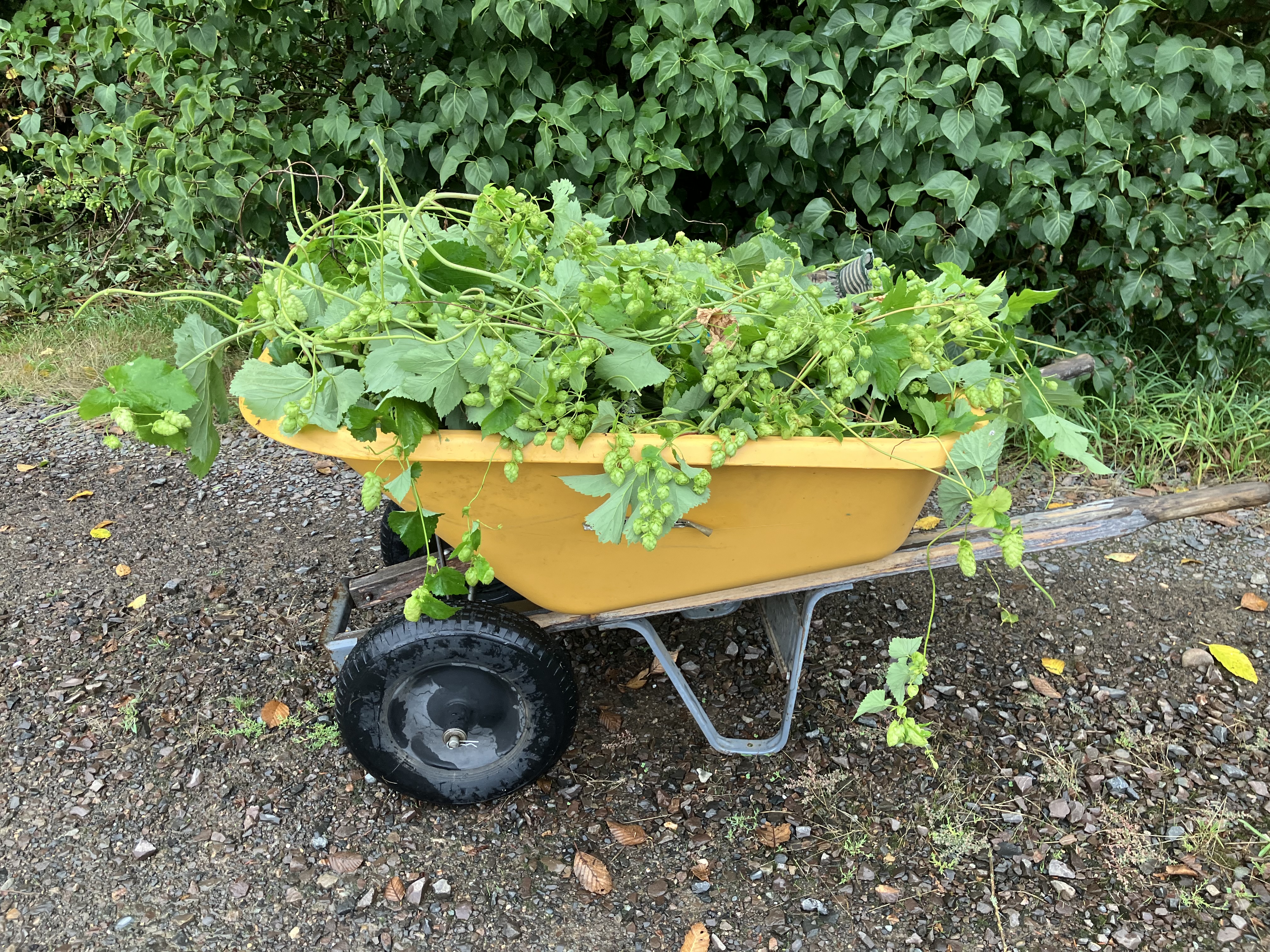
There is a wall of thick greenery on the north side of the land at EEC Forest Stewardship. There, an old wire fence demarcates the property line and hosts a hedge of elder stature. This lush vegetation is dominated by a critical invasive species- Ilex aquifolium. Because of its mature establishment on this fence line, I’ve let it be more often than not, as the trunks reside on my neighbor’s land more than mine, but when branches lean too far over, I do take out the saw and cut back the intrusion along the driveway. In recent years, I also saw the hedge of holly, a problem, and made it my solution- a lattes- for another aggressive grower (but native) Cascade hops. It’s been a success! This year I took down some of the second story high growth of both plants and had a fantastic hops harvest, as well as a harvest of good hard wood for tool handles and building material. I’ve quickly dulled a few chainsaw chains, but all for a good cause.

Two longer holly logs will go into refurbishing the hay shed. It’s main cross beams are starting to decompose. Many of the agricultural structures on the farm are cobbled together with scrap material and wild wood. The largest timbers are whole logs that were never fully debarked, so insects got in and are now dropping enough frass to show those major structural supports are failing. New holly beams will bring strength and stability to a crucial structure for hay storage, the chicken coop, geese enclosure, and winter ram shelter. Most of the buildings here are multi-purpose. I’m glad the invasive holly can still literally support needed covered space after harvest. It will be a bit of a challenge to debark these logs, but well worth the effort, as holly is an extremely hard wood that will last for decades to come.

The hops are going into a friend’s brewing projects, and I did dry some for use in herbal smoke blends and tea. Hops is a sleep aid and relaxant- think of how sleepy and cozy a beer can make you feel. The dry hops are an herb that’s been used for a long time in health and well-being, long before it was used in brewing, but today, few people know the medicinal side of this wonderful plant. It will continue to be a staple here at EEC, and help to keep back the holly hedges. Be aware that this plant is a prolific grower and loves to shoot out horizontal roots that send up new growth all around. Plant it where it will be able to trellis on something else- like an invasive shrub or tree. Hops coil tightly around what they can get hold of, binding the host plant until it’s strangled. It’s a heck of a vine. You can pot it and send it up a cord to remain in control, cutting the cord to bring down the hops each year with ease. Check out more on cultivating hops here.

High Mountain Awareness

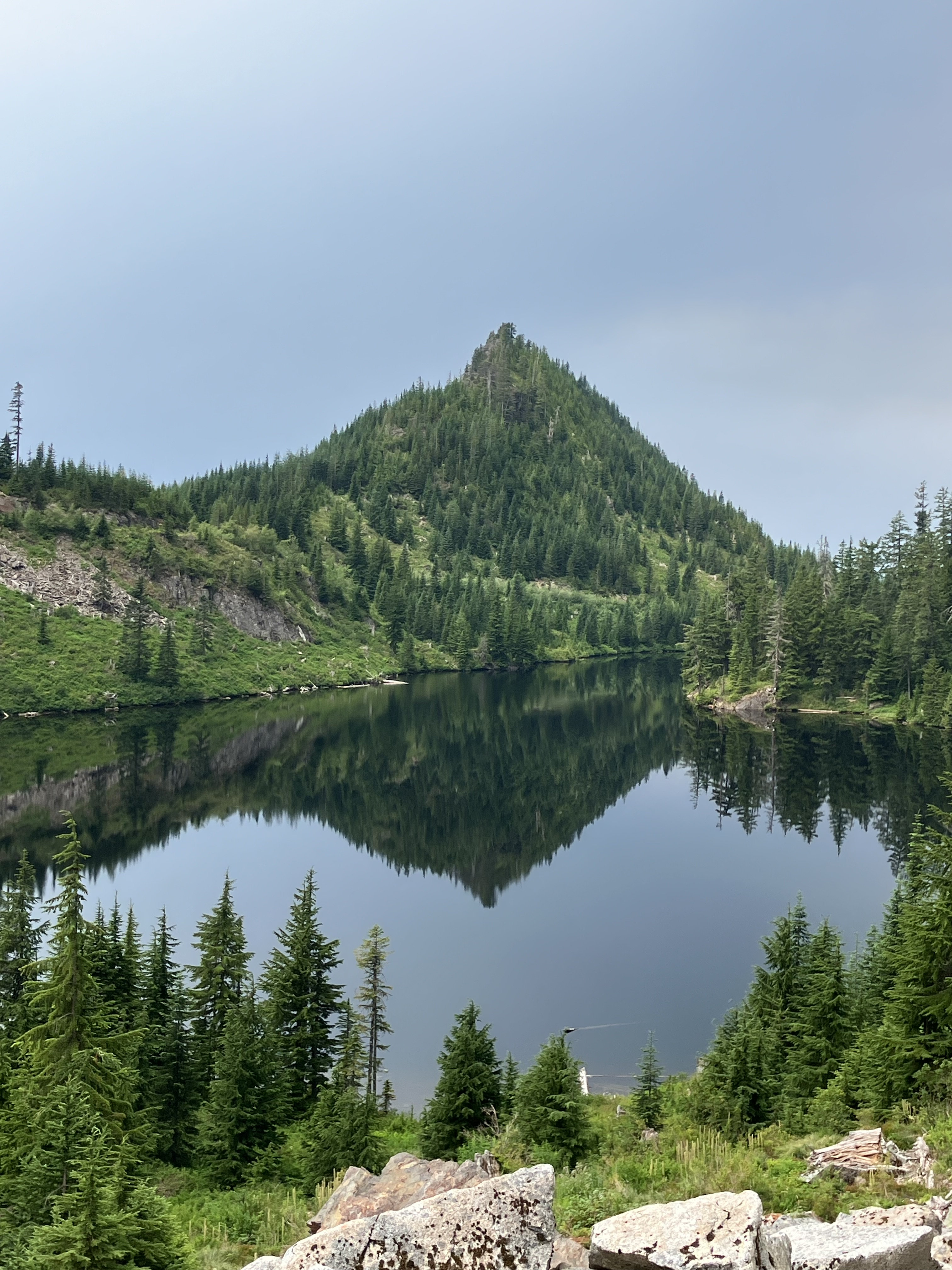
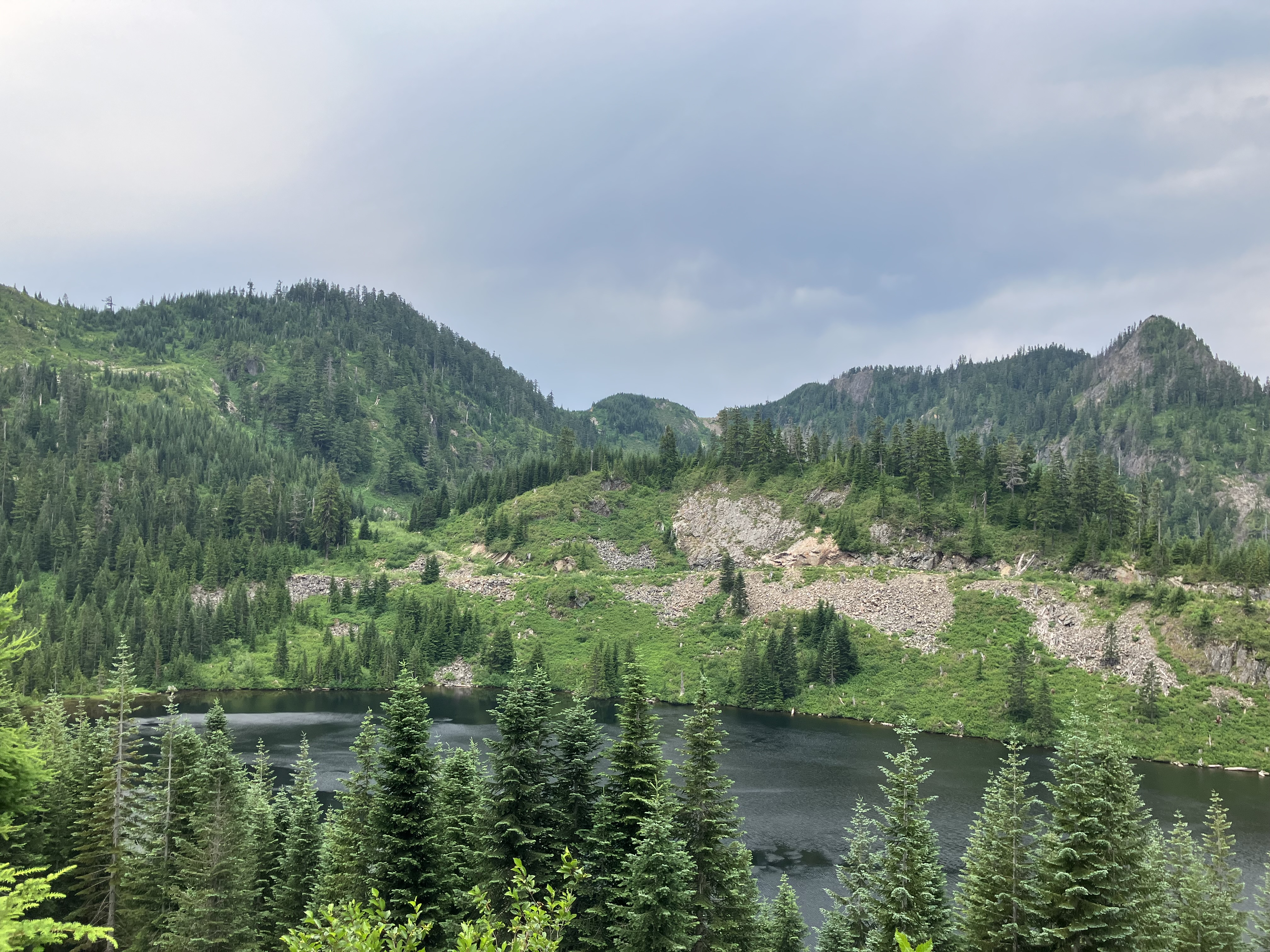
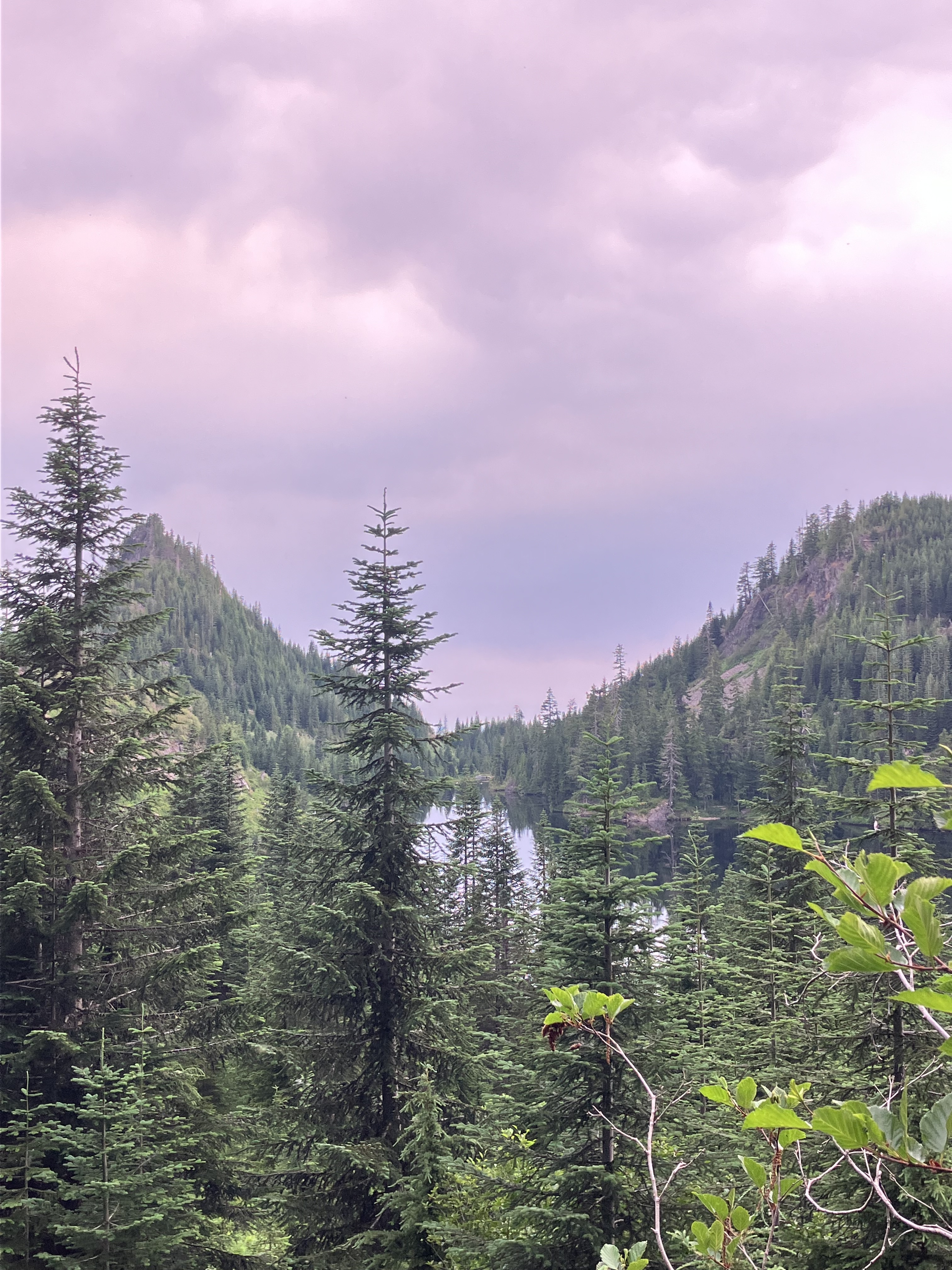
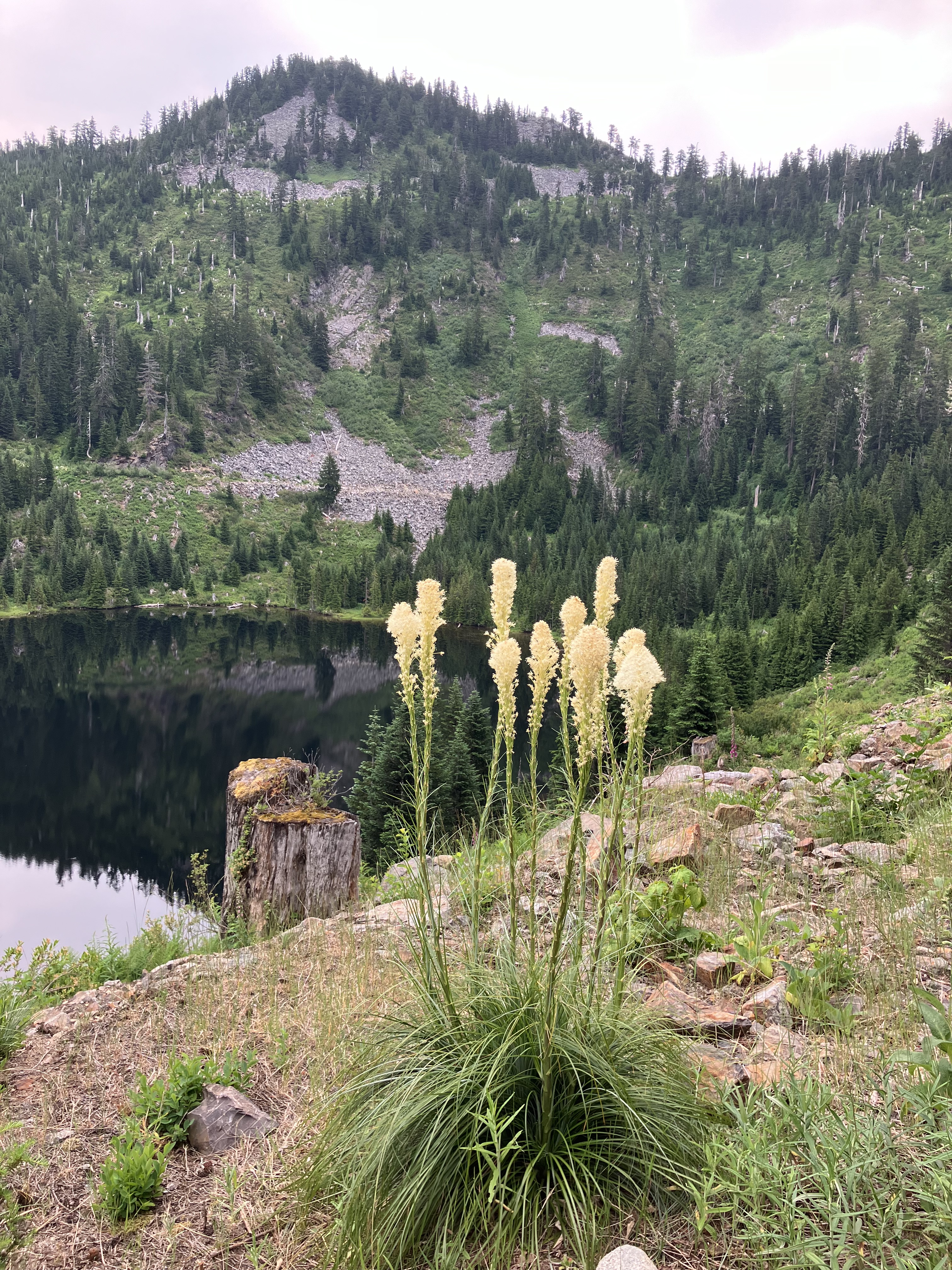
There are some truly magical places in The Central Cascades. I’m so grateful for the time, access, and those who have worked to protect these critical wilderness places near my home. Though these lakes were logged, and the trails left remain scars of logging roads from almost a century ago, the wilderness has returned, and offers breathtaking views of our beautiful mountains and priceless fresh water. I’ve spent a lot of time this summer exploring these higher elevation landscapes, and even swam in some of these waters where sometimes, there are not even stocked fish- amazing! The risk of going into these more remote places should not be taken lightly, and if you do go, look ahead and know the area and what to expect.

Alpine exploring takes a little planning and know how- I do not recommend just taking off on a trail without doing your research on place, weather, and what to bring to remain safe. There is wildlife here- some that could kill you. Not just bears and cougars, but also mountain goats, and then there’s the landscape its self. Massive rock slides that can shift at any time, steep edges with drops that you would not survive if you fell. Even a twisted ankle in the back country can put you at risk of not getting out before dark. At night, the temperatures at elevation drop dramatically, and without proper training on how to survive, you could be in for a fatal encounter with mother nature. On this day in July, 2024, I hiked up into The Central Cascades when there was a front moving in. No rain was expected, but I brought extra layers and kept an eye on the sky to make sure the weather cooperated. Since the mountain peaks make it hard to see the horizon, you won’t know if a storm is sneaking up on you till it might be too late.

My planned hike stayed below high ridge lines, so lightning was not a major threat. Always get down off high points if the weather is changing fast. My trail was well marked and not much elevation gain, so the day was relaxed and the distance short enough that I could get back to the truck quickly if the weather started to shift. Moody skies are important to read, and though the weather predictions were showing sun in the afternoon, I remained vigilant and timed my hike to be back out well before late afternoon. I was dazzled by the wildflowers and charmed by lakes that were glassy reflections of the peaks one minute, and then restless crushed velvet as the wind picked up. The gusts would come and go, but their signal of change kept me watching and feeling the air as I hiked on. By early afternoon, I felt the temperature dropping and turned to head back to the truck.

The sky darkened, and I felt a few drops of rain. The weather was changing, and that cold front was moving in. I remained calm, rushing would only raise my risk of falling. I continued to scan the landscape around me, stopping occasionally to listen, and watching my dog when she would stop and point. I do not hike with a gun, but I also don’t assume I am alone. People are the most dangerous thing you might encounter anywhere, but wildlife is also still a risk, and remaining alert and aware helps prevent unwanted encounters. You are more likely to die from hypothermia in the mountains than anything else, so please keep that in mind. A gun will not save you from freezing to death or becoming too dehydrated. Pack extra water and food when in the back country, and leave a clear map of where you are going with a friend, along with your planned time of arrival back home.

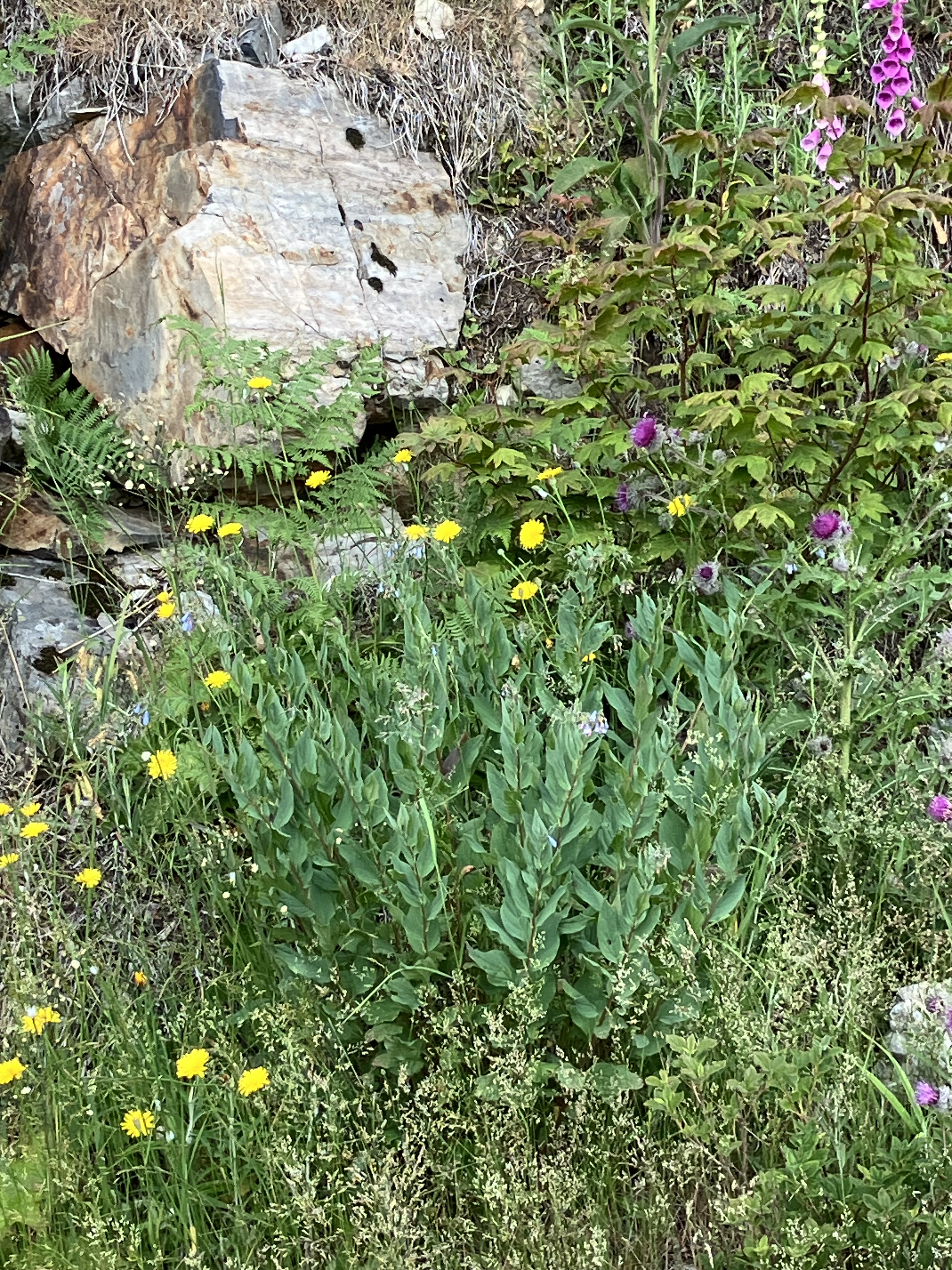
As I walked out, more wind picked up, and I watched mounting thunderheads forming in the distance. It was a good feeling to know I was heading towards the truck as the rain began to pick up. Still, it was relatively warm and the rain was not soaking through, so I felt comfortable and calm as I stopped to take a few pictured of plants to ID later at home.

As I came into view of the truck, I also saw the clouds curling down out of the sky and into the peaks around me. The front was arriving, and it was time to pack up and get down out of the clouds before I was socked in. As I began to drive away, the rain picked up, and I was graced with a show of incredible transition as the weather demonstrated her tour de force in the elevations. Imagine if I had still been on the trail hiking out when this fantastic transition occurred.

I watched my truck thermometer go from 68F down to 58F in seconds. The rain continued as the cloud bank blanketed the mountains and covered everything in a thick fog. Winds swept up from below and there was a mild sense of vertigo as my vision was obscured. In seconds all know landmarks disappeared, the wind picked up, and the damp rain continued. I was in the truck, safe and dry, heading out on a familiar road. If I had been up on the trail, I might have easily lost my way, become disoriented, and become yet another statistic in back country mistakes. Luckily, I had planned my exit and gotten out in time. The clouds continued to mount above, but I was heading down, and soon broke out of the mountain fog to see a familiar landmark below.

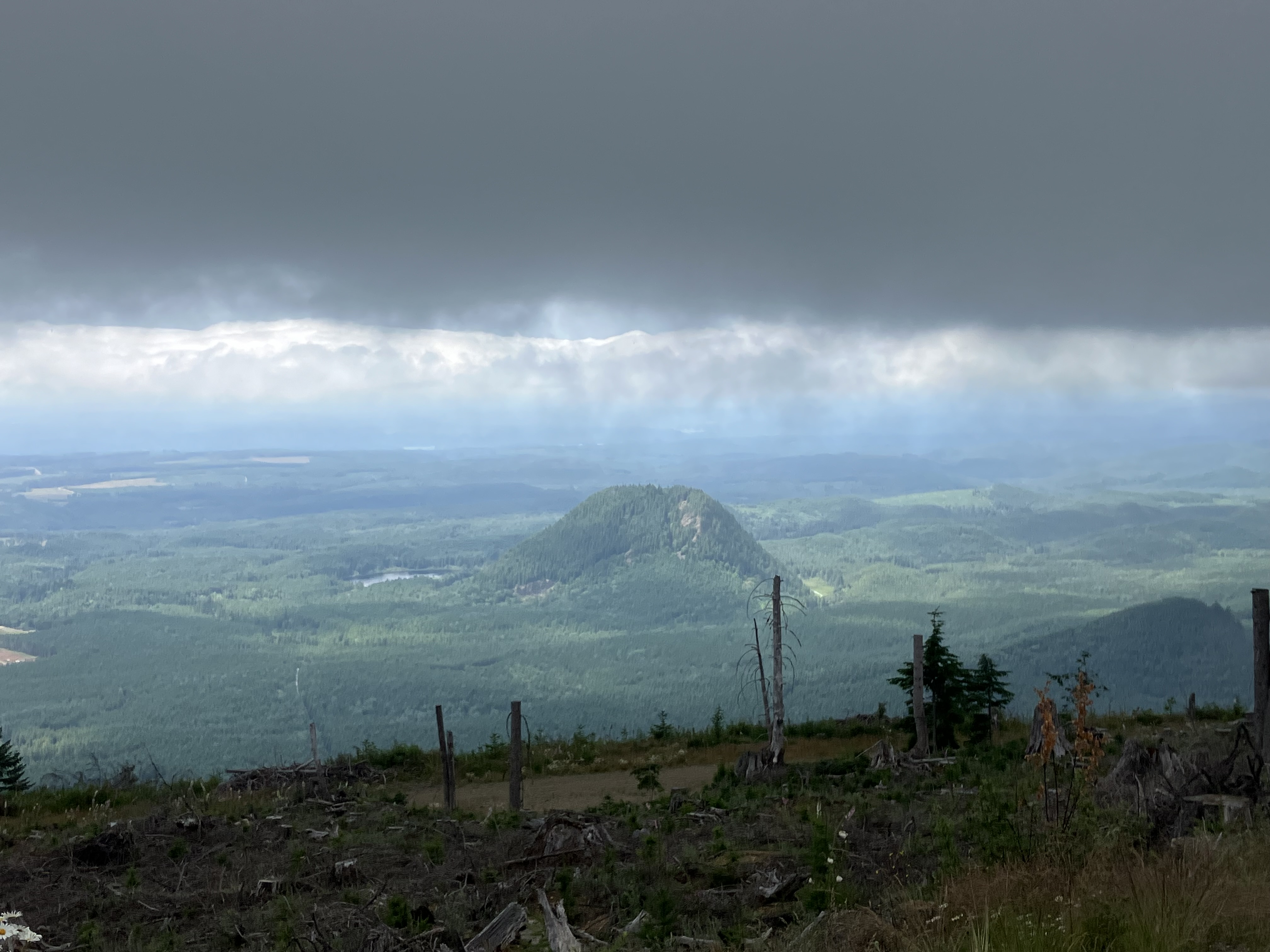
Fuller Mountain is an anomaly in The Upper Snoqualmie Valley which is an easy landmark from the western slope of my home range. The valley was in full sun, no one would have guessed what was happening a few thousand feet above. It’s always the unexpected that ruins our well laid plans. I’d been lucky with my timing. I had not know exactly when the front would be coming, and I could have been caught up in the clouds with only my familiarity with the trail to get me back out. This is how bad things happen in the mountains, and without careful planning, familiarity with the terrain, and a good exit strategy when it’s time to go, things can be very rough out there in the wilderness.

Questing for a Sign

During the hunting season, there are endless approaches to seeking food. Many of these techniques are dependent on many more other influences- weather, topography, geology, human impact, and time of day are all playing a role. When I’m looking for mushrooms, wet, cool weather is imperative. Young Douglas Fir dominate forest is ideal, and a ridge with some slope within a few hundred feet of wetland can raise probability of edible fungus, but you never know for sure. This is the beauty of reading the language of landscape, the sky, nature in all her forms, to best receive her bounty. When hunting Blacktail Deer, I’m looking for active sign that was recently made, usually near a diverse range of vegetation to brows, with places to hide, water to drink, and safe space to rest. Grown in clear cuts, like the one pictured above in foreground, are perfect deer habitat- with the understanding that hunting them within that thick cover is nearly impossible. So why walk into this mess? Because that’s where the deer are.

I began my walk by moving to the edge of the tree line next to the overgrown clearcut. These transition zones are good entering points off a road, and buffer some of the initial noise you will make moving into terrain with slash and logs spread all over the ground, muddy ruts from heavy machines working across the land, and the new growth weaving together to heal and regenerate the soil. On that rich earth there are clear shapes- signatures left by the inhabitants of this ever evolving commercial timber property. Those last words are the legacy of human impact- ownership over place. This philosophy of resource extraction by dominion through violence over the land remains. So do the original peoples who are now regaining their land through the dominion rights of our laws today. It will be a beautiful thing to see human signatures that are with nature upon these soils.

Today I am walking with this hope as I seek to connect to the land that feeds me directly in body, mind, and spirit. The deer moving across this clearing are doing the same- uninterrupted, even with colonial oppression for over 200 years. The plants also keep growing, and the wild waters flowing, even as money trumps the land in madness. I have to keep a sharp focus when moving through this terrain, just like the deer I am hoping to see. Though there are clear footfalls made fresh in the last hour, since the last hard downpour, I was not thinking about following any specific track, more the lines of passable trail these deer had erected through human induced chaos- which does somewhat mimic environmental drastic changes- like a forest fire, or blow down, but with less betterment of the place- but a reasonable profit for corporation to maintain.

Just before heading out on foot, I had driven a few miles to get here. The roads that allow for this access are monumental in build and devastation- including the accessibility, which allows me to walk into this setting for a hunt, and the machines to clearcut. As I was driving in, I came upon an active part of the tree farm agricultural “renewals”- spreading treated sewage from Seattle into recently clearcut expanses, much like the one the deer and I were enjoying. The Loop System of biosolids for the soil is green washing at its best. Treated sewage is full of prescription drugs, heavy metals, and forever plastics- which are then spread into watersheds- yes, it’s all connected- and the good news is- there’s a lot of fresh nitrogen in the ground to grow more trees! The overgrow clearcut I am walking in has been replanted with these excellent GMO timber producing forest products. The deer don’t eat them, they are nabbing the fresh, tender leaves and shoots of the last understory growth this plot will see for the chemical future. Herbicide is sprayed liberally to keep wild plants from shading out the industrial timber being cultivated.

Vine maple, willow, and fireweed all signal the brief flash of wilderness trying to come back. The Douglas fir will grow in this, and a forest would naturally evolve in time, but chemical application speeds up growth and guarantees more production for our industrial corporate profits. The cumbersome brush just feeds the deer, and after the herbicide treatment, wildlife stays away from these areas. That makes the sewage spread easier though, so it’s a win win for the farm. Remember, this is an agricultural practice. But I see a lot of brows (could you see it in the picture above?), and I stumble on through the maze of animal trails coiling through the piles of debris. I will applaud industry practices which sifted from burning slash to piling it, to spreading it across the barren soils after the cutting is done. This helps prevent more catastrophic erosion caused by logging. The treated sewage application will reintroduce some of the nutrients lost when the majority of the biomass (tree trunks) harvested in logging, are hauled away. This massive removal of fertility from the soil has to be replaced if more trees are to grow.

As I drove by the freshly fertilized fields, the smell caught my breath, and I rolled up my windows quickly while gagging on what is an horrific stench. It took about a mile of distance to get away from the odor and loud machine work. My overgrown clearcut was alive with other sounds- bird-calls, caking sticks as I stumbled around, and the occasional buzz of insects lazily bombarding through the brush with careless ease while I bumbled along trying to follow the deer trails. I knew I was not going to sneak up on a deer, but I would hopefully get a view of one rising from it’s lay to get away from me, and sure enough, by the time I was well into the center of the field, I could see a flagging tail and occasional bouncing head of a young blacktail doe hopping over the slash with ease as she moved away from my oncoming cacophony. To be clear- because there was no clear view, I was not even thinking about trying to take a shot. This was an exercise in finding the deer and getting them up and moving. Perhaps if I could keep in line with the deer till it popped out onto the road, or came into a clearing, then I might start to think of my options, but the doe quickly disappeared into the thick cover while I stumbled down into a bog with some large bones scattered about. What the?!?

My sudden limited vision and low lying predicament sent a slight sense of caution into my steps. The ground was open, but high walls of earth and brush loomed over me, and the area was littered with elk bones that had been gnawed upon. Scenes from Heart of Darkness came into my mind, and I hastened to get back onto higher ground, and take a look around me to make sure I was not warranting a stalker. But I’m carrying a gun- what am I afraid of? My gun would not catch a cougar with the element of surprise. When these big cats choose to make an ambush, they leap from behind, usually from above, and their long sharp teeth are the perfect width apart to sever the spinal chord. The blacktail sign was gone, and I beat a retreat out of the bog, climbing up the side of one earthen wall. My frantic brain, now in flight mode, pushed me towards a large old growth stump with enough elevation to give me some vision. I scrambled up the decomposed woody mass and surveyed my surroundings. There was not a cougar around that I could see, so I sat still for a long time waiting.

The sky to my east was filling up with darker clouds, and a rain sheet began to obscure the nearby mountains. Weather was coming in, and I didn’t want to be caught in it while scrambling through slash and derbies, so I planned my rout back to the road. Just as I was about to climb back down, I spotted the flag of a familiar tail and watched my doe flitting along about one hundred feet away. It was in the general direction of the road, so I decided to trail her again. Heading east, I used other stumps as landmarks to keep in the right direction. Soon the deer was lost again, but I came upon her bed (pictured below), and other lays in the area, which confirmed to me there were several deer using this clearcut as a bed down zone. That coupled with the tracks and brows all around confirmed this as a deer habitat that could be hunted successfully with some patience and a little luck. However, it was now starting to sprinkle, and I needed to get back to my truck before the downpour began.

The stalk was successful, in that I found a deer with lots of confirmed sign. When it’s not raining, blacktail deer tend to bed down and relax for a while. It’s a great time to go walking through the clear cuts to see what pops up. These industrial timber lands maintain openings in an otherwise impenetrable forest. If there was not so much chemical use, I’d say it’s a great place for deer to thrive, but in recent years, with all the applications going on, the wildlife is starting to disappear from the area. In the 2 weeks of hunting I usually have available, the tree farm is my go to place to seek a deer- but in the last five years, I’ve harvested from my own land or neighbor adjacent with permission. I’ve noticed a shift in the past 10 years of hunting the tree farm. The deer are going away, pushed out by unpalatable chemicals and activity in the area. This problem is not lost on The Snoqualmie Tribe, who recently purchased the northern 20,000 acres of The Snoqualmie Tree Far- which is owned by Campbell Global, an international conglomerate of resource extraction wealth. The tribes tend to continue logging practices, but some of the 20,000 acres is going to the tribe as ancestral land for restoration and traditional use. My hope is they plant native food crops and regenerate the forest for long term climate adaptation. In the end, they will do what they like- as they should, because all this land we’re on is stolen, and giving it back to the people who were following their original instructions like the deer, will have a far better overall impact than colonial greed.

Like the tracks and the lay, chemical sprays and treated sewage leave a mark that, unlike the tracks and lay, the marks of colonial industry will have a lasting cascade of detriment to the environment that will haunt all for generations to come. With the deer becoming far less prevalent in these areas of the tree farm, I worry the effects are compounding faster than science can keep up with. Like climate change, the environmental unraveling in our forests and wild water will come to us in pollutants we may not see, but cancer rates keep going up, and once introduced into the environment, most of these hazards cannot be easily mitigated. I continue to walk the landscape looking for signs. In areas of the tree farm that have not yet seen these applications, there is more wildlife activity, but as soon as the cut and spray begins, the animals shy away, and much of the diversity in vegetation is chemically killed. These practices do not help our habitat for the deer, or ourselves, and if we don’t start changing our own practices, all life will suffer and eventually become extinct. Still, I am grateful for every opportunity to be in the landscape learning from what nature reveals, even when the signatures of man made atrocities scar what’s left of the natural world. I’ll endeavor to connect and be apart of what’s left, while also remembering what was. Thank you deer nation, for continuing to stay present and in your place or origin.

Farm Grown Fruits

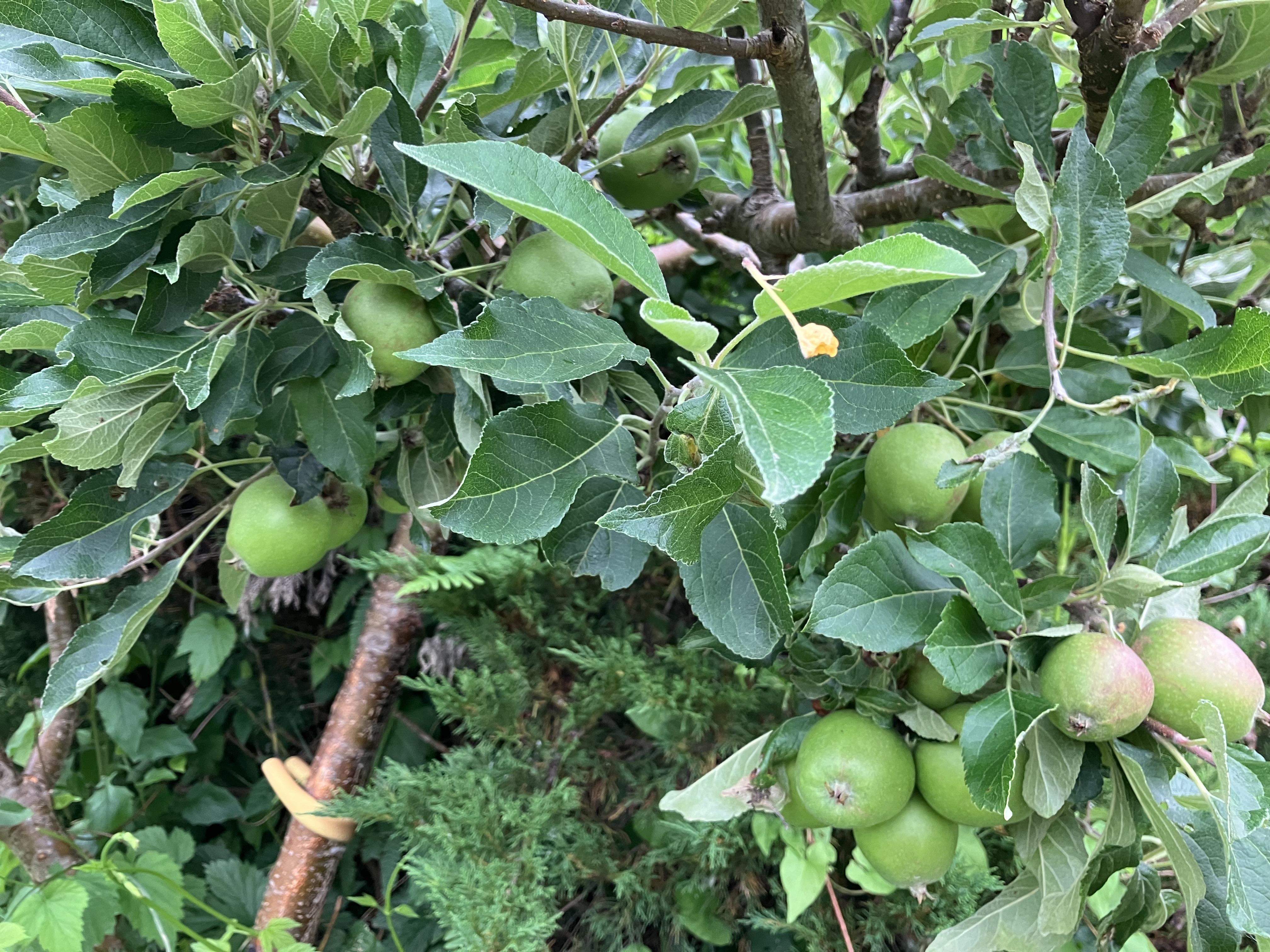
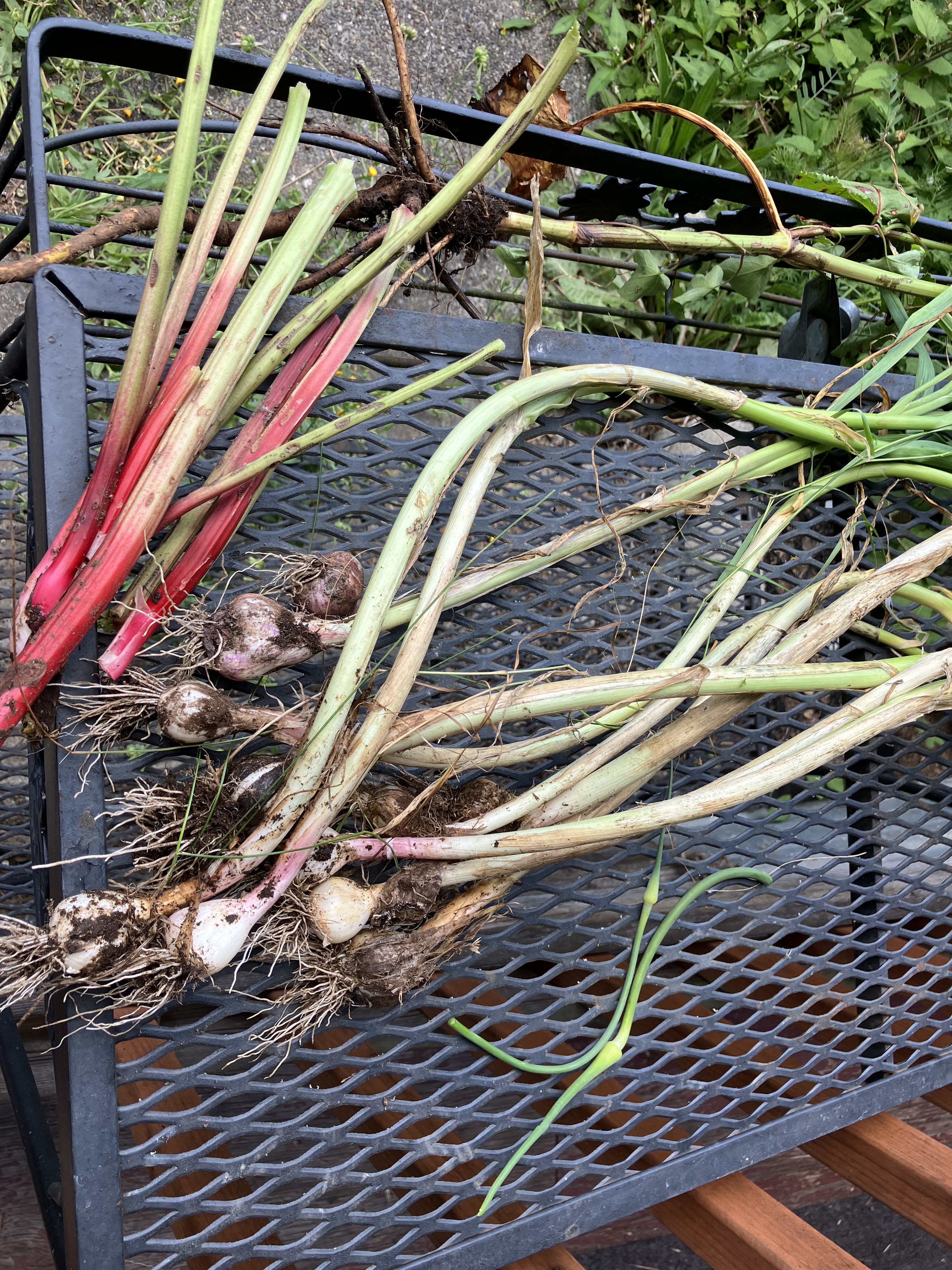
There are abundant cultivars at work in the landscape of EEC Forest Stewardship. Apples are putting on size and blushing red color on the branch while rhubarb and garlic spring out of the garden soil. So much abundance keeps growing all around and the harvest keeps on through these warmer months of high production. Apples and pears are the most common fruit trees on the landscape, but peaches and cherries are starting to gift us with seasonal bounty, and the plumbs manage a little fruit for mid summer too. Most of our apple trees aren’t ripe until fall, but peaches are almost ready by the end of July, and cherries finished at the start of summer. The variety of flavors and plant based foods here at Leafhopper Farm continue to diversify over time. Aronia berries and quinces are newest on the list of newly planted fruits, while grapes took five years to establish. As climate change continues, we’ll be watching all the effects on our numerous verities to keep selecting towards the successful adapters.

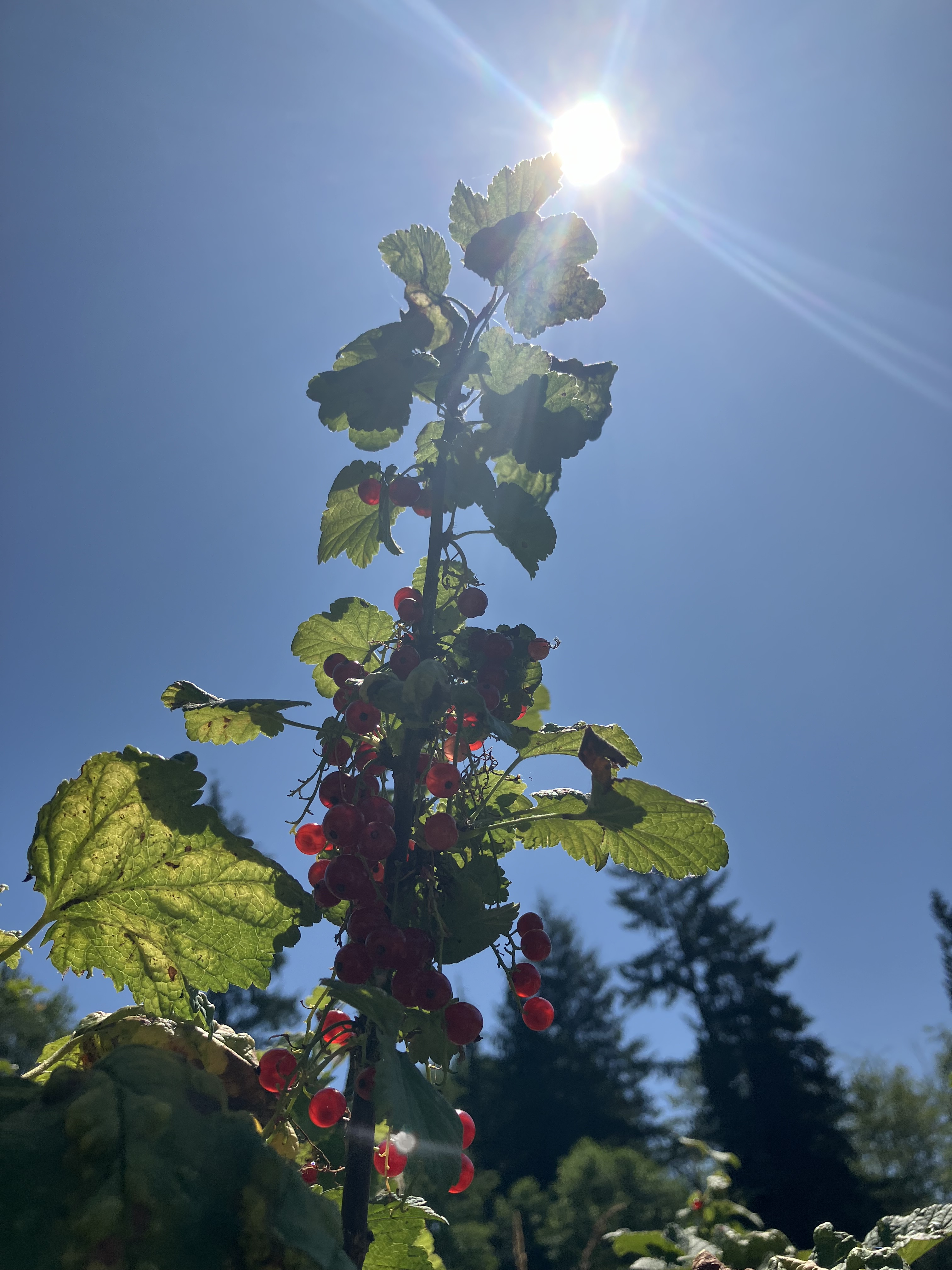
The currents (pictures below) have been quite abundant this year, after taking nearly 7 years to fully establish. I love these often overlooked cultivars, as America only legally allowed their cultivation again in the 1960s after a blight that shook the timber industry at the turn of last century. This is the main reason currents still lag behind other much more popular berry crops in The U.S.. Our native current types on the land are red flowering Ribus sanruineum, black gooseberry Ribus lacustre, and stink currant Ribus bracteosum. The cultivar verities have much more flavor and abundance, so we’ll keep bringing them in for palatable eating.

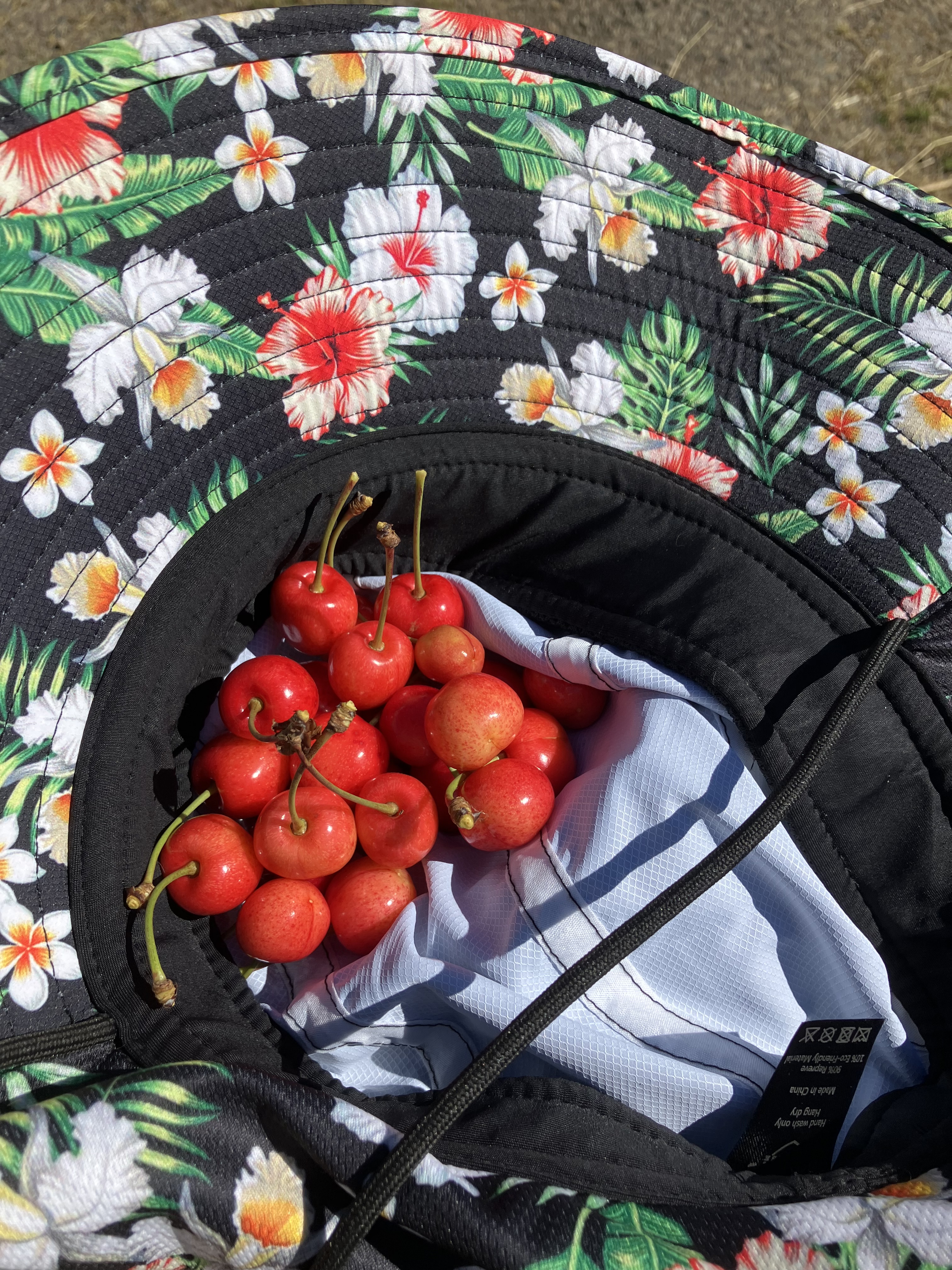
Stone fruit is so popular, and cherries are easily grown here in Washington. Our native species is choak cherry- and as the name suggests, they are not very tasty raw, with a large pit to catch in your throat. The sweet cherries we know and love today originate from Asia, but were brought to Washington in the mid 1800s. Today, you can walk almost any trail in the area and run into this endemic fruit tree in one variety or another. People have been spitting out pits for almost two centuries now, and escaped cultivars thrive on the landscape. Many revert back to being twenty feet tall, so a lot of the fruit is never enjoyed by people, but birds love the fruit, and find it easy to reach in the lofty heights. At EEC, we’ve planted both the dwarf and natural sized trees, but only recently began picking fruit with success. More of these trees are planned, but they are often susceptible to blights, which lower productivity and lifespan. Still, the fruit is delicious and the trees don’t need a lot of pampering to establish, so they make a great choice of food crop in our small holding.

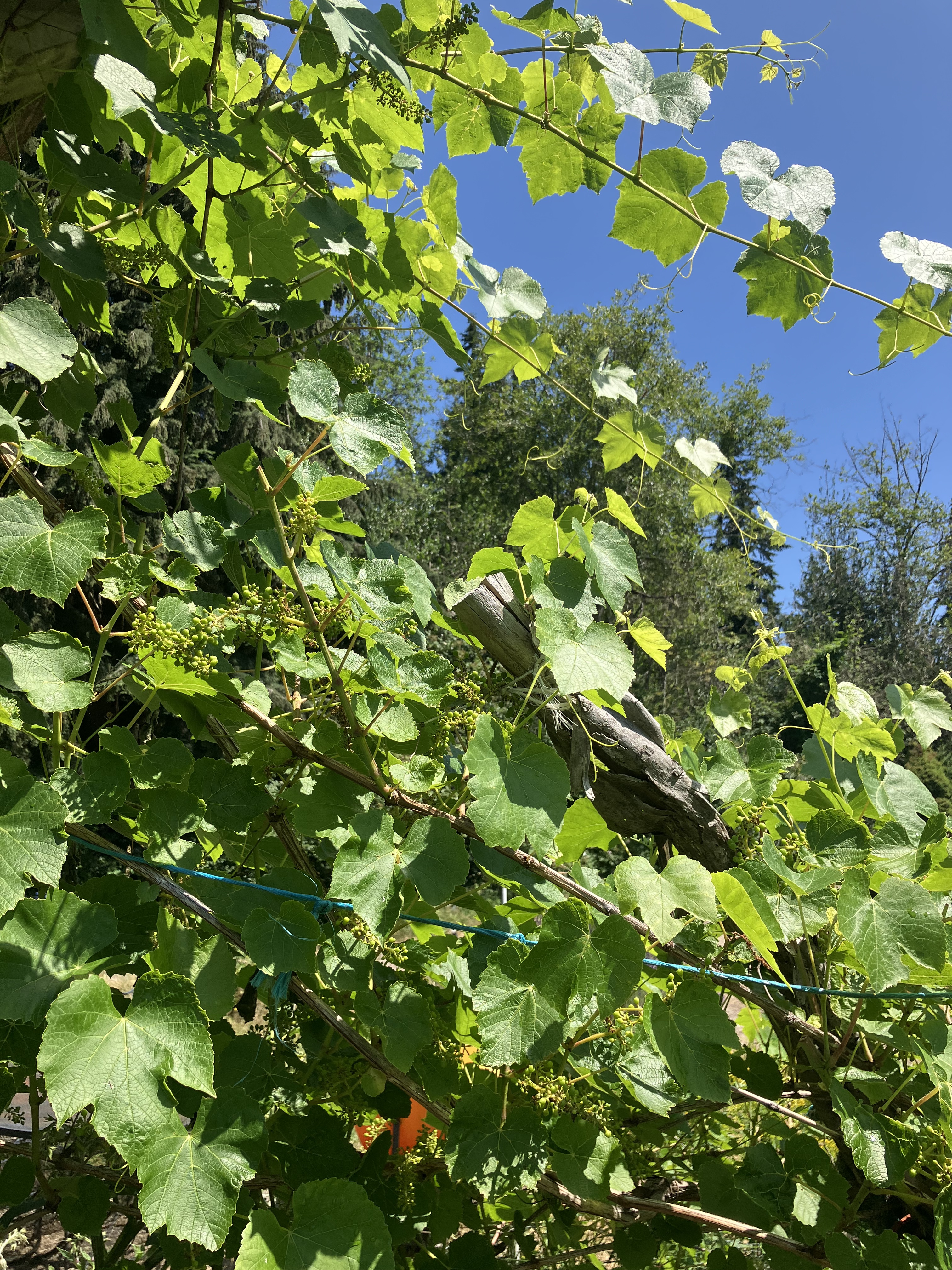
The grapes are coming on nicely this year. I’ve spent some time actually pruning this vine, as it reaches up the side of the porch from our small kitchen garden. Last year we enjoyed a couple of bunches, but this year, the vine has received enough water, light, and warmth at the right time to develop what looks like a bumper crop of fruit. Pollination was a bonanza at the start of July, and I often had to stay clear of the eager bugs flying in and out of this towering green gem. The fruit is some of the sweetest I’ve ever had, and seedless, so we’ll be taking cuttings to propagate this beautiful fruit. Our other grape, an Austrian Grüner Veltliner, is also trying to make some fruit this year. It’s a wine grape, and though neglected at best, it’s managed to fight off blackberry and drought to remain alive and well. I’m planning an actual arbor for this tough little vine, and hope one day to make a few bottles of one of my favorite white wines.

With summer setting in, we’ll keep watering and monitoring the modest fruit gains here at EEC, and plan for future plantings to come. All the trees are in need of fresh mulch and some companion planting, the development of food forest continues, slowly but surely here at Leafhopper Farm.

Full Up Fall

The hay is in- alfalfa to be exact, and we’re finishing harvests from fruit to slaughter here at EEC Forest Stewardship. This is one of my favorite times of year, because the larder and the other stores for coming winter are topped off. This includes wood for heat and food to eat. I’m actually doing a freezer space shuffle right now to make sure there is room enough for the large blacktail buck I harvested in late October. What a feast for the eyes! All this hard work will earn a rest through the dark lean times to come. It may seem like small milestones, but after many months of planning, gathering, and processing, most of the major tasks this fall are done.

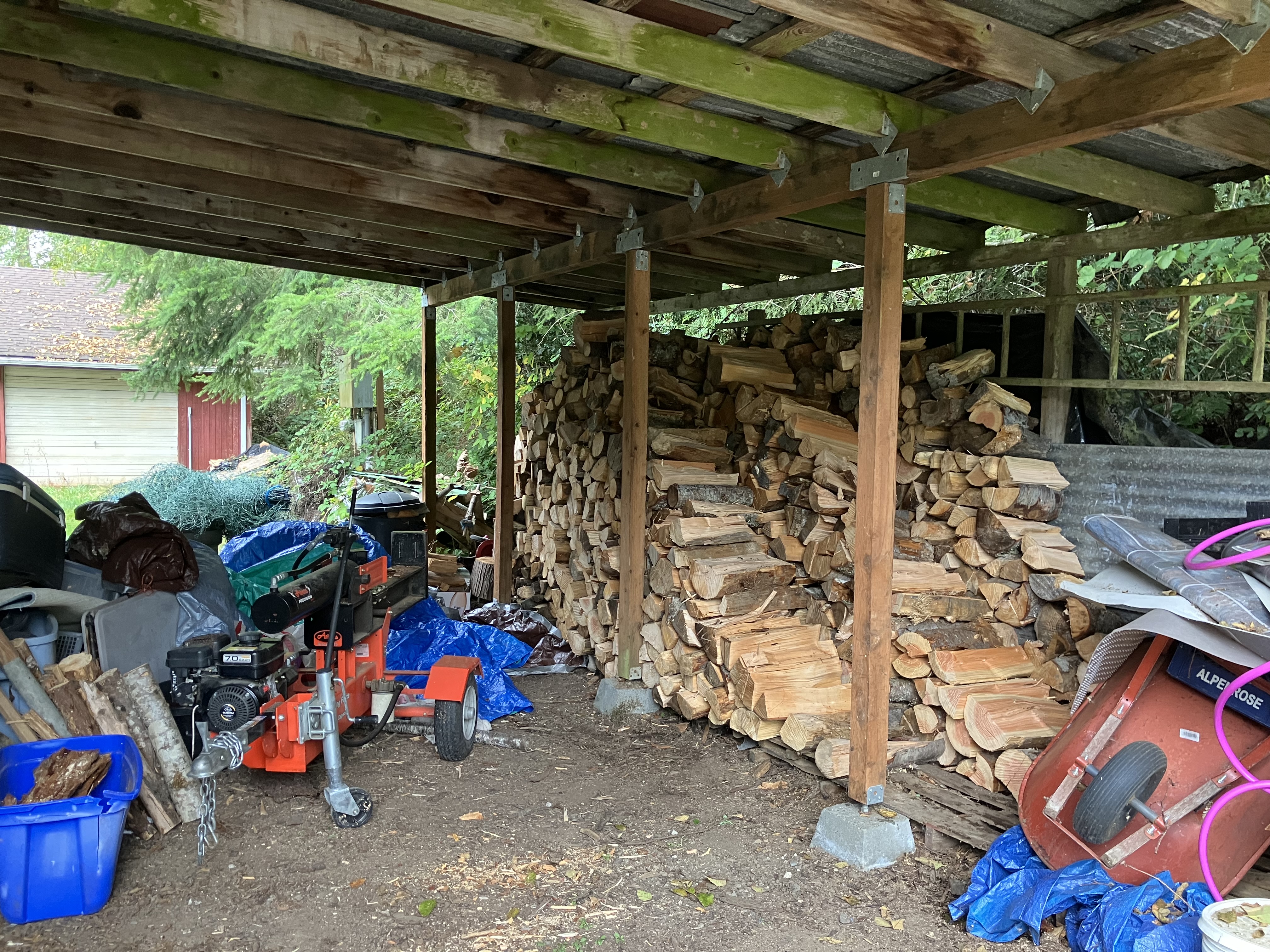
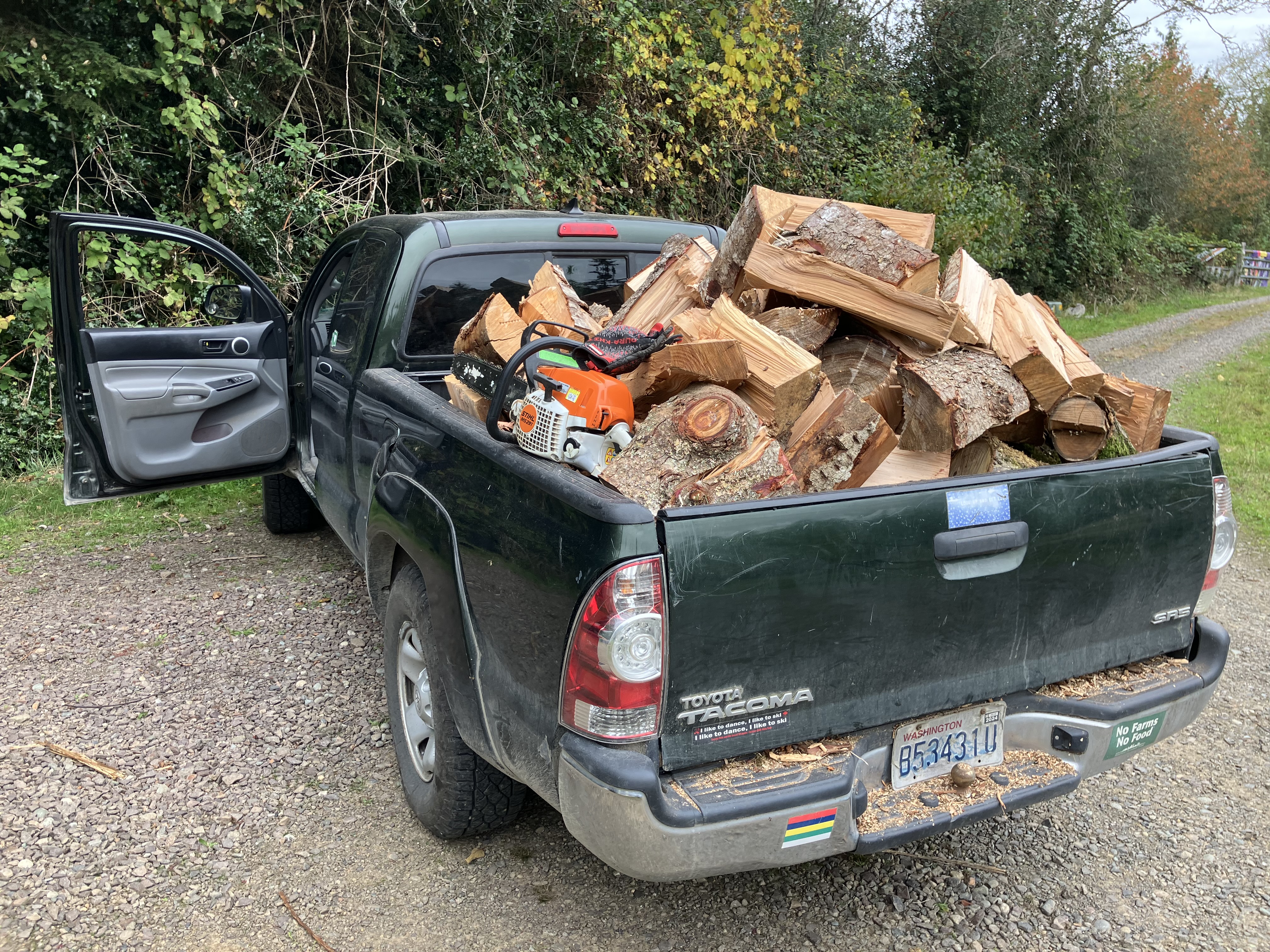
Getting the wood to heat the house is one of the most labor intensive tasks here on the farm. This year, for the first time, I did everything myself. It starts with cutting logs at the tree farm, hauling them home and unloading them in a sunny spot to season over the summer, and then bucking and splitting them in early fall to make sure they are stacked and covered before the rains come. I do borrow a splitter from a neighbor, because axing all that wood at once would break my body. Ten years ago I did my own splitting by hand, now I am thankful to have a machine to help. The stacking takes time too, but it’s such a reward to see all that seasoned wood piled up in the shed. This year, because of timing and an incoming weather pattern, I split and stacked most of the wood in 2 days. It was quite a task, and my back is now a little sore, but very muscular. Thanks to a body that keeps holding enough strength to carry through the hard labors. Within the next few years, I might have to shift how I process wood, because as we age, we don’t get stronger. Thankfully there is great body care to come in wonderful massage from my incredible therapist who keeps my body tuned up for the work to come.

All the signs of Fall this year point to a hard winter to come. There was a lot of goof fruit, mushrooms, and nuts to harvest this year. My buck was heavy with fat- the most I’ve ever seen on a deer I’ve processed. He was also mature, but putting on that extra fat because he also reads the signs of nature’s agenda. There is already snow on the lower peaks around here- a rare thing these days. I recall a few years ago when it was still 90F in October and the woods nearby were on fire. Luckily, this year the rains have come and we had a gentle summer of light heat and a enough rain to keep the pastures green. I’m still grazing my sheep on the land- usually I have them in the barn on hay by now, so it’s a great year for the sheep too. As the light fades and days shorten, I’m grateful for all the bounty and abundance in this life and the wonderful people I share it with.

Thank You Mogs

Mogs diapered last week in what we think was an owl attack. Our newest kitty to the farm had been careful to stay right around or under the house when outside under supervision, and seemed to be acclimating to the farm life when one morning, she was out after I left a door open to load the car in the early morning and by that evening when I came home, she was gone. So much sadness, but also the understanding that she was a free kitty who wanted to explore the world, and that’s always a risk outside. It was during the full moon, and our great horned owl activity had been on the uptick. I’ve lost a few chickens to these awesome night hunters in the past. Even another cat at the farm, Marrow, had a close call a few years ago, with a talon piercing his head- but missing the skull.

There is still hope that Mogs might be at a neighbors, but no word so far. We’ve alerted the vet’s office in case her chip activates, but this little kitty was never one to stray from the house, and her night adventure was sadly, what I’m guessing led to her disappearance. Lucia has been snuggling close at night and back on the porch now that the “usurper” has gone. In future, we’ll work to select larger, fully capable cats that can defend themselves better outside. Mogs was more indoor than not, but she also had a little hitch in her movement, which we think came from a back injury when she was a little kitten- before we knew her. She was a courageous feline friend and good cuddler on the couch. I’ll miss her morning chatter when she wanted to be fed, and her cute bent tail. She’s still scampering around in my dreams, and I know she had a brief but spectacular life here at the farm.

Miracle Harvest

I woke this morning thinking it was a rest day from hunting. I had a writing group session first thing and a doctor’s appointment in the late morning. As I walked to the door, I grabbed the dry cleaning and headed out. My hunting gear was in the truck- it always is now- and I drove down the driveway thinking about what a perfect morning it was. Then my eyes caught the flick of an ear off to my left in a willow patch on the neighbor’s property and I saw a young doe. As I rounded the turn, a large buck came into view. I thought to myself “they always show up in places I can’t hunt” and I drove on to the doctor appointment, happy to have at least seen a nice buck in the area.

Later on the way home, after dropping off the dry cleaning, I called my Mom and shared with her my sighting of the buck. In my heart I hoped he was still around, but commented to my Mom that it would be a miracle to see him again- much less have him walk onto my property and give me time to load and shoot. I had both my rifle and the shotgun in the car, so I would have the ability to take a safe shot with the 12 gauge, but the chances of him still being there and coming onto my property were slim. My wise mother said miracles do happen, and as I rounded the corner of the willow patch, I saw the doe stepping out onto my driveway, followed by the mature buck. I told Mom I would call her back and stopped the truck. Leaving the motor running- turning off the engine usually spooks animals- I concentrated on getting my hunter orange vest on and lifted the shotgun out of the truck with me, grabbing one shell from the center console. The buck had slipped through the fence and was now standing broad side less than 20 feet from me. I lifted the rifle to my shoulder and took aim. He was so majestic, looking at me as he stood in a perfect spot for me to take my shot. It was truly a miracle.

I pulled the trigger; the buck dropped onto the road, running in place. I’d hit a major artery in the neck and watched as the life flowed out of the animal while giving thanks for the harvest. My mentor has a belief that when a buck turns and stands broad side while looking at you, he is offering himself in a sacred covenant, which hunters and the deer nation have shared for thousands of years. I have always experienced this ritual in the hunt. As the deer turns to face me, he stands and offers a clear broad side shot, supporting a clean kill. It was a powerful moment as I watched the buck’s blood drain quickly. I had hit a vital artery, which caused the intense flow, making the buck’s transition into death hasten. There is always a moment of final flight in the deer’s instinct. He made his run as he lay on the ground. I gathered a hand full of tobacco and said prayers of thanks to the deer and the ancestors. When I kill and animal, I always speak to the cycle of life and death, knowing that I too will die one day, and that my blood and body will also return to the earth to feed future generations of life on this earth. It’s a powerful and humbling time, and I sat quietly awaiting the buck’s final moment, calm and present with him. When he was still, I carefully approached and touched his eye to see if there was any movement. The animal lay motionless in the road. Now the real work would begin.

I still had a bit of adrenaline running through me, and opened the tailgate of the truck to lift the deer by his antlers, pulling him up into the bed while protecting my back by leaning backwards, letting myself slowly fall into a sitting position while pulling the front half of the animal onto the tailgate. It was a feat- but slowly, the blacktail slid up and into the truck bed, as I carefully hauled him in. This is always a challenging part of hunting alone. If I can’t lift the animal into the pickup myself, I would have to cut it in half- and I didn’t want to make more of a mess on the road. Driving the short distance back to the house, I texted a few people who had been following my hunt this year to share the news of my success. One of them is a hunting mentee who said she could come help me with processing. It’s always such a reward to have a learning opportunity with my hunt, so I was glad to have the help and shared the experience.

Unloading the deer into a wheelbarrow was much easier, as I was moving the carcass down into something, rather than lifting up. The full dead weight of the animal must have been around 150 lbs. He’s the second largest black tail I’ve ever harvested. My mentee arrived and we started with taking off the scent glands on the back legs. This is important, because those sent patched can get all over your meat as you skin if you don’t remove them first. They were smelly- I love the scent, but it does not add good flavor. After that we hung the animal on the wench and raised it up to make processing easier. Next we took off the back hooves and started skinning. My mentee was careful and slow, an expected caution for a first time skinning. They diligently “unzipped” the back leg hide, and then I showed them how to prep the anus for gutting. If you are getting a little queasy reading this, my apologies, but processing an animal is not glamorous- it’s the true blood and guts of killing for food. I’ll spare the exact details, but needless to say, you don’t want any of the poop to get in the meat- so you have to tie up the end to prevent spills. Then we opened the stomach from tail to chest, slowly letting the guts out while grabbing the kidneys, liver, and heart of the deer, as well as lace fat from around the organs. This buck had the most fat on him I’d ever seen. A sure sign of health and wellness in the animal. His liver was also red and healthy looking and great eating, especially fresh. My mentee got a great lesson in gutting and skinning, then they had to take off for an afternoon appointment. I reminded them to wash hands before leaving- they had not noticed the dry blood in all the excitement.

I now had to cut the carcass into two parts to lift into the walk in cooler. There were already two lambs hanging, and I moved them to the sides to make room for this great buck. He hung beautifully in two parts, the meat a deep red, which reflected his health and vitality. So much gratitude to that food, which will nurture us through what I think is going to be a particularly harsh winter this year in 2024-25. This miracle harvest of good wild food will be cherished by many mouths and grateful folks who share my passion for hunting and gathering as much from nature as we can. You’ll not find anything as fresh or healthy in a grocery store- I guarantee it. This was my ninth blacktail buck harvest in 12 years of hunting. I remain a passionate caretaker of land which these animals feed on, cultivating more diversity in forage and cover for these magnificent beings. This buck likely fed on vegetation at EEC Forest Stewardship, and now, he is feeding me. Thus the cycle of life continues, and my relationship with the deer strengthens in our quest to steward this world through following our original instructions.

It’s That Time Again

The hunt is on as I quest for another black tail deer for good eating this winter. The weather is cool and wet- perfect for hunting this elusive animal. I’ve been taking a different approach this year, instead of getting up early, I’ve been rising with the sun and getting out shortly thereafter. It means a little more sleep, and less stress about getting into a spot at a certain time. I’ve not noticed a real difference in overall number of deer sighted, so I think I’m ok with this change. It has meant more time in the field too, because I’m covering more ground and also allowing myself to pick mushrooms when I see them on the drives from site to site. My other hunting spot is a generous offer from a neighbor to hunt their land near my house. It’s a quick drive over, and I’ve taken to sitting there in the evenings. My last two bucks have come from that property, so it’s a probable chance I harvest another there. We’ll see!

The fall light has been amazing, and with fresh snow on the peaks, I’ve really enjoyed my sits in the tree farm this year. Note the lack of rain- I keep missing the big downpours that are happening, but it makes for a much easier sit without constant rain. The deer have been shy to come out where it’s legal to harvest them. It’s also probable that most of the bucks have gone nocturnal. After they hear the first shots of the season, they disappear into thick cover and lay low. It’s made for a challenging hunt, but I have caught them a few times at night- so I know they are around. I said “hi” to the pair of nice mature guys picture below in the neighborhood out for a night stroll. This is typical behavior during modern firearm season. I was running into the same problem hunting Vashon Island. The deer went nocturnal and I never got a shot off.

Still, tis the season for good outside time enjoying the quiet time in the woods. It’s also been a good season of learning new parts of the tree farm. I’ve taken the time to go down a lot of side roads exploring, and the extra dirt time is paying off in mushrooms, new sit spot places, and a better understanding of my greater backyard. I even made friends with an immature bald eagle who has joined me on a couple of hunts, hoping my presence will spook up a few smaller creatures for the bird’s menu. He has a much better view from his perch- I wish he could give me a hint of where the bucks are.

There are always lessons and rewards for taking time to sit and observe. My mind is focused on deer sign, but there so much going on in the living world, it’s impossible not to notice all the details- from weather change to bird calls, what fungus is blooming and signatures in the mud from what’s been moving through. Such a special time of year for the living world, and what a gift to sit with the change and watch the leaves fall. Gratitude to the deer nation, snow on the peaks early this year, and the eagle that has been keeping me company in my sits.

Wine Time

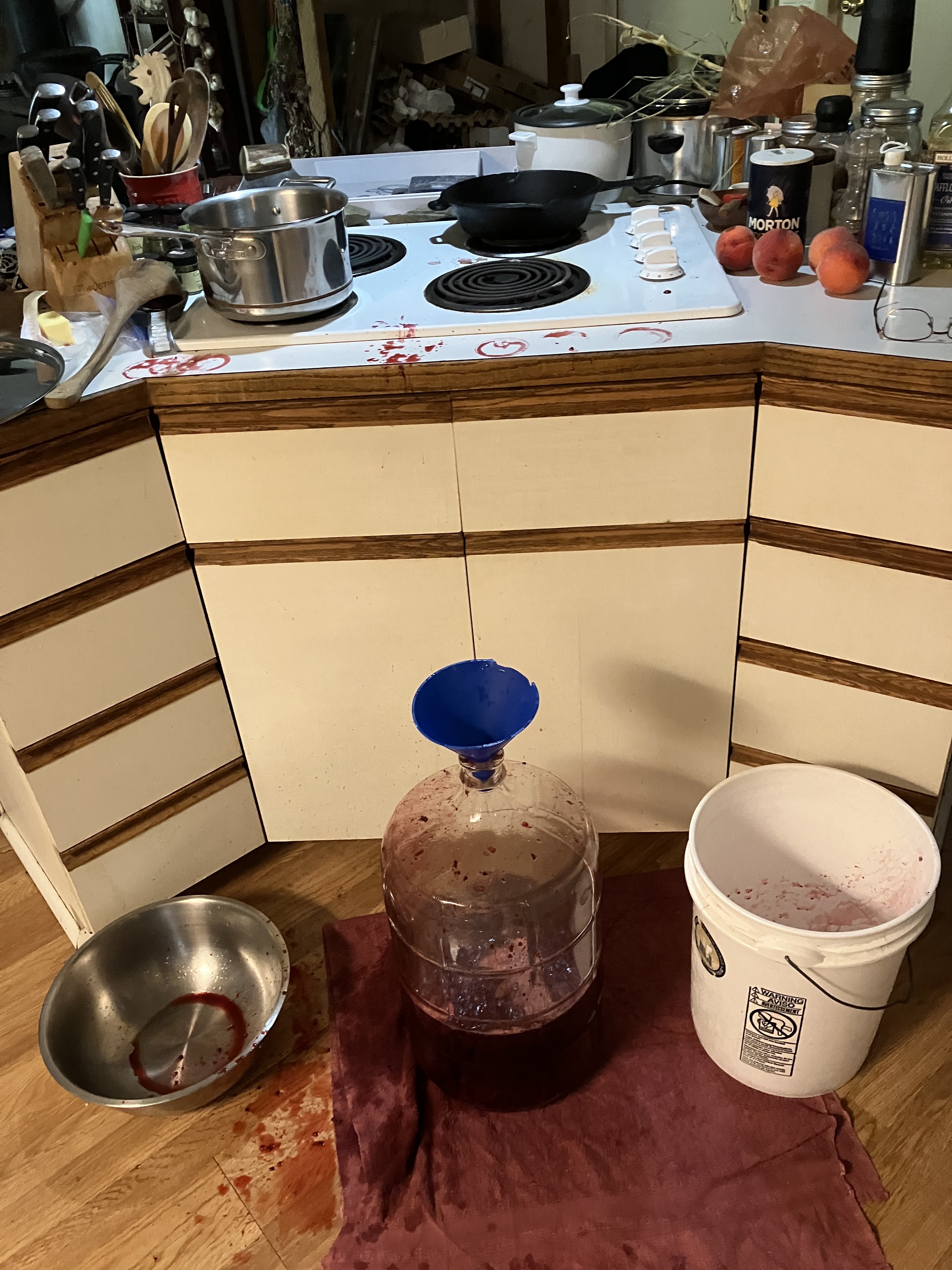
In August, the blackberries were harvested from the vine in vast quantities- over 10 lbs, and cooked into a tasty stew for a special fermentation fest. Hours of picking, cooking, and filling glass carboys has brought us 10 gallons of wine this year. The work was worth it- as I’m already taking some sample taste of the fruity punch and it’s delicious. A few months of lay down time after bottling will bring out this amazing festive beverage for winter holiday cheer when most needed. The steps to making your own house wine are relatively easy, and with a few store bought ingredients (mostly sugar), you’ll have a delicious drink to share with friends, family, and neighbors.

Getting the berries into the carboy is always a messy task, but the reward is worth every step. Buckets of berries go into this recipe, but you can make your own on a much smaller scale. You’ll need to find a good red wine yeast to put in with your pounds of sugar to make the fermentation happen. Sterilizing everything is also crucial to keep out unwanted molds and bacteria. The actual time fermenting is also short for berries. I’ve had mine in the carboys for just a couple of months. After the first six weeks, I racked the wine- taking out the fruit and adding another round of sugar to make sure the yeast has a good supply of food. It’s also important to keep your fermenting food out of sunlight. I wrap my carboys to keep out the light. You’ll need airlocks to let out the gas that forms as the yeast eats the sugar. Bubbling airlocks are a sure sign your fermentation is active and good.

Bottling also takes some glass and corks- and a corking mechanism. It takes some muscle to get those stoppers into the bottles, but uncorking later in the year will be worth all this effort. Make sure your bottles are also well sterilized before starting the process. After many hours of hard work, this home made wine will last us through the cold months ahead, and make a great holiday gift to all in need of a little cheer. Thanks to better living through chemistry!