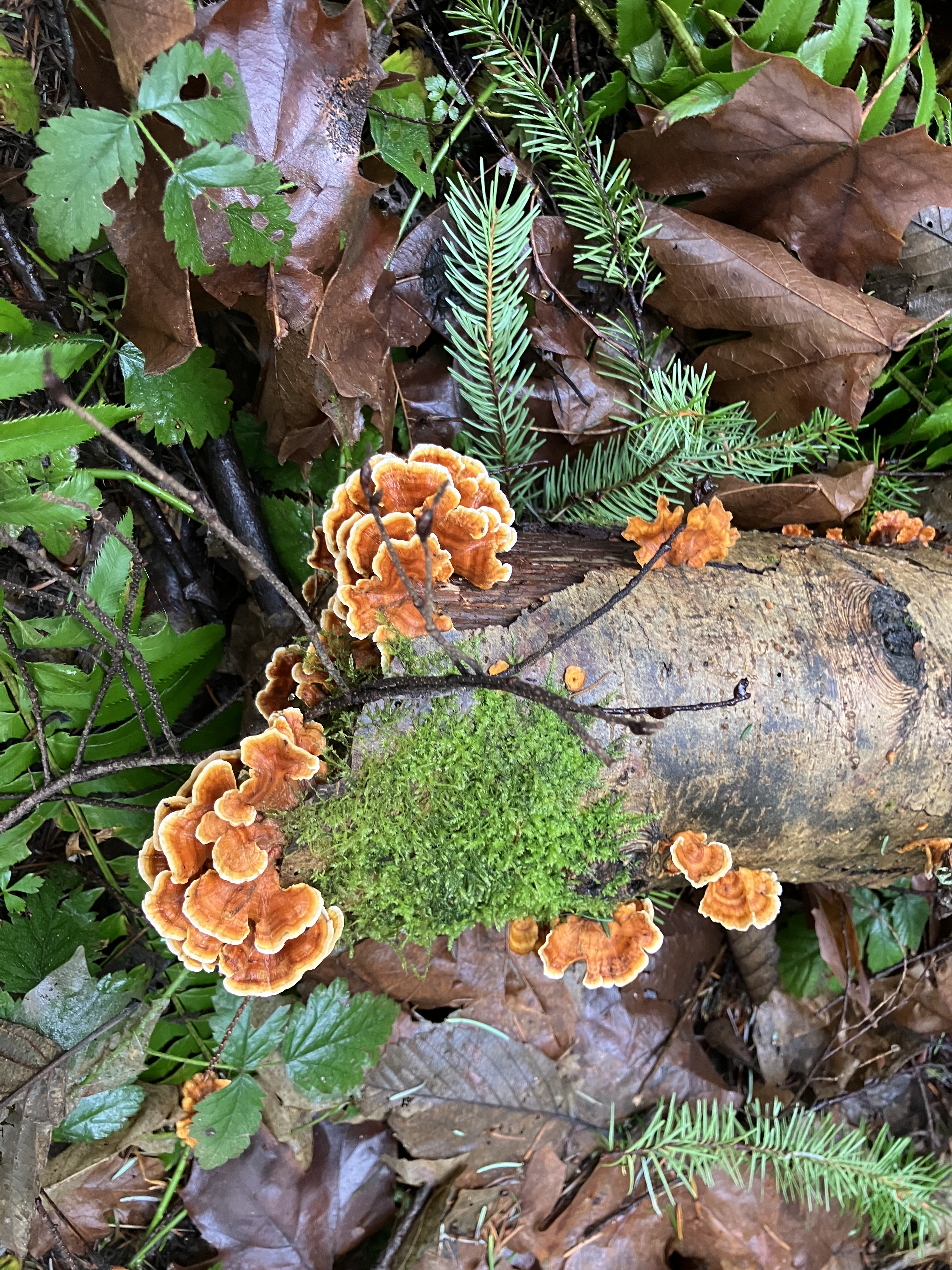
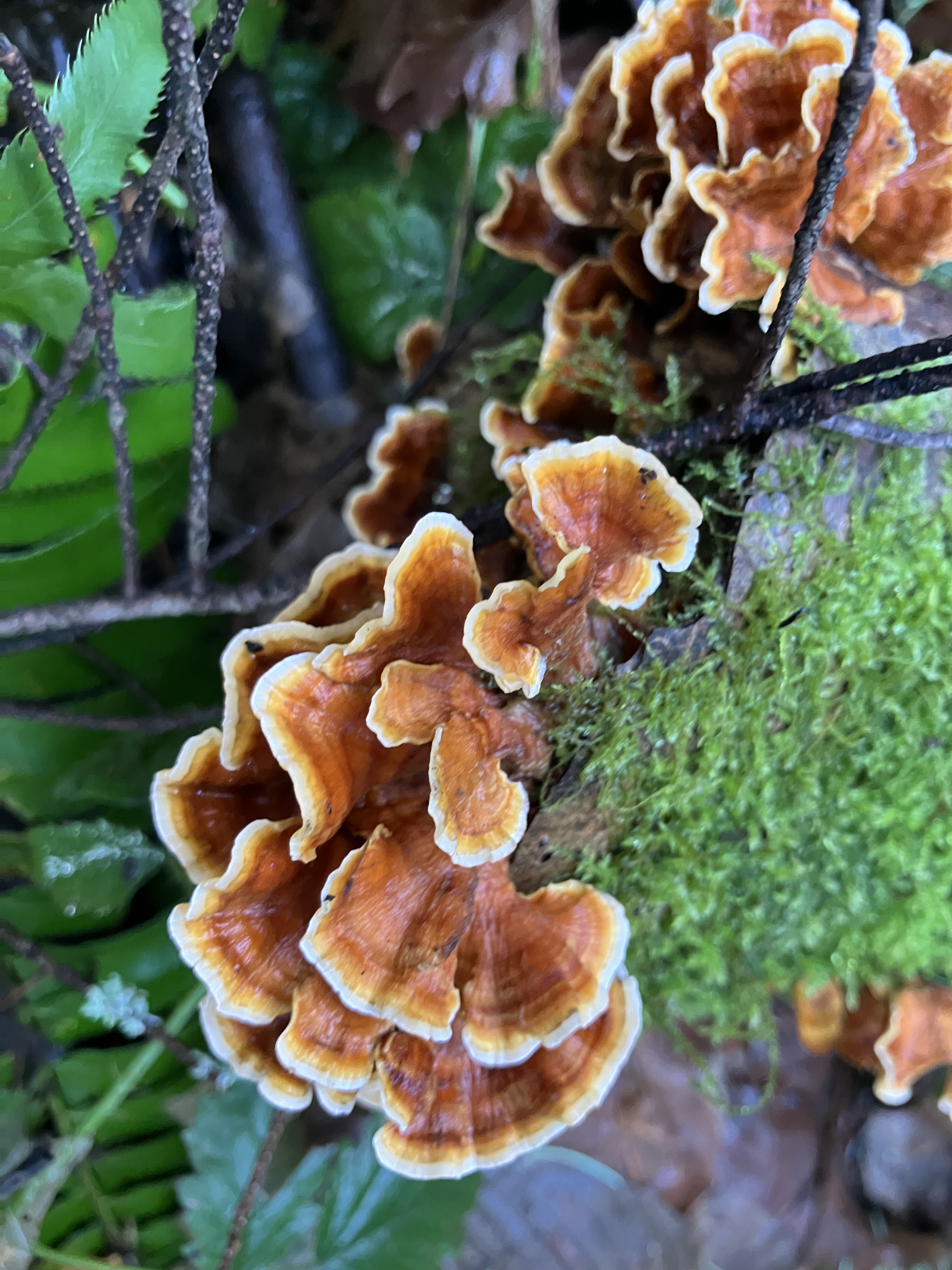
There are always mycological mysteries in the woods to look for here in The Pacific Northwest. These turkey tail variants were a bright spot in the leaf litter and fallen branches from recent wind storms in the fall of 2025. Now, the last day of January 2026 reveals more breakdown happening in these fungal forests. Debris is the key to a healthy temperate rainforest. Needles, leaves, logs, stumps, and twigs were once part of something living that banked nutrients and sun energy into living material, which in time, follows through its lifecycle and returns to dead matter on the ground from whence it came. Thus, the nutrients and sun energy is returned to the soil and redistributed back into the forest for current and future vegetative growth. That’s how massive forests continue to mature and survive. The mushrooms are playing two key roles in this cycle by breaking down the dead matter, and carrying it around through their mycelia, underground, to surrounding parts of the forest that need the nourishment.
Ecosystems are collective, complex parts of a working whole. If any one part is removed, the system can collaborate to fill the gaps, but if too many parts are removed, the system must evolve into something else, usually, an ecosystem less productive and more vulnerable to climate change. For example, where there are intact rainforests from peak to shore along The West Coast, there is less erosion from flooding because established root systems buried in 10-12 or more feet of topsoil with layers of material on the ground to protect the soil, which still acts as a sponge to soak up rain and hold it. This is how our old growth forests all over the world defend against fire, drought, flooding, and even freezing, as a large body of biomass is harder to drop the temperature of. Man I could have written that better, but there’s a nice long link line to click on for scientific elegance.
Our fungal friends remain an indicator species of soil health, though sometimes, a mushroom is unwelcome because of our preconceived notions on what’s healthy or attractive in our surroundings. To be sure, mold in food or mildew in our bathroom are not healthy fungal neighbors, in the soil outside, mushrooms are crucial, and though they may not always be the mushrooms you want to see, they are playing a role in ecological virility that should compel us to take note and embrace these breakdown cycles. When they are present in a still living tree, that’s a signal that the trees health is poor, and it’s better to recycle it back into the soil for a healthier tree or two to start. But landscaping does not like rotting wood on the ground- unless chipped and spread, which is putting a mulch layer down, but not at the slow rate needed to maximize the return of nutrients.
Humans get hung up in maximizing time, because we’re taught to dwell on death and how short our lives are. What if we turned that on it’s head a bit, and thought of a bigger picture we’re folded into? I think that’s where this current drive of religion comes from, we want to belong and share a story- we do, as living animals on this earth. Our individual part to play is so varied, like our personalities and abilities as people. Imagine if we were given the time and space to find our gifts within community, realizing our place, and being fully supported by those around us, because our gifts enhance their gifts through collective work and exchange. Nature is demonstrating this every day, and we the people chose to move further away from our natural rhythms with this earth, shutting out the very world we cannot live without, that irony still keeps me up at night sometimes.
In the Winter months, when the light is short and there is a little more personal time to reflect and turn inward, I try to look at nature more closely, seeking her guidance and gleaning inspiration for the coming Spring. Something that always pops up in my path, no matter where I’m walking, are mushrooms.
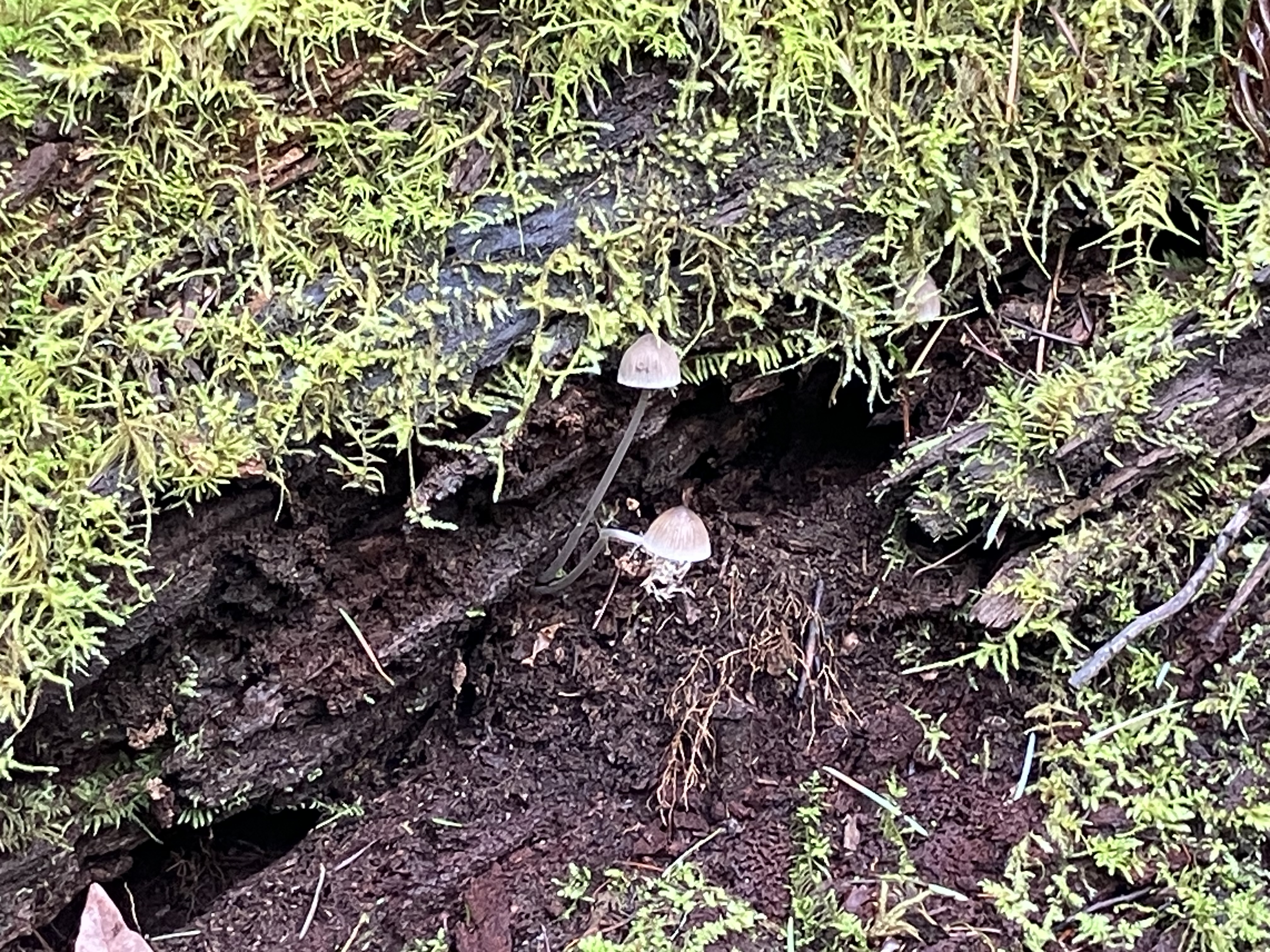
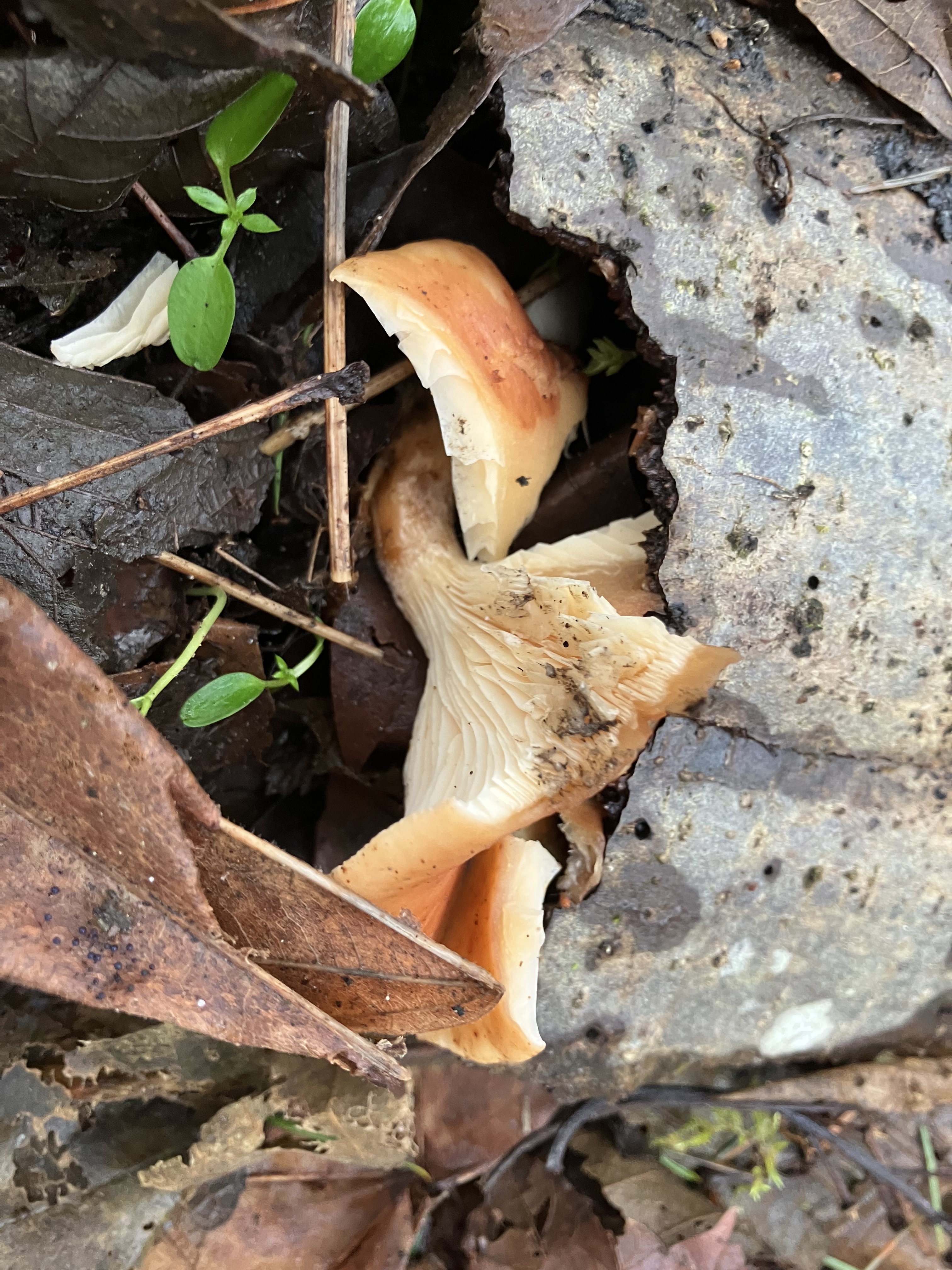
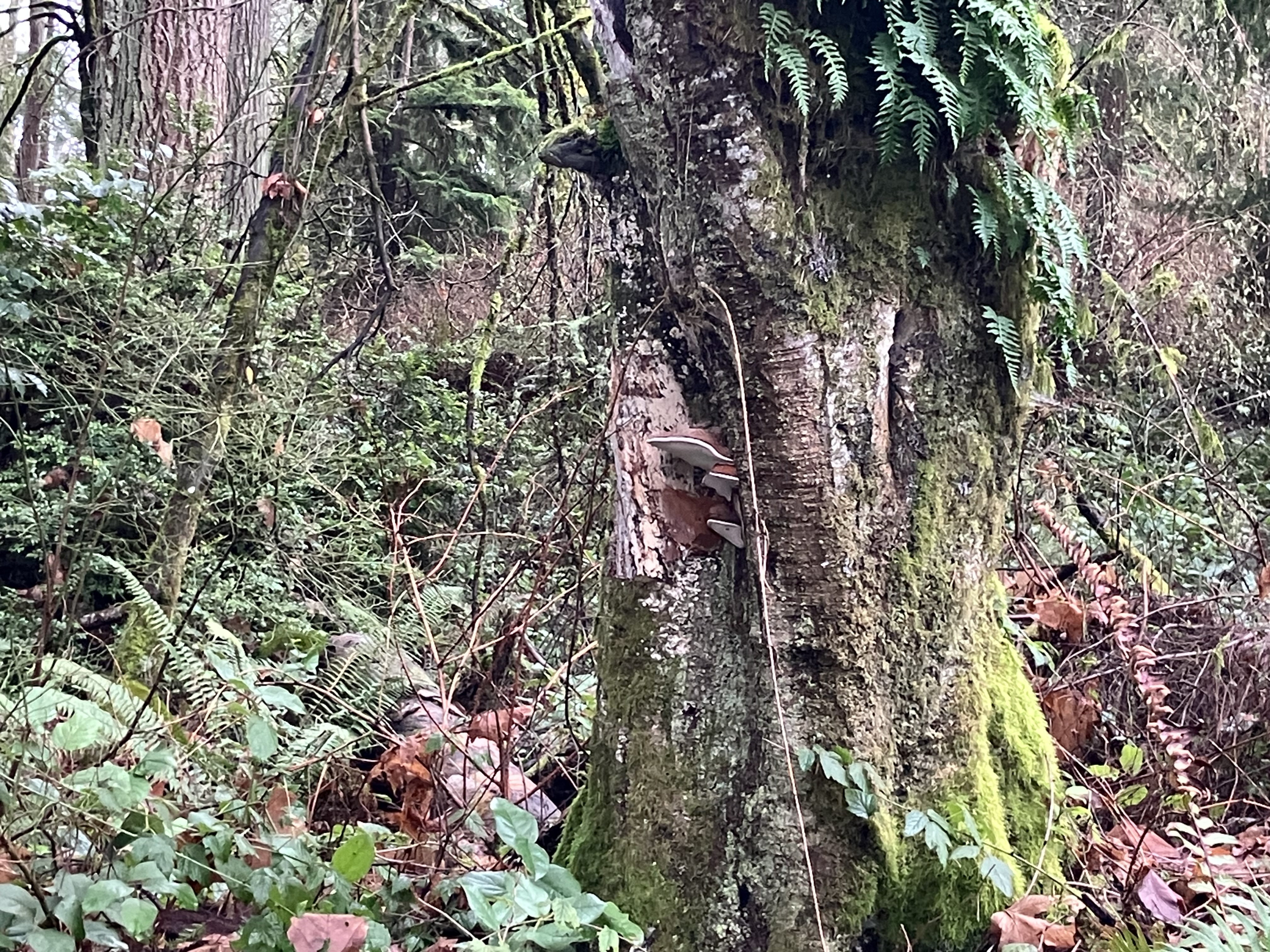
What a show- and it’s free to the inquiring eye, but also in my ears through bird song and crackling leaves underfoot, the bubbling brook along the path, and snapping twigs as I brush against the Salmon-berry stocks. The scent of decomposing wood, mossy wet rocks, and wet earth fills the air. This living system folds into my deepest memories, ancestral trails winding back into far distant memory. My whole body comes alive with it, moving through the forest and reliving foundational steps taken by all my relations. How can this experience not be healing? Why stay away from it? So many do, and some, not by their own choice, but by the make of our world today, much of our habitat is artificial light and stone, the makings of a prison for the mind and body. We can redesign, but not all of us will live in futuristic clear plastic jungle domes or rooftop garden paradise. Think of how suburban topiary and turf lawns might feel. Hey, even a house plant need light and water, make sure you get those two too.
We like to simplify things, so we don’t have to think too hard about basics, in most cases, but nature is another world from that one, it cannot be put into a pot, dressed with an LED, and given sugar and spice lattes to survive. Somehow, we’ve come to believe we can live like that, and the cracks of this facade are showing. In fact, the wall is coming down around us right now, and we’re worried about what time our next package will arrive. Time out people, circle up for a little nature insight. Go outside. Can you see the sky? Sunlight gives us much needed nutrients for our survival. Can you take a deep breath? Fresh air keeps out lungs healthy and strong. Can you touch living soil? I’m not talking about a sandbox or mulch playground- I mean dirt that’s continuous to the mantle of our planet’s core, with vegetation growing in it- that’s living soil. If any one of these basics does not exist in your world, you are bound to have some serious health problems. I’ve not even gone into the fourth key element of sutvival, safe drinking water, because we’re all challenged in that realm- microplastics and forever chemicals are global, so even in the rainforests of far off jungles (those really don’t exist anymore), our better living through chemistry has gifted us generational cancer rates that are exponential like Amazon Prime profits, and we keep streaming away, never imagining the streams nearby run full of unseen pollution that is in the bodies of babies when they are born.
But hey, mushrooms could help us with most of these pesky forever chemicals and microplastics, because there are species of mushrooms that eat toxins, neutralizing them in some cases, or at least binding them in a far less radical form. Our fungal friends cannot get us outside and reconnected on their own, unless, like me, you are excited to go see them outside. Luckily, there are literally millions and billions of other organizes outside to learn about and love, or get grossed out by, or feel a joy from. That’s the beauty of nature, it’s full of never ending lessons, good lessons, for us all. It’s also the first place I found myself, really connected with who I am and what brings me joy. Being outside is our best teacher, and great for the health of our bodies, including eyes that spend way too much time on screens today. Vision is children atrophies sooner when they are not outside, the dense layers of nature actually strengthen our eyes by forcing us to look at several depths all the time.
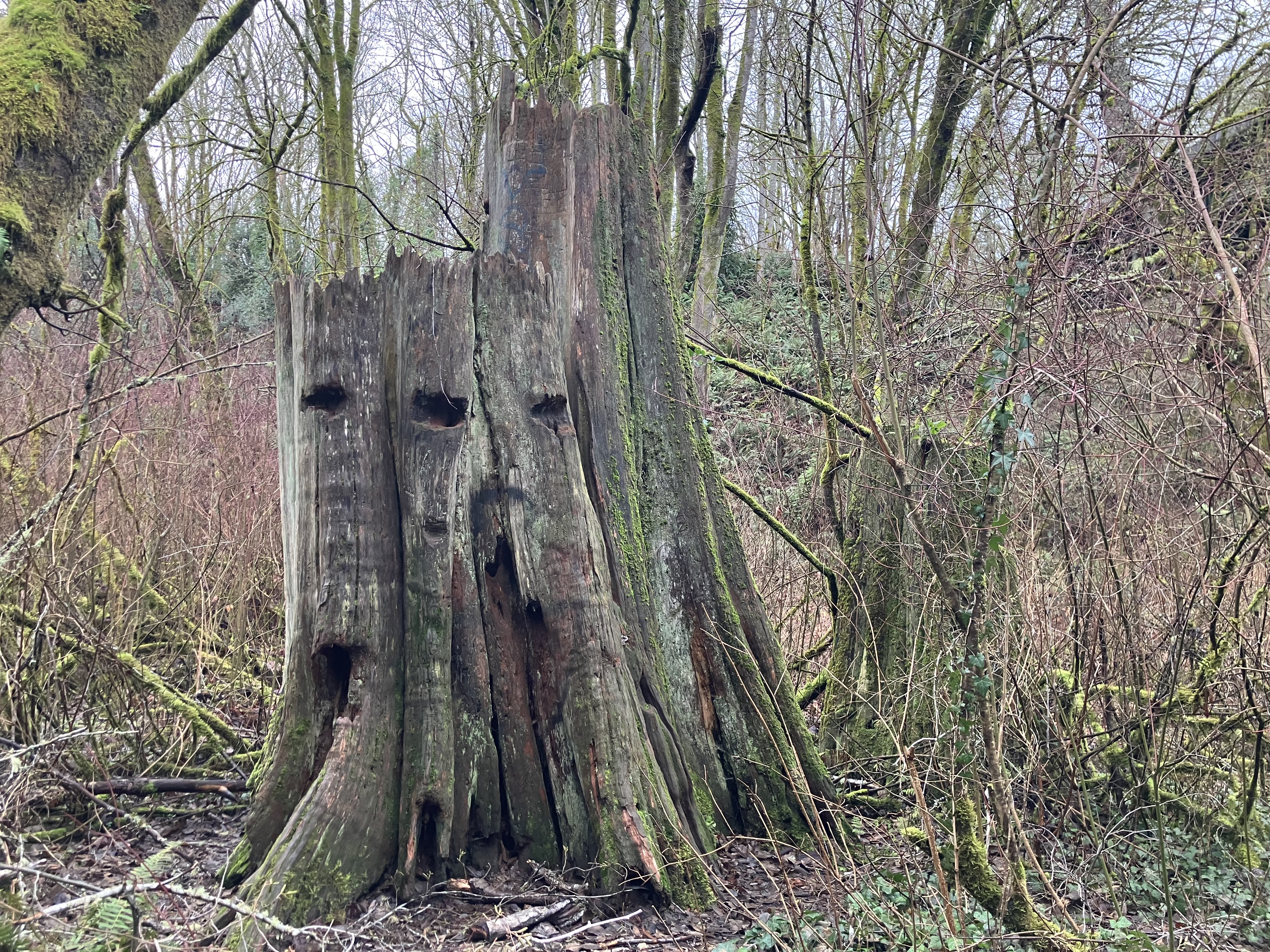
When humans began to see nature as something to exploit, rather than live with and be nourished by through a deep interconnected relationship, we began to evolve away from connection and caring. It’s been generations of removal, extraction, and abuse of the land that holds us. Even though much of the landscape we live in today pales to its former wildness, the mushrooms remain present and working hard decomposing and redistributing resources throughout the complex ecology of this earth. Our fungal friends do not give up, just shift in adaptation to the world as it continued to change. This is a good mindset for us all to take in. Perhaps it’s time for a change? I’m not sure exactly what that looks like, but the best change I’ve seen, happens outside.
It’s why I chose to live in a place where I could be outside year round and the living world around me remains bountiful and alive, with ocean shores, alpine peaks, rainforests, and step-desert all in one state. I’m walking in a state park just south of Seattle. It’s a densely developed surrounding area, but there was space made for trees and creeks too. Though the land was clearcut a century ago, younger trees are starting to girth out, showing potential for old growth some day. A volcano could change everything tomorrow, nature can still be a truly destructive force, but she’s equally durable, rebounding in her ever abundant way. We would do well to learn from her, and spend less time trying to get in her way. Our demand for convenience, this sycophant to cooperate power through economic dominion, clouds our judgment today. I’m not sure what can free us from this tyrannical bond, but Frodo really should get that ring to Mt. Doom, if you know what I mean.

 EEC Forest Stewardship