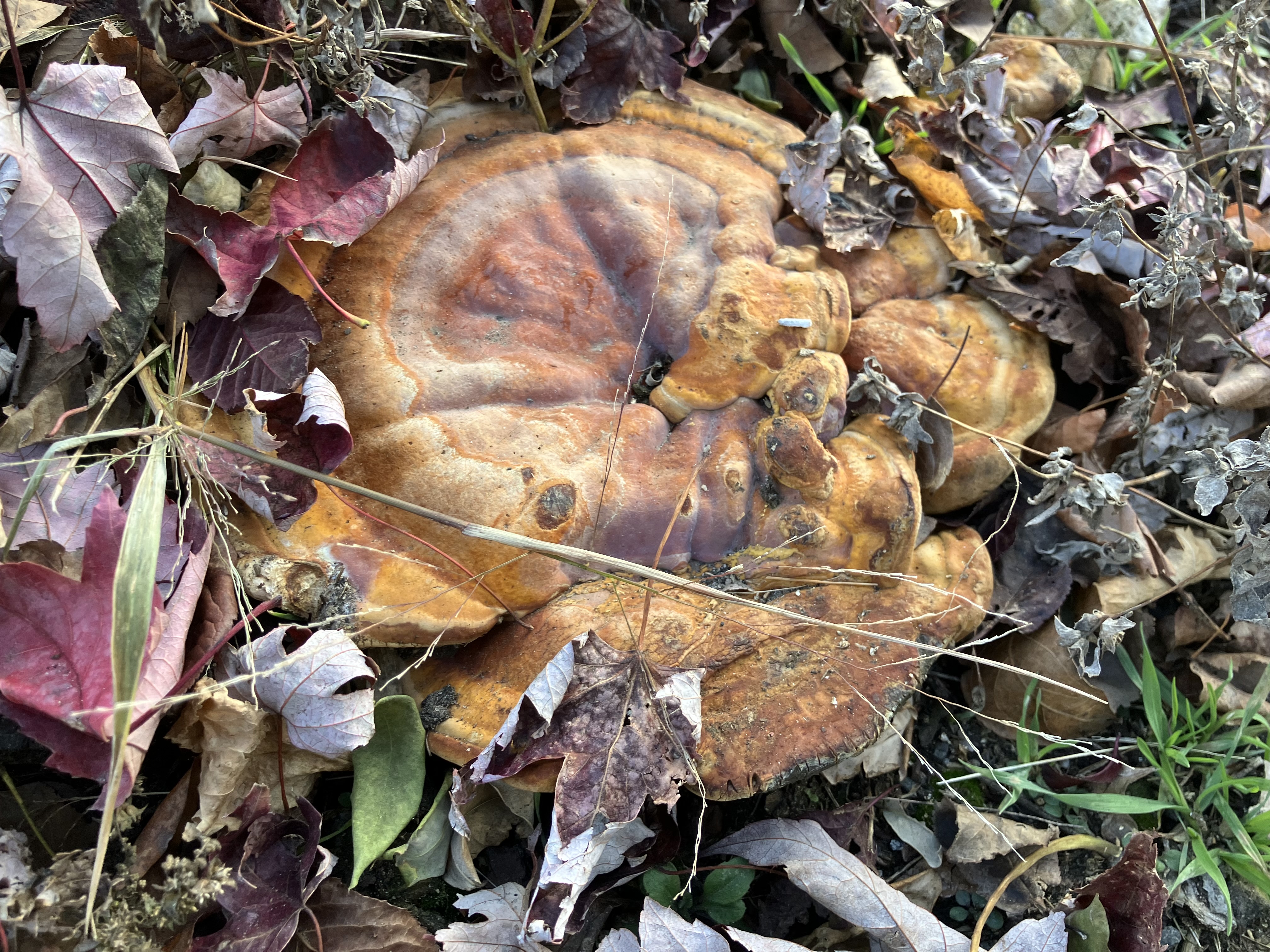
Anywhere you go- there’s a mushroom close by! I’ve just come back from a trip to The East Coast in late November, 2025. There was amazing autumn color still on the trees, and some mycological bursts of bright pigment as well. This Chicken of The Woods was a wonderful example, hardened by time and age, an old one like this is shellaced, not a choice edible, but still some sustenance steeped for a while if you’re in need. It was loose in the ground, protruding from the rotted out oak stump where a city tree used to grow, near a school. Ideally, something would be planted here to replace this fungal habitat, but for now, the mushrooms continue working to transform detritus into valuable soil. If we sit with just this complex system of nutrient exchange, even fathoming for a moment, the layers of evolution involved, out simple understanding of it, not even yet aware of the possibility. Gosh those leaves are so pretty.
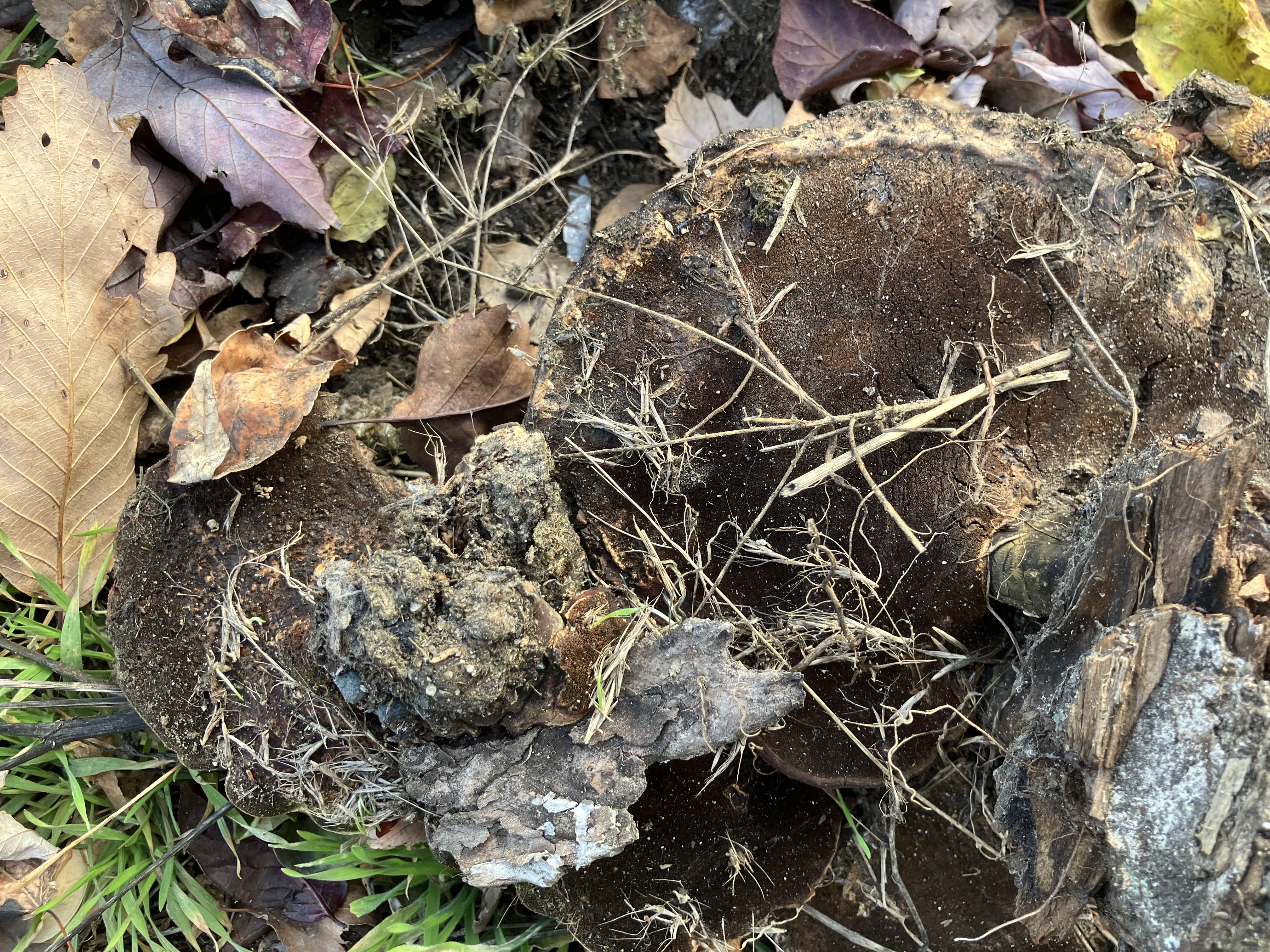
When I turn it over, this saprtrophic mushroom presents a glimpse of the happenings on a mycological level and beyond. This species needs rotting wood to thrive, though its mycelia can travel through and colonize rotting leaves from the same tree- usually an oak, and there are a lot around here- note Quercus montana leaf top left. This specimen is established in the almost gone stump of something, in a planter square between a paved parking lot, sidewalk, and a heavily used blacktop street. You can find mushrooms anywhere, and here, between a boys and girls club and a Moldavian church in West Springfield, an edible mushroom came forth, matured, released more spores, and continues to support mycelia in the soil.
So many of the species on The East Coast are a little strange to me, but I keep my eyes peeled and focus on what a dominate hardwood forest offers. Strolling through a different forest near The Catskills in New York, I could not help but notice all the blooming fruits of fall. You might think of apples and pears, but I was not in an orchard- well, not a recently cultivated one, I did notice many other saprotrophic examples slowly taking apart dead wood in a recovering forest. This particular forest was a Dutch homestead with an established cherry grove. The cultivated trees are long gone, but native black cherries are making a slow comeback. They need light, and are often found in edge spaces. Because this forest has no younger established evergreens, the cherry has continued into the canopy, with the potential to become an old growth tree. Nearby Turkey Tails passively break down a legacy of nutrients for the soil and vegetation that feeds all life on this earth.


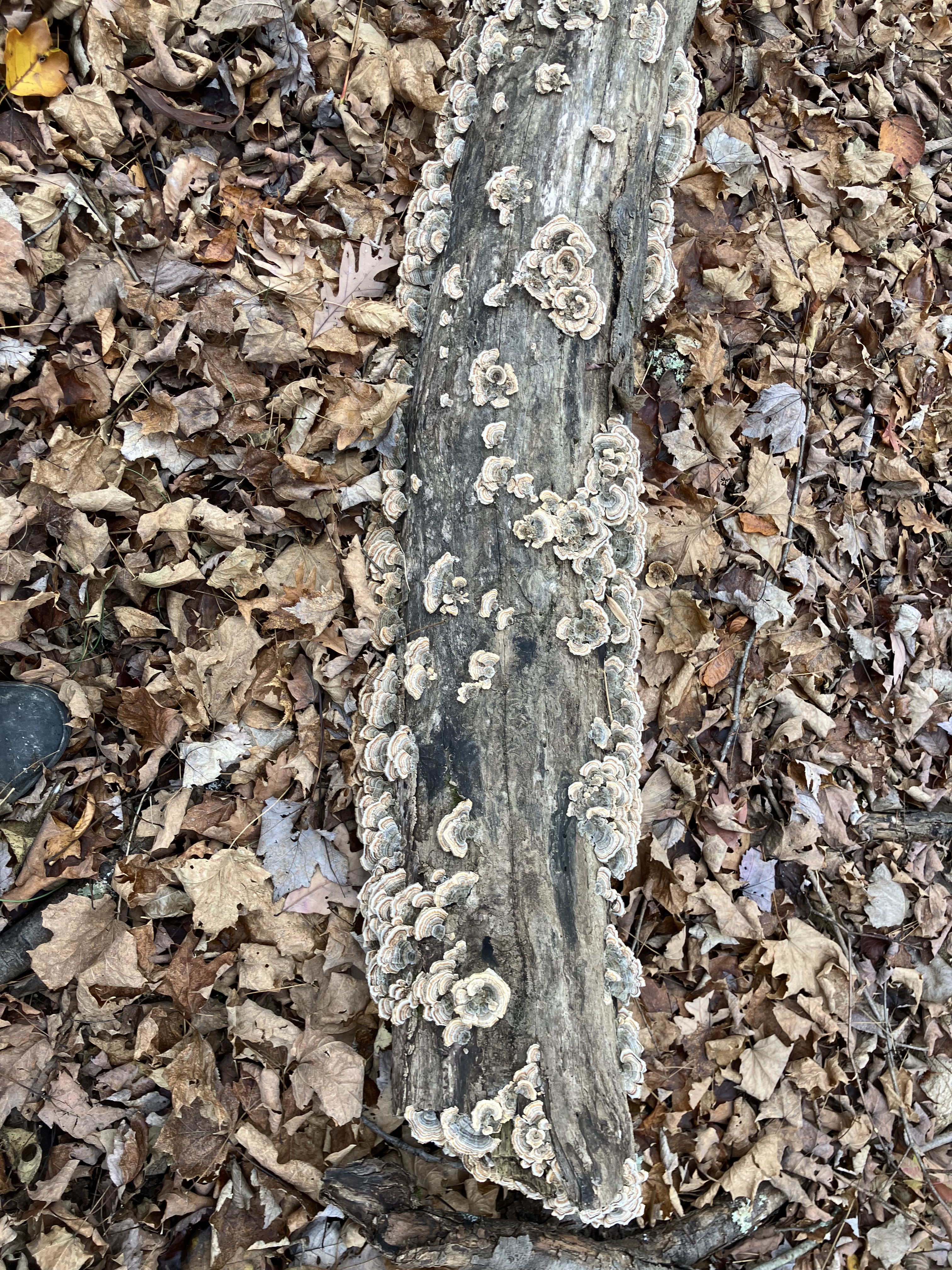

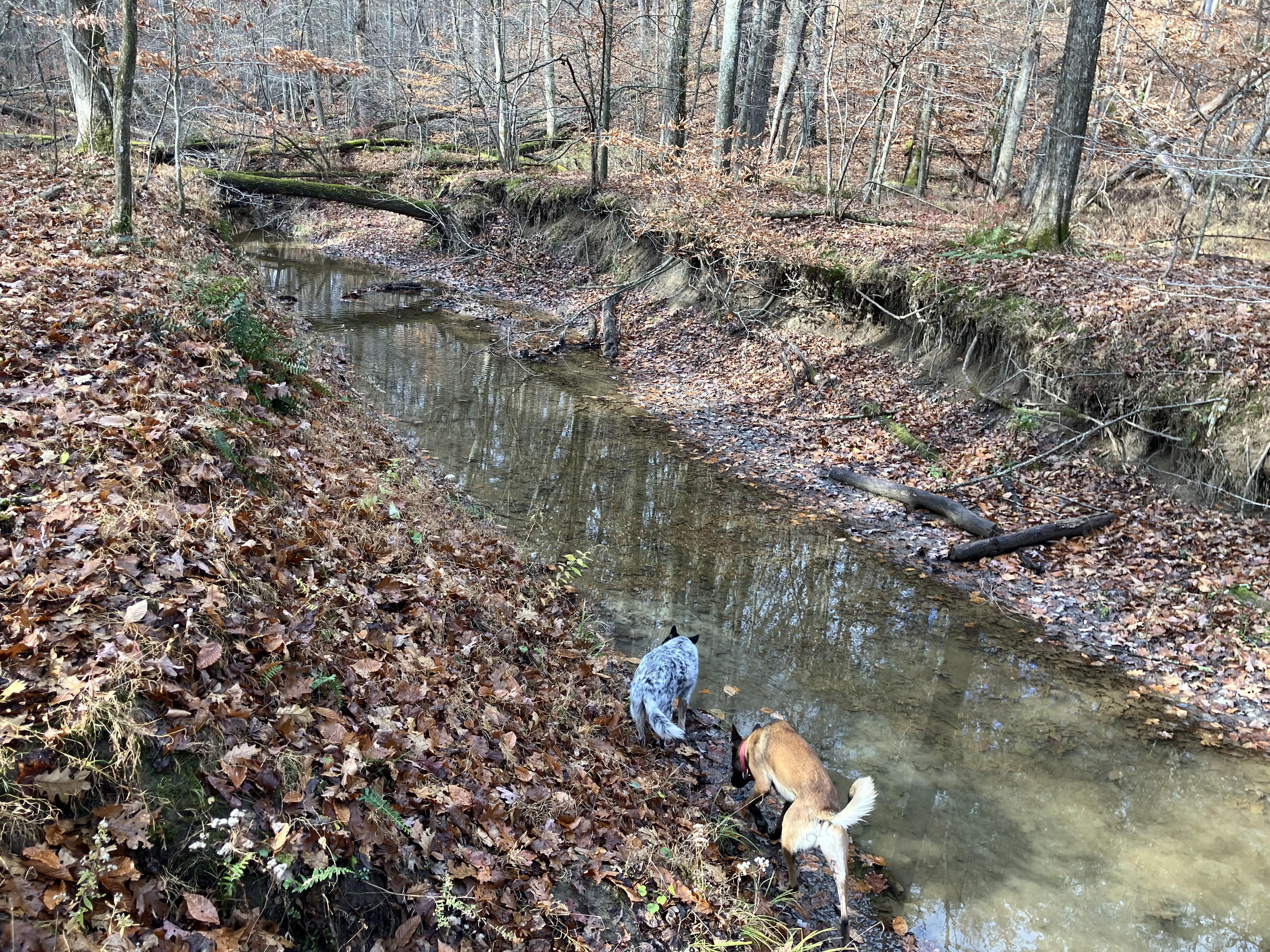
The log hosting this larger specimen, Trametes pubescens, is a bracket fungus enjoying a downed feast that will last many years. There’s a little calling card on this log, which crosses the small stream through a purposely canal drained wetland. The Dutch knew how to make wetlands go away to reveal wonderful topsoil for tilling. Row crops fed families and made abundance for selling in the local community, or keeping livestock, which most families did in the early 1800s. By the 1900s, dairies had consolidated in the bigger river valleys, and pasteurization put commercial milk on trains to go to the big cities like New York. The territorial marking of this turd might come from a fox, most likely vulpus vulpus. The animal is leaving a flag to say “there is a good crossing here”, a direct path above the deeply cut drain ditch that is now eroding away at a rapid rate, pulling in logs that will actually help restore this wetland, in time.
The family that came and dug this drainage came on the heels of a much larger shipping canal built in the early 1800s. It’s historic banks are stones throw, or easy cart ride down the hill, where this famiyl could sell their products, like the cherries, to a canal boat pulled by mules, heading to The Hudson River, a shipping highway before rail, and later trucks haul the world to and from major ports at it’s mouth down in the bay. Coal was streaming out of Pennsylvania along this canal, and all the little town stops along the way bought coal and traded agricultural goods. The Dumond family that lived here in the 1800s worked to make the land as productive as possible in their short tenure. However, they left a depleted landscape with lost wetlands and terrible erosion that is still cutting away the soil today. As trees naturally fall into the path of these active waters, the flow will slow and spill over into the awaiting wetlands. Eventually, the water will return to its old floodplain, but human intervention could speed up this recovery, with debris dams set in strategic areas to help guide the water out of the canal and back into the low lying areas of this forest.
We have dominion over the land, yet know so little about it. The primitive concept of dig, build, control, vs. a more enlightened observe, learn, reflect, fold in brings short term gain at long term greater loss. Humans have the ability to reason out common sense tactics for survival in almost any situation, yet we keep slipping back into reactionary extraction. Untangling ourselves from that economic nightmare now holding so much of the world in the hands of a few mega conglomerates will deteriorate as this wetland did, but the compelling topography of finite holding it all up is crashing. Exponential weather extremes deal catastrophic blows sending our living world back into balance, and like 99% of all life up until now, we shall go extinct. Until that time, we can work towards restoration and rewilding, weaving the natural world back into daily routines and rituals. I’ll take a page from these mushrooms and keep on transforming personal passion into a thriving life in this abundant world.
Connectivity is the key to this thriving, and our own actions can branch out similarly, locally, with people we see doing good work that feeds everyone. None of the leaves hold back on the tree year round, refuse to compost into rich soil, that feeds the mother tree, who grows new leaves every year, knowing they will drop again in The Fall. Someone wrote a poem about this endless giving, as a metaphor for mankind to take and hold close. The mycelium is another teacher, one you have to look closely to see, but she too is ever giving, weaving death back into life, transporting inactive matter to active neighborhoods of complex mineral, vegetable, and animal relationships that make all life possible, please fold yourself right in.

Canopy is very important to the soil in this part of the landscape, abundant in hard wood trees. In big prairie country, the grasslands put down 20′ deep root systems that have similar exchanges of minerals to build better soil, hosting all manner of biological factories under the surface. Grasslands to have a more complex underground system of biodiversity and microbial action, but the forests have an above ground diversity that is just as important. Looking up in to the canopy of this hardwood landscape, I can see trees that have died, and are now hosting all kinds of life, including important nesting habitat for birds in standing snags. These dead wood towers are very important to the environment, and should be left alone if they are not a danger to personal property or a heavily used throughway. Eventually, mycilia will also inhabit these dead standing complexes, helping to deconstruct the wood and returning it to the soil.

As humans, we think we know so much about woods, soil, and water, but nature is so complex, layered, and reliant on community activity to thrive. When people take away one part of these systems, it has a cascading effect on the whole process. We took out the old growth forest, causing huge erosion of the precious topsoil in every forest we cut. Then we killed off all the predator animals, thus removing a keystone part of the life and death cycle in the animal world. Our livestock borough disease, that killed much of the deer and all the elk, as well as the over hunting we did to sell fur, meat, and antler to industrial processing. Not to mention our own sickness brought from Europe to The First Nation People, who died by the millions before the Dutch settlers and colonial expansion began. Not much of this history is taught today, but you can learn a lot by listening to the oral histories still spoken by the descendants of the tribes, that still live in these landscapes throughout America.
Nature is always trying to restore balance, and the mycological friends in these forests show the strength and determination of the natural world. The smaller relics of recovery are just as important as the big flashy conservation tree planting and wetland restoration, and it’s done passively by millions of unseen organisms still alive all around us. I say passively because we don’t have to pay to implant them, work to reestablish the mushrooms, or guide them in what they should do. Nature runs independently of us humans, and that’s incredible to sit with and watch. The more time you can spend sitting and watching, wandering and exploring, the closer to the natural world you become. In fact, we the people are part of the earth’s living system, we’ve just strayed from our original instructions to steward and tend. If you can make time each day to tend, even just observing what grows on around you, you are taking steps towards re-connection and restoration in your self. Once you rediscover the wildness within, you can embrace nature as a part of, rather than separate from your mother earth.

The wilderness of New England still carries many scars of human disruption- from canals to clearcuts, the land is deeply changed by all our extraction and greed, brought on by a complete disconnect from the living world. We spent so much time thinking about what we could change, we didn’t stop to think if we should. Now, the consequences are coming home to roost, and the human species faces monumental survival challenges related to the exponential change nature is now adapting towards, with or without us. Looking down at the rotting logs around me, I stop to thank nature for continuing it’s evolution, regardless of our monkey minds and ideas pushing in. We cannot sway nature too far off course. Learning to see her adaptability and change, embracing it and learning to be with nature, rather than against it, this is the best evolutionary understanding we have. Fresh air to breath cannot be artificially contrived- not in a sustainable way, fresh water cannot be synthesized- H2O is just that, and no lab can conjure it out of thin air. Safe soil to grow out food is not made en mass online. You cannot scroll through different soil options and pick what you like for your home. Terra firma is what it is, and though we learn to amend and cultivate, our tilling abuse and monoculture nightmares are still actively destroying the priceless landscape for the sake of industrial madness. Yet the mushrooms continue, trees grow and die, wind pushed over shallow roots in the diminished topsoil, and water carries off the nutrients needed to stabilize the banks and return the land to wetland recovery. What can we do to work with nature, to re-wild ourselves back into our roles as stewards and co-workers of mother nature?

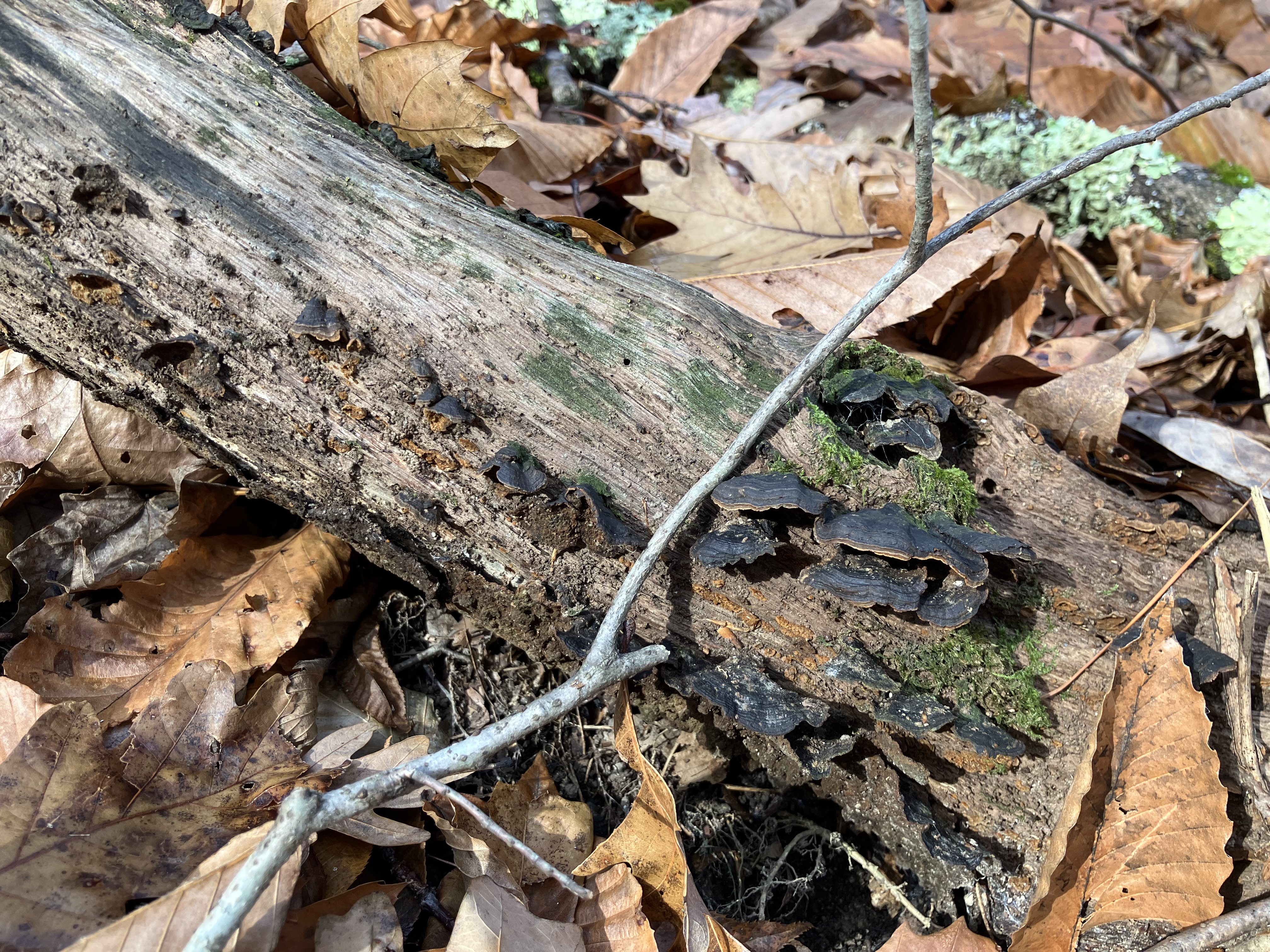
The Oak Curtain Crust pictured above is a fascinating species of mushroom I had not noticed before. It was a beautiful sunny day to capture some pictures of this beautiful bloom. Almost always found on fallen oak logs, the strain originates in tropical regions, and has found it’s way up into New York’s hard wood forests over time. Think of all the wood we’ve shipped all over the world, and you’ll better understand how fungus has traveled to all parts of the world- for better and worse. Many fungal strains caused irrevocable damage to our native forests. In much the same way small pox wiped out native populations of people, fungal strains entered the hardwood forests of New England and wiped out keystone species like our beloved American Chestnut. On the West Coast where I live now, The Western White Pine is gone from our canopy too. Mushrooms are certainly important to forest health, but non-native varieties make short work of the trees when they are not resilient. Over time, American Chestnuts are being genetically modified to resist the blight, but very few native trees remain alive today to carry on resistance. A GMO Western White Pine strain has also been created, and I’m planting them on my land in hopes of helping a crucial tree return, but to what end? Forests adapt naturally, even with chaotic loss, new forms of forest evolve. It’s that human cause that we keep ignoring. Then we come up with our own solutions, manipulating genetics and guessing at what might work. Again, when we stop to think about what we’ve done, maybe we can start by stopping some of the destructive madness of our own actions, and being to accept the consequences. I reflect back to that wonderful speech by Dr. Ian Malcolm in Jurassic Park, we did not stop to think, we rarely do. Take a page from the mushrooms and sit with it for a bit longer. Imagine the outcome of careful thought and gentle reflection. We could reshape our world in the image of nature, rather than grasping at technology as a savior from what could be our own garden of eden.

 EEC Forest Stewardship