

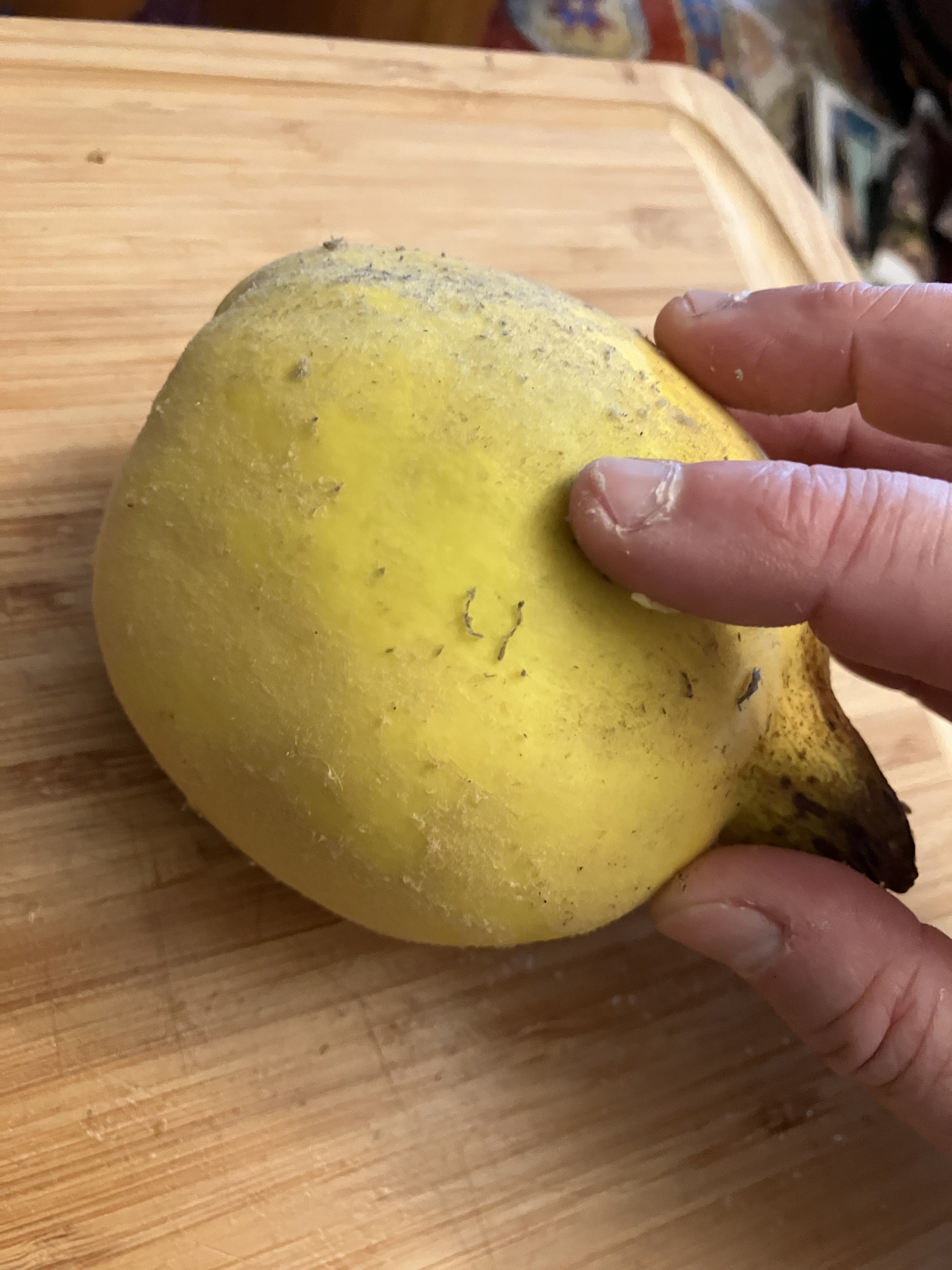
These are a forgotten fruit in many planned orchards, but I’m here today to encourage you to take a second look at Cydonia oblonga. I’ve planted three in Mom’s Orchard, and this year (3 since planting) they produced their first crop of fruit. My geese shook two off early, I picked one while it still had a lot of fuzz, and the majority I waited until they lifted easily off the branch. This is how I judge most of my fruit, though you can pick early to cold store into full ripeness, thus prolonging the fruit’s life and freshness. Still, I find picking when the fruit is ready to let go brings the best flavor and texture from the fruit, from apples to pears, and even these quinces. My first crop was modest in number, but generous in size of fruit. These are eating quinces, selected to grow large and sport a hefty flesh to seed ratio, great for slicing and dicing into salads, pies, and jellies. My first recipe is a classic quince “cheese”. This is the only way I had ever experienced quinces, but it was a dreamy flavor and texture adventure that I was excited to repeat.
Quinces have a generous natural pectin, which, with a little reduction and sugar, makes a wonderful jello like block of sweet fruit that you can slice and serve, usually as part of a charcuterie board with cheeses and crackers. This amazing fruit tree comes to Washington State and this little orchard spot from a local nursery, but the historical roots of the Quince begin in Iran’s Hyrcanian forests. Their homeland is temperate lowland broad-leaf forests on the south end of The Caspian Sea. The Puget Lowlands of Western Washington are similar conditions, though evergreen dominate, our orchard is broad-leaf dominate, and the soil is amended to suit the fruit bearing verities, which all require more dolomite lime, compost, and leaf mold debris. All of which are mixed and well rotted before application. The Quince had thrived in our soil, and likes a dryer summer. It took off as soon as it was transplanted with it’s root stock three years ago. The abundance of these trees speaks to the health of our soil, and the great conditions for this cultivar.

Above are two different types of Quince, with the larger one being from my eating variety. I say eating lightly, because, through I do love the raw taste, for many, it’s too astringent, but I liked the strange taste of my quince raw. The smaller one is from a different tree on another property across town. I don’t know it’s age or care, but all the fruit gifted me from this tree was this smaller size. I ended up processing them using a grater, rather than trying to cut them up. The core can be a little difficult to cut around as you are learning, and with smaller fruit, it’s just not worth the coring effort. It is recommended that quinces are cooked for best flavor, and I agree. This fruit has such a floral scent, along with a texture mixing pear and apple. The flavor is subtle, citrus with sweet rose water, or a hint of caramel. Something almost ancestral comes out of the tasting, I was enchanted at the start, and found that many quince recipes come from The Iberian Peninsula, and specifically Basque country.


Channeling some ancestral tasting, I continued dicing and slicing, then boiling and blending, ending up with a puree that went into molds to set overnight. The cheese should be firm like jello, but mine did not cook long enough, so even after a few days of sitting in the fridge, the liquid was still too viscus to set- I had not boiled down long enough. The only answer was a trip to the dehydrator. After which, I cut the flat fruit leather into pieces to go back into the fridge and freezer for future enjoyment. The sugar will keep the fruit stable, like a jelly or jam- which I could have made too, but I wanted something firm like the cheese. Net year, I’ll know to cook things a little longer. If you don’t have time for all this processing, you can grate the fruit off after peeling and freeze- that’s easiest with the smaller varieties. I did do that with the gifted fruit, and will look forward to making a small single loaf of cheese later this winter. Next fall, I’ll look forward to another wonderful harvest and some added experience in working with this unique orchard friend.

So much thanks to the abundant trees that gift us these sweet treats at harvest time. Thank you to all the people who carried these cuttings out of The Middle East, and all over the world for humanity to enjoy. Gratitude to the soil here in Washington, accepting this far flung grafted cultivar, and supporting it’s growth on this farm. May future generations have access to this food source and share in the bounty of yummy quinces!


 EEC Forest Stewardship