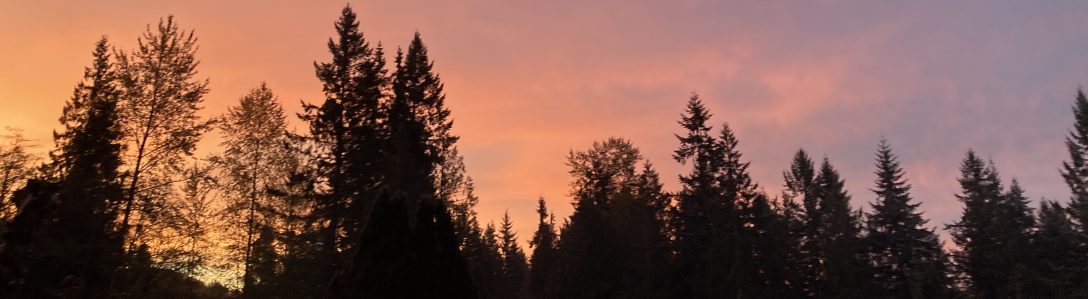

Valley loves out woodland adventures, and shows me where all the good rolling scent spots are while we wander through stream buffer groves at The Snoqualmie Tree Farm near North Bend Washington. On a cloudy afternoon, the rains held off long enough for us to check for some local fungi in our friendly forests. Though the tree farm is an active timber plantation, there are some areas where the machines are kept back just far enough to allow some older substrate and buried old growth legacy come together to offer a little gimps of what could be if the forest was intact. Though this whole area was clear cut at least twice, more recent setback laws have begun to protect certain token areas in the plantation- specifically stream buffers, which prevent erosion in our salmon streams. Thank you fish for protecting some of the forests.

In these less trampled upon soils, mushrooms abound, and I tried to capture a few photos of the unique things growing on in these thin strips of ecological protection. A pair of M. epipterygia brave the forest floor in golden splendor. I love mycena for being small, but colorful. They span the pigment spectrum from turquoise blue to flamingo pink and are often overlooked because they are small. No, you can’t seat them, but you can take a moment to look closely at their nature and makeup to appreciate a fine specimen of mycological diversity on the forest floor. Another potential rare find is some Cortinarius rubellus or deadly webcap. I’m not 100 percent sure, but they certainly look like them. Note Cortinarius is a huge genus under the family name Cortinariaceae. I label mushrooms under this heading if they have particular gill structure and cap shape, but it’s often hard to get to a particular genus, and I’m making a best guess for this encounter.
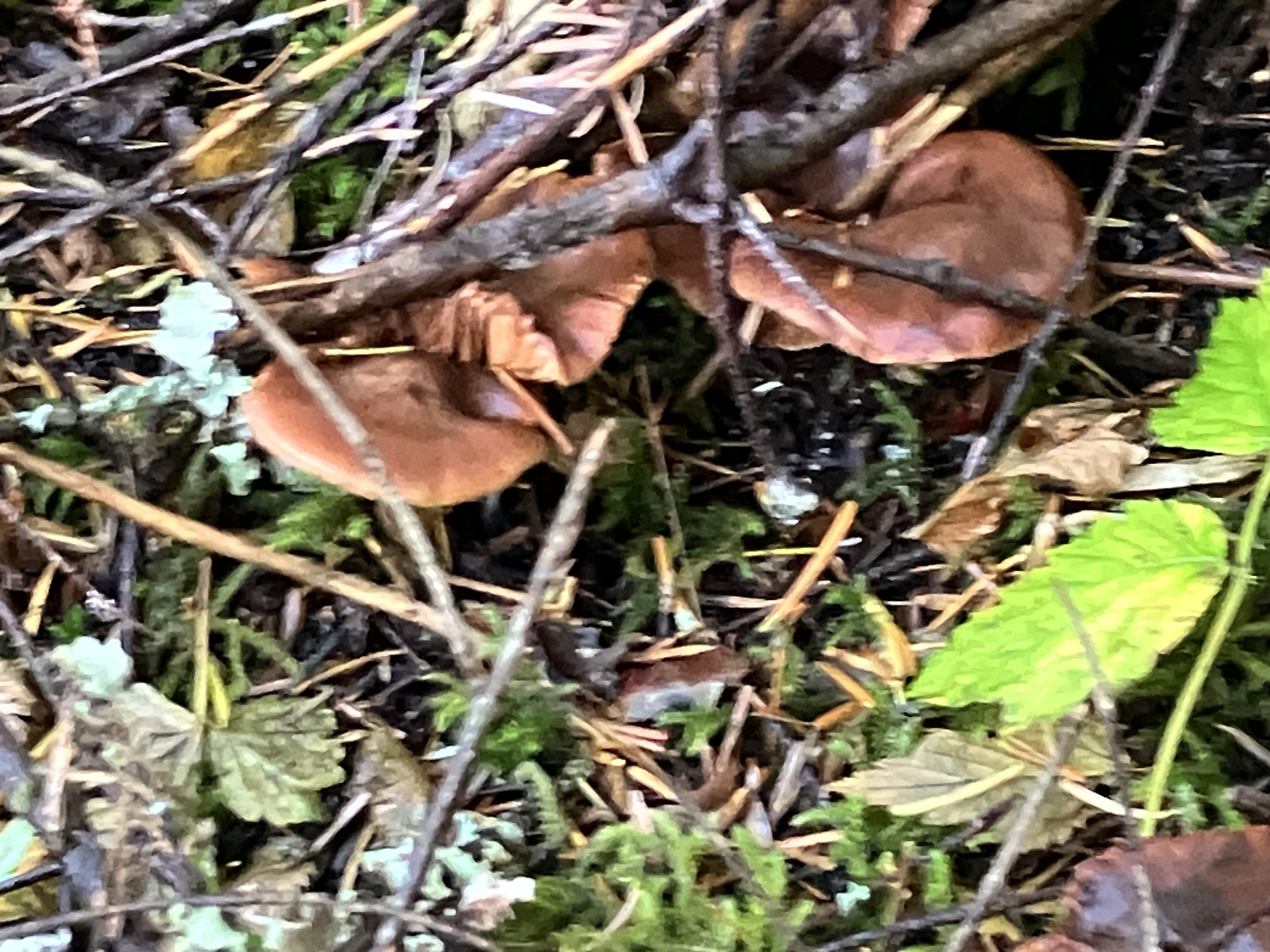
Sorry when the pictures are so blurry, I’m using my phone camera on uneven ground in a wet environment. I’ve never claimed to be a photographer, so my apologies, but you can see the general shape, color and big gills on this cluster of fruit. Remember, a mushroom is the blooming fruit of the mycelia, the root of the fungus, which is within the sub-strait, and the body of the fruiting mushroom you see above ground. Under the soil, the real magic of a mushroom’s powers are at work, breaking down tough wood chemical structures into digestible soil for the surrounding vegetation, that’s why mushrooms are so important, they break down debris to free up nutrients in the soil, and transport it to the roots of living plants to digest. Without the mushrooms work, none of the valuable nutrients in things would get back to the soil for more growth in living material. The cycle cannot continue without fungal friends doing the breakdown work so the nutrients can be restructured for the plants to use again. Thank you mushrooms!

Valley also helped me take a peek at the work going on underground. We didn’t have to do any digging, an overturned tree had lifted it’s roots and the thin layer of topsoil to reveal what goes on underground. A compacted root ball testifies to the hard glacial compaction just under the surface of this forest. The trees have shallow roots, which topple the tall masts easily once surrounding forests are clear cut. This leaves trees that once stood together standing alone in strong seasonal winds, which blow them down and create lucrative insurance claims for the tree farm. Under these trees we took a look at the soil layers and some mycelia working to connect the forest in a highway of nutrient rich transport lines. That’s the white looking webs in the photo below.

This new soil layer, with the mycology and tree rootlets, is only a few inches thick. That’s an important truth in these legacy timber stands- the soil erodes away with every cutting, leaving rocky compaction for the future GMO plantings. That’s why the tree farms now spread treated sewage from the city in younger thinning- there’s not enough nutrients left to grow our timber trees, that’s part of why the industry is pressing in on the few uncut areas of our American forests left. We are allowing old growth to be cut in Alaska, because not enough people see what’s going on up there. But here’s a quick satellite view, so you can see the activity from the comfort of your own screen at home. Welcome to The Tongass National Forest, where active logging continues, though there are Roadless Rules to “protect” this space. It’s not a place where a lot of people have eyes on things, but Alaska want’s you to know it’s being logged. All these active logging operations are taking what’s left of the soil and clean water through catastrophic erosion, which comes after clear cutting.

Oh, and only a few people- literally 50-60 folks, are employed through this timber grab in our National Forests, even less people profit from the sale of said timber, and in many cases, our tax dollars are actually subsidizing it, meaning we don’t get any money back for cutting this old growth. Hunters and anglers join the fight against logging these national forests, so it’s not just a woke argument people. Please pay attention. The United States has some of the greatest public lands on earth, and we don’t often think about how special that access really is. If you’re wondering, it’s very hard to find statistics on public land in Europe. About 8% is public in Great Briton. Nordic countries allow a lot of public access, but not public ownership. The continent is hard to translate- public access and right to roam– as in, pass through but not linger is more the vibe. Only The United States has the kind of truly public lands of any nation in the world, and we constantly turn a blind eye to the practices of logging, mineral extraction, and oil pumping that goes on within these lands that belong to us, the people. The current administration, 2025, is also questing to sell off those public lands into private hands, and you’re not hearing about that in the news.

Back in my own woods near home, I uncover the legacy of past trees that now form the base of these younger, commercially planted GMO timber trees. The decomposing roots of an ancient forest still nurture these baby trees, helping to prop up a grove of monoculture. An old red cedar, with fire scars remains in situ beneath a toppled commercial fir who’s little rootlets dangle above a 6″ native Douglas fir root that’s still holding sediment, even as it rots away. No new huge root systems are coming in to replace what’s lost. We keep cutting the young stuff now, never allowing a forest’s ecology to recover. How can anyone possibly call this practice sustainable? But industry experts do– our forests are working forests, bringing the next generation of forest products to a box store near you. So we just keep planting, growing, and cutting- taking the majority of the biomass out of the forests, and replacing it with treated sewage- that will work right? ha ha ha

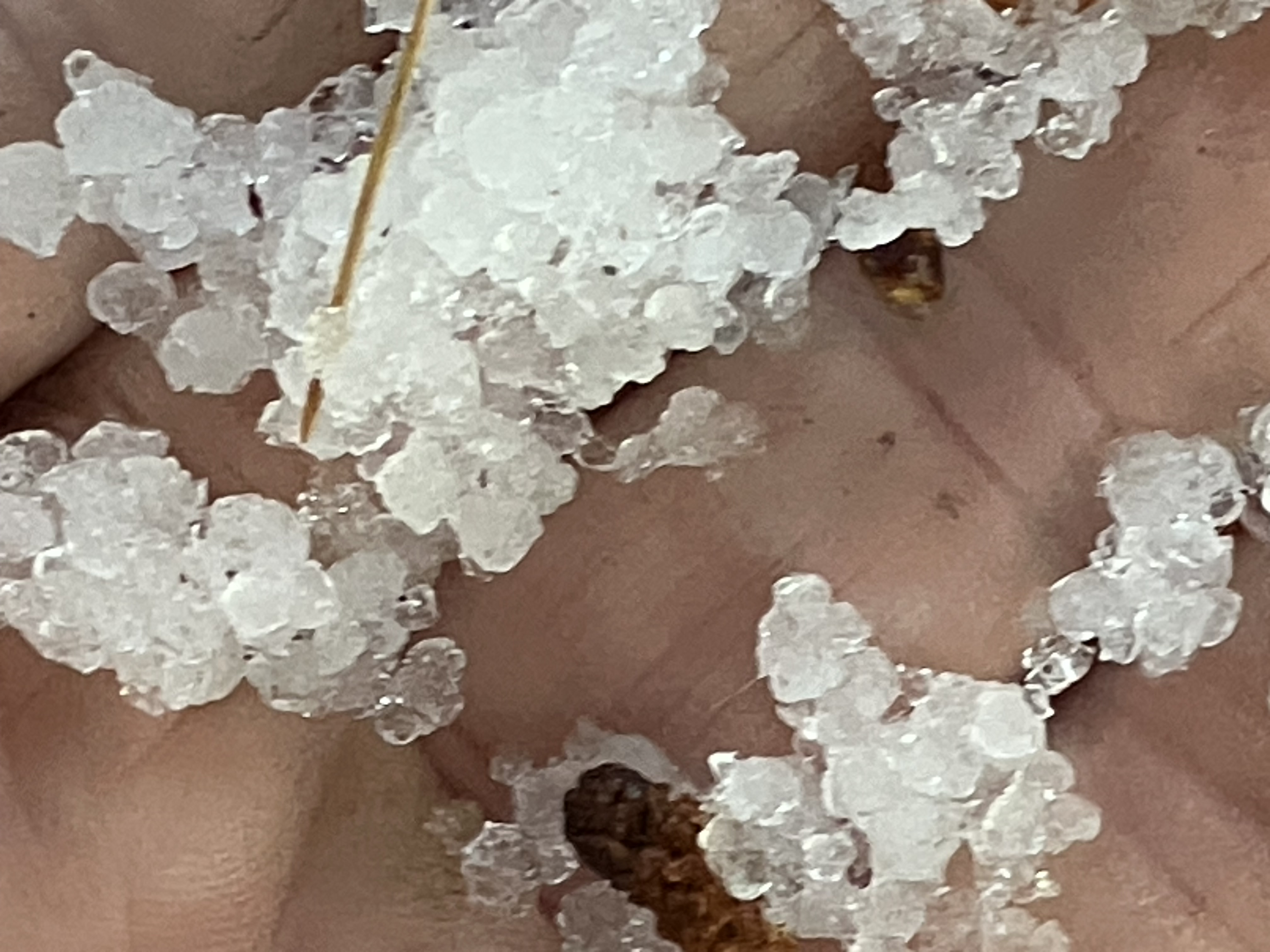
Ok, back to observations and a little less dooms day rant. As I walked through the intact canopy, I noticed something glistening and white in a shady spot of the forest grove and though it was snow. Taking a closer look, I discovered that it was not snow, but a collection of grapple which had not yet melted from a storm the day before. I captured that storm on film at the farm, and share it below to give an example of what was coming down that day, even at EEC Forest Stewardship. These frozen drops are too small to be called hail, but ice none the less, and slow melting at high elevations in the shade. This weather event has become more common in the last decade, and I think it’s a hint of things to come in our area. What if one day these events drop real hail instead of friendly grapple? Our weather is only supposed to get more extreme at Climate Change continues. What will happen to our billion dollar fruit industry when this frozen rain turns to baseball sized carnage? I’ll continue to be charmed by these small pellets, and hope we don’t see the softball sized chaos that sometimes falls in Texas and Oklahoma, where I grew up.
Back at the tree farm, I took a closer look at the soil makeup under the toppled trees on the edge of the stream buffer. The geology of The Central Cascades is a fascinating topic, and I’m always trying to untangle the layers of history locked in geologic time. Under this particular fallen giant, I found a variety of rocks, clay, sand, and ash that are typical in an active logging area. Glaciers brought in most of the gravel, so I can spot conglomerates of granite and basalt from volcanic activity on our Ring of Fire, as well as charcoal and ash from the burning that was done after clear cutting in the early 1900s. It was though then, that burning the clearings to open up the space for agriculture was the best practice for the time. It leaves a legacy of scorch marks on old growth stumps, and thin layers of burned materials on the landscape throughout Western Washington. I find this layer of incineration at EEC too. The sand and sand stone found here reminds us of the seashore, which is only about 30 miles from our forest location, and extended much further inland when the earth was enjoying a warmer period. These sandstones also predate the techtonic uplift that brought this landscape to the 3,000′ of elevation it stands at today. Thus, a shallow shoreline could have been here millions of years ago, forming the beach that later became this sandstone. The looser sand might be part of that beach, or could be volcanic in nature. These are mysteries for me, but I hope, with some time and research, I can learn more about how sand came to this forest and ended up in these layers beneath the trees.
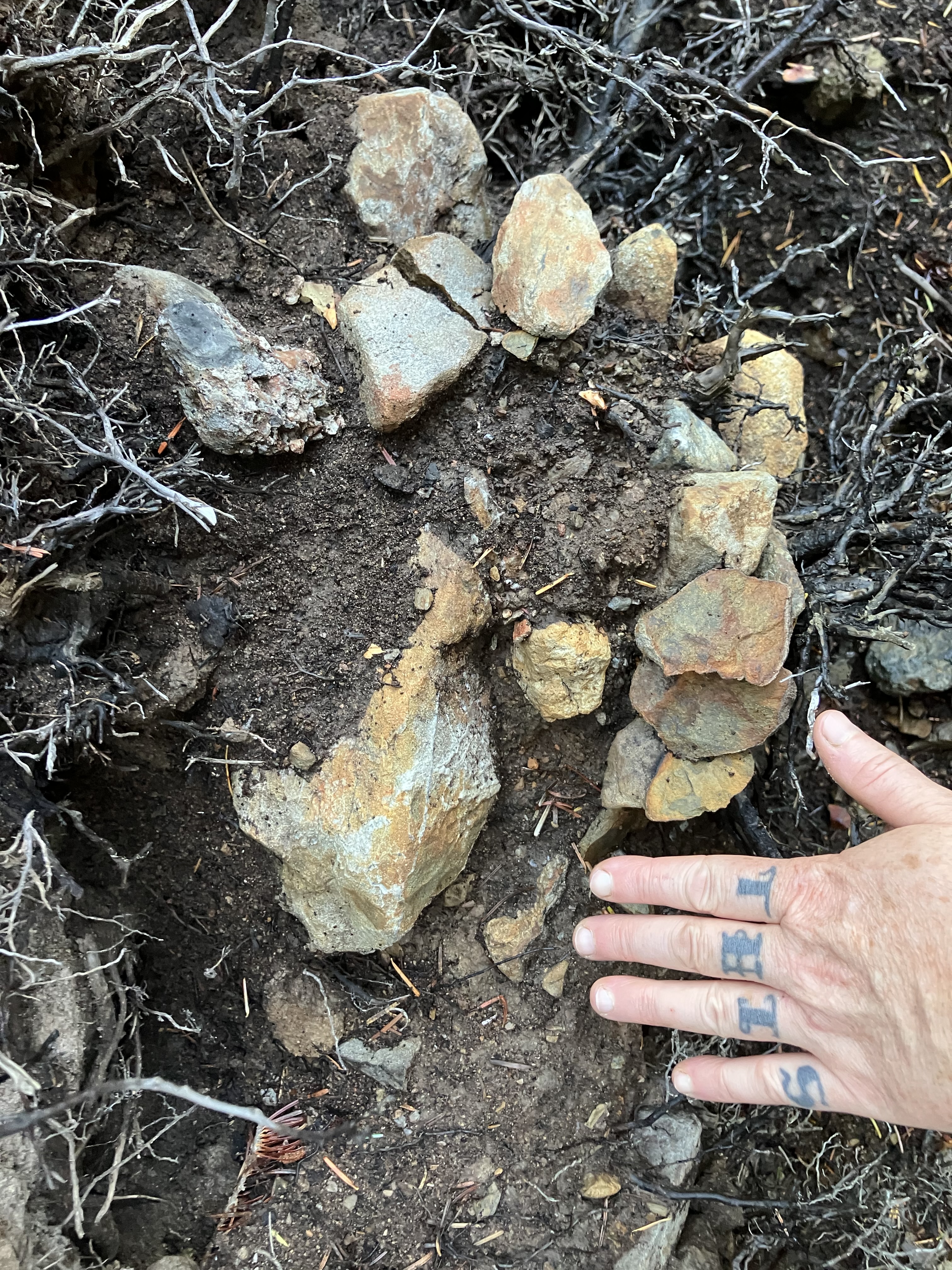
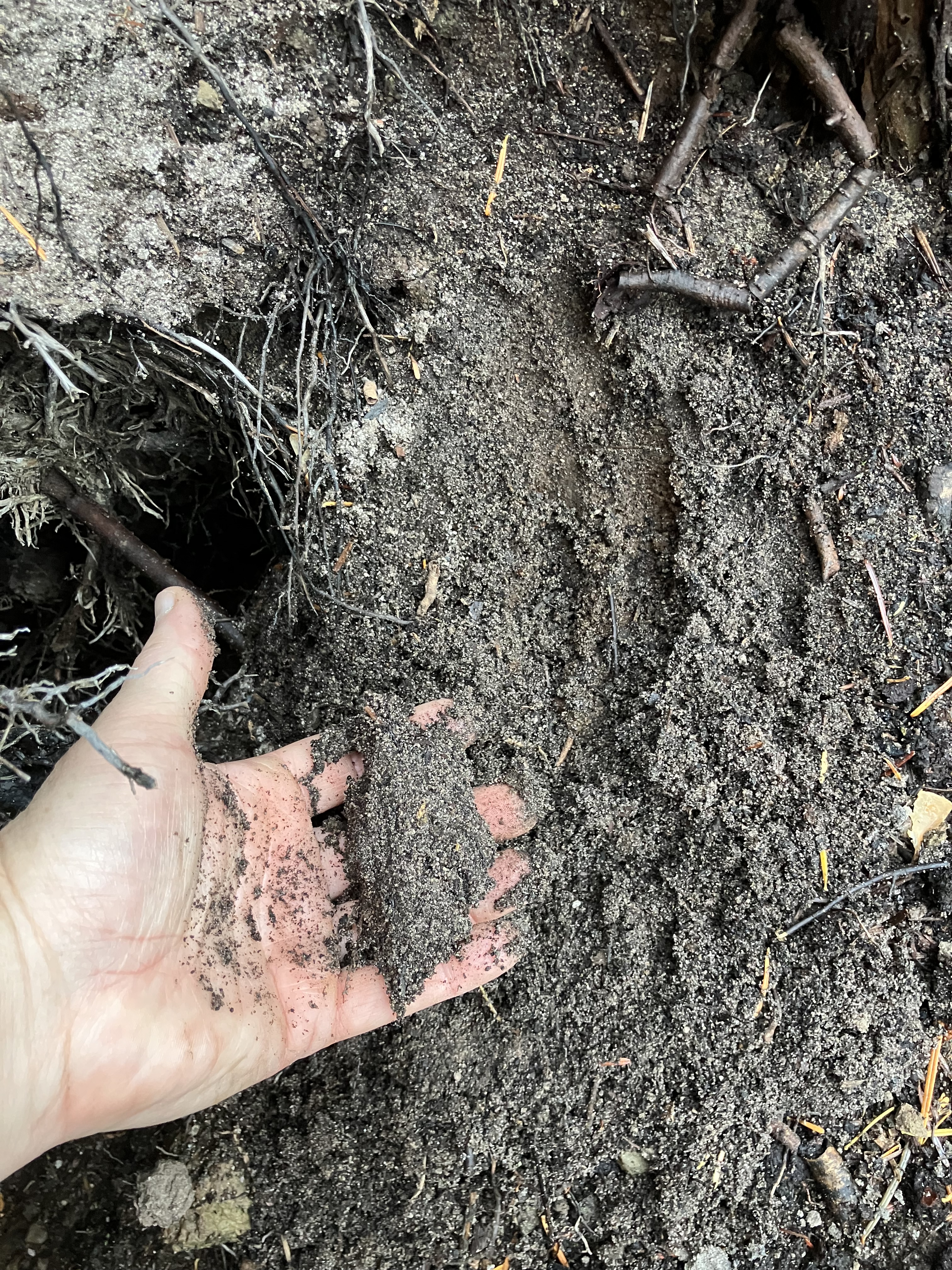

I’m actively crumbling some of the sand and ash from the underside of the root ball of this fallen tree. This is sand and ash, not forest topsoil. There is little accumulated biomass to create soil in this timber plantation. Old growth forests take thousands of years to build up enough topsoil to support themselves and remain rooted. It is speculated that tens of feet of topsoil were lost after initial clear cutting actions in these forests over one hundred years ago. Today, we can see that legacy continue every time we cut again. The landscape cannot support trees without soil, and the treated sewage will not be enough to replace the trees take and sold by the board foot in mills to this day.
Remember, this is all in a stream buffer forest that’s been left for preservation within the timber plantation. The ecologists require these buffers, by law, but they are flimsy, and the forest along these streams is not natural or healthy. At least it’s a green patch in a brown scalping. Here’s the above view of the little grove I’m learning in.
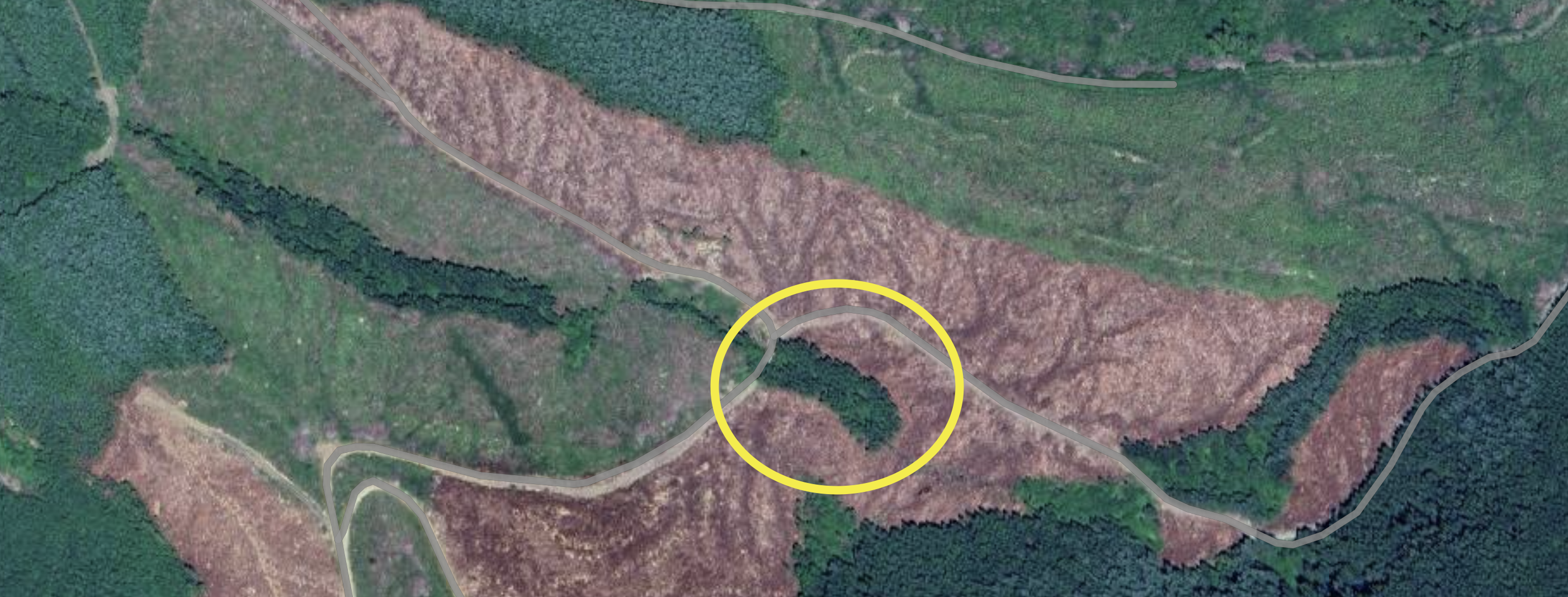
It’s not even extended along the entire stream that comes through. To the right and left of this grove, the water is still on the surface and running, but has no protective buffer. Why? I’m not sure, but I can guess that no one cutting the trees really cared. Who is going to see or comprehend this as an issue when so much of the world is on fire else where? Who among us will challenge the abuse? Who has time? At least you’re all reading this and taking it in. At least someone is showing you, or trying to. This is the slow death of our forests in real time. It’s not just the trees disappearing, its the soil, clean water, and countless layers of habitat vanishing in an instant of commercial consumption. We can’t put it back, not for generations to come. Where are we allowing forest to grow old again? Certainly not in these industrial plantations, and don’t let them try to convince you otherwise. Oh, they do replant, and put in more trees than they took, but then thin them out, spray the forest with chemicals, and mono-crop the place, still calling it forest, but it’s a shell of its former self, just visit The Hoh Rainforest to compare.
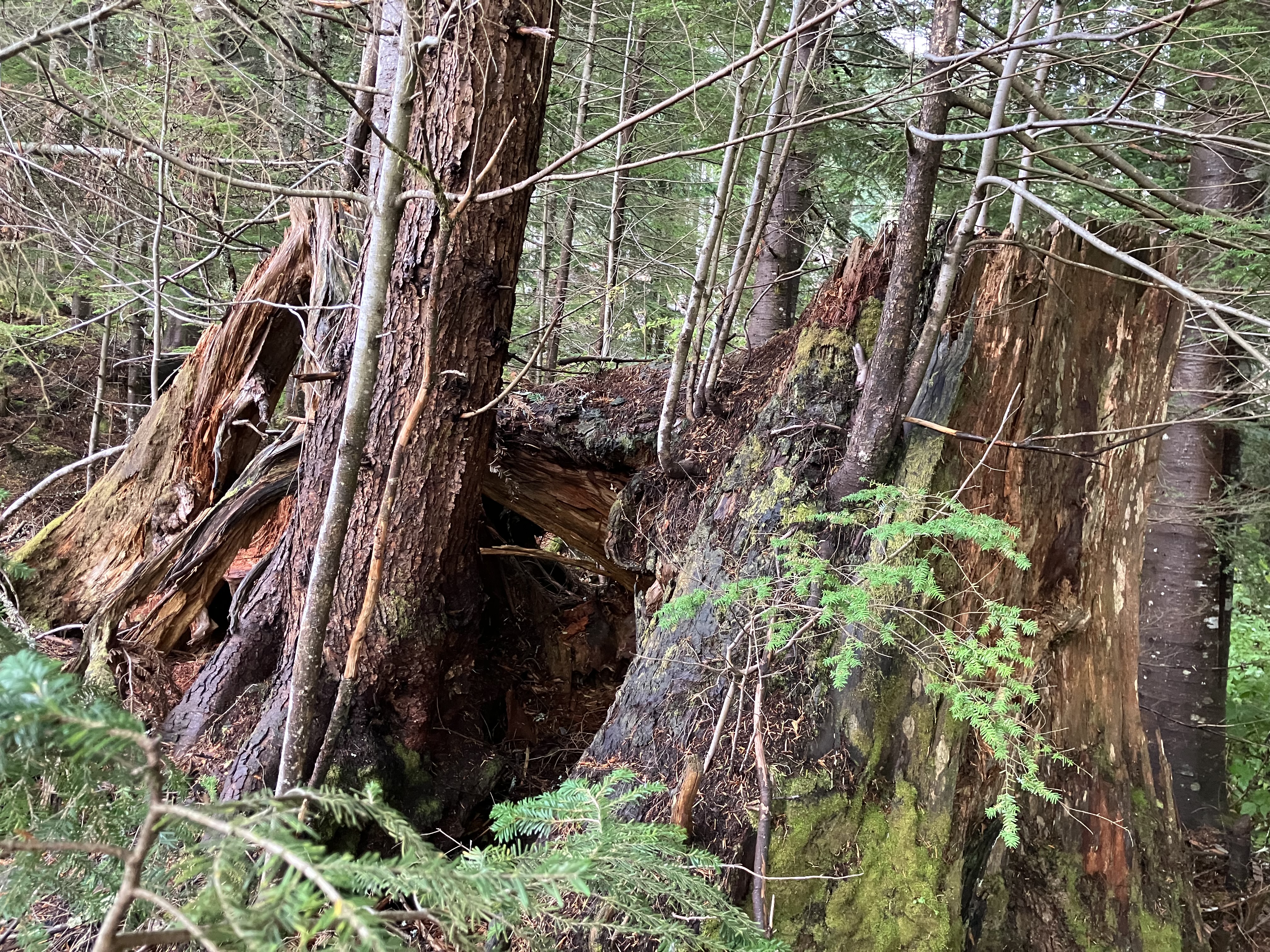
There are legacy stumps reminding of us of what once was, scattered all over the land of The West Coast, specifically The Temperate Rainforest of The Pacific Northwest. Those stumps bare witness to the great, complex forest that once was, and could be again if we would just let Mother Nature tend her wilderness, which in turn, protects our drinking water, food crops, and habitation on this planet, within the bounds of her finite resources. Below is a pair of stumps in the buffer, a red cedar and Sitka spruce, entwined together, as most of the forest floor is, these elder trees left their bones for future young saplings to grow up from, as the young Douglas Fir is doing, along with hemlocks, alder, and other seedlings taking root in the less disturbed edges of this stream buffer. These little strips may be small, but they harbor the remnant of young seedlings from the native trees that once stood here. I hope that these token places are allowed to remain less altered, and ultimately the home of future old growth groves, even a few ancient trees are better than none.
Gratitude for the lessons in survival and abundance, even in places where wide spread deprivation practices continue in the form of depleted ecology and removed biomass from the forest. Still, native trees grow, and mushrooms return. May the waters continue to flow, and the soils grow in community with intact forests, restoration stewardship, and science that shows the long term effects of resource removal, and how leaving the resources in their place makes a better world for you and me through the generations to come.

 EEC Forest Stewardship