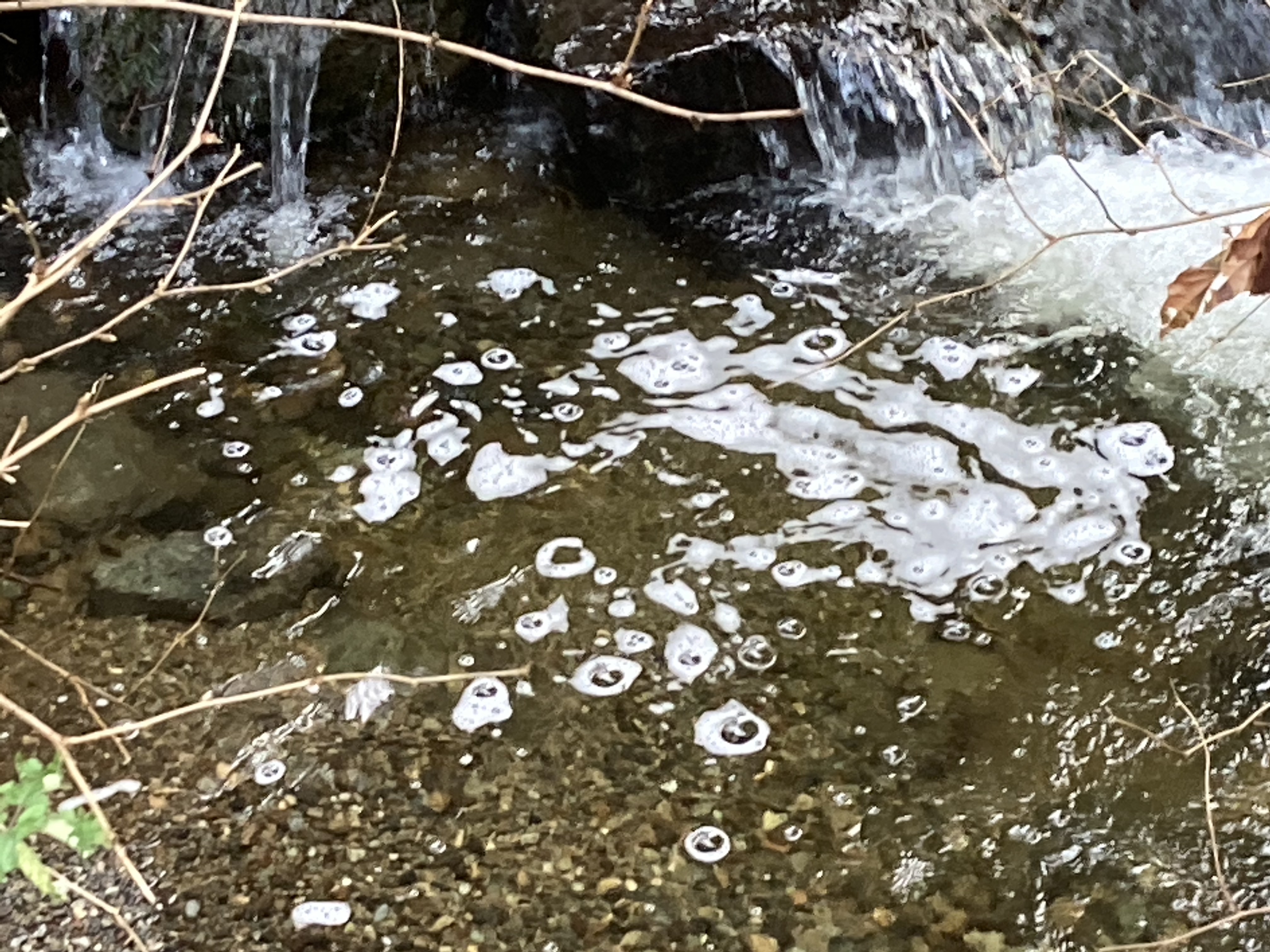
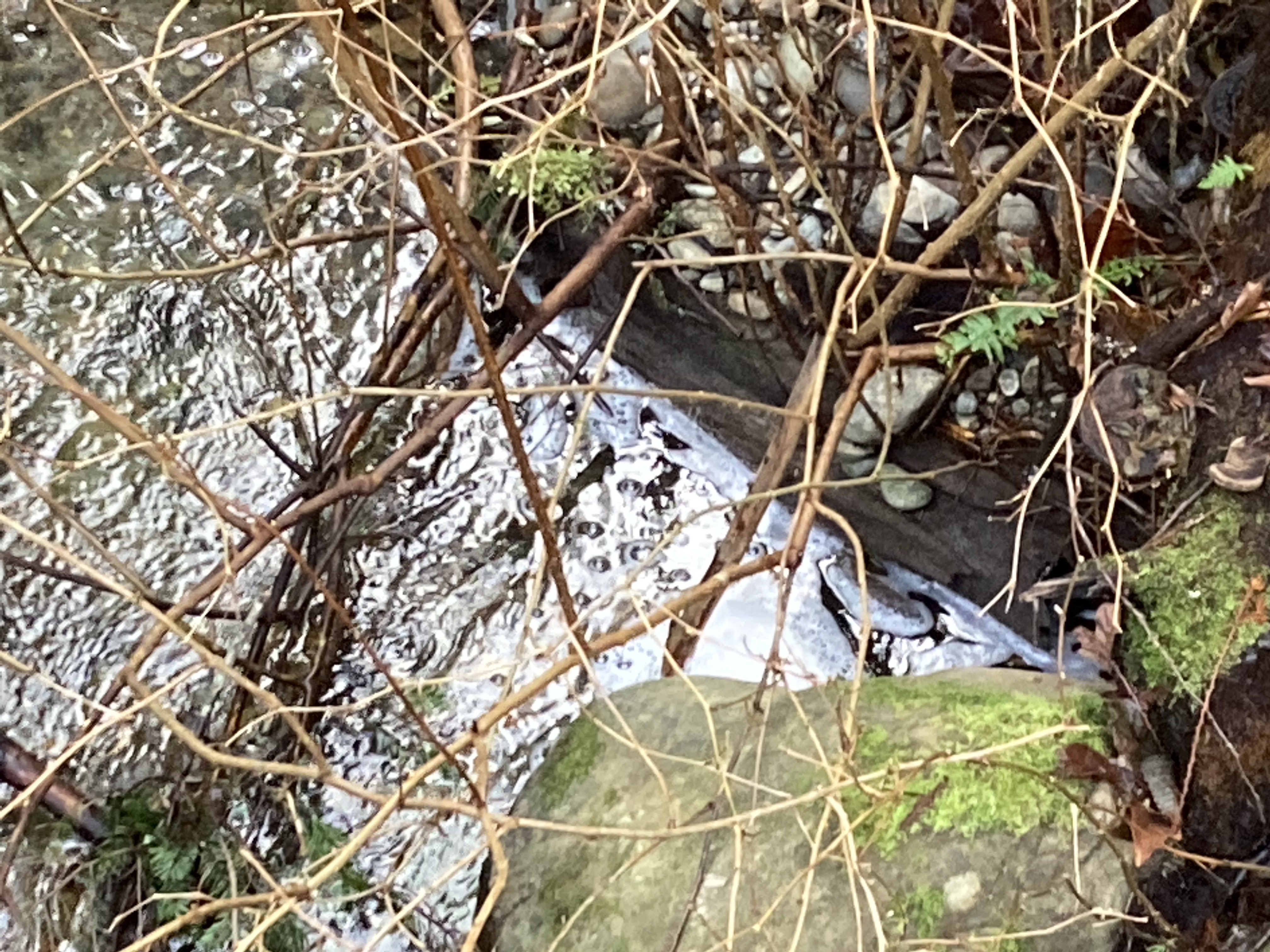
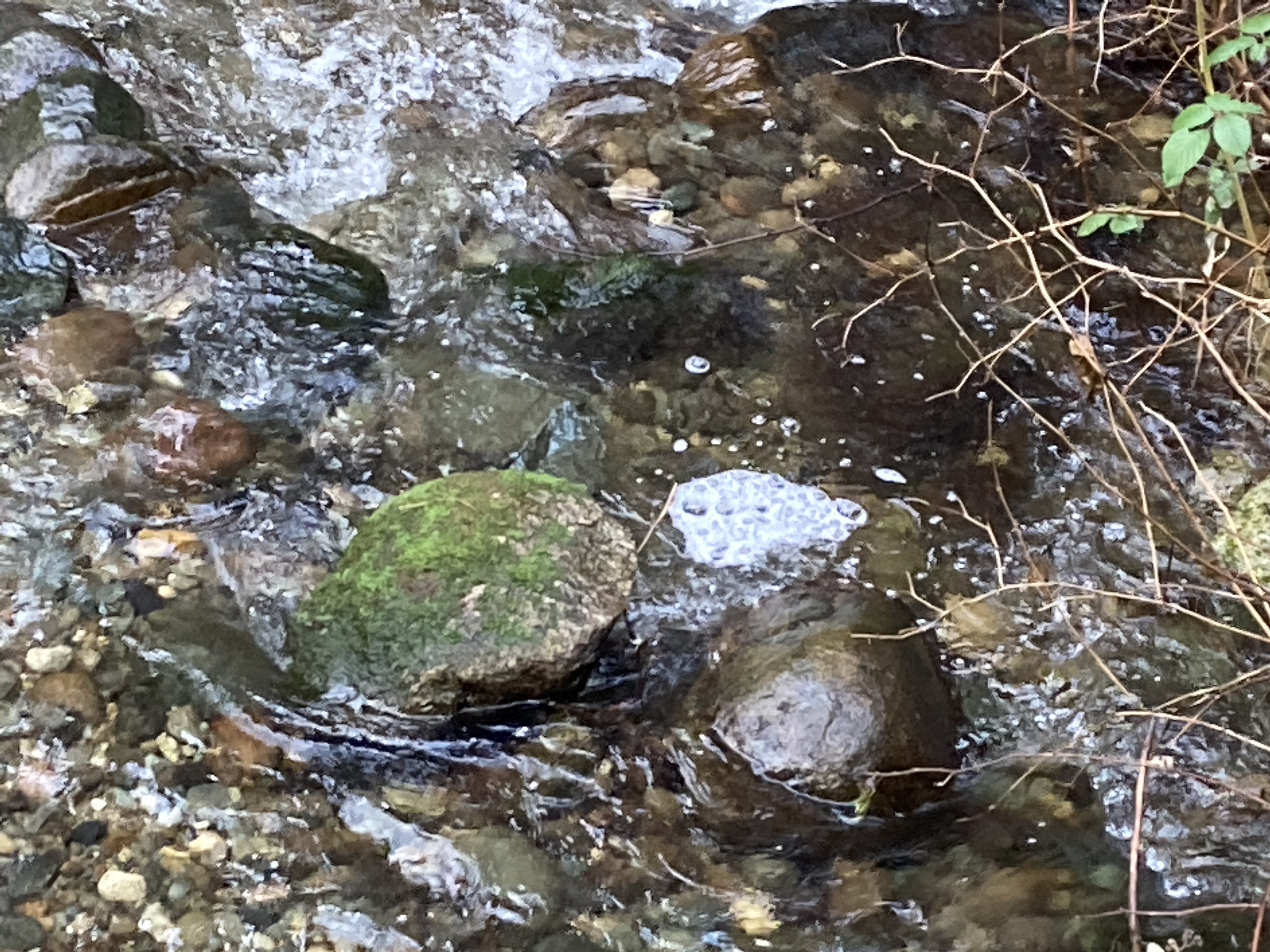
For years now, we’ve been working hard here at EEC Forest Stewardship to restore a buffer of dense, native forest around our salmonid stream. It’s the largest investment in restoration on the land so far, including many days of hard work fencing to keep livestock out. Even with six foot woven wire field fence, we can’t keep every threat at bay. Last week, I noticed soap suds in the water. Earlier that day I had also seen a neighbor washing her car in her front driveway, near the headwaters of our creek. There were too many suds in the water to have come from just the car washing, and after a chat with county water experts, we decided to take a sample to find out what’s in the water.
My concern was the volume of soap running in the stream. I’ve seen suds once in a while during major runoff periods, but nothing like this on a normal flow day. The most likely culprit- inappropriate tie in of laundry facilities too close to the stream. It’s one of the most common hazards to wild water in our county. So much bad runoff like this occurs, that the county will not make an official report until summer, during the driest period of the year, when there is little runoff to track from the creek back to the source. My local water ecologist said it was not enough runoff to address with legal action, but what about a formal site visit to fix the runoff? Nope, not without serious concern. It was hard to hear this, knowing more laundry would be draining into Weiss Creek.
Mindful design can prevent this pollution, but people often overlook ecological sensitivity when developing. Here in Western Washington, water is abundant, on the surface, and reflects the health of our ecosystem in plain, often painful sight. In Puget Sound, where this creek water will eventually end its journey to the sea, orcas are going extinct, wild salmon populations have crashed, and shellfish regularly test positive for methamphetamines because of the high concentration of sewage overflow into wild waters. Last month, we had major flooding in our county, and millions of tons of sewage poured into Lake Washington and Puget Sound. Local beaches were closed, and shellfish harvesting put on hold, actually, it was already on hold because of toxic algae blooms that have started happening in winter as well as summer due to warming ocean currents in The Pacific. People, it’s getting bad, and our pollution has been expanding, along with population.
What can we do? Be aware- of the limits our ecosystem can endure. Think about where your water is going after it disappears down the drain, or down the street. One huge action you can take right now? Stop buying toxic soaps and cleaners. I get sick walking down a cleaning isle in the supermarket- the smell of highly concentrated chemical compounds is noxious. Why these chemical agents are still legal is beyond me. Since we live on a septic system here at EEC, all products must be biodegradable. We do have a couple of grey water catchment systems- with limited use, and discharge stations into properly engineered catchment basins with sand and gravel filtration. They are also set back far away from any major water sources, from our well to the creek.
There is soap in our wild water at EEC right now, because someone is operating laundry facilities right next to the creek, with no awareness of ground saturation. The runoff is minimal right now, but over time, will lead to alterations in the creek’s chemistry, affecting our endangered fresh water muscles, salmon, trout, and any other living cells which rely on clean water to survive. This single laundry source will not kill off everything, but it’s the first of many to be found along this water’s path to the ocean. By the time this water reaches Puget Sound, its got a long list of possible pollutants which can be found here. Needless too say, our small part in keeping toxins out of wild water makes a difference. Hopefully, this sudsy mess clears up, but until the laundry being run upstream moves away from the creek, these bubble troubles will continue to persist.
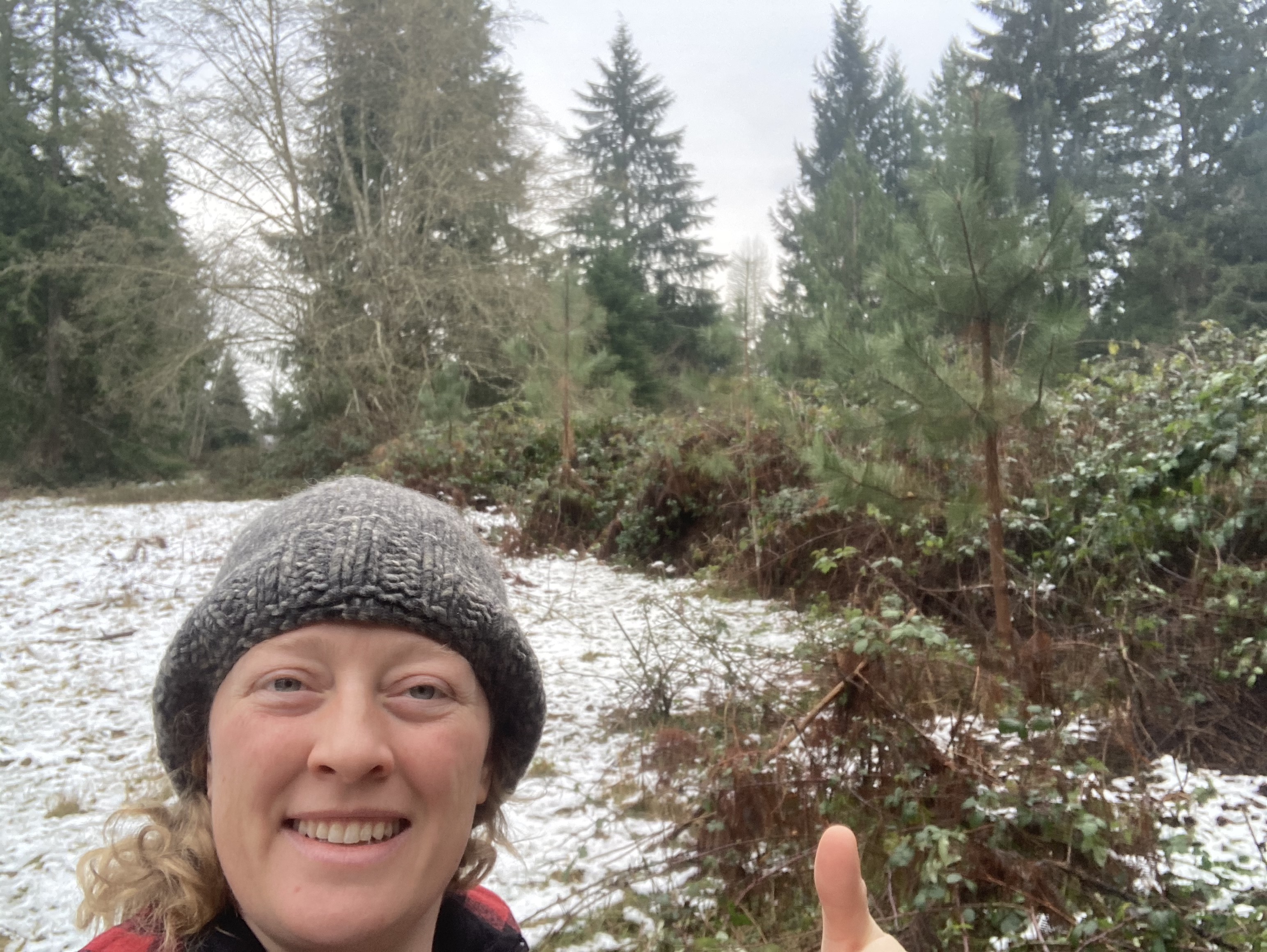
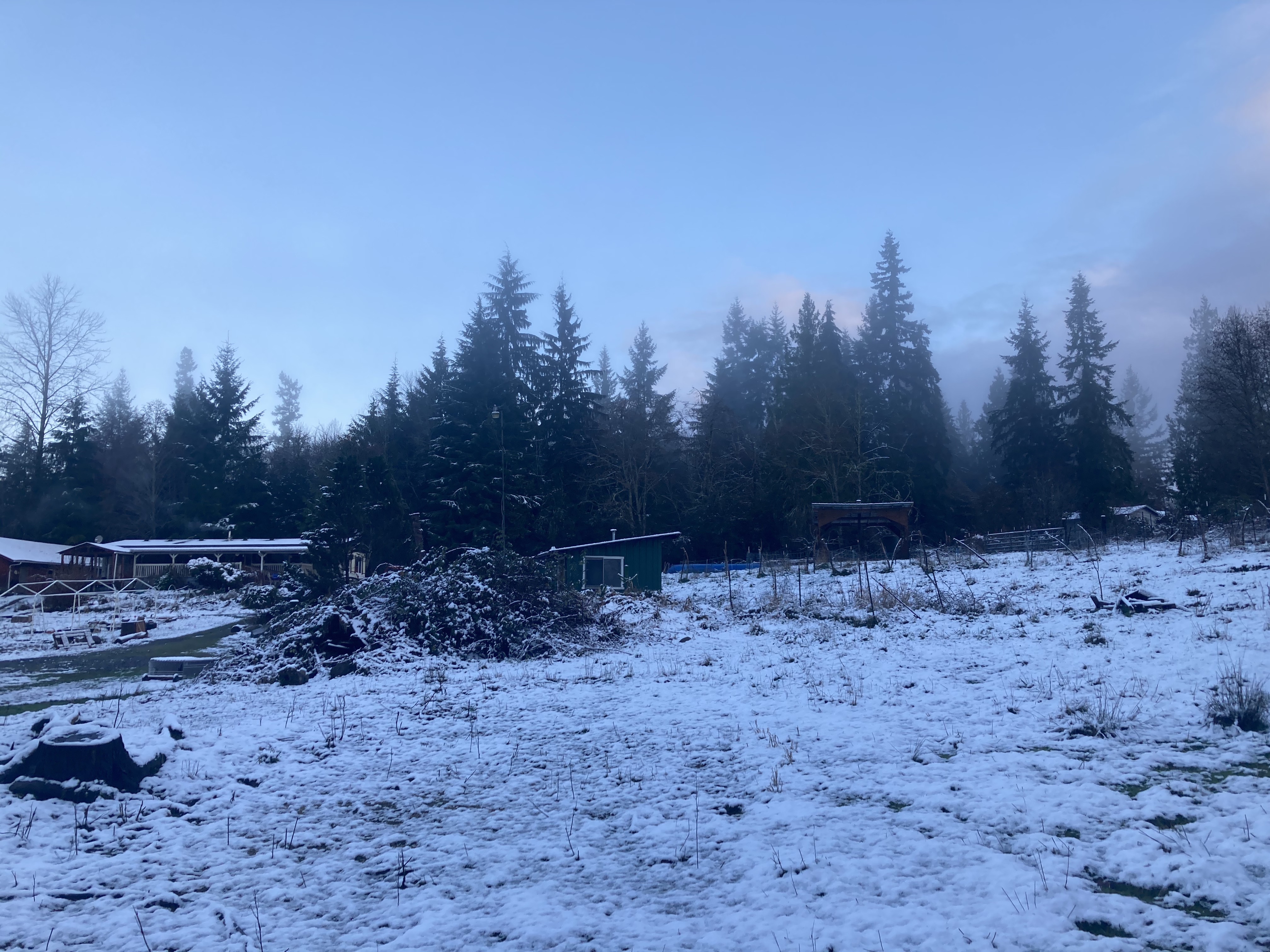
A modest grove of Ponderosa Pines stand at attention on the west fence line of “the back 40” after a few inches of snow on Winter Solstice. My hair is also now at shoulder length again- growing for Wigs for Kids this year. Made a resolution to be gentler with myself- and show empathy to my faults with grace. Though my hair grows fast, the trees are slow, and with good reason- putting on what could be thousands of rings in one lifetime, while I will hope for 100. The trees behind me also mark a fence line, which I am now clearing in preparation to install a new field fence- to keep in sheep and dogs, while deterring coyote. Only two large pasture areas will be fenced, leaving the open wildlife corridor along Weiss Creek as a highway for wildlife. In another 60 years, the whole place will become forest in perpetuity.
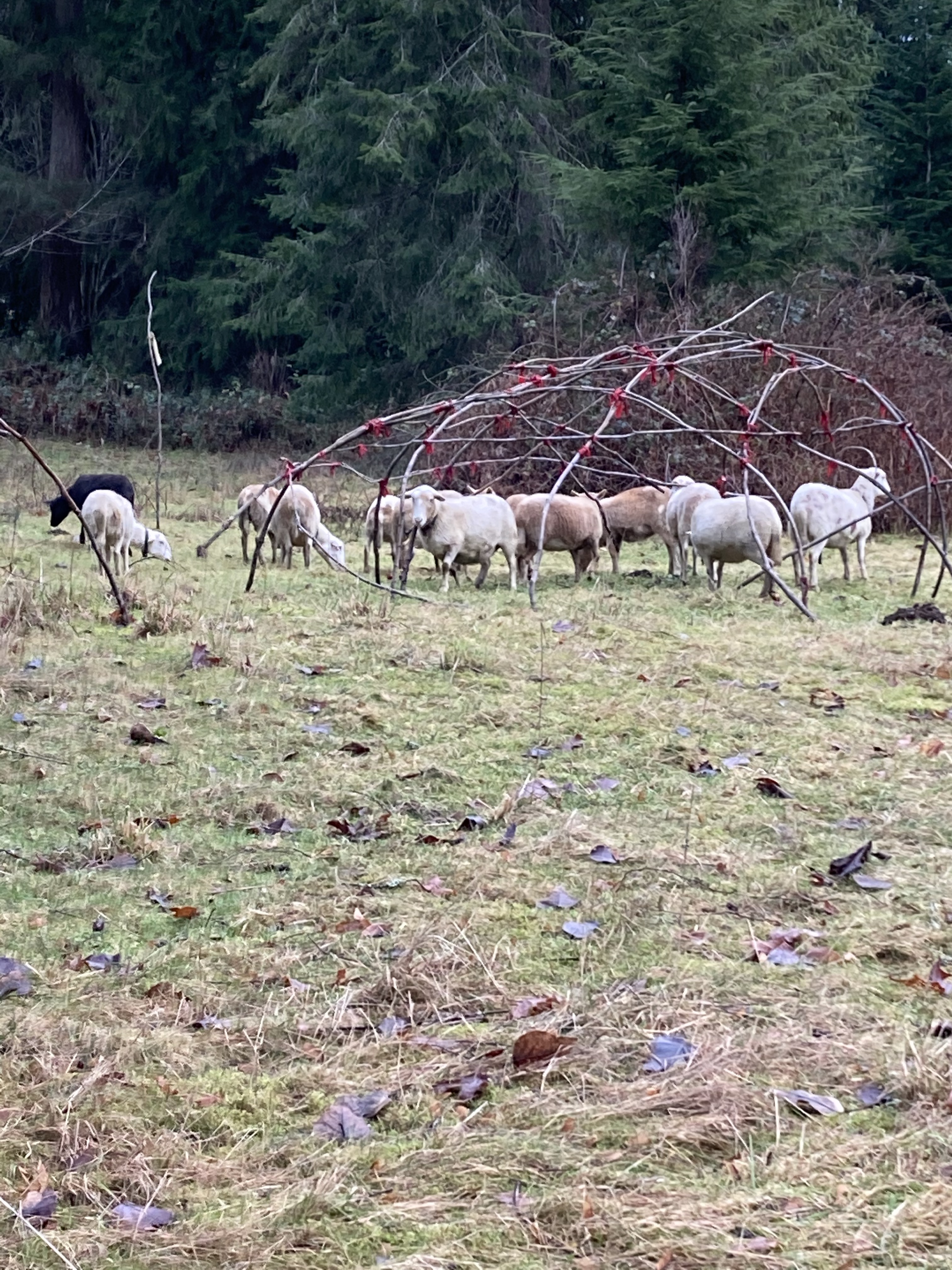
In the mean time- make way for new lambs and more forest replanting. Our herd of Katahdin Ewes are about to burst with new life- which will double our herd and requite a lot of smart resource management. This should be the largest flock you’ll ever see at EEC. After this year, we’ll be culling and selling to get our herd down to about 8 breeding ewes and one ram. That’s the dream team of working sheep here on the land- and our barn will be a palace for the resident flock. Right now we are at 14, with at least 8 lambs on the way- 16 if everyone has twins, but I doubt that. Still, we’ll have too many animals, and we only came to this as a plan to create our own herd from good breeding stock- most of which consisted of old ewes who will pass on some well established genetic material for our fresh, young herd. The older ewes have also had time to pass on wisdom to their daughters, thus ensuring good instinct and herd habits.
The slightly deconstructed sweat lodge frame you see in the picture above was erected just before COVID by a First Nation person who had to pause on his spiritual quest, as he was assigned to a COVID ward at his hospital as soon as the virus took hold- Washington State had the first domestic cases in The US. This amazing front line healthcare worker has not been able to get back here for work on his sweat lodge, but did celebrate a union of partnership with his beloved at the end of 2020. More good news in these darker times. The lodge will eventually become active, but for now, nature happily comes back into her own.
There has been a lot of new growth here at EEC Forest Stewardship- including the continued restoration of our stream buffer. Young native plants like snow berry, Douglas Fir, and even Saskatoon berry are continuing to hold fast in the replanting near our salmon bearing stream. This restoration is some of this first large scale replanting on the property, and it’s a motivational for how quickly overgrazed pasture invaded by blackberry can quietly turn back into a native forest with thriving under-story. Though just like the Ponderosa Pines, growth is slow, the long term regeneration of this landscape is easy to see, and celebrate.
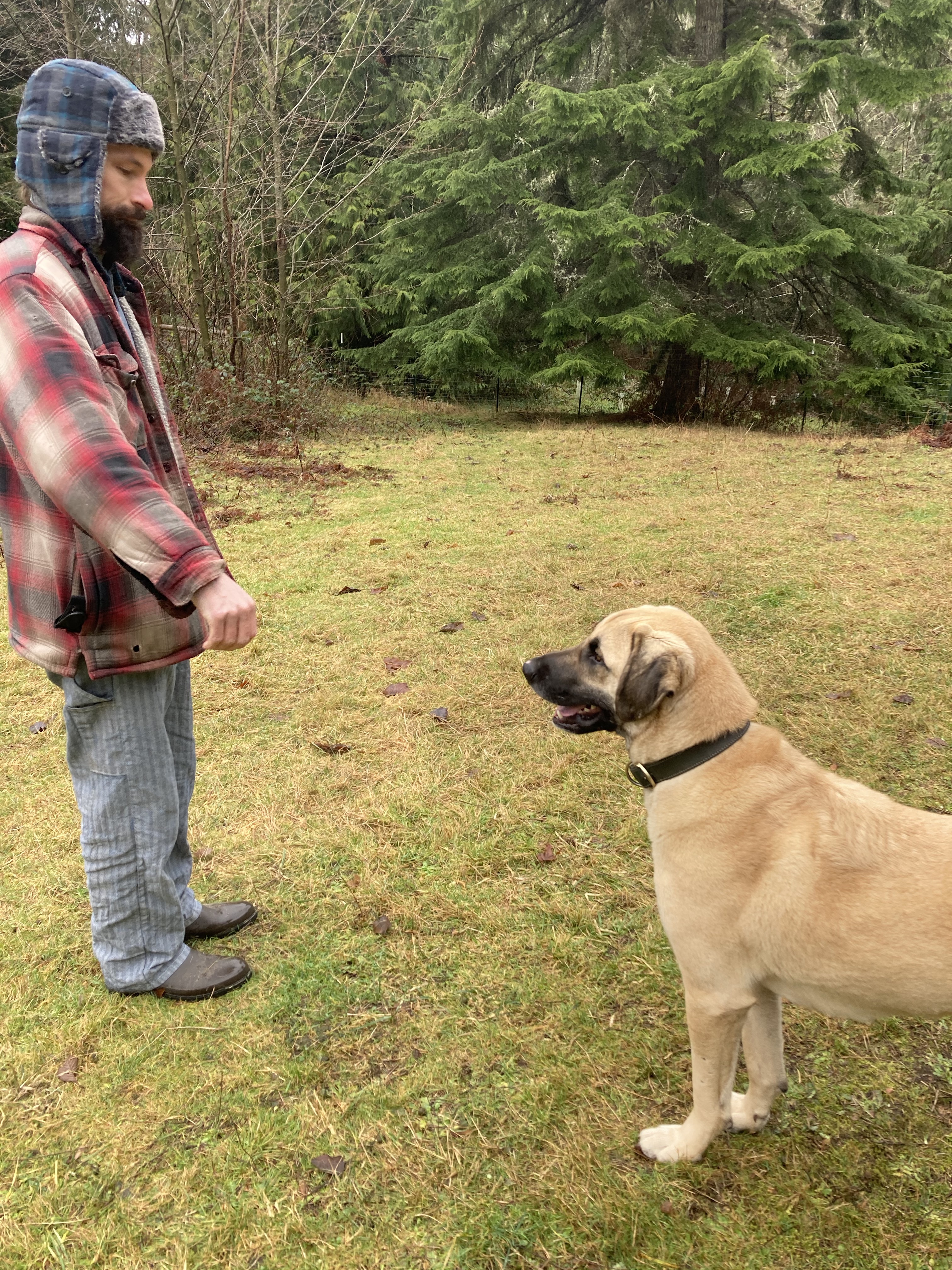
Our new Livestock Guardian Dog, Gill, has been a wonderful addition to the stewardship program. He continues to show great social ability and good manners at EEC. With a lot of good structure, routine, and patience, I’m learning how the Kangal (Anatolian) Shepherd works and plays. Gill has become good friends with Valentine, and the two can play for hours while I’m working in the field nearby. Though Gill came to us with a history of dog aggression, especially with toys and food, we have slowly been working on these behavioral challenges, and found that most of them melt away once Gill began to trust Valley as a balanced animal. She has never shown any possessive behavior, and happily drops a stick or bone if Gill wants it- he in turn grows tired of grabbing things the other dog could care less about, and goes back to his watch on the sheep. With his natural instincts fed, Gill shown no interest in what might be called delinquent behavior. It’ a win win for us and the dog.
In other animal news, baby chicks are growing up fast, showing lots of great instinct as fair feathered friend of fertility- pooping out organic yummy for our compost, and scratching away at the ground as soil aerators and bug pest predators. Yay chicken systems! We’ll plan to cull older hens in February, to make room for our new young pullets. A local outdoor educator has asked to buy a few hens from the cull for a survival class. It’s always great to support outdoor education, and lessons in animal processing is a specialty at EEC. In the mean time, cold winter weather has kept the chicks inside until more favorable temperatures arrive. In a few months, these young birds will also have enough plumage, and body mass to go outside. They will remain in their “round pen” setup next to the house for a few more months, gleaning bugs and weeds around the edges of our buildings so we don’t have to mow. I’ll also make use of them in the garden, turning the soil, in prep for the planting season.
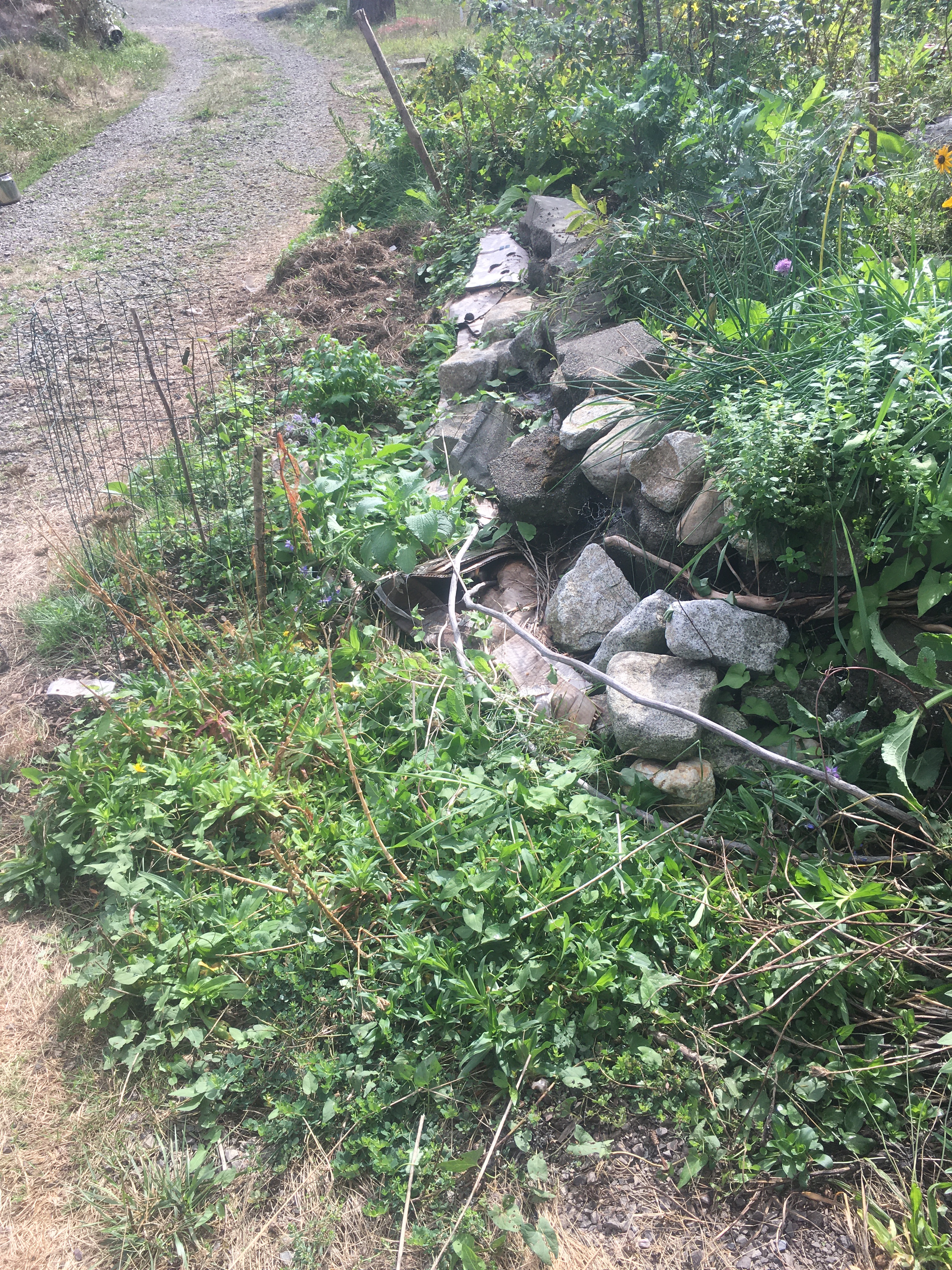
Speaking of gardening- I spent the Fall trying to rebuild edges- specifically along the driveway where greens began reaching into the road, pushing cars and trucks into the water redirect ditch on the other side. I pulled back the rock wall and began uprooting the invasion onto the road. The garden became a nursery for young native plants a few years ago, and this fall, many were uprooted from the garden and replanted into the greater landscape around us. The kitchen garden remains the most active cultivation garden near the house, but the front garden is the largest, and right now, full of grass. I have to admit, I’m not a great gardener- not in the veggie sense- and this winter, I am committed to working on re-establishing productivity in the gardens with the redesign of a greenhouse, and some major planning for seasonal replanting in the gardens. But that plan will have to wait a bit longer, as a more crucial infrastructure project is looming.
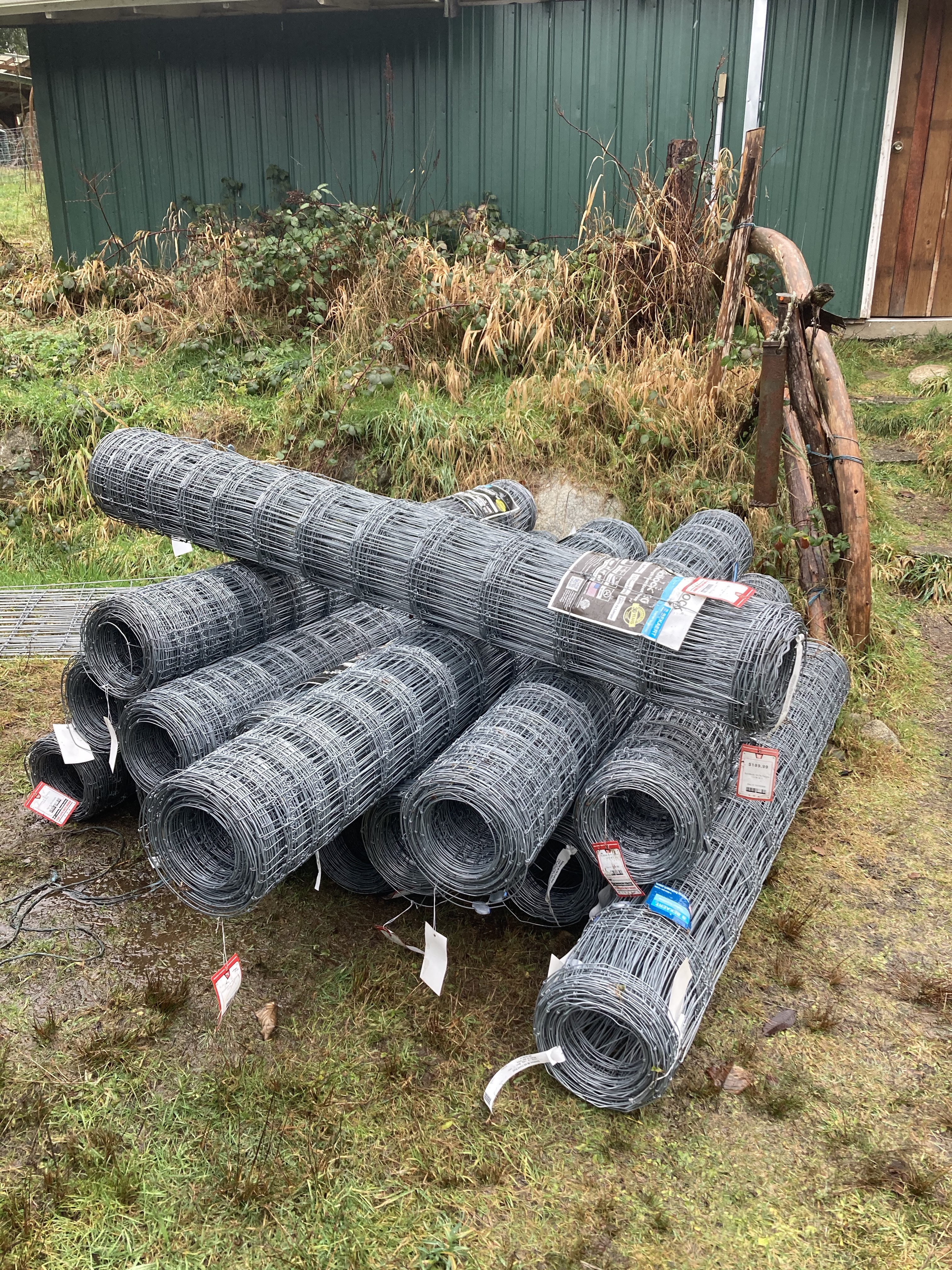
With the introduction of a Livestock Guardian Dog- Gill, the Anatolian Shepherd, we’re doing the responsible thing by establishing two large fenced fields to allow him free roaming space, while protecting our sheep from coyotes and roaming dogs by erecting 2,000 feet of six foot high field fence. This new boundary will establish the edged of the property (good fenced make good neighbors), while inviting our large dog to patrol freely, especially at night, when most predators are on the prowl. It’s taken a while to finally plan out fence lines, as these boundaries will be permanent (through my lifetime) and create hindrances to wildlife. We established the wildlife corridor first, so the migration paths of the animals could find the clear rout through. Once the new fencing goes up, wildlife will be funneled down to the creek, where they can pass through safely.
Though it is often encouraged to get fencing up quickly, at the start of a land stewardship project, I would say it is even more important to first know where the animals are moving, their trails and established territories within the landscape. Permaculture observations talk about human flow and traffic patterns, which dictate paths and gates. Animal paths are also important, though often overlooked when establishing hard edges on a property. This is one of the greatest challenges in dividing up a landscape into property lines. Hard boundaries often ignore natural features, animal migration routs, and even critical ecological niches where rare species are often found. Think of “The Wall” on our southern most boarder here in The US. There are massive lawsuits in action to stop the destruction of indigenous sacred sights, protect critical animal migration routs, and allow natural flow of a meandering habits of a huge river system.
In planning the long term management of EEC Forest Stewardship land- we cemented the long term reforestation plan with King County in our Public Benefit Rating System application, finalized in October of 2020. This contract will bind the land in a long term plan to slowly convert from agriculture to native forest over the next few decades. In setting resolution to be gentle with myself this year, I also put into action the slow plan of restoration, now on the books in our local county offices. In short- 20 years of sheep, then transition to another 20 years of replanting. The livestock will be fully phased out when I get into my 60s. As by then, the fertility of the land should be reasonably capable of supporting a forest, and my body will not be able to keep up with stock any more. In 40 years, the established forest will have grown tall enough to shade out most of our pastures, and without livestock, the land will need to be replanted to prevent blackberry from taking over again.
Our “zone 1” landscape will remain open, with orchard, out buildings, and residential habitat. In this area human activity will continue indefinitely, as long as it needs to. Right now, that looks like my home, but in 40 years, that could be an educational building or museum dedicated to holistic land stewardship. These are visions right now, and do not have to come to full fruition any time soon, slow growth, like the trees, making it easier to formulate the best design in time. Recognizing that anything could happen to disrupt, change, or eliminate this strategy, and that’s where continued adaptability comes into play. This is how nature survives, and EEC will too- maybe not as a forest as I see it, but as a landscape none the less. It is through strong intention, observation, and planning in both physical replanting and restoration, and legal definition which can help to formulate a strong future for forest on this property. May these actions help, not hinder, the natural world.
The struggles of 2020 were unprecedented in this world, and I fear the challenges will only continue. When we put our focus on the earth as a whole, transcending out personal fears and accepting our ignorance, we are open and ready to relate. Through relation with the world around us, we can better serve community needs, adapt to changing climate, and prepare for long term survival. Not just human survival, but ecological survival. As humanity confronts it’s ultimate vulnerability, perhaps we can restructure our consumer culture, to a more productive, collective mindset of restoration and rehabilitation for ourselves, and the environment. Gratitude for all the rich experience, opportunity, and privilege of land stewardship. Happy New Year!
In the hunter education curriculum of Washington State, we teach a section on carrying capacity. It is the concept that all ecological habitats have a maximum support limit for wildlife. This maximum is built off of finite resources- mainly food, shelter, and water available to animals for their survival. This habitat limitation is used to determine hunting limits in a given area- called a game management unit (GMU). Wildlife biologists hired by the state, study these carrying capacities and health of different species. When a wildfire comes through and destroys habitat, the hunting limits are raised in that GMU for the season to avoid what is called “winter kill”- usually the collapse of a species because of sudden loss of habitat, resulting in a mass die off during the harsher winter months. Starvation is the root cause of these animal’s decline.
Any ecological system has a carrying capacity, and all living things within that system thrive or decline with the health of that environment. Another important detail we teach in Washington State hunter education is human encroachment on wildlife, specifically habitat destruction for development, which is acknowledged as the number one cause of the loss of habitat for wildlife. What we do not connect is the human ability to “transcend” carrying capacity, living beyond the means of their environment, through industrialization. Humans have no carrying capacity- they expand exponentially- for the most part- though virus outbreaks and natural disasters can hinder populations for a period of time. Still, human population continued to grow without any need to accommodate their environment. We do not see a reason to hinder our expansion, as humanity generally believes it is divine right or manifest destiny, which allows their ultimate conquest of the natural world.
It is this egoism and complete lack of connection to nature’s limitation, which will be our ultimate downfall as a species. There is a mass extinction in progress, brought on by human overpopulation and consumption, a nightmare in the making. Because of the disconnect from nature and the biological indicators which dictate life on earth, people have become threatened by the collapse of nature, and are scrambling to point the finger at anything but themselves. Case in point- predator species.
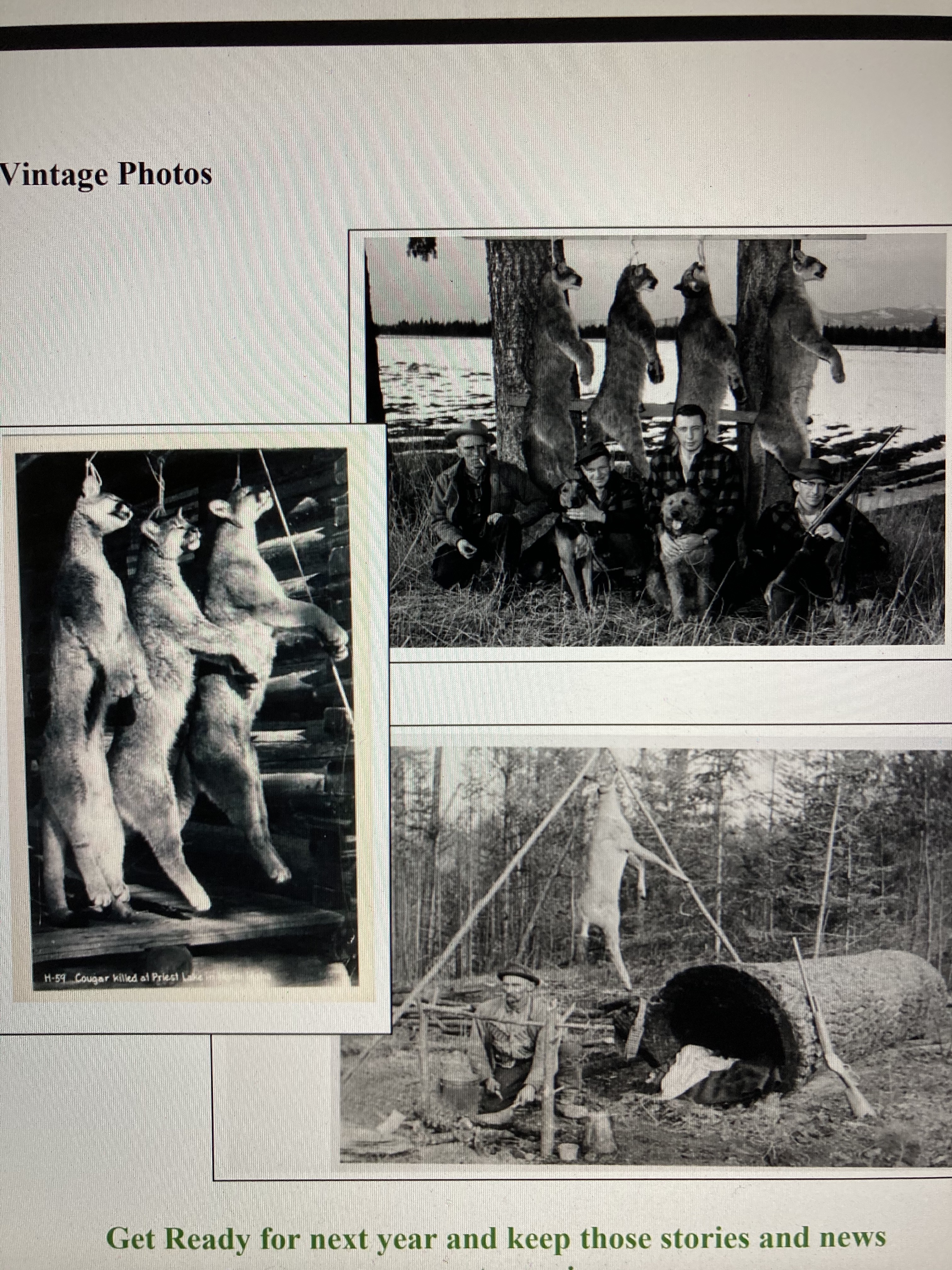
In a recent hunting report, I found myself wondering why the editors of this publication chose to feature historical photos celebrating the mass slaughter of cougars in the west. I was taken aback by this ending page of the report, as it seemed very insidious. Never had I seen such blatant hatred of wildlife portrayed in our field report. I wrote to the editor of this publication and voiced my concerns. He responded by saying because of mismanagement of predators in Idaho (his home) the populations of wolves and cougars had exploded, and elk and big horned sheep populations were crashing because of over predation. He warned me that soon, Washington State woulds be feeling similar effects, as we too have stopped allowing dog hunts of predators and left wolves protected from hunting all together.
He went on to say his family and beloved pets were under constant threat of cougar and wolf attacks from the wilderness beyond his backyard. As I read his response, I could not help but wonder how he didn’t see the irony in his choice to move into the wilderness, and then feel threatened by the wildlife there, blaming the animals for his situation. Without sounding too confrontational, I asked him about human encroachment on animal habitat and the likelihood of our destruction of habitat as part of the reason elk and sheep populations might be in peril. I reminded him that ecosystems were limited to their carrying capacities and that animal populations cannot grow beyond those limitations. He said he could not say- and that I should contact my local wildlife biologists to get more information.
Man- yes- men in particular, have been driven by fear of what they cannot control since the dawn of humans. This rather reptilian reaction to “other” was a once important part of discerning a threat- but remains cultivated as a way to project fear as hatred towards anything- specifically predator species, and people who don’t look or think like “us”. The willingness for people to turn into ignorant mobs and hunt down what they cannot understand seems to be an outdated model- one that would only feed destruction, which ultimately consumes all- our consumer culture today.
The insidiousness of these “hunted” cougar pictures goes far deeper than habitat destruction and human encroachment on the wilds. What my subconscious was reacting to in these pictures was a haunting familiarity to other photos I have seen in history books- ones in which it is not feared predator animals hanging, but people. Man’s desire to hate what he fears runs deep. I dare to speculate that the hatred towards wolves and cougar, are in the exact same vein of ignorance as white men’s fear of other races. This fear of the other has haunted humanity long enough, and our own carry capacity for the abuse of human rights has worn thin. My hope is that soon, this ignorant fear will collapse, not unlike the elk and sheep populations in Idaho, forcing us to take a hard, long look in the mirror.
EEC Forest Stewardship is taking a broad step in 2020, we’ve applied for our county’s Current Use Program. What is current use, you may ask? Well, it’s a process by which you give up development rights in a specific area of your privately owned land, and contractually promise to regenerate forest and/or maintain agricultural spaces for current and future food production. This fits beautifully in our mission here at EEC, and we’ve spent about five years working out our plan and trying to get other neighbors to sign on with us. We finally got our new neighbor to the east interested, and she’s agreed to co-apply together. This gave me the motivation to finish my plan, write hers, and pay the high fee to apply (almost $800 for both parcels).
It’s not cheap, but if you do get in, you’ll save more than that on land taxes each year, which will be a huge help in keeping our land affordable and accessible. Though the tax reduction is a good reason to join, we’re actually doing this more for the conservation and long term restoration plans already in place at EEC Forest Stewardship. Our Forest Stewardship plan is part of the PBRS system, so that work gets folded right into our application. The woman assessing out application has encouraged me to choose agriculture as a main focus, as food forests are not all native plantings, as cannot be labeled as forest restoration (at this time). It meant separating our plans and reworking a lot of the details, but our county support has done the grunt work (thank you Megan). Here’s the plan now-
Final Proposal PBRS
The biggest change in the plan is separation of the two parcels, but my neighbor is still on board with the plan to enter open space, and that’s the most important designation. Her application will also be agricultural, but I won’t be libel for any missed application on her property, and she will be independently graded from mine. It does still allow us to plan together, and I hope to support a forestry stewardship plan that does include both properties in scope. My neighbor’s placement at the headwaters of Weiss Creek, our salmanoid stream, means the spring fed habitat is protected at both ends. The other end, which empties into The Snoqualmie River, is replanted in native habitat and also in open space.
Since EEC Forest Stewardship already has a forestry plan, and acts upon it, we’ll continue implementation along side the PBRS Agricultural listing- which means keeping fields open, or in our case- the production of a nut grove and orchard. It will also allow us enough grazing space for sheep and chickens. At the end of my lifetime, the whole property will go into conservation easement with a nature learning center focusing on restoration agriculture. By that time, the native forest will have overtaken the pastures, and hopefully, the agricultural plantings are established for another two or three generations. After that, the whole property will be replanted as native forest (or more likely, naturally folded back in).
Visions of future forest for EEC
It’s important, as a land steward, to think ahead several generations. When folks acquire property (acknowledgement here of First Nation stewardship and stolen land- land which was not acquired until colonial ownership imposed its self on native people), privileged land owners act on immediate wants, rather than thinking through the long term care and succession of place. Usually it’s about building a home, shelter, which we equate to security and assets. Since that’s our current system of governance, that’s the game played. Sadly, it does not guarantee good stewardship of place.
Development goes hand in hand with population- homes won’t sell if there aren’t people to fill them. Strip malls only go in where people will shop. We are all contributing to this problem as a species, and until we act as one (globalization), our consumer impact on the natural world will continue to degrade quality of life for all living things. Small steps help, and putting land you are lucky enough to steward, into long term conservation, can have a huge impact. Targeting agriculturally impacted land allows for restorative practice, hand in hand with economic production, through agricultural sales to fund restoration.
Again, small steps- and at EEC Forest Stewardship, we not only produce agricultural commodities, but also embrace Washington State’s ecological improvement vision. Our county offers many incentives to improve habitat. From salmon stream to landslide prone slopes, EEC is replanting native forest for long term stability in the environment. PBRS, CREP, Forest Stewardship, and federal agencies like USDA work closely with land owners to meet professional goals with ecological recovery. It does mean signing contracts, and agreeing to “devalue” your property by giving up development rights. Without being able to look beyond our own lifetimes, it becomes clear that working towards restoring land is ultimately the greatest legacy to leave for future generations.


 EEC Forest Stewardship