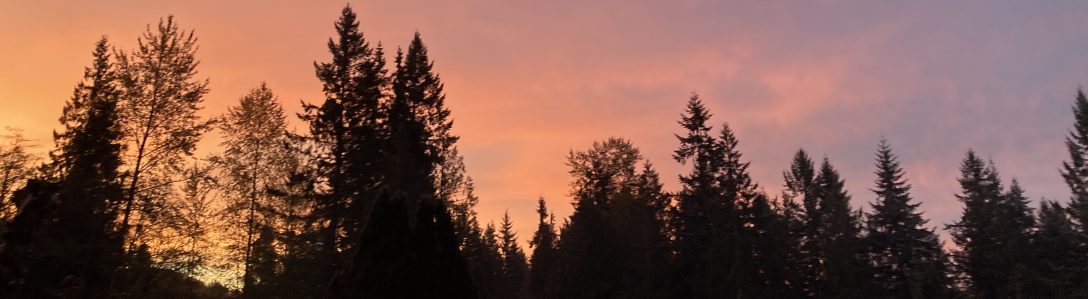
Dawn Chorus

looking east down the driveway

First light creeps
slowly reaching over my shoulder
recalling her warm caress
then whispering a lulled breeze
twisting soft curls
gold spun memories, a wide open plane
horizon lines running endlessly away
why I fled the heartland- decades ago

echoing robin’s song fills atmosphere
anywhere a bird can sing on open wing
animals quietly grazing across green velvet
bundles of white flock, drifting clouds
gently culminate into thunderheads
undulating sway of ruminant wonder

pear trees flocked in blossoms of fine white lace
do not compare themselves to sheep
looking only to the stars, reaching up
diamonds shine brightest in blackest night
then alighting gently like glossy dew
refracting deftly along briar’s edge
hands bleeding from holly prick
black pearls on wounded palm

obfuscated colors stick to grey hues
as gasping constellations fade
cold damp loam beneath bare feet
soon warming, like the sky
orange hues streak across heaven
backlit forest sighs into the day
swallow darts from grey to blue
in a flash, dawn erupts into morning

Pruning Paradise

It’s a race to get the fruit trees pruned back before they start budding. Usually, I would do this earlier in the winter, but the weather, lambing, and covid-19 happened. The established orchard on the land is a hectic mess, being in serious rehab after almost a decade of neglect. The branches tangle in chaos, and I’ve spent the last seven years trying to address the overgrowth. After studying and observing these elders for a few years, I started hacking away with little awareness of how to really shape the trees. Now, after a few more years of observation and gentle regenerative care, I’m taking off the last of the larger branches these trees should not have to support.

Fruit trees are all about producing fruit right? Well, to keep a tree fruiting nicely year after year, you have to keep them pruned up, otherwise, the tree puts all its energy into branches, growing new wood instead of food.

The plum tree pictured above has been left to it’s own devices for a few years now, and the branches have gone crazy. We’ve had no fruit for three years now, and I’m ok with that, because this is a rogue plum, and I’ve got enough trees to tend as it is, so I let this one go for now. I can always cut it back into shape as it matures. That’s part of the beauty of younger trees, they bounce back. With older wood, you have to do a lot of slow removal to let the tree recover. A good rule of thumb is take no more than a third of the tree in one pruning.

Getting pictures of these trees so you can see the transitions is very challenging. In the picture above, I’ve just finished pruning. You can see a pile of woody material on the ground. It’s definitely less than a third of the tree’s mass. My finger is hovering over the height these trees used to tower at. Fruit trees tend to grow up and then shoot out a new level of branches. These trees were two stories high, and now they are one. You should be able to harvest the fruit easily from a ladder. If you can’t reach the branch to prune from the ladder, you won’t be able to pick the fruit either.

This frost peach is already blossoming out. I managed to prune it and put in another tie back to continue encouraging it towards the wall of the building (late espalier plan). Stone fruit trees can be pruned any time, but taking off branches after buds have formed is going to knock off a lot of your future fruit before it has a chance to develop. Be mindful of your timing. The apple trees were still dormant, and I caught my pears just before blossoms opened, though it was risky, and I might have deformed many of the buds any way. Fruit trees are most vulnerable as they are budding out, so always take care with late pruning.

This photo shows a better perspective of cutting off the second story level of these older apple trees. The tree on left is still sporting it’s upper canopy, where as the trees to the right have been reshaped to a single story. The tree far right is throwing up a tall leader branch, and I’m leaving that 1st year growth to give the tree a crown. All trees naturally reach for the sky, trying to be the tallest thing in the area to receive the most sun. Pruning forces the shape of fruit trees to human advantage, giving us easy reach and many more fruits. However, when you take an entire second story of branches off a tree, it’s natural response is to put up a lot of first year growth the next year, trying to reform a crown. By leaving one or two first growth leads up, I trick the tree into thinking it still has the upper crown started, and hopefully less first year suckers will shoot up.

What’s wrong with first year growth? Well, you don’t get fruit off newly formed branches (first year). Second year wood will produce flowers, but first year only produces new wood and leaf buds, no flowers. On a well maintained fruit tree, you’ll only have suckers (first year) and some minor shaping if larger branches are rubbing or damaged from extreme weather. Pictured above are two frost peaches that have not been checked for three years. They keep going up, not out, and the energy to put on any fruit is hindered by the continued first growth.

The apple tree pictured above has been maintained to produce buds. Suckers are pruned back, and the young tree is tied to maintain certain growth shape against the bush behind it. You can see many 2 inch stubs coming off the upper branches. These are flower buds, and will hopefully produce fruit again this year. Last year I enjoyed a modest crop of large apples from this heirloom verity. This year, I hope to enjoy even more. The rewards of stewarding fruit trees is worth it’s weight in gold. Only this month did we eat the last of our apples. It was the first year we saved enough to enjoy through the whole winter. Several more pounds are stores away as dried fruit too, but there’s nothing like biting into a crisp apple you grew yourself.

More Hard Lessons

Deaths on the farm are always lessons which stick, deep in my gut. Could I have made a change? Yes, and I will now. Did I know better? Yes, and the consequence makes it count. Guilt is natural, but not consuming. This mistake will not happen in this way again, but there will be more hard lessons, that’s life.

This morning was sunny, bright, and cool. The rain before dawn was soaked in, with beautiful diamond dew drops covering every surface. It’s one of my favorite sights here in The Pacific Northwest; forest glimmers, pasture lush with water and green. The lambs leaped into freedom, their wary mother’s braking away as ewes do, forming an undulating mass of herd momentum up the hill. My hens looked fat, plump little birds so generous with their labors. Both on the soil and in the next box; truly, this animal is indispensable to agricultural restoration.

The goats cry out in painful screams for breakfast. I usually feed them last, as they are on the far end of the stall block. I’d taken my time with the sheep, moving fencing into an upper pasture. As I walked back down to the barn, it was tempting to ignore the goats, become frustrated with their nagging, but it was also a pleasure to know they were soon to be fed, and that their hard work in bramble removal was priceless.

Though sunny and nice out, I had already decided to leave them in. Brawnwin, my youngest doe, was expecting her first kids, and had, along with the rest of the herd, not wanted to leave the comforts of the barn. This is typical goat behavior, and I was in no mood that morning to force her and the others on a long march to the far field, where they were currently working. It was a win win, with food and fresh water just a step away. So I threw hay, looked for eggs, and then spotted the horror in the corner of the stall.

Two wet lumps lay motionless in a bed of straw. It was the kids. I could tell from where I stood that they were dead, the realization crushed me. Running around to the door of the stall, thinking they might have just dropped and need support, my mind was racing through solutions. The dry towels in the grain room, a heat lamp, the colostrum formula- then I saw the third little body, under the manger, and my heart sank. It was the oldest, a larger black mass, who she had been able to dry off. It was cold and stiff. As I gently lifted it, I knew all three were lost.

It’s the farmer’s fault, always, and anyone trying to say otherwise has not kept livestock. Without direct human care, feeding, watering, and healthy living environment, death will occur. So what went wrong? Where did I screw up? Usually, a mother to be in the ungulate family of domestics, like sheep and goats, should be given a separate space to birth in. I know this, and was practicing it diligently with my sheep already, who have been lambing for over a month. I knew my goat was pregnant, but had not been closely watching her progress.

First timers often struggle with birth, and can sometimes abandon their new offspring in confusion. Also, social dynamics in the herd can overshadow any mother baby bond. In this case, the dominate two does in the stall were probably upset by the new kids, and butted them around till they were dead. That was the evidence I soon confirmed with more handling of the little bodies. shattered bones and pulverized internal organs, a signature of death by ramming. What hell, and I had let it happen through neglect. It was a mistake, and the gentler side of my conscience knows this, but the inaction was inexcusable too.

So, the solution- cull larger, older goats from the herd. Then stick to small goats, and keep breeding in that direction. A few years ago we lost a new breeding buck because of an injury sustained while sharing a stall with a larger wether (castrated male goat). It was another size related mistake I’ve made in mixing large and small breeds. They can breed, but struggle to live together safely.

Goats have played a huge role in reclaiming ground from blackberry invasion, as a key part of the restoration of forest and pasture at EEC Forest Stewardship. Most of the larger plants have been pulled down by large goats, leaving the landscape about knee height in most places the bramble still persists. Between sheep and dwarf goats, we’ll be able to stay ahead of it from now on.

By culling our large stock, we invite easier handling of our animals- smaller is lighter. My current lead doe can pull me off my feet if she catches me off balance. It’s impossible to ask farm sitters to handle her, or my other large doe safely, so it’s time to cull them. This will make a lot more stall room for the two smaller goats, and we can even invest in one more breeding doe, for a core herd of three, which is perfect for the farm needs. Best of all, the dwarf goats we will now be exclusively working with, cannot jump the electric fencing, and can be released into pastures without tethering. This also adds additional ease of handling, and better quality of life for everyone.

Even though this was a tragedy of mismanagement on my part, and I have paid the price three times over, the lessons will bring good change in the long term. My only hope is that I can keep learning, but in a way that does not cost lives any more. Again, it was my responsibility, and I failed, but I will not let this happen again, and I encourage others to learn what they can from my own failings, to prevent similar mishaps. This year we will have no kids, and have to cull two goats, including the one I’ve had the longest. It’s never easy to slaughter, but I’d never want someone else to do it for me.

Another covenant I keep with my stock is raising them, and slaughtering in a clean and humane way at the right time. This is something I think all stock owners should do, for it would make factory farming impossible, and raise the standards of care for our animals. It would also take most meat out of the gross consumption market, and demand more alternative convenience eating, preferably choices that do not involve animal lives on mass scale. When you support fast food- you embrace animal abuse, and worker abuse too. Please know where your meat comes from. If you choose to indulge, support local small farms. If you live in the Duvall area, and are seeking pasture raised lamb or goat, you can contact this farmer- escocrain@gmail.com. I sell live animals on the hoof, and can help you with slaughter and butchering to fill the freezer with clean, healthy, and humanely raised meat.
Spring Gardening

What’s growing on in the gardens here at EEC Forest Stewardship? Yes, we do produce some small crops through the winter for use here on the farm. Garlic is up in our main planting space, along with kale, spinach, and wild mustard. In the purely aesthetic side, tulips are pushing through winter compost, and sedum reach for the warm stone walkway. On a sunny late winter day, as soil warms, I took time to establish walkways, berm up beds, and sew a few cold weather crops like beets, radish, and more kale. Right after planting seeds I got out the garden hose for a good watering.

The garden this year will demand a lot of attention, as we have an infestation of morning glory, which is a vigorous taproot structure that spreads through disturbed soil seeking nutrients and water as it webs through the dirt. The nightmare of tangled roots easily transplant with any digging, so no soil can leave the garden. which makes replanting from the native plant nursery I established here a few years ago nearly impossible without spreading the noxious weed.

While the “bindweed” is dormant, I’ve taken time to map out established plants and put a few seeds down to see if I can still eat from this garden through the summer. It also motivates me to keep after the morning glory through the summer. If you keep green leaves from shooting up, the roots eventually recede (I hope). A good cover crop of mustard, forget me not, and other perennial vetches have protected the soil through the hard rain of winter, and now, I slowly begin to turn the beds, weeding and prepping for new plantings. A marked colony of chives are greening up, a signal of Spring.

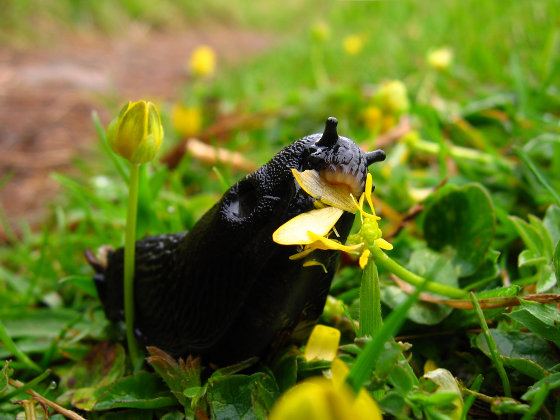
Any cold crop like Alliums and Brassicas are good to plant now in Western Washington. Carrots are also encouraged, through I find I loos most of them to slugs early on if I direct sew this early. We may think slugs aren’t out yet, it’s too cold. Oh no, they are out, and a lot are tiny offspring that recently hatched, so they are small terrors! I recommend beer traps (covered yogurt containers with slits to let the slugs in on the sides filled with cheap beer) they work to keep populations down and lure the slugs away from your lush greens. It works!

Another important part of prepping the garden for Spring is turning the compost. I keep kitchen waste in a bin compost system in the garden. weeds, grass clippings (from the scythe) and cardboard add a rich mix for the worms to feast on. When the waste has sat for many months, stack another bin on and keep composting. Then, in late winter, when things warm back up. I pull out the bottom bin and see dark loam full of worms and good organic fertilizer for the gardens.

Since the main two kitchen gardens are full of morning glory, I really don’t want to put this fine compost there, so I opt for a less formal bed where currents and a cultivar crabapple are planted. This soil could use a boost, so I flip the layered chocolate cake over in the bed and walk away. It’s that easy! What about spreading it? Well, why spend such effort and physical labor myself when I have a flock of fine bird who will love doing that work for me, and getting some worms in the deal too. The soil will not go far, and my hens will have a fun treat, a win win for all of us.

The kitchen composting system is modest, but efficient, and low maintenance. I’ve put my hand on the bottom (now top) of the pile to show you the fantastic layer of black gold from food and yard waste, which will now enter the ecology of this planted space, boosting nutrients and moisture to this bed. The trees, shrubs, and dirt in this area will thrive on these additions, and it was all freely compiled through smart organic waste management. There could be a few weed seeds in this mix too, so I usually mulch a place soon after the compost is spread. This prevents the unwanted seeds germinating. But if you wish to take advantage of the prime germination station, plant right into it to ensure the plants you want coming out on top.

In the rock gardens, our herb spiral begins to reawaken, with thyme and lavender overwintering happily, along with sedum (which needs to be pruned back) and a little weeding to free up the established plants. Grass continued to hassle from the edges, and I do spend time hand pulling a lot through the growing season- but it goes right into the nearby compost to further next year’s planting. I also chose to plant strawberries around the base of these beds, and we get fruit throughout the summer, but there’s another side to strawberries- they take over!

The keyhole garden has been the most difficult to defend from the fruit runners. YOu can already see an assault in progress, even at the beginning of March. I have to be careful about weeding back the strawberry too much at this time, as the current growth will produce the fruit, and if I pull it all now, the plants will not ripen with berries until next Fall. I tend to wait till after the first flush of fruit before culling them back a bit. By then, I’ll see flowering parts and avoid pulling them.

This keyhole may look a little patchy right now, and that’s to be expected, as that large open patch is where my horseradish grows. Like many large leafy plants, it goes dormant in winter, and disappears from the surface of the soil, but just like the tulip bulbs, there is a living plant with established root systems living just out of site. It’s helpful to keep updated maps of your planted spaces to remind you of where all those hidden gems are sleeping. Yes, I have dug up bulbs and roots accidentally in winter, forgetting I’d planted there the year before. Stakes and cages also help in keeping spaces protected.

If you do get a chance to start your garden before Spring, and I hope you do, remember to be patient with new seeds. It’s still winter, and the cold frosts will come till the end of April at our elevation, so any expectations should be retrained till after the first planting dates in Late April, early May. On a side note- you can start plants inside, and without a greenhouse, many of your seeds should be sprouted indoors under a grow light if possible. I don’t do this, because my success rate has been so low, I gave up and rely on my greenhouse, which should be completed by May. I’ll most likely buy tomato starts at a local valley farm, where a devoted vegetable cultivator has tones of greenhouse space, and the setup to mass produce a good crop of hot house plants. It’s worth the investment and saves you a lot of time and frustration as a gardener here in our wet, cool climate.

At EEC Forest Stewardship, gardening is not a main focus, but it is an important way to cultivate a selection of native and cultivar food to supplement meals. It also keeps me connected to growing things, tending space, and paying attention to what’s growing on around me. What pests are around, what beneficial insects are helping out, and how the weather is affecting the living world through each season. It’s also a place of pride on the land where I can teach about edible landscape, what grows easily in our bio-region, and how to set up low maintenance systems to feed yourself. There’s nothing like getting your hands in the soil, and later picking your own asparagus, peas, and lettuce for the perfect home grown salad.